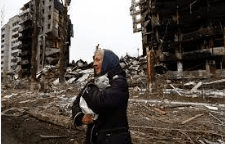
In the grand theatre of human civilization, war has always been the most brutal playwright—shattering dreams with the merciless weight of reality. The allure of noble causes, patriotic fervor, and utopian ideals often leads nations and individuals into conflicts, but as history repeatedly shows, it is not dreams that emerge victorious, but the cold, unrelenting truths of power, politics, and survival. When the cannons roar and the missiles descend, lofty aspirations evaporate under the suffocating heat of realpolitik.
Throughout the annals of history, leaders have promised glory, liberty, or justice through war, yet the aftermath is almost invariably a landscape littered with broken promises and shattered societies. The reality of war is not the triumphant march of idealism but the grim calculus of death, displacement, and destruction. Philosophers like Bertrand Russell have long warned that “War does not determine who is right—only who is left.” The dead do not live to realize their dreams, and the survivors often inherit nothing but ashes.
Today, in an era saturated with advanced weaponry, mass media propaganda, and geopolitical posturing, the delusion of victory remains as strong as ever. But behind the façade, war continues to be the graveyard of hope. As Chris Hedges argues in War Is a Force That Gives Us Meaning, war feeds on illusion and fantasy, yet what it leaves behind is invariably the iron fist of brutal truths. To understand this dynamic is not merely an intellectual exercise—it is a moral imperative.
1- The Mirage of Glorious Victory
The most persistent lie sold to societies before conflicts is the promise of glorious victory. Leaders across history, from ancient emperors to modern presidents, have framed wars as paths to national pride, liberation, or righteousness. Yet, the annals of human conflict tell a different story. Even the so-called victors often pay a steep price in terms of human lives, economic devastation, and social disintegration. The glory that was promised turns into hollow rhetoric when juxtaposed with the faces of widows, orphans, and ruined cities.
As Barbara Ehrenreich aptly observed in Blood Rites: Origins and History of the Passions of War, “What draws people to war is not the promise of victory, but the thrill of purpose and belonging.” The psychological manipulation of societies, especially through mass propaganda, ensures that victory is viewed not as a chance, but as a certainty. Yet, in war, certainty is the first casualty.
2- Death of Innocent Dreams
Innocent dreams—the aspirations of a peaceful life, academic pursuits, entrepreneurial ventures, or even the simple desire to raise a family—are among the first casualties in any war. These personal ambitions are obliterated by bombs, displacement, or conscription. What millions dream in their private hearts is swept away by the violent machinery of state-sponsored violence.
The harsh irony is that those who dream of a better world often become the primary victims. As Leo Tolstoy wrote in War and Peace, “The strongest of all warriors are these two—Time and Patience.” Yet, wars rob people of both. Youths who could have become scientists, poets, or entrepreneurs instead die in trenches or deserts, their dreams buried alongside them.
3- The Brutality of Realpolitik
While citizens may be fed narratives of freedom and democracy, the actual engines of war are driven by realpolitik—strategic interests, resource acquisition, and geopolitical dominance. Behind every war slogan is a calculated plan formulated by generals, think tanks, and defense industries, often far removed from ethical considerations.
Realpolitik reduces human life to numbers in a game of dominance. As Henry Kissinger cynically but accurately reflected, “America has no permanent friends or enemies, only interests.” The blunt machinery of political maneuvering obliterates sentimental dreams, leaving only the residue of exploitation behind.
4- Economic Devastation in War Zones
While leaders may speak of rebuilding after conflict, the immediate and long-term economic damage of war is catastrophic. Infrastructure—roads, schools, hospitals—is obliterated. Local industries collapse, leading to unemployment, poverty, and often famine. Global powers may profit through arms sales, but war-torn countries face generational economic setbacks.
According to Joseph Stiglitz in The Three Trillion Dollar War, the Iraq conflict alone cost the global economy trillions. That’s money not spent on education, healthcare, or scientific innovation. Economic realities after war reveal not prosperity, but prolonged suffering.
5- The Refugee Crisis
Modern conflicts generate unprecedented refugee crises. Millions are forced to flee their homes, risking death by sea or exploitation in foreign lands. Their dreams of stable lives are transformed into desperate hopes for mere survival. The refugee is the human embodiment of dreams dying under the weight of war’s cruel hand.
As noted by the United Nations High Commissioner for Refugees (UNHCR), contemporary wars—especially in Syria, Yemen, and Sudan—have displaced millions. Behind every refugee statistic is a human being who once dreamed of building, not begging.
6- Environmental Destruction
Wars not only kill humans—they devastate the environment. Bombings, chemical warfare, and scorched earth tactics destroy fertile lands, pollute rivers, and render regions uninhabitable for decades. Dreams of sustainable development or ecological balance are annihilated under the barrage of military aggression.
Rachel Carson’s warnings in Silent Spring resonate here. Though Carson spoke of pesticide dangers, her core insight applies: human arrogance—whether through chemical or military warfare—wreaks destruction far beyond the battlefield.
7- Psychological Trauma: The Silent Wound
War is not merely a clash of armies; it is a generator of mass psychological trauma. PTSD, depression, and intergenerational trauma affect both combatants and civilians. Dreams die not only because of external destruction but because of internal emotional disintegration.
The words of Viktor Frankl in Man’s Search for Meaning capture this grim reality: “An abnormal reaction to an abnormal situation is normal behavior.” Entire generations grow up carrying scars invisible to the eye but corrosive to the soul.
8- The Failure of Diplomacy
Every war signifies a colossal failure of diplomacy. The ideals of dialogue, negotiation, and compromise—cornerstones of enlightened human society—are thrown aside in favor of violence. Dreams of global cooperation are mocked by the sounds of artillery.
As Dag Hammarskjöld, former UN Secretary-General, once said, “The UN was not created to take mankind to heaven, but to save humanity from hell.” When wars erupt, it is a sign that humanity has chosen hell over reason.
9- War as a Business
Modern warfare is increasingly driven by corporate interests. The military-industrial complex profits handsomely from endless conflicts, supplying arms, technology, and private contractors. Peaceful dreams are shattered, not by accident, but by profit margins.
Dwight D. Eisenhower’s farewell warning about the military-industrial complex rings painfully true today. Wars, for some, are business opportunities dressed in the noble garb of patriotism or liberation.
10- Propaganda Machinery
Propaganda turns war into a righteous cause. Governments invest heavily in shaping public perception, often turning aggressors into saviors. The result is mass manipulation, making citizens unwitting accomplices in their own destruction.
Edward Bernays, in Propaganda, detailed how public opinion could be shaped like clay in the hands of skilled propagandists. Truth becomes elastic; lies become law; dreams are remodeled into nightmares by state narratives.
11- Children of War: Lost Generations
Children in conflict zones grow up amidst bombings, scarcity, and displacement. Their childhood dreams are replaced by the struggle to survive. Education ceases; innocence dies.
In They Fight Like Soldiers, They Die Like Children, Roméo Dallaire highlights how child soldiers are coerced into violence. These lost generations inherit trauma instead of textbooks, guns instead of playgrounds.
12- The Myth of the Clean War
There’s no such thing as a “clean war.” Talk of surgical strikes and precision bombing obscures the brutal truth: civilians always pay the highest price. The promise of technologically advanced warfare eliminating “collateral damage” is often proven false by the charred remains of hospitals and schools.
Chris Hedges reminds us again in War Is a Force That Gives Us Meaning that war depends on illusion. And chief among those illusions is the fantasy of a humane war.
13- The Erosion of Civil Liberties
Wars often lead to domestic repression. Governments invoke emergency powers, curtail freedoms, imprison dissenters, and tighten media control—all in the name of national security. Dreams of liberty wither under the shadow of authoritarianism masquerading as patriotism.
George Orwell’s 1984 was prophetic in this regard. War, real or manufactured, keeps populations docile and compliant while leaders tighten their grip.
14- Cultural Destruction
Wars don’t just kill people; they annihilate cultures. Museums are looted, ancient monuments reduced to rubble, libraries burned. Dreams of cultural preservation or revival turn to ash.
The destruction of Palmyra by ISIS or the burning of the Sarajevo library during the Bosnian war are grim reminders. As Umberto Eco said, “The real hero is always a hero by mistake; he dreams of being honest, not brave.”
15- Media Complicity
Mainstream media often becomes a cheerleader for war, embedding with military units and parroting government narratives. The dream of a free, independent press dies on the battlefield of ratings and political influence.
Noam Chomsky’s Manufacturing Consent exposes how media institutions, knowingly or unknowingly, often serve elite interests, further entrenching pro-war sentiment among the masses.
16- Rise of Extremism
War creates vacuums where extremism flourishes. The breakdown of order allows radical ideologies to take root, often among those whose peaceful dreams have been violently crushed.
As observed by Gilles Kepel in Jihad: The Trail of Political Islam, conflict zones are fertile ground for extremist recruitment, turning broken dreams into weapons.
17- Geopolitical Fallout
Wars rarely stay contained within borders. They create regional instability, global refugee crises, and economic shocks that ripple across continents. Dreams of international harmony are systematically destroyed by local conflicts metastasizing into global crises.
Zbigniew Brzezinski’s The Grand Chessboard outlines how great powers use smaller conflicts as pawns, disregarding human aspirations entirely.
18- Moral Injury
For soldiers, the emotional cost of having participated in war’s atrocities often leads to moral injury—a deep psychological scar distinct from PTSD. Their dreams of service and honor transform into guilt and remorse.
Jonathan Shay, in Achilles in Vietnam, examines how soldiers’ internal conflicts mirror ancient tales, showing that humanity’s suffering in war is an old but unlearned lesson.
19- Disillusionment Among Veterans
Returning veterans frequently find themselves alienated, disillusioned by the stark contrast between pre-war idealism and post-war reality. The promises of honor and glory are replaced by unemployment, psychological scars, and social neglect.
As Wilfred Owen wrote during WWI, “The old Lie: Dulce et decorum est / Pro patria mori.” The romanticization of war evaporates under the daily struggles of those who return home broken in body and spirit.
20- The Absurdity of “Winning”
What does it mean to win a war? Often, victory is pyrrhic—achieved at such devastating cost that it resembles defeat. Cities may fall, regimes may topple, but the deeper human losses render the word “victory” grotesque.
In Catch-22, Joseph Heller brilliantly satirizes this absurdity. War reduces human aspirations to bureaucratic nonsense, where winning often means little more than surviving.
Conclusion
In war, reality is merciless and dreams are brittle. Despite the grand narratives woven by propagandists and politicians, what remains after the dust settles is not triumph but tragedy. The scholar Chris Hedges was right when he wrote, “The rush of battle is often a potent and lethal addiction, for war is a drug.” And like any drug, it promises escape but delivers ruin.
If humanity is to survive, we must learn to prize dialogue over destruction, cooperation over conflict, and dreams over the brutal certainties of warfare. Until then, every war fought is another funeral for hope.
Bibliography
- Hedges, Chris. War Is a Force That Gives Us Meaning. PublicAffairs, 2002.
— An essential critique on the seductive power of war, illusions of meaning, and the destruction it leaves behind. - Ehrenreich, Barbara. Blood Rites: Origins and History of the Passions of War. Metropolitan Books, 1997.
— Explores humanity’s deep psychological and cultural fascination with war throughout history. - Stiglitz, Joseph E., and Linda J. Bilmes. The Three Trillion Dollar War: The True Cost of the Iraq Conflict. W. W. Norton & Company, 2008.
— Detailed economic analysis of the hidden and visible costs of modern warfare. - Tolstoy, Leo. War and Peace. Translated by Richard Pevear and Larissa Volokhonsky, Vintage Classics, 2007.
— Philosophical novel reflecting on war, power, and human folly during the Napoleonic era. - Frankl, Viktor E. Man’s Search for Meaning. Beacon Press, 2006.
— Insight into psychological survival during immense suffering; highly relevant to understanding trauma in war zones. - Hammarskjöld, Dag. Markings. Vintage, 1983.
— A profound collection of reflections from the former UN Secretary-General, emphasizing diplomacy’s moral responsibility. - Eisenhower, Dwight D. Waging Peace: The White House Years: A Personal Account, 1956–1961. Doubleday, 1965.
— Contains Eisenhower’s famous warning about the military-industrial complex. - Bernays, Edward. Propaganda. Ig Publishing, 2005.
— Foundational text on how governments and institutions manipulate public opinion, particularly during times of conflict. - Dallaire, Roméo. They Fight Like Soldiers, They Die Like Children. Vintage Canada, 2011.
— First-hand exploration of the tragedy of child soldiers in modern warfare. - Orwell, George. 1984. Penguin Classics, 2021.
— Timeless novel on totalitarianism, propaganda, and perpetual war for political control. - Chomsky, Noam, and Edward S. Herman. Manufacturing Consent: The Political Economy of the Mass Media. Pantheon Books, 1988.
— Classic critique of media complicity in shaping public attitudes toward war. - Kepel, Gilles. Jihad: The Trail of Political Islam. I.B. Tauris, 2002.
— A critical analysis of how modern political conflicts foster extremist ideologies. - Brzezinski, Zbigniew. The Grand Chessboard: American Primacy and Its Geostrategic Imperatives. Basic Books, 1997.
— Examination of U.S. global strategy, showing how geopolitical interests often override human welfare. - Shay, Jonathan. Achilles in Vietnam: Combat Trauma and the Undoing of Character. Scribner, 1995.
— Connects ancient Greek literature with modern combat trauma, offering deep psychological insights. - Heller, Joseph. Catch-22. Simon & Schuster, 1996.
— Satirical novel exposing the absurdities of war, bureaucracy, and the dehumanizing machinery of modern conflict. - Carson, Rachel. Silent Spring. Mariner Books, 2002.
— While focused on environmental degradation, Carson’s work resonates with the ecological devastation caused by warfare. - Eco, Umberto. Turning Back the Clock: Hot Wars and Media Populism. Harvill Secker, 2007.
— Essays addressing the decline of rational discourse, with specific reflections on the cultural impacts of conflict.

By Amjad Izhar
Contact: amjad.izhar@gmail.com
https://amjadizhar.blog
Affiliate Disclosure: This blog may contain affiliate links, which means I may earn a small commission if you click on the link and make a purchase. This comes at no additional cost to you. I only recommend products or services that I believe will add value to my readers. Your support helps keep this blog running and allows me to continue providing you with quality content. Thank you for your support!


Leave a reply to Amjad Izhar Cancel reply