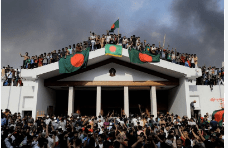
This text excerpts a book examining the creation of Bangladesh in 1971, arguing against the idea of its inevitability. The author analyzes the confluence of internal Pakistani politics, particularly the relationship between the military regime and Bengali political leaders, and external factors such as the Cold War, decolonization, and the burgeoning process of globalization. The role of India, the United States, the Soviet Union, China, and other global actors in the crisis is explored, including their responses to the refugee crisis and the atrocities committed in East Pakistan. The narrative traces the events leading up to the war, the war itself, and the eventual emergence of an independent Bangladesh, highlighting the complex interplay of political decisions and unforeseen circumstances. Finally, the book draws parallels between the 1971 crisis and contemporary international conflicts.
The Creation of Bangladesh: A Study Guide
Short Answer Quiz
- Describe the geographical and cultural challenges that contributed to the instability of united Pakistan. The two wings of Pakistan were separated by 1,000 miles of Indian territory, creating a logistical and political challenge. Furthermore, the two regions had distinct cultures, languages, and economic conditions, fostering resentment and a lack of unity.
- What role did Zulfikar Ali Bhutto play in the political events leading up to the creation of Bangladesh? Bhutto was a key figure in West Pakistani politics, serving in Ayub Khan’s cabinet and later forming the Pakistan People’s Party. His opposition to the Tashkent agreement and his fiery rhetoric against the regime made him popular among West Pakistani students.
- Why did Field Marshal Ayub Khan ultimately abdicate his position? Ayub Khan resigned due to widespread protests and a deteriorating political situation in Pakistan. He believed he could no longer preside over the potential destruction of the country and handed power to General Yahya Khan.
- How did General Yahya Khan’s personal characteristics affect his ability to govern? Yahya Khan’s “uncluttered” mind and fondness for drink and liaisons made him ill-suited for the demands of political and military power. His style was considered too “unreflective,” hindering his ability to handle complex issues.
- Explain the significance of the “Six Points” put forward by Sheikh Mujibur Rahman. The Six Points were a set of demands for greater autonomy for East Pakistan within a federal structure. They included control over taxation, foreign exchange, and their own military forces, which were seen by West Pakistan as a precursor to secession.
- Why was India initially hesitant to intervene directly in the East Pakistan crisis? India was wary of international norms regarding intervention in another country’s internal affairs and the risk of broader conflict. They also doubted Mujib’s intentions and the solidity of the Mujibnagar government, adopting a “wait and watch” policy.
- What were the primary objectives of the Soviet Union regarding the conflict in South Asia? The Soviet Union primarily sought to ensure a close relationship with India and contain Chinese influence in the region. They opposed the fracturing of Pakistan because they feared that an independent East Pakistan would be vulnerable to Chinese domination.
- How did the actions of the United States government under President Nixon influence the conflict in 1971? The Nixon administration favored Pakistan due to its role as an intermediary in the secret talks with China. This led to the US taking a position that was regarded as biased against India, which ultimately influenced other countries’ policies.
- Describe the roles of the Mukti Bahini and the Mujib Bahini. The Mukti Bahini consisted of the East Bengal Regiment, East Pakistan Rifles, and civilian freedom fighters who engaged in guerrilla warfare. The Mujib Bahini was a separate militia organized by India, independent of the Mujibnagar government and used for special operations.
- What factors led to Pakistan’s eventual defeat and the establishment of Bangladesh? Pakistan’s defeat was due to a combination of factors: India’s direct military intervention in East Pakistan, the Mukti Bahini’s effective guerrilla war against Pakistani forces, and the Pakistani Army’s overstretched resources, and poor strategic planning.
Answer Key
- Describe the geographical and cultural challenges that contributed to the instability of united Pakistan. The two wings of Pakistan were separated by 1,000 miles of Indian territory, creating a logistical and political challenge. Furthermore, the two regions had distinct cultures, languages, and economic conditions, fostering resentment and a lack of unity.
- What role did Zulfikar Ali Bhutto play in the political events leading up to the creation of Bangladesh? Bhutto was a key figure in West Pakistani politics, serving in Ayub Khan’s cabinet and later forming the Pakistan People’s Party. His opposition to the Tashkent agreement and his fiery rhetoric against the regime made him popular among West Pakistani students.
- Why did Field Marshal Ayub Khan ultimately abdicate his position? Ayub Khan resigned due to widespread protests and a deteriorating political situation in Pakistan. He believed he could no longer preside over the potential destruction of the country and handed power to General Yahya Khan.
- How did General Yahya Khan’s personal characteristics affect his ability to govern? Yahya Khan’s “uncluttered” mind and fondness for drink and liaisons made him ill-suited for the demands of political and military power. His style was considered too “unreflective,” hindering his ability to handle complex issues.
- Explain the significance of the “Six Points” put forward by Sheikh Mujibur Rahman. The Six Points were a set of demands for greater autonomy for East Pakistan within a federal structure. They included control over taxation, foreign exchange, and their own military forces, which were seen by West Pakistan as a precursor to secession.
- Why was India initially hesitant to intervene directly in the East Pakistan crisis? India was wary of international norms regarding intervention in another country’s internal affairs and the risk of broader conflict. They also doubted Mujib’s intentions and the solidity of the Mujibnagar government, adopting a “wait and watch” policy.
- What were the primary objectives of the Soviet Union regarding the conflict in South Asia? The Soviet Union primarily sought to ensure a close relationship with India and contain Chinese influence in the region. They opposed the fracturing of Pakistan because they feared that an independent East Pakistan would be vulnerable to Chinese domination.
- How did the actions of the United States government under President Nixon influence the conflict in 1971? The Nixon administration favored Pakistan due to its role as an intermediary in the secret talks with China. This led to the US taking a position that was regarded as biased against India, which ultimately influenced other countries’ policies.
- Describe the roles of the Mukti Bahini and the Mujib Bahini. The Mukti Bahini consisted of the East Bengal Regiment, East Pakistan Rifles, and civilian freedom fighters who engaged in guerrilla warfare. The Mujib Bahini was a separate militia organized by India, independent of the Mujibnagar government and used for special operations.
- What factors led to Pakistan’s eventual defeat and the establishment of Bangladesh? Pakistan’s defeat was due to a combination of factors: India’s direct military intervention in East Pakistan, the Mukti Bahini’s effective guerrilla war against Pakistani forces, and the Pakistani Army’s overstretched resources, and poor strategic planning.
Essay Questions
- Analyze the role of international actors, including the United States, the Soviet Union, and China, in the creation of Bangladesh. How did their strategic interests and political calculations influence the course of events?
- Discuss the internal political dynamics within Pakistan that contributed to the secession of East Pakistan. Consider the roles of key individuals, political parties, and regional grievances in shaping the conflict.
- Evaluate the effectiveness of India’s strategy in supporting the liberation of Bangladesh. How did its initial reluctance to intervene evolve into a full-scale military engagement, and what factors contributed to its success?
- Examine the emergence of Bengali nationalism and its significance in the struggle for independence. How did cultural, linguistic, and economic factors contribute to the growth of a distinct Bengali identity, and how did this identity fuel the movement for liberation?
- Assess the long-term consequences of the creation of Bangladesh for the region. How did the conflict reshape the geopolitical landscape of South Asia, and what were its lasting impacts on the relationship between India and Pakistan?
Glossary of Key Terms
- Awami League: A political party in East Pakistan, led by Sheikh Mujibur Rahman, advocating for Bengali autonomy.
- East Pakistan: The eastern wing of Pakistan, largely populated by Bengalis, which later became Bangladesh.
- Mukti Bahini: The Bengali liberation force, consisting of both regular military personnel and civilian guerrillas.
- Mujib Bahini: A separate militia force trained and supported by India, independent of the Mukti Bahini, with the intent of protecting against leftists and maintaining control.
- Six Points: A set of demands for greater autonomy for East Pakistan, put forth by Sheikh Mujibur Rahman and the Awami League.
- Tashkent Agreement: An agreement signed by India and Pakistan in 1966, ending the Indo-Pakistani War of 1965.
- Pakistan People’s Party (PPP): A political party in West Pakistan, led by Zulfikar Ali Bhutto, which gained power after the 1971 war.
- Non-Aligned Movement: A group of states that did not formally align themselves with or against any major power bloc during the Cold War.
- Indo-Soviet Treaty of Peace, Friendship, and Cooperation: A treaty signed between India and the Soviet Union in 1971, strengthening their political and military alliance.
- Washington Special Actions Group (WSAG): A U.S. government body that handled crisis situations and policy decisions, particularly during the 1971 conflict.
- Operation Searchlight: The military operation launched by the Pakistani Army in East Pakistan on March 25, 1971, aimed at suppressing the Bengali independence movement.
- Brezhnev Doctrine: A Soviet policy that asserted the right of the Soviet Union to intervene in countries where it perceived a threat to socialist rule.
- Sino-Soviet Split: The deterioration of political and ideological relations between the People’s Republic of China and the Soviet Union during the Cold War.
- Naxalite Movement: A far-left radical movement in India that has been classified as a terrorist organization.
The Creation of Bangladesh: A Global History
Okay, here’s a detailed briefing document based on the provided excerpts from “A Global History of the Creation of Bangladesh”:
Briefing Document: The Creation of Bangladesh
Introduction
This document summarizes the key themes, ideas, and facts presented in the provided excerpts from “A Global History of the Creation of Bangladesh.” The book explores the complex political, social, and international factors that led to the 1971 war and the subsequent birth of Bangladesh. The excerpts highlight the inherent instability of the united Pakistan, the breakdown of negotiations, the role of key international players, and the eventual military conflict.
I. Inherent Instability of United Pakistan
- Geographic and Cultural Divide: The book emphasizes the geographical separation and cultural differences between East and West Pakistan as a fundamental flaw. As the author notes, “no freak of history like united Pakistan with its two ethnically and culturally very different wings separated by 1,000 miles of hostile India, could possibly have lasted for long.”
- Economic and Political Imbalance: The excerpts highlight disparities in economic conditions and the imbalance of power between the two wings as key factors contributing to the disintegration. Historian Badruddin Umar is quoted stating that “from the beginning Pakistan was an unstable state. The physical distance between the two wings of Pakistan . . . and the very consider-able differences in the social, cultural and po liti cal life and traditions . . . differences in the economic conditions of the two parts and the imbalance in the structure of power. All these factors, from the very beginning, de-cided the course of po liti cal developments which logically and inevitably led to the disintegration and partition of Pakistan.”
- Inevitable Outcome: The narrative leans towards a deterministic view, suggesting the emergence of Bangladesh was practically inevitable. This is captured in the quote “The history of the emergence of Bangladesh, then, is no more than the chronicle of a birth foretold.” Salman Rushdie’s depiction of Pakistan as “that fantastic bird of a place, two Wings without a body, sundered by the land- mass of its greatest foe, joined by nothing but God” further illustrates this idea of a fundamentally flawed state.
II. Breakdown of Negotiations and Rise of Conflict
- Ayub Khan’s Abdication: The excerpts detail Field Marshal Ayub Khan’s resignation in 1969, due to his perception that the country was falling apart, marking a turning point in Pakistani politics. His statement that “It is impossible for me to preside over the destruction of our country” underscores the challenges to national unity.
- Yahya Khan’s Inadequacies: The successor, General Yahya Khan, is portrayed as ill-suited for his position, possessing a “uncluttered— some would say vacant— mind”. His leadership style, focused on military matters rather than political solutions and marred by a “hectic social routine” made him incapable of dealing with the growing crisis.
- Bhutto’s Ambitions: Zulfikar Ali Bhutto is presented as a key political player with a desire for power and a preference for a military-influenced political system. His aspiration to govern the country “as a strong man within the Turkish model” aligned with the military’s views, thus making him a potential partner.
- Failed Negotiations with Mujib: The negotiations between Yahya Khan and Sheikh Mujibur Rahman are shown to have failed, partly because Yahya never truly intended a political settlement, using the talks to confirm his view of Mujib’s “obduracy and treacherousness” in preparation for a military crackdown.
- Military Action as a Foregone Conclusion: Yahya’s actions, and particularly his dramatic statement “Then what do you expect me to do? I am becoming the laughing stock of the world as well as of the Army and there is a limit to any man’s pa-tience”, reveal a military solution was always the favored option despite protestations to the contrary.
III. India’s Role and Response
- Early Cautious Approach: India initially adopted a cautious approach, “to wait and watch,” despite pleas from Mujibur Rahman for intervention.
- Growing Support for Bengali Cause: As the crisis escalated, India provided increasingly overt support for the Bengali cause, providing aid and training for the Mukti Bahini.
- Recognition of Bangladesh as a Separate Entity Despite caution, India recognized that the situation in East Pakistan was “at the point of no return.”
- Guerrilla Warfare and Indian Assistance: India, through the Border Security Force (BSF) and other agencies, provided support and training to the Mukti Bahini, and later other groups, and assisted in actions such as targeting key infrastructure in East Pakistan. A quote illustrates the necessity of this: “he [Tajuddin] was quite clear in his mind that those bridges which had to be destroyed for military reasons should be destroyed without hesitation and even if there is some local feeling against their destruction.”
- Internal Tensions: Internal tensions within the Bangladeshi leadership, including conflicts between the Mujibnagar government and factions like the Mujib Bahini, complicated India’s support efforts.
IV. The International Context
- US-Pakistan Relationship: The Nixon administration maintained close ties with Pakistan, with Nixon stating to Indira Gandhi “We will go to Mars together,” and viewed the arms embargo against Pakistan as “iniquitous”. This influenced the US’s approach to the crisis and caused friction with India.
- Soviet Union’s Hesitation and Shift: The Soviet Union initially hesitated to support the idea of an independent Bangladesh, believing it could destabilize the region. However, over time, their stance shifted towards tacit support for India. A senior member of the CPI would note, the Soviet Union “was against the redrawing of bound-aries and would, if it came to that, have condemned but condoned Paki-stan’s repression of the people of East Pakistan to keep its state identity intact.”
- Indo-Soviet Treaty: The Indo-Soviet Treaty of Friendship and Cooperation was a significant step in India’s strategy, providing a deterrent against intervention by China or the United States. The text shows that Grechko said that India should “not be worried by Pakistan,” but it should “take into account the unpredictable enemy from the North.” This treaty was key in bolstering India’s strategic position.
- Other Nations’ Responses: The excerpts highlight the differing approaches of other international powers, such as Britain, Canada, Japan, and France, to the crisis, each influenced by their own geopolitical considerations. The Commonwealth, in particular, struggled to present a united front as countries pursued individual agendas.
- China’s Position: China was cautious and sought to maintain its alliance with Pakistan, but also aware of the potential threat from the Soviet Union, leading to a complex balancing act. Bhutto’s claims that China would intervene if India launched a war, reveal Pakistan’s attempts to deter India.
V. Military Escalation and War
- Mukti Bahini Expansion: The Mukti Bahini was rapidly expanded and armed by India, intensifying attacks on Pakistani forces in East Pakistan. However the Mukti Bahini were hampered, including by the fact that “the bullets supplied for the rifl es created a handicap for them as these bullets did not fi t the Chinese made rifl es used by the Mukti Fauj personnel.”
- Operational Plans: The Indian army developed a plan focused on securing key ports and preventing the movement of Pakistani troops but didn’t include the capture of Dhaka as an explicit goal.
- International Pressure: International pressure for a ceasefire was anticipated to be a limiting factor on the length of the conflict.
- Pakistani Offensive in West Pakistan In the event of Indian intervention in the East, Pakistan had planned to launch a large-scale offensive in the western sector against India. Yahya stated that “if the Indians imagine they will be able to take one morsel of my territory without provoking war, they are making a serious mistake. Let me warn you and warn the world that it would mean war, out and out war.”
- Bhutto’s Calculations Bhutto seemed to have calculated that an ignominious defeat capped off by the surrender of tens of thousands of troops would deal such a blow to the Pakistan army as to shake its grip on the polity, which then would clear the ground for his own po liti-cal ascendance.
VI. Post-War Challenges
- Repatriation and Recognition: The excerpts touch upon the complex issues of repatriating Pakistani prisoners of war and achieving international recognition for Bangladesh.
- Bhutto’s Role: Bhutto is presented as seeking to solidify his own power in Pakistan through the discrediting of the military. He also worked to prevent international recognition of Bangladesh by enlisting the help of Muslim allies.
Conclusion
The excerpts from “A Global History of the Creation of Bangladesh” offer a detailed and multifaceted account of the events leading to the 1971 war. They show the breakdown of the united Pakistan, the complex political maneuvering of key players, and the decisive role of international powers. The narrative leans towards a deterministic view, suggesting the creation of Bangladesh was almost inevitable given the structural weaknesses of the united Pakistan. The sources suggest the emergence of the new country was shaped by internal instability, failed negotiations, India’s strategic calculations, and the geopolitical complexities of the Cold War.
This briefing document should provide a good overview of the key points raised in the provided source excerpts. Let me know if you need any clarification or have additional questions.
The Birth of Bangladesh: A Nation Forged in Crisis
1. What were the key factors that made the creation of Bangladesh seem inevitable?
Several factors contributed to the perception that the breakup of Pakistan and the emergence of Bangladesh were inevitable. The significant geographical distance between West and East Pakistan, separated by 1,000 miles of India, created logistical and administrative challenges. Furthermore, the stark cultural, social, and political differences between the two wings fostered a sense of alienation. The economic disparities, coupled with an imbalance in political power, further fueled resentment in East Pakistan. These deep-seated structural issues, combined with perceived discrimination and a lack of representation, led many to believe that the union was unsustainable.
2. How did the political careers and actions of Ayub Khan and Zulfikar Ali Bhutto contribute to the crisis?
Ayub Khan’s authoritarian rule and eventual abdication created a power vacuum and destabilized the political landscape of Pakistan. His protégé, General Yahya Khan, eventually took over, showing a lack of understanding of political matters, contributing to the crisis. Bhutto, a charismatic and ambitious politician, initially rose to prominence within Ayub’s government before becoming a vocal critic. His fiery opposition to the regime, and his desire to share power with the military in a Turkish model of government, both contributed to and exacerbated the political instability of the time. Bhutto’s actions, particularly his opposition to the results of the 1970 elections, also further accelerated the disintegration of Pakistan.
3. What role did General Yahya Khan play in the events leading up to the 1971 war?
General Yahya Khan’s leadership was marked by a lack of political acumen and a preference for military solutions. While he was initially trusted by Ayub Khan, he eventually usurped power instead of aiding the failing regime, demonstrating his own ambitions. He was indecisive and relied on his military subordinates, whose focus was on maintaining their power. Yahya Khan’s ineffectual attempts at negotiation with Sheikh Mujibur Rahman were perceived as insincere, and he also allowed his personal life and habits to undermine his authority. Ultimately, he opted for a military crackdown in East Pakistan that triggered the war.
4. What were the key sticking points in negotiations between Yahya Khan and Sheikh Mujibur Rahman?
The negotiations between Yahya Khan and Sheikh Mujibur Rahman were fundamentally hampered by their differing views of power and autonomy. Yahya sought to maintain an active presidency with significant control over key ministries, while Mujib envisioned a largely ceremonial role for the president. The military also feared that a transfer of power without constitutional safeguards would undermine their institutional interests and that the Awami League would become too powerful. These disagreements, coupled with distrust and a lack of good faith, ultimately led to the failure of negotiations.
5. What was India’s initial approach to the crisis in East Pakistan and what influenced that approach?
Initially, India’s approach was cautious and marked by a desire to observe how events would unfold. Factors influencing this cautious approach included a desire to avoid direct conflict with Pakistan, concerns about the international implications of intervention, and a fear that supporting a secessionist movement could be seen as a violation of international law. There was also distrust and doubt regarding Mujib’s motives. The government was also influenced by advisors like P.N. Haksar, who advised caution and highlighted the need for legitimacy to be established through territorial control and effective governance.
6. How did India balance the various competing interests involved in supporting the liberation movement?
India faced a complex balancing act as it sought to support the liberation movement in East Pakistan. It had to navigate the competing interests of various groups, including the Mujibnagar government, the Mukti Bahini, and the Mujib Bahini, a separate militia organized by R&AW. They had to provide material support to the freedom fighters, training, weapons, and financial aid, all while preventing the movement from becoming captured by ultra-left factions and simultaneously attempting to maintain some control over the situation. They also had to attempt to balance their domestic political situation with the complexities of international relations.
7. What were the key objectives behind the Indo-Soviet Treaty and how did it impact the conflict?
The Indo-Soviet Treaty of Peace, Friendship, and Cooperation, signed in August 1971, was driven by mutual strategic interests. For India, the treaty was a means to secure Soviet support in the face of potential aggression, specifically from China. The treaty also aimed to limit Soviet arms sales to Pakistan and to improve India’s military capabilities. For the Soviets, the treaty was a means to solidify their relationship with India and counter China’s influence in the region. It also sought to ensure stability in South Asia and to prevent India from precipitating a war. While the treaty did not explicitly call for military intervention it did help reassure India, and ultimately helped accelerate its assistance to the liberation movement in East Pakistan.
8. How did the United States and China respond to the Bangladesh crisis?
The United States, under Nixon and Kissinger, adopted a policy of “tilt” toward Pakistan, viewing it as a key ally, and as a channel for their normalization with China. They also were concerned about the influence of the USSR. The US was cautious about international interference and focused on humanitarian aid, while simultaneously not wanting to upset its relations with Pakistan. China, on the other hand, initially offered verbal support for Pakistan, though this may have been more to deter India than to aid Pakistan directly. China also had no desire to cause further conflicts with either the USSR or the US. Both the US and China were hesitant to directly challenge Pakistan’s sovereignty, but ultimately both also remained wary of the growth of Soviet influence in South Asia.
The Birth of Bangladesh: 1969-1971
Okay, here’s the timeline and cast of characters based on the provided text:
Timeline of Events
- Pre-1969 (Various Dates):Growing tensions and differences between East and West Pakistan due to geographical separation, cultural differences, economic disparities, and power imbalances.
- Pakistan is described as an unstable state from its inception, with its two wings separated by India, having little in common and thus predisposed to fragment.
- 1958: Zulfiqar Ali Bhutto enters politics, handpicked by Ayub Khan to join his cabinet.
- 1965: Bhutto eggs on Ayub Khan to attack India. The subsequent war proves disastrous.
- 1966: Bhutto falls out with Ayub Khan over the Tashkent Agreement. General Agha Mohammad Yahya Khan is appointed commander-in-chief.
- 1968: Protests break out in West Pakistan, fueled by opposition to Ayub Khan’s regime. Bhutto emerges as a hero to the student protesters and is briefly imprisoned.
- March 2, 1969: Soviet and Chinese forces clash at the Ussuri River. A Soviet military delegation, led by Marshal Andrei A. Grechko, visits New Delhi.
- March 25, 1969: Field Marshal Ayub Khan resigns as President of Pakistan, handing power to General Yahya Khan.
- Early 1969: Moscow proposes a treaty of friendship and cooperation with India.
- May 1969: US Secretary of State William Rogers visits Pakistan, where Yahya Khan requests resumption of military supplies.
- Summer 1969: Nixon visits India and reiterates his commitment to India’s economic development.
- Early 1970: Moscow decides to stop military sales to Pakistan.
- Summer 1970: Bhutto advises Yahya not to worry about the upcoming elections, suggesting that they can run the country together.
- December 7, 1970: National elections in Pakistan result in a victory for the Awami League in East Pakistan and the Pakistan People’s Party in West Pakistan.
- January 1971: India’s intelligence agencies begin to report on an impending military crackdown in East Pakistan.
- Early 1971: The Pakistani military begins planning Operation Searchlight, a military crackdown on Bengali dissenters in East Pakistan.
- March 1, 1971: Yahya Khan postpones the scheduled session of the National Assembly, triggering unrest in East Pakistan.
- March 2, 1971: Indira Gandhi gives instructions to R&AW chief Kao regarding the assessment of East Pakistan affairs.
- March 6, 1971: Yahya Khan broadcasts a speech blaming Mujib for the prevailing political impasse and announces the National Assembly would meet on March 25th.
- March 14, 1971: Sheikh Mujibur Rahman sends an appeal for help to India through K. C. Sen Gupta.
- March 21, 1971: Yahya Khan arrives in Dhaka for negotiations with Mujibur Rahman.
- March 24, 1971: Bhutto and his party leaders conclude that military action is necessary and convey the message to Yahya Khan.
- March 25, 1971:The Pakistani army launches Operation Searchlight, a brutal military crackdown in East Pakistan.
- Yahya departs from Dhaka for West Pakistan.
- The scheduled session of the National Assembly is to take place today.
- March 26, 1971: Indira Gandhi declares India’s full support for the people of Bangladesh.
- March 27, 1971: Swaran Singh makes a statement in parliament affirming India’s support for the people of East Pakistan.
- Early April, 1971: The Border Security Force (BSF) prepares an assessment that identifies the Pakistani army’s Achilles’ heel in East Pakistan as its lines of supply and communication.
- April 11, 1971: The Swadhin Bangla Betar Kendra (Independent Bengal Broadcasting Centre) broadcasts Tajuddin’s speech, announcing the formation of a “mighty army.”
- April 13, 1971: The Government of Bangladesh announces its cabinet.
- April 17, 1971: The government of Bangladesh is formally proclaimed in a ceremony at Baidyanath Tala (renamed Mujibnagar). Syed Nazrul Islam takes guard of honor as acting president.
- Early April 1971: BSF begin working with the Mukti Fauj to target infrastructure.
- Mid-1971: Jayaprakash Narayan begins to advocate for international recognition of Bangladesh.
- May 1971: Nixon writes to Indira Gandhi, proposing a solution to the East Pakistan crisis, which is turned down by Gandhi.
- May 22, 1971: Yahya sends a message to U Thant requesting a large amount of food aid and edible oil.
- June 27, 1971: The secretary-general of the Commonwealth, Arnold Smith, receives a message from Prime Minister Sirima Bandaranaike of Ceylon, asking him to consult with all Commonwealth countries regarding a solution to the crisis.
- July 1971: Henry Kissinger visits India, and meets with Indira Gandhi and several of her cabinet members.
- July, 1971: D.P. Dhar informs P.N. Haksar that the USSR seems to consider the rupture between the two wings of Pakistan as ‘complete, emotionally and otherwise’.
- August 9, 1971: Gul Hassan Khan briefs Yahya on the plan for a Pakistani offensive in the western sector. Yahya approves of the plan and orders full mobilization.
- August 11, 1971: US senior review group meets with President Nixon.
- August 15, 1971: The Mujib Bahini is activated and begins operations inside East Pakistan.
- August 1971: India begins to substantially scale up its training of Mukti Bahini guerrillas.
- September 1971: D.P. Dhar travels to Moscow to discuss the possible signing of the treaty between India and the Soviet Union.
- September 1971: India increases material support to the Mukti Bahini.
- Early September, 1971: Pakistan begins mobilizing forces in the western sector in response to increasing Indian support for the Mukti Bahini.
- September 13, 1971: Kao meets with Mujibnagar’s emissary regarding the conflict between the Mukti Bahini and the Mujib Bahini, but declines to make any observations.
- Late September, 1971: D.P. Dhar convinces Indira Ghandi to instruct the Mujib Bahini to cooperate with the Mukti Bahini.
- October 1971: The total strength of the liberation forces stands at nearly 80,000.
- October 25, 1971: Nixon and Yahya Khan have a discussion regarding the state of affairs.
- November 1971: Radio Pakistan quotes Yahya as claiming China would intervene if India launched a war.
- November 30, 1971: The total strength of the liberation forces is a little over 100,000.
- December 3, 1971: Pakistan launches a preemptive strike on Indian airfields, initiating full-scale war.
- December 6, 1971: India recognizes the government of Bangladesh.
- December 11, 1971: D. P. Dhar travels to Moscow with a message from Indira Gandhi to Kosygin.
- December 16, 1971: Pakistani forces in East Pakistan surrender to the joint Indian and Bangladeshi forces.
- 1971 Onward:Bhutto delays the repatriation of Pakistani prisoners of war.
- Bhutto works to prevent international recognition of Bangladesh,
- Bangladesh struggles with internal political strife and economic instability
- The Coup of 1975 results in the death of Sheikh Mujibur Rahman
Cast of Characters
- Ayub Khan: Field Marshal and President of Pakistan until 1969. He came to power in a military coup and was forced to resign due to civil unrest. He is described as being embittered and insisting that ‘democratic methods are foreign to our people’.
- Agha Mohammad Yahya Khan: General and successor to Ayub Khan as President of Pakistan. He is described as professionally confident but lacking in political acumen. He enjoyed a hectic social life and was prone to drinking.
- Zulfiqar Ali Bhutto: A charismatic politician from West Pakistan, initially a protege of Ayub Khan, but later his political rival. Founder of the Pakistan People’s Party (PPP). He advocated for a “strong man” model of government similar to Turkey, and is described as having advised Yahya not to worry about the elections.
- Sheikh Mujibur Rahman: Leader of the Awami League in East Pakistan, advocating for autonomy and eventually independence for Bangladesh. Referred to as ‘the future Prime Minister of Pakistan’. He had requested aid from India by sending an appeal through K.C. Sen Gupta.
- Indira Gandhi: Prime Minister of India. She is described as cautious, but ultimately decisive in her support for Bangladesh. She met with and took the advice of D.P. Dhar, P.N. Haksar, and Rameshwar Nath Kao.
- P. N. Haksar: Principal advisor to Indira Gandhi, an experienced diplomat with a background in left-leaning politics. He is described as thinking in terms of historical parallels. He advised Gandhi on the need to wait and watch.
- Rameshwar Nath Kao: Head of India’s Research and Analysis Wing (R&AW), the foreign intelligence agency. He wielded considerable influence on the prime minister. He organized a separate militia, the Mujib Bahini.
- Tajuddin Ahmad: Prime Minister of the provisional government of Bangladesh in exile (Mujibnagar). He was a key figure in the liberation movement but sometimes came into conflict with military leaders and the Mujib Bahini.
- Syed Nazrul Islam: Acting President of Bangladesh. He took the guard of honor at the ceremony at Baidyanath Tala where the government of Bangladesh was proclaimed.
- Jayaprakash Narayan: Veteran Gandhian leader who strongly advocated for the recognition of Bangladesh. He sought expert opinions from jurists and argued that recognition was not in violation of international law.
- K.C. Sen Gupta: Deputy High Commissioner of India in Dhaka, through whom Mujib sent a special appeal for help to India.
- Rustamji: Chief of the Border Security Force (BSF) who approved of targeting the Pakistani Army’s logistical infrastructure in East Pakistan.
- M.C. Chagla: Eminent jurist and erstwhile cabinet minister who advised Jayaprakash Narayan that international recognition of Bangladesh would not violate international law.
- D. P. Dhar: A close advisor to Indira Gandhi, and a key figure in negotiations with the Soviet Union. He had a strong opinion of France and the Soviet Union, and pushed for the Indo-Soviet treaty.
- Marshal Andrei A. Grechko: Soviet Defense Minister, who led a military delegation to India in 1969. He played a key role in negotiating the Indo-Soviet Treaty.
- Alexei Kosygin: Soviet Premier who engaged with Indira Gandhi and Yahya Khan on several occasions, and advised caution with regard to the conflict. He was also key in negotiating the Indo-Soviet treaty.
- Henry Kissinger: National Security Advisor and later Secretary of State under President Richard Nixon. He was a key figure in US policy during the crisis, focused on US relations with Pakistan and China.
- Richard Nixon: President of the United States. He pursued a policy that favored Pakistan and did not initially support the independence movement.
- U Thant: Secretary-General of the United Nations, who attempted to mediate the crisis. He made an appeal for humanitarian assistance and made a proposal for stationing UN observers.
- Prince Sadruddin Aga Khan: UN High Commissioner for Refugees (UNHCR). He was cautious about violating Pakistani sovereignty.
- William Rogers: US Secretary of State. He made an effort to have Pakistan consider international humanitarian relief assistance.
- Arnold Smith: Secretary-General of the Commonwealth. He repeatedly attempted to mediate the conflict.
- Sirima Bandaranaike: Prime Minister of Ceylon, who asked the Commonwealth to intervene in the crisis.
- Mumtaz Alvie: Pakistan’s additional foreign secretary, who threatened to leave the Commonwealth due to statements made by London and Canberra.
- Sultan Khan: Additional Pakistani foreign secretary, who refused Ceyon’s offer for intervention and stated that Pakistan would handle the issue on their own.
- Gul Hassan Khan: Pakistan’s Chief of General Staff who briefed Yahya Khan on the plan for an offensive in the western sector.
- Major General K.K. Singh: Director of military operations for India. He conceived the initial operational framework for the war.
- General S. H. F. J. Manekshaw: Indian Army Chief. He did not want to attempt to capture Dhaka at the start of the war.
- Lieutenant General Sagat Singh: Commander of IV Corps in Tripura, who believed his forces could quickly advance to Dhaka.
- Major General Sujan Singh Uban: Retired Major General who helped raise the Special Frontier Force of Tibetan recruits and trained the Mujib Bahini.
- Vladimir Matskevich: Soviet Minister of Agriculture. He had a meeting with Nixon and Kissinger.
- Yuli Vorontsov: Soviet Ambassador to the US. He had a meeting with Nixon and Kissinger.
- P.S. Koutakhov: Soviet Air Marshal.
This detailed breakdown should give you a good overview of the key events and people involved in the creation of Bangladesh as described in your provided source material. Let me know if you need anything else!
The 1971 Bangladesh Crisis
The Bangladesh crisis of 1971 was a complex event with roots in the political, economic, and social dynamics of the South Asian subcontinent and involved multiple international actors [1, 2]. The crisis evolved from regional linguistic and economic tensions to a war for national liberation, influenced by the centralized Pakistani state and the actions of its ruling elites [3]. Here’s a breakdown of the key aspects:
Origins and Causes:
- Linguistic and Economic Disparities: While the language movement peaked in the 1950s, the push for Bengali nationalism didn’t begin until later, and economic contradictions present from the outset took almost 25 years to come to a head [3]. The tightly centralized character of the Pakistani polity, stemming from the British Raj, exacerbated these issues [3].
- Political Marginalization: The bureaucratic-military oligarchy that ran Pakistan from the early 1950s felt threatened by the political demands of the Bengalis and sought to derail them [3].
- Election Results: The Awami League, led by Mujibur Rahman, won a landslide victory in the 1970 general election [4]. However, negotiations for the transfer of power failed, leading to a military crackdown by General Yahya Khan [4].
Key Players and Perspectives:
- Pakistan: Viewed the conflict as a war of secession, blaming India for instigating Bengali separatism and using the crisis to divide Pakistan [5]. The Pakistani government portrayed the Bengalis as ungrateful and India as an aggressor [5].
- Bangladesh: Saw the conflict as a war of national liberation, the culmination of Bengali nationalism [6]. The struggle was to realize an independent state [6].
- India: Initially cautious, India eventually intervened, viewing the conflict as a continuation of its long-standing military rivalry with Pakistan and a struggle between secular nationalism and the “two-nation theory” [6, 7]. India’s stance was also shaped by the massive influx of refugees [8, 9].
- International Actors:Soviet Union: Sought to dissuade India from military intervention, while also attempting to nudge Pakistan toward a peaceful, political solution [10].
- United States: Initially averse to the breakup of Pakistan [2]. The US also tried to establish contact with the Mujibnagar government, and India tried to regulate and monitor those contacts [11].
- China: Publicly urged political negotiations with the Bengalis [12]. China was concerned about the possibility of Soviet and Indian intervention [13].
- Other Nations: Countries like Britain, France, and West Germany, were also involved [2]. Japan was sympathetic to the plight of the Bengalis and was understanding of India’s position [14].
Key Events:
- Military Crackdown: The Pakistani military’s actions in East Pakistan led to widespread violence and a massive refugee crisis [9].
- Refugee Crisis: Millions of refugees fled into India, creating a humanitarian crisis and placing immense strain on India’s resources [15, 16]. The majority of these refugees were initially Muslim, but the ratio shifted to primarily Hindu refugees [17].
- Formation of the Bangladesh Government-in-Exile: Tajuddin Ahmad and other Awami League leaders formed a government in exile, seeking international recognition and support for their liberation struggle [18, 19].
- Indian Intervention: India, after initially being cautious, intervened militarily in support of the Mukti Bahini, the Bengali liberation forces [20, 21].
- Indo-Soviet Treaty: The signing of this treaty was not directly a result of the crisis, but rather enabled the two countries to find common ground [22]. It was a move by India to find more support in case of military intervention from China or Pakistan [23].
International Dimensions:
- Global Public Opinion: The crisis became a focal point for global attention. The international press played a significant role in highlighting the atrocities [24, 25].
- Humanitarian Concerns: Humanitarian organizations and activists mobilized to provide relief and exert pressure on the international community [26].
- United Nations: The UN was involved, but its response was limited, due to a lack of consensus among member states and the principle of state sovereignty [27, 28].
Consequences:
- Creation of Bangladesh: The war led to the emergence of an independent Bangladesh [2].
- Humanitarian Tragedy: The conflict resulted in significant loss of life and displacement [29]. The exact number of casualties remains disputed [29].
- Geopolitical Shifts: The crisis altered the balance of power in South Asia and highlighted the complexities of the Cold War dynamic [2].
- Post-Independence Challenges: Independent Bangladesh faced political instability, economic challenges and the need to address past injustices [30, 31].
Long-term Significance:
- Precursor to Modern Conflicts: The Bangladesh crisis foreshadowed many aspects of later conflicts, including the tension between sovereignty and human rights, the importance of international media, and the complex interplay of international actors [32].
- Historical Legacy: The memory of 1971 continues to shape Bangladesh’s politics and society, with ongoing war crimes trials [33].
The 1971 Bangladesh crisis is a significant historical event that offers valuable insights into the complexities of nationalism, international relations, and the human cost of conflict. It also highlights the challenges of balancing competing interests and norms in the global arena [32].
The Fall of Pakistan and the Rise of Bangladesh
The dissolution of Pakistan in 1971 and the emergence of Bangladesh was a complex event with multiple contributing factors, and the sources emphasize that the outcome was not inevitable [1-3].
Here’s a breakdown of the key aspects:
Factors Contributing to the Breakup:
- Geographic and Cultural Divide: The two wings of Pakistan were geographically separated by 1,000 miles of India, and they had vastly different cultures, languages, and traditions [1]. This geographical separation and cultural differences are cited as major factors contributing to the instability of the state [1].
- Language: The imposition of Urdu as the sole official language of the state was a significant point of contention [4]. This triggered protests by Bengali students in East Pakistan, who feared that their career prospects would be undermined [4]. The language movement is argued to have marked a “sharp psychological rupture,” shattering the dream of a united Pakistan for many in the Bengal delta [5].
- Economic Disparities: Economic imbalances and the unequal distribution of resources between East and West Pakistan also fueled resentment [1]. The perception that the West Pakistani elites were exploiting East Pakistan’s resources further intensified the conflict [6].
- Political Marginalization: The centralized nature of the Pakistani state, dominated by West Pakistani elites, marginalized the Bengalis [6]. The bureaucratic-military oligarchy sought to undermine the political power of the Bengalis [6]. The insistence on “parity” between the two wings was an attempt to diminish the political significance of East Pakistan’s demographic majority [7].
- Suppression of Democracy: The imposition of martial law in 1958 and the abrogation of representative democracy under General Ayub Khan further fueled Bengali resentment and turned them toward independence [7]. The dismissal of the United Front government in 1954, which had campaigned for greater autonomy for East Pakistan, demonstrated the unwillingness of the West Pakistani elites to accommodate Bengali demands [7].
The Role of Key Individuals and Groups:
- Sheikh Mujibur Rahman: As the leader of the Awami League, Mujibur Rahman initially sought greater autonomy for East Pakistan within a united Pakistan. However, the military regime’s unwillingness to compromise led him to demand independence [8]. His six-point program for autonomy was seen by some in West Pakistan as a threat to the state’s unity [9, 10].
- Zulfikar Ali Bhutto: Bhutto played a role in exacerbating the crisis by stoking the regime’s fears about Mujib and his six points, even warning that they “spell the destruction of Pakistan” [10]. He sought to maintain central control on key subjects and worked with the military in derailing the constitutional process [9, 10].
- West Pakistani Elites: The bureaucratic-military oligarchy that ran Pakistan was unwilling to share power with the Bengalis, viewing their political demands as a threat to their interests [6]. They sought to maintain control and were unwilling to accommodate Bengali demands for greater autonomy [7].
Turning Points:
- 1969 Uprising: The 1969 uprising in East Pakistan, led by students, with an eleven-point program, highlighted the growing discontent [11]. This program is said to have exceeded the imagination of ordinary political parties and was widely accepted by the people [11].
- 1970 Elections: The Awami League’s landslide victory in the 1970 elections demonstrated the overwhelming support for Bengali autonomy in East Pakistan [8]. The failure to transfer power to the Awami League after the elections was a major catalyst for the crisis [12].
- Military Crackdown (Operation Searchlight): The military crackdown on March 25, 1971, marked a significant turning point, leading to widespread violence, a refugee crisis, and the eventual war for independence [13].
The International Context:
- Cold War Dynamics: The Cold War played a role in shaping the responses of various international actors. Both the United States and the Soviet Union initially were averse to the breakup of Pakistan [3]. However, the US’s relationship with China complicated the situation [3, 14].
- India’s Involvement: India’s intervention was crucial for the success of the liberation movement [15, 16]. Concerns about the refugee crisis and the potential for regional instability led India to support the cause of Bangladesh [17, 18]. India’s initial approach was cautious, but as the situation escalated, it became more proactive [17, 18].
- International Pressure: While global public opinion was largely sympathetic to the cause of Bangladesh, most countries were unwilling to intervene directly due to concerns about state sovereignty [3, 18, 19].
The Inevitability Question:
- Contingency vs. Determinism: The sources argue against the idea that the emergence of Bangladesh was inevitable, emphasizing the role of contingency and choice [2]. The actions and choices of political leaders, as well as the interplay of domestic and international forces, shaped the outcome of the crisis [2, 20].
- Missed Opportunities: The sources point out that Bengali political elites were willing to work within the framework of a united Pakistan, at least until the late 1960s [21]. The failure to accommodate Bengali demands and the military regime’s crackdown ultimately led to the demand for independence [2].
- Short-Term Triggers: The sources suggest that the events of the late 1960s were crucial in making regional autonomy a non-negotiable demand [2]. The military regime’s inflexibility in dealing with Bengali political leaders further exacerbated the situation [2].
Conclusion:
The dissolution of Pakistan and the creation of Bangladesh resulted from a complex interplay of factors, including geographic, cultural, and economic disparities, political marginalization, and the inflexibility of the ruling elites [1]. While some may have viewed the breakup as inevitable, the sources argue that it was not a foregone conclusion. The choices and actions of key individuals, as well as the broader geopolitical context, played a decisive role in shaping the outcome of the 1971 crisis [2].
Global Responses to the Bangladesh Crisis
Global reactions to the Bangladesh crisis were complex and multifaceted, influenced by various factors including the Cold War, decolonization, and the rise of a transnational public sphere [1, 2].
Initial Hesitation and State Sovereignty:
- Many nations initially hesitated to intervene, prioritizing the principle of state sovereignty and non-interference in internal affairs [3-6]. The United Nations Charter, while affirming human rights, also included a clause that prevented intervention in matters within the domestic jurisdiction of any state [4].
- The crisis was often viewed through the lens of India-Pakistan relations, rather than as a struggle for self-determination by the people of East Bengal [7].
- The international community’s response was also affected by the recent example of Nigeria, where the secessionist movement in Biafra had not been supported [3].
The Cold War Context:
- The Cold War dynamic initially led to a perceived alignment of the United States and China with Pakistan, and the Soviet Union with India [1]. However, this was a simplification as both the US and the Soviet Union were initially averse to the breakup of Pakistan [6].
- The Sino-Soviet split further complicated matters, placing the two communist powers at odds during the crisis [6].
- The United States, under the Nixon administration, was reluctant to put pressure on Pakistan. The US stance played a role in pushing India toward the Soviet Union [8]. The US was also concerned about the “great collusion between China and Pakistan” [9]. The US was also trying to establish contact with the Mujibnagar government, and India sought to monitor those contacts [10].
- The Soviet Union initially sought a negotiated settlement, and they were reluctant to rush to the aid of the Bengalis [11]. However, the Soviet Union and India did find common ground as the crisis escalated, culminating in the Indo-Soviet treaty of August 1971 [8, 12].
The Rise of Transnational Public Opinion:
- The crisis captured global public imagination, partly due to the rise of transnational humanitarianism and the globalization of conscience [2, 13, 14].
- Non-governmental organizations (NGOs) played a significant role in providing relief and mobilizing public opinion [14]. The expansion of media, like radio and television, helped spread awareness of the crisis [15].
- Diaspora communities, particularly the Bengali diaspora in Britain, were crucial in publicizing the cause of Bangladesh and mobilizing political action [16].
- The global protests of the 1960s, especially the anti-Vietnam war movement, contributed to a growing sense of global solidarity and a demand for freedom and rights [17]. The counterculture of the 1960s also played a role in the “globalization of conscience” [17].
- The crisis became a focal point for international media, with reports highlighting the atrocities being committed by the Pakistani army [18].
Differing National Responses:
- Britain: Faced significant public and parliamentary pressure to take a stronger stance against Pakistan [18]. The British media and humanitarian organizations had closer ties to the Indian subcontinent [16]. Britain was also home to a large community of Pakistani migrants, predominantly Bengalis [16].
- France: Initially took a more conservative stance, viewing the crisis as an internal matter for Pakistan [19]. However, under the influence of President Pompidou, France shifted its position to favor a political solution that would stop the flow of refugees [19, 20].
- West Germany: Initially adopted a discreet or neutral position on the conflict [21]. However, they eventually resumed deliveries to India and maintained their embargo on Pakistan [22].
- Japan: Was sympathetic to the plight of the Bengalis and realized that an independent Bangladesh was bound to emerge [23]. However, they had little influence with Pakistan [23].
- Canada: Initially sought to focus on the humanitarian aspects of the crisis and proposed integrating the refugees into India [24]. Canada’s approach was met with resistance from India [24].
- Yugoslavia: While a founding member of the non-aligned movement along with India, Yugoslavia did not support external intervention or the creation of an independent Bangladesh, due to concerns about ethnic secessionism [25, 26].
The United Nations’ Role:
- The UN’s response was limited due to the principle of state sovereignty [4, 5].
- Secretary-General U Thant was reluctant to intervene directly and was primarily concerned about the potential threat to peace and security [5, 27].
- The UN Security Council and General Assembly were largely ineffective in resolving the crisis. The General Assembly adopted a resolution calling for a ceasefire and troop withdrawal, but this was non-binding [28].
- India viewed the UN as ineffective and was primarily engaging with it to avoid being outmaneuvered by Pakistan [7, 29].
Consequences of Global Reactions:
- The global reactions to the Bangladesh crisis highlight the challenges of balancing competing interests and norms in the international arena.
- The crisis also demonstrates the increasing influence of transnational actors and public opinion in shaping global events [30].
- The varied responses of different nations underscore the complex dynamics of international relations, where decisions are often driven by a mix of principle, national interest, and political expediency [31].
- The crisis revealed the limitations of the international system in addressing humanitarian crises when they are perceived as internal matters of sovereign states.
The Bangladesh crisis served as a precursor to many of the challenges of the post-Cold War world, including the tensions between state sovereignty and human rights, the competing considerations of interests and norms, and the role of international media and NGOs [32].
India and the Liberation of Bangladesh
India’s role in the Bangladesh crisis was multifaceted, evolving from initial caution to active support for the liberation movement, ultimately leading to military intervention [1, 2].
Initial Cautious Approach:
- Despite public sympathy for the Bengali cause, the Indian government, led by Prime Minister Indira Gandhi, initially adopted a cautious approach [1, 3].
- There was concern about the international implications of interfering in Pakistan’s internal affairs, given Pakistan’s UN membership [3]. India was wary of setting a precedent that could be used against it concerning Kashmir [3].
- India also had to consider the potential reactions from China and the possibility of a Pakistani attack on Kashmir [2].
- India’s leadership believed that international law and morality only accorded legitimacy to a successful rebellion and that the international community was unlikely to recognize an independent Bangladesh until Mujib and his colleagues established their legitimacy [3].
Factors Influencing India’s Shift:
- The massive influx of refugees from East Pakistan into India placed a significant strain on resources and threatened regional stability [4, 5]. This refugee crisis was a major factor in India’s decision to actively intervene in the crisis [6].
- The brutality of the Pakistani military crackdown and the reports of genocide committed against Bengalis galvanized Indian public opinion, increasing domestic pressure on the government to take action [7, 8].
- India was concerned about the possibility of the liberation movement being taken over by radical groups if the crisis was prolonged [9].
- The perception that the US was not pressuring Pakistan to negotiate with Mujib, and that the US was sowing dissent within the Awami League, also prompted India to take a more assertive role [10].
- India’s strategic interests were also a consideration, as an independent Bangladesh was seen as beneficial to India’s security concerns [1, 3].
Support for the Liberation Movement:
- India provided material assistance to the Mukti Bahini, including arms, ammunition, communication equipment, broadcasting facilities, civil supplies, and medicines [11].
- India established safe passage and transit arrangements for Bengali rebels [11].
- India helped to organize the Bengali resistance movement and advised them on their channels of command and communication [11].
- India encouraged the creation of a liberated area near its border which would enable India to have some influence over the turn of events and ensure that its help was properly utilized [11].
- A liaison group was set up in Delhi with the authority to take decisions, as well as a servicing facility in Calcutta [11].
- The Research and Analysis Wing (R&AW) played a key role in coordinating assistance and guiding the committee deliberating on the crisis [11].
- D.P. Dhar was appointed as the point man for managing the relationship with the Bangladesh movement. He worked to strengthen the cabinet of the government in exile and to secure support from leftist groups [12, 13].
- India publicly affirmed its support for the exile government’s resolution calling for complete independence [13].
Diplomatic Efforts:
- India launched a major diplomatic effort to persuade the international community to pressure Pakistan. Ministers and special envoys were dispatched to various capitals in Europe, North Africa, and Asia [14].
- Indian diplomats were instructed to make energetic efforts to present India’s arguments to their host governments, not being content with receiving assurances of limited aid [14].
- The Indian government also enlisted Jayaprakash Narayan to tour major capitals to present the moral case of the Bengalis [14].
- India sought to establish contact with the Mujibnagar government to monitor and regulate them [10].
Military Intervention:
- India began to increase operational support for the Mukti Bahini and prepared for the possibility of open conflict with Pakistan [15].
- The signing of the Indo-Soviet Treaty of Peace, Friendship, and Cooperation in August 1971 provided India with crucial diplomatic backing and a hedge against Chinese intervention [16, 17]. However, even after the treaty, Moscow continued to urge restraint [18].
- India took measures to avoid giving the US any pretext for intervention on the western front [19].
- Despite its support for the Mukti Bahini, India continued to emphasize its desire for a peaceful solution, even as it prepared for a final offensive [7, 20].
- India’s military intervention in December 1971 ultimately led to the surrender of Pakistani forces and the creation of Bangladesh [21].
Key Considerations and Constraints:
- India’s actions were driven by a mix of humanitarian concerns, strategic interests, and domestic political pressures [3, 11].
- India was keen to avoid direct military intervention, fearing the possibility of Chinese involvement [3, 22].
- India was also aware of the limitations of the international system and the reluctance of major powers to intervene in the crisis [23, 24].
- Despite the Indo-Soviet treaty, Moscow continued to advocate for a peaceful resolution and was not fully supportive of India’s stance on the crisis [18].
Conclusion:
India’s role in the Bangladesh crisis was pivotal in the creation of Bangladesh. The Indian government’s response evolved from initial caution to active support and military intervention, influenced by the refugee crisis, domestic public opinion, and strategic interests. India successfully managed the complexities of international relations, balancing its interests with the humanitarian needs of the Bengali people.
International Response to the Bangladesh Crisis of 1971
The international politics surrounding the Bangladesh crisis were complex, involving various global powers with differing interests and agendas, and often constrained by the principles of state sovereignty and non-interference [1].
Initial reluctance to intervene:
- Many nations initially hesitated to intervene, prioritizing the principle of state sovereignty and non-interference in internal affairs [1]. The UN Charter, while affirming human rights, also included a clause preventing intervention in matters within the domestic jurisdiction of any state [1].
- The crisis was often viewed through the lens of India-Pakistan relations, rather than as a struggle for self-determination by the people of East Bengal [1].
- The international community’s response was also affected by the recent example of Nigeria, where the secessionist movement in Biafra had not been supported [1].
- India itself initially adopted a cautious approach, concerned about international implications and potential reactions from China [1].
Cold War dynamics:
- The Cold War initially led to a perceived alignment of the US and China with Pakistan, and the Soviet Union with India, although this was an oversimplification [2, 3]. Both the US and the Soviet Union were initially averse to the breakup of Pakistan [2, 4].
- The United States, under Nixon and Kissinger, aimed to avoid complications in the region, and was biased in favor of Pakistan, viewing India’s stance as “liberal soft-headedness” [2]. The US was primarily concerned with limiting Chinese and Soviet influence in the region [2]. The US also sought to use the crisis to improve relations with China [5, 6].
- The US was also trying to establish contact with the Mujibnagar government, and India sought to monitor those contacts [7].
- The Soviet Union initially sought a negotiated settlement, and was reluctant to support the Bengali cause [8, 9]. However, the Soviet Union and India found common ground as the crisis escalated, culminating in the Indo-Soviet treaty of August 1971 [10]. Moscow’s main goal was to prevent another war on the subcontinent [4].
- The Sino-Soviet split further complicated matters, placing the two communist powers at odds [3]. The Soviet Union saw China as an adversary and sought to counter its influence in Asia [11].
Key Players and their Positions:
- Britain faced significant public and parliamentary pressure to take a stronger stance against Pakistan, partly due to closer ties to the Indian subcontinent, as well as a large community of Pakistani migrants, predominantly Bengalis, living in Britain [12, 13]. Britain’s core interests in South Asia lay with India rather than Pakistan, however, and it sought to avoid taking sides [13].
- France initially took a conservative stance, viewing the crisis as an internal matter for Pakistan, but later shifted to favor a political solution that would stop the flow of refugees, due to President Pompidou’s influence [14]. France also believed that Pakistan needed to deal directly with Mujib and the Awami League [15].
- West Germany initially adopted a discreet or neutral position, but eventually resumed deliveries to India, maintaining their embargo on Pakistan [16, 16]. West Germany was anxious to not intensify the problems between India and Pakistan [16].
- Japan was sympathetic to the plight of the Bengalis and recognized that an independent Bangladesh was likely, but had little influence with Pakistan [17].
- Canada initially focused on the humanitarian aspects of the crisis and proposed integrating the refugees into India, but this was met with resistance from India [18, 19].
- Yugoslavia, despite being a founding member of the non-aligned movement with India, did not support external intervention or the creation of an independent Bangladesh, due to concerns about ethnic secessionism [20, 21]. Tito offered to mediate between Pakistan and India, but was ultimately unsuccessful [22].
The United Nations’ Limited Role:
- The UN’s response was limited due to the principle of state sovereignty and the reluctance of major powers to intervene [23].
- Secretary-General U Thant was reluctant to intervene directly and was primarily concerned about the potential threat to peace and security [24].
- The UN Security Council and General Assembly were largely ineffective in resolving the crisis. The General Assembly adopted a resolution calling for a ceasefire and troop withdrawal, but this was non-binding [25, 26].
- India viewed the UN as ineffective, primarily engaging with it to avoid being outmaneuvered by Pakistan [23]. India’s ambassador to France thought that if India sought a solution to the crisis, the UN should be avoided [23].
India’s Diplomatic Strategy:
- India launched a major diplomatic effort to persuade the international community to pressure Pakistan, sending ministers and special envoys to various capitals [17].
- India sought to present its arguments to other governments and to mobilize international public opinion [7].
- India also sought to establish contact with the Mujibnagar government to monitor and regulate them [7].
Shifting Alliances and Tensions:
- India’s relationship with the Soviet Union deepened, leading to the signing of the Indo-Soviet Treaty of Peace, Friendship, and Cooperation in August 1971, which provided crucial diplomatic backing against potential Chinese intervention [4, 10].
- The US viewed India’s growing closeness with the Soviet Union with concern [27, 28].
- The US and China were also secretly moving closer together, which further complicated the situation [5, 29]. The Chinese believed that the US had considerable leverage over India due to its economic aid [29].
- India, despite its non-aligned stance, sought support from Israel, highlighting the complex and shifting alliances of the time [30, 31].
Consequences and Observations:
- The crisis highlighted the limitations of the international system in addressing humanitarian crises when they are perceived as internal matters of sovereign states [23].
- The responses of different nations underscored the complex dynamics of international relations, where decisions are driven by a mix of principle, national interest, and political expediency [1].
- The crisis also demonstrated the increasing influence of transnational actors and public opinion in shaping global events [1].
- The global reactions to the Bangladesh crisis revealed the tensions between state sovereignty and human rights, the competing considerations of interests and norms, and the role of international media and NGOs [19, 32].
International Response to the Bangladesh Crisis of 1971
The international politics surrounding the Bangladesh crisis were complex, involving various global powers with differing interests and agendas, and often constrained by the principles of state sovereignty and non-interference [1].
Initial reluctance to intervene:
- Many nations initially hesitated to intervene, prioritizing the principle of state sovereignty and non-interference in internal affairs [1]. The UN Charter, while affirming human rights, also included a clause preventing intervention in matters within the domestic jurisdiction of any state [1].
- The crisis was often viewed through the lens of India-Pakistan relations, rather than as a struggle for self-determination by the people of East Bengal [1].
- The international community’s response was also affected by the recent example of Nigeria, where the secessionist movement in Biafra had not been supported [1].
- India itself initially adopted a cautious approach, concerned about international implications and potential reactions from China [1].
Cold War dynamics:
- The Cold War initially led to a perceived alignment of the US and China with Pakistan, and the Soviet Union with India, although this was an oversimplification [2, 3]. Both the US and the Soviet Union were initially averse to the breakup of Pakistan [2, 4].
- The United States, under Nixon and Kissinger, aimed to avoid complications in the region, and was biased in favor of Pakistan, viewing India’s stance as “liberal soft-headedness” [2]. The US was primarily concerned with limiting Chinese and Soviet influence in the region [2]. The US also sought to use the crisis to improve relations with China [5, 6].
- The US was also trying to establish contact with the Mujibnagar government, and India sought to monitor those contacts [7].
- The Soviet Union initially sought a negotiated settlement, and was reluctant to support the Bengali cause [8, 9]. However, the Soviet Union and India found common ground as the crisis escalated, culminating in the Indo-Soviet treaty of August 1971 [10]. Moscow’s main goal was to prevent another war on the subcontinent [4].
- The Sino-Soviet split further complicated matters, placing the two communist powers at odds [3]. The Soviet Union saw China as an adversary and sought to counter its influence in Asia [11].
Key Players and their Positions:
- Britain faced significant public and parliamentary pressure to take a stronger stance against Pakistan, partly due to closer ties to the Indian subcontinent, as well as a large community of Pakistani migrants, predominantly Bengalis, living in Britain [12, 13]. Britain’s core interests in South Asia lay with India rather than Pakistan, however, and it sought to avoid taking sides [13].
- France initially took a conservative stance, viewing the crisis as an internal matter for Pakistan, but later shifted to favor a political solution that would stop the flow of refugees, due to President Pompidou’s influence [14]. France also believed that Pakistan needed to deal directly with Mujib and the Awami League [15].
- West Germany initially adopted a discreet or neutral position, but eventually resumed deliveries to India, maintaining their embargo on Pakistan [16, 16]. West Germany was anxious to not intensify the problems between India and Pakistan [16].
- Japan was sympathetic to the plight of the Bengalis and recognized that an independent Bangladesh was likely, but had little influence with Pakistan [17].
- Canada initially focused on the humanitarian aspects of the crisis and proposed integrating the refugees into India, but this was met with resistance from India [18, 19].
- Yugoslavia, despite being a founding member of the non-aligned movement with India, did not support external intervention or the creation of an independent Bangladesh, due to concerns about ethnic secessionism [20, 21]. Tito offered to mediate between Pakistan and India, but was ultimately unsuccessful [22].
The United Nations’ Limited Role:
- The UN’s response was limited due to the principle of state sovereignty and the reluctance of major powers to intervene [23].
- Secretary-General U Thant was reluctant to intervene directly and was primarily concerned about the potential threat to peace and security [24].
- The UN Security Council and General Assembly were largely ineffective in resolving the crisis. The General Assembly adopted a resolution calling for a ceasefire and troop withdrawal, but this was non-binding [25, 26].
- India viewed the UN as ineffective, primarily engaging with it to avoid being outmaneuvered by Pakistan [23]. India’s ambassador to France thought that if India sought a solution to the crisis, the UN should be avoided [23].
India’s Diplomatic Strategy:
- India launched a major diplomatic effort to persuade the international community to pressure Pakistan, sending ministers and special envoys to various capitals [17].
- India sought to present its arguments to other governments and to mobilize international public opinion [7].
- India also sought to establish contact with the Mujibnagar government to monitor and regulate them [7].
Shifting Alliances and Tensions:
- India’s relationship with the Soviet Union deepened, leading to the signing of the Indo-Soviet Treaty of Peace, Friendship, and Cooperation in August 1971, which provided crucial diplomatic backing against potential Chinese intervention [4, 10].
- The US viewed India’s growing closeness with the Soviet Union with concern [27, 28].
- The US and China were also secretly moving closer together, which further complicated the situation [5, 29]. The Chinese believed that the US had considerable leverage over India due to its economic aid [29].
- India, despite its non-aligned stance, sought support from Israel, highlighting the complex and shifting alliances of the time [30, 31].
Consequences and Observations:
- The crisis highlighted the limitations of the international system in addressing humanitarian crises when they are perceived as internal matters of sovereign states [23].
- The responses of different nations underscored the complex dynamics of international relations, where decisions are driven by a mix of principle, national interest, and political expediency [1].
- The crisis also demonstrated the increasing influence of transnational actors and public opinion in shaping global events [1].
- The global reactions to the Bangladesh crisis revealed the tensions between state sovereignty and human rights, the competing considerations of interests and norms, and the role of international media and NGOs [19, 32].

By Amjad Izhar
Contact: amjad.izhar@gmail.com
https://amjadizhar.blog
Affiliate Disclosure: This blog may contain affiliate links, which means I may earn a small commission if you click on the link and make a purchase. This comes at no additional cost to you. I only recommend products or services that I believe will add value to my readers. Your support helps keep this blog running and allows me to continue providing you with quality content. Thank you for your support!


Leave a comment