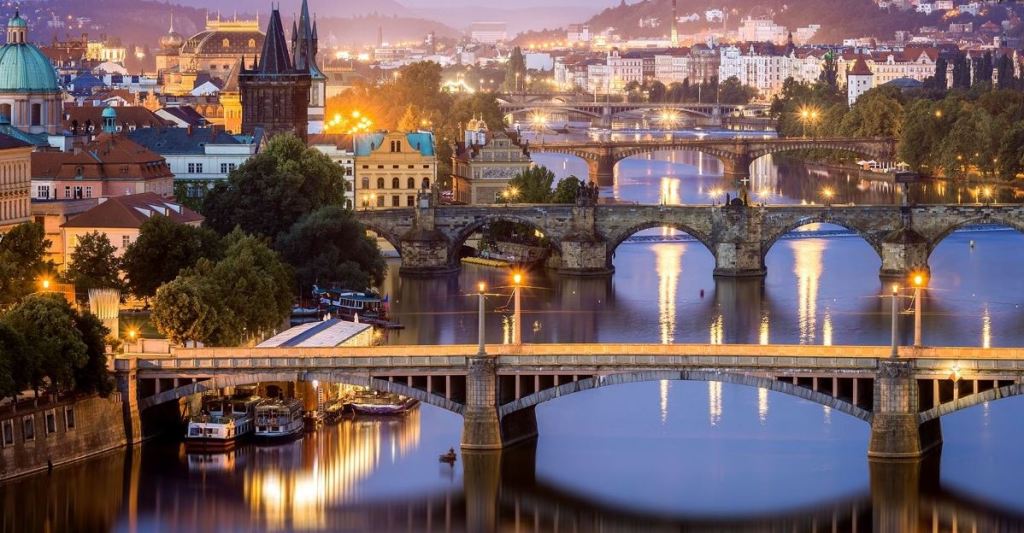
The provided text is primarily an extensive Wikipedia article about Prague, the capital and largest city of the Czech Republic. It offers a comprehensive overview of the city, covering aspects such as its history from its founding to modern times, its geography and climate, and its administration and demographics. The article also details Prague’s rich culture, including its attractions, museums, and festivals, as well as its economy, tourism industry, and educational institutions. Finally, it touches upon transportation, sports, and international relations, painting a broad picture of this significant European capital.
Prague Study Guide
Quiz
- What is the origin of the name “Prague” according to one prominent theory?
- Name two significant historical events that took place in Prague during the Habsburg era and briefly describe their impact on the city.
- What was the Prague Spring, when did it occur, and what was the Soviet Union’s response?
- Describe Prague’s geographical location in relation to the Vltava River and mention one significant geomorphological feature of the city.
- What are the three main lines of the Prague Metro, and when was the first section of the metro system opened?
- Identify two major cultural institutions in Prague and mention a significant function or event associated with each.
- Name three architectural styles that are prominently represented in Prague’s cityscape.
- What is Prague’s classification as a global city according to GaWC studies, and what does this classification generally indicate?
- Mention two of Prague’s nicknames and briefly explain the historical or cultural basis for one of them.
- What tragic event occurred at Charles University in December 2023, and what was its significance in the history of the Czech Republic?
Answer Key
- One prominent theory suggests the Czech name Praha is derived from an old Slavic word, práh, meaning “ford” or “rapid,” referring to the city’s origin at a crossing point of the Vltava river. Another legendary etymology links the name to Princess Libuše’s prophecy about a city being built where a man “hews a threshold.”
- The second Defenestration of Prague in 1618, where Protestant nobles threw Catholic officials out of windows, directly triggered the Thirty Years’ War, a devastating conflict for Prague and Bohemia. Later, during the reign of Rudolf II, Prague became the capital of European culture, attracting scientists, artists, and alchemists to his court at Prague Castle, fostering a period of prosperity.
- The Prague Spring was a brief period of political liberalization and reform in Czechoslovakia in 1968 under the new secretary of the Czechoslovak Communist Party, Alexander Dubček, who aimed for “socialism with a human face.” This period was forcibly ended by the Soviet Union and other Warsaw Pact countries (excluding Romania and Albania) through a military invasion of Czechoslovakia and Prague in August 1968, suppressing further reform attempts.
- Prague is situated on the Vltava River, which flows through the city. Geomorphologically, most of Prague is located in the Prague Plateau, characterized by varied terrain including hills like Petřín and Vítkov, and valleys along the river and its tributaries.
- The three main lines of the Prague Metro are Line A (green), Line B (yellow), and Line C (red). The first section of the Prague Metro, between the Kačerov and Florenc stations on Line C, was put into operation in 1974.
- The National Theatre (Národní Divadlo) is a significant cultural institution known for its opera, drama, and ballet performances, often with English subtitles for opera. The Estates Theatre (Stavovské divadlo) is historically important as the venue for the premieres of Mozart’s operas Don Giovanni and La clemenza di Tito.
- Prague’s architecture prominently features Romanesque, Gothic, Renaissance, and Baroque styles, reflecting its long and rich history as a major European center through different historical periods. More modern styles like Art Nouveau, Cubist, and Neo-Classical are also present.
- Prague is classified as a “Beta+” global city according to GaWC studies. This classification indicates that Prague is a significant city that links moderate economic regions into the world economy and demonstrates a notable level of international connectivity and influence.
- Prague is known as the “City of a Hundred Spires” due to its numerous historical churches and towers, with estimates now suggesting around 500 spires. Another nickname is the “Mother of Cities” (Praha matka měst), a historical motto reflecting Prague’s long history and importance as a central European capital.
- A mass shooting took place at Charles University in central Prague on December 21, 2023, resulting in the deaths of 15 people and injuries to 25 others. It was the deadliest mass murder in the history of the Czech Republic, marking a significant and tragic event in the nation’s history.
Essay Format Questions
- Analyze the significance of Prague’s location on the Vltava River in shaping its historical development, considering aspects such as trade, defense, and cultural identity.
- Discuss the impact of major political transitions in the 20th century, including the establishment of Czechoslovakia, the Nazi occupation during World War II, the Communist era, and the Velvet Revolution, on the urban landscape and cultural life of Prague.
- Evaluate the factors that have contributed to Prague’s enduring appeal as a major international tourist destination, considering its historical architecture, cultural institutions, and modern developments.
- Compare and contrast the roles of Prague as a center of political power and as a hub of cultural innovation throughout its history, providing specific examples from different eras.
- Examine the challenges and opportunities Prague faces in balancing its rich historical heritage with the demands of a modern, globalized city in the 21st century.
Glossary of Key Terms
- Bohemia: A historical region in Central Europe, largely coextensive with the western two-thirds of the modern Czech Republic. Prague served as its capital for centuries.
- Habsburg Dynasty: One of the most influential royal houses of Europe, which ruled Bohemia (including Prague) from 1526 to 1918. Their rule significantly shaped Prague’s political and cultural landscape.
- Thirty Years’ War (1618-1648): A major European conflict that began in Bohemia with the Defenestration of Prague. It had a devastating impact on the city, causing significant population decline and upheaval.
- First Czechoslovak Republic (1918-1938): The independent state formed after the collapse of Austria-Hungary, with Prague as its capital. This period saw significant modernization and cultural flourishing in the city.
- Velvet Revolution (1989): A non-violent transition of power in Czechoslovakia that ended the one-party rule of the Communist Party. Prague was a central stage for these events, leading to the establishment of a democratic government.
- UNESCO World Heritage Site: A designation given by the United Nations Educational, Scientific and Cultural Organization to places of outstanding universal value. The Historic Centre of Prague received this designation in 1992.
- Vltava River: The longest river within the Czech Republic, flowing through Prague. It has been central to the city’s development, serving as a trade route and influencing its geography and culture.
- Prague Castle (Hradčany): A vast complex of palaces, churches, and gardens that has been the seat of Bohemian rulers, Holy Roman Emperors, and presidents of Czechoslovakia and the Czech Republic for over a millennium.
- Old Town (Staré Město): One of the historical districts of Prague, known for its medieval architecture, Old Town Square, and the Astronomical Clock.
- Lesser Town (Malá Strana): Another historic district of Prague, situated below Prague Castle, characterized by baroque palaces, churches, and picturesque streets.
Prague Briefing Document
Date: December 2, 2024 Source: Excerpts from “Prague – Wikipedia”
This briefing document provides an overview of Prague, the capital and largest city of the Czech Republic, based on the provided Wikipedia excerpts. It covers the city’s etymology, history, geography, administration, demographics, culture, economy, tourism, education, transport, and international relations, incorporating quotes from the original source where appropriate.
1. Overview and Key Facts:
- Prague (Czech: Praha) is the capital and largest city of the Czech Republic and the historical capital of Bohemia.
- Located on the Vltava River, it has a population of approximately 1.4 million people (2024 estimate: 1,384,732). The larger metropolitan area has a population of over 2.2 million.
- Prague is a significant political, cultural, and economic hub of Central Europe.
- It boasts a rich history and diverse architecture, including Romanesque, Gothic, Renaissance, and Baroque styles.
- Nicknames include “City of a Hundred Spires” (estimated 500 today), the Golden City, the Mother of Cities, and the Heart of Europe.
- Classified as a “Beta+” global city and ranked among the most livable and visited cities in the world.
2. Etymology and Names:
- The Czech name Praha derives from the old Slavic word práh, meaning “ford” or “rapid,” referencing its origin at a Vltava River crossing.
- Another legendary etymology connects the name to Princess Libuše, who prophesied the city “to be built where a man hews a threshold of his house.” The word práh could also refer to the edge of rapids or fords, acting as a “threshold” to the castle.
- The English spelling is borrowed from French. Historically, it was pronounced to rhyme with “vague.”
- The Jewish community refers to Prague as “עיר ואם בישראל” (Ir va-em be-yisrael), meaning “The city and mother in Israel,” reflecting its long and significant Jewish history.
3. History:
- Early History: The region was settled in the Paleolithic age. Celtic tribes, including the Boii, inhabited the area (giving Bohemia its name) before being displaced by Germanic tribes. Slavic tribes settled in the 6th century AD.
- The construction of Prague Castle began in the late 9th century (first masonry by 885), and Vyšehrad fort was founded in the 10th century. Legend attributes the founding to Princess Libuše in the 8th century: “I see a great city whose glory will touch the stars.”
- Prague became the seat of Bohemian dukes and kings and a bishopric in 973.
- Late Middle Ages: Under King Ottokar II in 1257, Malá Strana (Lesser Quarter) was founded. Charles IV (r. 1346–1378) significantly elevated Prague’s status, establishing Charles University and beginning the construction of the Gothic St. Vitus Cathedral in 1344, the same year Prague became an archbishopric.
- The Prague astronomical clock was installed in 1410 and is the oldest still working.
- Jan Hus, a Charles University theologian, preached reforms, was deemed heretical, and burned at the stake in 1415, contributing to the Hussite Wars.
- Prague’s city militia fought bravely under the Prague Banner during the Hussite Wars. One captured banner from 1648 still exists in Stockholm.
- Habsburg Era: The election of Ferdinand I of Habsburg in 1526 led to religious conflicts as Protestantism gained popularity. Emperor Rudolf II (1576–1611) made Prague his home, fostering a golden age for arts and sciences.
- Famous residents included astronomers Tycho Brahe and Johannes Kepler.
- Prague became the “capital of European culture” during this period.
- The second Defenestration of Prague in 1618 sparked the Thirty Years’ War, a harsh period for Prague. The city’s population declined significantly.
- In 1784, the four municipalities (Malá Strana, Nové Město, Staré Město, Hradčany) merged, and Josefov (Jewish Quarter) was included in 1850. The Industrial Revolution brought growth and the creation of suburbs like Karlín (1817).
- 20th Century:First Czechoslovak Republic (1918-1938): Prague became the capital of newly independent Czechoslovakia, with Prague Castle as the seat of President Tomáš Garrigue Masaryk.
- Second World War (1939-1945): Nazi Germany occupied Prague in 1939, proclaiming Bohemia and Moravia a protectorate. Most of Prague’s Jewish population was deported and killed. The assassination of Reinhard Heydrich in Prague in 1942 led to severe reprisals. Prague suffered some bombing towards the end of the war but less than other major cities.
- Cold War (1948-1989): Czechoslovakia was under Soviet control. The Prague Spring of 1968, an attempt at democratic reforms (“socialism with a human face”), was brutally suppressed by the Warsaw Pact invasion.
- After the Velvet Revolution (1989 onwards): The peaceful Velvet Revolution led to the end of communist rule. In 1992, the Historic Centre of Prague became a UNESCO World Heritage Site. In 1993, Prague became the capital of the new Czech Republic after the Velvet Divorce. The city re-emerged as a significant European cultural center.
- Prague experienced major floods in 2002 and hosted significant international events (IMF/World Bank summits, NATO Summit).
- A mass shooting at Charles University in December 2023 resulted in 15 deaths, the deadliest in Czech history.
4. Geography and Climate:
- Prague is situated on the Vltava River, with the Berounka River flowing into it in the suburbs.
- The terrain is part of the Prague Plateau, with some extensions into the Hořovice Uplands and the Central Elbe Table lowland.
- Notable hills include Petřín and Vítkov.
- Prague has an oceanic climate bordering on a humid continental climate, with relatively cold winters and mild, sunny summers. Precipitation is moderate.
5. Administration and Politics:
- Prague is the capital of the Czech Republic and has a specific status as both a municipality and a region. It also houses the administration of the Central Bohemian Region.
- Administered by the autonomous Prague City Assembly (65 members) elected through municipal elections.
- The city is divided into 10 municipal districts, 22 administrative districts, 57 municipal parts, and 112 cadastral areas.
6. Demographics:
- The population of Prague was 1,384,732 as of January 1, 2024. The metropolitan area has a significantly larger population.
- Historically a multi-ethnic city with Czech, German, and Jewish populations.
- Prague has the oldest and best-educated population in the Czech Republic, with the lowest proportion of children.
- In the 2011 census, only 10.8% claimed adherence to a religion, with Roman Catholicism being the majority.
- The number of foreign residents has been significant, with Ukrainians being the largest group in recent years.
7. Culture:
- Traditionally a major cultural center of Europe, hosting numerous cultural events.
- Significant institutions include the National Theatre (Národní Divadlo) and the Estates Theatre, where Mozart’s premieres were held, the Rudolfinum (home to the Czech Philharmonic), and the Municipal House (Prague Symphony Orchestra).
- Many world-class museums, including the National Museum (Národní muzeum), the Jewish Museum in Prague, and the National Gallery.
- Hundreds of concert halls, galleries, cinemas, and music clubs.
- Hosts numerous festivals, including the Prague Spring International Music Festival, the Prague International Jazz Festival, and various film and writers’ festivals.
- With the growth of low-cost airlines, Prague has become a popular weekend tourist destination.
- Features buildings by renowned architects like Adolf Loos (Villa Müller), Frank O. Gehry (Dancing House), and Jean Nouvel (Golden Angel).
- Prague has been a popular filming location for Hollywood and Indian films.
8. Cuisine:
- Czech beer has a long history, with brewing dating back to 993.
- Numerous restaurants, bars, and pubs, especially in Old Town, Žižkov, and Vinohrady, focus on Czech beer.
- Hosts several microbrewery festivals.
- Home to historical breweries like Staropramen, U Fleků, and the Strahov Monastery Brewery, as well as many microbreweries.
9. Economy:
- Prague is the economic heart of the Czech Republic, contributing significantly to the national GDP.
- In Eurostat research, Prague ranked highly among European regions in terms of GDP per inhabitant, significantly above the EU average and the rest of the Czech Republic.
- The average monthly gross wage in Prague is the highest in the country.
- A significant center for business, attracting foreign investment.
- Na příkopě street is one of the most expensive in Central Europe and ranked among the most expensive globally for rent.
10. Tourism:
- Since the fall of the Iron Curtain, Prague has become a major global tourist destination.
- Suffered less damage during WWII, preserving its historic architecture.
- Features a pristine and varied collection of architectural styles.
- Ranked highly in global lists of best destinations.
- Receives over 8.4 million international visitors annually (as of 2017).
- Main attractions include:
- Hradčany and Lesser Town (Malá Strana): Prague Castle, St. Vitus Cathedral, Charles Bridge, Strahov Monastery.
- Old Town (Staré Město) and Josefov: Old Town Square, Astronomical Clock, Jewish Quarter.
- New Town (Nové Město): Wenceslas Square, National Museum, National Theatre, Dancing House.
- Vinohrady and Žižkov: National Monument in Vitkov, Church of St. Ludmila, Žižkov Television Tower.
- Other Places: Vyšehrad Castle, Prague Zoo, Prague Metronome.
11. Education:
- Prague is a major center for higher education in the Czech Republic.
- Public Universities: Includes Charles University, Czech Technical University in Prague, University of Economics, Prague, Czech University of Life Sciences Prague, Academy of Arts, Architecture and Design (VŠUP), Academy of Performing Arts (AMU), and Academy of Fine Arts (AVU).
- Private Universities and Colleges: A significant number of private institutions also operate in Prague.
- International Institutions: Several international cultural and educational institutions have a presence in Prague.
12. Science, Research, and Hi-Tech Centers:
- Prague is an important center for research, hosting a significant number of institutes of the Czech Academy of Sciences and public research institutes.
- A substantial portion of the country’s researchers and research and development expenditure is concentrated in Prague.
- Several multinational companies have established research and development facilities in the city.
- Prague was selected to host the administration of the EU’s Galileo satellite navigation system.
13. Transport:
- Prague has a high rate of public transport usage (52% modal share).
- Public Transportation: The Prague Integrated Transport (PID) system includes the Prague Metro (three lines, fourth under construction), tram system (one of the longest globally with the largest rolling stock), buses, commuter trains, funiculars, and ferries.
- Has a common ticketing system with various options for single rides and tourist passes.
- Roads: Features inner and outer ring roads, including the Blanka tunnel complex (part of the City Ring).
- Rail: A major hub of the Czech railway system with connections to all parts of the country and major European cities. Hlavní nádraží is the main international railway station.
- Air: Served by Václav Havel Airport Prague, the largest and busiest airport in the Czech Republic.
14. Sport:
- Prague is a site for numerous sports events, national stadiums, and teams in various sports (football, ice hockey, basketball, American football, speedway, athletics).
- Notable teams include Sparta Prague and Slavia Prague (football and ice hockey).
15. International Relations:
- Prague is twinned with several major cities worldwide, including Berlin, Brussels, Chicago, Frankfurt am Main, Hamburg, Kyoto, and Taipei.
- A number of other settlements around the world share a similar name, often due to Czech emigration.
This briefing document summarizes the key information about Prague from the provided Wikipedia excerpts, highlighting its rich history, cultural significance, economic importance, and status as a major European capital.
Frequently Asked Questions about Prague
1. What is the origin and meaning of Prague’s name? The Czech name Praha is derived from an old Slavic word, práh, meaning “ford” or “rapid,” referring to the city’s original location at a crossing point on the Vltava River. Another interpretation links práh to “threshold,” possibly referencing the river’s edge as a means of crossing or a legendary tale involving Princess Libuše who prophesied the city’s founding where a man “hews a threshold of his house.” It’s also suggested that Praha comes from na prazě, the shale hillside rock upon which Prague Castle was initially built. The English spelling is borrowed from French.
2. What are some of Prague’s historical nicknames and what do they signify? Prague has several evocative nicknames reflecting its rich history and significance. “City of a Hundred Spires” (though the current estimate is around 500) highlights its numerous historical towers and churches. “Golden City” and “Heart of Europe” speak to its historical importance as a cultural, political, and economic center. “Mother of Cities” (Praha matka měst) emphasizes its long history and influence in the region. The local Jewish community has also called it Ir va-em be-yisrael, meaning “The city and mother in Israel,” acknowledging its ancient and continuous Jewish presence.
3. What are some key historical periods and events that have shaped Prague? Prague’s history spans from early Paleolithic settlements to its current status as the Czech Republic’s capital. Key periods include its founding around Prague Castle in the 9th century, its rise as the seat of Bohemian dukes and kings, and its elevation to an archbishopric in 1344 under Charles IV, a golden age marked by the establishment of Charles University and the start of St. Vitus Cathedral. Prague played significant roles in the Bohemian and Protestant Reformations, the Hussite Wars (marked by the defenestrations of Prague), the Thirty Years’ War (which significantly impacted the city), the Habsburg era, the creation of Czechoslovakia after World War I, the Nazi occupation during World War II, the Communist era and the Prague Spring, the Velvet Revolution in 1989, and its subsequent development as the capital of the Czech Republic.
4. What are some of Prague’s most famous historical and cultural landmarks? Prague boasts a vast array of iconic landmarks representing various architectural styles. These include Prague Castle (the largest ancient castle complex in the world) with St. Vitus Cathedral, the Charles Bridge (a historic 14th-century bridge), Old Town Square with the Prague Astronomical Clock and Church of Our Lady before Týn, Lesser Town (Malá Strana) with St. Nicholas Church, New Town (Nové Město) with Wenceslas Square and the National Museum, Vyšehrad Castle, and the Jewish Quarter (Josefov) with its historical synagogues. Modern architectural highlights include the Dancing House. The city is also home to significant cultural institutions like the National Theatre and the Rudolfinum.
5. How significant is tourism to Prague, and what makes it a popular destination? Tourism is a vital part of Prague’s economy. Since the fall of the Iron Curtain, it has become one of the world’s most popular tourist destinations, receiving millions of international visitors annually. Its popularity stems from its rich history, remarkably preserved and varied architecture (ranging from Romanesque to ultra-modern), vibrant cultural scene with numerous festivals and events, renowned Czech beer and cuisine, and its classification as a “Beta+” global city with a high quality of life. Prague’s relatively lesser damage during World War II compared to other European cities has allowed its historical architecture to remain largely intact.
6. How is Prague administratively organized, and what can you tell me about its government and demographics? Prague serves as both a municipality and a region within the Czech Republic. Administratively, it is divided into 10 municipal districts, 22 administrative districts, 57 municipal parts, and 112 cadastral areas. The city is governed by the autonomous Prague City Assembly, consisting of 65 elected members. Prague’s population is the largest and oldest in the Czech Republic, with a high level of education. While historically multi-ethnic, it is now predominantly Czech. A relatively low percentage of the population identifies with a religion, with Roman Catholicism being the most common among those who do. Prague’s population has grown significantly over the centuries, reaching nearly 1.4 million in the capital city and over 2.2 million in the metropolitan area.
7. What is Prague’s role in the Czech Republic’s economy, and what are some key economic indicators? Prague is the economic hub of the Czech Republic, contributing significantly to the national GDP. It boasts a highly developed industry and a strong service sector, attracting foreign investment and hosting research and development facilities of multinational companies. Prague consistently ranks high among European regions in terms of GDP per inhabitant, often surpassing the EU average. The average wage in Prague is also significantly higher than the national average. The city is an important center for science, research, and hi-tech industries, hosting numerous institutes of the Czech Academy of Sciences and universities engaged in research activities.
8. How developed is Prague’s transportation infrastructure? Prague has a highly efficient and extensive public transportation system, Prague Integrated Transport (PID), which includes the Prague Metro (with three operating lines and a fourth under construction), a vast tram network (one of the longest in the world with the largest rolling stock), bus services, commuter trains, funiculars, and ferries. Prague has one of the highest rates of public transport usage globally. The city also has inner and outer ring roads to manage car traffic. Rail connections link Prague to major cities within the Czech Republic and across Europe. Václav Havel Airport Prague is a major international airport in Central and Eastern Europe, serving as a hub for several airlines. Cycling infrastructure is also present, though its modal share is smaller compared to public transport and walking.
Prague: A Concise History
Prague’s history spans from early settlements to its current status as the capital of the Czech Republic.
Early History:
- The region where Prague is located was settled as early as the Paleolithic age.
- Mythological accounts, citing Jewish chronicler David Solomon Ganz, claim the city was founded as Boihaem around 1306 BC by King Boyya.
- In the 5th and 4th centuries BC, the Celtic tribe Boii appeared, establishing settlements and naming the region Bohemia.
- Germanic tribes later moved into the area, and a 2nd-century map by Ptolemaios mentioned a Germanic city called Casurgis in the area of present-day Prague.
- Slavic tribes settled the Central Bohemian Region in the 6th century AD, building fortified settlements.
- The construction of Prague Castle began near the end of the 9th century, expanding an existing fortified settlement from around 800 AD. The first masonry under the castle dates to at least 885 AD.
- Vyšehrad, another prominent Prague fort, was founded in the 10th century.
- Legend attributes Prague’s foundation to the 8th-century Czech duchess and prophetess Libuše, who prophesied a great city and ordered the construction of a castle and town called Praha.
- Prague became the seat of the Dukes and later Kings of Bohemia, and a bishopric was established in 973 under Duke Boleslaus II the Pious.
- By 965, Prague was an important trading seat with merchants from across Europe, including many Jews. The Old New Synagogue dates back to 1270.
- The first bridge, the Judith Bridge, was built over the Vltava River around 1170 by King Vladislaus I. It was destroyed by a flood in 1342 and later rebuilt as the Charles Bridge.
- In 1257, during the reign of King Ottokar II, Malá Strana (Lesser Quarter) was founded near Prague Castle, becoming a district primarily for German people with autonomous legal administration. It was located opposite the existing Staré Město (Old Town).
Late Middle Ages:
- Prague flourished in the 14th century under Charles IV, Holy Roman Emperor and King of Bohemia (1346–1378), who transformed it into an imperial capital. By the 1470s, it was the third-largest city in the Holy Roman Empire.
- Charles IV ordered the building of the New Town (Nové Město) adjacent to the Old Town.
- The Charles Bridge was erected to replace the Judith Bridge.
- In 1347, Charles University, the oldest university in Central Europe, was founded.
- Construction of the Gothic St. Vitus Cathedral within Prague Castle began in 1344, the same year Prague was elevated to an archbishopric.
- The Prague astronomical clock was first installed in 1410, making it one of the oldest in the world and the oldest still working.
- Jan Hus, a theologian and rector at Charles University, preached reforms of the Church in Prague, leading to his condemnation and execution in 1415.
- His death, coupled with Czech proto-nationalism and proto-Protestantism, spurred the Hussite Wars. The first defenestration of Prague occurred in 1419.
- Hussite forces, led by Jan Žižka, defeated Emperor Sigismund at the Battle of Vítkov Hill in 1420.
- The city militia fought bravely under the Prague Banner during the Hussite Wars. This banner, dating back to at least 1419, is the oldest preserved municipal flag of Bohemia.
Habsburg Era:
- In 1526, the Bohemian estates elected Ferdinand I of the House of Habsburg.
- The fervent Catholicism of the Habsburgs led to conflict with the growing popularity of Protestant ideas in Bohemia and Prague.
- Under Holy Roman Emperor Rudolf II (elected King of Bohemia in 1576), Prague became his home and the capital of European culture. His court attracted scientists, musicians, and artists like Tycho Brahe, Johannes Kepler, and Arcimboldo.
- In 1618, the second defenestration of Prague sparked the Thirty Years’ War, a harsh period for Prague.
- Following the Battle of White Mountain (1620), 27 Czech Protestant leaders were executed in Old Town Square in 1621, and many others were exiled. Prague was forcibly converted back to Roman Catholicism.
- Prague suffered during the Thirty Years’ War, with attacks in 1631 and the Battle of Prague in 1648, leading to a significant decline in population.
- In 1689, a great fire devastated Prague, leading to renovation and rebuilding.
- A major plague outbreak in 1713–14 killed thousands.
- Prague was invaded by Frederick the Great of Prussia in 1744 and again in 1757, causing destruction. Empress Maria Theresa briefly expelled Jews from Prague in 1745.
- In 1784, the four municipalities of Malá Strana, Nové Město, Staré Město, and Hradčany were merged into a single entity. The Jewish district, Josefov, was included in 1850.
- The Industrial Revolution brought significant changes to Prague, and the first suburb, Karlín, was created in 1817.
- The revolutions of 1848 in Europe also affected Prague but were suppressed.
- The Czech National Revival gained momentum, leading to a decrease in the German-speaking population and the demand for equal status for the Czech language.
20th Century:
- Following World War I and the collapse of the Austro-Hungarian Empire, Prague became the capital of Czechoslovakia. Prague Castle became the seat of President Tomáš Garrigue Masaryk.
- In 1939, Nazi Germany occupied Czechoslovakia, and Hitler proclaimed Bohemia and Moravia a German protectorate from Prague Castle.
- During World War II, most Jews were deported and killed. Prague witnessed the assassination of Reinhard Heydrich in 1942, leading to bloody reprisals.
- Prague suffered several bombing raids by the US Army Air Forces in 1945. However, many historic structures escaped major damage.
- In May 1945, an uprising against Germany occurred, followed by the liberation of Prague by the Red Army on May 9. The German population was largely expelled after the war.
- During the Cold War, Czechoslovakia, including Prague, was under Soviet control. The Prague Spring of 1968, an attempt at political reform, was suppressed by the Soviet-led invasion.
- In 1989, the Velvet Revolution, sparked by a student demonstration, led to the end of communist rule.
After the Velvet Revolution:
- In 1992, the Historic Centre of Prague was inscribed as a UNESCO World Heritage Site.
- In 1993, following the Velvet Divorce, Prague became the capital of the new Czech Republic.
- Since the 1990s, Prague has again become an important cultural center of Europe.
- Prague experienced widespread floods in 2002 that damaged buildings and the underground transport system.
- In December 2023, a mass shooting at Charles University resulted in multiple fatalities, becoming the deadliest mass murder in Czech history.
Prague: Geography, Climate, and Administrative Divisions
Prague is situated on the Vltava river. In the suburbs of Lahovice, the Berounka flows into the Vltava. There are 99 watercourses in Prague with a total length of 340 km (210 mi), with the Rokytka and Botič being the longest streams. The city also contains 3 reservoirs, 37 ponds, and 34 retention reservoirs and dry polders. The largest pond is Velký Počernický with 41.76 ha (103.2 acres), while the largest body of water is Hostivař Reservoir with 42 hectares (103.8 acres).
In terms of geomorphology, most of Prague is located in the Prague Plateau. The city’s territory extends into the Hořovice Uplands in the south and into the Central Elbe Table lowland in the north. The highest point is the top of the hill Teleček on the western border at 399 m (1,309 ft) above sea level, and the lowest point is where the Vltava leaves the city in Suchdol at 172 m (564 ft). Notable hills in the center of Prague include Petřín at 327 m (1,073 ft) and Vítkov at 270 m (890 ft).
Prague is located approximately at 50°5′N 14°25′E. It is at roughly the same latitude as Frankfurt, Germany; Paris, France; and Vancouver, Canada. The northernmost, southernmost, westernmost, and easternmost geographical points of the city are also defined.
Prague has an oceanic climate (Cfb; Dobk) bordering on a humid continental climate (Dfb). Winters are relatively cold with average temperatures around freezing (0 °C) and little sunshine. Snow cover is common from mid-November to late March, though significant accumulations are infrequent. Milder periods can occur in winter. Summers are usually sunny with an average high temperature of 24 °C (75 °F), although nights can be cool. Precipitation is moderate (600–500 mm or 24–20 in per year) due to Prague’s location in the rain shadow of the Sudetes and other mountain ranges. Winter is typically the driest season, while late spring and summer can experience heavy rain, often as thundershowers. The average sunshine hours have increased over time. Temperature inversions are common between mid-October and mid-March, leading to foggy, cold days and potential air pollution. Prague is also a windy city, with prevalent western winds and an average speed of 16 km/h (10 mph) that often helps to break inversions and clear the air. Detailed climate data for Clementinum, Prague, including record highs and lows, average temperatures, precipitation, snowfall, humidity, and sunshine hours, are also available.
Administratively, Prague is the capital of the Czech Republic and has a specific status as both a municipality and a region. Since 1990, it is again de facto a statutory city. Prague also houses the administrative institutions of the Central Bohemian Region. The city is divided into 10 municipal districts (1–10), 22 administrative districts (1–22), 57 municipal parts, and 112 cadastral areas. The boundaries of many urban, administrative, and city districts are independent of cadastral territory boundaries. Cadastral areas remain relevant for land registration and house numbering.
Prague Governance and Administrative Structure
Prague functions as the capital of the Czech Republic and holds a unique status as both a municipality and a region. Since November 24, 1990, it has been de facto a statutory city. The city also hosts the administrative institutions of the Central Bohemian Region.
The administration of Prague is carried out by the autonomous Prague City Assembly, which consists of 65 members elected through municipal elections. As of December 20, the city is governed by a centre-right coalition called Together Prague, which holds 18 seats. They govern in conjunction with the Pirates (centre to centre-left) with 12 members and the Mayors and Independents group (centre to centre-right) with 5 members. This governing coalition has a comfortable majority of 35 out of 65 seats in the assembly.
The opposition parties in the Prague City Assembly include ANO 2011 (right-wing populist) with 14 members, Prague Together (centre) with 11 votes, Freedom and Direct Democracy (right wing to far-right) with 3 members, and 2 unaffiliated Independents.
The executive body of Prague is the Prague City Council, which is elected by the Assembly. The municipal office is located at Prague City Hall and comprises 11 members, including the mayor. The City Council is responsible for preparing proposals for the Assembly meetings and ensuring the implementation of adopted resolutions. The current Mayor of Prague is Bohuslav Svoboda, a member of the Civic Democratic Party.
Historically, until 1949, Prague’s administrative districts were formed by whole cadastral units, municipalities, or towns. However, a fundamental change in the administrative division occurred in 1949. Since then, the boundaries of many urban districts, administrative districts, and city districts are independent of cadastral territory boundaries, leading to the division of some cadastral territories into administrative and self-governing parts. Despite these changes, cadastral areas (such as Vinohrady and Smíchov) remain relevant, particularly for the registration of land and real estate and for house numbering.
Prague is currently divided into a complex administrative structure consisting of 10 municipal districts (1–10), 22 administrative districts (1–22), 57 municipal parts, and 112 cadastral areas.
Prague: Demographics and Cultural Heritage
Prague has a dynamic demographic profile and a rich cultural heritage, as detailed in the sources.
Demographics:
- As of the 2011 census, the official population of Prague hovered around 1.3 million. However, the real population is estimated to be much higher, closer to 1.9 or 2.0 million, due to only about 65% of residents being marked as permanently living in the city. Additionally, 300,000 to 400,000 commuters come to Prague on weekdays for work, education, or commerce.
- About 14% of the city’s inhabitants were born outside the Czech Republic, which is the highest proportion in the country. In September 2024, there were 349,317 foreign residents, with 128,615 holding permanent residence. The most numerous nationalities include Ukrainians, Slovaks, and Russians. Other significant foreign resident populations include those from Vietnam, Kazakhstan, Mainland China, the United States, and Romania.
- 64.8% of the city’s population self-identified as ethnically Czech in the 2011 census, slightly higher than the national average. A significant portion, almost 29%, declined to answer the ethnicity question, suggesting the actual percentage of ethnic Czechs could be higher.
- Prague’s population is characterized as the oldest and best-educated in the Czech Republic, with the lowest proportion of children. In terms of religion, only 10.8% of census respondents claimed adherence to a religion, with the majority being Roman Catholics.
- The historical population of Prague has shown significant changes over time.
- In 1378, the population was around 40,000.
- It decreased to 25,000 by 1500.
- By 1610, it had rebounded to 60,000.
- The population reached 79,000 in 1798.
- A significant increase occurred in the 19th century, reaching 270,389 in 1869 and growing to 1,301,432 by 2021.
Culture:
- Prague is traditionally considered one of the cultural centres of Europe, hosting numerous cultural events. The historic center of Prague has been a UNESCO World Heritage Site since 1992.
- The city is home to many significant cultural institutions:
- National Theatre (Národní Divadlo).
- Estates Theatre (Stavovské or Tylovo or Nosticovo divadlo), notable for the premières of Mozart’s Don Giovanni and La clemenza di Tito.
- Rudolfinum, home to the Czech Philharmonic Orchestra.
- Municipal House, home to the Prague Symphony Orchestra.
- Prague State Opera (Státní opera), performing at the Smetana Theatre.
- The city has more than ten major museums, along with numerous theatres, galleries, and cinemas. Examples include the National Museum, Veletržní palác (housing the largest collection of National Gallery art), and Rudolfinum (a concert and exhibition hall).
- Prague is known for its diverse architecture, spanning Romanesque, Gothic, Renaissance, Baroque, Rococo, Neo-Renaissance, Neo-Gothic, Art Nouveau, Cubist, Neo-Classical, and ultra-modern styles. The city has buildings by renowned architects such as Adolf Loos (Villa Müller), Frank O. Gehry (Dancing House), and Jean Nouvel (Golden Angel).
- The city has earned the nickname “City of a Hundred Spires“. Although some enthusiasts have counted over five hundred towers and spires, the moniker reflects the city’s impressive skyline and historical architecture. It is also historically known by the Latin motto “Praga Caput Rei publicae” (“Prague, Head of the Republic”) and “Praga mater urbium” (“Prague, Mother of Cities”), with its Czech equivalent “Praha matka měst“. Historically, it was also called “Praga Caput Regni” (“Prague, Head of the Kingdom”).
- Prague has been a popular filming location for international productions, including Hollywood and Bollywood movies, attracted by its architecture, lower costs, and existing infrastructure. Notable films shot in Prague include Mission Impossible, Blade II, Children of Dune, and Spider-Man: Far From Home, as well as numerous Indian films.
- Historical fiction novels are also set in Prague, such as The Discovery of Witches and Shadows of Night by Deborah Harkness.
- Czech beer has a long history, with brewing dating back to 993. Prague has numerous restaurants, bars, and pubs, particularly in Old Town, Žižkov, and Vinohrady, known for serving Czech beer. The city also hosts microbrewery festivals and is home to historical breweries like Staropramen, U Fleků, and Strahov Monastery Brewery.
- In terms of social media recognition, Prague was ranked 7th on “Europe’s 10 most beautiful cities to visit in autumn” in October 2024 based on Google search and Instagram hashtag analysis.
Prague continues to be a significant cultural and demographic hub in Central Europe, attracting a diverse population and millions of tourists annually due to its rich history and cultural offerings.
Prague: Economy and Tourism Overview
Prague has a significant and well-performing economy, and tourism plays a vital role in it, as highlighted by the sources.
Economy:
- Prague’s economy accounts for a substantial portion of the Czech Republic’s overall economic output, contributing 25% of the Czech GDP. This makes it the highest performing regional economy in the country.
- As of 2021, Prague’s GDP per capita in purchasing power standard was €58,216, ranking it as the third best performing region in the EU, at 203% of the EU-27 average. In 2010, Eurostat research placed Prague fifth among Europe’s 271 regions in terms of gross domestic product per inhabitant, achieving 172% of the EU average, surpassing Paris and significantly exceeding the Czech Republic’s average of 80%.
- Prague employs almost one-fifth of the entire Czech workforce, and its wages are significantly above the national average (approximately +20%). In the fourth quarter of 2020, the average salary in Prague reached CZK 45.944 (around €1,800) per month.
- Since 1990, Prague’s economic structure has shifted from industrial to service-oriented. While industry remains in sectors like pharmaceuticals, printing, food processing, and manufacturing of transport equipment, services account for around 80% of employment. Key service sectors include financial and commercial services, trade, restaurants, hospitality, and public administration. There are 800,000 employees in Prague, including 120,000 commuters.
- The number of legally registered foreign residents in Prague has been increasing, constituting about 18% of the workforce as of March 2010. Approximately one-fifth of all investment in the Czech Republic takes place in Prague.
- In a 2010 survey, Prague was named the best city in Central and Eastern Europe (CEE) for business. In 2005, it was considered among the top three most livable cities in CEE by The Economist. In 2010, Prague ranked 29th globally out of 289 cities for innovation.
- Na příkopě is the most expensive street among all the states of the V4 (Visegrád Group). In 2017, with a rent of €2,640 per square meter per year, it ranked as the 22nd most expensive street in the world. Pařížská street is the second most expensive.
- Prague is the location of several important offices and institutions of the Czech Republic, including the President, the Government, both houses of Parliament, various ministries, the Czech National Bank, and major broadcasters. It also hosts international projects like the Galileo global navigation project.
Tourism:
- Since the fall of the Iron Curtain, Prague has become one of the world’s most popular tourist destinations.
- Prague suffered relatively less damage during World War II, allowing its historic architecture to remain largely intact. It boasts a diverse collection of architectural styles, from Romanesque to ultra-modern.
- As of 2017, the city received more than 8.4 million international visitors annually. In 2017, Prague was the fifth most visited European city after London, Paris, Rome, and Istanbul. In 2023, Prague was visited by 7,442,614 guests who stayed overnight, with 78.8% being from abroad. The average number of overnight stays for non-residents was 2.3.
- Almost one-half of the national income from tourism is spent in Prague. The city offers approximately 73,000 beds in accommodation facilities, most built after 1990, including around 51,000 in hotels and boarding houses.
- Main attractions in Prague include:
- Prague Castle with St. Vitus Cathedral.
- Charles Bridge.
- Old Town Square with the Astronomical Clock and Church of Our Lady before Týn.
- Jewish Quarter (Josefov) with the Old New Synagogue and Old Jewish Cemetery.
- Petřín Hill with the Petřín Lookout Tower and Mirror Maze.
- Wenceslas Square with the National Museum.
- Vyšehrad Castle.
- Dancing House.
- Numerous churches, palaces, museums, and galleries.
- In 2023, the most visited tourist destinations in Prague were Prague Castle, Petřín funicular, Prague Zoo, Petřín Lookout Tower, and Old Town Hall.
- Prague is classified as a “Beta+” global city, comparable to Vienna and Washington, D.C., indicating its significance in the global economy and tourism. It ranked sixth in the Tripadvisor world list of best destinations in 2016. In 2021, it ranked 7th globally for conference tourism performance. As of December 2024, Prague is ranked 3rd among the best places to visit during Christmas.
- The return of the Matějská pouť (St. Matthew’s fun fair) Cyclone roller coaster in 2025 is also expected to be a tourist attraction.
Overall, Prague boasts a strong and diverse economy where tourism is a significant contributor, drawing millions of visitors with its rich history, cultural landmarks, and architectural beauty.
Prague, the capital of the Czech Republic, is a city that feels like stepping into a fairy tale. Known as the “City of a Hundred Spires,” it boasts stunning medieval architecture, charming cobblestone streets, and a vibrant cultural scene. Here are some highlights to consider for your trip:
- Top Attractions: Don’t miss the iconic Charles Bridge, Prague Castle, and the Astronomical Clock in Old Town Square. For breathtaking views, head to the Petřín Lookout Tower.
- Local Tips: Wear comfortable shoes for exploring the cobblestone streets, and pack layers to adapt to the weather.
- Getting Around: Prague has an excellent public transport system, but note that the metro doesn’t go all the way to the airport. You can take a bus or pre-book a taxi for convenience.
- Best Time to Visit: Spring and autumn are ideal for pleasant weather and fewer crowds.
If you’d like, I can help you plan an itinerary or find more specific recommendations!
Prague is full of delightful hidden gems that go beyond the usual tourist spots. Here are a few to consider:
- Wallenstein Garden: A serene Baroque garden with a large lake, statues, and even peacocks. It’s a peaceful escape from the city’s hustle.
- Colloredo-Mansfeld Palace: A stunning palace with original Baroque interiors and a beautiful courtyard. It’s a lesser-known architectural treasure.
- Letná Park: Offers breathtaking views of the city and is a great spot for a relaxing walk or picnic.
- Vyšehrad: A historic fort with panoramic views, a beautiful cemetery, and a quieter atmosphere compared to Prague Castle.
- John Lennon Wall: A colorful wall filled with graffiti and messages of peace and love, tucked away in the Malá Strana district.
Would you like more details about any of these spots?
The Wallenstein Garden, part of the Wallenstein Palace complex in Prague, has a fascinating history. It was constructed between 1624 and 1630 by Albrecht von Wallenstein, a powerful Czech nobleman and military leader during the Thirty Years’ War. Wallenstein envisioned the palace and its garden as a grand residence to rival Prague Castle2.
The garden was designed in the Italian Mannerist style, featuring manicured lawns, flower beds, fountains, and a large pond. It also includes unique elements like an artificial grotto and an aviary. The garden’s serene atmosphere is enhanced by the presence of peacocks, which have become one of its charming trademarks3.
Over the centuries, the garden has undergone various modifications but has retained its historical and architectural significance. Today, it serves as a public space where visitors can enjoy its beauty and tranquility, as well as cultural events during the summer2.
Would you like to know more about its architectural features or current uses?
The Wallenstein Garden in Prague is a beautiful blend of architectural styles, primarily influenced by Early Baroque and Italian Mannerism.
- Early Baroque: This style is evident in the garden’s grand design, symmetry, and ornate features, such as the statues and fountains. The Baroque influence reflects the ambition of Albrecht von Wallenstein, who wanted the palace and garden to rival Prague Castle in grandeur.
- Italian Mannerism: The garden’s artificial grotto and intricate details showcase the Mannerist style, which emphasizes elegance and artistic flair.
These styles combine to create a space that is both majestic and tranquil, making it a unique historical and cultural landmark in Prague.
Would you like to explore more about its features or other Baroque landmarks in the city?
The Wallenstein Garden holds significant historical value as part of the Wallenstein Palace complex, which was constructed between 1624 and 1630 by Albrecht von Wallenstein, a prominent military leader during the Thirty Years’ War. The garden and palace symbolized Wallenstein’s immense power and ambition, as he sought to rival the grandeur of Prague Castle2.
The garden’s design reflects the cultural and artistic influences of the Early Baroque and Italian Mannerist styles, showcasing the opulence and sophistication of the era. It also served as a space for leisure and entertainment, hosting events and gatherings that highlighted the social and political prominence of its owner3.
Today, the Wallenstein Garden is a public space, offering a glimpse into Prague’s rich history and architectural heritage. It remains a testament to the city’s cultural evolution and the legacy of one of its most influential historical figures.
Would you like to explore more about its features or its connection to the Thirty Years’ War?

By Amjad Izhar
Contact: amjad.izhar@gmail.com
https://amjadizhar.blog
Affiliate Disclosure: This blog may contain affiliate links, which means I may earn a small commission if you click on the link and make a purchase. This comes at no additional cost to you. I only recommend products or services that I believe will add value to my readers. Your support helps keep this blog running and allows me to continue providing you with quality content. Thank you for your support!
