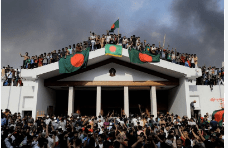
Multiple Bangladeshi news sources report on the aftermath of a July 2024 coup d’état, focusing on the formation of an interim government led by Professor Muhammad Yunus. Key events covered include a planned December 31st declaration by a student movement to invalidate the 1972 constitution, ongoing investigations into a secretariat fire, land disputes, and the upcoming Bangladesh Premier League (BPL) cricket season. Political discussions center on the Awami League’s potential participation in future elections and the need for national unity. Social issues such as journalist accreditation cancellations and the trial of those involved in the July violence are also highlighted.
Bangladesh Political Study Guide
Quiz
- What is the Anti-Discrimination Student Movement planning to announce on December 31st, and where will this announcement take place?
- Why are the journalist accreditation cards being cancelled, and what is the justification for allowing some journalists temporary access to the Secretariat?
- What is the BPL, and what are some key details about the opening of Season Eleven?
- What action has been taken regarding privately owned land in Bhaluka, Mymensingh, and what does this reveal about corruption?
- What is the interim government’s position on the July Revolution declaration and the role of the anti-discrimination student movement in this political climate?
- What is the state of commodity prices, and what steps has the government taken to address this issue?
- What are some of the key concerns or criticisms that have been articulated about the actions of the interim government and its advisors?
- What is the main grievance of the families of the martyrs of the July revolution?
- What are the concerns of Bangladesh citizens bordering Myanmar, and what is the government doing about it?
- What are the key elements of the manifesto being developed by the anti-discrimination student movement, and what is its stated intention?
Answer Key
- The Anti-Discrimination Student Movement is planning to announce a manifesto declaring the end of the Mujibist constitution and the irrelevance of the Awami League. This declaration is scheduled to take place at the central Shaheed Minar on December 31st.
- The journalist accreditation cards are being cancelled as part of a policy change. Temporary access is granted to some journalists to prevent misconceptions while new cards are issued and a new policy is being implemented that will require a selection process.
- BPL is the Bangladesh Premier League, a popular franchise cricket league. Season Eleven began with matches between Barisal and Rajshahi, and Rangpur Riders defeated Capitals in their opening match.
- Privately owned land in Bhaluka, Mymensingh has been seized by land robbers and unscrupulous officials of the Forest Department despite a High Court order prohibiting it, highlighting corruption and disregard for the rule of law.
- The interim government views the July Revolution declaration as a private initiative with which it has no involvement. However, the anti-discrimination student movement played a key role in overthrowing the previous government and is now a major part of this political landscape.
- The commodity prices are not being controlled, and the Chief Advisor urged field administrators to bring them under control. The government is also trying to monitor the distribution of agricultural products and fertilizers to help stabilize the market.
- Key criticisms include a lack of national unity, distrust of advisors, a fear of being a long term interim government, and the potential for political parties and the student movement to diverge from one another.
- The main grievance of the families of the martyrs of the July revolution is not a lack of financial support but the absence of justice for the murders of their family members. They blame the police for having been directly involved.
- Bangladesh citizens bordering Myanmar are concerned about the sounds of gunfire and their safety. The government is maintaining communication with the Myanmar government and Arakan Army, and it has temporarily closed fishing in the area.
- The manifesto, based on the people’s uprising, is a declaration for the future of Bangladesh after the fall of a long dictatorship. It aims to address the desires of the public and end rotten politics through a new political arrangement and a new Bangladesh exchange.
Essay Questions
- Analyze the role and influence of the Anti-Discrimination Student Movement in the current political landscape of Bangladesh, focusing on its relationship with the interim government and other political parties.
- Evaluate the significance of the planned December 31st declaration, including its intended purpose, symbolism, and the potential impacts on the political system and national unity.
- Discuss the challenges and conflicts facing the interim government, including the management of commodity prices, land disputes, and the push for political and constitutional reforms.
- Assess the effectiveness and legitimacy of the interim government in Bangladesh, focusing on the perceptions of various stakeholders, the role of consensus, and its transition towards a free, fair and impartial election.
- Examine the role of media, particularly the issues around journalism accreditation and access to the Secretariat, and how they reflect broader political tensions and power dynamics.
Glossary of Key Terms
- Interim Government: A temporary government established after the fall of a previous regime, tasked with managing the state during a transition period, often towards new elections.
- July Revolution: A popular uprising that overthrew the previous government, which was led by a student movement in July of 2024.
- Anti-Discrimination Student Movement: A student-led organization that played a key role in the July revolution and is now heavily involved in planning for the country’s future.
- Mujibist Constitution: Refers to the Constitution of 1972, which is associated with Sheikh Mujibur Rahman, and is viewed as foundational by some and oppressive by others.
- BPL: Bangladesh Premier League, the country’s popular franchise cricket league.
- Shaheed Minar: A national monument in Bangladesh, central to important political and cultural events.
- Accreditation Card: An official identification card for journalists to access government buildings and events.
- Land Robbers: Individuals or groups involved in illegally seizing land, often with corrupt officials.
- Constituent Assembly: A body formed to create a new constitution for a country.
- Referendum: A vote on a specific issue, in this case, a new constitution or changes to existing governing documents, to determine the will of the people.
- National Unity: A state of cohesion and agreement among different groups and political parties within a country.
- Fascism: A political ideology characterized by authoritarian leadership, suppression of dissent, and strong nationalism; an important factor in the rise of the Anti-Discrimination Student Movement.
- Weighted Average Method: A process of giving more weight to the opinions or votes of larger political parties when trying to reach consensus and make a decision.
- National Dialogue: Formal discussions between all the interested parties (political or otherwise) when trying to address a national issue.
- July Declaration: Refers to a proclamation or manifesto created after the July revolution, meant to be a foundational document for a new Bangladesh.
- DSA (Digital Security Act) & CSA (Civil Security Act): Laws viewed as restricting freedom of speech and often used to suppress dissent.
- Genocide Trial: A legal process aimed at prosecuting those responsible for mass killings, a particularly significant focus of the current government as it relates to the previous regime.
Bangladesh’s July Revolution: A Nation in Flux
Okay, here is a detailed briefing document analyzing the provided text excerpts:
Briefing Document: Analysis of Political & Social Events in Bangladesh
Date: October 26, 2024 (Assumed based on the content’s internal timeline)
Introduction:
This briefing document analyzes a series of news reports, discussions, and political statements, primarily from “Channel I” and “ATN Bangla” news sources, providing insight into the complex political landscape in Bangladesh following a recent coup or “July Revolution” that ousted Sheikh Hasina’s government. The reports cover a range of issues, from the formation of a new interim government to land disputes, BPL cricket, and the ongoing political and social ramifications of the revolution. A key focus is the planned December 31st declaration by the Anti-Discrimination Student Movement.
Key Themes and Issues:
- The July Revolution & Interim Government:
- Coup Context: The texts reveal that a coup or “July Revolution” led to the ousting of Sheikh Hasina’s government, which fled on August 5th. The movement was spearheaded by students, and it included violent clashes. As Abdul Hannan Masood, a coordinator for the Anti-discrimination student movement, said, “This is a one-party movement in July. It has happened through a bloody conflict. The government has fallen. Sheikh Hasina has fled.”
- Interim Government: Following the coup, Dr. Muhammad Yunus has been appointed as Chief Adviser to an interim government. This government’s legitimacy seems to stem from a consensus among political parties and student groups. Yunus himself urges field administration to work on “the objectives of the coup.” There is some disagreement on the formal process of its recognition. As Abdul Hannan Masood says, “This responsibility was given to the government on August 8. We did not give any official recognition to the government. Dr. Mohammad Yunus has been called upon to form the government of this country.”
- Government Objectives: The Interim Government’s priorities include maintaining law and order, controlling commodity prices, addressing corruption, and preparing for free, fair and impartial elections. According to a news report, the Chief Advisor also stressed “maintaining law and order in their respective areas and maintain communal harmony” and directed them “to work intensively to ensure the preservation of agricultural products, supply of fertilizers and peace and order in the industrial areas.”
- Reform Commissions: Fifteen commissions were set up for reforms. Some of these commissions are expected to submit their reports soon.
- The Anti-Discrimination Student Movement and the December 31st Declaration:
- Central Role: This student movement played a critical role in the July Revolution, with students giving their lives on the streets. They aim to dismantle the “Mujibist constitution,” referring to the 1972 constitution that they believe perpetuates an unjust system. As Abdul Hannan Masood said, “We want this Mujibist constitution to be buried. The declaration will be made from the very place where the one-point declaration was made, the grave of the Mujibwadi 72 Constitution will be written.”
- December 31st Manifesto: The movement is planning a significant declaration on December 31st at the Shaheed Minar, which is presented as a historic moment. They are preparing a “manifesto of the people’s uprising” based on a national consensus. The event aims to present a vision for a new Bangladesh based on the desires of those who participated in the uprising. As Sardis Alam, a coordinator of the movement, states, “This manifesto of ours can contain the hopes and aspirations of all. It is the manifesto of the future Bangladesh.” The Chief Organizer, Abdul Hannan Masud, says there may be 250,000 students participating.
- Rejection of the 1972 Constitution: The students see the 1972 constitution as flawed and a source of oppression. They claim it is not aligned with the spirit of the Liberation War, claiming that it was not what their forefathers intended. Abdul Hannan Masood argues: “The spirit of the liberation war in the constitution of 1972 is the spirit that has taught us the spirit of the liberation war. I am taking position against the spirit of Mujibii spirit.”
- Historical Document: The planned declaration is intended to be a historical document that recognizes the sacrifices made during the July Revolution and outlines the goals of the movement. As Abdul Hannan Masood stated, “It should be clear to the nation that it should remain as a historical document.” They intend to record the goals of the movement in this declaration.
- Political Divisions & Tensions:
- National Unity vs. Disunity: While the initial coup saw some national unity, cracks are beginning to show between the student movement and political parties. The student movement is accused by some politicians of being “garbage” who are trying to claim all the credit. There are conflicting views on how the country should be governed post-revolution, and some political parties are seemingly suspicious of the student movement’s goals.
- Concerns over the Student Movement’s Approach: Some established political figures, like Dr. Mizanur Rahman, argue that the student movement’s call to dismantle the 1972 constitution threatens the foundations of the state, especially since the interim government was formed under it. They advocate for a more collaborative approach. Abdul Latif Samrat says, “If any such declaration is to be made then all the political parties have to sit together and a national declaration can be made from among them.” The student movement has also been criticized for being inflexible and not engaging in proper dialogue with political parties before creating their proclamation.
- BNP Concerns: The BNP appears to be cautious, expressing concern that actions should not delay elections. Mirza Abbas, a BNP leader, stated, “The attempt to abolish the constitution is regrettable and can be amended.” They are also wary of the government or student movement trying to benefit from the political turmoil.
- Accusations of Conspiracy: Legal adviser Asif Nazrul stated that there were “many conspiracies going on to question the government.” Rezwan Ahsan urged citizens to not create differences among themselves.
- Media & Censorship:
- Accreditation Cancellation: Over 3,000 journalist accreditation cards have been cancelled, raising concerns about press freedom. Information Adviser Nahid Islam said that journalists were initially not allowed into the secretariat. Temporary passes are being issued, and the government is implementing policy changes.
- Temporary Media Closure: The text mentions a temporary closure of media, including private outlets, following the coup. While media access has been restored, there’s a sense of unease and questions about the government’s long term relationship with the press.
- Other Social Issues:
- Land Grabbing: There are reports of land grabbing by “land robbers and unscrupulous officials” in Bhaluka, Mymensingh, defying a High Court order. The forest department is implicated in the corruption.
- Commodity Prices: The interim government is focused on controlling commodity prices in the lead-up to Ramadan.
- Environmental Concerns: Illegal hill cutting in Sylhet is causing environmental damage and loss of life. There are also concerns over the lack of coordination, political influence, and protracted legal processes that allow this activity to continue.
- BPL Cricket: The start of the Bangladesh Premier League (BPL) is covered, highlighting its significance in the national consciousness.
Key Quotes:
- On the Revolution: Abdul Hannan Masood: “This is a one-party movement in July. It has happened through a bloody conflict. The government has fallen. Sheikh Hasina has fled.”
- On the 1972 Constitution: Abdul Hannan Masood: “We want this Mujibist constitution to be buried…the grave of the Mujibwadi 72 Constitution will be written.”
- On the Manifesto: Sardis Alam: “This manifesto of ours can contain the hopes and aspirations of all. It is the manifesto of the future Bangladesh.”
- On the nature of the interim government: Abdul Latif Samrat: “An unelected government cannot stay in power for long and that creates a crisis and you see that crisis.”
Analysis:
The situation in Bangladesh is highly volatile. The initial euphoria of the coup and the establishment of the interim government is being challenged by political disagreements. The student movement, while playing a pivotal role in the revolution, faces pushback from established political forces who see their plan to dismantle the 1972 constitution as too radical.
The planned declaration of December 31st has the potential to be a significant event. The success or failure of this declaration, along with the ability of the interim government to navigate these challenges and maintain consensus, will significantly impact the country’s future. The ongoing issues of land grabbing, media censorship, and environmental destruction highlight the deep-seated problems that the new government must address. There are also concerns that the government has not made enough progress and that their decisions have been undermined. As Mizanur Rahman states, “The press conference was held. Now today, students, I will add a little bit to you. Honorable Chief Adviser, Press Secretary made a comment that the government has nothing to do with it, but if you see an adviser to the government, Mr. Nahid Islam, he is the press secretary.”
Conclusion:
The news reports and discussions indicate a nation in flux. The anti-government revolution has given rise to new challenges: the formation of a functioning interim government, a major constitutional debate, and political division. The success of the interim government and the ultimate outcome of the planned December 31st declaration remain uncertain, but they will likely determine the future of Bangladesh’s political and social landscape.
Bangladesh’s July Revolution and its Aftermath
FAQ:
- What is the “July Revolution” and what led to it? The “July Revolution” refers to a mass uprising led by an anti-discrimination student movement that resulted in the overthrow of the previous government, with Sheikh Hasina fleeing. This coup was sparked by widespread dissatisfaction with the existing political system and a desire for a new political arrangement, as the people had given their lives and their children’s lives to see the system overthrown. The movement claims the previous government had been in power for 16 years, manipulated elections and was corrupt, thereby needing to be overturned and replaced.
- What is the significance of the December 31st declaration by the anti-discrimination student movement? The December 31st declaration is intended to be a historical document that solidifies the goals and aspirations of the July Revolution. It will be presented at the Shaheed Minar, a place of great significance, and will address the desire for a new political structure in Bangladesh. A central component of the declaration is the symbolic “burial” of the 1972 constitution, which they argue has been corrupted and used to justify oppression and they will be making it clear to the nation that this is a document of the Bangladeshi people. This declaration aims to present a manifesto for the future of Bangladesh, aiming to be a document that reflects the aspirations of everyone, not any single group.
- What is the role of the interim government led by Dr. Mohammad Yunus? The interim government, led by Dr. Mohammad Yunus, was formed after the coup, and took power after three days of no government. It is tasked with stabilizing the country, restoring law and order, controlling commodity prices, and preparing for free and fair elections. This government does not intend to stay in power indefinitely but is focused on necessary reforms in order to have fair elections. The interim government is intended to be a consensus government, in that it came to power with the support of the students and the political parties.
- Why are journalists’ accreditation cards being canceled and what is the situation regarding access to the Secretariat? Over 3000 journalists’ accreditation cards are being canceled as part of a policy review, and it may be in part due to the government wanting to control the narrative of information that is being distributed. The government is taking this step to ensure only genuine journalists receive accreditation with the intention of ensuring no misconceptions by those with improper access. Initially, about 200 journalists with temporary passes are being allowed entry into the Secretariat with more to be granted passes after review. These passes are valid until new cards are issued.
- What are the allegations of land grabbing and how is the government responding? There are reports of land grabbing by “Bhoomidyu Chakra” (land mafia) and corrupt forest department officials, who are allegedly seizing privately owned land and leasing it anonymously, ignoring High Court orders. There have been claims of the government actually being behind these seizures. The government has formed commissions to investigate these allegations and is taking action to ensure there is no state bias and to ensure the public gets justice by bringing all those involved in corruption to justice.
- How does the anti-discrimination student movement view the 1972 constitution and the concept of the “spirit of the liberation war”? The anti-discrimination student movement sees the 1972 constitution as fundamentally flawed and believes it has been twisted by successive governments. They argue it has been used to justify oppression and corruption, therefore they want to “bury” it. They feel that the “spirit of the liberation war” has also been hijacked and distorted to serve the interests of those in power, which they see as fundamentally undermining the original principles of the war. They feel that this government needs to get rid of this corrupted version of the liberation war spirit.
- What are the main concerns regarding the transition to a new government and the process of reform? There are concerns that the process of transition and reform may lack coordination between the student movement, political parties, and the government. There is discussion about whether the new government is working with the right groups or that the government may be doing its own bidding. There are disagreements on the timing and extent of reforms, with some advocating for a quicker timeline and others urging a more cautious approach to ensure representation for the majority of the country. There is discussion on whether the political parties can come together with this anti-discrimination movement in order to maintain a proper national unity.
- What is the current situation of the BPL and what does it mean for the future of Bangladeshi cricket? The Bangladesh Premier League (BPL) Season XI has started with much fanfare and excitement, with several teams featuring international stars. There is optimism that the BPL will bring out new talented cricketers and provide a boost to Bangladeshi cricket. The tournament includes free water for spectators and will hold games in memory of the martyrs of July and August and it has been noted that spectator safety and security has been emphasized.
Bangladesh: 2024 Political Upheaval and its Aftermath
Okay, here is a detailed timeline of the main events and a cast of characters based on the provided sources:
Timeline of Events
July 2024
- July Coup/Revolution: A mass uprising/coup occurs, led by an anti-discrimination student movement, resulting in the fall of the previous government and the reported fleeing of Sheikh Hasina. The exact date within July is not specified but a “July Revolution” is consistently referred to throughout the texts. The student movement makes clear that they will not recognize the constitution formed as a result of this revolution.
- Formation of Interim Government: Dr. Mohammad Yunus is called upon to form and lead an interim government after the collapse of the previous government. This government is not officially recognized in the texts.
August 2024
- August 5: The previous government is said to have fallen and fled. The formation of a national unity among political parties and especially student organizations is noted to have occurred after this date.
- August 8: The student movement claims they gave responsibility to the government to rebuild the state, but did not give official recognition to it.
- Early August: The anti-discrimination student movement proposes a national government to Tariq Rahman and all political parties. They do not agree, leading to Dr. Yunus’s interim government.
Late 2024
- Ongoing: Land grabbing and illegal expropriation of land is reported in Bhaluka, Mymensingh, with officials defying High Court orders and continuing to lease land to individuals (specifically the case of Nazmul Islam).
- Ongoing: BPL Season XI is organized, with preparations and matches taking place at various locations throughout the country. BPL matches are to be held at Mochad corner grounds as a memorial for the martyrs of July and August.
- Ongoing: The Secretariat Fire; Offices of five ministries are burnt down. An investigation is launched. Journalist accreditation is cancelled and then replaced by temporary passes.
- Ongoing: Commission is formed by the government to look into reforms and their recommendations are expected by December.
- Ongoing: Ongoing issues relating to land grabbing and the illegal cutting of hills and dunes.
- November 2024: Reports of food cooking training in Narayanganj as an initiative to build self-reliance among women.
- Late 2024: The Chief Advisor urges officials to keep prices normal during Ramadan, to act in the spirit of the mass uprising, and to complete reform peacefully.
December 2024
- December 30: The deadline for the submission of the investigation into the fire at the secretariat.
- December 31: Anti-discrimination student movement to announce “Declaration of Revolution” at the Shaheed Minar, including the declaration that the 72′ constitution and Awami League are irrelevant. They also plan to present a manifesto outlining a roadmap for the future of the country, based on the July coup. They plan for 250,000 students at this event. The goal is to “end sack politics.”
- December 31: The government publicly states it has nothing to do with the July declaration or the student movement’s event.
- End of Year: Thousands of tourists visit Cox’s Bazar to see out the year.
General/Recurring Events:
- Political Unrest: A general state of political flux is implied throughout the texts, with competing political factions, accusations of conspiracy, and calls for unity.
- Land Issues: Repeated reports of illegal land occupation, particularly in Mymensingh.
- Media Restrictions: Temporary bans and new accreditation policies are established for journalists in the secretariat.
- BPL Season XI: The Bangladesh Premier League’s 11th season is highlighted, showing the popularity of cricket in the country, with mentions of the teams, key players, and ticket issues.
Cast of Characters
Key Political Figures:
- Dr. Mohammad Yunus: The Chief Advisor of the interim government formed after the July coup. He is tasked with leading the country through reforms and preparing for free and fair elections.
- Sheikh Hasina: Former leader of the overthrown government. She is accused of genocide by student protesters. She is implied to have fled the country, but there is no specific confirmation.
- Tariq Rahman: A political figure to whom the anti-discrimination student movement proposed a national government.
- President (Unnamed): Administered the oath of office to Dr. Mohammad Yunus.
- Sheikh Abdur Rashid: Cabinet Secretary under the interim government.
Advisors to the Interim Government:
- Nahid Islam: Information and Broadcasting Advisor; also the Press Secretary for the Chief Adviser. He initially cancels journalist accreditations.
- Rafiqul Bashar: Information Advisor
- Shafiqul Alam: Chief Adviser’s Press Secretary, who announces the manifesto based on the national consensus.
- Jahangir Alam Chowdhury: Home Affairs Advisor.
- Asif Nazrul: Public Law Advisor, who states the Legal Aid Cell has been formed and notes that there are “conspiracies” against the government.
- Syeda Rezwan Ahsan: Advisor who states there are conspiracies to question the government, and urges for justice for the martyrs.
Anti-Discrimination Student Movement Leaders:
- Abdul Hannan Masud: Coordinator of the anti-discrimination student movement and chief organizer of the December 31st declaration. He is the most prominent student leader.
- Sargis Alam: One of the coordinators of the anti-discrimination student movement. He is also the General Secretary of the July Shaheed Smriti Foundation.
- Hasnat: Convener of the anti-discrimination student movement.
- Tara Masur Shakeel: A young leader of the anti-discrimination student movement.
- Abdullah: Member of the anti-discrimination student movement.
Other Political Figures:
- Ruhul Kovid: Senior Joint General Secretary of an unnamed party, asking for vigilance.
- Rezvi: Member of an unnamed party, stating that opponents of the liberation war are trying to cause trouble.
- Mirza Abbas: Member of an unnamed party who states the attempt to abolish the constitution is regrettable.
- Advocate Ruhul: Senior Joint Secretary General of BNP.
- Abdul Latif Samrat: Committee member of the Bangladesh Nationalist Party (BNP). He is also a former President of United States BNP.
- Dr. Mohammad Mizanur Rahman: General Secretary of a public forum.
- Dr. Abdul Moin Khan: Member of the BNP Standing Committee.
- Anam Ehsanul Haque Milon: Former Minister of State for Education.
Other Individuals:
- Nazmul Islam: Owner of land in Bhaluka, Mymensingh, who is targeted by land grabbers.
- Ashraful Alam Sal: Bit official involved in the illegal expropriation of Nazmul Islam’s land.
- Alim Al Raji: Channel I reporter covering the land grabbing issue.
- Enayetur Rahman: Channel I representative from Patuakhali.
- Sadiqur Rahman Sakir: Channel I representative from Sylhet.
- Afroja Hasi: Channel I reporter from Sylhet.
- Arpan Barua: Channel I representative from Cox’s Bazar.
- Maria Shimu: Channel I News presenter.
- Mr. Mustafa: Channel I News presenter.
- Tariqul Islam Masum: Channel I host.
- Roni: Channel I reporter working with Alim Al Raji.
- Shamsul Arefen: Desk Report ATN News.
- Mohammad Nabi: Captain of Fortune Barisal BPL team.
- Risad: Fortune Barisal BPL Player.
- Myers and David Malan: International stars on the Barisal BPL team.
- Aizaz Ahmed: Coach of Durbar Rajshahi BPL team.
- Thisara Pera: Captain of the Dhaka Capitals BPL team.
- Liton Das: Player on Dhaka Capitals BPL team.
- Mehdi Hasan Mirza: Captain of the Khulna Tigers BPL team.
- Dr. Hussam Abu Safia: Director of the hospital who was arrested by international aid groups.
- Kamal Adwan: Person calling on Israel to release the director of the hospital.
- Dr. Shafiqur Rahman: Gives a speech at Birganj Upazila Government College in Dinajpur.
- Dr. Enamul Haque: Jamaat Secretary General.
- Mohammad Rashidunnabi: Sramik Kalyan Federation District Branch Vice President.
- Zakia Akhter: Channel I reporter in Narayanganj.
- Mohammad Saidur Rahman: Secretary of the Ministry of Health and Family Welfare.
- Professor Sabira Khatun: President of GOSB.
- Prof. Abu Jafar: Director General of Health Department.
- Zareen Karim: Managing Director of Orion Pharma Ltd.
- Prof. Farhana Dewani: President of OGSB.
- Prof. Rehana Parveen: Vice President of GOSB.
- Mehdi Hasan: Player for the Rangpur Riders BPL team.
- Iftekhar: Player for the Rangpur Riders BPL team.
- Saif: Player for the Rangpur Riders BPL team.
- Khush Dil Shad: Player for the Rangpur Riders BPL team.
- Tanjid Hasan: Player for the Dhaka Capitals BPL team.
- Mahmudullah Riyad: Player for the Fortune Barisal BPL team.
- Fahim Ashraf: Player for the Fortune Barisal BPL team.
- Nurul Sohan: Player for Rangpur Riders BPL team.
Let me know if you have any other questions.
Secretariat Building Fire Investigation
The sources discuss a fire that occurred in building number seven of the secretariat [1]. Here’s a breakdown of what the sources reveal about this incident:
- Investigation: An investigation into the fire was conducted and a report was to be submitted to the Chief Adviser [1, 2]. The investigation was initially given a deadline of December 30th, but this was extended because the investigation was not complete [3].
- Preliminary Report: A preliminary report was to be given to the Chief Counsel [2]. The investigation work was said to be progressing successfully and an audit was planned [2]. The committee investigating the fire is still meeting [1].
- Cause: The sources indicate that the cause of the fire is still under investigation [1].
- Damage: The fire affected the offices of five ministries, which were temporarily moved to other locations [4].
- Impact on Access:Initially, journalists were temporarily banned from entering the secretariat after the fire [1, 5].
- Later, temporary passes were issued to a limited number of journalists (around 200 initially), allowing them access until new accreditation cards were issued [2, 5].
- There were concerns that the fire could be a planned event, leading to the implementation of long-term reforms and a new detention card for journalists after a selection process [5].
- Security Concerns: There was concern inside the Secretariat that the fire might be part of a plan, leading to the need for long-term reform [5].
- Ongoing Restrictions: Even after journalists were allowed to enter, restrictions for visitors remained in place [1].
- Ministry Operations: While the affected offices were not operational, other ministries and departments opened as usual [4].
- Eyewitness accounts A reporter was able to show the burnt areas of building number seven and ash [1].
- Relevance to Larger Issues: The fire is mentioned in connection with other events, including the cancellation of journalist accreditation and the broader political climate [2, 4, 6].
The sources suggest the fire is a significant event, prompting security concerns and changes to access procedures for the secretariat while an investigation into the cause was conducted [1, 2, 5].
Journalist Accreditation Overhaul Following Secretariat
The sources discuss journalist accreditation in the context of a recent fire at the secretariat and other political events. Here’s a breakdown of the key points regarding journalist accreditation:
- Cancellation of Accreditation: Over 3000 journalist accreditation cards were canceled [1-3]. The Information Adviser announced this cancellation [3].
- Temporary Ban: Initially, journalists were temporarily not allowed to enter the secretariat [2, 4]. This ban was implemented due to security concerns after the fire [5].
- Temporary Passes: To address the access issues, temporary passes were issued to journalists [1]. About 200 journalists were initially granted these passes [1]. These temporary passes allowed entry from the day after the announcement [1, 2]. These passes were to remain valid until new cards were issued and reviewed, and were intended for genuine journalists [1].
- New Accreditation Cards: New accreditation cards were planned to be issued [1]. The process for issuing these cards was to involve a selection process [4].
- Policy Changes: The sources indicate there would be some changes in policy regarding journalist access [4].
- Restrictions: There were issues with journalist access for four months prior to these changes [4].
- Press Conferences: The Press Wing of the Chief Adviser planned to hold its first press conference on a Sunday afternoon [1]. The new accreditation cards were also to be issued at an open press conference center [1].
- Reasons for Changes: The cancellation of the old passes and the introduction of new ones were due to the issues faced by journalists in the last four months and the need to avoid misconceptions [4].
- Journalist Organization: There is a journalist organization that works within the secretariat [5].
In summary, the sources indicate a significant overhaul of the journalist accreditation process, driven by security concerns after the secretariat fire and other issues. This included a mass cancellation of old cards, a temporary ban on access, and the subsequent issuance of temporary passes, with a plan to issue new accreditation cards under a revised policy.
The Bangladesh July Revolution
The sources discuss the “July Revolution” as a significant event that led to a change in government and is associated with various political and social actions. Here’s a detailed breakdown of the key aspects of the July Revolution as described in the sources:
- Overthrow of Government: The July Revolution involved the overthrow of the previous government and the flight of Sheikh Hasina [1, 2]. A new government was formed, led by Dr. Mohammad Yunus, after a popular coup [2, 3].
- Student Leadership: The anti-discrimination student movement played a crucial role in leading the mass uprising that resulted in the July Revolution [1, 3, 4]. Student leaders are recognized as having mobilized people and political parties [5].
- Declaration of July: A key aspect of the revolution is the Declaration of July, a manifesto that is intended to serve as a historical document reflecting the goals and objectives of the movement [1, 2, 5].
- This declaration is meant to be a roadmap for the future of Bangladesh [1].
- The declaration is intended to express the desire of the people after the fall of a long dictatorship and to establish a new political arrangement [4, 6].
- It is expected to contain the hopes and aspirations of all people [1].
- The declaration is to be presented to the nation soon [4].
- The declaration aims to dismantle the old foundations of the government and rebuild them [5].
- Rejection of the 1972 Constitution: A significant part of the July Revolution is the rejection of the 1972 constitution, which is seen as the foundation of a system that needs to be dismantled [1, 5].
- The constitution is considered a document of the liberation war, which some want to bury [7].
- The anti-discrimination student movement aims to declare the 1972 constitution invalid [3, 7].
- December 31st Program: The anti-discrimination student movement plans to re-enact the coup on December 31st at the central Shaheed Minar [3]. This is the same place where the one-point declaration was made [1]. This day is intended to be a historic day, ending the country’s “sack politics” [4].
- Interim Government: The interim government, formed after the coup, is seen as a result of the popular uprising and the national unity that followed [3, 8, 9].
- This government is tasked with restoring law and order, controlling commodity markets, and preparing for free and fair elections [10].
- There are differing views on how the interim government should function and whether it is truly aligned with the spirit of the revolution [11, 12].
- National Unity: The sources discuss the national unity that emerged after August 5th, involving various political parties and student organizations [7, 8]. There are concerns about this unity fracturing [7, 13].
- Reforms and Changes: The revolution aims at significant reforms in the country’s political and social systems [14, 15]. The interim government is expected to make these reforms visible [10]. These include reforms to the police force [14, 16].
- Martyrs and Justice: The July Revolution resulted in casualties, and the families of the martyrs are seeking justice [1, 16, 17]. There are calls for the trial of those responsible for the killings [6, 16, 18]. The government has formed a legal aid cell to assist the families of the martyrs [16].
- Criticism and Opposition:Some political parties express concerns about the lack of coordination and consultation in the process of the revolution [7, 13].
- There is criticism about the role of bureaucrats and their resistance to the reforms [12].
- Some accuse the anti-discrimination student movement of undermining the spirit of the liberation war by rejecting the 1972 constitution [7, 19].
- Public Support The people are described as supporting the movement with sacrifices and lives [5, 6]. They are demanding a new political system and end to “rotten politics” [6].
In summary, the July Revolution is portrayed as a transformative event driven by a popular uprising, particularly led by students, with the aim of dismantling the existing political system and establishing a new order. The Declaration of July is central to this process, aiming to capture the spirit of the revolution and guide the country’s future. There are calls for unity, justice, and significant reforms, along with criticisms and concerns about the revolution’s direction and implementation.
Land Grabbing in Bangladesh: The Bhaluka Case
The sources describe several instances of land grabbing, primarily focusing on a case in Bhaluka, Mymensingh, and also mentioning broader issues of land acquisition. Here’s a breakdown of the key points regarding land grabbing:
- Bhaluka, Mymensingh Case:
- Private Land Seized: Land grabbers and unscrupulous officials from the Forest Department are accused of seizing privately owned land in Bhaluka, Mymensingh, despite a High Court order prohibiting such actions [1, 2].
- High Court Order Defied: The land grab is occurring in defiance of a High Court declaration and prohibition [1-3].
- False Claims: The Forest Department falsely claimed that Nazmul Islam’s land was forest area [2, 3]. A survey and sketch map later confirmed the land was not part of the forest [2, 3].
- Landowner Labeled a Land Robber: Despite owning the land, Nazmul Islam was labeled a land robber by officials [4, 5].
- Anonymous Leasing: The land was anonymously leased to another party, even though it was privately owned [4, 5].
- Use of Force: Caretakers of the land were beaten, signboards with High Court instructions were removed, and security gates were broken by those seizing the land [4, 5]. Water was also thrown to prevent access to the land [4, 5].
- Gang Involvement: The land was seized with the help of a gang and a Bit official named Ashraful Alam [4, 5].
- Ongoing Problem: This issue has been ongoing, with the land owner facing problems since 2006 [2, 3]. The problem recurred in 2017 and again in 2022 [2, 4, 5].
- No Action Against Officials: Despite accusations, the accused officials could not be found for comment [4, 5].
- Landowner’s Plight: The landowner, Nazmul Islam, has lost his property including tin houses and steel gates and is facing constant harassment by the land grabbers [2, 3, 5].
- General Land Grabbing Practices:
- Unscrupulous Officials: The sources mention that dishonest officials are involved in land grabbing [3].
- Violation of Court Orders: Land is being occupied publicly in violation of court orders [1-3].
- Anonymous Leasing: Land is being leased anonymously to others after being seized [4, 5].
- Corruption: Land grabbing is linked to corruption among government officials [3].
- Connection to Other Issues The land grabbing issue is connected to other issues mentioned in the sources such as:
- Government Corruption Land grabbing is linked to dishonest government officials [3].
- High Court Land grabbing occurs in defiance of a high court order [1-3].
- Police Impunity: There is no indication that the police are intervening to stop the land grabbing or protect the landowner.
- Political Instability: Land grabbing may reflect the broader instability after the July revolution, and a disregard for the rule of law by some actors.
In summary, the sources highlight a significant problem of land grabbing, with the case in Bhaluka, Mymensingh, serving as a detailed example of how private land is seized by unscrupulous officials and land grabbers, despite court orders and the owner’s legal rights. The incident showcases the impunity with which such actions are carried out, the use of force and intimidation, and the complicity of corrupt officials. The sources also suggest a broader problem of land grabbing and corruption, indicating this is not an isolated incident.

By Amjad Izhar
Contact: amjad.izhar@gmail.com
https://amjadizhar.blog
Affiliate Disclosure: This blog may contain affiliate links, which means I may earn a small commission if you click on the link and make a purchase. This comes at no additional cost to you. I only recommend products or services that I believe will add value to my readers. Your support helps keep this blog running and allows me to continue providing you with quality content. Thank you for your support!

