This document is the fourth edition of English Grammar in Use, a self-study grammar textbook. The book’s numerous units cover various grammatical points, such as phrasal verbs and verb tenses, with accompanying exercises and answer keys. Seven appendices offer supplementary information on topics like irregular verbs and American English. A study guide and additional exercises are included to aid in learning. The text emphasizes a flexible approach, encouraging learners to focus on their individual grammatical challenges.
Instructions: Answer the following questions in 2-3 sentences each.
Explain the difference between the present perfect and past simple tenses.
What are modal verbs and how are they used?
When do we use the -ing form after a verb?
When do we use the infinitive form after a verb?
Explain the difference in meaning between “I remember doing it” and “I remembered to do it.”
What is the difference between “I’m used to driving” and “I used to drive”?
Give an example of a sentence using a preposition followed by an -ing form.
Explain the difference between “I saw him cross the road” and “I saw him crossing the road.”
How can we use an -ing clause to show the reason for something?
Give an example of how we can use “so that” to express purpose.
Answer Key
The present perfect tense is used for actions completed in a time period up to now, while the past simple is used for completed actions in the past. For example, “I have lived in London for five years” (present perfect) vs. “I lived in Paris for two years” (past simple).
Modal verbs are auxiliary verbs like can, could, may, might, must, should, will, and would. They express possibility, ability, permission, obligation, and other nuances of meaning. They are followed by the base form of the main verb.
We use the -ing form after a verb in several cases: a) as a gerund acting as subject or object, b) after certain verbs like enjoy, stop, mind, etc., c) after prepositions, and d) in certain fixed expressions.
We use the infinitive form after a verb to express purpose, after certain verbs like decide, want, forget, etc., and after adjectives like easy, difficult, etc.
“I remember doing it” implies that I have a memory of performing the action in the past, while “I remembered to do it” means that I successfully recalled and completed the action.
“I’m used to driving” means that I am accustomed to driving and find it comfortable, while “I used to drive” indicates that driving was a habit in the past but is no longer.
Example: “I’m interested in learning English.” Here, the preposition “in” is followed by the -ing form “learning.”
“I saw him cross the road” describes a complete action witnessed by the speaker, while “I saw him crossing the road” indicates an action in progress at the time of observation.
Example: “Feeling tired, I decided to stay home.” The -ing clause “Feeling tired” explains the reason for the speaker’s decision.
Example: “I wear a coat so that I don’t get cold.” This sentence shows that the purpose of wearing a coat is to avoid feeling cold.
Essay Questions
Discuss the various ways in which the present continuous tense can be used in English, providing examples to illustrate each usage.
Compare and contrast the use of “will” and “going to” when expressing future actions. In what contexts is each form more appropriate?
Explain the concept of modal verbs and their significance in English grammar. Discuss the various modal verbs and their specific meanings, providing examples to illustrate their usage.
Analyze the different grammatical structures used to express purpose in English. Discuss the nuances in meaning and usage of these structures, providing examples to support your explanation.
Compare and contrast the use of -ing forms and infinitive forms after verbs in English. Discuss the different verbs that typically take each form and the situations in which using one form over the other changes the meaning of the sentence.
Glossary of Key Terms
TermDefinitionTenseA verb form that indicates the time of an action or state.Modal VerbAn auxiliary verb (can, could, may, might, must, should, will, would, shall) that expresses possibility, ability, permission, obligation, and other nuances of meaning.GerundA verb form ending in -ing that functions as a noun.InfinitiveThe base form of a verb, often preceded by “to” (to walk, to study, etc.).ParticipleA verb form that functions as an adjective (present participle: -ing; past participle: -ed or irregular form).ClauseA group of words that contains a subject and a verb and forms part of a sentence.PrepositionA word that shows the relationship between a noun or pronoun and another word in the sentence (in, on, at, for, to, with, by, etc.).ConjunctionA word that connects words, phrases, or clauses (and, but, or, because, so, although, etc.).AdverbA word that modifies a verb, adjective, or another adverb (quickly, slowly, very, really, etc.).Question TagA short question added to the end of a statement to confirm information or seek agreement (You’re coming, aren’t you?).SubjectThe noun or pronoun that performs the action of a verb in a sentence.ObjectThe noun or pronoun that receives the action of a verb in a sentence.Passive VoiceA grammatical construction in which the subject of a sentence receives the action of the verb (The ball was thrown by John).Active VoiceA grammatical construction in which the subject of a sentence performs the action of the verb (John threw the ball).Reported SpeechThe restatement of what someone has said, often with changes in tense and pronouns (He said that he was tired).Direct SpeechThe exact words that someone has said, enclosed in quotation marks (“I am tired,” he said).Countable NounA noun that can be counted and has both singular and plural forms (book, books).Uncountable NounA noun that cannot be counted and usually does not have a plural form (water, advice, information).Compound NounA noun made up of two or more words (toothbrush, bus stop, washing machine).Phrasal VerbA verb combined with a preposition or adverb to create a new meaning (take off, put on, look up, etc.).IdiomA phrase with a figurative meaning that is different from the literal meaning of the individual words (kick the bucket, raining cats and dogs).
Briefing Document: English Grammar Review based on “Essential Grammar in Use” by Raymond Murphy
This briefing document summarizes key themes and important grammatical points covered in excerpts from Raymond Murphy’s “Essential Grammar in Use.” It highlights the book’s approach to explaining various grammatical concepts, using examples and dialogues for clarity.
Main Themes
Emphasis on Practical Usage: The book prioritizes everyday English usage, focusing on clear communication and understanding of common grammatical structures.
Gradual Progression: The excerpts demonstrate a structured progression through different grammatical topics, starting with basic tense usage and moving towards more complex structures like modals, verb patterns, and relative clauses.
Contextual Learning: Dialogues and situational examples help illustrate the practical application of grammar rules, making it easier to grasp their meaning and usage.
Focus on Common Mistakes: The book addresses typical errors made by English learners, offering clear explanations and tips to avoid them.
Key Grammatical Points and Examples
1. Present Tenses for Future Actions
The book explains how present tenses can express future events, particularly when schedules or fixed plans are involved.
Example Dialogue:“Are you going out this morning?”
“No, I’m going to clean my room.” (Present continuous for a planned action)
2. Present Perfect Tense
Emphasis is placed on the present perfect’s use for actions or experiences within a timeframe that continues up to the present.
Example Dialogue:“Have you travelled a lot, Jane?”
“Yes, I’ve been to lots of places.” (Present perfect for experiences within Jane’s lifetime)
3. For and Since with Present Perfect
The distinction between “for” (duration) and “since” (starting point) with the present perfect is clearly explained.
Example: “I haven’t been to the cinema for ages.” (Duration of time)
Example: “It’s five years since I had a holiday.” (Specific starting point)
4. Past Simple vs. Present Perfect
The book contrasts the use of the past simple for completed actions in the past with the present perfect for actions connected to the present.
Example: “It didn’t rain this week.” (Past simple – week is finished)
Example: “The weather has been cold recently.” (Present perfect – recent period connects to the present)
5. Modal Verbs
A detailed breakdown of modal verbs like “can,” “could,” “must,” “should,” “may,” and “might” is provided, focusing on their various functions (ability, permission, obligation, possibility, etc.).
Example: “Could I use your phone?” (Requesting permission)
Example: “You should see a doctor.” (Giving advice)
6. -ing and Infinitive Verb Patterns
The book clarifies when to use verbs followed by -ing forms or infinitives, including situations where both are possible.
Example: “I enjoy playing tennis.” (Verb + -ing)
Example: “I want to learn Spanish.” (Verb + infinitive)
7. Prepositions
Usage of prepositions in different contexts is covered, including prepositions of place, time, and those used after specific adjectives and verbs.
Example: “Look at those people swimming in the river.” (Preposition of place)
Example: “I’m interested in learning more about this.” (Preposition after adjective)
8. Relative Clauses
The use of relative pronouns (who, which, that) to connect clauses and provide additional information is explained.
Example: “An architect is someone who designs buildings.” (Defining relative clause)
9. Passive Voice
The formation and usage of the passive voice are illustrated.
Example: “The window was broken.” (Passive voice – focus on action rather than the doer)
10. Apostrophes
The book clarifies the rules for using apostrophes to indicate possession and in contractions.
Example: “My sister’s room.” (Possession)
Example: “It’s a nice day.” (Contraction of “it is”)
Conclusion
Raymond Murphy’s “Essential Grammar in Use” offers a clear and practical guide to English grammar, focusing on common usage patterns and addressing areas where learners often face difficulties. Its use of examples and dialogues, along with a systematic approach to grammatical concepts, makes it a valuable resource for improving English language skills.
English Grammar FAQ
What is the difference between “I am doing” and “I do” when talking about the future?
“I am doing” (present continuous) is used to talk about fixed plans or arrangements in the future. For example, “I am meeting Sarah for lunch tomorrow.”
“I do” (simple present) is used with future time expressions to talk about schedules or timetables. For example, “The train leaves at 8:00 AM.”
How do I use “going to” to talk about the future?
“Going to” is used to express intentions or predictions based on present evidence. For example:
Intention: “I am going to study hard for my exams.”
Prediction: “Look at those dark clouds! It’s going to rain.”
What is the difference between “will” and “shall” when talking about the future?
In modern English, “will” is generally used for all subjects (I, you, he, she, it, we, they). “Shall” is occasionally used in formal contexts with “I” and “we” to make offers or suggestions.
For example:
Offer: “Shall I open the window for you?”
Suggestion: “Shall we go to the cinema this evening?”
When do I use “will” and when do I use “going to” for the future?
Will:Predictions: “I think it will rain tomorrow.”
Decisions made at the moment of speaking: “I’m thirsty. I’ll get some water.”
Offers and promises: “I will help you with your homework.”
Going to:Planned events: “We are going to visit Paris next year.”
Predictions based on present evidence: “She is going to have a baby.”
How do I use the present perfect tense?
The present perfect (have + past participle) is used to talk about:
Unfinished past: Experiences or actions that started in the past and continue to the present. For example, “I have lived in London for five years.” (I still live in London)
Finished past with present result: Actions completed in the past that have a present result or relevance. For example, “I have lost my keys.” (I don’t have them now).
What is the difference between “for” and “since” when used with the present perfect?
For: A duration of time. “I have been working here for three months.”
Since: A specific point in time. “I have been working here since January.”
What are some common verbs that can be followed by either -ing or to + infinitive?
Some common verbs that can be followed by both -ing and to + infinitive, with a change in meaning, are:
Remember:“I remember closing the door.” (I did it and I recall it now)
“Remember to close the door.” (Don’t forget to do it).
Regret:“I regret telling him the truth.” (I wish I hadn’t).
“I regret to tell you that you didn’t get the job.” (I’m sorry to inform you).
Try:“Try taking a deep breath.” (Experiment with this action).
“I tried to open the window, but it was stuck.” (I made an effort).
How do I use question tags correctly?
Question tags are short questions added to the end of statements to confirm information or seek agreement. They use the auxiliary verb from the statement and the subject pronoun.
Negative statement + positive tag: “You don’t like coffee, do you?”
The intonation of the tag can change the meaning:
Rising intonation: Indicates a genuine question.
Falling intonation: Expresses certainty or invites agreement.
Understanding Phrasal Verbs
Phrasal verbs are verbs that are combined with other words, such as in/out, on/off, up/down, away/back, by, about, through, along, over, forward, round, or around, to create a new meaning. [1] These additional words are sometimes called particles. [2] Phrasal verbs can be used in a variety of ways.
Phrasal verbs for movement and direction:
Some phrasal verbs are used to describe movement and direction. For example, go away and come back. [2]
Other examples include: take off (shoes), drive away, and look away. [2, 3]
Phrasal verbs with a special meaning:
Often, phrasal verbs have a special meaning that is different from the meaning of the individual words. [4] For example, get on can mean to have a good relationship, and sort out can mean to solve a problem. [2]
Additional examples: break down (engine stopping), look out (be careful), take off (go into the air), get on (how did you do), and get by (manage). [4]
Phrasal verbs with a preposition:
Sometimes, a phrasal verb is followed by a preposition. [5] For example: run away from, keep up with, look up at, and look forward to. [5]
Phrasal verbs with an object:
When a phrasal verb has an object, there are usually two possible positions for the object. [5] For example, you can say: “I turned on the light,” or “I turned the light on.” [5]
However, if the object is a pronoun (it/them/me/him/etc.), only one position is possible. [5] For example: “I turned it on.” [5]
The sources provide a number of examples of phrasal verbs and their meanings. The source also includes exercises to help you practice using phrasal verbs.
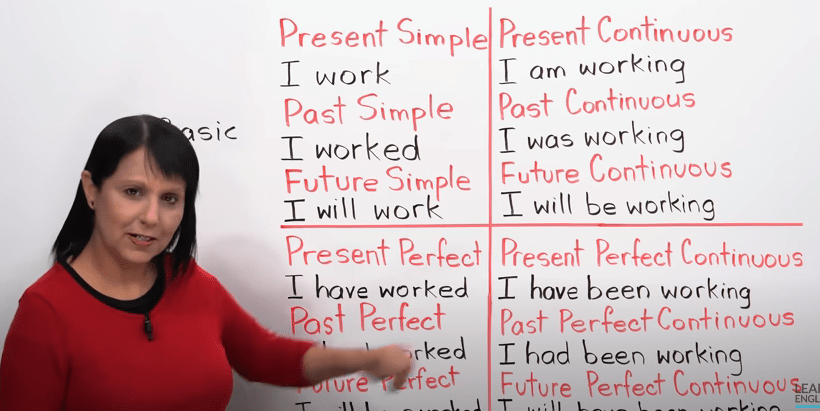
English Verb Tenses
The sources primarily focus on English verb tenses, categorizing them as simple or continuous, and present or past.
Simple Tenses:
Present Simple (I do): This tense is used for actions happening repeatedly or in general. [1, 2] For example: “What do you usually do at weekends?” [3] and “It doesn’t rain very much in summer.” [3]
Past Simple (I did): This tense describes actions completed in the past. [4] For instance: “Tom lost his key yesterday.” [5] and “When did your friends arrive?” [5]
Continuous Tenses:
Present Continuous (I am doing): This tense is for actions happening at or around the time of speaking. The action is not complete. [2] Examples: “The water is boiling. Can you turn it off?” [3] and “What are you doing?” [3]
Past Continuous (I was doing): This tense describes actions that were in progress at a particular time in the past. [6] For example: “Katherine was waiting for me when I arrived.” [7]
Perfect Tenses:
The sources also discuss perfect tenses, which are formed using “have” and the past participle of the verb:
Present Perfect Simple (I have done): This tense is used for actions or states that started in the past and continue up to the present. [8] It is also used for actions that happened at an unspecified time in the past. [8, 9] Examples include: “Jane has been to China twice.” [9] and “My hands are very dirty. I**’ve been repairing** my bike.” [10]
Present Perfect Continuous (I have been doing): This tense emphasizes the duration of an action that started in the past and continues up to the present. [11] For example: “It has been raining for two hours.” [12] and “Joe has been eating too much recently.” [10]
Past Perfect Simple (I had done): This tense is used for actions that were completed before another action or time in the past. [13] For instance: “They were still working. They hadn’t finished.” [14]
Past Perfect Continuous (I had been doing): Similar to the past perfect simple, this tense is used for actions that were in progress before another past action or time. [15]
Future Tenses:
English uses various structures to express future time, including:
Present Continuous (I am doing) with a future meaning: Used for pre-arranged plans in the future. [10, 16] For example: “Are you going to watch anything on TV this evening?” [17] and “He is playing tennis on Monday afternoon.” [16]
(Be) going to (do): Expresses intentions or predictions based on present evidence. [18] For example: “The boat is going to sink.” [19] and “It’s getting a bit dark, isn’t it? It’s difficult to read. Yes. I’ll turn on the light.” [20]
Will (‘ll): Used for predictions, spontaneous decisions, and promises. [17, 21-23] Examples: “Do you think Kate will pass the exam?” [17] and “Don’t worry about the exam. I’m sure you**’ll pass**.” [23]
Future Continuous (will be doing): Describes an action that will be in progress at a specific time in the future. [5] For instance: “Don’t phone between 7 and 8. We**’ll be having** dinner then.” [24]
Future Perfect (will have done): Indicates an action that will be completed before a specific time or another action in the future. [5] For example: “Phone me after 8 o’clock. We**’ll have finished** dinner by then.” [24]
The sources provide detailed explanations and numerous examples of each tense, including common usage patterns and exceptions.
English Grammar Essentials
The sources cover a wide range of English grammar rules, providing explanations and examples for each. Some key areas discussed include:
Verb Tenses
Simple vs. Continuous: Simple tenses (present simple and past simple) are used for actions that happen repeatedly or in general, while continuous tenses (present continuous and past continuous) describe actions that are in progress at a specific time.
Present Perfect: The present perfect tenses (simple and continuous) are used to describe actions or states that started in the past and continue up to the present, or for actions that happened at an unspecified time in the past.
Past Perfect: The past perfect tenses (simple and continuous) are used for actions that were completed before another action or time in the past.
Future Tenses: English expresses future time using various structures, including the present continuous with a future meaning, “going to,” “will,” the future continuous, and the future perfect.
Modal Verbs
Can, Could, (Be) Able to: These verbs express ability, possibility, and permission.
May, Might: These verbs express possibility and permission.
Must, Have to: These verbs express obligation and necessity.
Should, Ought to: These verbs express advice and recommendation.
Would: Used for polite requests, hypothetical situations, and past habits.
Conditional Sentences
If Clauses: The sources explain the different types of conditional sentences and the verb tenses used in each type. They cover “if” clauses with present simple, past simple, and past perfect tenses.
Passive Voice
Forming the Passive: The passive voice is formed using “be” and the past participle of the verb. It is used when the focus is on the action rather than the doer of the action.
Reported Speech
Changes in Tenses: When reporting speech, tenses often shift back in time (e.g., present simple becomes past simple).
Reporting Verbs: Different reporting verbs (e.g., say, tell, ask) are used depending on the type of speech being reported.
-ing and to … (Infinitive)
Verbs Followed by -ing: Some verbs are followed by the -ing form of the verb (e.g., enjoy, avoid, finish).
Verbs Followed by to … : Other verbs are followed by the infinitive form of the verb (e.g., decide, want, hope).
Verbs Followed by -ing or to … : Some verbs can be followed by either the -ing form or the infinitive, with a difference in meaning or usage (e.g., remember, forget, try).
Articles (a/an/the)
Countable and Uncountable Nouns: Articles are used with countable nouns (a/an for singular, the for both singular and plural). Uncountable nouns generally do not use articles.
Specific vs. General: The article “the” is used to refer to specific things, while “a/an” is used for general or non-specific things.
Pronouns and Determiners
Personal Pronouns: (e.g., I, you, he, she, it, we, they)
Determiners: (e.g., this, that, these, those, some, any, no, all, many, much, few, little)
Adjectives and Adverbs
Adjectives: Describe nouns.
Adverbs: Describe verbs, adjectives, or other adverbs.
Comparative and Superlative Forms: Adjectives and adverbs have comparative and superlative forms to express degrees of comparison.
Prepositions
Time: (e.g., at, in, on, for, since, during, until)
Place: (e.g., at, in, on, to, from, under, over)
Other Uses: Prepositions are used in many different contexts to express relationships between words in a sentence.
Phrasal Verbs
Form and Meaning: Phrasal verbs combine a verb with one or more particles (e.g., in, out, on, off, up, down) to create a new meaning.
Types of Phrasal Verbs: The sources categorize phrasal verbs based on their structure and whether they take an object.
The sources provide comprehensive explanations and examples of these grammar rules, along with exercises to practice using them.
Advanced English Grammar Usage Guide
The sources focus heavily on proper English usage, aiming to clarify common areas of confusion for intermediate English learners. Here’s a breakdown of key usage points:
Verb Tense Usage:
Present Simple vs. Present Continuous: The present simple is for repeated or general actions, while the present continuous is for actions happening at or around the time of speaking. For example, “I usually go to work by car” (present simple) versus “I**’m going** to the cinema this evening” (present continuous) [1].
Present Perfect vs. Past Simple: The present perfect connects the past to the present, often for unfinished duration or unspecified time, whereas the past simple is for completed past actions. For instance, “Have you known each other for a long time?” (present perfect) versus “When did they first meet?” (past simple) [2, 3].
Stative Verbs: Certain verbs related to states (like, know, believe) are not typically used in continuous tenses [4, 5]. For example, “Do you believe in God?” (correct) rather than “Are you believing in God?” (incorrect) [5].
Modal Verb Usage:
Can vs. Could: “Can” is for present ability, while “could” is for past ability or more polite requests. For example, “I can hear a strange noise” (present) and “Could you open the door, please?” (polite request) [4, 6].
May vs. Might: Both express possibility, but “might” suggests a slightly lower likelihood. For example, “I may go to Ireland” (perhaps will) and “It might rain later” (perhaps will) [7].
Must vs. Have to: “Must” emphasizes the speaker’s obligation, while “have to” is more about external obligation. For example, “I must go now” (speaker’s urgency) versus “I have to work tomorrow” (external schedule) [8].
Should vs. Ought to: Both give advice, but “ought to” is slightly more formal. For example, “You ought to have come” [9].
Conditional Sentence Usage:
Real vs. Unreal Conditionals: “If I do…” is for real possibilities, while “If I did…” is for hypothetical, unlikely situations. For example, “If it rains, we’ll stay home” (real possibility) versus “If I won the lottery, I’d buy a house” (unlikely) [10, 11].
Other Usage Points:
Countable vs. Uncountable Nouns: Some nouns have different meanings depending on whether they’re countable or uncountable. For instance, “a hair in my soup” (countable, specific) versus “You’ve got very long hair” (uncountable, general) [12].
Articles (a/an/the): “The” is used for specific things, while “a/an” is for general things. The sources provide detailed rules for article usage [13-19].
Word Order: Adverbs like “always,” “never,” and “often” are usually placed before the main verb [20].
Prepositions: The sources emphasize correct preposition use with verbs, adjectives, and nouns, as these can be tricky for learners [21-36].
By focusing on these specific usage patterns, the sources help learners improve their grammatical accuracy and achieve more natural-sounding English.
The Passive Voice: A Comprehensive Guide
The sources explain that the passive voice is used when the focus is on the action itself rather than who or what is performing the action. The passive voice is formed using “be” + past participle. [1-3]
Here’s a breakdown of the passive voice based on the sources:
Active vs. Passive: An active sentence emphasizes the subject performing the action. For example, “My grandfather built this house.” In contrast, a passive sentence puts the focus on what is acted upon: “This house was built by my grandfather.” [2]
Unknown or Unimportant Actor: The passive voice is often used when the actor is unknown or unimportant. For example, “A lot of money was stolen in the robbery.” [2]
Using “By”: If you want to specify the actor in a passive sentence, you can use “by.” For instance, “Two hundred people are employed by the company.” [2]
Tense Forms: The sources provide examples of the passive voice in different tenses:
Present simple: “This room is cleaned every day.” [3]
Past simple: “This room was cleaned yesterday.” [4]
Present perfect: “The room looks nice. It has been cleaned.” [5]
Past perfect: “The room looked nice. It had been cleaned.” [5]
Present continuous: “The room is being cleaned at the moment.” [6]
Past continuous: “The room was being cleaned when I arrived.” [6]
Infinitive: “A mystery is something that can’t be explained.” [7]
Future: “A new supermarket is going to be built next year.” [7]
Two Objects: When a verb has two objects, you can make two different passive sentences. For example, with the verb “give”:
“Somebody gave the police the information.” (active) [8]
“The police were given the information.” (passive) [8]
“The information was given to the police.” (passive) [8]
“Being + Past Participle”: This form is used to describe actions that are happening to someone. For instance, “I don’t like being told what to do.” [9]
“Get” in Passive: In informal spoken English, “get” can sometimes be used instead of “be” in passive sentences. For example, “Nobody got hurt.” [10]
The sources offer a thorough examination of the passive voice, including its formation, usage, and various applications in different tenses.
Affiliate Disclosure: This blog may contain affiliate links, which means I may earn a small commission if you click on the link and make a purchase. This comes at no additional cost to you. I only recommend products or services that I believe will add value to my readers. Your support helps keep this blog running and allows me to continue providing you with quality content. Thank you for your support!
This book serves as a guide for writing effective business English in a global context. It emphasizes clarity, conciseness, and understanding the audience, which often includes non-native English speakers. The author addresses common writing pitfalls, grammar and punctuation, and provides practical tips for various business communications like emails and letters. The text highlights the evolving nature of business English and the importance of adapting style for different cultural expectations. Ultimately, it aims to equip readers with the confidence and skills to write professional and impactful business communications that achieve their objectives.
Business English Writing Skills Review
Study Guide
This study guide is designed to help you review the key concepts presented in the provided excerpts on business English writing. It covers various aspects, including audience awareness, clarity, common errors, formatting, and specific business communication types.
I. Understanding Your Audience:
Defining Readers and Customers: Recognize the interchangeable use of terms like readers, target readership, customers, and audience. Understand that “customer” encompasses both external buyers and internal colleagues, suppliers, and public sector contacts.
Global vs. Specific Audience: Determine whether your writing is intended for a specific group of English users or a worldwide audience. This will influence your word choice and style.
Reader Expectations: Emphasize the importance of understanding and meeting the expectations of your target readership, including their potential familiarity with different English variations.
II. Clarity and Conciseness:
Central Philosophy: Reinforce the core principle of effective business English: creating clear, concise messages and avoiding verbosity. Understand that every word counts.
Avoiding Misunderstandings: Focus on strategies to minimize confusion, including careful word choice, avoiding idioms, clichés, and unnecessary nuances that may be interpreted differently.
Plain Language: Advocate for the use of simple, accessible language over complex or overly formal vocabulary. Understand that intelligent business writing prioritizes understanding.
Checking for Understanding: Implement methods to ensure your words are understood by your readers, including asking for feedback and being open to clarification.
III. Common Writing Challenges:
Native vs. Non-Native English Speakers: Recognize that both groups face unique challenges in business English writing.
Impact of First Language: Be aware of how first language conventions can influence English writing (e.g., gendered nouns, pluralization, reflexive pronouns).
Standard vs. Non-Standard English: Understand the importance of using standard English for global business communication and the potential pitfalls of using localized or informal variations (e.g., Singlish).
Homonyms: Be aware of homonyms and their potential for causing confusion.
Abbreviations and Acronyms: Use them judiciously, always defining them on first use unless they are universally recognized. Be cautious of culturally specific meanings.
Online Dictionaries and Cut-and-Paste: Recognize the potential for errors and inappropriate language when relying solely on online dictionaries and using cut-and-paste without careful context analysis.
Tone and Style: Understand the impact of formal, informal, and neutral tones in business writing and the importance of choosing an appropriate style for the audience and context. Avoid barrier words and curtness.
IV. Grammar and Punctuation:
Importance of Accuracy: Emphasize that correct grammar and punctuation are crucial for clear communication and maintaining professional credibility.
UK vs. US English: Be aware of key spelling and grammar differences between UK and US English and maintain consistency.
Common Errors: Review examples of grammatical mistakes (e.g., verb tense, subject-verb agreement, incorrect word forms) and punctuation errors (e.g., comma usage, apostrophes).
Parts of Speech: Understand the basic functions of nouns, pronouns, adjectives, verbs, adverbs, prepositions, conjunctions, and interjections.
Verb Tenses: Pay particular attention to the appropriate use of present simple and present continuous tenses.
Subject-Verb Agreement (Concord): Ensure that verbs agree in number with their subjects.
Question Tags: Understand their function and how to form them correctly.
Transitional Words and Phrases: Recognize how these words and phrases create fluidity and logical connections in writing.
Punctuation Marks: Understand the correct usage of various punctuation marks, including commas, full stops, quotation marks, apostrophes, hyphens, brackets, colons, and semicolons.
V. Formatting and Structure:
Paragraphing: Understand how paragraphs organize ideas and improve readability.
Headings and Bullet Points: Recognize the value of using headings and bullet points to signpost information and break up text.
Date and Time Formats: Be aware of different international conventions for writing dates and times and the potential for confusion. Recommend using unambiguous formats when necessary (YYYY-MM-DD).
Numbers and Measurements: Understand potential differences in the interpretation of large numbers (billion, trillion) and decimal points. Be aware of metric and imperial measurement systems.
Addresses: Note the difference between UK postcodes and US zip codes.
VI. Specific Business Communication Types:
E-mail:Emphasize the need for careful checking before sending.
Understand the use of CC and BCC and related privacy concerns.
Discourage multi-lingual and overly long, embedded email threads.
Advocate for clear subject lines, concise content, and a clear call to action.
Stress the importance of appropriate tone and avoiding informal language in professional contexts.
Letter Writing:Identify the purpose and desired impact of the letter.
Consider the format, font, and readability.
Use informative subject headings.
Follow appropriate salutations (Dear Sir/Madam, Dear Mr./Ms. [Surname]) and sign-offs (Yours faithfully, Yours sincerely, Best regards) based on whether the recipient’s name is known.
Ensure consistency with open or closed punctuation.
CVs and Covering Letters:Highlight the importance of clear, concise language and avoiding “over-Englishing.”
Use correct terminology (mobile vs. cell).
Focus on key strengths and relevant experience.
VII. Quality Control:
Proofreading: Implement effective proofreading techniques, such as reading aloud or reading backwards, to identify errors.
Spellcheck and Grammar Check: Use these tools but recognize their limitations and the importance of selecting the correct English variety.
Seeking Feedback: Don’t hesitate to ask for help from others when unsure.
Learning from Mistakes: Maintain a list of commonly made errors for quick reference.
Quiz
Answer the following questions in 2-3 sentences each.
Why is it important to consider your audience when writing business English?
What is the central philosophy of effective business English writing, according to the text?
Give an example of how a common idiom could cause confusion in international business communication.
Why might relying solely on an online dictionary be problematic for business writing?
Explain the difference between the UK and US English conventions for writing dates.
What is the potential misunderstanding that can arise from using the phrase “next Tuesday”?
Why should you define abbreviations and acronyms when using them in business writing?
What are some negative consequences of sending business emails too quickly without checking them?
What are the key elements to consider when writing a formal business letter?
Why is it important to avoid “over-Englishing” in business communication, particularly in CVs and covering letters?
Answer Key
Considering your audience is crucial because it helps you tailor your language, tone, and style to ensure your message is understood correctly and achieves its intended purpose. Different audiences may have varying levels of English proficiency, cultural backgrounds, and expectations.
The central philosophy of effective business English writing is to create clear and concise messages while avoiding unnecessary words. The fewer words used, the more important it is to ensure those words are accurate and appropriate for the context.
An example of idiom confusion is the phrase “to pull someone’s leg.” A non-native speaker might literally interpret this as a physical action, rather than understanding its intended meaning of joking or teasing. This can lead to misunderstanding and misinterpretation of the message.
Relying solely on online dictionaries can be problematic because they may offer multiple translations with subtle differences in meaning or suggest overly formal or archaic words that are not commonly used in contemporary business English. Additionally, they may not provide sufficient contextual information for appropriate usage.
The UK English convention for writing dates typically follows the Day/Month/Year (DD/MM/YY) format, while the US English convention uses the Month/Day/Year (MM/DD/YY) format. This difference can lead to significant confusion, especially when only numbers are used (e.g., 01/02/03 could be January 2nd or February 1st).
The phrase “next Tuesday” can be ambiguous because it could refer to the immediate upcoming Tuesday or the Tuesday of the following week. This uncertainty can lead to missed appointments or scheduling errors, especially if the day of the week the message was written is not considered.
You should define abbreviations and acronyms on their first use because not all readers may be familiar with them, especially in a global business context. Providing the full form in brackets ensures clarity and avoids potential misunderstandings, promoting effective communication.
Sending business emails too quickly without checking can result in spelling and grammar mistakes that damage your professional image. It can also lead to an abrupt tone, failure to answer questions properly, or emotional overreactions, all of which can negatively impact the recipient’s perception of you and your company.
Key elements to consider when writing a formal business letter include identifying the letter’s purpose and desired impact, using a standard and readable font, including a clear subject heading, using the correct salutation and sign-off based on whether you know the recipient’s name, and ensuring your key messages are presented clearly and concisely.
Avoiding “over-Englishing” is important because using exaggerated or overly complex language that deviates from natural English can sound unnatural, confusing, and even meaningless to native English speakers. In the context of job applications, it can undermine the candidate’s credibility and obscure their actual qualifications.
Essay Format Questions
Discuss the challenges faced by both native and non-native English speakers when writing for a global business audience. What strategies can be implemented to mitigate these challenges within a company?
Analyze the impact of tone and style in business email communication. How can writers ensure they adopt an appropriate and effective tone for different recipients and situations?
Evaluate the importance of grammatical accuracy and correct punctuation in business writing. How can errors in these areas affect a company’s professional image and its communication effectiveness?
Explore the differences in date, time, and numerical conventions across different English-speaking regions and internationally. What best practices should businesses adopt to avoid misunderstandings related to these conventions in their global communications?
Discuss the evolution of business letter writing in the digital age. While some traditional conventions remain, what are the key adaptations and considerations for writing effective business letters today?
Glossary of Key Terms
Business English: The variety of English used in professional and commercial contexts, focusing on clear, concise, and effective communication for business purposes.
Target Audience/Readership: The specific group of people for whom a piece of writing is intended. Understanding their background, knowledge, and expectations is crucial for effective communication.
Verbosity: The use of more words than necessary; wordiness. Effective business writing aims to minimize verbosity.
Idiom: An expression whose meaning cannot be understood from the literal meanings of the individual words (e.g., “to kick the bucket”).
Cliché: An overused phrase or expression that has lost its original impact and can make writing seem tired and unoriginal (e.g., “in this day and age”).
Nuance: A subtle difference in or shade of meaning, expression, or sound. While part of language, relying heavily on nuances can lead to misunderstandings in cross-cultural communication.
Homonym: A word that is spelled and pronounced the same as another word but has a different meaning (e.g., “principal” and “principle”).
Acronym: An abbreviation formed from the initial letters of other words and pronounced as a word (e.g., “NATO”).
Abbreviation: A shortened form of a word or phrase (e.g., “Ltd.” for Limited).
UK English: The variety of the English language commonly used in the United Kingdom.
US English: The variety of the English language commonly used in the United States.
Spellcheck: A computer program or feature that checks the spelling of words in a text.
Grammar Check: A computer program or feature that checks the grammatical correctness of sentences in a text.
Tone: The attitude or feeling conveyed in a piece of writing (e.g., formal, informal, courteous, direct).
Salutation: The greeting at the beginning of a letter or email (e.g., “Dear Mr. Smith”).
Sign-off: The closing of a letter or email before the sender’s name (e.g., “Yours sincerely”).
Proofreading: The process of carefully reading and correcting a written text before it is published or sent.
Concord (Subject-Verb Agreement): The grammatical rule that a verb must agree in number and person with its subject.
Transitional Words/Phrases: Words or phrases that connect ideas and sentences, creating a smooth flow in writing (e.g., “however,” “furthermore,” “as a result”).
Postcode (UK): A group of letters and numbers that identifies a specific area for postal purposes in the UK.
Zip Code (US): A numerical code that identifies a specific geographic area for postal purposes in the US.
“Over-Englishing”: The act of non-native English speakers using exaggerated or overly complex English that sounds unnatural and can obscure meaning.
Briefing Document: Effective Business English Writing
This briefing document summarizes the main themes and important ideas from the provided excerpts of a book focused on improving confidence and competence in writing English for global business. The central philosophy emphasizes creating clear, concise messages and avoiding verbosity, highlighting that precision becomes crucial when using fewer words.
Main Themes:
Importance of Clarity and Conciseness: The overarching theme is the need for business English to be easily understood by a global audience. The author repeatedly stresses the importance of clear and concise communication to avoid misunderstandings and achieve business objectives.
“My central philosophy is this: writing business English effectively for international trade is about creating clear, concise messages and avoiding verbosity. But the fewer words you write, the more important it is that you get them right.” (Preface)
“Throughout this series you will see that writing business English is about reducing verbosity, avoiding misunderstand-ings and crafting clear, concise messages. But the fewer words you write, the more important it is that you get them right.” (Chapter 3)
Understanding Your Audience: A key element of effective business writing is knowing who you are communicating with, including their potential level of English proficiency, cultural background, and expectations.
“Throughout this book I use the terms readers, target reader-ship, customers and audience interchangeably. I use ‘cust-omer’ both in its most common usage as a person who buys goods or services from a business, and in the broadest sense of signifying a person that you deal with in the course of your daily work.” (Chapter 1)
“The advice I constantly give is: reflect the expectations of your target readership. One size will not fit all.” (Chapter 3)
“Naturally, it is essential to be reader-driven when you write.” (Chapter 3)
Navigating Differences in English Usage: The document highlights the variations between UK and US English (spelling, grammar, vocabulary) and the challenges posed by anglicized words and expressions used in different parts of the world. Consistency in chosen English variety within a company is emphasized.
“unless I indicate otherwise, the spelling and grammar used in the series are the UK English variety requested by my publishers, to follow their house style.” (Chapter 1)
“Terms that are understood in Western Europe may not have the same currency in Asian markets and so on. Just because English-sounding words and expressions have crept into your company usage, this does not mean they are internationally recognized.” (Chapter 1)
Examples of confusing anglicized terms are given: “‘a parking’ (UK English: a car park; US English: a parking lot) or ‘presentation charts’ used predominantly in Germany (UK English and US English: presentation slides) or ‘handy’ in continental Europe (UK English: mobile phone; US English: cellphone) or ‘beamer’ in France and elsewhere (UK English: projector).” (Chapter 1)
Avoiding Common Pitfalls: The excerpts detail numerous common errors and confusions, including the misuse of idioms, clichés, nuances, online dictionaries (leading to overly complex or inappropriate vocabulary), homonyms, incorrect grammar, punctuation, and tone.
Examples of idioms and the caution advised: “‘to be the bee’s knees’ means to be really good, to be excellent. ‘Over the moon’ means delighted. ‘To get the drift’ of something means to get the general meaning. ‘To pull the wool over someone’s eyes’ means to deceive them or obscure something from them.” (Chapter 3)
“Non-NE writers can wrongly feel they must choose the most complicated ‘intelligent-sounding’ choice – which is often the longest – when they come face to face with a bewildering selection of words to choose from. So out goes ‘outcome’, that almost everyone will understand, and in comes ‘consecution’.” (Chapter 3)
Example of homonym confusion: “We can provide the services you outline in principal but we request a supplementation. … The correct word would be ‘principle’.” (Chapter 4)
The dangers of terse or overly formal/informal tone in emails are highlighted. “‘Done.’ … is so often seen as discourteous. Just by adding three words and changing the reply to ‘I have done that’ can improve readers’ perception.” (Chapter 4)
Importance of Proofreading and Seeking Feedback: The need to thoroughly check written communication for errors in spelling, grammar, and meaning before sending is strongly emphasized. Seeking help when unsure is also encouraged.
“One thing is sure: nobody ran a spellcheck or grammar check.” (Chapter 4, discussing a poorly written company entry)
“Always check your writing before you issue it. If you are not sure, ask for help from someone who will know.” (Chapter 5)
Adapting to Modern Business Communication: The evolving nature of business English, influenced by the rise of email and a trend towards informality (while maintaining professionalism), is discussed.
“This is largely because e-mail is today’s predominant business writing and globally people write for it in a style that is halfway between conversation and formal writing. What’s more, it is having a noticeable effect on the way people write other documentation.” (Chapter 3)
Specific Writing Conventions: The document provides detailed guidance on various aspects of written communication, including:
Dates: Highlighting the differences between UK (DD/MM/YY) and US (MM/DD/YY) formats and recommending the YYYY-MM-DD format for clarity when there is doubt. Confusion around terms like “next Tuesday,” “in a couple of weeks,” and “fortnight” is also addressed.
Time: Emphasizing the need for clear time notation to avoid missed appointments and deadlines.
Numbers and Measurements: Pointing out the different interpretations of “billion” and “trillion” across countries and explaining the use of commas and decimal points in English. The differences between metric and imperial systems are also noted.
Addresses: Mentioning the UK use of “postcodes” versus the US “zip codes.”
Common Confusions: Providing explanations and correct usage for frequently mixed-up words like “programme/program,” “receive/recieve,” “stationary/stationery,” “licence/license,” “remember/remind,” “there/their,” “where/were/we’re,” “may/can,” “should/must/have to,” and “borrow/lend.”
Abbreviations and Acronyms: Advising to write them in full at the first mention, unless they are universally recognized. The importance of understanding “incoterms” in international trade is highlighted.
Email: Offering advice on avoiding sending too quickly, using the draft folder, being mindful of the “cc” field, managing multi-lingual threads, embedding responses cautiously, structuring emails clearly, and maintaining appropriate tone.
Letter Writing: Discussing the purpose and impact of letters, formatting considerations (font, subject heading), and providing examples of salutations and sign-offs for different situations. Guidance on addressing individuals with correct titles is also included.
CVs and Covering Letters: Providing a template for a UK English CV and cautioning against “over-Englishing” in describing suitability for a role.
Punctuation and Grammar: Offering a refresher on basic punctuation marks, nouns and gender in English, parts of speech, comma usage, apostrophes, plural formation, articles, paragraphs, verbs and tenses (with specific attention to the present continuous tense), subject-verb agreement, question tags, comparison of adverbs, and transitional words and phrases.
Most Important Ideas and Facts:
Global Readership: Business English writing should primarily aim for clarity and understanding across diverse international audiences.
UK vs. US English Awareness: Be conscious of the differences between these major varieties of English and maintain consistency within your communication.
Avoid Jargon and Colloquialisms: Use plain language and avoid idioms, clichés, and overly nuanced expressions that may not translate well or be universally understood.
Context Matters: Tailor your language and style to your specific audience and the purpose of your communication.
Professionalism: Errors in English, including tone and formality, can negatively impact your and your company’s credibility.
Structure for Clarity: Organize your writing logically with clear paragraphs and headings to aid comprehension.
Actionable Steps: Clearly state the purpose of your communication and any required actions, including who, what, and when.
Leverage Checklists: Utilize the provided checklists for action at the end of each chapter to improve your writing practices.
Continuous Learning: Recognize that business English is constantly evolving and commit to ongoing improvement.
This briefing document provides a foundational understanding of the key principles and practical advice presented in the source material for writing effective business English in a global context. By focusing on clarity, audience awareness, and attention to detail, individuals and organizations can enhance their communication and achieve their business objectives more effectively.
Effective Business English Writing: A Concise Guide
FAQ on Effective Business English Writing
1. Why is clear and concise writing so important in global business English?
In international trade, effective business English is paramount for creating clear, concise messages and avoiding misunderstandings. Since fewer words are often used, it’s crucial that each word is precise and correctly conveys the intended meaning to a diverse global audience. Ambiguity or the use of jargon and culturally specific expressions can lead to confusion, wasted time, and potentially damaged business relationships. Ensuring clarity and conciseness helps to streamline communication, improve efficiency, and project a professional and quality-conscious corporate image.
2. Who should you consider your “customers” or target readers to be in business writing?
The term “customer” in the context of business English writing should be interpreted broadly. It includes not only external individuals or entities that buy goods or services but also internal colleagues, suppliers, and those in the public sector with whom you interact in your daily work. Therefore, when writing, you should consider the perspective and potential understanding of anyone who might read your message, regardless of their direct purchasing role.
3. What are some key challenges posed by the variations within the English language (e.g., UK vs. US English)?
One significant challenge is the existence of different correct spellings (e.g., “recognize” vs. “recognise”), grammatical nuances, and vocabulary (e.g., “car park” vs. “parking lot,” “mobile phone” vs. “cellphone”) between different varieties of English, primarily UK and US English. Companies need to make active decisions about which variant to use for consistency and to avoid undermining their corporate image. Furthermore, anglicized words used in specific regions or within companies may not be universally understood, leading to confusion for a global audience.
4. How should businesses approach the use of idioms, clichés, and nuances in their written communications?
Idioms, clichés, and nuances should be approached with caution in business writing, especially for a global audience. Idioms, being language-specific expressions, can be misinterpreted by non-native speakers. Clichés are overused expressions that can make writing seem tired and ineffective. Nuances, subtle differences in meaning between words, can also lead to misunderstandings as interpretations can vary between native speakers and across cultures. It is generally advisable to avoid them in favor of clearer, more direct language to minimize the risk of confusion.
5. What are some pitfalls to be aware of when using online dictionaries and the “cut and paste” function for business writing?
While online dictionaries can be helpful, they may suggest overly complicated or contextually inappropriate words (e.g., “consecution” for “outcome”). Non-native writers might mistakenly choose these “intelligent-sounding” but less common words, hindering understanding. Similarly, using “cut and paste” without careful consideration of context can lead to grammatically incorrect or nonsensical writing, as phrases may not fit the new context. It’s crucial to prioritize clarity and common usage over overly complex vocabulary or blindly copied text.
6. How has the style of business English evolved, particularly with the rise of email?
Business English today often seems more informal than in the past, influenced significantly by the prevalence of email communication. The style of email tends to fall somewhere between conversation and formal writing. This informality is also affecting other forms of business documentation, leading to a more accessible and straightforward style that focuses on expressing facts simply. While this shift promotes reader engagement, it’s still essential to be mindful of audience expectations and maintain professionalism where appropriate.
7. What are some common grammatical and punctuation areas where both native and non-native English writers can struggle in business writing?
Both native and non-native English writers can encounter difficulties with various aspects of grammar and punctuation. Some common issues include the correct use of commas, apostrophes (especially the difference between possessive “its” and contraction “it’s”), subject-verb agreement (concord), and question tags. Additionally, understanding and correctly applying the different verb tenses, particularly the present continuous versus the present tense, can be challenging. Even seemingly simple aspects like writing dates and times can lead to confusion due to differing international conventions.
8. What are some key considerations for writing effective business emails for a global audience?
When writing business emails for a global audience, it’s crucial to be clear, concise, and culturally sensitive. Avoid overly informal salutations unless you are certain it is appropriate for your recipient. Summarize the main points of message threads to ensure clarity and avoid multi-lingual threads. Be cautious when using the “cc” field due to privacy concerns. Design your emails with readability in mind, using clear fonts, good layout, and sufficient white space. Most importantly, clearly state the purpose of your email, any required actions, and relevant timeframes to ensure a response. Always proofread for spelling and grammar errors using the appropriate variety of English.
Effective Business English: Principles and Practices
Business English is the variety of English used for dealing with business communication. It is a major language of commercial communication, the internet, and global access to knowledge. However, it’s important to note that there are many variants of Business English, and this can present challenges if communication is not designed thoughtfully for the target audience.
Why is Effective Business English Writing Important?
Effective Business English writing is crucial because it can win business, lose business, and communicate the framework for achieving results. Readers judge writing for what it is, and poor writing can lead to confusion, misunderstanding, customer complaints, and even customers walking away. Clear and concise messages are essential. Writing is a fundamental skill for individuals and businesses, and developing it throughout one’s career is important. English business writing, in its various forms, is a common route to the market.
Challenges in Business English Writing:
Differences between ‘standard’ and ‘variant’ English: UK English is not the same as other variations like US, Australian, or Singapore English. Consistency in the chosen variant within a company is vital for a strong corporate image.
Native vs. Non-Native English Speakers: While there are more non-native speakers of English than native speakers, both groups face common problems in business writing. Non-native speakers may struggle with translating from their native language and choosing the right English words. This can lead to over-complicated or incorrect messages. Native speakers can be complacent and assume their writing is clear.
Global Business Context: Business English is often directed at a non-native English audience. Mixing English with native language patterns can create sub-varieties that are unintelligible to foreign readers. Anglicized words used in specific regions may not be understood globally.
Evolving Nature of English: Business writing and the English language are constantly changing, leading to increasing diversity in style. There’s a move towards more ‘people’ words and informality.
Common Confusions: Both native and non-native writers can be confused by idioms, clichés, nuances, homonyms, abbreviations, acronyms, and the active vs. passive voice. Relying solely on online dictionaries and cut-and-paste can also lead to errors.
Key Principles of Good Business English Writing:
Clarity and Conciseness: Aim for clear, concise messages, avoiding verbosity.
Understanding the Audience: Consider how readers see themselves and how they might perceive the writer’s message. Adapt writing style to different cultures.
Accuracy: Ensure writing is free of mistakes in spelling, punctuation, and grammar. Mistakes can negatively impact a company’s credibility.
Appropriate Tone and Style: Choose a style that is appropriate for the audience and the purpose of the communication, often finding a middle ground between overly formal and informal. Avoid jargon where possible.
Reader-Focus: Write from the reader’s perspective, empathize with them, and use positive, proactive language. Consider their feedback on writing.
Purposeful Writing: Every piece of business writing should have a clear purpose and desired outcome.
Quality Matters: Getting writing right the first time is essential. Checking and double-checking work is a worthwhile investment of time.
Specific Areas in Business English Writing:
E-mail: This is the predominant form of business writing. Structure e-mails clearly, use readable fonts, and be mindful of tone and appropriateness. Avoid multi-lingual threads and over-conciseness.
Letter Writing: While less frequent than emails, letters still require adherence to certain conventions regarding format, salutations, and closings. Personalizing letters can be beneficial for relationship building.
Punctuation and Grammar: These are aids to understanding and clear communication. A good command of these increases confidence.
Everyday Business Writing: Pay attention to differing conventions for writing dates, times, and numbers in a global context to avoid misunderstandings.
The Word Power Skills System:
The source introduces a four-step system for premier business writing: be correct, be clear, make the right impact, and focus on readers as customers. This system emphasizes the importance of accuracy, clarity, impact, and customer-centricity in business communication.
In conclusion, effective Business English writing is a vital skill for success in today’s globalized world. It requires attention to detail, an understanding of the audience and cultural context, and a commitment to clarity and accuracy. By focusing on these aspects, individuals and companies can enhance their communication and achieve their business objectives.
Business English: Native and Non-Native Writers
The sources discuss native English (NE) and non-native English (non-NE) speakers and writers in the context of business English, highlighting their definitions, common challenges, and potential strengths.
For ease of reference, the source defines a native English (NE) speaker or writer as a person whose first language is English, and native English (NE) writing as their writing. Conversely, a non-native English (non-NE) speaker or writer is defined as someone whose first language is not English, and non-native English (non-NE) writing refers to their writing. It’s noted that there are more non-native speakers of English than native English speakers. In fact, over 1 billion people speak English, and this number is projected to increase significantly. This underscores that English is no longer exclusive to native English-speaking nations but acts as a bridge across borders and cultures.
Both native and non-native speakers share common problems when writing English for business. However, non-native English writers face unique challenges:
They have an extra step in the writing process: translating their thoughts from their native language into English before writing them down.
Simply translating can lead to over-complicated or incorrect messages, a focus on specific words rather than overall meaning, and losing sight of the business need for a call to action.
Non-native writers may unintentionally create sub-varieties of English by mixing English with the language patterns of their native country, such as Chinglish, Manglish, and Singlish, which can be unintelligible to foreign readers.
They might struggle with anglicized words used in specific regions that are not universally understood.
There’s a tendency for some non-native English writers to feel a compelling need to choose the most complicated vocabulary, which the source terms “over-Englishing the English“, based on a mistaken belief that complex words sound more intelligent. However, in business, readers prefer simplicity and clarity.
Non-native English writing can also pose problems for native English speakers:
Native speakers may not fully understand the non-NE writer’s meaning or may understand only some aspects.
They might almost understand but fail to ask clarifying questions.
Over time, repeated exposure to a non-NE writer’s approximation of an English word can lead native speakers to almost accept it as correct, even if it’s not in a dictionary, though its meaning might not be entirely clear (e.g., ‘automisation’).
Native speakers can be unsure whether they should correct non-NE writers’ mistakes.
They can be irritated by overly concise or overly complicated non-NE writing.
Interestingly, the source points out that non-native English writers can have an advantage. Forward-thinking companies often actively encourage and train their non-NE employees to perfect their business English writing skills, emphasizing the customer’s perception of quality and professionalism. This can ironically lead to non-NE staff making more effort than native speakers to avoid confusion and misunderstandings.
Conversely, native speakers can be complacent, assuming their English proficiency is a given and that everyone understands them. This complacency can lead to mistakes and a loss of competitive edge. The source provides examples of native English writers making errors that had negative consequences.
Ultimately, the source emphasizes that the goal is not necessarily to achieve the proficiency of a native English speaker but to reach the level of competence needed to succeed in all business writing. Both native and non-native speakers need to focus on clarity, conciseness, accuracy, and understanding their audience to write effectively in business English.
Effective Business Email Communication Strategies
The sources highlight that e-mail is by far the predominant form of business writing today, with inestimable billions sent worldwide each day. Conservative estimates suggest that upwards of 75 percent of our business writing is e-mails. Despite this overwhelming prevalence, very few companies offer training or specific advice on how to write effective business e-mails.
The source poses crucial questions about our approach to business e-mails:
How many do you write in a week at work?
Do you treat them all as professional, corporate communication?
Do you always check if e-mail is the right medium for the message, or would a phone call or face-to-face conversation be more effective?
The overuse of e-mail can lead to inefficiency in the workplace and a loss of traditional problem-solving skills. When writing e-mails for global business, non-native English writers may write over-concisely to avoid mistakes, which can result in a lack of clarity. Furthermore, formatted messages can become indecipherable on handheld devices if features like font, colours, and bullet points are lost. As e-mails are rapidly replacing letters, it is essential to maintain standards in them, recognizing that they are equally important as other forms of corporate communication.
Several e-mail scenarios to watch out for are discussed:
Sending too quickly without checking for spelling, grammar mistakes, abrupt tone, or unanswered questions can negatively impact how readers judge your e-mails.
Using the draft folder can be helpful if you are pressured and cannot complete an e-mail immediately, allowing time for review or assistance.
The use of CC (carbon copy) is for copying others on an email. While generally fine internally, including external recipients in the CC field can raise privacy and data protection concerns.
BCC (blind carbon copy) sends a copy without revealing the recipient’s address to others, useful for confidentiality.
Multi-lingual e-mail threads can be frustrating and confusing if recipients cannot understand the language used. It is recommended to summarize main points in English, avoid multi-lingual threads, and start each message afresh to ensure clarity for all recipients.
Embedding responses within an e-mail thread can become confusing, especially with multiple contributors and variant English. It’s advisable to start a new e-mail rather than letting embedded messages become hidden. Using different colours for embedded comments can also lead to misinterpretations, as colours (like red) can have negative connotations in some cultures. Using all capitals can be perceived as shouting according to e-mail etiquette.
The structure of e-mails is crucial for readability. Readers generally dislike solid blocks of text. Using an easy-to-read font, good layout, and white space through paragraphs can greatly improve comprehension, especially for those less proficient in English. Every e-mail should have a clear purpose, time frame, and call to action to ensure a response. If an e-mail has no purpose, it should not be written.
Designing how you write e-mails involves considering:
Corporate communication guidelines: Are there specific styles or fonts to use? Is the font readable (e.g., Arial, Tahoma, Verdana) and of an appropriate size (12 point or above)? Is standard English being used? Are spellcheck and grammar check used with the correct English variety?
Tone and appropriateness: Introduce the right tone for your audience. Consider the opening salutation (e.g., ‘Hi’, ‘Hello’, ‘Dear’ with first name, title and surname, or just first name) and use mirroring techniques in cross-cultural situations. Always refrain from writing anything you wouldn’t say face-to-face or want others to see.
Subject heading: Use a meaningful subject heading and refresh it regularly to reflect the current content of the e-mail thread.
Regularly refresh e-mails: Consider stopping e-mail threads after a few messages and starting a new one with a recap of key points.
Before sending an e-mail, it’s important to:
Reread and check for correctness at every level.
Ensure it doesn’t include inappropriate previous threads.
Check if attachments are included and are in English if necessary.
Explain why someone has been copied in.
Ensure the subject heading is good and the e-mail is easy to read (font, size, etc.).
After sending, check if you have achieved the desired outcome and if your English has been effective.
Finally, before pressing send, ask yourself:
Is e-mail the right communication medium? Is your English professional and fit for purpose?
Would you be comfortable saying this face to face or having it seen by others?
Would it be a problem if the e-mail were forwarded without your knowledge?
Did you systematically address all points in the e-mail you are replying to?
Have you run a spellcheck and grammar check in the correct English variety?
Have you developed the right rapport with your readers and met their business and cultural expectations?
Have you checked your meanings?
In essence, the source emphasizes that while e-mail is a powerful and pervasive tool, it requires careful consideration of clarity, tone, audience, and purpose to be effective in a business context.
Effective Business Letter Writing in English
The sources emphasize that while business English letter writing has evolved, certain conventions should still be followed to achieve your objectives. It’s crucial to identify the purpose of your letter (to inform, instigate action, etc.) and consider its potential impact and the desired feeling in the reader.
Regarding format, the source provides an outline for setting out a business letter in English:
Your company name and contact details
Addressee’s name and job title
Addressee’s company or organization name
Number or name of building
Name of street or road
Post town
Postcode (UK addresses)
County, district, or state
Area code or zip code (US addresses)
Country
Date
Reference number
Opening salutation (with or without a comma, depending on house style)
Heading
Main body of text
Closing salutation (with or without a comma, depending on house style)
Name of writer
Position in organization
Enc. (refers to enclosures, if there are any)
The source notes that even within the UK, there are differing conventions for placing the date and address, as well as for salutations and endings. Other countries will also have their own conventions. Therefore, one size does not fit all, and you need to adapt based on your chosen house style.
For the opening salutation, if you do not know the name of the person you are writing to, the UK English convention is “Dear Sir or Madam”. In this case, the letter should end with “Yours faithfully”. However, if you know the person’s name, you should use it in the salutation (e.g., “Dear Mr Smith”, or informally “Dear Yusuf”) and end the letter with “Yours sincerely”. It is advisable to try to ascertain the name of the person you are writing to, as personalizing your letter writing can be crucial for business success. In US English, a letter ending with “Dear Sir or Madam” could conclude with “Sincerely”, “Best regards”, or “Yours truly”.
The source also discusses open punctuation in business letters, where you can choose to either include or omit a comma after the opening and closing salutations. However, consistency in your choice is important.
When addressing letters, always check the spelling of the recipient’s name and their correct job title, as readers are justifiably offended by incorrect personal details. If you are unsure of a foreign or unfamiliar name’s gender, you could try to make enquiries or use the person’s full name (e.g., “Dear Chris Palmer”) to avoid embarrassment. Standard titles used in English include Mr, Master, Mrs, Ms, and Miss, with common practice today being to write “Mr” and “Mrs” without a full stop. “Dr” is used for both male and female medical doctors and PhD holders.
For addressing envelopes, maintain a professional approach, as this is often the first point of contact. Incorrect details can lead to the mail being returned unopened.
The source briefly mentions CVs and covering letters, noting that a good, customized covering letter sent with your CV can improve your chances of getting an interview. Avoid using standard letters and make sure to send them to the correct person with accurate details. “To whom it may concern” is used when the recipient’s name is unknown, such as in open references.
Overall, while standard formats exist, the source emphasizes the need to adapt your style to the circumstances and your readers. You can be innovative and move away from overly formal language. It’s important to build in rapport and politeness in your letters. Finally, always use spellcheck and grammar check (in the correct variety of English) before sending your letter, and avoid embellishing or over-complicating your writing. Regularly ask yourself if you achieved the desired result from your letter and if the English you used was effective.
Business Writing: Punctuation and Grammar Essentials
The sources emphasize that punctuation and grammar are crucial aids for clear communication in business writing. They help readers understand messages and allow writers to feel more confident and in control of their English writing. A good command of these can lead to improved confidence for the writer and satisfaction for the readers because sentences are designed to work effectively.
Why Punctuation and Grammar Matter:
Unpunctuated writing can be difficult to decipher, hindering the understanding of the intended meaning. Unlike poetry, business writing should aim for clarity, and punctuation serves as an aid in achieving this.
Punctuation helps readers understand messages and highlights where emphasis needs to go.
Grammar helps structure business writing into manageable sections, aiding readers in understanding the meaning.
Poor punctuation and grammar can create a negative impression of the writer and their company.
Mistakes in grammar can make a writer sound unhelpful and can misdirect the benefit of communication away from the customer.
Punctuation Marks and Their Usage:
The source provides a list of common English punctuation terms and symbols:
Capital letters (upper case) and lower case.
Comma (,): Signifies a brief pause and is used to link lists of items, groups of words, adjectives, actions, and adverbs. It should not be used in place of a full stop to separate complete statements; a conjunction is often better for fluidity.
Full stop (UK English) or period (UK and US English) or dot (.): Used to separate complete statements.
Speech or double quotation marks or inverted commas (“ ”) and speech or single quotation marks or inverted commas (‘ ’).
Question mark (?).
Exclamation mark (!).
Apostrophe (’): Shows where one or more letters have been left out of a word (contraction, e.g., I’m, it’s, you’ll). It also shows possession or ownership (e.g., student’s rights, students’ rights, men’s, children’s), with specific rules for singular and plural possession, and irregular forms like “its” which is possessive but takes no apostrophe. Be careful not to use an apostrophe followed by ‘s’ to signify a plural meaning (e.g., tomatoes, companies, not tomato’s, company’s).
Hyphen or dash (–): Can be used to break up text and make longer sentences more manageable, similar to commas, and can act as a point of emphasis.
Slash or stroke (/).
Brackets ( ( ) ) and square brackets ( [ ] ): Used to break up text, especially lengthy passages, to avoid overwhelming the reader. Asides can be placed within commas or brackets.
Ampersand (&).
‘At’ sign (@).
Colon (:).
Semicolon (;).
Asterisk (*).
Grammar Elements:
Nouns and Gender: English nouns and pronouns have four genders: masculine, feminine, common, or neuter. Unlike many other languages, the definite article (‘the’) and indefinite articles (‘a’, ‘an’) do not change according to gender. Non-native English writers should be mindful of not applying their native language’s gender conventions to English words, such as referring to neuter words as “he” or “she”. Note that there are exceptions where inanimate objects like ships and sometimes cars are referred to as “she”.
Parts of Speech: English words are categorized into nouns, pronouns, adjectives, verbs, adverbs, prepositions, conjunctions, and interjections. Understanding these categories is essential for constructing grammatically correct sentences.
Verbs and Tenses: Verbs express an action or state of being and have different tenses (present, past, future, and continuous forms). The simple tenses (present, future, past) are the starting point for global business writing. Subject-verb agreement (concord) is important to ensure the verb form matches the subject. Non-native English writers sometimes forget to check this.
Comparison of Adjectives and Adverbs: Adjectives and adverbs have positive, comparative, and superlative degrees to show comparison. Short words typically add “-er” for comparative and “-est” for superlative, while longer words use “more” and “most”. There are also irregular forms (e.g., good, better, best; bad, worse, worst).
Transitional Words and Phrases: These words and phrases (e.g., and, but, however, for example, therefore) improve the fluidity of writing by creating links between ideas and paragraphs, making it easier for the reader to follow the writer’s train of thought.
Active and Passive Voice: Most companies prefer the active voice in business writing, where the subject performs the action. The passive voice, where the subject is acted upon, is generally less direct.
Nominalization: This involves using nouns in place of verbs, which can sometimes make writing sound pompous and obscure the message in business contexts. Using the verb form often provides more energy and clarity.
Question Tags: Used in conversation and increasingly in emails to encourage a response and check agreement or understanding (e.g., It’s a good outcome, isn’t it?). Non-native speakers can find them tricky to master, requiring a balance of the same verb on both sides and a negative in the questioning part.
The source advises to identify areas of punctuation and grammar to improve and to use spellcheck and grammar check (set to the correct English variety) as tools, but to be aware that they are not fail-safe, especially with homophones. Ultimately, the goal is to write clearly and correctly so that readers understand the message without extra effort.
Affiliate Disclosure: This blog may contain affiliate links, which means I may earn a small commission if you click on the link and make a purchase. This comes at no additional cost to you. I only recommend products or services that I believe will add value to my readers. Your support helps keep this blog running and allows me to continue providing you with quality content. Thank you for your support!
Have you ever caught yourself constantly agreeing, apologizing, or downplaying your own needs just to keep the peace? People-pleasing is often mistaken for kindness, but in reality, it can be a self-destructive habit that erodes confidence and personal boundaries. The words we choose to express ourselves have power—they shape our relationships, influence how others perceive us, and, most importantly, define how we value ourselves. Unfortunately, many common phrases reinforce the idea that our own needs and desires come second to those of others.
The problem with people-pleasing language is that it subtly conditions us to prioritize external validation over our own well-being. It teaches us to minimize our feelings, tolerate discomfort, and take on responsibilities that aren’t ours to bear. This linguistic pattern, often ingrained from childhood, can lead to burnout, resentment, and even an identity crisis. As author and researcher Brené Brown states, “Daring to set boundaries is about having the courage to love ourselves, even when we risk disappointing others.” The first step toward breaking free from people-pleasing tendencies is recognizing the phrases that keep us trapped in this cycle.
In this article, we’ll examine 17 common people-pleasing phrases that you should remove from your vocabulary. By eliminating these expressions, you can start asserting yourself with confidence, setting healthier boundaries, and fostering relationships built on mutual respect rather than self-sacrifice. Words matter—it’s time to choose ones that empower rather than diminish you.
1- “I’m fine.”
How many times have you said, “I’m fine,” when you were anything but? This phrase is often a defense mechanism used to avoid confrontation, suppress emotions, or appear low-maintenance. The problem is that constantly downplaying your feelings can lead to emotional suppression, which, according to psychologist Dr. Guy Winch, can have long-term mental health consequences, including anxiety and depression. By refusing to acknowledge and express your true emotions, you deny yourself the opportunity for genuine support and connection with others.
A more honest and self-respecting approach is to express how you truly feel—without fearing judgment. Instead of saying, “I’m fine,” try, “I’m feeling overwhelmed, but I appreciate you asking.” This small shift in language invites meaningful conversations and allows those around you to offer real support. As author Susan Cain notes in Quiet: The Power of Introverts in a World That Can’t Stop Talking, authenticity in communication strengthens relationships and fosters deeper connections.
2- “It’s no trouble at all.”
While offering help can be a generous act, dismissing the effort involved can make others take your time and energy for granted. Saying “It’s no trouble at all” minimizes the work you’re putting in, making it easier for people to continue expecting favors without recognizing their impact on you. Over time, this pattern can lead to resentment and burnout, especially if you feel unappreciated or overextended.
Instead of brushing off your effort, acknowledge it. A simple rephrase like, “I’m happy to help, but I do have other commitments as well” sets a boundary while still offering assistance. Dr. Henry Cloud, in his book Boundaries: When to Say Yes, How to Say No to Take Control of Your Life, emphasizes that setting limits doesn’t make you selfish—it makes you responsible for your own well-being.
3- “I don’t mind.”
This phrase, often used to avoid conflict or seem agreeable, can signal to others that your preferences are unimportant. When you say, “I don’t mind,” you unconsciously train people to disregard your input, reinforcing the idea that your needs are secondary. Over time, this can erode self-confidence and make decision-making difficult because you’ve conditioned yourself to defer to others.
Instead, express your real opinion. If you truly have no preference, you can say, “I’m open to either option, but I’d like to hear what you think.” This statement still communicates flexibility without erasing your voice. As communication expert Celeste Headlee suggests in We Need to Talk: How to Have Conversations That Matter, effective dialogue requires both parties to contribute their thoughts, rather than defaulting to passivity.
4- “I’m sorry” (when you’re not)
Apologizing excessively—even when you haven’t done anything wrong—undermines your confidence and reinforces the idea that you’re at fault for things beyond your control. Dr. Harriet Lerner, author of Why Won’t You Apologize?, explains that over-apologizing can signal low self-esteem and make others view you as less authoritative. When you say, “I’m sorry” unnecessarily, you place yourself in a submissive position, diminishing your credibility in both personal and professional settings.
Rather than defaulting to an apology, practice using alternatives like, “Thank you for your patience” instead of “Sorry for the wait.” If an apology is truly warranted, make it meaningful—acknowledge responsibility, express genuine remorse, and move forward with a solution. Shifting from unnecessary apologies to more constructive responses will help you maintain self-respect and command greater respect from others.
5- “Yes” (when you mean no)
Saying “yes” when you really want to say “no” is a classic people-pleasing habit that can lead to exhaustion and resentment. Author and entrepreneur Greg McKeown, in his book Essentialism: The Disciplined Pursuit of Less, emphasizes that every “yes” is a trade-off—agreeing to something you don’t want means sacrificing time and energy for what truly matters. Overcommitting yourself often leads to burnout, leaving you feeling overwhelmed and stretched too thin.
Learning to say “no” doesn’t mean you’re being difficult—it means you value your time and priorities. Instead of a hesitant “yes,” try responding with, “I appreciate the offer, but I can’t commit to that right now.” This approach is firm yet polite, making it clear that your boundaries matter. Remember, saying “no” to something unimportant means saying “yes” to yourself.
6- “I’ll just do it myself.”
Taking responsibility is admirable, but constantly shouldering tasks to avoid burdening others can lead to frustration and burnout. The belief that “it’s easier if I just do it myself” often stems from perfectionism or a fear of disappointing others. However, as leadership expert Simon Sinek notes, “Delegation isn’t about losing control; it’s about empowering others.” If you always take on everything yourself, you not only exhaust yourself but also deny others the opportunity to learn and contribute.
Instead of doing everything alone, practice asking for help. Say, “I’d love your input on this,” or “Could you take care of this part?” Allowing others to share the workload fosters collaboration and prevents you from becoming overwhelmed. Recognizing that you don’t have to do it all is a crucial step toward balance and well-being.
7- “It’s not a big deal.”
Downplaying your own concerns, achievements, or struggles can lead others to do the same. When you say, “It’s not a big deal,” you minimize your worth and discourage people from recognizing your contributions. This habit can stem from discomfort with praise or a fear of appearing self-important, but it ultimately weakens your confidence and impact.
Instead, own your experiences. If someone compliments you, resist the urge to brush it off. Instead of “It’s nothing,” try, “Thank you, I worked hard on it.” This subtle shift allows you to accept recognition gracefully while reinforcing your value. As Amy Cuddy discusses in Presence: Bringing Your Boldest Self to Your Biggest Challenges, embracing your accomplishments strengthens your confidence and helps you show up more authentically in life.
8- “I should…”
The phrase “I should” carries a sense of obligation rather than genuine desire, often making you feel guilty or pressured into doing things you don’t truly want to do. Psychologist Dr. Richard Carlson, in Don’t Sweat the Small Stuff, explains that excessive use of “should” leads to unnecessary stress and dissatisfaction. It implies external expectations rather than personal choice, keeping you trapped in a cycle of obligation.
Instead, replace “I should” with “I want to” or “I choose to.” This shift helps you take ownership of your decisions rather than feeling bound by guilt or duty. For example, instead of saying, “I should exercise more,” say, “I want to make time for my health.” This approach empowers you to act out of intention rather than obligation.
9- “Whatever you want.”
While being easygoing can be a positive trait, constantly deferring decisions to others sends the message that your opinions don’t matter. Saying “Whatever you want” too often can make you seem indifferent or uninvested, weakening your ability to advocate for yourself. Dr. Marsha Linehan, a leading psychologist in emotional regulation, explains that assertive communication is key to building mutual respect in relationships.
Instead of dismissing your own preferences, express your thoughts with confidence. Try saying, “I’d like to hear your thoughts, but I was thinking about…” This keeps the conversation open while ensuring that your voice is heard. Relationships thrive when both parties contribute equally, so practice asserting your needs.
10- “I’ll try.”
Saying “I’ll try” often conveys uncertainty and lack of commitment, making it easy to back out or not follow through. Leadership expert John C. Maxwell emphasizes in The 15 Invaluable Laws of Growth that success requires decisiveness and confidence, not hesitation. When you say, “I’ll try,” you leave room for doubt rather than fully committing to an action.
Replace “I’ll try” with stronger language, such as “I will” or “I’m working on it.” This small change makes a significant difference in how others perceive your reliability and how you approach challenges. Confidence begins with the words you choose, so commit with certainty.
11- “Don’t worry about me.”
This phrase, while seemingly selfless, often prevents people from offering support when you actually need it. By insisting that others shouldn’t worry, you may unintentionally isolate yourself or suppress your emotions. Dr. Brené Brown, in The Gifts of Imperfection, argues that vulnerability and connection go hand in hand—allowing others to care for you fosters stronger relationships.
Instead, acknowledge when you need support. Say, “I appreciate your concern, and I could use some help.” This openness strengthens connections and shows that accepting help is not a weakness but a sign of trust.
12- “I guess…”
Using “I guess” weakens your statements and makes you seem unsure of yourself. This phrase often creeps into speech as a way to avoid sounding too assertive, but it ultimately diminishes your credibility. As negotiation expert Chris Voss states in Never Split the Difference, confident communication is key to influencing others and standing your ground.
Instead, replace “I guess” with clear, direct statements. Instead of “I guess I can do that,” say, “Yes, I can do that” or “No, I can’t commit to that.” Owning your decisions demonstrates confidence and self-respect.
13- “I’m just…”
The word “just” minimizes whatever follows it, making your statements appear weaker. Saying, “I’m just checking in” or “I just wanted to ask” reduces the importance of your message, making it sound apologetic. Communication expert Debra Fine, in The Fine Art of Small Talk, explains that removing unnecessary qualifiers makes your speech more impactful.
Instead, drop the “just” and state your point directly. Say, “I wanted to follow up,” or “I need clarification.” Speaking with clarity and confidence increases your credibility.
14- “I’ll do whatever you think is best.”
While deferring to someone else’s expertise is fine in some situations, constantly saying this phrase makes it seem like you lack your own perspective. It signals a lack of confidence in your own judgment.
Instead, express your thoughts first. Say, “I trust your input, but here’s what I think…” This creates a balanced conversation rather than making you seem passive.
15- “It’s probably my fault.”
Blaming yourself unnecessarily can erode self-esteem. Instead of assuming fault, focus on facts.
Replace it with, “Let’s figure out what happened.” This keeps the discussion objective rather than self-deprecating.
16- “I’ll get to it eventually.”
Procrastination language weakens credibility. Instead, use clear timeframes: “I’ll complete this by…”
17- “I’m flexible.”
Being adaptable is great, but overusing “I’m flexible” can make it seem like you have no boundaries. Instead, say, “Here’s what works best for me.”
Conclusion
Language shapes reality. By eliminating these people-pleasing phrases, you can start asserting yourself, setting boundaries, and communicating with confidence. Choose words that reflect your worth—you deserve to be heard.
Affiliate Disclosure: This blog may contain affiliate links, which means I may earn a small commission if you click on the link and make a purchase. This comes at no additional cost to you. I only recommend products or services that I believe will add value to my readers. Your support helps keep this blog running and allows me to continue providing you with quality content. Thank you for your support!
Nothing is more frustrating than dealing with someone who constantly tries to one-up you in a conversation, making you feel intellectually inferior. Whether it’s a coworker who belittles your ideas, a friend who always has a “better” take, or an online debater who refuses to back down, these encounters can be exhausting. The key to maintaining your composure while shutting down condescending remarks is to use carefully chosen phrases that neutralize their superiority complex without escalating the situation.
When faced with intellectual arrogance, responding with grace, wit, and a hint of strategic deflection can make all the difference. The right words can subtly shift the power dynamic, preventing unnecessary arguments while preserving your dignity. This approach not only protects your confidence but also helps you navigate conversations without getting drawn into an endless battle of egos. As Aristotle wisely said, “It is the mark of an educated mind to be able to entertain a thought without accepting it.”
In this article, we’ll explore powerful phrases that can effectively disarm someone who thinks they’re always the smartest person in the room. These responses will help you assert yourself with professionalism and tact, ensuring you maintain control of the conversation while keeping your self-respect intact. Let’s dive in.
1 – “That’s definitely an interesting perspective.”
This phrase is a subtle yet effective way to acknowledge someone’s opinion without necessarily agreeing with it. It neutralizes their attempt to dominate the conversation by making them feel heard, while also maintaining a neutral stance. When someone asserts their intelligence aggressively, responding with this phrase shifts the focus from a debate to an acknowledgment, allowing you to steer the discussion in a more constructive direction.
Using this phrase can also put the other person in an unexpected position—forcing them to reflect on their argument rather than continuing to push it forward. According to Dale Carnegie in How to Win Friends and Influence People, making people feel valued, even when they are being difficult, can disarm their defensiveness and lead to more productive conversations.
2 – “Could you clarify that for me?”
This phrase serves two purposes: it forces the other person to elaborate on their point, and it subtly tests whether they truly understand what they are talking about. Intellectual arrogance often thrives on vague assertions and sweeping statements. By asking for clarification, you shift the burden of proof onto them, which can expose weak arguments or exaggerations.
Philosopher Socrates famously employed this method, known as the Socratic questioning technique, to dismantle flawed reasoning. As highlighted in The Art of Thinking Clearly by Rolf Dobelli, asking someone to clarify their argument can reveal inconsistencies, often making them realize they might not be as knowledgeable as they assumed.
3 – “I never really considered that angle.”
This phrase gives the illusion of openness while subtly steering the conversation away from confrontation. It acknowledges the other person’s viewpoint without conceding that it is correct. By using this response, you allow yourself time to evaluate their argument without feeling pressured to accept it outright.
It also serves as a confidence-building strategy, demonstrating that you are open to new ideas while maintaining control of the discussion. As John Stuart Mill suggested in On Liberty, engaging with differing perspectives is valuable, but that doesn’t mean you must adopt them. Instead, you can use this phrase to redirect the conversation in a more balanced manner.
4 – “Let’s be objective and look at the facts.”
When someone insists on their intellectual superiority, they often rely on strong opinions rather than hard evidence. This phrase is a powerful way to bring the discussion back to reality, cutting through emotional arguments and subjective claims. By focusing on facts, you remove the element of personal bias, making it more difficult for them to dismiss your response.
In Thinking, Fast and Slow, Daniel Kahneman explains how cognitive biases often cloud judgment, leading people to overestimate their knowledge. By steering the conversation toward objectivity, you encourage critical thinking while subtly challenging their perceived authority. It also puts them in a position where they must substantiate their claims rather than simply asserting them.
5 – “Everyone has their own strengths.”
This phrase is a diplomatic way to level the playing field. Instead of engaging in a direct intellectual battle, it reminds the other person that intelligence is multifaceted and that expertise in one area does not equate to superiority in all fields. This response can subtly deflate an ego without causing outright conflict.
Howard Gardner’s Frames of Mind: The Theory of Multiple Intelligences emphasizes that intelligence is not a single measurable trait but a spectrum of capabilities. Whether someone is well-read, mathematically gifted, or articulate, they do not hold a monopoly on intelligence. By using this phrase, you shift the focus from competition to mutual respect.
6 – “Thanks for sharing your view.”
Sometimes, the best way to shut down an overly confident person is to acknowledge their input without engaging further. This phrase is a polite yet firm way to signal that you have heard them, but you are not necessarily swayed by their argument. It prevents them from feeling ignored while allowing you to exit the conversation gracefully.
Psychologist Robert Cialdini, in Influence: The Psychology of Persuasion, highlights the power of reciprocity—people feel validated when acknowledged. By thanking someone for their perspective, you make them feel heard without giving them the satisfaction of winning the debate. It subtly ends the exchange on your terms.
7 – “Thanks for your insights.”
Similar to the previous phrase, this response is a professional and courteous way to acknowledge someone’s input while maintaining control of the conversation. It prevents further argument by closing the topic without direct confrontation.
In Difficult Conversations by Douglas Stone, the authors emphasize that people seek validation more than agreement. By offering polite acknowledgment, you neutralize condescension while keeping the discussion productive. The key is in your delivery—use a calm, composed tone to reinforce that you are not intimidated or impressed by their intellectual posturing.
8 – “I see what you mean, but have you considered [alternative idea]?”
One of the best ways to challenge someone who assumes intellectual dominance is to introduce an alternative perspective. This phrase acknowledges their argument while simultaneously redirecting the conversation toward another viewpoint. By doing so, you shift the power dynamic, making them defend their stance rather than simply asserting it.
In The Righteous Mind by Jonathan Haidt, the author explains how people tend to engage in confirmation bias—favoring information that supports their existing beliefs. By gently introducing another perspective, you encourage a more nuanced discussion rather than a one-sided lecture.
9 – “That’s certainly one way of looking at it.”
This phrase subtly challenges a know-it-all by implying that their viewpoint is not the only valid one. It plants the idea that other perspectives exist without directly arguing against them. This can make an overconfident person reconsider their position without feeling outright dismissed.
As philosopher Karl Popper emphasized in The Open Society and Its Enemies, true intellectual growth comes from considering multiple viewpoints. By using this phrase, you maintain a composed and open-minded stance while subtly undermining their self-perceived intellectual monopoly.
When faced with someone who asserts their knowledge as absolute truth, this phrase introduces doubt without outright contradiction. It signals that credible sources may offer alternative viewpoints, encouraging a broader discussion rather than blind acceptance of their claims.
As highlighted in The Death of Expertise by Tom Nichols, people often overestimate their knowledge based on limited exposure to a subject. By referencing other readings or studies, you introduce a level of intellectual humility that can be hard for them to dismiss without further discussion.
11 – “Let’s just agree to disagree.”
There are times when the best way to handle an argumentative person is to disengage entirely. This phrase is a direct yet diplomatic way to end a conversation that is going nowhere. It acknowledges the disagreement without allowing it to escalate into unnecessary conflict.
In The 48 Laws of Power, Robert Greene warns against unnecessary intellectual battles, as they often drain energy without yielding productive results. Knowing when to step back is a sign of wisdom, and this phrase allows you to do so while maintaining your composure.
12 – “That’s a different take.”
This response is a neutral yet effective way to acknowledge an opinion without committing to agreement. It subtly suggests that the person’s perspective is not the only valid one, encouraging them to reconsider their stance.
Philosopher Michel de Montaigne famously said, “The greatest thing in the world is to know how to belong to oneself.” By refusing to be drawn into someone else’s intellectual ego trip, you maintain control over the conversation and your own sense of self-assurance.
13 – “Your perspective is definitely unique.”
This phrase can be a subtle way to imply that their argument is unconventional or even questionable without outright stating it. It validates their input while also signaling that their perspective may not be widely accepted.
As Nassim Nicholas Taleb explains in The Black Swan, many people are unaware of their own cognitive biases. By framing their argument as “unique,” you encourage them to examine whether their views are based on solid reasoning or personal assumptions.
14 – “Can you give me some more details on that?”
This phrase challenges someone to substantiate their claims, which can be particularly effective if they are bluffing or relying on vague generalizations. Many people who assert their intelligence aggressively do so without having a deep understanding of the subject they are discussing.
In Superforecasting: The Art and Science of Prediction, Philip Tetlock emphasizes that true expertise comes from precision and the ability to explain concepts clearly. If someone struggles to provide details, it can expose their overconfidence and weaken their intellectual authority.
15 – “That’s a good point, but…”
Acknowledging part of an argument before introducing a counterpoint is a classic debate strategy. This phrase allows you to challenge someone without making them feel completely dismissed. It keeps the conversation balanced while still asserting your own perspective.
As psychologist Adam Grant explains in Think Again, people are more receptive to new ideas when they feel their existing beliefs have been validated first. By starting with agreement before introducing a contrasting viewpoint, you increase the likelihood of a productive discussion.
16 – “I have to respectfully disagree.”
Sometimes, the best response is direct honesty. This phrase asserts your disagreement without hostility, making it clear that you are standing your ground. It prevents someone from bulldozing over your viewpoint while keeping the conversation civil.
As John Locke argued in An Essay Concerning Human Understanding, true intellectual progress comes from questioning and challenging ideas rather than blindly accepting them. This phrase allows you to assert yourself with confidence while upholding a respectful discourse.
Conclusion
Intellectual arrogance can be frustrating to deal with, but the right responses can help you navigate these conversations with confidence and grace. By using strategic phrases, you can subtly disarm those who assume they are the smartest person in the room while maintaining control over the discussion.
As demonstrated by scholars and thought leaders throughout history, intelligence is not about proving oneself superior but about fostering meaningful dialogue. The key is to remain composed, professional, and strategic in your responses. The next time you encounter someone who tries to outsmart you, remember that the real power lies in how you choose to engage—or disengage—with them.
Affiliate Disclosure: This blog may contain affiliate links, which means I may earn a small commission if you click on the link and make a purchase. This comes at no additional cost to you. I only recommend products or services that I believe will add value to my readers. Your support helps keep this blog running and allows me to continue providing you with quality content. Thank you for your support!
This book, “How to Write Better Essays,” by Bryan Greetham, guides university students through the essay-writing process. It emphasizes a multi-stage approach encompassing interpretation of the essay question, thorough research using effective note-taking strategies, and careful planning to structure arguments. The text then addresses the writing process itself, promoting clarity and conciseness in style and the use of evidence to support claims. Finally, it details the revision process, advocating for separating the creative writing phase from the editing phase to produce a polished and impactful essay. The book includes numerous practical exercises and examples to illustrate the concepts.
Essay Writing Study Guide
Quiz
According to the text, why is it important to identify the “instructional verbs” in an essay question?
Explain the three-step technique described in the text for analyzing concepts.
What is the danger of relying too heavily on “authorities,” and how can this be avoided?
Describe how “linear notes” can be useful in the planning stage of writing an essay?
What is the purpose of using “logical indicators” in sentences and paragraphs?
The text discusses using short sentences. What effect can they have on the reader?
In the context of the text, explain what it means to “write in talk in print.”
According to the six-point code, when is it necessary to cite a source?
What is the function of a topic sentence in a paragraph?
What are the key elements of “active learning” described in the text?
Quiz Answer Key
Identifying instructional verbs is crucial because they indicate the specific range of abilities the examiner wants to assess in the essay, guiding you on what type of answer is expected (e.g., analyze, discuss, define).
The three-step technique involves first, identifying the different ways you use a concept, then, refining the concept by comparing examples and non-examples, and finally, testing the refined concept by considering borderline cases and contrasting it against other cases.
Relying too heavily on authorities can lead to passive acceptance of ideas without critical analysis, hindering the development of your own thoughts, and examiners can mark you down for uncritical acceptance. To avoid this, the text advocates engaging with sources through questioning, evaluation, and forming your own interpretations.
Linear notes can help in the planning process by providing a clear structure for your ideas, helping you organize them in a logical sequence, and ensuring that your essay remains focused and coherent.
Logical indicators are words or phrases used to indicate the relationship between ideas in a sentence or paragraph, helping guide the reader through your argument and making the connections and transitions clear, such as by using words like, “therefore, ‘however’ or ‘moreover”.
Short sentences can make the reader carefully consider your point, particularly when used after a series of longer sentences, which tend to feel more comforting and are best suited for analysis and elaboration.
Writing in talk in print means striving to achieve a style that mirrors spoken language, with natural rhythms and phrasing that is easy to understand and follow, and avoiding overly complex or stilted language.
According to the six-point code, it’s necessary to cite a source whenever the ideas or opinions are distinctive to a particular source, when the structure of organization is distinctive, and when the author provides distinctive phrases, passages, or even a single word used in their work.
A topic sentence introduces the main idea of a paragraph, establishes its relevance to the essay, indicates the direction of your argument and acts as a transition to the new idea by connecting it with what came before.
Key elements of active learning involve consciously and actively processing information, engaging critically with sources, and forming your own ideas, rather than simply passively absorbing and reproducing what you read.
Essay Questions
Discuss the claim that the ability to effectively interpret and analyze a question is the most important skill for successful essay writing.
Analyze the role of note-taking in the development of critical thinking and independent thought, as suggested in the provided text.
Evaluate the importance of revision and editing in the essay-writing process, considering the various stages and techniques described in the text.
Critically assess the relationship between an effective style of writing and the clarity and persuasiveness of an argument.
To what extent does understanding the difference between passive and active learning styles influence an individual’s ability to succeed in higher education?
Glossary of Key Terms
Active Learning: A mode of learning where the student engages with the material, questions assumptions, and constructs their own understanding rather than passively absorbing information.
Analysis: The process of breaking down a complex topic or idea into its component parts in order to understand it more deeply.
Authorities: Individuals or sources that are often cited as reliable or experts in a particular field, but that should not be accepted uncritically.
Brainstorming: A technique for generating a large number of ideas on a particular topic in a short period of time, often used as a starting point for planning.
Concepts: Abstract ideas or mental representations of things or categories of things.
Criticism and Evaluation: The process of assessing the strengths and weaknesses of an idea or argument, and forming an informed judgment about its validity or usefulness.
Economy: A writing style where only the words necessary to convey the idea clearly are included, with nothing superfluous included.
Fluency: The ability to write in a smooth, clear, and easily understandable manner without pauses or interruptions.
Instructional Verbs: Words used in essay questions that indicate the type of thinking or approach that is required in the answer (e.g., analyze, compare, discuss).
Linear Notes: A method of taking notes in a sequential list of lines, often using an outline structure, that help organize and present information.
Logical Indicators: Words and phrases used to signal the connections and relationships between ideas, such as “therefore,” “however,” or “in addition”.
Mnemonics: Techniques or devices used to aid memory, often involving creating acronyms or rhymes to remember key points.
Pattern Notes: A visual method of note-taking that uses a central idea and branches out to associated ideas, commonly known as mind maps.
Plagiarism: Presenting someone else’s work or ideas as your own, without proper acknowledgment.
Readability: The quality of writing that makes it easy to read and understand, often achieved through clear, concise language and appropriate structure.
Retrieval System: The methods and strategies used to recall and access information, including mental processes and external systems.
Revising: The process of reviewing and refining your writing to improve its clarity, coherence, and overall quality.
Style: The manner in which an author writes, including word choice, sentence structure, and overall tone.
Topic Sentence: A sentence that states the main point or idea of a paragraph, usually placed at the beginning.
Transitions: Words or phrases that provide a link between ideas or paragraphs to create a smooth flow of thought in writing.
Talk in Print: A writing style that mimics natural spoken language, aiming for clarity and ease of understanding.
How to Write Better Essays: A Comprehensive Guide
Okay, here’s a detailed briefing document based on the provided excerpts from “How to Write Better Essays”:
Briefing Document: “How to Write Better Essays”
Introduction
This document provides a comprehensive overview of the key themes and concepts presented in the provided excerpts from Bryan Greetham’s “How to Write Better Essays.” The focus is on understanding the stages of essay writing, from interpreting the question to effective revision, and emphasizes the importance of analytical skills and original thought. The document highlights techniques for improving writing style, research, and time management to enhance essay quality and academic performance.
Key Themes and Concepts:
The Stages of Essay Writing:
Interpretation of the Question: This crucial first step involves a deep analysis of the question’s core concepts and structure. It requires identifying key words and understanding their multiple potential meanings.
Analysis of Concepts: This stage focuses on breaking down concepts into their component parts, revealing their various uses and implications. The text provides a practical example involving ‘power’ and ‘authority’ where each concept can be broken down into multiple applications. For example: “From these examples you might conclude that the most obvious way in which we use the word ‘power’ is to describe somebody as having force, the capacity to compel us to do something against our wishes… But we also use it in the phrase ‘the power of persuasion’.”
Testing Concepts: This involves refining the initial understanding of the concepts by considering borderline cases and contrasting examples, allowing for a more nuanced and precise definition. “Then, test it. Think up a borderline case, one that doesn’t easily fit. This will lead you to refine your original concept.”
Planning: The process of organizing research and ideas into a coherent and logical structure before writing. Planning is presented as an essential activity for crafting cohesive arguments and saving time during the writing process.
Writing: This involves using appropriate language, clear sentence structures, and logical indicators to effectively communicate ideas. Style should be “talk in print.” “Aim to create writing that is talk in print.”
Revision: A multi-stage process to check for structure, clarity, style, and accuracy. It includes proofreading and reading out loud.
Analytical Skills & Critical Thinking:
Importance of Analysis: The text stresses the need to move beyond mere description to critically examine and deconstruct arguments and concepts. “Analyse: Separate an argument, a theory, or a claim into its elements or component parts; to trace the causes of a particular event; to reveal the general principles underlying phenomena.”
Revealing Structure: Learning to see the underlying structure of questions and arguments, such as the implied relationship between concepts or assumptions in the question being asked. For example, highlighting the importance of understanding the word ‘only’ in the essay prompt: “‘Advertisers seek only to ensure consumers make informed choices.’ Discuss… Yet it not only alerts the reader to the suspicion that this may be a question largely about concepts, it also reveals the structure of the question.”
The Three-Step Technique: The book introduces a three-step method to help students discover the multiple aspects of a concept. This involves: 1. Identifying how a concept is used in more than one way. 2. Exploring the implications of each way a concept is used. 3. Testing the concept through borderline examples and comparing with contrasting cases.
Devil’s Advocate: The author recommends exploring multiple sides of an argument even those one may not agree with: “It means playing devil’s advocate by arguing not just for the side of the argument that you support, but for the side with which you may have little sympathy.”
Challenging Authorities: Encouraging students not to blindly accept authorities but to analyze, evaluate, and criticize them. “There are some students who, realising that they should not be taking authorities on trust, that they should be analysing, criticising and evaluating them, jump from a statement of the problem in the topic sentence to evaluation, without any attempt to analyse and discuss the issues.”
Concept Exploration:
Multiple Meanings: The importance of understanding that concepts can have multiple meanings and implications which need to be revealed before answering the essay question.
Use of Examples: Summoning up examples is key to breaking a concept down into its multiple meanings.
Identifying Core Characteristics: The book provides an example of forming the concept of an ‘Olic’ using a series of figures to show how essential common characteristics can emerge from a set of different items.
Effective Research and Note-Taking:
Active Reading: Reading with a purpose beyond just passive intake of information. “If you’ve left sufficient time between reading the text the first time for comprehension, and then reading it for structure, you’re more likely to have a clear, uncluttered set of notes free from all unnecessary ma-terial.”
Clear Note Structures: Emphasizing the need to take clear, concise notes using techniques such as linear notes or pattern notes (mind maps). “Remember, notes are of little use if they’re not a record of your understanding of the subject.”
Organized Systems: Creating systems for efficient storage and retrieval of information, using tools like notebooks and index cards.
Personal Insights: Using times of solitude to actively process ideas and develop personal insights and arguments. “Such moments of reverie are the time when the mind can process the material it’s taken in during the day, and organise it into structures for us to use if we have the will to access it.”
Writing Style and Communication:
“Talk in Print”: The concept of aiming for a style that is natural, clear, and engaging, mimicking the tone of spoken conversation. “Aim to create writing that is talk in print.”
Simplicity and Economy: Emphasizing the use of short, clear sentences, specific nouns and verbs, and avoiding superfluous language. “In a nutshell: Aim to create writing that is talk in print. Don’t lose the reader in long sentences. Wherever possible use short sentences with clear structures.”
Logical Indicators: The importance of using transition words and phrases to indicate the direction and logic of an argument. “In effect these work as ‘logical indicators’: they indicate what you will be doing in the paragraph. You might be striking a contrast with what you’ve just done in the previous paragraph (‘In contrast’, ‘However’).”
Avoiding Jargon and Clichés: The text emphasizes the need for precise language and avoidance of tired phrases.
Active Voice: The need to write in the active voice rather than the passive where appropriate.
Planning and Time Management:
Timetabling: Structuring study time into a consistent timetable to maximize efficiency and reduce stress.
Specificity: Creating a specific plan for studying each task rather than vague intentions.
Planning in the Exam: The necessity of planning within the time constraints of the exam to ensure a well-structured response.
Subconscious Processing: Alerting the subconscious mind to gaps in knowledge to be filled in while doing other tasks.
Avoiding Plagiarism
Citing Sources: Providing references for ideas, arguments and distinctive structures.
Common Knowledge: Understanding what does and does not need a citation.
The Six-Point Code: The book recommends following a six-point code to assist students in knowing what needs to be cited:
Distinctive Ideas
Distinctive Structure or organizing strategy
Phrases Used Verbatim
Any single word used distinctively.
Revision
Purposeful Revision: Check the essay for a range of different things in a series of revisions.
Read Aloud: Reading the essay out loud to check for fluency and rhythm.
Check for Specificity: Ensure the essay is as clear and specific as possible.
Multiple Passes: Not to tackle everything in one revision but to look at different aspects at each revision stage.
Illustrative Examples:
The text uses the example of the phrase “PARIS IN THE THE SPRING” to illustrate that people selectively ignore words to see what their mind wants to see.
The example of the ‘Olic’ figures illustrates how to analyze the common characteristics of a concept.
The use of advertising examples, such as emphasizing a car’s acceleration while ignoring its rusting issues, shows how advertisers selectively omit information.
Conclusion:
“How to Write Better Essays” offers a systematic and practical guide to essay writing, emphasizing the importance of analysis, original thought, and clear communication. By mastering the stages of essay writing, improving critical thinking skills, and effectively organizing research and time, students can significantly improve the quality of their academic work. The book provides tools and techniques not only for writing essays but also for becoming more effective and independent learners. This document highlights the core components of the book, which if put into practice by students could radically change their approach to academic study.
Essay Writing and Academic Skills FAQs
Frequently Asked Questions on Essay Writing and Academic Skills
How do I effectively interpret an essay question to ensure I’m addressing the core issues?
The first step is to identify the key concepts in the question by underlining them. Then, examine how you use these concepts in different contexts. Consider whether a concept has multiple meanings or uses. For example, “power” can refer to physical force or the ability to persuade. Breaking down key terms and their relationships (e.g. ‘power’ and ‘authority’) reveals the structure of the question and the necessary arguments. Pay close attention to instructional verbs like “analyse,” “discuss,” or “evaluate,” as these indicate what kind of approach you need to take in your response. Finally, you must consider what are not the main topics of discussion in the prompt.
What is the three-step technique for analyzing concepts, and how can I apply it to essay writing?
The three-step technique is a method for examining concepts in depth and preparing for a thorough essay. The first step is to analyze the concept by exploring its various uses. The second step is to form an initial concept and list essential characteristics. The final step is to test the concept by identifying a borderline case that doesn’t quite fit, then adjusting the concept. For example, in analyzing the concept of ‘advertising,’ you might start with the idea that its only goal is to inform consumers, then consider advertising that does the opposite. This testing and refinement allows for more nuanced and robust arguments in your essay.
How can I effectively use brainstorming to generate ideas for my essays?
Brainstorming is a creative way to generate ideas. Start by identifying the main concept(s) and thinking of any related examples, points, or arguments that come to mind. Don’t censor your initial thoughts, even if they seem irrelevant or absurd. The goal is to get a range of possible arguments and ideas on paper. Then, analyze and organize these ideas to reveal a structure for your essay, filtering the less relevant items and combining related ideas into larger points. You may then organize these points into a linear note format to begin structuring your essay.
What’s the difference between power and authority, and how is that relevant to essay writing?
Power is the capacity to compel someone to do something, often through force or the threat of it. A police officer has the power to arrest you. Authority, in contrast, involves a legitimate right to demand compliance, often because of an institution or a moral understanding. Authority can also come from expertise or experience. A mugger has the power to coerce compliance, but does not possess the authority to do so. Understanding this distinction allows for a more nuanced discussion when dealing with these concepts in essays, helping you formulate original arguments and insights based on your analysis.
What are some effective note-taking strategies that will support my essay writing process?
Effective note-taking should help you organize ideas and arguments. Linear note-taking, although useful for specific subjects, may not be the best for essays. Linear notes should include a structure of main points, sub points and specific examples. Pattern notes allow more flexibility by visually mapping out connections between ideas, allowing you to develop more original ideas, or to evaluate an argument from multiple perspectives. Notes should be brief, using abbreviations, without unnessicary clutter. Further, consider taking “notes on notes,” as this allows you to take advantage of how your mind recalls the information.
How can I make my writing style clearer and more impactful, and avoid losing the reader?
Clarity and impact can be achieved through multiple methods. Use concise language, avoid jargon and clichés, and focus on specific and definite nouns. Avoid using too many adjectives and adverbs. Favor the active voice over the passive voice. Prioritize short, simple sentences that are easy to follow. When using longer sentences, use clear logical indicators (“therefore,” “however,” “similarly”) to guide the reader through your argument. Think of your writing as talk in print, and read your work out loud to evaluate its flow. Also, make use of logical indicators (connectives), which guide readers along the points you are making.
What are the key elements of a well-structured essay, and how do I plan for each element?
A well-structured essay includes an introduction, body paragraphs, and a conclusion. The introduction should interpret the question and indicate your thesis or main argument. Each body paragraph should focus on a single idea related to the main argument. Start each paragraph with a clear topic sentence that connects back to your thesis. Support your claims with examples and evidence. Make sure each paragraph has a clear structure and each part leads naturally to the next. Use transition words and phrases to link ideas smoothly between paragraphs. Your conclusion should provide a summary of your argument and its implications and show your own original analysis of the argument or prompt. Further, in order to maintain the reader’s focus, you must consider not simply the content, but how your essay “sounds,” as your pace and flow can impact the reader’s perception.
How should I revise my essays to improve their quality, and what are the common pitfalls to avoid?
Effective revision is not merely proofreading for errors but should occur over multiple stages and with different goals. A common mistake is to jump immediately into editing. First, reread your work to analyze the flow of your arguments and make sure the structure is clear. Next, revise it to ensure the meaning is clear and the language is concise. Then you will revise for the evidence and the points you are making, making sure each argument is properly supported. Then check for clarity and finally listen for the “sound” of the essay. Avoid the temptation to simply offer your opinion without supporting it with argument and evidence, and do not simply offer a restatement of previous arguments. Also, be wary of plagiarism and avoid using overly complicated sentences.
How to Write Better Essays: A Critical Analysis
Okay, here is the detailed timeline and cast of characters based on the provided text:
Timeline of Main Events & Concepts
2001:
First publication of “How to Write Better Essays” by Bryan Greetham.
General Study Techniques (Throughout the book, no set date)
Emphasis on active learning, not passive.
Use of three-step technique for analysis and defining concepts
Brainstorming and using your own ideas.
Use of pattern notes and linear notes.
Focus on planning and structuring arguments.
Importance of critical evaluation and evidence.
Development of clear, concise writing style.
Organization of study time, creating a schedule and using downtime effectively.
Importance of revisions
Importance of citing sources
Emphasis on preparation for essay exams
Concepts/Arguments Discussed (Throughout the book, no set date)
The nature of rules vs. standards in law (referencing Duncan Kennedy)
Hobbes’s view on covenants extorted by force.
The concept of human equality.
Compatibility of democracy and individual freedom.
The relevance of anomie and subculture to criminality.
Efficient levels of smoking and immunizations.
The nature of freedom (being free from vs. being free to)
The relationship between authority and power.
The influence of preconceptions on perception.
The role of advertising (and whether it serves to ensure consumers make informed choices)
Manipulation techniques in advertising (e.g. selective info, distortions, association, subliminal)
Totalitarian leaders/states. (with reference to Schapiro)
The rise of dictators.
The value of the Rule of Law (referencing A. V. Dicey)
John Stuart Mill’s harm principle.
Legal vs. moral obligations.
Arguments for civil disobedience (using examples from Gandhi, Suffragettes and other relevant figures.)
The concept of “pain” being both necessary and sufficient for the justification of personal interest.
The nature of interest, including “proxy interests” (using examples from Frey and Karen Quinlan).
Arguments against private languages (referencing Wittgenstein)
The role of logical indicators (i.e. transitions) in writing.
Importance of the active voice, and concrete nouns.
Understanding plagiarism.
University/Academic Citations and Concepts (Throughout the book, no set date)
Specific examples of university exam questions used from Cornell, Maryland, York, and Oxford.
Citations for works from London, Harvard, Oxford.
Example reference to the University of Newcastle.
1930s:
Mention of the Moscow joke about paranoia and lack of trust under totalitarian rule.
Cast of Characters
Bryan Greetham: The author of “How to Write Better Essays.” He dedicates the book to Pat, Robert Greetham (his father), and Harry Rowe.
Pat: Mentioned as a crucial figure in the author’s life, “without whom nothing is possible.”
Robert Greetham: The author’s father, cited as one of two great men that inspired the author.
Harry Rowe: Cited as an inspiration to the author.
John Peck and Martin Coyle: Authors of “How to Study Television.”
Keith Selby and Ron Cowdery: Authors of “How to Study Television.”
Duncan Kennedy: A legal scholar whose claim about rules vs. standards and individualism vs. altruism is discussed.
Hobbes: A philosopher whose views on covenants and obligation are examined.
Schapiro: (Assumed to be Leonard Schapiro, based on context) A historian or political scientist, who the author references in relation to the “totalitarian state” concept.
Ernst Röhm: Mentioned as an opponent of Hitler.
Trotsky, Kamenev, Zinoviev & Bukharin: All mentioned as opponents of Stalin.
Wilson: Referenced in the context of the Treaty of Versailles.
A.V. Dicey: A legal scholar whose arguments for the importance of the Rule of Law are mentioned.
John Stuart Mill: A philosopher whose principle about restrictions of freedom is discussed.
Mahatma Gandhi: A key historical figure whose actions in relation to civil disobedience are discussed.
Martin Luther King, Jr: Mentioned as a figure related to acts of civil disobedience in the US.
Frey: A person referenced in a discussion about pain as it relates to personal interests.
Karen Quinlan: A person referenced in the same discussion about pain and personal interests.
A. Huxley: (likely Aldous Huxley) Referenced in the section of the text concerning political and social manipulation, as well as the dangers of propaganda, relating to his book Brave New World Revisited.
Matthew Arnold: Referenced, with a quote from him in a footnote.
G. W. E. Russell: Referenced as the source of the Matthew Arnold Quote.
Ignaz Semmelweis: A person referenced in a discussion about analysis in the scientific method.
Ludwig Wittgenstein: A philosopher whose ideas on private language are discussed.
David Dockrill, Joe Mintoff, John Wright, C.A. Hooker: Academics referenced by way of personal acknowledgement.
This timeline and cast of characters should give a solid overview of the content of the source document.
Mastering Essay Writing: A Structured Approach
The sources provide a comprehensive guide to essay writing, emphasizing a structured approach that incorporates both study and thinking skills [1]. The guide is designed to assist students at various levels, from school to university, by providing a step-by-step process for writing essays [1, 2].
Here are some key aspects of essay writing skills covered in the sources:
Understanding the value of essay writing: Writing essays is a crucial step in the learning process as it helps in organizing thoughts and developing ideas [3]. It also offers opportunities for feedback from tutors, and can be used as revision material [4].
Stages of Essay Writing: The sources outline five distinct stages for writing a good essay [5]:
Interpretation of the question: This involves understanding the meaning and implications of the question to avoid irrelevance [6, 7]. Analyzing the key concepts in the question is also a critical step [8, 9].
Research: This stage involves gathering relevant material and focusing on answering the questions identified in the interpretation stage [10, 11].
Planning: Planning is essential to provide a clear structure to the essay [12-15]. It involves editing and ordering ideas [16-18].
Writing: This stage focuses on getting ideas down freely, while keeping the inner editor at bay to allow for fluency [19, 20].
Revision: This involves reviewing the essay for structure, content, and style [21, 22].
Interpretation of the Question:
It is essential to avoid jumping straight into research, which can result in irrelevant notes [6].
It’s important to understand the range of abilities the examiner wants to see [23].
Careful interpretation helps in revealing the structure that the essay should adopt [7, 24].
Analyzing key concepts is important to ensure the essay qualifies for the highest marks [8].
A three-step technique can be used to analyze concepts, which involves generating examples, analyzing core characteristics, and testing these characteristics [25-28].
Research Skills:
The sources discuss how to process ideas effectively, including reading analytically and critically [29].
Effective note-taking strategies such as pattern notes and linear notes are essential [30, 31].
The ability to criticize and evaluate arguments is crucial, and a four-step technique for doing so is provided [32, 33].
Using a card system or project box helps in organizing research material [34, 35].
Planning the Essay:
Planning helps in avoiding losing the reader and in strengthening weaker arguments [13, 15].
Rehearsing arguments in detail before writing is important [36, 37].
Planning includes editing the material to remove irrelevance [17, 38].
Ordering ideas from simple to complex helps in creating a persuasive argument [18].
Planning is also useful for examinations as it helps in structuring ideas for improved memory and recall [39, 40].
Writing the Essay:
The guide emphasizes the importance of writing freely by keeping the inner editor at bay, and of splitting the writing and revision stages [19, 20].
It suggests hanging a question over what is written rather than imposing a narrow thesis statement [41, 42].
Introductions should analyze the implications of the question and outline the structure of the essay [43].
Paragraphs should have clear topic sentences, and each paragraph should be tied to the major issues identified in the introduction [44, 45].
Conclusions should tie back to the introduction to make the essay cohesive [46-48].
Style: The sources focus on simplicity, economy and clarity [49-52].
Writing should be like “talk in print” [50, 51].
Sentences should be clear and concise, and logical indicators should be used to guide the reader [53].
The active voice is preferable to the passive voice [54].
Transitions should be used to create fluency between paragraphs [55].
Evidence should be used to “show rather than tell” [56].
Revision: The sources highlight that revision is essential for improving the quality of the work [21, 22, 57].
A five-stage revision strategy is recommended which focuses on structure, and content [22].
Revisions should focus on identifying areas that require work, checking the essay’s structure, and revising for clarity and style [58, 59].
It involves both the writer’s and the editor’s skills [21].
Importance of Thinking Skills: The guide emphasizes the importance of analytical, critical, and evaluative thinking skills [1, 7, 12, 34, 60-63].
The ability to analyze, criticize, synthesize, and evaluate are important for higher marks [61, 63, 64].
It is important to move beyond just recall and comprehension [61, 65].
The guide also notes that examiners are concerned with how you reach your conclusions, not just the conclusions themselves [66].
By following the advice in the sources, students can develop strong essay writing skills that enable them to produce clear, well-structured, and insightful essays.
Essay Structure: A Comprehensive Guide
The sources emphasize that essay structure is a critical component of effective essay writing, and provide guidance on how to achieve a well-structured essay [1]. Here’s a breakdown of essay structure based on the information in the sources:
Importance of Structure: A clear structure is essential for an essay to achieve high marks [1]. Without it, essays can become irrelevant, confusing, and poorly organized, potentially missing the point [1, 2]. A well-planned structure helps readers follow the arguments and understand the essay’s relevance to the question [3, 4].
Revealing Structure from the Question: The structure of an essay should be derived from a careful interpretation of the essay question itself [5]. Analyzing the key concepts within the question is crucial to revealing the structure the essay should adopt [6-8].
This involves identifying how many parts the question has and the weight each part should be given [7].
The analysis of key concepts influences, if not determines, the structure of the essay [7].
Five Stages of Essay Writing: The sources present five distinct stages for writing a good essay, which inherently contribute to its overall structure [1]:
Interpretation of the Question: This initial stage involves understanding the meaning and implications of the question, as well as the examiner’s expectations. It sets the foundation for the essay’s structure [5, 9].
Research: Research is guided by the interpretation of the question. It provides the material needed to develop the essay’s arguments, and should be focused by the structure developed in the first step [10, 11].
Planning: This stage involves organizing the essay’s content into a logical framework. It is crucial for a coherent and relevant essay [3, 12].
Writing: This is where the plan is executed, with a focus on clear and coherent expression [13, 14].
Revision: The final stage, involving reviewing and refining the essay’s structure [15, 16].
Planning and Structure: Planning plays a vital role in creating a well-structured essay [3, 17]. A plan acts as a “city map” for readers, guiding them through the arguments and ideas [4].
Planning strengthens weaker arguments by providing a logical sequence for the reader to follow [18].
Planning also involves editing and ordering ideas to ensure a clear and logical progression [19, 20].
The planning stage is an opportunity to rehearse arguments, ensuring they are clearly and consistently developed [21].
Introductions, Paragraphs, and Conclusions: The structural framework of an essay is built with introductions, paragraphs, and conclusions [22].
Introductions should interpret the implications of the question and outline a “map” of the essay’s structure, guiding the reader through the arguments [23]. They should also establish the relevance of the topic by identifying the major issues [24].
Paragraphs should have a clear topic sentence, which ties the paragraph to the essay’s main issues. Each paragraph should also develop the idea in the topic sentence, and include relevant evidence to support the arguments [25, 26]. Paragraphs should also be linked by effective transitions [27].
Conclusions should tie back to the introduction, providing a sense of completion and reinforcing the essay’s main arguments [28, 29].
Linear Notes: When taking notes, the sources suggest linear notes as the most appropriate method for extracting the structure of arguments and passages, as it reflects the hierarchy of ideas, with indentations that indicate subsections [30].
Revising for Structure: The revision stage involves checking the essay’s overall structure, including whether the introduction has correctly set out the direction of the essay, the arguments in each paragraph are relevant, and the conclusion provides a sense of closure [31].
Logical Flow: The organization of ideas in an essay should progress logically from simple to complex ideas [32, 33]. This method is both logical and psychologically effective, leaving the reader with the impression that the entire essay was of high quality [32].
Transitions and Topic Sentences: Transitions between paragraphs help maintain a logical flow and guide the reader, while clear topic sentences make each paragraph’s purpose clear [26, 27, 34].
In summary, the sources emphasize that essay structure is not just about organization, but about revealing the underlying logic and argument in a way that is clear and persuasive to the reader [35]. This involves a multi-stage approach from careful interpretation of the question through planning, writing, and revision, with attention to how all parts of an essay contribute to its overall coherence [20, 36].
Effective Essay Planning Strategies
Effective planning is a crucial stage in essay writing, according to the sources, and it significantly impacts the quality and coherence of the final product [1]. Planning is not merely about organizing content; it is a process that involves careful consideration of the essay’s structure, arguments, and evidence [2, 3]. Here’s a breakdown of effective planning strategies based on the sources:
Purposeful Planning: Planning is essential to give your essay a clear structure for the reader to follow [4]. Without a plan, essays often lack logical flow, which makes it difficult for examiners to understand the relevance of the arguments [4, 5]. A well-structured plan strengthens even the weakest points by creating an obvious logical sequence, providing a “safety net” [6].
Rehearsing Arguments: Effective planning involves rehearsing your arguments in as much detail as possible before writing [3, 5]. This allows you to sort out the main ideas and the details needed to explain and support them [7]. By rehearsing arguments, you can make sure all arguments are relevant, clearly stated, and supported with sufficient evidence [2].
Editing Material: Planning requires a ruthless approach to editing, cutting out any material that is irrelevant to the essay question [8-10]. Even if some material is interesting, it should be discarded if it does not directly address the core issues of the essay [9, 10]. This editing process is critical for maintaining a clear and logical structure [9].
Ordering Ideas: Ordering your ideas is another key aspect of planning [8, 11]. The sources suggest moving from simple to complex ideas, and from peripheral issues to central ones [11]. This ensures that the essay builds a coherent and persuasive argument, presenting each idea in its proper context [11].
Planning Methods: The sources suggest two main approaches to planning:
Linear Notes: This method involves rehearsing your arguments in a step-by-step format, converting pattern notes into linear notes before writing [12, 13]. This approach can provide greater control over the structure and progression of your arguments [13].
Pattern Notes: Pattern notes are useful for the initial brainstorming of ideas but can also be used throughout planning [12, 14]. When time is limited, pattern notes can help capture ideas quickly [13]. The most important point is that the planning method should be flexible and appropriate for the task [13, 15, 16].
Planning for Examinations: In exam situations, planning is even more critical due to the time constraints [17, 18]. It is better to spend some time planning the essay than to start writing without a plan [17]. Planning helps in the recall of ideas and arguments, and in structuring the essay to avoid incoherence [19]. It is useful to plan all the questions you have to answer before writing to allow your mind time to work on the details of each answer while you are writing other answers [20, 21].
Benefits of Planning:
Prevents Losing the Reader: A well-defined plan acts as a roadmap for readers, guiding them through your arguments and ideas [5]. It ensures that readers understand the flow of the essay and the relevance of your points [5, 22].
Strengthens Weaker Points: A clear structure provides a context that can strengthen weak arguments [6]. When ideas are clearly presented, even less convincing points can gain clarity from the structure of the essay [6].
Improves Memory: The mind recalls structures and patterns [19, 23]. Planning helps organize ideas, making them easier to remember during both the writing process and the revision stage [19].
Enhances Understanding: Planning is a crucial stage for processing and understanding the subject matter [24]. By rehearsing arguments in detail you can test your understanding of the ideas and arguments [24].
In summary, effective planning is a deliberate process of structuring, organizing, and rehearsing your essay content [12, 13]. It’s an opportunity to make sure all the arguments are relevant, the structure is clear and logical, and sufficient evidence is available [2]. By using effective planning strategies, you can significantly enhance the clarity, coherence, and persuasive power of your essay [5].
Effective Essay Planning Strategies
Effective planning is a crucial stage in essay writing, according to the sources, and it significantly impacts the quality and coherence of the final product [1]. Planning is not merely about organizing content; it is a process that involves careful consideration of the essay’s structure, arguments, and evidence [2, 3]. Here’s a breakdown of effective planning strategies based on the sources:
Purposeful Planning: Planning is essential to give your essay a clear structure for the reader to follow [4]. Without a plan, essays often lack logical flow, which makes it difficult for examiners to understand the relevance of the arguments [4, 5]. A well-structured plan strengthens even the weakest points by creating an obvious logical sequence, providing a “safety net” [6].
Rehearsing Arguments: Effective planning involves rehearsing your arguments in as much detail as possible before writing [3, 5]. This allows you to sort out the main ideas and the details needed to explain and support them [7]. By rehearsing arguments, you can make sure all arguments are relevant, clearly stated, and supported with sufficient evidence [2].
Editing Material: Planning requires a ruthless approach to editing, cutting out any material that is irrelevant to the essay question [8-10]. Even if some material is interesting, it should be discarded if it does not directly address the core issues of the essay [9, 10]. This editing process is critical for maintaining a clear and logical structure [9].
Ordering Ideas: Ordering your ideas is another key aspect of planning [8, 11]. The sources suggest moving from simple to complex ideas, and from peripheral issues to central ones [11]. This ensures that the essay builds a coherent and persuasive argument, presenting each idea in its proper context [11].
Planning Methods: The sources suggest two main approaches to planning:
Linear Notes: This method involves rehearsing your arguments in a step-by-step format, converting pattern notes into linear notes before writing [12, 13]. This approach can provide greater control over the structure and progression of your arguments [13].
Pattern Notes: Pattern notes are useful for the initial brainstorming of ideas but can also be used throughout planning [12, 14]. When time is limited, pattern notes can help capture ideas quickly [13]. The most important point is that the planning method should be flexible and appropriate for the task [13, 15, 16].
Planning for Examinations: In exam situations, planning is even more critical due to the time constraints [17, 18]. It is better to spend some time planning the essay than to start writing without a plan [17]. Planning helps in the recall of ideas and arguments, and in structuring the essay to avoid incoherence [19]. It is useful to plan all the questions you have to answer before writing to allow your mind time to work on the details of each answer while you are writing other answers [20, 21].
Benefits of Planning:
Prevents Losing the Reader: A well-defined plan acts as a roadmap for readers, guiding them through your arguments and ideas [5]. It ensures that readers understand the flow of the essay and the relevance of your points [5, 22].
Strengthens Weaker Points: A clear structure provides a context that can strengthen weak arguments [6]. When ideas are clearly presented, even less convincing points can gain clarity from the structure of the essay [6].
Improves Memory: The mind recalls structures and patterns [19, 23]. Planning helps organize ideas, making them easier to remember during both the writing process and the revision stage [19].
Enhances Understanding: Planning is a crucial stage for processing and understanding the subject matter [24]. By rehearsing arguments in detail you can test your understanding of the ideas and arguments [24].
In summary, effective planning is a deliberate process of structuring, organizing, and rehearsing your essay content [12, 13]. It’s an opportunity to make sure all the arguments are relevant, the structure is clear and logical, and sufficient evidence is available [2]. By using effective planning strategies, you can significantly enhance the clarity, coherence, and persuasive power of your essay [5].
Avoiding Plagiarism: A Guide for Students
The sources provide detailed guidance on understanding and avoiding plagiarism, which is considered a serious form of academic dishonesty [1]. Here’s a comprehensive overview of how to avoid plagiarism, according to the sources:
Understanding Plagiarism: Plagiarism is presenting someone else’s ideas or arguments as your own [2]. It includes using an idea without acknowledgment, copying paragraphs without quotation marks, and quoting without proper citation [2]. Even a single distinctive word can constitute plagiarism if not properly attributed [3, 4]. Essentially, any activity that involves taking credit for someone else’s work is plagiarism [2].
Unintentional Plagiarism: The sources note that many instances of plagiarism are unintentional, often stemming from a lack of awareness or poor organizational skills [5]. Students may blend their own ideas with those from texts, fail to paraphrase adequately, or take rushed notes, resulting in unintentional plagiarism [5].
The Problem with Over-Referencing: The sources argue that the solution to plagiarism can be as harmful as the problem itself [6]. Students may believe that the only way to avoid plagiarism is to give a reference for every idea, which leads to the impression that there is nothing new in education and that their role is just to recycle the opinions of others [6]. This approach can discourage original thinking and may result in an essay that simply repeats what others have said [6].
When to Cite Sources: The Six-Point Code: The sources provide a six-point code to guide decisions about when to cite sources [7]:
Distinctive Ideas: Cite sources whenever ideas or opinions are distinctive to a particular source [7].
Distinctive Structure: Cite sources when the author uses a particular method of approaching a problem or if there is a distinctive intellectual structure to the work, even when the information is put into your own words [7].
Information or Data: Cite the source for facts, statistics, tables, and diagrams [4].
Verbatim Phrases or Passages: Use quotation marks and cite the source for any direct quotes, including distinctive single words [4].
Not Common Knowledge: Cite the source when the information or opinion is not widely known [4].
When in Doubt, Cite It!: It does no harm to cite, as long as you are not citing merely to impress the examiner [8].
Common Knowledge: There is no need to cite common knowledge that is widely known [3]. However, if an author has presented common knowledge in a distinctive way, a citation is appropriate [3].
Strategies to Minimize Plagiarism:
Organization: Proper planning and time management are key to avoiding plagiarism. Starting an essay with enough time allows for careful note-taking and thoughtful processing of ideas [9, 10].
Active Processing: Actively process the information, analyze the structure, and criticize the arguments to integrate the ideas with your own thinking [9]. This reduces the tendency to rely too heavily on the wording and structure of the original sources [9].
Interpretation: A clear understanding of the essay question can reduce the risk of plagiarism [10]. When you interpret the question and brainstorm your own ideas, you are less likely to adopt the ideas of others wholesale [10].
Note-Taking: Clearly mark borrowed ideas in your notes using different colors or distinct methods to differentiate them from your own thoughts [10]. Also, always record the full citation details (author, title, page numbers, and date) at the top of your notes for easy reference [11].
Index Card System: The sources recommend using an index card system as a good way to force yourself to put ideas into your own words [12].
Referencing: The sources say that a good referencing system must be clear, accurate and consistent [13]. It must give credit to the author for the original ideas and must give your readers sufficient detail to locate the reference for themselves [13]. The sources also note that most tutors do not mind what system you use so long as it is clear, accurate and consistent [13].
Acknowledging Uncited Sources: You should also acknowledge the help you have received from friends, colleagues, and tutors [14]. Informal discussions can often lead to insights that are worth acknowledging [14, 15].
In summary, avoiding plagiarism involves a combination of understanding what constitutes plagiarism, using effective strategies to process information, accurately citing sources, and being organized and thorough in research and note-taking. The emphasis is on acknowledging other people’s contributions, while at the same time developing your own ideas [16].
A Five-Stage Essay Revision Strategy
The sources emphasize that revision is a crucial stage in essay writing, not just a final check for errors, but a process that significantly enhances the quality and impact of the essay [1, 2]. Revision should involve a shift of focus from the writer to the editor, and be seen as an opportunity to refine and strengthen your ideas [1, 3]. The sources propose a five-stage revision strategy, separating structural and content-focused revisions [1]. Here’s a detailed look at these revision strategies:
The Importance of Revision:
Enhancing Creativity: Revision allows for more creative writing during the writing stage because you do not have to worry about producing the final, polished version in one attempt [2]. Knowing that you can polish your prose later, allows you to focus on the ideas, connections and comparisons which give your writing impact [2, 4].
Shifting Focus: Revision involves shifting focus from the creative act of converting ideas to language, to a more conscious focus on the way you have used words and structures [3].
Purposeful Revision: The sources advocate revising with a clear purpose, focusing on different aspects of the essay in each revision, rather than attempting to revise everything at once [1, 5]. This makes the process more manageable and effective [5].
The Five-Stage Revision Strategy:
First Revision: Reassurance: This initial revision is about reading through the essay to get a sense of how it sounds. It’s a way of reassuring yourself that the essay reads well and identifying problem areas [6].
Listen for passages where the flow of the text breaks down or sounds awkward, and note them for later review [6, 7].
This revision is not for making changes, but for identifying areas that need further attention [7, 8].
Second Revision: Structure: This revision focuses on the larger structural elements of the essay [9].
Check the introduction to make sure it clearly sets out the map of the essay [9].
Examine the conclusion to ensure it ties back to the introduction and provides a sense of closure [9-11].
Review the logical structure of the essay, ensuring that arguments are presented in a coherent sequence and are relevant to the essay question [9, 12].
Ensure that all the arguments are clearly stated and well developed [12].
Assess if there is sufficient evidence to support your claims and that the evidence is doing real work and is not just padding [12, 13].
Make sure the essay has answered the question set and dealt with all the implications of that question that you identified in the interpretation stage [11, 13].
Third Revision: Content Accuracy: In this revision, the focus is on the accuracy of the content and the mechanics of writing [14, 15].
Check for factual accuracy, ensuring all information is correct [15].
Review the grammar, punctuation, and spelling [15].
Ensure clear distinction between your own ideas and those of others, with proper acknowledgment of sources [15, 16].
Confirm that all sources have been properly referenced and that you have not omitted any text from the bibliography [16].
Fourth Revision: Style: This revision concentrates on the style and readability of the essay [16].
Remove unnecessary words, phrases, and sentences [17].
Cut down long complex sentences into shorter, more manageable ones [17].
Replace obscure words with simpler ones [17].
Use strong nouns and verbs in place of unnecessary modifiers [17].
Use the active voice [17].
Fifth Revision: Readability: The final revision should focus on the overall readability of the essay [18].
Check how well the essay reads, as if you were reading it for the first time, paying close attention to the rhythm and pace of the writing [18].
General Revision Tips:
Cooling Off Period: Allow a cooling off period of at least a day between writing and revising to allow your editorial eye to become engaged [3, 8].
Checklists: Use checklists to ensure that you do not overlook any critical aspects of revision, and that you address your revisions as the examiners would [18, 19].
Read Aloud: Reading your essay aloud or getting someone else to read it can help identify awkward passages, as the ear can often pick up on issues more effectively than the eye [7, 18, 20].
Note Mistakes: Note any recurring issues, like spelling mistakes, poor transitions, or punctuation problems, and consult your notebook regularly to address them in the future [21].
Use Feedback: Organize yourself to respond effectively to feedback provided by tutors and use the feedback to identify areas to improve [21, 22].
In summary, revision is not just about correcting mistakes; it is a vital part of the writing process that helps to refine arguments, improve clarity, and enhance the overall quality of the essay. By using a structured approach, you can make the revision process more manageable and produce a more polished and persuasive piece of work.
Affiliate Disclosure: This blog may contain affiliate links, which means I may earn a small commission if you click on the link and make a purchase. This comes at no additional cost to you. I only recommend products or services that I believe will add value to my readers. Your support helps keep this blog running and allows me to continue providing you with quality content. Thank you for your support!
This document presents a spoken English course, using audio recordings and repetition exercises to teach conversational phrases and vocabulary. The lessons progressively introduce various grammatical structures and tenses, focusing on pronunciation and fluency. The curriculum incorporates thematic units, including greetings, directions, and narratives, to contextualize language learning. Supplementary materials provide vocabulary lists and explanations of grammatical points, aiming to build comprehension and conversational skills. A fable is included to illustrate the importance of consistent practice.
English Language Learning FAQ
Basic Communication
1. How do I greet someone in English?
There are several ways to greet someone in English, depending on the level of formality. Some common greetings include:
Formal:
“Hello”
“Good morning”
“Good afternoon”
“Good evening”
Informal:
“Hi”
“Hey”
2. How do I introduce myself in English?
You can introduce yourself by saying:
“Hello, my name is [your name].”
“Hi, I’m [your name].”
Asking for Information
3. How do I ask for directions in English?
To ask for directions, you can say:
“Excuse me, can you tell me where the [place] is?”
“Can you direct me to the [place], please?”
4. How do I ask for the price of something in English?
You can ask for the price by saying:
“How much does this cost?”
“How much is this?”
“What’s the price of this?”
Grammar and Vocabulary
5. What are irregular verbs, and how do I learn them?
Irregular verbs are verbs that do not follow the standard rules for forming the past tense and past participle. It’s best to learn them by practicing and memorizing them. Some resources provide lists of irregular verbs with their different forms.
6. What are helping verbs, and how do they work?
Helping verbs, also known as auxiliary verbs, are used with main verbs to express different tenses, moods, or voices. They include verbs like “be,” “do,” “have,” “will,” “can,” “could,” “may,” “might,” “must,” “shall,” and “should.”
For example:
“I am going to the store.” (“am” is the helping verb, “going” is the main verb)
“She will be here soon.” (“will” and “be” are helping verbs, “here” is the main verb)
7. How do I use pronouns like “this,” “that,” “these,” and “those”?
This and these are used to refer to things that are nearby.
This is used for singular nouns: “This book is interesting.”
These is used for plural nouns: “These apples are delicious.”
That and those are used to refer to things that are farther away.
That is used for singular nouns: “That building is tall.”
Those is used for plural nouns: “Those cars are expensive.”
8. How do I make my sentences more polite in English?
You can make your sentences more polite by:
Using modal verbs like “could” and “would.” For example, instead of saying “Give me that book,” you could say “Could you please pass me that book?”
Using phrases like “excuse me,” “please,” and “thank you.”
Using indirect language instead of being too direct. For example, instead of saying “I need to leave now,” you could say “Would it be alright if I left now?”
Spoken English Learning Quickly Study Guide
Short-Answer Quiz
Instructions: Answer each question in 2-3 sentences.
What are three ways to greet someone in English?
How do you ask someone if they are a resident of the city you are in?
How do you ask someone the cost of something?
Provide three examples of irregular verbs in the past tense.
Explain the difference between “it is promised” and “he is promising”.
What are two ways to express doubt in English?
How would you ask someone to wait politely?
What is the difference between “this” and “that”?
How do you emphasize the verb “to speak” in the sentence “I speak English”?
Provide three examples of modal verbs and their meanings.
Answer Key
Three ways to greet someone in English are: “Hello, how are you?”, “Hi, how are you?”, and “Hello.”
You can ask someone if they live in the city by saying: “Do you live here?”, “Do you live here in the city?”, or “Are you from this city?”
Two ways to ask the cost of something are: “How much does it cost?” and “How much do I owe you?”
Three examples of irregular verbs in the past tense are: went (go), saw (see), and gave (give).
“It is promised” refers to a promise that has been made, indicating a completed action. “He is promising” describes the act of making a promise, indicating an ongoing action.
Two ways to express doubt in English are: “I doubt it” and “Please don’t doubt”.
You can politely ask someone to wait by saying: “Wait” or “Please wait”.
“This” is used to refer to a singular object that is close by, while “that” refers to a singular object farther away.
To emphasize the verb “to speak” in “I speak English”, you can add the auxiliary verb “do”: “I do speak English”.
Three modal verbs and their meanings are: can (ability), should (recommendation), and will (certainty).
Essay Questions
Discuss the importance of learning irregular verbs in English. How can understanding irregular verbs improve fluency and comprehension?
Explain the concept of verb conjugation in English. Using examples from the source material, illustrate how verbs change form to reflect tense and person.
Analyze the use of modal verbs in spoken English. Choose five modal verbs from the glossary and provide examples of how they are used in different contexts.
Explain the difference between regular and irregular verbs in English. Provide examples of each type of verb and describe their conjugation patterns.
Using examples from the source material, discuss the importance of proper pronunciation in spoken English. How does accurate pronunciation contribute to effective communication?
Glossary of Key Terms
Irregular Verb: A verb that does not follow the standard rules of conjugation in English. Examples include: go/went/gone, see/saw/seen, and give/gave/given.
Verb Conjugation: The process of changing the form of a verb to reflect tense, person, number, and mood.
Tense: Refers to the time frame of an action or state of being (past, present, future).
Modal Verb: A type of auxiliary verb that expresses possibility, obligation, permission, or ability. Examples include: can, could, may, might, must, shall, should, will, and would.
Pronunciation: The way in which a word or language is spoken, including aspects like intonation, stress, and individual sounds.
Auxiliary Verb: A verb that helps the main verb express tense, mood, or voice. Examples include: be, do, have, and modal verbs.
Possessive Pronoun: A pronoun that indicates ownership. Examples include: mine, yours, his, hers, ours, and theirs.
Emphasis: Giving special importance or prominence to something. In spoken English, emphasis can be achieved through changes in volume, intonation, or word choice.
Infinitive: The base form of a verb, typically preceded by “to”. For example, “to go”, “to see”, “to give”.
Gerund: A verb form ending in “-ing” that functions as a noun. For example, “running”, “swimming”, “reading”.
English Language Learning Quickly: Table of Contents
Lesson 1: Basic Greetings and Introductions
Greetings and Farewells: Introduces basic greetings like “hello”, “goodbye”, and responses like “fine, thank you”.
Personal Information: Covers asking and providing basic personal information such as name and city of residence.
Numbers 0-1000: Teaches pronunciation of numbers, from zero to one thousand.
Simple Questions and Requests: Introduces phrases for asking simple questions like location of a store or the cost of an item.
Alphabet and Sentence Repetition: Includes practice for reciting the alphabet and repeating basic sentences.
Lesson 2: Expanding Vocabulary and Verb Conjugation
Common Verbs: Introduces a range of common verbs with example sentences and their various conjugations.
Irregular Verb Conjugations: Focuses on irregular verb conjugations in present, past, and future tenses.
Alphabet and Irregular Verb Review: Includes practice reciting the alphabet and repeating irregular verbs.
Verb Tables: Provides a visual representation of verb conjugations for common irregular verbs like “to be,” “to look,” and “to watch.”
Lesson 3: Questions, Answers, and Verb Practice
Questions and Responses: Introduces question-and-answer scenarios with various phrases and responses.
Yes/No Questions: Focuses on answering questions with a simple “yes” or “no”, including confirmation phrases.
Verb Conjugation and Practice: Offers extensive practice with various verb conjugations, both regular and irregular.
Alphabet and Irregular Verb Review: Provides additional practice reciting the alphabet and repeating irregular verbs.
Verb Tables: Provides visual representations of verb conjugations for verbs like “to be”, “to look”, and “to watch”.
Lesson 4: Negative Sentences and Contractions
Negative Sentences: Introduces negative sentences and their structure, utilizing various verbs.
Contractions: Teaches common contractions used in negative sentences, like “don’t” and “didn’t”.
Lesson 5: Personal Pronouns and Possessives
Personal Pronouns: Reviews and practices personal pronouns like “I”, “you”, “he”, “she”, “it”, “we”, and “they”.
Possessive Pronouns: Introduces possessive pronouns like “mine”, “yours”, “his”, “hers”, “ours”, and “theirs”.
Questions and Answers with Pronouns: Incorporates pronouns into question-and-answer practice, including yes/no questions.
Lesson 6: Tense Practice and Irregular Verbs
Tense Switching: Focuses on switching between past, present, and future tenses using a given sentence structure.
Irregular Verb Practice: Expands on irregular verb conjugations, including “to decide”, “to hold”, “to let”, and “to see”.
Lesson 7: Verb Conjugation and Practice
Verb Conjugation and Practice: Provides further practice with various verbs, both regular and irregular, including negative forms.
Irregular Verbs: Focuses on conjugating and practicing irregular verbs like “to become”, “to get”, “to throw”, and “to bite”.
Lesson 8: Question Formation and Irregular Verbs
Question Formation: Introduces question formation using “why” and responses incorporating past tense verbs.
Irregular Verbs: Continues practice with irregular verbs like “to think”, “to go”, “to run”, and “to drive”.
Lesson 9: Modal Verbs and Irregular Verb Practice
Modal Verbs: Introduces modal verbs like “can”, “could”, “may”, and “must”, focusing on their meaning and usage.
Irregular Verbs: Continues practice with irregular verbs like “to save”, “to question”, “to guard”, and “to grow”.
Lesson 10: Sentence Structure and Common Phrases
Sentence Structure: Explains and provides examples of basic English sentence structure using subject, verb, and object.
Common Phrases: Introduces a variety of common phrases and expressions used in everyday conversation.
Lesson 11: Verb Conjugation and Question Formation
Verb Conjugation and Practice: Offers continued practice with a mix of regular and irregular verbs.
Question Formation: Includes practice forming questions and providing appropriate answers, particularly with negative responses.
Lesson 12: Verb Conjugation and Sentence Completion
Verb Conjugation and Practice: Further expands on conjugating and practicing irregular verbs like “to draw”, “to sleep”, “to have”, and “to drink”.
Sentence Completion: Includes exercises for completing sentences with specific phrases and verb tenses.
Lesson 13: Irregular Verbs and Polite Expressions
Irregular Verb Practice: Focuses on conjugating and practicing irregular verbs like “to steal”, “to stick”, “to swim”, and “to swing”.
Expressing Opinions and Disagreement: Introduces phrases for expressing opinions, disagreement, and polite rebuttals.
Lesson 14: Vocabulary and Irregular Verbs
Vocabulary Building: Presents a comprehensive list of vocabulary words categorized by theme, enhancing word knowledge.
Irregular Verbs: Includes extensive practice with a range of irregular verbs across various tenses.
Lesson 15: Pronoun Usage and Sentence Structure
Pronoun Usage: Provides explanations and examples of how to use pronouns like “this”, “that”, “these”, and “those”.
Emphatic “Do”: Explains the use of “do” for emphasizing a statement in both affirmative and negative sentences.
Sentence Structure: Explains the use of “however” and “even though” to connect contrasting ideas within a sentence.
Polite Expressions: Offers examples of how to rephrase commands or suggestions into more polite forms.
Lesson 16: Irregular Verbs and Sentence Completion
Irregular Verbs: Focuses on conjugating and practicing a diverse set of irregular verbs across different tenses.
Sentence Completion: Offers exercises that require applying specific verb tenses and completing sentences with given phrases.
Expressing Prohibition: Introduces phrases for expressing prohibition using “shouldn’t” and “need to”.
Politeness Strategies: Presents examples of how to make suggestions or commands more polite using modal verbs and softened language.
The provided text does not contain any narratives or events to construct a timeline or a cast of characters. It is an excerpt from a language learning textbook, specifically focusing on English grammar and pronunciation.
The text includes:
Basic greetings and farewells: Hello, goodbye, thank you.
Simple conversational phrases: How are you?, Fine, thank you.
Numbers and the alphabet: Pronunciation and repetition exercises.
Common verbs: Conjugation of regular and irregular verbs in different tenses.
Sentence structures: Examples of simple questions, commands, and statements.
Grammatical concepts: Use of articles, pronouns, and prepositions.
Therefore, it’s impossible to create a timeline or cast of characters from this type of text.
Please provide narrative sources like stories, news articles, historical accounts, etc., to allow for the creation of a timeline and character list.
Briefing Doc: Spoken English Learning Quickly
This briefing document reviews the main themes and key elements of the provided source, “012-spoken-english-learning-quikly.pdf”. This document appears to be a self-study guide for learning basic spoken English.
Main Themes:
Practical Conversation: The source focuses on common phrases and questions used in everyday conversations, including greetings, introductions, asking for directions, expressing gratitude, and basic inquiries about time and cost.
Verb Conjugation: A significant portion is dedicated to learning verb conjugation, covering present, past, and future tenses. Both regular and irregular verbs are addressed.
Pronunciation: The source incorporates phonetic transcriptions and audio cues (references to “.mp3” files) to aid in proper pronunciation of words and sentences.
Grammar Fundamentals: Basic grammar elements like pronouns, possessive pronouns, and the use of “this/that/these/those” are introduced and explained.
Key Elements & Facts:
Basic Greetings & Farewells:“Hello, how are you?” / “Hi, how are you?”
“Fine, thank you.” / “Fine, thanks.”
“Thank you. Goodbye.” / “Goodbye.”
Introducing Yourself:“My name is ___________.”
Asking for Directions:“Can you tell me where the store is?”
“Can you tell me where the bathroom is?”
Essential Questions:“How much does it cost?”
“How much do I owe you?”
“What time is it?”
Verb Examples (Regular & Irregular):To talk: “I talk / He talks / She talked / I will talk”
To promise: “He promised to be good.” / “Please promise.” / “I am promising it.”
To be: “I am / He is / She was / They will be”
Grammar Concepts:Possessive Pronouns: “Whose credit card is this? Do you own it? (Yes, it’s mine.)”
Practicality: The focus on conversational English makes it useful for real-world interactions.
Repetition: The repetitive nature reinforces vocabulary and grammar rules.
Audio Support: The use of audio files enhances pronunciation practice.
Weaknesses:
Limited Scope: The content primarily covers beginner-level English.
Lack of Context: Some phrases and grammar concepts could benefit from more contextual examples.
Quotes:
Emphasis using “Do”: “You don’t speak English, do you? Yes, I do speak English.”
Using “However” for contrast: “I don’t have much money, however, I still need to buy it.”
Saying Things Politely: “You need to leave. Don’t you need to leave?”
Overall, this source offers a practical, albeit basic, introduction to spoken English. The inclusion of audio aids and repetitive exercises is beneficial for reinforcing learning. However, further resources may be needed for more comprehensive language acquisition.
Here is a discussion about English learning based on the provided sources:
The sources are excerpts from “012-spoken-english-laerning-quikly.pdf” which is a student workbook designed to teach spoken English [1].
The workbook is for university students, professionals, and anyone who wants to speak English well [2].
It can be used by both beginner and advanced students, and self-study is also possible [3, 4].
The workbook focuses on teaching spoken English quickly through normal, everyday sentences [5].
It emphasizes speaking aloud, thinking in English, and consistent practice for fluency [6, 7].
The workbook includes lessons on English sentences, pronunciation, exercises, and vocabulary [8-10].
It also covers essential grammar concepts such as verb tenses, sentence structure, and common grammatical errors [11-13].
The sources highlight the importance of practicing with an English teacher for better pronunciation, even if self-studying [4].
It suggests reviewing previous lessons weekly and recording oneself to monitor progress [14].
The workbook encourages learners to supplement their studies by listening to English audio, reading newspapers, and utilizing the lesson texts for further practice [15-18].
It provides advice on how to effectively learn vocabulary from newspapers, including identifying and practicing expressions [17, 19, 20].
It emphasizes the importance of persistence and effort in language learning, comparing it to pushing a heavy car—it requires initial effort but yields progress over time [21, 22].
The workbook includes a comprehensive vocabulary list covering a wide range of topics, and it also provides a table index for easy navigation [23, 24].
The workbook advocates a holistic approach to English learning, combining focused lessons with practical application through listening, reading, and consistent speaking practice. It emphasizes the importance of effort and persistence for achieving fluency.
Insights on Spoken English from “Spoken English Learned Quickly”
The sources, excerpts from the student workbook “Spoken English Learned Quickly,” provide a robust framework for understanding and learning spoken English. The workbook emphasizes several key principles for acquiring fluency:
Focus on Speaking: The most important aspect of learning spoken English is, unsurprisingly, to speak it aloud. The workbook emphasizes that “To learn to speak English correctly, you must speak it aloud,” and to do so loudly and clearly. [1]
Think in English: The workbook stresses the importance of thinking in English for fluency. It cautions against simply reading answers, encouraging learners to make their minds work to formulate responses in English. [1]
Consistent Practice: The workbook encourages practicing for one to two hours daily, five days a week, for optimal results. [2] This consistent practice aims to help learners speak fluently and be easily understood by native speakers.
The Role of Rhythm and Pronunciation: The workbook distinguishes between knowing vocabulary and grammar, and actually speaking fluently with correct rhythm and pronunciation. It recommends continued use of the audio recordings for at least a year after finishing the lessons to master these elements. [3]
Normal, Everyday Sentences: The workbook utilizes normal, everyday sentences for its lessons, making it suitable for both beginners and advanced learners. The idea is that beginners benefit from learning practical phrases, while advanced learners can use the same sentences to refine their pronunciation and fluency. [4]
Importance of an English Teacher: The workbook suggests that while self-study is possible, practicing with an English teacher, even for a short time each week, can significantly improve pronunciation. [5]
Supplementary Learning Activities: Beyond the core lessons, the workbook encourages learners to enhance their spoken English by:
Listening to English audio recordings. [3]
Reading newspapers aloud, focusing on new vocabulary and expressions. [6, 7]
Reading the lesson texts for additional practice. [8]
The workbook offers detailed instructions on how to effectively use newspapers for spoken English practice, including guidance on identifying, understanding, and practicing expressions. It also provides a comprehensive vocabulary list and a table index for easy navigation.
The underlying philosophy of the “Spoken English Learned Quickly” workbook seems to be that by focusing on speaking, thinking in English, and consistently practicing with correct pronunciation and rhythm, learners can achieve fluency in a shorter time compared to traditional methods that emphasize written English and grammar rules.
Effective Language Learning Strategies: Insights from “Spoken English Learned Quickly”
The sources, focusing on spoken English learning, offer valuable insights applicable to broader language acquisition. They highlight several key principles:
Active Participation: Language learning is not a passive process. The sources emphasize speaking aloud, engaging with the language actively rather than simply reading or listening. [1, 2] This active participation forces the learner to think and formulate responses in the target language, accelerating the learning process. [1]
Consistent Effort: Just like pushing a heavy car, language learning requires persistent effort, especially initially. [3] The sources recommend a significant time investment, suggesting one to two hours of practice daily for five days a week. [4] While this might seem demanding, it underscores the importance of consistent effort for success.
Focus on Practical Communication: The sources prioritize spoken language and fluency over written grammar rules. [5] They utilize everyday sentences, equipping learners with practical phrases for daily conversations. [6, 7] This approach prioritizes real-world communication skills over theoretical grammatical knowledge.
Embrace Mistakes: While striving for accuracy, the sources acknowledge that making mistakes is an inevitable part of the learning journey. The emphasis is on practice and repetition, allowing learners to refine their pronunciation and fluency over time. [2, 6]
Utilize Multiple Learning Methods: The sources encourage learners to combine focused lessons with diverse learning methods. They suggest listening to audio recordings, reading newspapers aloud, and engaging with lesson texts for comprehensive language exposure. [5, 8-10]
Vocabulary Acquisition: The sources offer practical advice on learning vocabulary from newspapers. This includes identifying new words, understanding their meanings within context, and practicing their usage in sentences. [10-14]
The Importance of a Teacher: While the sources promote self-study, they recognize the value of a language teacher, particularly for pronunciation refinement. [15] They suggest even a small amount of time with a teacher can significantly benefit the learner.
The “Spoken English Learned Quickly” workbook presents a holistic approach to language learning, advocating active participation, consistent effort, practical communication, embracing mistakes, and utilizing diverse learning methods. While its primary focus is on spoken English, these principles can be applied to learning other languages effectively.
The “Spoken English Learned Quickly” course places a significant emphasis on vocabulary acquisition, integrating vocabulary study into each lesson [1-29]. The course provides vocabulary lists for each lesson and encourages students to engage with vocabulary actively [30, 31].
Key Aspects of Vocabulary in the Course:
Lesson-Specific Vocabulary: Each lesson includes a list of vocabulary words that are relevant to the lesson’s content [2, 8, 9]. These lists provide the words that students will encounter in the lesson’s exercises and texts.
Vocabulary Study: The course instructs students to study the new vocabulary words before starting each lesson [30, 32].
Translation: Students are encouraged to look up the meaning of each new vocabulary word in their own language and write it down. This step helps students to actively engage with the words and comprehend their meanings [30, 32].
Vocabulary Notebook: Students are advised to keep a small notebook to record new vocabulary words and expressions. They are encouraged to review these words frequently throughout the day [30].
Repetition and Review: The course emphasizes the importance of repetition to learn new words. Students are asked to repeat the exercises until they can say them fluently and correctly. Regular review of vocabulary is also emphasized [30, 31].
Active Use: Students are encouraged to use new vocabulary words in sentences and in conversation with other English speakers [33].
Comprehensive Vocabulary: The total vocabulary for the course consists of 1,923 words, with 568 verb entries. Irregular verbs are presented in bold font. [29].
Vocabulary Types: The vocabulary includes words from a variety of categories including:
Basic words and greetings: Simple greetings and everyday vocabulary used in basic conversation [2, 3].
Action verbs: Regular and irregular verbs with conjugations in different tenses [2, 8, 34, 35].
Nouns: Concrete and abstract nouns related to daily life and activities.
Adjectives: Words describing characteristics, states, or conditions.
Adverbs: Words that modify a verb, adjective, or another adverb.
Expressions: The course includes common English expressions, and encourages students to learn these [11, 36].
Vocabulary Learning Strategies:
Contextual Learning: Students are encouraged to learn new vocabulary within the context of sentences and expressions. The course emphasizes that language is not just about individual words, but also about how those words are used in sentences [37].
Newspaper Articles: The course advises using newspaper articles to expand vocabulary and improve fluency. Students are asked to select newspaper articles, identify new vocabulary words, look them up in a dictionary, and study their meanings [37-39].
Lesson Texts: Students are also encouraged to read the lesson texts for vocabulary practice [33].
Emphasis on Meaning: The course directs learners to not only recognize the vocabulary, but also to understand their full meaning.
Importance of Vocabulary:
Fluency: The course stresses that while knowing vocabulary and grammar is important, fluency is the ability to use the words in actual conversation [40, 41].
Speaking Skills: The goal of the course is to enable students to speak English fluently and understand native speakers [31].
By using these vocabulary strategies and resources, the “Spoken English Learned Quickly” course helps students build a strong vocabulary base that enables effective communication in English.
Exploring Verb Usage in “Spoken English Learned Quickly”
The sources, excerpts from the workbook “Spoken English Learned Quickly,” offer a practical approach to understanding and using English verbs. While they don’t explicitly discuss grammatical rules in a traditional sense, the sources emphasize the importance of speaking aloud and practicing verb usage in context for effective learning.
Here’s a breakdown of insights related to verb usage found in the sources:
Verb Conjugation and Tenses: The sources present various verb tables, including “TO BE,” “TO DO,” “TO HAVE,” and “TO GO,” showcasing their conjugation in different tenses. These tables are designed for learners to practice speaking the verb forms aloud, internalizing their usage through repetition rather than rote memorization.
Regular and Irregular Verbs: The workbook distinguishes between regular and irregular verbs, providing practice exercises for both. Regular verbs follow predictable patterns for past tense and past participle formation, while irregular verbs require individual memorization. The exercises for both types encourage learners to repeat the various forms aloud, solidifying their understanding through active practice.
Helping Verbs (Auxiliary Verbs): The sources introduce the concept of helping verbs, classifying them into those that change form (like “to be,” “to do,” and “to have”) and those that remain constant (like “can,” “could,” “may,” “might,” etc.). These verbs are presented in the context of sentences, demonstrating their usage in different tenses and situations.
Two-Word Verbs (Phrasal Verbs): The workbook dedicates sections to two-word verbs, also known as phrasal verbs, which combine a verb with a preposition or adverb to create a new meaning. These verbs are often tricky for English learners, as their meanings can’t be deduced from the individual words. The sources provide lists of common two-word verbs along with example sentences, encouraging learners to practice their usage in context.
Verb Agreement: The sources touch upon the concept of subject-verb agreement, illustrating how the verb form changes depending on the subject. This concept is presented through examples, showcasing how singular and plural subjects require different verb forms.
Active and Passive Voice: The sources demonstrate the difference between active and passive voice through examples. The workbook emphasizes that while both voices are grammatically correct, the active voice is generally preferred in spoken English for its clarity and conciseness.
While the sources don’t delve deeply into theoretical grammar rules, they offer a practical approach to verb usage through:
Repetition and Practice: Learners are encouraged to repeat verb forms and sentences aloud, internalizing their usage through consistent practice.
Contextual Learning: Verbs are presented within the context of sentences, allowing learners to grasp their meanings and usage in real-world situations.
Focus on Spoken Language: The workbook prioritizes spoken English, encouraging learners to acquire fluency by speaking aloud and practicing verb usage in a conversational setting.
The sources’ approach to verb usage aligns with their overarching philosophy of learning spoken English quickly through active participation, consistent effort, and a focus on practical communication. They emphasize that mastering verb usage is essential for achieving fluency in English.
Mastering Pronunciation: Insights from “Spoken English Learned Quickly”
The sources, excerpts from “Spoken English Learned Quickly,” place a strong emphasis on pronunciation as a crucial element of spoken English fluency. While the provided materials don’t offer specific pronunciation drills, they highlight several key principles and strategies for developing clear and accurate pronunciation:
Speak Aloud: The most fundamental principle emphasized throughout the sources is the importance of speaking aloud. The workbook consistently reiterates that “To learn to speak English correctly, you must speak it aloud.” This active vocalization is crucial for training the mouth and vocal cords to produce English sounds accurately.
Listen and Repeat: The workbook’s structure revolves around audio recordings that guide learners through various exercises. Learners are instructed to listen to the examples and then repeat the sentences and phrases, mimicking the pronunciation and intonation of the native speakers on the recordings. This repeated listening and imitation helps learners internalize correct pronunciation patterns.
Practice with an English Teacher: While the workbook supports self-study, it acknowledges the significant benefits of practicing with an English teacher, particularly for refining pronunciation. The sources suggest that even a short session each week with a teacher can help learners identify and correct pronunciation errors, and receive personalized feedback.
Focus on Rhythm and Intonation: The sources distinguish between knowing vocabulary and grammar, and being able to speak fluently with natural rhythm and intonation. They recommend consistent use of the audio recordings for at least a year after finishing the lessons to absorb and master the subtle nuances of English pronunciation.
Record Yourself: While not explicitly mentioned in the sources, recording oneself while practicing pronunciation can be a valuable tool for self-assessment. Listening to recordings can help learners identify areas where their pronunciation deviates from the target model, allowing them to focus on specific areas for improvement.
Phonetic Awareness: While not directly covered in the sources, developing phonetic awareness can significantly enhance pronunciation. This involves understanding the individual sounds (phonemes) that make up English words and being able to distinguish between them. Resources like phonetic charts and pronunciation guides can aid learners in this process.
Exposure to Authentic English: The sources encourage learners to supplement their studies by listening to authentic English audio materials, such as news broadcasts, podcasts, and movies. This consistent exposure to native speakers can help learners familiarize themselves with various accents and speaking styles, further refining their pronunciation skills.
The sources’ emphasis on speaking aloud, listening and repeating, practicing with a teacher, and focusing on rhythm and intonation, lays a strong foundation for pronunciation development. Learners are encouraged to actively engage with the language, mimicking native speakers and continuously refining their pronunciation through practice and feedback. While the sources don’t provide explicit pronunciation drills, they advocate a holistic approach that integrates pronunciation practice into every aspect of spoken English learning.
Affiliate Disclosure: This blog may contain affiliate links, which means I may earn a small commission if you click on the link and make a purchase. This comes at no additional cost to you. I only recommend products or services that I believe will add value to my readers. Your support helps keep this blog running and allows me to continue providing you with quality content. Thank you for your support!
This text is a table of contents and excerpts from the fourth edition of English Grammar in Use, a self-study grammar book. The book covers various grammar points, including phrasal verbs and verb tenses, with numerous exercises and answer keys. Seven appendices offer supplemental information on verb conjugation, spelling, and American English. A study guide and additional exercises are included to aid learning. The excerpts demonstrate the book’s structure and teaching approach, illustrating grammar rules with examples and practice activities. Finally, the book concludes with a detailed index for easy navigation.
English Grammar Study Guide
Quiz
Explain the difference between using “will” and “going to” when talking about the future.
Provide an example of a sentence using “would” for a hypothetical situation.
How do you form a question with “shall” and what does it generally indicate?
Describe the difference in meaning between “must” and “have to.”
Give an example of when to use the expression “had better.”
What are two common ways to use the verb + “-ing” form?
Explain how to form the present perfect tense and what it indicates about time.
Give two examples of when “for” and “since” are used with the present perfect.
When do you use “so that” as opposed to “to” when expressing purpose?
Explain how to form a question tag and when the intonation rises or falls.
Quiz Answer Key
“Will” is often used for spontaneous decisions or offers, while “going to” is used for pre-planned actions or predictions based on evidence.
“If I won the lottery, I would travel the world.”
A question with “shall” is formed using “shall I” or “shall we”, and it is generally used to ask for someone’s opinion or make a suggestion.
“Must” often expresses an obligation from the speaker’s perspective, while “have to” expresses an external obligation, such as a rule.
“You had better finish your homework before dinner” expresses a strong recommendation with possible negative consequences if not followed.
Two common uses of verb + “-ing” are after prepositions (e.g., “I’m good at playing”) and to form continuous tenses (e.g., “I’m reading”).
The present perfect is formed using “have/has” + the past participle, and it indicates a connection between the past and the present.
“I have lived here for five years” uses “for” to specify the duration, while “I haven’t seen him since last summer” uses “since” to specify the starting point.
“So that” is often used when the purpose is negative or involves a result clause; “I hurried so that I wouldn’t be late,” whereas “to” is more common for general purpose; “I went to the store to buy milk.”
Question tags are formed with an auxiliary verb and a pronoun, with the tag reflecting the tense of the main verb; intonation rises when it is a real question, and intonation falls when seeking agreement.
Essay Questions
Discuss the different uses of modal verbs, providing examples of each, and explain how they add nuance to English sentences.
Analyze the differences between using “-ing” and “to” forms with verbs, including how the meaning can shift based on the choice of form.
Explore the uses of the present perfect and how it differs from the past simple. Include situations where each tense would be more appropriate.
Explain the use of conditional sentences, focusing on the first and second conditional. Explain the differences in hypothetical situations.
Discuss how prepositions impact the meanings of English sentences and include specific preposition examples to explain meaning changes.
Glossary
Adverb: A word that modifies a verb, adjective, or another adverb, often indicating manner, place, time, or degree (e.g., quickly, here, yesterday, very).
Apostrophe: A punctuation mark (‘) used to indicate missing letters in contractions (e.g., can’t, I’m) or possession (e.g., John’s car).
Auxiliary Verb: A verb that helps another verb (e.g., be, have, do, will, can, may) to form tenses, questions, and negatives. Also called helping verbs.
Clause: A group of words containing a subject and a verb that forms a part of a sentence.
Conditional: A sentence that expresses a condition and its result, often starting with “if” or “unless”.
Conjunction: A word that connects words, phrases, or clauses (e.g., and, but, or, because, when).
Contraction: A shortened form of a word or phrase, with missing letters replaced by an apostrophe (e.g., isn’t, they’ve).
Determiner: A word that introduces or specifies a noun (e.g., a, the, my, some, this).
Gerund: The “-ing” form of a verb when used as a noun (e.g., Swimming is fun).
Infinitive: The basic form of a verb, usually preceded by “to” (e.g., to be, to go, to eat).
Modal Verb: An auxiliary verb that expresses possibility, necessity, permission, or obligation (e.g., can, could, will, would, may, might, must, should).
Noun: A word that represents a person, place, thing, or idea (e.g., friend, London, book, happiness).
Past Participle: The form of a verb used to form perfect tenses (e.g., spoken, eaten, written) and the passive voice.
Phrasal Verb: A verb combined with an adverb or preposition to form a new meaning (e.g., look up, give up, get on).
Possessive: A form showing ownership (e.g., my, your, his, her, its, our, their, John’s).
Preposition: A word that shows the relationship between a noun or pronoun and another word in a sentence, often indicating direction, time, place, or manner (e.g., in, on, at, to, from, with, by).
Pronoun: A word that replaces a noun (e.g., I, you, he, she, it, we, they).
Question Tag: A short question added to the end of a statement (e.g., You’re tired, aren’t you?).
Relative Pronoun: A pronoun that introduces a relative clause (e.g., who, whom, whose, which, that).
Short Form: See contraction.
Subjunctive: A verb form expressing wishes, suggestions, or hypothetical situations (e.g., “I insist that he be on time”).
Superlative: An adjective or adverb expressing the highest degree of a quality (e.g., best, most difficult).
Syllable: A unit of pronunciation having one vowel sound, with or without surrounding consonants (e.g., re-mem-ber has three syllables).
Tense: A verb form that indicates time (e.g., present, past, future).
English Grammar Essentials
Okay, here’s a detailed briefing document based on the provided excerpts from “15001-I Raymond Murphy ( PDFDrive ).pdf”, focusing on key themes and concepts related to English grammar:
Briefing Document: English Grammar Review
I. Introduction
This document provides a review of key grammatical concepts extracted from “15001-I Raymond Murphy ( PDFDrive ).pdf,” a resource for English language learners. The focus is on tenses, modals, verb patterns, question formation, and other essential elements of English grammar. This document will be helpful for students of English grammar in identifying key grammatical structures and rules.
II. Main Themes and Key Concepts
A. Tenses and Time:
Future Tenses: The document introduces various ways to express the future, including:
Present Continuous for future arrangements (e.g., “I’m playing volleyball” indicating a future, planned action).
“Going to” for intentions and predictions (e.g., “I’m going to clean my room.”).
“Will/Shall” for offers, promises, and spontaneous decisions (e.g., “I’ll help you with it.”). It also covers future continuous (“will be doing”) and future perfect (“will have done”).
“When I do / When I’ve done”: This section indicates that we use the present simple or present perfect when talking about the future in time clauses using ‘when’ or ‘if’.
Present Perfect: Used to describe experiences or actions with a connection to the present, often with “for” and “since” to indicate duration. As stated in the text, “When we talk about a period of time that continues from the past until now, we use the present perfect (have been / have traveled etc.).”
The text also explains the use of present perfect to talk about life events or time periods up to the present.
Contrasted with past simple, which is for completed actions in the past (e.g. “It was cold last week.” vs “The weather has been cold recently”).
There is emphasis on the use of ‘for’ and ‘since’ with the present perfect, and the use of ‘it’s … since’ to describe the time elapsed since something happened.
Past Simple: Used to talk about finished actions in the past. (e.g., “My grandfather died before I was born.”) and the use of ‘did’ in negative and interrogative past simple clauses.
Present Simple: Used for regular, habitual actions or general truths. (e.g. “He always gets ill”).
B. Modals:
Ability: “Can” and “could” for ability, and “be able to” as an alternative. (e.g. “Are you able to put the fire out?”)
Possibility & Permission: “May” and “might” for possibility, and “can,” “could,” and “may” for permission (e.g. “May I come in?” is more formal).
Obligation & Necessity: “Must” and “have to” for obligation; “mustn’t” for prohibition; “needn’t” for lack of necessity. (e.g., “You mustn’t touch the paintings.”)
Advice & Suggestion: “Should” for advice or suggestion. Also introduces “had better” and “It’s time…”. (e.g. “You should eat something now.”).
Requests & Offers: “Can,” “could,” and “would” used to ask people to do things, also “Can I have… ?” and “Could I have…?”. Includes the use of “do you mind if I?” and “is it alright/ok if I…?”
Would: Explores different uses of “would,” including conditional sentences, polite requests (“Would you please be quiet?”) and offering something (“Would you like a cup of coffee?”).
Modal verbs in general: “can” and other modal verbs – See Appendix 4.
C. Verb Patterns:
Verb + -ing: Discusses verbs followed by the -ing form (gerund), like “enjoy doing,” “stop doing,” and expressions like “be/get used to.” (e.g., “I enjoy swimming.”). It also covers the structure “verb + preposition + -ing”, as in, “succeed in -ing”.
Verb + to…: Explores verbs followed by the infinitive with “to,” like “decide to,” “forget to,” and “want you to.” (e.g., “I want you to go”).
Verb + -ing or to…: Examines verbs that can be followed by either the gerund or the infinitive with “to,” such as “remember,” “regret,” “try,” “need,” and “help,” often with differences in meaning. (e.g. “Remember to lock the door.” vs. “I remember locking the door.”). Also covers verbs such as ‘like’.
Preposition + -ing: Covers the structure of using ‘-ing’ forms after prepositions. (e.g. “I’m good at playing the guitar.”)
“-ing” Clauses: Explains how to use ‘-ing’ clauses, such as, “Feeling tired, I went to bed early”.
Object + -ing : Addresses the structure of using an object between a verb and an ‘-ing’ form, as in, “I can’t imagine George riding a motorbike”.
Passive ‘-ing’ form: Introduces the structure of the passive ‘-ing’ form, ‘being done’, as in, “I don’t mind being kept waiting”.
‘having done’: Introduces the use of ‘having done’ to talk about completed actions, as in, “They admitted having stolen the money”.
D. Questions and Negatives:
Question Formation: Covers the use of “do/does” in present simple questions, and “did” in past simple questions. The document also discusses the use of auxiliary verbs, such as modals, in questions. The use of ‘why’ in negative questions is also highlighted: “Why don’t we eat out tonight?”. It also covers embedded questions, where the usual question word order is not followed. (e.g. “Do you know what he is doing?”)
Negative Sentences: The use of ‘did not’/’didn’t’ is highlighted for past simple negative sentences, and the use of auxiliary verbs in negative structures is shown.
Answering Negative Questions: The document outlines how to answer negative questions in English, explaining the difference between ‘yes’ and ‘no’ in this context. (e.g. “Don’t you want to go?” “Yes, I want to go.” or “No, I don’t want to go.”)
Question Tags: Explains question tags and how they are used to invite agreement (“It’s a nice day, isn’t it?”) or to ask real questions (“You haven’t seen Lisa today, have you?”). The change in intonation and usage is also discussed. The document also outlines which question tag follows ‘Let’s’ and ‘Don’t’.
Negative Questions with positive tags: The document introduces the usage of “negative sentence + positive tag” to ask for things, information or to ask people to do things. (e.g. “You haven’t got a pen, have you?”)
Asking questions in passive voice: The structure of using question words in questions that are in passive voice is addressed (e.g. “When was this house built?”).
E. Other Key Grammatical Points:
‘S and Of: The document highlights the use of ‘s and of to show possession. It also covers the use of ‘s with time words and periods of time.
Pronouns: Covers the use of possessive pronouns, such as ‘a friend of mine’
Irregular Verbs: Points to an Appendix for a list of irregular verb forms.
Short Forms: An overview of the common short forms used, such as ‘m and ‘ve, and when to use them is provided. This includes using ‘s for is/has, and ‘d for would/had. It also addresses when to use short forms after question words.
Spelling Rules: Covers common spelling rules such as adding ‘s’ to nouns, changing ‘y’ to ‘ies’, or ‘i’ before adding ‘ed’, ‘er’ or ‘est’, also the rules for doubling the final consonant in words.
Numbers: It touches on how we see a quantity of time, distance or money as one thing in English, and therefore use a singular verb with it. (e.g. “Three years is a long time”).
Verb + preposition combinations: It discusses different verb and preposition combinations that commonly appear in English, and which prepositions follow specific verbs.
Adjective + preposition combinations: It discusses different adjective and preposition combinations that commonly appear in English, and which prepositions follow specific adjectives.
III. Quotes and Examples
The briefing document integrates direct quotes from the source to emphasize concepts:
“When we taLk about a period of time that continues from the past until now, we use the present perfect (have been / have travelled etc.).”
“That bag looks heavy. I’ll help you with it. (not I help)”
“Could you wait a moment, please?”
“‘Do you mind if I use your phone?’ ‘Sure. Go ahead.’”
“It ^ supposed to be a secret.”
“Many people don’t have enough to eat. (not Many people doesn’t)”
“I’m going to a wedding on Saturday. A friend of mine is getting married. (not a friend of me)”
“If we go by bus, it will be cheaper.”
“They admitted having stolen the money.”
“I hurried so that I wouldn’t be late.”
IV. Conclusion
This briefing document outlines crucial aspects of English grammar based on the provided source. It highlights tenses, modals, verb patterns, question formation, and other areas, all of which are crucial to mastering English grammar. The use of examples from the text provides a practical understanding of grammatical concepts. This document should be a valuable reference for those studying or reviewing English grammar.
English Grammar Guide
What is the difference between ‘going to’ and ‘will’ when talking about the future?
‘Going to’ is generally used for future plans and intentions, especially when there is evidence that the plan has already been decided, whereas ‘will’ is often used for spontaneous decisions, offers, promises, and predictions. For example, you would use “I’m going to clean my room” if it is a planned activity, but “I’ll help you with that” is a spontaneous offer to assist. ‘Will’ can also be used for predictions without necessarily implying prior planning, like “It will rain tomorrow”.
How do I know when to use the present perfect (have/has + past participle)?
The present perfect is used to talk about a period of time that continues from the past up to the present. It connects the past to the present. For example, “I have traveled a lot” refers to your experiences in life up to this point. It is also used to talk about actions that are relevant to the present. The present perfect uses “for” and “since” to indicate the duration or starting point of something that began in the past and continues to the present, like in “She’s lived in Berlin for the last few years.”
What is the difference between using ‘for’ and ‘since’ with the present perfect?
Both ‘for’ and ‘since’ are used with the present perfect to express how long something has been happening. ‘For’ is used to express a duration of time (e.g., “for five years”), while ‘since’ is used to express a specific starting point in time (e.g., “since 2010”). For example, you might say, “I have lived here for ten years,” or, “I have lived here since 2013.”
When do I use ‘can,’ ‘could,’ and ‘may’ for requests and permission?
‘Can’ and ‘could’ are both used to ask for things or permission, with ‘could’ being slightly more polite. ‘Can’ is common in informal requests or when asking to do something. ‘May’ is more formal and is often used for seeking permission. For example, you might ask, “Can I have the salt?” “Could I borrow your phone?” or “May I come in?”. “Do you think you could…” is also a common way to make a more polite request.
What is the structure for conditional sentences using ‘if’?
There are different conditional structures using “if”. One structure involves “if + present simple, will + infinitive,” which talks about real or possible future situations (e.g., “If we go by bus, it will be cheaper”). Another structure is “if + past simple, would + infinitive,” for hypothetical situations (e.g., “If I knew, I would help”). There’s also “if + past perfect, would have + past participle,” which deals with unreal past conditions and their consequences (e.g., “If I had known, I would have helped”). These are often used to express possibilities or impossibilities in the present or future.
How do I correctly use question tags at the end of sentences?
Question tags are mini-questions added to the end of a statement. They are used to seek agreement or confirmation and consist of an auxiliary verb and a pronoun. If the main clause is positive, the tag is usually negative, and vice versa. For example, “It’s a nice day, isn’t it?” If your voice goes down at the end of the tag, you are inviting agreement. If it goes up, you are genuinely asking a question. After “Let’s,” the question tag is “shall we?” After “Don’t,” it is “will you?” The meaning of a question tag changes with the intonation.
What are the rules for forming the possessive with nouns (like ‘s) and where should I use ‘of’?
Singular nouns use an apostrophe + s (‘s) to show possession (e.g., “my sister’s room”). Plural nouns that end in ‘s’ use an apostrophe after the ‘s’ (e.g., “my sisters’ room”), whereas plural nouns not ending in ‘s’ use apostrophe + s (e.g., “the men’s changing room”). For things, ideas, and locations, we generally use “of” to express possessive relationships (e.g., “the temperature of the water”). However, ‘s can be used with places, time words, or periods of time (e.g. “Italy’s prime minister”, “yesterday’s newspaper”, “a week’s holiday”).
How do I choose between using ‘like’ and ‘as’ as prepositions?
‘Like’ is used as a preposition to show similarity, for example, “He is like his father.” ‘As’ is often used in expressions describing someone’s job, function, or role, for example, “She worked as a tour guide,” or for when the two things are happening at the same time, “I was thinking as I walked”. ‘As’ can also indicate the manner or way something is done. In addition, ‘as if’ is used to describe something that looks like something else, such as “She acts as if she owns the place”.
English Grammar in Use
Okay, here is a detailed timeline and cast of characters based on the provided text:
Timeline of Events and Topics
This source is not a narrative, so there is no single timeline to follow. Instead, this timeline represents topics covered in the book:
Basic Verb TensesIntroduction to Present Simple (I do) and Present Continuous (I am doing) for future events.
Introduction to future tenses using (I am) going to (do)
Introduction to future tenses using Will / shall
Differentiating between “Will” and “Going to”.
Introduction to future continuous (will be doing) and future perfect (will have done).
Use of “When I do” / “When I’ve done”
Use of when and if for future actions.
Modals:Exploring the usage of Can, Could, and (be) able to.
Using Could (do) and Could have (done).
Distinguishing between Must and Can’t.
Using May and Might (Part 1 & 2)
Differentiating between Have to and Must.
Using Must, Mustn’t, and Needn’t.
Exploring Should (Part 1 & 2).
Using Had better and It’s time…
Understanding Would.
Using Can/Could/Would you… for requests, offers, permission, and invitations.
Exploring verb + -ing or to… (remember/regret etc.)
Exploring verb + -ing or to… (try/need/help)
Exploring verb + -ing or to… (like/would like etc.)
Using Prefer and would rather.
Understanding preposition + -ing.
Using Be/get used to something.
Using verb + preposition + -ing.
Using expressions with -ing.
Understanding To, for… and so that…
Using adjective + to…
Differentiating To…(afraid to do) and preposition + -ing (afraid of -ing).
Understanding See somebody do and see somebody doing.
Using -ing clauses.
Present Perfect:Present Perfect (I have done) as a time frame from the past until now.
Using “for” and “since” to express the duration of an action.
Differentiating between present perfect and simple past.
Using the present perfect for recency or a lack of a time marker.
Forming present perfect and past simple questions.
Past SimpleUsing did/didn’t in questions and negative sentences
Using have (not have got) for actions and experiences
Auxiliary Verbs and QuestionsUnderstanding auxiliary verbs in questions.
Using short form answers.
Using question tags.
Understanding question order.
Future Tense“Going to” for planned actions.
Use of “Will” for offers, agreements, promises and requests.
Using Shall I…? / Shall we…? for suggestions.
Dialogue practice with future plans.
Requests, Offers, and InvitationsUsing can and could for making requests.
Using “Can I have …?” / “Could I have …?” for requesting items.
Using Can, Could, and May to ask permission.
Using Would you like…? to offer or invite.
If ClausesConditional sentences type 1 and 2
Distinction between using “if we go” and “if we went.”
Use of supposed to be.
Other Grammar ConceptsUse of “neither do I” or “Nor do I”
Use of “I think so” / “I hope so”
Using question tags.
Direct and indirect questions.
-ing form after some verbs.
Passive Voice
Use of “for” and “to” for purpose.
Use of “so that.”
Singular and plural nouns and verbs
Possessives using ‘s.
Use of own.
Using there is and it is.
Using “each” and “every.”
Definition and usage of various nouns.
Use of adjectives and prepositions.
Understanding phrasal verbs.
Short forms (contractions).
Spelling Rules.
Adverbs and prepositions
Understanding comparatives and superlatives
Using conjunctions
Continuous Verb forms
Determiners
Modal verbs
Negative sentences
Regular and Irregular verbs
Relative clauses
Subjunctive verbs
Syllables
Various verb tenses
Adjectives and adverbs.
Apostrophes.
Using many, much, few, and little.
Using like and as.
Understanding the difference between during and for
Understanding by, of, to, and for prepositions.
Using “some,” “any,” and “no.”
Understanding “the,” “a,” and “an.”
Using since and for
Understanding “if,” “when,” “unless.”
Using question tags.
Cast of Characters
Dave: One of the participants in a sample conversation discussing Jane’s travels. He initiates the questions about Jane’s past experiences.
Jane: Another participant in the sample conversation. She provides details about her past travels, specifically to China and India.
Adrian: Mentioned in a sample sentence as someone who is never ill.
Sue: Mentioned in a sample sentence as someone who lives in Berlin.
Tom: A person who attempts to schedule a visit with the reader, but the reader is unable to accept due to prior engagements.
Joe:Engages in a sample dialogue with Sarah, talking about a business trip to London and her personal life.
He tells Sarah that Matt is in Canada
In the dialogue, he discusses that he has been unemployed for months and is going to Canada.
Sarah:Engages in a sample dialogue with Joe, asking about his life and mentioning her friend’s delayed train.
She asks him about Matt’s whereabouts
She inquires about his job situation
Matt: A person who is mentioned by Joe to be in Canada.
Jenny: In a sample conversation, she’s making plans to go to the cinema with Helen.
Helen: Participates in two dialogues:
She is making cinema plans with Jenny.
She then invites Tina to the cinema
Tina: She’s invited to join Jenny and Helen at the cinema.
Louise: In a sample conversation, she is waiting in a restaurant with Sarah for Paul.
Paul: Is late for dinner with Louise and Sarah
Emily: Mentioned in a sample sentence as someone who earned a lot of money this year, but not so much last year.
Mr. Carter: Mentioned as a family with a house.
Jack and Karen mentioned as a couple getting married.
Shakespeare: Mentioned as a person who has written a play
Various Unnamed Friends: These characters appear in various example sentences and dialogs within the textbook, providing contexts for grammatical practices.
Note: Most characters do not develop beyond their brief appearances in example sentences or dialogues. They are primarily used to illustrate grammar points.
If you have any more sources or need further clarification, just let me know!
A Guide to English Phrasal Verbs
Phrasal verbs are combinations of a verb and another word, which can be a preposition or an adverb [1, 2]. The second word often gives a special meaning to the verb [3].
Here are some general points about phrasal verbs:
They often consist of a verb and one of the following words: in, out, on, off, up, down, away, back, by, about, through, along, over, forward, or around [1].
Phrasal verbs are often used with verbs of movement [1].
The second word can change the verb’s meaning [3]. For example, “break down” means that the engine stopped working [3].
Sometimes a phrasal verb is followed by a preposition. For example, “run away from” [4].
The sources provide many examples of phrasal verbs, grouped by the second word:
“Give away” means to give something for free, while “take something back” means to return it [12].
Object placement with phrasal verbs:
If a phrasal verb has an object, the object can usually be placed after the phrasal verb or between the verb and the particle. For example, you can say “turn on the light” or “turn the light on” [4].
However, if the object is a pronoun, it can only be placed between the verb and the particle. For example, “turn it on” [4].
The sources also provide exercises to test your knowledge of phrasal verbs [13].
English Verb Tenses: A Comprehensive Guide
The sources provide a comprehensive overview of verb tenses in English, including their forms and uses. Here’s a discussion of verb tenses based on the provided material:
Present Tenses
Present Simple This tense is used for general truths, repeated actions, and habits [1, 2]. The structure of the present simple is the base form of the verb, with an -s added for third-person singular subjects (he/she/it) [3]. For example, “Water boils at 100 degrees Celsius” and “I always get hungry in the afternoon” [2].
It is also used with verbs of perception (see, hear, smell, taste) [4].
It is not usually used in the continuous form when it means ‘believe’ or ‘have an opinion’ [5].
Present Continuous The present continuous tense describes actions happening at or around the time of speaking [1, 2]. It is formed using “am,” “is,” or “are” + the present participle (-ing form of the verb) [6]. For example, “The water is boiling,” and “What are you doing?” [2].
It can also be used to describe things that are changing [7].
Some verbs are not normally used in the present continuous, like “want,” “know,” and “believe” [5].
It can be used when “think” means ‘consider’ [4].
It is used to describe personal arrangements [8].
Past Tenses
Past Simple The past simple tense is used for completed actions in the past [1, 6]. Regular verbs form the past simple by adding “-ed,” while irregular verbs have different forms [9-12]. For example, “I got home late last night” [13]. It is also used to ask “When…?” or “What time…?” [13].
Past Continuous The past continuous describes actions that were in progress at a specific time in the past [6]. It is formed using “was” or “were” + the present participle (-ing form of the verb) [6]. For example, “Katherine was waiting for me when I arrived” [14].
Present Perfect Tenses
Present Perfect Simple The present perfect simple tense connects the past with the present and is used when the exact time of an action is not important [15]. It is formed using “have” or “has” + the past participle [6, 16]. For example, “I have been to China twice” [15].
It is used for a period of time that continues from the past until now [15].
It can be used with “just,” “already,” and “yet” [17].
Present Perfect Continuous This tense focuses on the duration of an action that started in the past and is still continuing or has recently finished [1, 18, 19]. It is formed using “have” or “has” + “been” + the present participle (-ing form of the verb) [6]. For example, “It’s been raining for two hours” [20].
The continuous form emphasizes the duration of the action [19].
Past Perfect Tenses
Past Perfect Simple The past perfect tense is used to describe an action that happened before another action in the past [6, 21]. It is formed using “had” + the past participle [6]. For example, “He said he had to go” [22].
Past Perfect Continuous The past perfect continuous describes an action that was ongoing before another action in the past [6, 17]. It is formed using “had” + “been” + the present participle (-ing form of the verb) [6].
Future Tenses
Present Tenses for the Future Both present continuous and present simple tenses can be used to describe future events [8, 19].
Present continuous is used for personal arrangements [8].
Present simple is used for scheduled events [8].
“Going to” The structure “going to + verb” is used to talk about future plans and intentions [23, 24].
“Will/Shall” “Will” is used to talk about future happenings or situations and for decisions made at the time of speaking [25-28]. “Shall” can be used in questions offering or suggesting something [25, 29].
Future Continuous (will be + -ing) is used for actions in progress at a specific time in the future [30, 31]. For example, “We’ll be having dinner then” [32].
Future Perfect (will have + past participle) is used for actions that will be completed before a specific time in the future [30, 31]. For example, “we will have finished dinner by then” [32].
Other Points
The present perfect is not used to talk about a finished time in the past [13, 26].
American English often prefers the past simple over the present perfect in some contexts [33, 34].
The sources provide exercises to test your knowledge of verb tenses [35].
This information should give you a strong understanding of verb tenses as they are presented in the sources.
English Grammar Rules
The sources provide a wide array of English grammar rules, which can be categorized as follows:
Nouns and Articles
Countable and Uncountable Nouns: Many nouns can be used as countable or uncountable, often with a difference in meaning [1, 2]. For example, “a noise” vs “noise” in general [1]. Countable nouns can be singular or plural [3].
Articles: Before singular countable nouns, “a” or “an” is used [3]. The article “the” is used in specific contexts [4].
Singular and Plural: Plural nouns are used for items with two parts (e.g. trousers, glasses) and take a plural verb [5].
Noun + Noun: Compound nouns are created by combining nouns (e.g., “a tennis ball”) [6].
Possessives: The possessive “‘s” is used to show possession (e.g., “your sister’s name”) [7].
Pronouns and Determiners
Reflexive Pronouns: Words like “myself,” “yourself,” and “themselves” are used when the subject and object of a verb are the same [8].
“Own”: “On my own” and “by myself” both mean “alone” [8].
“There” and “it”: “There” and “it” are used in sentences to introduce subjects or situations [6, 9].
“Some” and “any”: “Some” and “any” are used with plural countable nouns in different contexts [10]. “Some” can mean a number of, a few of, or a pair of [10]. “Any” is used in questions and negative statements [6, 11].
“No,” “none,” and “any”: These words are used to express negation, with “none of” often followed by a plural verb [12].
“Much,” “many,” “little,” and “few”: These determiners are used with uncountable and countable nouns to express quantity [6, 13].
“All,” “most,” “no,” and “none”: These determiners are used to specify the quantity or extent of something [6].
“Each,” “every,” and “whole”: These words are used to describe individual items in a group [6, 14, 15].
“Both,” “neither,” and “either”: These words are used to describe pairs of items [6, 16].
Adjectives and Adverbs
Adjectives: Adjectives describe nouns, and can end in “-ing” or “-ed” (e.g., “boring/bored”) [17, 18]. The order of adjectives in a sentence follows a specific pattern [17, 19].
Adverbs: Adverbs modify verbs, adjectives, or other adverbs, and many end in “-ly” [17, 20, 21].
Comparatives and Superlatives: Comparatives compare two items (e.g., “cheaper”), while superlatives identify the highest degree of something (e.g., “the longest”) [22-24].
“So” and “such”: These words are used to intensify adjectives or adverbs [22, 25].
“Enough” and “too”: “Enough” means sufficient, and “too” indicates excess [22, 26].
“Quite,” “pretty,” “rather,” and “fairly”: These words are used to modify adjectives and adverbs with varying degrees of intensity [22, 27].
Verbs and Tenses
Present Simple: This tense is used for general truths, habits, and repeated actions [28-31].
Present Continuous: Used for actions happening now, or for temporary or changing situations [28-31].
Past Simple: Used for completed actions in the past [28, 32].
Past Continuous: Used to describe actions in progress in the past [22, 28, 33].
Present Perfect: Connects the past with the present [28, 32].
Future Tenses: “Going to” is used for plans, while “will” is used for predictions or decisions made at the time of speaking [28, 33-36]. “Shall” is used for suggestions or offers [7, 29, 34, 37-39]. Future continuous and future perfect describe actions that will happen at a specific time or before another future action [28, 34].
Modals
“Can,” “could,” and “be able to”: Used for expressing ability or possibility [28, 40, 41].
“Must,” “can’t,” and “have to”: Used for expressing obligation or certainty [28, 42-44].
“May” and “might”: Used to express possibility or permission [28, 37, 45].
“Should,” “ought to,” and “had better”: Used for giving advice or expressing obligation [1, 28, 35, 46-48].
“Would”: Used for polite requests and conditional sentences [2, 28, 38].
If and Wish Clauses
“If” clauses: Used for conditional sentences [3, 4, 10, 29].
“Wish” clauses: Used to express regrets or desires [4, 10, 29, 49].
Passive Voice
Passive voice: Used when the focus is on the action rather than the doer [5, 29, 50]. “Be” is used in passive constructions [29, 50]. “Have something done” is used to express actions performed by someone else [29, 51].
Reported Speech
Reported speech: Used to convey what someone said, often involving tense changes [29, 52, 53].
Questions and Auxiliary Verbs
Question Formation: Questions are formed using auxiliary verbs, and question words like “who,” “what,” and “where” [29, 54, 55].
Auxiliary Verbs: Auxiliary verbs such as “have,” “do,” and “can” are used in questions and short answers [29, 56].
Question tags: Used to confirm information or seek agreement [29, 57].
-ing and to…
Verbs followed by -ing: Certain verbs are typically followed by the “-ing” form (e.g., “enjoy doing”) [58-62].
Verbs followed by “to”: Other verbs are followed by “to” + the infinitive form (e.g., “decide to do”) [58, 60, 63-68].
Verbs with both -ing and to: Some verbs can be followed by either form with little or no difference in meaning (e.g., “begin to do” or “begin doing”) [58, 60, 61].
Relative Clauses
Relative clauses: Used to give more information about a noun, using relative pronouns like “who,” “that,” “which,” and “whose” [17, 69-73].
Extra Information clauses: These clauses add additional non-essential information [17, 72, 73].
-ing and -ed clauses: Used to shorten relative clauses [17, 74].
Conjunctions and Prepositions
Conjunctions: Words like “although,” “though,” “even though,” “in spite of,” and “despite” are used to join clauses with contrasting ideas [22, 75]. “In case,” “unless,” and “as long as” are used for conditional statements [22, 76, 77].
Prepositions: Words like “at,” “on,” and “in” are used to indicate time or position [78-80]. They are also used to express relationships between nouns, verbs, and adjectives [78, 81-88].
Phrasal Verbs
Phrasal verbs: Combinations of a verb and a particle (e.g., “look up,” “take off”) often create new meanings [78, 89, 90]. The position of an object with phrasal verbs can vary [78, 89].
Word Order
Word order: The basic word order in English is subject-verb-object [22, 91]. Adverbs can be placed in different positions in a sentence [22, 92].
Other Points
American English: There are some differences in grammar and spelling between British and American English [93-96].
Spelling: There are specific spelling rules for verb endings such as “-s,” “-ing,” and “-ed” [67, 68, 93, 97-101].
This overview should provide you with a good understanding of English grammar rules as presented in the sources.
A Comprehensive Guide to English Grammar and Usage
The sources offer various insights into English usage, covering aspects of grammar, vocabulary, and style. Here’s a breakdown of key points related to English usage based on the provided material:
Verb Tenses and Usage
Present Simple: The present simple is used for general truths, repeated actions, and habits [1]. For instance, “Water boils at 100 degrees Celsius” is a general truth [2]. It is also used with verbs of perception like “see,” “hear,” “smell,” and “taste” [3]. The present simple is not typically used in the continuous form when it expresses belief or opinion [3].
Present Continuous: This tense is used to describe actions happening at or around the time of speaking, such as “The water is boiling” [2]. It can also describe changing situations or personal arrangements [3, 4]. However, some verbs, such as “want,” “know,” and “believe” are not typically used in the present continuous [3].
Past Simple: The past simple is for completed actions in the past, like “I got home late last night”. It is used to ask about a past time or when something happened [5].
Past Continuous: This tense describes actions in progress at a specific time in the past [6].
Present Perfect Simple: This tense is used to connect the past with the present when the exact time isn’t important [6]. For instance, “I have been to China twice”. It is used when a period of time continues from the past until now [6].
Present Perfect Continuous: This tense emphasizes the duration of an action that started in the past and continues to the present [6]. For example, “It’s been raining for two hours” [5].
Future Tenses: The sources cover the use of present tenses for future events (present continuous for personal arrangements and present simple for scheduled events) as well as “going to” (for plans) and “will” (for predictions and decisions) [4, 7, 8].
Modal Verb Usage
Can, Could, and Be Able To: These are used to express ability or possibility [9, 10]. “Could” is also used for polite requests [9].
Must and Have To: These express obligation or necessity [11].
May and Might: These are used to express possibility or permission [8]. For example, “It might rain later” [8].
Should, Ought to, and Had Better: These are used for advice or obligation, with “had better” typically used for specific situations [12-14].
Would: This is used for polite requests, conditional sentences, and describing hypothetical situations [15-17].
Conditional and Wish Clauses
If Clauses: These are used to express conditional statements [18, 19]. For example, “If I won a lot of money, I might buy a house” [15].
Wish Clauses: These are used to express regrets or desires [19-21]. For example, “I wish I knew…” [19].
Passive Voice
The passive voice is used when the focus is on the action rather than the doer [22]. For instance, “The programme was watched by millions of people” [23]. The sources explain how to form passive constructions using “be” and past participles [22, 24, 25].
Reported Speech
Reported speech is used to convey what someone said, often involving tense changes [26, 27]. For example, changing “I’m not feeling good” to “He said he wasn’t feeling good” [26].
Question Formation
Questions are typically formed using auxiliary verbs and question words such as “who,” “what,” “where,” “why” [28, 29].
-ing and to…
Some verbs are followed by the “-ing” form (e.g., “enjoy doing”) and others by “to + infinitive” (e.g., “decide to do”) [30, 31]. Some verbs can be followed by either with little change in meaning (e.g., “begin to do” or “begin doing”) [32-34].
Articles and Nouns
The articles “a,” “an,” and “the” are used before nouns, with “a/an” used before singular countable nouns and “the” used in specific contexts [35-42].
Countable and uncountable nouns have different usage rules.
For example, “noise” is uncountable, and “a noise” is countable. [21]
“Hair” is typically uncountable but becomes countable to refer to one or more strands of hair, as in “a hair” [21]
“Experience” is both countable and uncountable. As an uncountable noun it means knowledge or skill, as a countable noun it refers to something that you have done [22].
Some nouns are plural, including “police”, “trousers”, and “glasses” [28].
Prepositions and Conjunctions
The sources address the use of prepositions to indicate time, location, and relationships between words, for example, “at,” “on,” and “in” [43-53].
Conjunctions such as “although,” “though,” “even though,” “in spite of,” “despite,” “in case,” “unless,” and “as long as” are used to join clauses and express relationships between ideas [54-56].
Phrasal Verbs
Phrasal verbs, combining a verb and a particle (e.g., “look up,” “take off”) often create new meanings [57].
Word Order
The typical word order in English is subject-verb-object [58, 59].
Other Important Usage Points
American English: The sources note some differences in grammar and spelling between British and American English [60-65].
Formal vs. Informal: The sources discuss the use of short forms (contractions) in informal speech and writing [40].
“Like” and “As”: The sources discuss the usage of “like” and “as,” explaining that “like” is used to compare things and “as” can mean ‘in the same way’, ‘while’, or ‘because’ [66, 67].
“Used to”: The sources explain that “used to do” refers to a past habit, and “be/get used to” describes being accustomed to something [17].
“So” and “Such”: These words are used for emphasis. For example: “The food was so hot that we couldn’t eat it.” and “It was such a long day that we decided to go to bed early” [32, 68].
“Had better”: This is similar to “should” but is used for specific situations [14].
This discussion covers the key aspects of English usage explained within the sources.
The Passive Voice in English
The sources provide detailed explanations of the passive voice in English, including its formation and usage [1-3].
Formation of the Passive Voice
The passive voice is formed using the verb “to be” in the appropriate tense, plus the past participle of the main verb [4, 5].
Present simple passive: am/is/are + past participle (e.g., is cleaned, are seen) [4].
Past simple passive: was/were + past participle (e.g., was cleaned, were seen) [6].
Future simple passive: will be + past participle (e.g., will be cleaned) [7].
Present perfect passive: has/have been + past participle (e.g., has been cleaned, have been seen) [8].
Past perfect passive: had been + past participle (e.g., had been cleaned) [8].
Present continuous passive: am/is/are being + past participle (e.g., is being cleaned, are being followed) [9].
Past continuous passive: was/were being + past participle (e.g., was being cleaned, were being followed) [9].
The sources also note that “get” can be used instead of “be” in the passive, primarily in informal spoken English, but only when things happen [10]. For example, “nobody got hurt” [10].
The passive infinitive is formed with to be + past participle (e.g., to be cleaned) [7].
The passive of doing/seeing etc. is being done/being seen [11].
Use of the Passive Voice
The passive voice is used when the focus is on the action or the receiver of the action rather than the doer [5, 12].
It is often used when the doer is unknown or unimportant [12]. For example, “A lot of money was stolen in the robbery” [12].
The passive voice is also used when it is obvious who is responsible for the action, or when we don’t want to say who did the action [12].
The word “by” is used to indicate who or what performs the action when this is important or needs to be mentioned [4]. For example, “This house was built by my grandfather” [4].
Active vs. Passive
In an active sentence, the subject performs the action, whereas, in a passive sentence, the subject receives the action [5, 12, 13]. For example:
Active: “Somebody built this house in 1961.” [12]
Passive: “This house was built in 1961.” [13]
When using an active verb, the sources say “we say what the subject does,” and when using a passive verb, “we say what happens to the subject” [12].
Passive with Two Objects
Some verbs can have two objects [14]. This means that there are two ways to form a passive sentence, often beginning with the person receiving the action [14]. For example, with the verb “give”:
“The police were given the information.” [14]
“The information was given to the police.” [14]
Other verbs that can have two objects include: ask, offer, pay, show, teach, and tell [14].
Verbs Often Used in Passive
The sources include examples of verbs commonly used in the passive voice. These include: build, clean, damage, see, employ, invite, pronounce, lock, send, injure, need, take, bother, cover, steal, cancel, repair, restore, and many others [4, 6, 15-17].
Other Notes
The sources clarify that in the passive form of doing/seeing etc., the form is being done / being seen [11].
The expression “I was born” is always used, not “I am born” [11].
The passive voice is a fundamental aspect of English grammar, and the sources provide a comprehensive guide to its formation and proper usage.
Affiliate Disclosure: This blog may contain affiliate links, which means I may earn a small commission if you click on the link and make a purchase. This comes at no additional cost to you. I only recommend products or services that I believe will add value to my readers. Your support helps keep this blog running and allows me to continue providing you with quality content. Thank you for your support!
This YouTube transcript meticulously explains 500 English grammar rules, ranging from basic to advanced C2 level. The speaker covers parts of speech, verb tenses, conditionals, modal verbs, and the passive voice, often contrasting simpler and more sophisticated usages. Numerous examples and illustrative diagrams are provided to clarify complex grammatical concepts and their applications in various contexts. The transcript also explores the subtle nuances of word placement and meaning shifts based on context. Finally, it encourages active learning by proposing a task for the viewer to engage with.
Advanced English Grammar Study Guide
Quiz
Instructions: Answer each question in 2-3 sentences.
What is a determiner, and what role do articles play as determiners?
Describe the difference in usage between the articles “a/an” and “the.”
What are copular verbs, and how do they relate to the use of the indefinite article (“a/an”)?
What are the rules for using no article (the zero article) before a noun?
How do “this,” “that,” “these,” and “those” differ in their demonstrative usage?
Explain how “some” and “any” differ in their basic usage within sentences.
What are the basic rules for using “much” and “many,” and how can they be used without a noun?
Describe how adverbs of frequency are usually positioned in a sentence.
Explain the difference in meaning between “really” when it goes at the beginning of a sentence and when it goes after a noun.
What is a compound verb and what are some ways to make them?
Quiz Answer Key
A determiner is a word that specifies a noun, indicating which, how many, or whom the noun refers to. Articles, a, an, and the, are types of determiners. They are used to denote if a noun is general or specific.
“A/an” is used before a singular countable noun when it is one of many, introduced for the first time, and not specific. “The” is used when a noun is specific, unique, or previously mentioned.
Copular verbs, such as “to be,” link descriptive information to the subject. When “a/an” is used to describe a subject after a copular verb, it describes a general characteristic or an example of that noun.
No article is used before a noun when it is plural, refers to a general concept or topic, or when it is an uncountable noun when we are not being specific.
“This” and “these” refer to things that are near in proximity or time, with “this” used for singular nouns and “these” for plurals. “That” and “those” refer to things that are further away, also with singular and plural usage, and they can also be used for hypothetical situations and experiences that are far in time.
“Some” is generally used in positive or affirmative statements and questions where a positive answer is expected, while “any” is typically used in negative statements and general questions.
“Much” is used with uncountable nouns, while “many” is used with countable nouns, both indicating a large quantity. They can be used without a noun when the noun is clear from the context.
Adverbs of frequency usually take the mid position in a sentence, usually between the subject and the verb, but can sometimes be at the end in informal situations or before the subject when they describe the whole situation.
When “really” is used after a noun, it means “to a great extent.” When it is used at the start of a sentence it means “in actual fact.”
A compound verb is a combination of two or more words, and it usually includes a prefix, or sometimes a combination of two different words, such as brainstorm or overestimate.
Essay Questions
Instructions: Please answer the following questions in essay format.
Analyze how the choice of articles (a/an, the, or zero article) significantly alters the meaning of a sentence. Provide examples using different types of nouns (countable, uncountable, plural, singular).
Discuss the use of demonstrative pronouns (“this,” “that,” “these,” “those”) in relation to proximity, time, and hypothetical situations. How can choosing the wrong demonstrative impact the intended meaning?
Explore the advanced uses of quantifiers (“some,” “any,” “much,” “many”) and how they function beyond their basic definitions. Include situations in which the “rules” for using them can change.
Explain how adverbs are used to add levels of complexity to a sentence, discussing the different types of adverbs (frequency, place, manner, etc.) and where they fit in a sentence.
Explain the function of modal verbs and their various uses to express concepts like possibility, obligation, permission and speculate about the future, as well as more advanced concepts such as a planned time, certainty, or annoying behavior.
Glossary of Key Terms
Article: A type of determiner (a, an, the) that specifies whether a noun is general or specific. Determiner: A word that introduces a noun, indicating which, how many, or whom the noun refers to. Countable Noun: A noun that can be counted and has a plural form. Uncountable Noun: A noun that cannot be counted and does not have a typical plural form. Plural Noun: A form of a noun that indicates more than one item. Singular Noun: A noun form that refers to a single item. Definite Article: “The” – used when the noun being spoken about is specific or known. Indefinite Article: “A” or “An” – used when the noun being spoken about is one of many, and not specific or known. Zero Article: The absence of any article (a, an, or the) before a noun, usually when referring to a general concept or plural nouns. Copular Verb: A verb that connects a subject to a noun, adjective, or other word that describes or identifies the subject, such as forms of “to be,” “seem,” “appear,” etc. Demonstrative Pronoun: A pronoun that points out specific people or things (this, that, these, those). Quantifier: A word used to express quantity (some, any, much, many, etc.). Adverb: A word that modifies a verb, adjective, or another adverb, providing information about how, when, where, or to what extent something is done. Adverb of Frequency: An adverb that indicates how often something occurs (often, rarely, sometimes, etc.). Adverb of Place: An adverb that indicates where something is located or occurs (above, below, inside, etc.). Adverb of Manner: An adverb that describes how something is done (slowly, quickly, carefully, etc.). Subject Complement: A word or phrase that follows a linking verb and describes or identifies the subject. Compound Verb: A verb that is formed by combining two or more words, often with prefixes, creating a new verb with a related meaning. Transitive Verb: A verb that requires a direct object to complete its meaning. Intransitive Verb: A verb that does not require a direct object. Ditransitive Verb: A verb that takes two objects, a direct and an indirect object. Delexical Verb: A verb that loses its typical meaning and instead relies on the object to carry the activity, e.g. to have a shower Modal Verb: An auxiliary verb that expresses possibility, necessity, permission, or obligation (will, would, can, could, may, might, must, should). Subjunctive: The mood of a verb used to express wishes, hypothetical situations, or commands. Subordinator: A word that introduces a dependent clause (if, when, because, etc.). Noun Clause: A clause that functions as a noun in a sentence and can have its own subject and verb. That Clause: A subordinate clause introduced with the subordinator “that.” Object Complement: A noun or adjective that follows an object and describes it further. Relative Clause: A clause that modifies a noun or pronoun and which contains a relative pronoun (who, which, that, whose, etc) First Conditional: A conditional sentence that expresses a real or likely possibility. Second Conditional: A conditional sentence that expresses a hypothetical or unlikely possibility. Third Conditional: A conditional sentence that expresses a hypothetical situation in the past and its imagined consequences. Zero Conditional: A conditional sentence that expresses a general truth or a situation that is always true.
Mastering English Grammar
Okay, here is a detailed briefing document summarizing the key themes and ideas from the provided text, with quotes included.
Briefing Document: Comprehensive English Grammar Review
Overall Theme: The provided text is a transcript of a video lesson designed to provide a comprehensive overview of English grammar, moving from basic concepts to more advanced and nuanced points. The lesson covers a wide range of topics with particular emphasis on: articles, demonstratives, quantifiers, adverbs, adjectives, verbs (including modals and conditionals), subordinators, and noun clauses.
Key Concepts & Ideas (Organized by topic):
1. Articles (a, an, the, zero article):
Indefinite Articles (a, an): Used before singular, countable nouns when the noun is “one of many” and it’s the first mention.
“We use uh or an before a noun when it is one singular noun of many… we’re not focusing on a specific example of the noun though.”
“A” precedes consonant sounds, “an” precedes vowel sounds. “if it’s a vowel sound then we say um before it if it’s a consonant sound we say uh before it”
Definite Article (the): Used when the noun is unique, specific, or has been previously mentioned.
“whenever we use the’ we are making the noun unique in some way… we’re focusing on a specific example of the noun here”
“if you’ve mentioned it before in the same context we usually switch from uh to the”
Zero Article: Used before plural nouns when referring to a general group, uncountable nouns in general, topic nouns, and abstract nouns.
“used no article before a noun when it is one plural noun of many… we’re not referring to just one phone here”
“with abstract nouns that are not usually counted… it’s an idea in our minds”
Advanced Article Use
Copular verbs can be followed by “a” in second mention. “I bought a phone it was a black phone I’ve used uh twice here with the first mention and the second mention”
“A” is used before a group noun. “A range of phones are on sale”
“A” is used when an example represents all types of the noun “a phone is useful for watching videos”
“The” is used before a group noun to specify “the range of phones in the shop”
“The” is used when specifying a noun to make it unique or with a superlative. “the latest phone”
Special Article Rules:
Countries: Use “the” with plural names, real word names, or island groups (e.g., “the United Kingdom”) but not with simple country names (e.g., “France”).
Rivers: Use “the” (e.g., “the river Amazon”), but not with lakes or waterfalls (e.g., “Lake Victoria”).
Mountains: Use “the” with ranges (e.g., “the Himalayas”) but not with individual mountains (e.g., “Mount Everest”).
Directions: Use “the” when north, south, etc., are nouns (e.g., “the North”), but not when describing another noun (e.g., “South London”).
Places: Most places take “the” (e.g., “the shops”), but common places like “church”, “school”, and “home” often don’t, unless specifying.
Transport: Use “the” before the transport type (e.g., “the train”), but not after “by” (e.g., “by train”).
2. Demonstratives (this, that, these, those):
Basic Use: “This” and “these” refer to things near, while “that” and “those” refer to things far.
“this refers to things that are near that refers to things that are far”
Advanced Use: “This” and “these” can refer to situations/experiences near in time, while “that” and “those” refer to situations/experiences far in time or hypothetical situations.
“this and these can refer to situations and experiences that are near in time… that and those can refer to situations and experiences that are far in time”
3. Quantifiers (some, any, much, many):
Basic Use: “Some” and “any” indicate an unspecified amount. “Some” is for positive sentences, while “any” is for negative sentences and questions. “Much” and “many” indicate a large amount, with “much” for uncountable and “many” for countable words.
“some here is used with positive sentences … and any is used with negatives… or questions”
“much and many mean a large amount… much is used with uncountable words… beans is countable”
Advanced Use: “Some” can be used in a question if a positive response is expected. “Any” can be used in affirmative clauses with negative words (e.g., “hardly”, “rarely”, “never”) to express a small quantity.
“some first of all usually represents a positive meaning therefore if asked in a positive way… any usually represents a lack of something”
4. Adverbs:
Types: The lesson covers adverbs of manner, frequency, place, certainty, completeness, and evaluation.
Frequency: Adverbs like “rarely,” “sometimes,” “often,” “usually,” and “always” can be replaced with more advanced versions (e.g., “barely,” “sporadically,” “frequently,” “routinely,” “invariably”).
Placement: Adverbs generally take the mid-position (subject-adverb-verb) but can be flexible. “frequency adverbs tell how often a word happens and they usually take the the mid position”
Adverbs of Manner: Can be front, mid, or end position, though there are exceptions. “adverbs of manner tell how something happens and they can go in many positions usually you can be very flexible”
Certainty: Ly ending adverbs usually take mid position (possibly, probably). Models without ly are often front or end (maybe). “words ending ly to do with certainty commonly but not exclusively take the mid position”
Completeness: Usually mid position, but can be end for emphasis (e.g., “entirely,” “completely”). “again these usually go in the mid position”
Evaluation: No strong position trend (e.g., “surprisingly”). “with valuative adverbs there’s no strong trend for position”
Special Adverb Rules:“Quite” changes meaning before adjectives (fairly, totally) and before nouns. “when quite means somewhat or fairly it usually goes before the whole noun phrase… or totally when you place it before the adjective and after the article”
“Rather” normally before adjectives, but in storytelling before articles (e.g., “It was rather a cold winter”).
“Already”, “yet”, “still”: specific placement rules and exceptions, noting that “yet” can be an adverb or conjunction and “still” is mid-position (unless negative or a conjuction)
“Even,” “only”: usually mid position but front when referring to the subject
“Hard,” “hardly”: distinct meanings. Hard means with effort, hardly means not much.
5. Adjectives:
Basic Use: Adjectives describe nouns.
Comparative & Superlative: One syllable add -er / -est. Two or more syllables, use more/most. Irregular forms (good/better/best, etc.)
“if you have a on syllable word adjective then to make it a comparative add e ER… if there’s two or two syllables or more then usually we use more”
Equal and negative comparisons use as … as and not as … as
Adjective Placement: Typically before a noun (e.g., “a fast car”), but can be placed after copular verbs, nouns in poetry or songs, certain nouns (e.g., “something special”), or when describing a state or action with verbs like wipe (e.g., “I’m wiping the floor clean”)
Adjectives follow copular verbs (is, seems etc.)
“I saw the sky blue”
“I’m wiping the floor clean… literally what happens to the floor it becomes clean”
Special Rules:With words “as”, “how”, “so”, “too”, and “that”, adjectives can precede the article (e.g., “as fast a car”).
Adjectives can end a sentence to make it rhyme.
Adjectives can follow a noun when they describe something with a copular verb (is, seems etc.).
When a verb object is followed by an adjective, the adjective describes what the object becomes.
Adjectives Ending in -ly: If they already end in ly (e.g. friendly) do not add another ly for the adverb. Adverbs and adjectives can have the same form (e.g., fast, slow).
6. Verbs:
Subjunctives: Use the infinitive form, not changing for tense, often showing importance or in hypothetical situations.
“with the subjunctive put simply we use the verb infinitive in instead of changing for tense in the second clause”
Transitive vs. Intransitive: Transitive verbs take objects (e.g., “I am driving a car”), intransitive verbs do not (e.g., “I am swimming”).
Transitives can take a passive form. Intransitives cannot.
Some verbs change meaning when used intransitively vs transitively. “Victoria returned the dress… Victoria went out but she has just returned”
Ditransitives: Take two objects: direct and indirect (e.g., “He gave a gift to his father”). Indirect objects can be moved before the direct object if “to” is dropped
Some verbs follow the rule, some do not, so must be learned.
Delexical Verbs: Transfer the activity to the object rather than performing it themselves. (e.g. “I gave it a try”) “delexical verbs can shift the activity onto the object”
Compound Verbs: Made up of two words. (e.g. “brainstorm”, “overestimated”) “compound verbs refer to English verbs which are a combination of two words”
Copular Verbs: Link subject to a noun or adjective but do not show an activity (e.g., “the food tastes nice”).
Followed by nouns and adjectives, not adverbs.
Some verbs can be copular or non-copular based on the verb and subject (the verb can carry an activity if non copular).
Causatives: Involve getting someone else to do something (e.g., “I had my phone fixed”). Get means you organised it and have means you arranged it. “we’re putting the emphasis on the person who does the action, not the person who received the action”
Auxiliaries/Negatives: Usually requires an auxiliary verb. Feelings and mental processes may take “think not” and “hope not” type negatives. “most negatives require an auxiliary”
State vs. Active Verbs: State verbs relate to states and situations. Active verbs show actions.
Some verbs like “appear” can be both. “we’re making the point that verbs do not always fit into one of these categories sometimes they’re mixed”
Regular and Irregular Verbs: Some verbs are regular and the past form of the verb follows the rules. Some are irregular and must be learnt by heart.
Verb + Preposition: Certain verbs require specific prepositions before their objects (e.g., “listen to”, “look at”), but the prepositions are dropped if the object is dropped. “Many verbs require a preposition to go before the object… if the object is dropped the preposition is also dropped”
7. Tenses and Time:
Present Simple/Continuous: Simple for permanent and continuous for temporary situations or those that are in progress.
Use simple to talk about past permanent situations, continuous for temporary, repeated, or hypothetical past situations. “for situations that feel more permanent about the past use the simple form… if it’s a temporary situation in the past it’s common to use the continuous form”
Past Simple/Continuous: Simple for sequential events and continuous for actions that take place over time or together.
Use continuous with high frequency adverbs (always) when talking about repeated actions. Use past tenses for distancing and to make sentences more polite. “if you have a past activity that was often repeated The Continuous form would be preferred here… we create distance in time between uh us and the person listening… distance in time can be created by using past tenses”
Simple form is most common when “that” is the subject of the sentence.
Past Perfect: When events are not in time order. Past perfect not required after subordinator of reason if the two events happen at the same time.
Can be omitted in lists where there is symmetry and the same grammar is repeated. “when events are not in time order we use the past perfect… particularly with reason clauses I had left my phone at home because my mother needed it not because my mother had needed it”
Future (will, going to, present continuous):“Will” for expectations, certainty, promises, offers, consent, plans made in the moment, predictions without physical evidence, orders, threats and refusals.
“Going to” for plans already made, physical evidence for predictions, future arrangements.
“Present continuous” for fixed arrangements.
“Going to” is used with state verbs but “present continuous” is not.
Future perfect completion of something by a future time. Often used with “by”.
Future perfect continuous activity ongoing up to a point in the future. Often used with “for” and “since”.
“Will have finished” for anticipating what is true without evidence.
Passive Voice: Used when the receiver is more important than the agent. Transitives take the passive, intransitives do not.
Can be used to increase formality and focus. “the passive is more formal… to focus on the receiver of an action”
Passive can be used with “with” after to introduce an agent.
Use of “it” as a dummy subject. “it points to the information that’s underlined people do not live on Mars”
“Being” should not be used next to “been”. “they had been being followed by millions of viewers… it is usually avoided it’s too confusing”
Omission of words when relative clauses are defining or non-defining, or when passive structures or short phrases (to be/which are) can be removed.
Object complements: When the object is described by a noun or phrase after the verb (e.g. “she was considered a genius by the students”).
“By” can be replaced by “through” or “of”.
“Let” does not take “to” when made passive.
Some verbs are almost always passive: “born”, “repute”, and “rumor”. “there are some verbs that are almost always passive and these verbs are born repute and rumor”
Zero Conditional: Describes general truths. If + present simple, present simple. “If the weather is nice it’s hot, if the weather is not nice it’s cold”“When” can be used instead of “if” with little change in meaning. “if told to leave do so immediately… when told to leave do so immediately”
First Conditional: Describes possible and realistic future situations. If + present simple, will/can/should.
Can introduce a consequence in the form of advice using should.
Past tense can be used in the “if” clause if a past event will influence a present consequence.
“Going to” can be used to emphasize that a future action is planned.
“Should” in first clause when something is unlikely but might happen.
Informally “if” can be omitted for quick instructions (but it can sound rude).
“When” can be used in place of “if”.
Subject can be dropped along with to be for formal instructions.
“If you must”: A phrase that means a reluctant acceptance of something that may need to happen.
Second Conditional: Describes imaginary or unlikely situations. If + past simple/were, would/could/might.
“Will” can be used in the second part if asking for something in a polite way.
Use “would be” if describing present consequences, use “could have” for a possible past consequence.
“Were to” for a future hypothetical action.
Use “would it be” to politely ask to do a particular action.
“But for”: Introduces the only reason something didn’t happen.
“If it wasn’t for”: Introduces the only reason something was able to happen.
Third Conditional: Describes imaginary situations in the past. If + past perfect, would/could/might + have + past participle.
Present or future consequences can be described. “although this structure usually refers to a past consequence… it can also refer to a present or future consequence if the content text allows”
Use “would be” for present consequences, “could have” introduces a possible consequence.
“If anything”: Introduces truth of a situation when looking at a sentence before.
“If so”: Connects a consequence to a condition from a previous sentence.
“If not”: Refers to a consequence if a condition is not met, or can intensify a phrase.
Inversion: Conditionals can be inverted so that “if” disappears, and “were”, “had”, or “should” comes first. “sometimes we can invert structures when we’re talking about conditionals”
“If only”: Introduces desire. Present (past tense), future (would), and past (past perfect).
Supposing and Imagine: Introduces hypothetical situations. “supposing is one of those this is similar to if in the first clause… this can turn an if clause into an independent sentence”
Provided that / Providing: Introduces a unique condition. “provided that the food has been cooked thoroughly it will be safe”
On condition that: Introduces a condition that must be fulfilled before the consequence.
So long as is similar.
What if: Introduces a hypothetical question.
Clauses can be reversed.
Will/would/had can be contracted informally.
Imperative Clauses can precede “if” or “when”.
“Unless” introduces a conditional meaning except if.
“Even if” introduces a conditional with the sense that doing something won’t enable a condition to be fulfilled.
9. Modal Verbs (can, may, might, should, will, must, need, ought to, dare):
Basic Uses of “can”: Ability, permission, requests, possibility, and negative deduction.
Advanced Uses of “can”: Can be used as a request where the opposite is expected, for extreme surprise, or in the passive. Can be omitted in the sentence to avoid repetition.
“As luck would have it”: A phrase meaning you have been very lucky in a situation.
“Would you believe it”: A phrase to show disbelief or surprise.
“May” Basic Uses: Logical deduction (present/past), permission, good wishes.
“May” Advanced Uses: May as well or might as well (cannot succeed so do the following); past lamentation (something you should have done, an annoyance); might as a noun (strength) and future speculation (a situation that is not possible).
“Should” Basic Uses: Advice, obligation, right thing to do.
“Should” Advanced Uses: Good idea for the past (I should have done X, I shouldn’t have done Y); used in conditionals to describe expectations; planned time of events (It should have started at X).
“Will” Basic Uses: Expectations, certainty, promises, offers, consent, plans made in the moment, predictions without evidence.
“Will” Advanced Uses: Orders, threats, refusals, knowledge you expect in the listener, for annoying behaviour. As a regular activity that is expected.
“Will” can be used as a noun (desire).
“Dare” as a Modal Verb: Means to be brave or encourage bravery, followed by “to” but can be followed by the infinitive without to in negative and question form, where it acts like a modal.
“Had better”: Used to mean something is a good idea or should be done but it isn’t technically a modal verb. “had better a modal verb or not… you had better say sorry you’ve really upset her”
“Must” Advanced Uses: Certainty in the past, annoyance, determination. Also to stress importance (“it must be emphasized”).
“Needs must” means that actions are essential to meet your needs. Must can also be a noun.
Used for things that are almost always present (e.g. “must always be”).
“Need”: Like “have to” for obligation. Optional “to” in negative form, never in question form.
Ought to: Grammatical rules similar to “need to”.
10. Subordinators:
Subordinators of Time: When, before, after, as soon as, while, until, since, once, by the time (a future moment or period)
Advanced Subordinators of Time: No sooner than (two actions in quick succession). The moment (action immediately after another), whenever (anytime or every time).
Subordinators of Manner: How, as if, as though, in whatever way, in such a way (action is organized).
Subordinators of Distance: As far as (and as), to the point where/that, at the point, to the extent that (degree of abstraction).
Subordinators of Frequency: Each time, every time, at any time, in the instance that (one specific time).
Subordinators of Reason: As, because, since, in that, seeing that, on account of (formal), in the light of (more formal).
Subordinators of Purpose: So that, in order that, for the purpose of, in the hope of, with the intention of, with a view to.
Subordinators of Result: Such… that, with the consequence that, consequently, therefore (formal), hence (formal).
Subordinators of Comparison: As, than, whereas, while. “subordinators of comparison use as than whereas and while”“Where” shows a contrast between one thing in relation to another.
Subordinators of Exception: Except that, unless, apart from. “except that introduces something that is different”
11. Noun Clauses:
Noun Clauses: Clauses acting as a noun.
Use any question word followed by a clause (who, what, when, where, why, which, how etc.). “you can make noun clauses with any question word wh words followed by a clause or how followed by a clause”
Can function as a subject, object, or complement in sentences.
Use a that Clause:
As a direct object.
As a subject compliment.
As an adjective complement.
As a noun compliment.
Rarely as a subject “you can use a that clause as a subject that I cannot explain is surprising you won’t hear this very often it’s not used much”
Quotes that exemplify the scope of the lesson:
“welcome to one of the biggest English grammar videos on YouTube… it’s like a grammar book but on video”
“we’re looking at all of the grammar points here and all of the grammar points here too”
“there’s over 5 hours of English grammar lessons and over 500 English grammar points explained”
“this is a really special video because it’s going to fill in so many gaps in your knowledge of advanced English grammar areas”
Conclusion:
This briefing document outlines the major concepts and specific grammar rules discussed in the provided text. The video lesson aims to provide an extensive grammar resource, covering a wide range of topics from basic articles to complex conditional structures and noun clauses, all with clear explanations and examples. The lesson emphasizes the importance of mastering not only the basic rules but also the nuances and advanced aspects of English grammar for effective and nuanced communication. It is a resource suitable for both learners looking to understand the basic principles of English grammar and more advanced learners seeking to refine and expand their knowledge.
English Grammar Essentials
What are articles, and what are the three main types in English? Articles are a type of determiner that specify whether a noun is specific or general. The three main articles in English are ‘a’, ‘an’, and ‘the’. ‘A’ and ‘an’ are used for general, non-specific countable singular nouns, while ‘the’ is used for specific nouns. Sometimes, no article is used, which is known as the “zero article”.
How do you decide whether to use ‘a’ or ‘an’ before a noun? The choice between ‘a’ and ‘an’ depends on the sound of the following word, not the actual letter. Use ‘a’ before words starting with a consonant sound (e.g., a phone) and use ‘an’ before words starting with a vowel sound (e.g., an alarm clock). It’s important to focus on the sound and not the letter, as there are cases where the letter and the sound do not match.
When should you use the definite article, ‘the’? ‘The’ is used to make a noun unique or specific. It can be used when the noun is already known to the listener or has been mentioned before. It’s also used when referring to a specific item, unique group or a superlative (e.g., the latest phone), and with group nouns where a particular group is being referred to. ‘The’ can precede countable and uncountable nouns as long as it makes the noun unique.
When is the “zero article” used in English grammar? The “zero article” means using no article (a, an, or the) before a noun. This occurs when referring to a plural noun in general (e.g., phones are half price), when discussing topic nouns (e.g., connectivity is vital), abstract nouns that are not usually counted (e.g., connectivity), or when discussing what a plural noun is usually like (e.g., phones enable people to connect).
How do ‘this’, ‘that’, ‘these’, and ‘those’ function in English grammar? ‘This’ and ‘these’ refer to nouns that are near the speaker, either physically or in time, while ‘that’ and ‘those’ refer to nouns that are further away. ‘This’ and ‘that’ refer to singular nouns while ‘these’ and ‘those’ refer to plural nouns. ‘That’ can also be used to refer to hypothetical situations. These words can also refer to experiences, or be used to modify a feeling or a level of certainty.
What are some basic and advanced uses of quantifiers like ‘some,’ ‘any,’ ‘much,’ and ‘many’? ‘Some’ and ‘any’ both mean an unspecified amount, but ‘some’ is typically used in positive sentences, while ‘any’ is used in negatives and questions. ‘Much’ and ‘many’ mean a large amount, with ‘much’ used for uncountable words (like food) and ‘many’ used for countable words (like beans). In advanced use, ‘some’ can be used in a question if you expect a positive response, whereas ‘any’ can be used in affirmative sentences to express a limited quantity, especially if a negative word comes before it.
How can adverbs of frequency, place, and manner be used, and how can basic examples of these be upgraded? Adverbs of frequency, like rarely, sometimes, often, usually, and always, indicate how often an action occurs and usually go in the mid-position of a sentence (subject + adverb + verb), but they can be at the end in informal speech. Adverbs of place can come after what they describe or before the whole situation, and describe physical locations. Adverbs of manner describe how an action is performed and are quite flexible in placement, and can be placed at the beginning, middle or end of a sentence. More advanced alternatives are available for the basic forms including barely, sporadically, frequently, routinely, invariably for adverbs of frequency; over, aloft, beneath, within, alongside for adverbs of place, and sluggishly, swiftly, faintly, vociferously, attentively, and sloppily for adverbs of manner.
What are some key rules regarding the placement and meaning of adverbs of certainty, completeness, and evaluation? Adverbs of certainty, often ending in ‘-ly’ (like ‘possibly’ and ‘probably’), usually take the mid position in a sentence (after the verb ‘to be’ or between the subject and the verb). Adverbs of completeness typically go in the mid position (e.g., entirely) but can go at the end if you want to stress the situation completely (e.g. completely). Evaluative adverbs, like surprisingly, show the speaker’s response and are quite flexible in placement, with no strong trend for their position in a sentence. There are special word rules with such words like quiet and rather, that change meaning depending on the position in a sentence, which must be understood.
English Grammar Essentials
The provided sources extensively cover English grammar, including articles, demonstratives, quantifiers, adverbs, adjectives, verbs, conditionals, the passive voice, and more [1-48].
Articles
Articles are determiners that specify a noun [1].
The articles are a, an, and the [1].
A or an are used before a singular, countable noun when it is one of many, not a specific example [1]. Use a before consonant sounds and an before vowel sounds [49].
The is used to make a noun unique, referring to a specific example, or when the noun has been previously mentioned [49].
A zero article is when no article is used [49].
Zero articles are used with topic nouns in a general sense, abstract nouns that are not usually counted, and when saying what a plural noun is usually like [50].
The is used with countries that are real words or plurals or island groups, but not with other country names [51].
The is used before rivers, but not lakes or waterfalls [51].
The is used with mountain ranges, deserts, and forests, but not individual mountains [51].
The is used with compass directions when they are nouns, but not when they are describing another noun [51].
The is used with most place nouns, except some common places such as church, school, and home [52].
The is used with transport types, but not when ‘by’ is used [52].
Demonstratives
The most common demonstratives are this, that, these, and those [2].
This and these refer to things that are near in space or time [2, 53].
That and those refer to things that are far in space or time, and can be used for hypothetical situations [53].
This and that can refer to information from a previous sentence with the difference being a sense of near or far [54].
Those can be a general word referring to everyone who is defined by what comes after “who” [54].
That can mean “to a great extent” [3].
Quantifiers
Some and any both mean an unspecified amount [3].
Some is used with positive sentences, and any is used with negative sentences or questions [3].
Much and many mean a large amount [3].
Much is used with uncountable words, and many is used with countable words [3].
Many is more common in affirmative statements than much [4].
A lot of is preferred to much in affirmative contexts [4].
Much can be a subject on its own in formal writing, meaning a great amount [4].
Adverbs
Adverbs have three main positions: front, mid, and end [4].
Adverbs of degree tell how much an adjective, adverb, or verb is [5].
Just comes in the mid position or after the subject [5].
Too comes before a determiner or adjective [5].
Enough can come at the end of a sentence or before the noun it describes [5].
Really usually comes before the word it modifies [5].
Adverbs of certainty commonly take the mid position [6].
Adverbs of completeness usually go in the mid position [6].
Valuative adverbs do not have a strong trend for position [6].
When quite means somewhat or fairly it usually goes before the whole noun phrase [6].
Hardly and hard have different meanings [7].
Fine and finely have different meanings [7].
Late and lately have different meanings [7].
Most and mostly have different meanings [7].
Wide and widely have different meanings [7].
Adjectives
The + adjective means all of the adjective [7].
Country adjectives can often become nouns by adding an S, except countries ending in sh, ch, or eas [8].
When it is obvious which noun is being described by an adjective, the noun can be omitted [8].
With words like as, how, and so, the adjective can come before the article [8].
Intensifying adjectives need to go before their noun [9].
When there are multiple adjectives, they follow an order: opinion, size, physical quality, age, shape, color, origin, material, purpose [9].
Adjectives ending in -ed mean something else causes the feeling, and adjectives ending in -ing mean the subject causes the feeling [10].
Most adjectives ending in -ed do not have a vowel sound, but there are exceptions [10].
For one-syllable adjectives, add -er to make it comparative and -est to make it superlative [11].
For adjectives with two or more syllables, use more/most to make it comparative/superlative [11].
Use as + adjective + as for equal comparison [11].
Adverbs often add -ly to an adjective, but some adjectives end in -ly [12].
Some adverbs and adjectives have the same form [12].
Adjectives can be used after imperatives to describe expected behavior [12].
With copular verbs, the adjective can come after the noun [12].
Adjectives can be followed by a preposition phrase or a to clause or that clause [13].
An adjective’s meaning can change when it changes position [13].
Verbs
The subjunctive uses the verb infinitive instead of changing for tense in the second clause, usually showing importance or being hypothetical [13].
For hypothetical situations, use the past subjunctive, with the past form of “to be” becoming “were” [14].
For situations stating importance, use the present subjunctive, with the bare infinitive “be” [14].
Transitive verbs need an object, while intransitive verbs do not [14].
Ergative verbs are transitive when the subject does the activity, but intransitive when the subject receives the activity [15].
Some verbs change from transitive to intransitive with no meaning change [15].
Ditransitive verbs have two objects, direct and indirect [16].
When the direct object comes before the indirect object, separate them with a preposition.
When the indirect object comes first, do not use a preposition [16].
Some verbs must take the direct object first [16].
Delexical verbs shift the activity onto the object [17].
Compound verbs are a combination of two words, often with a prefix [17].
Copular verbs link the subject to an activity or noun, and are followed by nouns or adjectives, but not adverbs [18].
Some verbs can be copular or non-copular [18].
Get and have can be used to show an arrangement for someone else to do an activity [19].
Most negatives require an auxiliary verb, but with feelings and mental processes, a verb can be followed by ‘not’ [19].
Many verbs require a preposition before the object, but the preposition is dropped if the object is dropped [19].
State verbs take the simple form, and active verbs take the continuous form, but many verbs can be state or active [20].
With mental process verbs, the state form means you’ve reached a decision, and the active form means you are in the process of reaching a decision [20].
Verbs related to discovering a quantity become active, while reporting a quantity becomes state [21].
“To be” is a state verb, but it can be an active verb to show temporary behavior [21].
“To see” is usually a state verb, but it is an active verb for relationships and meetings [21].
Tenses
The present simple is used for facts, truths, descriptions, present habits, present routines, and timetables [21].
It can also be used to describe future time in subordinate clauses, instructions, formal correspondence, and permanent situations [22].
It is also used with state verbs [22].
The present continuous is used to indicate present activities and activities close to the present [22].
It can also be used for future plans and background information [22].
With the historical present tense, the continuous form gives background information and simple forms make progress in a story [23].
The past simple is used for finished actions, finished states, past facts, past descriptions, and past habits [23].
The past continuous is used for finished activities, the longer of two past actions, when interrupting a long action, or to give background to a story [24].
If a past idea is no longer true, use the simple form [24].
To link past events together in sequence, use the simple form, but use the continuous form for events happening at the same time [24].
For situations that feel more permanent in the past, use the simple form, but for temporary situations, use the continuous form [25].
For past activities that were often repeated, use the continuous form [25].
Past tenses can be used to show you are being hypothetical or to create distance in time to be more polite [25].
The present perfect is used for recently completed activities, recently completed states, and speaking about the past from the context of the present [26].
If the focus is on an activity, use the continuous form, and if the focus is on the completion of an event, use the simple form [26].
If the focus is on something being permanent, use the simple form, and if the focus is on something being temporary, use the continuous form [26].
The present perfect is common with already, just, and yet, but the past simple can be used with these words depending on the English variety [27].
News reports start with the present perfect to give general information, but switch to the past simple for more specific information [27].
The past perfect is used to make clear which event happened first when events are not in order, and for repeating events before a point in the past [28].
It is used when being hypothetical about the past [28].
It is used to show events immediately before another, for reporting speech in the past, and for intentions or wishes that did not happen [28, 29].
Temporary situations up to a point in the past are often in the continuous form, while states up to a point in the past are usually simple [29].
If events are in time order, use the past simple, and if they are not in time order, use the past perfect [29].
With reason clauses, do not repeat the past perfect; with coordinator clauses, repeat the past perfect [30].
“Will” is used for expectations, certainty, promises, offers, consent, and future plans [30].
“Going to” is used for restating previous decisions, and the present continuous is used for fixed arrangements [31].
“Going to” can be used for fixed arrangements, and is used with state verbs [31].
The future perfect is used for completion of something by a known future time, while the future perfect continuous is for an activity that is ongoing up to a point in the future [31].
Conditionals
The first conditional uses the present simple and “will” to say a condition and a present or future consequence [32].
“Will” can be used in both clauses where one condition requires another [32].
The second conditional is for unreal situations with an imagined outcome, using the past simple with “would” [32].
The third conditional is for an unreal past situation, using the past perfect [32].
The zero conditional uses the present tense in both clauses for a general cause and effect rule [32].
The order of clauses in a conditional can usually be reversed [38].
In informal situations, “if” can be omitted when giving quick instructions [36].
“When” can sometimes replace “if” [36].
“Unless” can introduce a conditional, meaning “except if” [39].
“Even if” introduces a conditional with the sense that doing something won’t enable the condition to be fulfilled [39].
“Imagine” can turn an “if” clause into an independent sentence [38].
“Provided that”, “providing”, and “on condition that” introduce a unique condition [38].
“So long as” is similar to “on condition that” [38].
“What if” introduces a hypothetical question about a condition [38].
A past simple clause with “will” can be used to describe a likely future consequence [35].
“Should happen to” adds extra condition to a clause [36].
“If” can be omitted by omitting the subject and to be, used in formal or official instructions [36].
In informal situations, “would” can be used in the “if” clause [37].
When making requests more formal, “would” can be used to make it more polite [37].
The clause after “if” can contain “should” to give advice [37].
Second conditional is often used when someone does something, but the second person doesn’t understand why it didn’t lead to a particular consequence [37].
Passive Voice
The passive voice is formed with “to be” plus the past participle of the verb, and the subject receives the action instead of doing it [32].
The passive voice can emphasize the action, the receiver of the action, or the information itself [33].
Use the passive voice when the agent is unknown, obvious, or unimportant [33].
Some verbs cannot be used in the passive voice because they are not active verbs [33].
Dummy subjects can be used, such as “it” which refers to information that follows [33].
“Being” is the present participle of “to be” and can be used with the passive [33].
“By” is used to introduce the agent in the passive voice [34].
With defining relative clauses, the relative pronoun and “to be” can be omitted [34].
With non-defining relative clauses, these clauses can be shortened and moved to the front of the sentence as a participle clause [34].
Object infinitives can be made passive when there is an object before the infinitive [34].
Modal Verbs
“Can” is used for ability, permission, requests, possibility, and negative deduction [39].
“Could” can be used for possibility, permission, past ability, polite requests, and suggestions [39, 40].
“May” is used for possibility, polite requests, and formal permission [40].
“May well” states a higher level of possibility, and “may as well” means what you should do when there is a problem [41].
“Might” can mean a low possibility or past lamentation [41].
“Might” can be a noun meaning “strength” [41].
“Should” is used for advice or suggestions, obligation, and the right thing to do [41].
“Should” can be used for a good idea for the past that did not happen, what is expected in a situation, and planned times [42].
“Ought to” can replace should in formal situations, and has a different grammatical arrangement in the question and negative forms [43].
“Shall” is generally a more formal and less used version of will, and can be used for the future, polite offers, or obligation [43].
“Shall” is used for added obligation [43].
“Must” is used for obligation, prohibition, and strong recommendation, and has a specific grammatical form in questions and negatives [44].
“Must” can also be used as a noun, meaning something you should do or have [44].
“Need to” and “have to” can be used instead of must for obligation, prohibition, and strong recommendation [44].
“Needs must” means doing something necessary to meet your needs [44].
“Will” can be used to show that something is very likely or a desire [45].
“Will have noticed” refers to knowledge at the time you’re speaking [45].
“Will” can be used to show annoyance or typical behavior [45].
“Will” can be a noun meaning “desire” [46].
“Dare” can be a modal verb when used in the negative or question form [46].
Other
Coordinating conjunctions join equal grammatical structures (for, and, nor, but, or, yet, so), while subordinators introduce a dependent clause [47].
Alternatives for coordinating conjunctions for nouns include: along with, combined with, together with, and in addition to [47].
Subordinators of time include: before, after, and when [47].
Subordinators of time include: once, each time, every time, any time, and in the instance that [48].
Subordinators of reason include: in that, seeing that, and on account of [48].
This is a comprehensive overview of the information found in the sources.
English Articles: A Comprehensive Guide
Articles are a type of determiner that specify which, how many, or whom a noun refers to [1]. There are three articles in English: a, an, and the [1]. There are also instances when no article is used, which is called zero article [2].
Basic Rules for A and An
Use a or an before a singular, countable noun when it is one of many, and it’s the first time the noun has been mentioned [1].
Use ‘a’ before a word that begins with a consonant sound [1]
Use ‘an’ before a word that begins with a vowel sound [1]
For example, “I bought a phone,” or, “I bought an alarm clock” [1].
When using a or an, the speaker is not referring to a specific example of the noun [1].
For example, “a phone” could be any phone, not a specific brand or model [1].
Basic Rules for Zero Article
Use zero article before a plural, countable noun when it is one of many and is mentioned for the first time [2].
For example, “Phones are half price on Black Friday” [2].
When using zero article with plural nouns, the speaker is not focusing on a specific example of the noun [2].
For example, “phones” could be any number of phones [2].
When listing features or information about a plural noun, the zero article can be used repeatedly [2].
For example, “Phones are half price on Black Friday. Phones are useful for keeping up with news. Phones are owned by the majority of adults” [2].
Use zero article with uncountable nouns [2].
For example, “water” [2].
Advanced Rules for A and An
A or an can be used after copular verbs when mentioning a noun for a second time [2].
For example, “I bought a phone. It was a black phone” [2].
A or an can be used before a group noun, if it is considered a singular group [3].
For example, “a range of phones” [3].
A or an can be used to introduce an example that represents all types of that noun [3].
For example, “A phone is useful for watching videos” [3].
Advanced Rules for The
The can be used before a group noun to specify a particular group [3].
For example, “the range of phones in the shop,” means a specific range of phones [3].
The can be used when specifying a noun to make it unique [3].
For example, “the latest phone” [3].
The is used with superlatives, like “latest,” which means “the last one to happen before now” [3, 4].
Advanced Rules for Zero Article
Zero article can be used with topic nouns in a general sense [4].
For example, “Connectivity is vital in the 21st century” [4].
Zero article can be used with abstract nouns that are not usually counted [4].
For example, “connectivity” [4].
Zero article can be used when stating what a plural noun is usually like [4].
For example, “Phones enable people to connect with each other across the globe,” states what phones are usually like [4].
Special Article Rules
Use the with countries that are plural or consist of real words. Do not use an article for other countries [5].
For example, “the United Kingdom,” but “France” [5].
Use the before rivers [5].
For example, “the Amazon river” [5].
Do not use an article before lakes or waterfalls [5].
For example, “Lake Victoria” or “Niagara Falls” [5].
Use the with mountain ranges, deserts, and forests [5].
For example, “the Himalayas,” “the Sahara,” or “the Amazon rainforest” [5].
Do not use an article before individual mountains [5].
For example, “Mount Everest” [5].
Use the with compass directions when they are nouns [5].
For example, “I live in the North” [5].
Do not use the with compass directions when they are adjectives [6].
For example, “I live in South London” [6].
Use the before most nouns for places, but some common places drop the [6].
For example, “the shops,” “the museum,” but “church,” “school,” and “home” [6].
Use the if you are deliberately specifying one place and not another [6].
For example, “Did you go to the church?” means one particular church [6].
Use the before common transport types, but when using “by” do not use an article [6].
For example, “I’m taking the train,” but “I’m traveling by train” [7].
A Comprehensive Guide to English Adverb Placement
Adverbs are words that modify verbs, adjectives, or other adverbs [1]. They can add detail to a sentence by describing how, when, where, or to what extent something is done [1-3]. Adverbs are versatile and can appear in different positions within a sentence [2, 4]. There are, however, some rules about where adverbs can and cannot go [2].
Basic Adverb Positions
Front position: Before the subject [5].
Example: “Quickly, they ran to get out of the rain” [5].
Mid position: Between the subject and the verb [5].
Example: “They quickly ran to get out of the rain” [5].
End position: After the verb and any objects [5].
Example: “They ran quickly because it was raining” [5].
Adverbs with Auxiliary Verbs
In the mid position, adverbs can come after an auxiliary verb but before the main verb [5].
Example: “They have probably been running to get out of the rain” [5].
Adverbs with the Verb “To Be”
With the verb “to be,” the adverb usually comes after the verb [5].
Example: “They were completely wet by the time they arrived” [5].
Informally, an adverb can come before “to be” to emphasize the verb [2].
Example: “They really were trying to avoid the rain” [2].
Restrictions on Adverb Placement
Adverbs usually cannot go between a verb and its object [2].
Example: “They left the house quickly,” not “They left quickly the house” [2].
Adverbs usually cannot go between two verbs that are next to each other [2].
Example: “They started running quickly,” not “They started quickly running” [2].
Adverbs of Degree
Adverbs of degree indicate the intensity or amount of an adjective, adverb, or verb [2, 3].
Basic adverbs of degree: slightly, mostly, very, completely, extremely, enough, almost [2]
Adverbs of manner can go in the front, mid, or end position [4].
Example: “Confidently, she entered the room” [4].
Example: “She gladly told of all her past achievements” [4].
Example: “Her friends left the room quietly” [4].
To improve clarity, adverbs of manner should not be too far from the word they describe [7].
Example: “The people who had been waiting outside in the rain for an opportunity to speak confidently entered the room,” is better than “Confidently, the people who had been waiting outside in the rain for an opportunity to speak entered the room” [7].
Adverbs of Time
Adverbs of time indicate when something happens [7].
Basic adverbs of time: early, late, eventually, recently, previously [7].
Advanced adverbs of time: timely, belatedly, ultimately, lately, formerly [7].
They usually go in the front or end positions [8].
Example: “Last year, there was a fantastic celebration” [8].
Example: “There was a fantastic celebration last year” [8].
They can come after the noun they describe [8].
Example: “The people after had to go home” [8].
Adverbs of duration usually come at the end of a sentence or clause, unless it is key information, in which case they can go at the front [8].
Example: “For a long time, people had not left their homes” [8].
Multiple Adverbs
When multiple adverbs are used, they often follow the order of manner, place, and time [8].
Example: “You need to play brilliantly out there tomorrow” [8].
Adverbs with Modals
Adverbs usually follow modal verbs [8].
Example: “You must always wash your hands before eating” [8].
If you are intensifying the modal, the adverb can go before it [9].
Example: “You really must wash your hands before eating” [9].
Adverbs of Certainty, Completeness, and Evaluation
Adverbs of certainty often take the mid position [9].
Example: “This is possibly the hottest day of the year” [9].
Example: “I probably know all of the people in this room” [9].
Other adverbs of certainty are more likely to be at the front or end position [9].
Example: “Maybe you should open the window” [9].
Adverbs of completeness usually go in the mid position [9].
Example: “The box is entirely full” [9].
They can go at the end of the sentence to emphasize the whole situation [9].
Example: “I finished eating the cake completely” [9].
Valuative adverbs have no strong trend for position [9].
Example: “The movie was surprisingly good.”
Special Rules for Individual Adverbs
Quite: When “quite” means “somewhat,” it usually goes before the whole noun phrase [9].
Example: “There was quite a loud noise coming from the hall.” [9]
When “quite” means “totally,” it is placed before the adjective and after the article [10].
Example: “It was a quite unnecessary noise.” [10]
Rather: Usually comes before adjectives, but can come before the article in storytelling [10].
Example: “It was a rather cold day.” [10]
Example: “It was rather a cold winter in Canada.” [10]
Already: Placed in the mid or end position [10].
Example: “I’m already doing it.” [10]
Example: “I’m doing it already.” [10]
Yet: Usually goes at the end of the sentence, or at the front of a clause when it is a conjunction [10].
Example: “I haven’t done it yet.” [10]
Example: “He didn’t have any tickets, yet they still let him in.” [10]
Still: Usually goes in the mid position, but before the verb phrase when it is a negative [10].
Example: “I have still got the same car.” [10]
Example: “I still haven’t been to the garage.” [10]
Even and only: Usually go in the mid position, unless referring to the subject, in which case they go at the front [10].
Example: “It even has sat nav.” [10]
Example: “It only has a maximum speed of 30 km per hour.” [10]
Example: “Even my rich relatives want to buy my car.” [10]
Example: “Only my father doesn’t want it.” [10]
A Comprehensive Guide to English Modal Verbs
Modal verbs are auxiliary verbs that express a range of meanings such as possibility, necessity, permission, and obligation [1]. They add nuance to sentences and indicate the speaker’s attitude towards the action described by the main verb [1]. Some common modal verbs include can, could, may, might, must, shall, should, will, and would [1].
Basic Uses of Modal Verbs
Can: Expresses ability, permission, requests, possibility, and negative deduction [2].
Ability: “I can play the guitar” [2].
Permission: “You can start the exam” [2].
Requests: “Can you pass me the salt?” [2].
Possibility: “You can walk up the hill on this path” [2].
Negative deduction: “That can’t be the right answer” [2].
Could: Indicates ability in the past, polite requests, past possibility, and suggested actions [3].
Past ability: “I could touch my toes when I was a child” [3].
Polite requests: “Could you help me with my homework?” [3].
Past possibility: “We could see the beach from our hotel room” [3].
Suggested actions: “You could try the back door” [3].
May: Used for logical deduction in the present, permission, and offering good wishes [4].
Logical deduction: “The train may be coming” [4].
Permission: “May I sit next to you?” [4].
Good wishes: “May you enjoy good health” [4].
Might: Expresses logical deduction in the present or past, and future speculation [4-6].
Logical deduction: “The train might be coming.”
Logical deduction in the past: “The train might have left” [4].
Future speculation: “We might have been able to see Big Ben” [5].
Must: Indicates obligation, prohibition, strong recommendation, and certainty [7].
Obligation: “You must not walk on the grass” [7].
Strong recommendation: “You must go on a river trip” [7].
Certainty in the present: “They must be on the boat trip” [7].
Shall: Used for the future, polite offers, and indicating requirements [8]. It is generally a more formal version of will [8].
Future: “We shall visit our aunt” [8].
Polite offers: “Shall I give you some assistance?” [8].
Requirements: “Everyone shall leave the area immediately” [8].
Should: Used for advice or suggestions, obligation, and the right thing to do [6].
Suggestions: “You should stop smoking” [6].
Obligation: “Children should not play ball games on the grass” [6].
Right thing to do: “We should tell the hotel that we broke the shower” [6].
Will: Used for expectations about the future, certainty, promises and offers, consent, future plans made in the moment, and predictions without physical evidence [9, 10].
Expectations for the future: “They will be here at 6pm” [9].
Certainty: “Nothing will stop the rain from falling” [9].
Promises and offers: “I will buy you an ice cream” [9].
Consent: “They will let you into the country” [9].
Future plans made in the moment: “I’ll call my friend” [10].
Predictions without physical evidence: “I think it will rain later” [10].
Would: Indicates the past of will for reported speech, past habits and routines, hypothetical situations, and polite requests [11].
Past of will: “They said they would return next summer” [11].
Past habits and routines: “The circus would come to my town every year” [11].
Hypothetical situations: “If I were braver, I would work with lions in a zoo” [11].
Polite requests: “Would you give up your chair for the elderly lady?” [11].
Advanced Uses of Modal Verbs
Can for extreme surprise [3]: “Can you believe it!”
Could:
Past permission: “They could play in the park when they were younger” [3].
Present deduction: “That could be my coat” [3].
Past deduction: “They could have arrived late” [11].
A possible future outcome which will now never happen: “She could have become a professional dancer” [11].
Would:
Future in the past: “The day ended badly, it would get better the next day” [11].
Past refusal: “I wouldn’t go to the zoo last year” [11].
Commenting on a situation: “I’m not surprised you’re going, I would do the same” [11].
With have been to express regret about a situation: “It would have been nice” [4].
“Would you believe it” to express that something is hard to believe [4].
As an alternative for will in formal requests [12].
May:
May as well/Might as well means that there are no other options and it’s best to do something [4]. “I may as well give up.”
Past lamentation: “You might have told me the brakes didn’t work” [5].
To mean strength: “I tried with all my might” [5].
Future speculation: “We may have been able to see Big Ben” [5].
Should:
A good idea for the past that didn’t happen: “I should have started learning English when I was younger” [6].
Something that happened but wasn’t a good idea: “I shouldn’t have spent so much time doing nothing” [6].
In conditionals to say what is expected in the situation: “If you’re cold, you should put a coat on” [6].
Planned time of events: “It should start at 3pm” [6].
With a slight change to mean that the planned time has been changed or delayed: “It should have started at 2pm” [6].
Future expectation: “It should be a wonderful occasion” [8].
Shall:
Added obligation: “You shall get back before it’s dark” [7].
Must:
Certainty in the past: “He must have left his phone in his bag” [7].
Annoyance: “Must you talk so loudly?” [7].
Determination: “I must carry on” [7].
To stress importance with “it must be…that”: “It must be emphasized that the plane will leave” [7].
Need:
Can be used with and without “to” depending on the sentence structure [13].
The phrase “needs must” means that something is necessary to meet one’s needs [13]. “I don’t want to work overtime, but needs must”.
As a noun, to mean that something is necessary or a must do: “Walking through the Alps is a must” [13].
Will:
For threats: “Don’t get in my way, I’ll call security” [14].
For the present: “You will have noticed that I’m wearing a pink ribbon” [14].
To express annoyance: “He will interfere in our games” [15].
To describe typical behavior: “She will always watch her favorite program at that time” [15].
As a noun, meaning desire: “I don’t have the will to finish the race” [15].
Dare: As a modal verb, can be used without “to” in negative and question sentences [16]. “I don’t dare go out in the snow.” “Dare you cross the weak bridge?” [16].
Had better: Indicates that something is a good idea and that it should be done; has more urgency than should [16]. “You had better say sorry.”
The modal verb that was missed in the description of the basic uses of modal verbs is ought to. In positive statements, ought to can be used in place of should in more formal situations [8]. In questions, ought is used without to, and in negative sentences, ought not to or ought not are used [8].
Conditional Tenses in English
Conditional tenses are used to express hypothetical situations and their potential consequences [1]. They often involve the use of if clauses and are categorized into zero, first, second, and third conditionals, each with specific structures and meanings [1].
Zero Conditional
The zero conditional is used to express general truths, scientific facts, or habitual actions [1-3].
It uses the present simple in both the if clause and the main clause [1-3].
Example: “If the weather turns cold, people don’t go out” [3].
The if clause can be replaced with a when clause to emphasize that something will definitely happen [3].
Example: “When autumn arrives, the leaves on many trees turn brown” [3].
A range of modal verbs can follow when clauses, leading to different meanings [3].
Example: “When you get home, you must keep quiet” [3].
The zero conditional indicates that a condition will always lead to the same consequence [2, 3].
First Conditional
The first conditional is used to express real or likely situations in the present or future [1, 4].
It uses the present simple in the if clause and will in the main clause [1, 4].
Example: “If they arrive for the lecture early, they will get a seat” [4].
The word then can be included before the will clause to make it clearer that one thing depends on another [4].
Will can also be used in the if clause if the condition is a result of the consequence [5].
Example: “If you will benefit from my assistance, I will help you” [5].
Will in the if clause can also be used for polite requests [5].
Example: “If you will sign the register, we will let you join the class.” [5].
Other modal verbs like might, could, must, can, and should can be used instead of will in the main clause [5].
Example: “If we run fast, we might catch the train” [5].
Example: “If you want to catch the train you must arrive on time” [5].
Must and should can move the condition to the second clause when talking about needs, wants, or wishes [6].
Example: “If you want to get a seat on the train, you should travel at quiet times” [6].
The first conditional can use a past simple in the if clause to describe a likely future consequence of a past situation [6].
Example: “If the factory didn’t use high-quality materials, it will wear out quickly” [6].
Going to can be used instead of will to emphasize a pre-planned consequence [7].
Example: “If the materials arrive on time, I’m going to make socks” [7].
The structure if you should, if you happen to, or if you should happen to is used when something probably will not happen, but the condition is stated just in case it does [7].
Example: “If you should find the buttons, tell me” [7].
In informal situations, if can be omitted but may sound impatient or rude [2].
Example: “Want to finish early, work harder” [2].
For formal or official instructions the subject and to be can be omitted [2].
When can be used instead of if, with little change in meaning [2].
Second Conditional
The second conditional is used to express unreal or unlikely situations in the present or future [1, 8].
It uses the past simple in the if clause and would in the main clause [1, 8].
Example: “If I earned a lot of money, I would buy a bigger car” [8].
The verb to be can be expressed as were instead of was [8].
Example: “If I were rich, I would choose a fast car” [8].
This structure can be followed by a question when something is true and a related question is asked [8].
Example: “If you were in my city last week, why didn’t you visit me?” [9].
In informal speech, would can be included in the if clause [9].
The word would is used to make requests more polite [9].
Example: “I would prefer it if you would drive more slowly” [9].
Should can be used in the if clause to represent advice based on a hypothetical situation [9].
Example: “If you were paid $10,000, you should do it” [9].
Might can be used to indicate a possible consequence [10].
Example: “If I were paid $20,000, I might do it” [10].
Will can be used instead of would in the main clause when making a polite request with a promise [10].
The structure were to in the if clause introduces a hypothetical future activity [10].
Example: “If you were to jump out of a plane, your parents would be terrified” [10].
The phrase would it be is used as a polite way of asking if something can or cannot be done [10].
But for is used to introduce the only reason why a situation did not happen [11].
Example: “But for the storms, we would have jumped out of a plane today” [11].
If it wasn’t for is used to introduce something that saved a situation from a bad consequence [11].
Example: “If it wasn’t for John, I would never have fulfilled my ambitions” [11].
Third Conditional
The third conditional is used to express unreal situations in the past and to imagine how they might have been different [1, 11].
It uses the past perfect in the if clause and would have + past participle in the main clause [1, 11].
Example: “If I had studied harder, I would have passed my exams” [11].
The second clause can refer to a present or future consequence if the context allows it [11].
Example: “If I had studied harder, I would have reached a higher level by now” [11].
Would be can be used as an alternative to would have + past participle when the consequence is in the present [11].
Example: “If I had studied harder, I would be studying at a higher level” [12].
Could have can be used instead of would have to express a possible consequence [12].
Example: “If I had revised every day, I could have passed” [12].
Might can also be used instead of could [12].
The adverbial phrase if anything introduces a clause that means if there is any possibility of the previous thing being true, then this should happen instead [12].
Example: “I don’t think I should invite her, if anything, she should invite me” [12].
The phrase if so links a consequence back to a condition in the previous sentence [12].
Example: “Why don’t you see if you can get time off, if so we can accept your mother’s invitation” [12].
The phrase if not indicates a consequence if a condition is not fulfilled [12].
Example: “Why don’t you see if you can get time off, if not ask for a day off” [12].
If not can also be used to intensify a situation [12].
Example: “Often, if not always, she invites us” [12].
The word if can disappear when inverting the sentence structure [13].
Example: “Were I to spend time with my son, I would play games with him” [13].
Example: “Had I spent more time with my son, I would have played games with him” [13].
Example: “Should there be no school today, I will take my son to the park” [13].
Other Conditional Structures
If only is used to introduce a desire for something to be different [13].
With a past tense: a desire for something to be different in the present.
Example: “If only the weather was better” [13].
With would: a desire for something to be different in the future.
Example: “If only it would stop raining” [13].
With a past perfect: wishing for a different outcome in the past [13].
Example: “If only it had been a sunny day” [13].
Supposing is similar to if, often leading to a question [13].
Example: “Supposing the delivery is late, how will we feed our guests” [13].
Imagine can turn an if clause into an independent sentence, or be used without if to introduce a hypothetical situation [14].
Example: “Imagine if everyone had enough food, all charities would close” [14].
Example: “Imagine life in an igloo, it would be challenging” [14].
Provided that and providing introduce a unique condition for the consequential clause [14].
Example: “Provided that the food is cooked thoroughly, it will be safe” [14].
On condition that means that the second clause can only be fulfilled after the first condition is also fulfilled [14].
So long as is similar to on condition that [14].
Example: “So long as you get qualified, you can become our cook” [14].
What if introduces a hypothetical question about a condition [14].
The order of clauses can usually be reversed [14].
Will, would, and had can be contracted informally to ‘ll or ‘d [14].
An imperative clause can be used before an if or when clause [15].
Example: “Answer him if he speaks” [15].
Unless can introduce a conditional meaning except if [15].
Example: “Unless you listen, you won’t know the answer” [15].
Even if introduces a condition with the sense that doing something won’t enable the condition to be fulfilled [15].
Example: “Even if you read all the books, you won’t learn what the lecturer can tell you” [15].
Affiliate Disclosure: This blog may contain affiliate links, which means I may earn a small commission if you click on the link and make a purchase. This comes at no additional cost to you. I only recommend products or services that I believe will add value to my readers. Your support helps keep this blog running and allows me to continue providing you with quality content. Thank you for your support!
These texts present a comprehensive guide to understanding and mastering English tenses. The series focuses on both basic and advanced tenses, providing step-by-step instructions and practical exercises. Rebecca, the instructor, emphasizes clear explanations of when and how to use each tense, along with common mistakes to avoid. The materials cover the nuances of the present simple and present continuous tenses, highlighting differences in usage related to permanent vs. temporary actions, routines, facts, and schedules. Spelling changes, contractions, and short answers are also addressed for practical application. Overall, the goal is to provide learners with the structure needed to communicate fluently and confidently in English.
Mastering English Tenses: A Study Guide
Quiz: Short Answer Questions
What is the main purpose of understanding English tenses, according to the source?
How many tenses are there in the English language?
What are the six basic tenses that Rebecca refers to in the text?
What does the present simple tense generally describe? Give an example.
What does the present continuous tense generally describe? Give an example.
According to the text, what are the five situations in which we can use the present simple tense?
How do you form the present simple tense in positive sentences for the subjects he, she, and it?
When is the present continuous tense also called the present progressive tense?
What is the difference between an action verb and a stative verb? Give one example of each.
When is it acceptable to use a present simple tense to speak of something in the future?
Quiz Answer Key
According to the source, the main purpose of understanding English tenses is to make a big improvement in English by being able to communicate more fluently and confidently. It allows you to use the right tense to convey when something happened.
In the English language, there are twelve different tenses. They are often divided into basic and advanced tenses.
The text does not specifically name the six basic tenses. Instead, it indicates that they are the ones usually learned first when starting to learn English.
The present simple tense generally describes something that is true in general, more or less permanent, or a routine activity. An example is “I work at the bank.”
The present continuous tense generally describes something that is happening right now or something temporary. An example is “I am teaching.”
The five situations in which we can use the present simple tense are to talk about things which are permanent, routines, facts, schedules, and to use adverbs of frequency.
In positive present simple sentences, for the subjects he, she, and it, you need to add an “s” to the end of the verb (e.g., he works, she works, it works).
The present continuous tense is also called the present progressive tense because both names refer to the same grammatical concept and can be used interchangeably.
An action verb describes an action, such as “run,” while a stative verb describes a state or condition, such as “understand”. The use of stative verbs is generally limited in continuous tenses.
It is acceptable to use the present simple tense to speak of something in the future when referring to a regularly scheduled event. In such cases, a time indicator like ‘tomorrow’ is necessary for clarity.
Essay Questions
Discuss the importance of mastering English tenses for effective communication. Use examples from the provided text to support your argument.
Explain the differences between the present simple and present continuous tenses, providing specific examples of when each should be used and when errors are commonly made.
Outline Rebecca’s suggestions for successfully completing the English tenses program. How do these recommendations align with effective language learning strategies?
Analyze the role of “stative verbs” in the English language, discussing their impact on tense usage, particularly concerning the present continuous tense.
Compare and contrast the uses of the present simple and present continuous tenses, explaining how the choice of tense affects the meaning and interpretation of a sentence.
Glossary of Key Terms
Tense: A grammatical category that expresses time reference, indicating when an action or state occurs (past, present, or future).
Present Simple: A verb tense used to describe habits, general truths, permanent situations, and regularly scheduled events.
Present Continuous (Progressive): A verb tense used to describe actions happening at the moment of speaking, temporary situations, or trends.
Verb “To Be”: A verb that functions as a main verb or an auxiliary (helping) verb; its forms (am, is, are, was, were, being, been) are essential for constructing various tenses and sentences.
Adverb of Frequency: A word or phrase that indicates how often an action occurs (e.g., always, never, sometimes, often, rarely).
Contraction: A shortened form of a word or phrase, where letters are omitted and replaced with an apostrophe (e.g., “don’t” for “do not,” “I’m” for “I am”).
Action Verb: A verb that describes a physical or mental action (e.g., run, jump, think, read).
Stative Verb: A verb that describes a state, condition, feeling, or mental process, rather than an action (e.g., know, like, have, understand).
Routine: A sequence of actions regularly followed, often habitual or customary.
Schedule: A plan that indicates when events or activities are set to occur.
Mastering English Tenses: A Comprehensive Guide
Okay, here’s a briefing document summarizing the key themes and ideas from the provided text excerpts about English tenses.
Briefing Document: Mastering English Tenses
Subject: Understanding and Utilizing English Verb Tenses (Present Simple vs. Present Continuous)
Source: Excerpts from “Pasted Text” (engVid series on English verb tenses)
Overview: The provided text focuses on English verb tenses, particularly the present simple and present continuous tenses. It emphasizes the importance of mastering tenses for clear and fluent communication and offers a structured approach to learning them. The presenter, Rebecca Ezekiel, highlights common mistakes and provides practical tips for effective learning and practice.
Main Themes & Ideas:
Importance of Tenses: Tenses are fundamental to English communication. “Tenses tell us when something happened, and whenever you communicate in English, you’re using an English tense.” A strong grasp of tenses provides structure and clarity. “If your structure is weak, your English will be weak. But if your structure is strong, your English will be strong.”
Structured Learning Approach: The material promotes a systematic learning process, breaking down the 12 English tenses into basic and advanced categories. The approach focuses on understanding when and how to use each tense, with ample practice. “In this program, you will learn how to use each of the English tenses, step by step, so that you can communicate more powerfully and correctly and confidently in English.”
Present Simple vs. Present Continuous (Progressive): A significant portion of the text is dedicated to differentiating between the present simple and present continuous tenses, highlighting their distinct uses and common points of confusion.
Present Simple: Used for general truths, permanent situations, routines, facts, and schedules. Example: “I work at the bank” (permanent job). “The sun rises in the east” (fact). “Our class starts at 9:00.” (Schedule).
Present Continuous: Used for actions happening right now or temporary situations. Example: “I am working” (happening now). “We are staying at a hotel” (temporary). The use for a trend, describing a change or development, is also described: “The prices of homes are increasing”. It can also be used to complain about something “They’re always making noise.” It can sometimes be used to describe future events when a future time is specified “She’s flying to Mexico next week.”
Forming Tenses: The text provides detailed explanations on how to form the present simple and present continuous tenses, covering positive, negative, and question structures.
The “to be” verb is essential to the present continuous. “In order to use this tense correctly, you need to know two things: you need to be sure that you know the verb “to be” perfectly, and then you need to know how to add the verb + ing and any changes you need to make in spelling.”
Contractions: Contractions are used extensively in informal speaking.
“So, in English, sometimes, instead of saying, for example, “I am learning”, we shorten it or contract it and say, “I’m learning”. So, why do we do that? Usually, it’s faster, it’s easier, and we use it a lot in informal conversation and also in informal writing.”
However, contractions are inappropriate for use in formal business writing or academic writing.
Spelling Rules: Specific spelling rules are outlined for adding “-s,” “-es,” and “-ing” to verbs, including changes required for verbs ending in “e,” “ie,” and CVC (consonant-vowel-consonant) patterns.
Short Answers: Proper short answers are taught for real conversation, without unnecessary repetition of the full question. For example: “If someone says, “Do they need help?”, then you can just say, in short, either “Yes, they do” or “No, they don’t”.” “Is he working late?” you could simply say “Yes, he is”, or “No, he isn’t.” “
Common Mistakes: The material addresses common errors, such as confusing present simple and present continuous, incorrect verb forms, spelling mistakes, missing words, and using stative verbs in the continuous tense.
“So usually the mistakes are of four different kinds. Sometimes, the mistake is in the tense itself.”
“And with this tense, we cannot use stative verbs, and in fact, in any continuous tense in English, you cannot use stative verbs.”
Stative Verbs vs. Action Verbs: It is critical to be aware of Stative Verbs, which describe states of being, conditions, emotions or senses, rather than an action. Stative verbs cannot be used in continuous tenses.
Learning Tips: The presenter recommends making a plan/schedule, actively participating in lessons (taking notes, repeating phrases), and reviewing material regularly. “Really, it’s not just about wishing that you get better, or hoping that you get better in English. It’s about making a decision and then taking the actions.”
Limitations of the Present Continuous: This should not be used to describe permanent situations, like where someone lives, which should be present simple.
Key Quote:
“Remember, tenses give structure to the language. If your structure is weak, your English will be weak. But if your structure is strong, your English will be strong.”
Target Audience: English language learners of all levels, particularly those struggling with English verb tenses.
Call to Action: Begin with the first tense (present simple) and progress systematically through the series. Practice frequently and apply the rules to real-life situations.
English Tenses: A Comprehensive Question and Answer Guide
Frequently Asked Questions About English Tenses
1. Why is mastering English tenses important?
Mastering English tenses is crucial for clear and effective communication. Tenses provide the structure of the language and indicate when an action occurs (past, present, or future). A strong grasp of tenses allows you to express yourself fluently and correctly, avoiding misunderstandings. Without it, your English could appear weak or confusing.
2. How many English tenses are there, and how are they categorized?
There are twelve English tenses. These are often categorized into six basic tenses (usually learned first) and six advanced tenses. They can also be categorized as simple or continuous/progressive tenses. This categorization helps learners understand the patterns and rules that apply across the tense system.
3. What is the difference between the present simple and the present continuous tenses?
The present simple (e.g., “I work”) is used to describe things that are generally true, permanent situations, routines, facts, and schedules. The present continuous (e.g., “I am working”) is used to describe actions happening right now, temporary situations, and trends. The key difference is that present simple refers to general or habitual actions, while present continuous focuses on actions in progress or temporary states.
4. Can the present continuous tense ever be used to talk about the future?
Yes, the present continuous can be used to talk about the future, but only when you specify a time in the future (e.g., “She’s flying to Mexico next week“). Without a future time marker, the present continuous implies that the action is happening now.
5. What are “stative verbs,” and how do they affect tense usage?
Stative verbs describe a state, condition, mental state, emotion, or possession (e.g., “know,” “like,” “have”). These verbs generally cannot be used in continuous tenses, including the present continuous. So, it’s incorrect to say “I am needing help”; you should say “I need help.” However, stative verbs can be used in the present simple tense. Action verbs, on the other hand, can generally be used in both present simple and present continuous.
6. What are some common mistakes that learners make when using the present simple tense?
Common mistakes include:
Confusing it with the present continuous (using present continuous for permanent situations).
Incorrect verb forms (especially forgetting the “-s” for he/she/it).
Spelling errors (particularly with verbs ending in -s, -sh, -ch, -x, or -y).
Missing essential helping verbs (“do” or “does” in questions and negative sentences).
7. What are some common mistakes that learners make when using the present continuous tense?
Common mistakes include:
Missing the verb “to be”.
Using the incorrect form of the verb “to be.”
Using stative verbs.
Incorrect spelling when adding “-ing.”
Using it to describe permanent actions or activities.
8. What is the best way to practice and improve my understanding of English tenses?
To effectively learn and practice English tenses:
Create a study schedule and stick to it.
Take your time with each lesson.
Take detailed notes and review them regularly.
Think of and create examples that apply to your own life.
Repeat example sentences aloud.
Pay close attention when reading and listening to spoken English.
Practice making positive sentences, negative sentences, and questions to test yourself.
Understanding English Present Simple and Continuous Tenses
English tenses indicate when an event occurs, whether in the past, present, or future. There are twelve tenses in English, which can seem daunting, but they can be divided into six basic and six advanced tenses. Recognizing patterns in the English tense system can make learning easier.
The source material highlights two basic tenses to describe the present in English:
Present Simple: Describes something that is generally true or more or less permanent. It can also describe routines, facts, and schedules.
Present Continuous: Describes something happening now or something temporary. It can also describe something happening around now or a trend.
Here’s how to form the present simple and present continuous tenses:
Present Simple:
Use the base form of the verb for subjects I, you, we, and they (e.g., I work).
For he, she, and it, add an “s” to the base form of the verb (e.g., he works).
To make a negative sentence, add “do not” before the verb (e.g. I do not work). With he/she/it, use “does not” (e.g. He does not work).
To ask a question, use “do” before the subject (e.g., Do you work?). With he/she/it, use “does” (e.g. Does he work?).
Present Continuous:
Use a form of the verb “to be” (am, is, are) + the verb + “-ing” (e.g., I am working).
To make a negative sentence, add “not” after the verb “to be” (e.g. You are not working).
To ask a question, reverse the order of the subject and the verb “to be” (e.g. Are you working?).
When learning the present continuous tense, it’s important to understand that stative verbs (verbs that describe a state or condition) generally cannot be used in the continuous form.
To improve English tenses, the source suggests creating a study plan, watching lessons, participating actively by taking notes, repeating pronunciation, answering questions, doing exercises, and reviewing material.
Present Simple Tense: Usage, Formation, and Common Mistakes
The present simple tense is a basic English tense used to describe various situations. It is important to understand when to use it, how to use it, and what mistakes to avoid.
When to use the present simple tense:
Permanent situations: Use the present simple to describe situations that are generally true or more or less permanent. For example, “We live in New York” or “He works at a bank”.
Routines: Use it to talk about regular activities or routines. For example, “I wake up at 6:00 every day”.
Facts: Use it to state facts or scientific truths. For example, “The sun rises in the east”.
Schedules: Use it to refer to regularly scheduled events. For example, “Our class starts at 9:00”.
Adverbs of frequency: Use it with adverbs of frequency to describe how often something happens. Examples of adverbs of frequency include always, never, sometimes, rarely, and often. For example, “She always takes the bus”.
How to form the present simple tense:
Positive sentences: For the subjects I, you, we, and they, use the base form of the verb (e.g., I work). For he, she, and it, add an “s” to the base form of the verb (e.g., he works).
Negative sentences: For the subjects I, you, we, and they, use “do not” before the verb (e.g., I do not work). The contraction of “do not” is “don’t” (e.g. I don’t work). For the subjects he, she, and it, use “does not” before the verb (e.g., He does not work). The contraction of “does not” is “doesn’t” (e.g. He doesn’t work).
Questions: For the subjects I, you, we, and they, use “Do” before the subject and the base form of the verb (e.g., Do you work?). For the subjects he, she, and it, use “Does” before the subject and the base form of the verb (e.g., Does he work?). Question words (who, what, when, where, why, how, etc.) can be added at the beginning of the question (e.g. Where do you work?).
Spelling changes in the present simple tense (for he, she, it):
Generally, add an “s” to the base form of the verb (e.g., dance becomes dances).
If the verb ends in s, sh, ch, or x, add “es” (e.g., kiss becomes kisses).
For verbs ending in a consonant and y, drop the y and add “ies” (e.g., study becomes studies).
Irregular verbs have different endings; for example, go becomes goes, do becomes does, and have becomes has.
Short answers in the present simple tense:
If a question starts with “Do,” the short answer will include a form of “do” or “don’t,” depending on whether it’s a positive or negative answer (e.g., “Do they need help?” “Yes, they do” or “No, they don’t”).
If a question starts with “Does,” the short answer will include a form of “does” or “doesn’t” (e.g., “Does he speak French?” “Yes, he does” or “No, he doesn’t”).
In the affirmative or positive answer, do not use a contraction. In the negative form, it is common to use a contraction.
Common mistakes to avoid:
Confusion between present simple and present continuous tenses. Present simple is for something permanent, and present continuous is for something temporary.
Incorrect verb form.
Spelling mistakes.
Missing words, such as a helping verb.
Present Continuous Tense: Usage, Formation, and Common Mistakes
The present continuous tense is a basic English tense that is often one of the first tenses learned by English students. It is also called the present progressive tense. The present continuous tense may not exist in all languages, so it is important to understand how to use it correctly.
When to use the present continuous tense:
Something happening right now: For example, “The baby is sleeping” or “It’s raining outside”.
Something happening around now: The action may not be happening this minute but is happening around this time. For example, “He is writing a book” or “He’s working on a project”.
Something temporary: It is not something that happens all the time, but something temporary. For example, “We are staying at a hotel”.
A trend: Something that’s changing or developing. For example, “The prices of homes are increasing”.
Repeated action (usually negative): Used to complain about something. For example, “They’re always making noise”.
The future (in a special way): Use the present continuous to talk about something in the future by including a specific time, such as “next week,” “tomorrow,” or “next year”. For example, “She’s flying to Mexico next week”.
How to form the present continuous tense:
Use the subject (I, you, we, they, he, she, it) + the verb “to be” (am, are, is) + the verb + “-ing”. For example, “I am working,” “You are working,” or “He is working”.
To make the sentence negative, add “not” after the verb “to be”. For example, “You are not working” or “He is not working”.
To form a question, reverse the order of the subject and the verb “to be”. For example, “Are you working?” or “Is he working?”. Question words (when, where, how long, why, etc.) can be added to the beginning of the question while keeping the same word order.
Contractions in the present continuous tense:
| Affirmative | | Negative | | | :————- | :——— | :———————– | :——— | | I am | I’m | I am not | I’m not | | You are | You’re | You are not | You’re not | | | | | You aren’t | | He is | He’s | He is not | He’s not | | | | | He isn’t | | She is | She’s | She is not | She’s not | | | | | She isn’t | | It is | It’s | It is not | It’s not | | | | | It isn’t | | We are | We’re | We are not | We’re not | | | | | We aren’t | | They are | They’re | They are not | They’re not| | | | | They aren’t|
Spelling changes when adding “-ing”:
For most verbs, add “-ing” to the end of the verb (e.g., eat becomes eating).
For verbs ending in “e”, drop the “e” and add “-ing” (e.g., use becomes using).
For verbs ending in “ie”, drop the “ie” and add “y” and then “-ing” (e.g., lie becomes lying).
For some verbs ending in a consonant-vowel-consonant (CVC) pattern, double the last letter (e.g., clap becomes clapping).
Short answers in the present continuous tense:
Answers take their cues from the question itself. For example, if someone asks, “Is he working late?” you can reply, “Yes, he is” or “No, he isn’t”.
In a positive answer, do not use a contraction. In a negative answer, it is acceptable to use a contraction.
If someone asks, “Are you studying?” you can reply, “Yes, I am” or “No, I’m not”.
When NOT to use the present continuous tense:
Do not use the present continuous tense to talk about any permanent actions or activities.
Do not use the present continuous tense with stative verbs, which describe a state or condition. Action verbs can be used in the present continuous tense.
Common Mistakes to Avoid:
Missing the verb “to be”.
Using the incorrect form of the verb “to be”.
Using the main verb incorrectly.
Making spelling mistakes.
Using a stative verb.
Using the present continuous tense to describe permanent situations.
English Verb Tenses and Forms: A Comprehensive Guide
Here’s a discussion of verb forms, drawing on information from the sources:
English tenses rely on different verb forms to indicate when something happens.
Present Simple Tense:
Base Form: For I, you, we, and they, use the base form of the verb. For example, “I work”.
Adding “s”: For he, she, and it, add an “s” to the base form of the verb. For example, “He works”. This is the only instance where an “s” is added to the verb.
Negative Form: Use “do not” (or “don’t”) before the base form for I, you, we, and they (e.g., “I don’t work”). Use “does not” (or “doesn’t”) for he, she, and it (e.g., “He doesn’t work”).
Question Form: Use “Do” before the subject for I, you, we, and they (e.g., “Do you work?”). Use “Does” before the subject for he, she, and it (e.g., “Does he work?”).
Present Continuous Tense:
Formation: This tense combines a form of the verb “to be” (am, is, are) with the present participle (base form + “-ing”). For example, “I am working,” “You are working,” “He is working”.
Negative Form: Add “not” after the verb “to be”. For example, “You are not working”.
Question Form: Invert the subject and the “to be” verb. For example, “Are you working?”.
Spelling Changes with -ing:
Generally, add “-ing” to most verbs (e.g., eat becomes eating).
Drop the “e” for verbs ending in “e” (e.g., use becomes using).
Replace “ie” with “y” then add “-ing” for verbs ending in “ie” (e.g., lie becomes lying).
Double the final letter for some verbs with a consonant-vowel-consonant (CVC) pattern (e.g., clap becomes clapping).
Irregular Verbs:
Some verbs, especially irregular verbs, have unique forms in the present simple tense. Examples include “go” becoming “goes,” “do” becoming “does,” and “have” becoming “has”.
Stative Verbs:
Stative verbs describe a state or condition, not an action. They often relate to mental or emotional states, possession, or senses.
Avoid using stative verbs in continuous tenses. For example, rather than saying “I am needing help?”, use “Do you need help?”.
Common Present Simple and Continuous Tense Mistakes
Here’s a discussion of common mistakes, drawing on information from the sources:
Present Simple Tense Common Mistakes:
Confusion with present continuous: Mixing up present simple (for permanent situations) with present continuous (for temporary situations). For example, saying “I am living in Tokyo” when Tokyo is your permanent residence is incorrect; instead, say “I live in Tokyo”.
Incorrect verb form: Using the wrong verb form in positive, negative, or question sentences. For example, saying “We likes to travel” is incorrect; the correct form is “We like to travel”.
Spelling: Errors in spelling, particularly with the addition of “s,” “es,” or “ies” to verbs for he, she, and it. For example, writing “She trys to save money” is incorrect; the correct spelling is “She tries to save money”.
Missing words: Leaving out essential helping verbs. For example, “What time you finish work?” is missing the helping verb “do”; the correct question is “What time do you finish work?”.
Present Continuous Tense Common Mistakes:
Missing the verb “to be”: Omitting “am,” “is,” or “are”. For example, “My brother watching the news” is incorrect; it should be “My brother is watching the news”.
Incorrect form of “to be”: Using the wrong form of “to be” (am, is, are). For example, “Bob and Maria is driving home” should be “Bob and Maria are driving home”.
Incorrect main verb: Using the main verb incorrectly. For example, “She is do her homework” is incorrect; it should be “She is doing her homework”.
Spelling: Making errors in spelling when adding “-ing” or changing the verb form.
Using stative verbs: Using stative verbs in the present continuous tense. For example, saying “I am needing some water” is incorrect because “need” is a stative verb; the correct sentence is “I need some water”.
Permanent situations: Using this tense to describe permanent situations. For example, “We are manufacturing cars” is incorrect if it’s not a temporary activity; the correct tense would be present simple: “We manufacture cars”.
General Advice for Avoiding Mistakes:
Differentiate permanent and temporary: Remember that present simple is for permanent or general situations, while present continuous is for what is happening now or is temporary.
Know verb forms: Understand how to form positive, negative, and question sentences in both tenses.
Practice spelling: Pay attention to spelling changes when adding suffixes like “-s,” “-es,” or “-ing”.
Master “to be”: Ensure you know how to use the verb “to be” correctly as it is essential for the present continuous tense.
Recognize stative verbs: Learn to identify stative verbs and avoid using them in continuous tenses.
Review: Regularly review the rules and practice to reinforce correct usage.
Learn all the Tenses in English: Complete Course
The Original Text
Do you want to make a big improvement in your English? One of the best ways to do that is by mastering English tenses. This means understanding the difference between saying “I work” or “I am working”, “I have worked”, or “I had worked”, and so on. Tenses tell us when something happened, and whenever you communicate in English, you’re using an English tense. The only question is, are you using the right tense? In this series, you will learn all of the English tenses. These are full, complete classes for anyone who wants to speak, write, or understand English more easily and clearly. With each tense, we will go step by step from beginning to end. We’ll also go through the program from beginner level to the advanced level of tenses. And we’ll do lots of practice along the way. In addition, I will show you a special way to understand these tenses, so you can really start to use them more easily and quickly. Remember, tenses give structure to the language. If your structure is weak, your English will be weak. But if your structure is strong, your English will be strong. So, join me in this program to master the English tenses so that you can communicate fluently and confidently in English. Hi, I’m Rebecca, and welcome to this series on English tenses. In this program, you will learn how to use each of the English tenses, step by step, so that you can communicate more powerfully and correctly and confidently in English. Now, when we say English tenses, what does that mean? Tenses are simply the way we talk about time in any language. So, for example, when we want to say when something happened, we’re using tenses. If we’re talking about the past, the present, or the future, we need to use tenses. And in English, there are twelve tenses. Don’t let that frighten you. I’m going to explain it to you in a way that makes it much easier for you to understand and start to use each of these tenses. And that’s how you will progress in your English. Okay? So, first, I’ve divided the tenses into six basic tenses and six advanced tenses. And I’m going to show you exactly the kind of patterns that exist throughout this tense system, so that as you go forward, many parts of it will become easier and easier. Okay? Alright. That’s first of all. Now, in terms of what are these lessons actually like? In terms of the content – these are not short lessons. These are full, complete classes on each tense. Alright? Just as if – if you were in a language school in North America or England or Australia. That’s the kind of class it’ll be. A solid class on each tense. So, in these classes, I will explain, for each tense, when to use it and how to use it. We will do lots of practice so that you really feel comfortable using that tense correctly in terms of the grammar, in terms of when to use it. And also, we’ll look at some common mistakes that students often make so that you don’t make those mistakes. I’ve also created some bonus lessons where we compare different tenses. Because sometimes the confusion is not within the tense but between tenses. So, I’ve got some comparison lessons that will help you understand the differences. Okay? Next – so, how could you do this course? Here are my suggestions. First, make a plan, alright? Make a schedule for yourself. When are you going to watch them? And then, like any school, show up for class. Really, it’s not just about wishing that you get better, or hoping that you get better in English. It’s about making a decision and then taking the actions. So, you’ve already made the decision, because you’re watching this, and that’s amazing. Now, make the plan so you can take the action steps you need to reach your goal. Okay? That’s first. Next – watch the lesson. Alright? Take your time with it. Don’t rush through it, even if some part seems easy, watch it anyway. Let your brain get really comfortable and completely knowledgeable in that area, okay? And while you’re watching, participate. What does that mean? Be an active learner. Make notes. Go get a special notebook, a special binder, just for this course, this program, alright? Take notes as you go along. Participate and repeat after me when I’m – when we’re doing the pronunciation sections. Answer me when I’m asking questions, work on the exercises with me so that you are fully engaged and learning fully throughout that time, alright? Next – review. Whenever you have time or during the week or something like that, between your classes, review what you’ve learned. Go back – if there’s any particular part you’re not sure about, go back over it and just learn it again. Review it so that you’ll feel really sure as you go forward into the other tenses. And it will make everything so much easier for you, okay? I know that this program will work for you. Just stay with it and show up and keep going through it, step by step, and I know that it will lead you to a higher level of English. How do I know that? Let me take just a few seconds to tell you a little bit about myself. My name’s Rebecca Ezekiel. I’ve been teaching English for more than 30 years, and I’ve worked with thousands of students from all over the world to help them improve their English for academic purposes, business purposes, and all kinds of other reasons. Alright? I’ve also created lots of training programs for corporations and governments and schools and colleges. So, I assure you, you’re in good hands. I understand you. I understand your challenges, but also your hopes and dreams in improving your English to really expand your life. So, let’s go on this journey together and, most important, let’s get started! In this video, I’m going to give you an overview of all of the English tenses. And I’m going to show you a special way to understand them so that you can learn them more easily. So, this video is part of the http://www.engvid.com series on English verb tenses. But what are tenses anyway? Tenses are just the way we refer to time in a language. We could be talking about the past or the present or the future. In English, there are twelve different tenses, and they can be explained in many different ways, but I’m going to show you a simple way that I think will make it much easier for you to learn, understand, and start using them. So, let’s have a look. So, on the board, I’ve written the twelve tenses. In red are the names of the tenses, and in black is an example each time of that tense. Alright? But right now, you don’t have to worry about that. This is just to give you the big picture, alright? But don’t worry if you don’t know the names of these tenses or the examples. It doesn’t matter at all. Once we begin the program, you will be learning one tense at a time and you’ll learn everything you need to know when you get to that tense. Alright? So, what do we need to see here, though, that is helpful to us? So, even though there are twelve tenses, I’ve divided them in a particular way. The first six are what I call the basic tenses. Because usually, these are the ones you learn first when you start learning English. The second part, the second six tenses are more advanced tenses. Usually, you start learning those a little bit later. That’s the first part. Now, let’s look at it this way. On this side, we see simple tenses. On this side, we see continuous tenses, which are sometimes called progressive tenses. But all those names, simple, continuous, doesn’t matter right now. Because when you get to that tense, you’ll understand it. What is important, though, is that many of the patterns and rules that you’ll learn here will help you throughout this part of the tenses. And many of the rules and patterns about grammar, pronunciation, and spelling that you learn right here with this continuous tense will help you all the way through to the most advanced tense. What does that mean for you? It means that, as you go forward in this program, from the beginner tenses and the more basic tenses to the more advanced tenses. It’s not – everything is not going to get harder. Many of the points will actually become easier, because you will already have learned them up here in the basic tenses, or here, because many of these, as you can see – actually all of them have some sort of continuous aspect, which you will understand completely when you get there. Okay? So, that’s the most important points that I think you should take away right now from this. All you need to do at this point now is to begin the program with the first tense, which is the present simple tense. So I wish you all the best. Hi, I’m Rebecca. Welcome to this series on English tenses. In this class, we will look at the present simple tense. I’ll show you exactly when to use it, how to use it, and also what mistakes to be careful of when you’re using this tense. We’ll also go through lots of practice exercises together, so you’ll learn exactly how to use this tense correctly and confidently. Are you ready? Let’s get started. This series is about English tenses. But what are tenses anyway? Tenses are simply the way we talk about time in English. What do we mean by time? We mean the past, the present, the future, right? These are all different times and we have different tenses to express or talk about those times. So, in this lesson, we’re going to look at the two basic ways that you – we can speak about the present in English and they are: the present simple and the present continuous, or present progressive as it’s also called. Now, although we are focusing on the present simple, I want to give you a little overview so you understand the basic differences between these two simple tenses, alright? So, let me give you an example. In present simple, we would say “I work”. And in present continuous, we would say “I am working”. So, what’s the difference? What’s the difference between these two sentences? What’s the difference, is there a difference? I don’t know, what do you think? Well, I do know. And there is a difference. Perhaps, in your language, there isn’t any difference because in many languages, there is no difference between the way that these two ideas are expressed, but in English, there is a difference in the idea and the way that we say it. So, let me explain what that difference is. When we say “I am working”, which is that other tense, present continuous, which we can learn later, that is talking about something that is happening now, or something temporary. What do I mean by now? For example, I am teaching. You are listening, right? All these things are happening right now. So, when we are saying that, when I’m saying that, I’m using present continuous. But when I say “I work”, that is in general. For example, I may not be working at this moment, but I work somewhere. I have a job. So, when we talk about something that’s true in general, that’s present simple. Also, present simple is for something that’s more or less permanent. For example, if you have a job, of course, no job or thing in life is necessarily permanent. What does permanent mean, that it lasts all the time, but let’s say you’re not changing jobs every day. So, more or less, this is the job you’ll always have. This is your permanent job. So then, for those kind of activities, we use present simple and we say “I work at the bank”. “I work in the store” etc. But, “I am working” would just be right now, or it could also be for something temporary. “Temporary” means only for a short period of time. This is for always, this is for a short period of time. This is true in general, and this one is true for something happening now. So, those are some basic differences between these two tenses. Now, let’s focus on the tense that we’re working on today, which is present simple. So, how does it sound? How does it actually work? It’s like this – so these are the different subjects, and this is the verb and the way we use it. So just repeat it after me: I work. You work. We work. They work. He works. She works. And: It works. “It” meaning the air conditioner, or the computer. “It” is for something which is not a person but it’s for a thing. And we saw some differences there. Don’t worry about those changes now. We’re going to learn all about that in a later part of this lesson, okay? So that’s what it sounds like. This is a basic description of these two differences which you can keep in mind as we now move forward with the present simple tense. Now, let’s look at when we use the present simple tense, okay? So, we have five different situations in which we can use this tense. Let’s go through them one by one. First of all, we can use the present simple tense to talk about things which are permanent. Which are more or less always true, okay? For example: “We live in New York”. So, let’s suppose that this is where you live, right? Not just for a short time, but for a long time, and more or less, it’s a permanent situation. It’s always true for you. It doesn’t mean it’s completely true always, but most of the time, this is where you live. So, that’s what we consider permanent. So, we could say “We live in New York”, “He works at a bank”, so when we say, “He works at a bank”, it means that’s his permanent regular job, okay? It’s not a temporary job, it’s not a job that he has just for a little while, that’s where he works most of the time, okay? So, we use this for permanent situations. Think about yourself, okay? Whenever you’re trying to learn a tense, one of the great things you can do is to think of an example that applies to your life, or to people that you know. What is permanent for you? So, you could say a sentence right now, such as “I live in “, whichever city you live in. Or, if you’re working somewhere, and then you could say “I work _“, okay? So, you, by making these sentences are already using the present simple tense. It’s that simple. Okay. So, let’s look at another situation in which you can use the present simple tense. For routines. So, what’s a routine? A routine is something you do regularly, okay? For example, “I wake up at 6:00 every day.”, okay? “I go to sleep at 11:00”. So, wake, go, these verbs are in the present simple tense because they’re talking about a regular activity, a routine. We can also use this tense to talk about facts. For example: “The sun rises in the east”. It’s just a fact, it’s something that’s a scientific truth. It’s not something that I decided or you decided, it’s just true. We could also say “The sun sets in the west”, okay? Next, we can use this tense to talk about schedules, because think about it, what is a schedule? A schedule tells us when something is going to happen, and that’s kind of connected to this point, right? A regularly scheduled event. So, for example, we could say “Our class starts at 9:00.” Why are we using present simple? Because our class always starts at 9:00, alright? It’s kind of permanent, it’s kind of a routine, it’s a schedule. Or, the flight leaves at noon. Not just this time, but the flight always leaves at noon. It has a schedule and therefore we’re using the present simple tense with the words “starts” and “leaves”. Okay, got that? Now, let’s look at one other situation. There are some words in English, and they’re called adverbs of frequency, to describe how often something is happening. And these words are shown down here, but let’s look at this sentence first. “She always takes the bus”. So, always is a word that tells us how often something happens, and all of these words down here are just like that. So, if always is like 100% of the time, we have other words. We have the word “never”, which is 0%, it never happens. It doesn’t happen at all. So, we could say he or she never takes the bus. We could also say, let’s say, 50% of the time, okay, she takes the bus. So, we could say “She sometimes takes the bus”. Or, once in a while, okay, “She rarely takes the bus”. Or, “She often takes the bus”. So, when you see one of these words, which are called adverbs of frequency, that also tells you that you should be using the present simple tense, along with these other situations. So, if you want to learn it really well, as I said, apply it to yourself. Say something about your routine. Say something about what you always do, or what you never do, and that way, you are already using the present simple tense. Now, let’s look at how to form the present simple tense. So, I’ve divided the board into three sections. For positive sentences, negative sentences, and for questions. And we’ll go through each one step by step, okay? So, for these subjects, I, You, We, and They, we just say “work”. For example, “I work”. You can say it after me, that way, you will remember the grammar, you’ll also get the pronunciation, and it’ll help you to learn and remember. So, repeat after me: I work, you work, we work, they work. Good. Now, look what happens here. When it comes to he, she, and it, we need to add an “s”, okay? That’s all. We need to add an “s” for he, she, and it, not because it’s plural, it’s not plural, but from a grammar point of view, in the present simple, we need to add an “s” here. So, say it after me: He works, she works, and it works. Okay? Very good. So, that’s for a positive or affirmative sentence. Now, let’s look at a negative sentence. So, what we would say is “I don’t work” if we’re shortening it, or we would say “I do not work”. So, what happened here? How did we make it negative? First, we have to add this word “do”, and down here, we have to add the word “does”. So, this is a helping verb that we have to use in this negative form, alright? So just learn it the way it is and then you’ll understand it and you’ll get used to it. So, we say “I do not work”. The “do not”, when we shorten it, becomes “don’t”, and how does that happen? We take out the “o” here and then we squeeze these words together, we join them together, and it becomes “don’t”. So, first, let’s say it with the contraction, with the short form, because that’s how we usually speak. It is correct to say, “I do not work”, but usually we’ll say “I don’t work”, alright? But the most important thing to remember is here we say, “I do not work” but here it becomes “He does not work”, and “does not” when we shorten it, when we contract it, becomes “doesn’t”. So, what happened here? We cancelled the “o” and again, we joined these two words “does” and “not” and it became “doesn’t”, and you can always know how to spell this contraction or this short form because of where we put the apostrophe. We put the apostrophe, this little comma that’s in the in the air, in the place where we take out a letter. So, we put it here instead of the “o” and we put it here instead of the “o”. So, let’s go through these. I don’t work, You don’t work, We don’t work, They don’t work. Now, let’s go to he, she, and it. Remember, he, she, and it is always going to be a little bit different. Let’s hear it and say it: He doesn’t work, She doesn’t work, It doesn’t work. Let’s say the phone, the computer, it doesn’t work, okay? Now, let’s go to the questions. So, what happens in the questions? In the question, we also have to use that helping verb: “do”. “Do” here, and “does” down here, and we have to change the order, so instead of saying “I do”, we say “Do I?”, alright? So, repeat it after me: Do I work? I don’t know, I don’t remember. Do you work? Do we work? Do they work? Down here, you would say, with he, she, and it: Does he work? Does she work? Does it work? Alright? Now usually, of course, you’re not just going to say “Do you work?” You might say something more than that. Do you work on Fridays? Do you work Monday to Friday? Do you work at the bank? Alright? So usually there’s something more, but I’ve just put the basic form here so that you understand the structure of how to use this tense. Now, another important point is that sometimes, when we ask questions, we don’t just start with “do” or “does”, but we need to add a question word, right? So, maybe you want to say “where”. What are the question words, first of all: who, what, when, where, why, how, how much, how many, how often, okay? These are all what are called question words, but if you have one of these question words, all you have to do, it’s really easy, the only thing you have to do is to put that question word right before this structure. So, “Where do you work?”, right? When do you work? Why do you work? How much do you work? How often do you work? But we’re keeping the same structure and we still need to have that helping verb “do”. The same down here: Where does he work? When does she work? Okay? So, keep that structure and even if you have a question word, don’t worry, just put it at the beginning. So, here we have some examples: Where do you live? What do you do? Okay? But the most important thing to remember is this part, okay? He works. She works. It works. This is the only place in the entire board where we’re adding an “s” to the verb itself. Everywhere else, we’re just using the base form of the verb, right? So, let’s say our verb is “to work”. So, here it’s “work”. I work, I don’t work, Do you work? He works, here it’s different, but after that, it goes back to the base form of the verb, right? He doesn’t work. Does he work? So even though with he, she, and it in the positive sentence we add the “s”, but here in the negative, no, go back to the base form and in the question, go back to the base form of the word “work”, but you do need to remember that in that positive sentence, add the “s”, okay? So, that’s the structure of the present simple tense. It’s really pretty straightforward, you just need to practice it and you will get it. Now, let’s look at some of the spelling changes we need to make in the present simple tense. We only need to make those changes, as I mentioned earlier, when we’re using he, she, or it, because, for example, we say “I work” but “He works”, right? So what was the spelling change we needed there? We had to add an “s”. And most of the time, with most verbs, all you need to do is add that “s”. For example, dance becomes dances. You can say it after me as well, okay? Cook – cooks. Sleep – sleeps. Alright? So there, all we did, we just added the “s” for the he, she, or it. Next, if the verb ends with an s, or an sh, or a ch, or an x, then we need to add “es”. And we can almost hear it, okay? Just listen. For example, kiss – kisses. You see that we’re hearing “kisses” “es” a little bit – it’s a little bit longer, so that tells us we need to add an “es”. The next one, wash becomes washes. Teach – teaches. Fix – fixes. Okay? So, that’s another change. Another one is verbs ending in a consonant and y. What do I mean by that? If we look at this verb: study, it ends with a y, right? And just before the y, we have a consonant. What’s a consonant? Anything that’s not a vowel is a consonant. So, what’s a vowel? A vowel in English is a, e, i, o, or u. Everything else: b, d, g, x, etc., these are all consonants. So, d is a consonant. Or here, in the word try, we have a y and before that, we have a consonant, right? So, what happens in those cases? We have to drop that last y and we have to add “ies”. You’ve probably seen this lots of times, okay, but this is actually what’s happening. So, study becomes studies. Try becomes tries, okay? You’ll get it, you’ll see. Fry – fries, right? Like French fries, okay? Alright. So, then, last of all, there are some other verbs. They’re usually irregular verbs, okay? These are the most common patterns, but there are a few verbs where the ending might be different in one way or another, okay? Sometimes the verb really changes and you have to pay attention to that. You may be familiar with many of these already, but here are a few examples. Go becomes like “I go”, “He goes”. “I do”, “She does”. “I have”, “It has”. So you see that in some cases, the verb changed completely, okay? So these are the most common patterns for spelling changes in the present simple tense. Now, let’s look at how to give short answers in English. See, in real conversation, when someone asks you a question, we don’t usually repeat the whole question in our answer. We just give what’s called like a short answer. Let me give you an example. If someone says, “Do they need help?”, then you can just say, in short, either “Yes, they do” or “No, they don’t”. So, we do not have to say “Yes, they need help”, right? You don’t have to repeat that whole question. You just give what’s called the short answer. And how do you know how to shorten it? It’s really easy. So, if the question starts with “Do”, like this, right? Then your answer will include some form of “do” or “don’t”, depending on if it’s a positive sentence or a negative one. So, we see here “Do they need help?” “Yes they do.”, right? Or “No, they don’t.” Alright? So, the “do”, the way the question starts is the way you will be able to answer it, alright. It’s really pretty simple, it really is. The important thing to remember is that in the affirmative or positive answer, we cannot shorten it, okay? There is no way to shorten that correctly. So here, we have to say “Yes, they do”, but here we can use the short form, or that contraction that we learned, and you can say “No, they don’t”. Alright? Let’s look at another example. This time, I think you’ll be able to apply the principle yourself. So, the question is “Does he speak French?”. So, how did it start? With “does”. So, what are our options? “Yes, he does.”, right? Or “No, he doesn’t.” Okay? Again, the “does” is used in the short answer. “Yes, he does.” “No, he doesn’t.” Got it? Alright. So, based on that, you can see that you could answer any question that someone’s asking you in present simple by just listening carefully to the question, but you do have to pay attention also to the subject here. So for example, in this last one, “Do you like this song?”, somebody asks you, “Do you like this song?”. So your answer – they’re asking you, so you can’t say “Yes, you”, you have you say “Yes, I”. “Yes, I do”, the “do” comes into play again, or “No, I don’t.” So again, you do see the same principle applied all the way. And again, remember, in the positive form, you cannot shorten it, but in the negative form you can and you should shorten it because that’s how we normally speak, and these short answers are used a lot in normal conversation, so it would be a good idea for you to learn them and it’s really pretty fast and I think you might have already learned them. So, do you understand? You could say “Yes, I do!” I hope that’s what you said, okay? Alright. Now, let’s look at some common mistakes that students often make when they start using the present simple tense, and this way you’ll know what to be careful of so that you don’t make these kind of mistakes, alright? Let’s look. So usually the mistakes are of four different kinds. Sometimes, the mistake is in the tense itself. So remember we mentioned at the beginning that there can be present simple and present continuous, and that present simple is for something permanent and present continuous is for something temporary. So sometimes, learners get mixed up between these two tenses. So, let’s say in this example that this person lives in Tokyo, right? It’s not just for a little while, it’s where that person lives. So, if that person said “I am living in Tokyo”, that would be wrong. If that’s where the person stays permanently, he or she should say “I live in Tokyo”. They could say “I am living in Tokyo” only if it’s something temporary, alright? So, that is one mistake that’s sometimes made with the present simple, that confusion between it and present continuous. Now, let’s look at another kind of mistake. That’s when a mistake is made with the verb form. You’ll find it because now you’re good at this, okay? Ready, let’s read. These are all mistakes, okay, so these are all wrong, we’re going to correct them together. The sentence right now says “We likes to travel.” So, the verb is wrong. What should it be? “We like to travel”. Say it after me: We like to travel. Good. Here’s a mistake, the same thing in the verb form, but in a negative sentence: “They doesn’t eat vegetables.” That’s wrong, you know that. What should it be? “They don’t eat vegetables”. Say it after me: “They don’t eat vegetables”. Good. And here’s a mistake in the question: “Does you talk to him often?” That’s wrong. We can’t say that. We need to say what? “Do you”. Say it after me: “Do you talk to him often?” Good. Alright? So those are verb form kind of mistakes. Another mistake that’s possible is in spelling. We looked at the many kinds of spelling, right, and you need to make the changes. So here, the person wrote “She trys to save money”, but the spelling of the verb is incorrect, because here it’s a y and before that it’s a consonant, remember? So what should it be? “Tries”. They had to drop that “y” and add “ies”. So, you’ll pick up those spelling changes, okay? Just pay attention when you’re reading and so on and it’ll come to you unnaturally. Next, sometimes an entire word is missing. So, let’s look at this one. This is a question: “What time you finish work?”. It almost sounds right, but it’s not. It’s wrong. Grammatically in English, that’s wrong. Can you understand it? Yes, you can understand it, but it’s still wrong. So, how do we correct it? Did you find the mistake? So we should say “What time do you finish work?”. So, what was missing was that helping word, okay, that helping verb, remember, we do have to add that even if you have a question word here like “what time”, alright? “What time do you finish work?”. So, these are the four main kinds of mistakes that you have to be careful of. In tense, using the wrong tense, using the wrong verb form, making any kind of spelling mistakes, or leaving out an essential verb or helping verb. Alright? That’s it! You’ve been learning a lot, so now it’s time to practice. Let’s get started. Number 1: I take, but he . What would you say in present simple? I take, he takes, right? You have to add that “s” there, right? Very good. Now, let’s work it the other way. Number 2: She does, We . Do you know it? We do. Very good. Number 3: You enjoy. She . Yes, I can hear you. She enjoys. Very good. Alright Now, let’s make some phrases negative, alright, so we’re going from positive to negative. Number 4: They study. They _________. Use the contraction. They don’t study. Right? “Don’t” being short for what? Do not. Right, you’ve got it. Number 5: The next one. He sings. Make it negative. He ____. Yes, He doesn’t sing. “Doesn’t” is short for what? Does not. Very good. Now, let’s make some questions. So, let’s read the sentence first. Number 6: She wants to buy a new phone. How would we ask the question? What’s the helping verb you have to use, helping word? Do, or does, giving you a clue there. Here, it’s “She”, so we have to say, “Does she want to buy a new phone?” Okay, so remember, we come back to the base form of the verb and we have to use “do” or “does”, but because it’s she, we’re saying “does”. “Does she want to buy a new phone?” Okay? Good. Let’s do the last one. Number 7: They sell books online. Ask a question about that. Again, what are you going to start with? “Do” this time, right. “Do they sell books online?”, right? Okay? Why “do”? Because now we’re talking about they. And why “does” here? Because we were talking about “she”, alright. So, if you got those right, that’s great! If you got any wrong, maybe you can go back later and check those parts, but we’re going to practice some more, we’re going to learn a little bit more, and you’ll get it for sure by the end of this, okay. Stick with me. To review: you know the present simple tense when you know when you use it, which we talked about, and how to use it. And how do you know that you know how to use it? When you can do these things: you can make a positive sentence, a negative sentence, and a question. For example, you should be able to say easily “They live in Amsterdam.” or “They don’t live in Amsterdam.” or “Do they live in Amsterdam?”. You should be able to switch easily and comfortably and quickly and correctly between these three sentences, okay? So, remember, this is the present simple tense, but this is an entire series that we have of English tenses, so from the present simple, you can go to the next class which is on the present continuous tense, and that way you can take your English forward step by step, alright? And if you’d like a little more practice on this tense, the present simple tense, go to http://www.engvid.com , alright? Thank you very much for watching, I know you’re a serious student, and I know you’re going to make good progress. Hi, I’m Rebecca, and welcome to this class on the present continuous tense, which is also called the present progressive tense. Now, this class is part of the engVid series on English verb tenses. So, the present continuous tense is a basic tense. It’s usually one of the first tenses that you start to learn when you start studying English. However, it doesn’t exist in every language, and it might not exist in your language. So, it’s possible to make mistakes very easily and it’s a basic tense, so we really don’t want to make those kind of mistakes. So, just stay with me. We’re going to go through it step by step. I’ll show you exactly how to use it, we’ll do lots of practice together, and you will understand and be able to use it. So, are you ready? Let’s start. So, there are two basic tenses, first, to start to talk about the present. They are the present simple and the present continuous, okay? We know it has two names, I’m just going to use one name. So, what’s the difference? Let’s look at some examples in each of these tenses. So, in the present simple, I would say “I work”. In the present continuous, I would say “I am working”. So, what is the difference between these two? “I am working” talks about something that’s happening right now. For example, I am teaching. You are watching. You are listening. Or, it can also talk about something temporary, like you’re watching this lesson this moment, but also for a short time. Short is a general idea, okay? So, it could be something that’s happening now, or something temporary. However, we use “I work” in present simple to talk about things that are true in general. I work in this company, but I’m working now. Or, I work in this company, but I’m not working now. I’m having lunch. See the difference, okay? We also use present simple to talk about things that are more permanent, like your job, right? You don’t change your job usually every day. It’s more or less permanent; where you work, where you live. This is more permanent and general, present simple, and this is more temporary and now. So, that’s the basic overview and the basic idea. And, how do we actually form this tense? We form it by using the subject like I, you, we, they, he, she, it, plus the verb “to be”, plus the verb, plus -ing. Let’s look at an example: “I am working”. So, we have the subject and the verb “to be” and each form of the verb “to be”. I am working, You are working, We are working, They are working, He is working, She is working, It’s working, okay? Like the computer, the air conditioner, whatever, okay? So, that’s the basic overview of this tense. Now, let’s look at when we use the present continuous tense. So, as we saw earlier, we can definitely use it to talk about something that’s happening right now. For example, “The baby is sleeping”, don’t make noise, okay? Or for example, “Oh, it’s raining outside”, alright? So those are examples of something happening right now. We can also use this tense to talk about something that’s happening around now. For example, “He is writing a book”. So, he might not be writing it this minute, but he’s writing it around now. We don’t know how long it’ll take, but it’s happening around this time. So, we can use it in that context. For example, we could also say “He’s working on a project”. Maybe the project is going to take one week and maybe it’ll take one year, or ten years, we don’t know, but it’s happening around now, okay? Next, we can also use it to talk about something temporary. Not something that happens all the time, but something temporary. For example, that book, right? We don’t know, maybe it’s going to take him three years to write the book, but in his mind, it’s not something that’s going to last forever. It’s something temporary, okay? So, this is more about how you look at what is happening. Or, this example, something temporary, “We are staying at hotel”. We live in our home, that’s permanent, but right now, while we’re in this city, while we’re travelling, we are staying at a hotel. That’s something temporary. Okay? Next, we can also use it to talk about a trend. A trend is something that’s changing, okay? Something that’s developing. For example, “The prices of homes are increasing”. Let’s say the prices were here, and now the prices are going up, so we can say the prices are increasing. Some sort of changes that are happening. And we can also talk about a trend in terms of something that’s popular. Often, we talk about things – fashion trends, for example, right? People are wearing a certain color. People are wearing bright colors this summer, or people are wearing certain kinds of shoes. So, we can talk about trends using this present continuous tense, alright? So, those are the basic ways in which we use this tense, but I just want to let you know that there are also two slightly more advanced ways in which we can use this tense. So, let’s look at what they are. The first one is to talk about some kind of repeated action, but it’s usually something negative. So, we’re using it to kind of – when we want to complain about something. For example, if you say, “They’re always making noise”, that’s a negative remark, right? So, we can use “always” in this context with the present continuous tense. Usually, we use words like always, never, sometimes, frequently, and so on, to talk about present simple. Something that’s true in general. For example, “They always help us”, or just to talk about facts. But when you’re talking about something negative, then very often we can use this present continuous tense, but that’s a slightly more advanced way to use it, so don’t worry about it too much, but you might hear people using it that way. And, another point, I know that I said this is called the present continuous, and it talks about the present, not the past, not the future, the present, however, sometimes we can actually use it to talk about the future, but only in a special way. So, let’s look at what that is. If I say, “She’s flying to Mexico next week.”, now, if I didn’t say “next week”, if I only said, “She’s flying to Mexico”, what does it mean? It’s happening right now. So, when I want to use this tense to talk about the future, I have to say something like this. I have to say next week, tomorrow, next summer, next year, I have to give it some kind of time in the future and then you can use present continuous for the future in a slightly more advanced way, okay? So, those are the basic ways in which we use this tense. Now, let’s look at when not to use the present continuous tense. So, first of all, everything here, all these examples, these are all wrong, okay? And we’re going to understand why. So, we cannot use the present continuous tense to talk about any permanent actions or activities. For example, for most people, where they live, where they work, these are more or less permanent. They don’t change every day. They’re not temporary, right? So, if I live in Canada all the time, then it would be wrong to say, “I am living in Canada”. That would only be okay if it was something temporary. Similarly, if I work at ABC company, and that’s my permanent job, it would be wrong to say, “I am working at ABC Company”. I would need to say, “I work at ABC Company”. That would be a difference tense, the present simple tense. And similarly here, if I live in Canada, I need to say “I live in Canada” and not “I am living”, because that would be temporary. So, that’s the most common kind of mistake that people make, so be really careful of that. Similarly, we have stative verbs. This is another area that you have to be really careful about. Why? Because in English, there are two kinds of verbs: action verbs and what are called stative verbs. So, action verbs are your normal verbs that you know most of the time like work, run, play, jump, okay? And stative verbs describe a state, or a condition. It could be a mental state. It could be an emotional state, okay? And with this tense, we cannot use stative verbs, and in fact, in any continuous tense in English, you cannot use stative verbs. Let me give you some examples of stative verbs. For example, it would be wrong to say, “I am understanding English”. No. You cannot say that, because “understand” is a stative verb, to do with your mind, so it’s wrong to say that, okay? This is all wrong, okay. It would be wrong to say, “We are liking this show”. Liking is wrong because “like” is a stative verb. So, we would need to say, “We like this show”. “I understand English”, okay? Similarly, here, when you talk about verbs that refer to what you own, what you possess, what you have, we cannot use those verbs in the stative form with this tense. So, it would be wrong to say, “They are having a car”. You would need to say, “They have a car”. Similarly, again, there’s a long list of stative verbs, but the verb “need” and the verb “want” are very common verbs which are usually stative verbs and therefore you can’t use them in this tense. So, it would be wrong to say, “Are you needing help?”. You would need to say, “Do you need help?”, okay? So, whether you have learned the present simple or not, don’t worry right now, just understand that with the present continuous, you cannot use stative verbs, so everything here is wrong. Now, let’s look at how we form the present continuous tense. Let’s start by looking at a sample sentence. “I am working”. So, we saw that there are three parts: I, which is the subject, am, in this case, which is a form of the verb “to be”, then we have the verb “work”, right, and then we have “-ing”, alright? So, in order to use this tense correctly, you need to know two things: you need to be sure that you know the verb “to be” perfectly, and then you need to know how to add the verb + ing and any changes you need to make in spelling. So, what I’ve done is I’ve divided this lesson. First; into just looking into the verb “to be” to make sure that you’re using it correctly, because if you have mistakes in the verb “to be”, this central part, then you will make mistakes in this tense. But if you’ve got it right, then you’ll be absolutely fine. So, let’s just take a minute to review the verb “to be”, alright? And then we’ll move on to the next part. So, in a positive sentence, it would be I am. You are. We are. They are. He is. She is. It is. Now, when we say the verb “to be”, the verb “to be” is one of the most common verbs, but it is used in two ways. One is by itself. For example, I can say “I am a teacher.”, or we can also use the verb “to be” as a helping verb, as it’s being used in this tense. Then, I could say “I am teaching”. Now, the verb “to be” became a helping verb, but one way or the other, whether I’m using the verb “to be” by itself or I’m using it in this context, then I still need to know exactly how to use the verb “to be”. So now, let’s look at the negative. I am not. You are not. We are not. They are not. What do you notice? We’re just adding “not”, right? Let’s do it a little bit more. He is not. She is not. It is not. Okay? Right now, don’t worry about this last part. We’re going to add that soon, okay? Let’s just get this part right, the verb “to be”, alright? Next, let’s look at when we have the verb “to be” in a question or in our tense. So, what do we do? Instead of saying “I am”, we say “Am I?”. If you had the verb after that, you’d say, “Am I working?” and so on, but we’ll look at that in a minute. Right now, just master this part. It’s a critical part of understanding and using this tense correctly. Are you? Are we? Are they? Right? The same at the bottom here: Is he? Is she? Is it? Alright? So, make sure that you can use the verb “to be” so that you can use the present continuous tense correctly. Now, let’s look at how we form the full present continuous tense. You already know the verb “to be”, now we’ll say a positive sentence, a negative sentence, and a question. So you can repeat after me, it will be very good practice to also hear the correct form. I am working. You are working. We are working. They are working. He is working. She is working. It is working. Okay, got that? Good. For the negative, it’s very easy, you just add “not” before the verb, plus the -ing, so “not working”, right? You are not working. He is not working. They are not working. Like that, okay? It’s very simple, just take this and add “not working”. Now, for the question, we have to reverse the order. So, instead of saying “I am”, we say “Am I?”, right? Just like with the verb “to be”, same thing, that’s why I told you the verb “to be” is so important, it’s part of this tense. So, repeat after me, the questions: Am I working today? Are you working? Are we working? Are they working? Is he working? Is she working? Is it working? So, that’s your basic question form. Now remember, you can always add a question word before that. For example, you could say “When are you working?”. Where are you working? How long are you working? But what’s important – what’s important if you do that is to keep this same order. Keep your question order. Don’t turn it back into a sentence. Just add the question word, like when, or how long, or why, or something like that, and keep this structure. When are you working? Where are you working? Why are you working? And so on, okay? And that’s how you form the present continuous tense. Now, let’s look at how we use contractions in the present continuous tense. So, in English, sometimes, instead of saying, for example, “I am learning”, we shorten it or contract it and say, “I’m learning”. So, why do we do that? Usually, it’s faster, it’s easier, and we use it a lot in informal conversation and also in informal writing. We do not usually use contractions like these in formal business writing or in academic writing, but we use them a lot on an everyday basis. So, let’s see how to spell them and how to pronounce them. So, I am becomes I’m. What happened here? We took away the A and put an apostrophe where we took away the letter and we joined those two words. I’m. You are becomes you’re. We are becomes we’re. They are becomes they’re. He is becomes he’s. She is — she’s. And it is — it’s. Okay? Alright, so let’s say a sentence, a really short sentence, with these contractions, so you can learn how to say them easily and naturally. I’m learning. You’re learning. We’re learning. They’re learning. He’s learning. She’s learning. It’s learning. Okay? Good. Now, we can do the same thing when it’s negative. So, instead of saying “I am not”, we can shorten it in one way only, we can say “I’m not”. So basically, we just took the “I’m” and added “not”, alright? So, we just got rid of this and then we joined these two, okay? Sorry, we didn’t join them, but we used them, one after the other, okay? I’m not. So, let’s say a sentence: I’m not watching. Are you watching TV? No, you can put it off, I’m not watching, okay? Next: You are not becomes what? There are two possibilities here. First, let’s just add “not”. So, “you are not” can become you’re not, we’re not, they’re not. Or, “You are not” can be contracted in a different way. Here, we’re just going to take away the O here and put an apostrophe and combine these two. What we did here is we took this one and we got rid of this letter and combined this one. So, let’s look at it for a second. “You are not here” became “You’re not”. We contracted these two words. “You are not here”, we got rid of the o and we joined these two words: are not. So, the other possibility is “You aren’t”. Say it after me: You aren’t watching. We aren’t watching. They aren’t watching. Okay? Very good. The same here – “He is not” can become “He’s not”, right? We got rid of this one. She’s not, It’s not. Or, we can get rid of the o here and join this and we can say “He isn’t”, She isn’t watching. It isn’t watching. So that’s how we spell and pronounce the contractions. Now, let’s look at some spelling changes we need to make to the verb when we’re using the present continuous tense. So, with all of the verbs, you need to add “-ing”. And to most of the verbs, that’s all you need to do. You just need to add “ing”. For example, eat becomes eating. Walk – walking, right? All we did was add that “ing”, but with some verbs you need to make a few small other changes. For verbs ending in E, we need to drop the E and then add “ing”. For example, use becomes using, so we dropped or cancelled this E and added ing. Take becomes taking. Again, we dropped or cancelled the e, alright? Good. For verbs ending in “ie”, we need to drop the ie and add y and then add the ing. For example, lie, right, l-i-e, cancel ie, add y, then ing. Lying. Tie becomes tying, okay? That’s it! Now, for some verbs, ending in a C-V-C pattern, we have to double the last letter. What does that C-V-C? C stands for consonant, V for vowel, and C again for consonant. A vowel in English is A,E,I,O or U and a consonant is any other letter. So, what you do is look at the verb, alright, you look at the verb from the end, it will be easier, and if it follows that pattern, right, C, a p is a consonant, an a is a vowel, and then the l is a consonant, so if it follows that pattern, C-V-C, then double that last letter. Now, there are some special circumstances, it doesn’t always apply, but it often applies. There are patterns in English spelling and sometimes there are exceptions. So, in this case, clap becomes clapping. Sit becomes sitting. Okay? And those are the major spelling changes you need to make. Now, let’s look at how to give short answers in the present continuous tense. So, in English, if someone asks you a question and your basic answer is “Yes” or “No”, we don’t usually just say “Yes” or “No”. We usually say a little bit more than that. But, at the same time, we don’t have to repeat everything they asked us in the question in our answer. So, what we do is something like this. If someone says, “Is he working late?” you could simply say “Yes, he is”, or “No, he isn’t.” And how do you know what to say here? You just take it from here, right? So, is he? Yes, he is. Or, no, he isn’t. Alright, so, what’s important to notice is that in the positive answer, you cannot use any contraction. You cannot shorten it and say “Yes, he’s”. No, that’s wrong. But in the negative, you can definitely use the contraction. You can say “No, he is not”, it’s not wrong, but usually we’ll just use the contraction. The same thing here: “Are they going to the meeting?” So, we could say what? Yes, they are, or no, they aren’t, okay? So, you’re basically taking your answer clues from the question itself. And again, no contraction possible in the positive answer. Here’s another one. “Are you studying?” So here, it’s going to be a little bit different. Why? Because they’re asking, “Are you” and they’re – you have to answer with “I”, right? So here, you cannot use it, but you will simply say “Yes I am” or “No, I’m not”. Got it? You can’t take it from there, but you can still just give a short answer. You don’t have to say “Yes, I am studying”, “No, I am not studying”, just say “Yes, I am”, “No, I’m not”. In fact, it’s a good thing to just know this phrase, alright? Yes, I am. No, I’m not. So, for example, if I ask you “Are you learning the present continuous tense?” “Yes, I am.” “Are you making progress in your English?” “Yes, I am”. “Are you feeling happy?” I hope you’re saying “Yes, I am.” Now, let’s practice what you’ve been learning. So, we have some positive sentences we’re going to work with, some negative ones, and some questions. So, first, we’ll take a sentence which is in present simple and we’re going to change it to present continuous, okay? Number 1 — “I go” becomes what? “I am going.” Or “I’m going.” Alright? You can also contract it or shorten it. “We wait”. Let’s use the contracted form and turn it into the present continuous form. “We wait” becomes what? “We’re waiting”, right? We’re waiting. We are waiting. We’re waiting. Good. “They play” – again, let’s use the contraction just so you can practice the spelling, also where to put that apostrophe and so on and pay attention to it. “They play.” becomes “They’re playing.”, okay? Very nice. Alright. Now, we have a sentence that’s already in present continuous. What we want to do is to change it to the negative form in present continuous. “She’s calling.” How can we make that negative? There are two ways. She’s calling – make it negative – She’s not calling, this is one way, and the other way – She isn’t calling, right? Those were the two ways that we learned. She’s not calling. She isn’t calling. Alright? Very good. “We’re cooking”. Make it negative. First, the easy way, you can always just use the easy way too, if you’re unsure – We’re not cooking. I call this one the easy way, because you just need to add “not” and it’s 100% right. It’s not like that one is better than this one, no, everything is equally correct. We’re not cooking, or what’s the other way though? We aren’t cooking. Okay? So again, pay attention to the spelling there. Next, number 6 – “I’m reading”. Make it negative. What will it become? I’m not reading, and in this case, that’s the only form that we can make it negative. Alright. Now, the questions. So, right now, it’s just a sentence. Let’s see how we can make it into a question. “They are buying a new car.” Make it a question, it’s really easy. Got it? Yes, just move these around. Are they buying a new car? And of course, the first word will be capitalized, and the second word will not. “She is doing her homework.” Make it a question, what is it? The same thing. Is she doing her homework? Good. And if you’re writing it, again, it would be capital for the first letter and then not capital after that. “We are leaving at 8:00.” Make it a question – same thing. Are we leaving at 8:00? And of course, at the end of each of these, we would have a question mark if you’re writing it down. So, how did you do? Hope everything is going well, and I’m sure it is. Let’s look at a little bit more. Now, let’s look at some common mistakes that are made with the present continuous tense, and you can help me correct them. The first kind of mistake – sometimes the verb “to be” is missing. For example, “My brother watching the news”. So, what did that student need to say? What did that person want to say? What’s missing? The verb “to be”? So, we have to say “My brother is watching the news”, okay? Remember, we have the subject, the verb “to be”, and then the verb + ing. Sometimes, the same thing can happen but in a negative sentence. For example, this person wrote “John not helping”. How can we correct that? “John” – the easy way to correct it is to say “John is not helping” or you can always contract it and say “John’s not helping”. Okay? Or we can say “John isn’t helping”. Alright. Sometimes, the verb “to be” is missing in a question. Instead of saying “She going?”, what’s wrong there? What should we be saying? We should be saying “Is she going?”. Is she going, right? Again, we needed that verb “to be”. We can’t have this tense without the verb “to be”, right? That’s why we looked at it so many times, so make sure that you don’t forget it. Next, sometimes the verb “to be” is there, but it’s incorrect. There’s an incorrect form of it being used. For example, this person wrote “Bob and Maria is driving home”. That’s not right. They have the verb “to be” but it’s not in the right form because “Bob and Maria” is like “they”, right, so it should be “Bob and Maria are driving home”, okay? And here, this person wrote “He ain’t studying.” Now, “ain’t” is actually slang. You might hear it a lot in songs or in music or in movies, okay, but in academic English, in correct grammar, it’s not acceptable, so if you’re doing an exam or if you’re writing a paper for university or if you’re trying to impress a client, it’s probably not such a good idea to use it. Instead of that, you should use the correct version which is what? “He isn’t studying”, okay? That doesn’t mean you can never use slang, you can certainly use slang with your friends or casually whenever you want to, but just be aware – what is slang, and what is not slang. Next, sometimes the verb, the main verb, not the verb “to be”, but the verb in the sentence is used incorrectly. For example, this person wrote “She is do her homework”. How can we fix that? “She is doing her homework”. And this one wrote “The game is start now”. It should be “The game is starting now”, okay? There we go, good. See, I’m sure you can find these now yourself, right? And that’s the way. Now you’ve learned, you know the rules, you’re able to apply the words, whether you’re reading something or whether you’re looking at something or whether you’re writing it yourself or whether you’re speaking, it will come out right. Next, sometimes mistakes are made in spelling. For example, there are several mistakes here. “She’s lieing” but this should be what? Not lie, lying. This was one of those verbs also, “She’s siting”, but it’s consonant, vowel, consonant, so we need to double the last letter, sitting, and here, “writeing”, ends with an E, the verb “write”, so we need to get rid of that E, okay? So be careful of those spelling changes that we talked about. Also, here’s a spelling mistake. This person wrote “Were going to the mall.” That’s what they wanted to say, but what’s missing here? The apostrophe, good. So, that goes right here, okay? Instead of “We are” it became “We’re”. “We’re going to the mall”. Okay? Next, sometimes people forget, and they use a stative verb anyway in this tense and they might say something like “I am needing some water.”, but can we say that? No. In correct English, you cannot say that, because “need” is one of those stated verbs. So, you’d need to change that and just say “I need some water”. The same here, “I’m wanting to visit Hawaii”. No, “want” is another stated verb, so we just say, “I want to visit Hawaii”, okay? And last of all, remember what I told you, what we talked about earlier, that we don’t and should not be using this tense to talk about permanent situations. So, for example, somebody asked this person “What does your company do?” and he said, “We are manufacturing cars.” But that’s not right, because it’s not something they do just temporarily, it takes a lot of work and organization to do this work, so it should be not “We are manufacturing cars.”, but just “We manufacture cars.”, okay? So, in that case, using the present continuous tense would be incorrect. You just needed there – the other present simple tense. So, these are some of the common mistakes, and I think you see that once you know the rules, the rules actually make it easier for you. They free you to speak and communicate more correctly. So, we’ve covered a lot in this class. Let’s review now, just one last time. You know this tense when you can make, what? A positive sentence, a negative sentence, and a question. For example: “David is making coffee.” A positive. “David is not making coffee.” A negative sentence. “Is David making coffee?” A question, or to add question words to that, for example, “When is David making coffee?” “Why is David making coffee?”, and so on. Okay? So, what can you do from here? To practice this tense, try to think of examples in your own life. Talk to yourself as you’re going through your day. What are you doing at that moment? I’m waking up, I’m brushing my teeth, I’m taking a shower, I’m having breakfast, there are so many things that you can say as you’re walking around. You don’t have to say them aloud, you can also say them in your mind, okay, but try to use the tense that you’ve learned so well right now, okay? Now, when you feel that you know this tense, then you can go on to the next lesson in this series, because this is a series of the verb tenses. Next, after that, you can also practice a little bit more, if you wish, by taking a quiz on http://www.engvid.com . Thanks very much for watching, and all the best with your English. In this lesson, you will learn the difference between the present simple tense and the present continuous tense, which is also called the present progressive tense. In other words, you’ll learn the difference between saying “I work” or “I am working”. So, this lesson is part of a series created by engVid to help you learn all of the English verb tenses. Now, I have created lessons on each of these tenses separately, and maybe you have already watched them, and now you’re watching this, which is great, or you can watch this lesson and then you can go on and watch the other separate lessons so that you can go into more detail if you wish. So, both of these tenses are basic tenses. However, they don’t exist in all languages, and maybe they don’t exist in your language, so pay a little more attention and as you do, you will understand easily the differences between these tenses. So, shall we begin? Let’s go! So, the present simple tense sounds like this: I work. The present continuous tense sounds like this: I am working. So, what’s the very basic difference? The basic difference is that “I am working” talks about something that’s happening right now, or something temporary that happens for a short time. “I work”, present simple, talks about something that’s true in general, or something more permanent, something that lasts for a long time. That’s the very basic difference, but we’re going to be looking at all of the really specific differences between these two tenses. But first, let’s see, what does this tense even look like? What does it sound like? Let’s see that. So, with present simple, we basically take the subject + the verb. In this case, our sample verb is “work”. So, it would sound like this – you can say it after me if you like. It’s good to repeat things out loud, helps you to feel more comfortable and get used to using it yourself. So, we would say: I work. You work. We work. They work. But here we have a difference: He works. We have to add an “s” there. She works. It works, okay? Again, once you’ve studied this tense in detail, you’ll know all of these changes perfectly, but I’m just giving you an overall view. When it becomes negative, it becomes “He does not work.”, or, if it becomes a question, it would say “Does he work?”, alright? So, that’s the basis of the present simple. Now, let’s look at present continuous. Now here, what happens? We have a subject: I, he, you, they, etc., + the verb “to be”, we need that helping verb here, + our basic verb, which in this case is “work”, + “-ing”, so it’s a little bit longer because we have that helping verb in the middle, plus we have “-ing” at the end, okay? So, how does this sound? I am working. You are working. We are working. They are working. He is working. She is working. And, it is working, alright? So, that’s the basic positive form of it. The negative form would be just to add a “not”. “You are not working”. He is not working. And if we shorten that, it becomes “He isn’t working”. And if we make it into a question, change the order, we would say “Is he working?” Are you working? Are they working? And so on, okay? So, that’s the basic structure of the two tenses, and next we will be looking at when to use them. So, we use these two tenses in different ways. Let’s understand now what they are. So, in the present simple, we would say, for example, “I live in this building”. This is my permanent residence. This is where I live all the time. So, we use present simple: “I live”. In present continuous, we might say “I am staying at a hotel.” This is something temporary. It’s not all the time, it’s only for some time. So, here, we have “I am staying”, which is present continuous, here we have “I live”, which is present simple. Permanent, temporary. Next, we could say “He plays the guitar.” This is true in general. It means he knows how to play the guitar. He plays. Present simple. Here, we could say “He is playing the guitar.” That means he’s doing that right now. He is playing now. As soon as we say, “He is playing”, even if we don’t use the word “now”, this tense already means that it’s happening right now, okay? So, he plays in general, but he is playing the guitar means it’s happening right now. Another example, “We watch the news at 9:00pm.” “We watch”, okay? This is to talk about a routine, every day we watch the news at 9:00pm. Alright? So that’s to describe a routine, something that happens regularly. Or, we could say here “We are watching the news.” “We are watching” means what? In this case again, it’s happening right now, okay? We’re watching the news, call us later, we’re just watching the news, happening now. But, every day, we watch the news at 9:00, okay? So that’s a routine, that’s again something that’s happening now. See the difference? Let’s look at another one. “The sun sets in the west.” “The sun sets”, okay? The sun rises in the morning, the sun sets in the evening. This is just a fact, okay? So, we use present simple to talk about facts. But, here, we could say “Look, how beautiful, the sun is setting! The sky is all orange and pink and lovely colors”. So, this means the sun “is setting” means it’s happening right now, alright? So here, it was a fact, the sun sets in the west, it’s just a fact, and here, it’s happening now. So, these are the first few differences between these two tenses. Now, here are some more differences. In present simple, we would say “The price rises every year.” This is something that happens in general. In present continuous, we might say “The price is rising this year.” This is a trend, this is the general direction in which things are changing, so here, the price “is rising” this year, but the price “rises every year”, okay? This is present simple. Next, suppose we want to talk about a habit. We might say “She always takes the bus.” She always takes – but here, we might say “She is always complaining about the bus.” So, when you’re talking about a negative habit, then we can use present continuous, but if you’re just talking about a regular habit, then you would use present simple. Alright? Next, we could say, in present simple, “The flight leaves at 7:00pm.” Now, why do we use present simple for that? Because it’s a regularly scheduled event, right? The flight leaves at 7:00pm, that’s the schedule. It always leaves at 7:00pm. But in present continuous, we might say “The flight is leaving.” The flight is leaving means what? The flight is leaving right now, okay? And we know that because we have “is leaving”. Here, we had just “leaves”. Okay. And now here’s something where both of these tenses can actually be used for the same purpose, but in different ways, with different language. So, we could say, for example, even though this is the present simple, and even though this is the present continuous, until now we have been talking about present uses, but let’s look at this example, this is different. “The flight leaves at 7:00pm tomorrow.” What, Rebecca, really? Leaves, present simple, and tomorrow? Yes, we could say that, and we do say that sometimes. Why? Because it’s kind of connected with this one because it’s a regularly scheduled event, right? Then we could use it to talk about tomorrow, okay? And sometimes we do. So, we could say “The flight leaves at 7:00pm tomorrow.” and it’s kind of connected to this idea of the schedule, alright? But similarly, you could also say “The flight is leaving at 7:00pm tomorrow.” Again, you’re saying, “Rebecca, really, this is present continuous, why are we using it to talk about the future?” Because we can! It has a special use where we can say – use present continuous to talk about something in the future but you have to say something like tomorrow, next week, next Monday, next year. You have to give the time, because if you say, “The flight is leaving at 7:00pm.”, what does it mean? It’s leaving right now. But – or, a little bit in the future – but if we say the flight is leaving at 7:00pm tomorrow, then we know for certain it’s in the future and yes, we can also use present continuous along with a few other ways to talk about the future. There’s one other really important difference between the present simple tense and the present continuous tense, and that has to do with the kind of verbs we can use with each tense. So, one way to divide verbs in English is to see whether it’s an action verb or whether it’s a stative verb. An action verb is something that has action. For example, run or jump, or sing and dance, read and write. These are all action verbs. And action verbs, we can use in the present simple tense and we can also use them in the present continuous tense. For example, I could say “She runs”, as in, she runs every day, or “She is running”, like she’s running right now, but stative verbs are different. Stative verbs describe a state or condition. It could be a mental state, it could be an emotional state, it could talk about possession, it could talk about certain senses, and there is a list of stative verbs which you need to learn when you’re studying English grammar, because most of the time, we cannot use the stative verbs in the continuous tenses. But, with the present simple, you can use all the verbs. You can use the action verbs and you can use stative verbs, no problem, alright? So, for example, we can definitely say “He knows them.” or “We like them.”, knowing being something mental, and like being something emotional, alright? So, with present simple, use any verb you like. With present continuous, be careful, definitely you can use the action words, but if you are not sure about the stative verbs, avoid them. As a general rule, be careful of using any stative verbs with the present continuous tense.
Affiliate Disclosure: This blog may contain affiliate links, which means I may earn a small commission if you click on the link and make a purchase. This comes at no additional cost to you. I only recommend products or services that I believe will add value to my readers. Your support helps keep this blog running and allows me to continue providing you with quality content. Thank you for your support!
Mr. Gradgrind’s rigidly fact-based educational methods fail his children, Louisa and Thomas, who secretly attend a theatrical performance. This leads to a family crisis and exploration of their stifled emotions. Mr. Bounderby, Gradgrind’s self-made friend, embodies the town’s materialistic values. A bank robbery further complicates matters, with suspicion falling on Tom, who flees with the help of James Harthouse, a charming but morally bankrupt gentleman who also becomes involved with Louisa. The novel explores themes of social class, emotional repression, and the destructive nature of unchecked ambition.
Hard Times Study Guide
Quiz
Describe the initial encounter between Sissy Jupe (girl number 20) and Mr. Gradgrind’s educational methods. Sissy Jupe struggles to define a horse based on Mr. Gradgrind’s facts and is scolded for using her imagination when she says she would like a carpet with pictures of flowers on it because she loves flowers. Mr. Gradgrind wants children to accept facts only and not “fancy.”
How does the narrator characterize Mr. M’Choakumchild and his teaching style? Mr. M’Choakumchild is depicted as a product of a rigid, fact-based system, a “factory” for turning out teachers. He is extremely knowledgeable in many academic areas, but lacks practical wisdom and understanding of how to teach effectively. He teaches by rote memorization.
Explain Mr. Gradgrind’s educational philosophy and how it is implemented in his own household. Mr. Gradgrind believes in education based solely on facts, dismissing imagination and emotions. His children are raised like models, trained from a young age with lectures and devoid of traditional childhood experiences, like stories and moon-gazing.
What does the “horse-riding establishment” represent in opposition to Mr. Gradgrind’s world? The horse-riding establishment represents entertainment, imagination, and freedom of expression which are all things that Mr. Gradgrind and his education oppose. The show emphasizes spectacle and artistry as opposed to facts and logic.
What is the significance of the “keynote” of Coketown? Coketown is described as a place dominated by industry and devoid of beauty or nature, reflecting the destructive influence of an entirely fact-based society. It is a town of red brick, smoke, machinery, and dirty canals which represents the results of Mr. Gradgrind’s values on society.
Describe Mr. Bounderby’s character and his relationship with the Gradgrind family. Mr. Bounderby is a boastful, self-made man who values practicality and dismisses sentimentality. He is highly interested in the Gradgrind family, particularly Louisa, but often displays arrogance and insensitivity in his interactions with them.
What causes Mr. Gradgrind concern about his children’s education, and what is Mr. Bounderby’s perspective? Mr. Gradgrind is worried that some “idle imagination” has “crept” into his children’s minds, showing a weakness of his educational system. Mr. Bounderby dismisses the concern, calling any curiosity about outsiders “vulgar” and wanting “idle” children to be punished.
What happens to Sissy Jupe and why? Sissy is eventually taken in by the Gradgrinds because Mr. Bounderby is upset that she was admitted to the school and Mr. Gradgrind sees it as a way to remove her “fancy” from the school and expose it to the “facts.” Also, Sissy’s father has run off and she has no one else to take care of her.
Explain the symbolism of the “statistical clock” in Mr. Gradgrind’s study. The “statistical clock” symbolizes the cold, calculating nature of Mr. Gradgrind’s approach to life and education. The beat “like a rap upon a coffin lid” shows how deathly this approach is for imagination and emotion.
Why does Louisa agree to marry Mr. Bounderby, and how does she feel about it? Louisa agrees to marry Mr. Bounderby as a dutiful act, as her father had “proposed” and it was “not important to her.” She accepts it with little emotion, but this is because she sees it as a strategic act to help her brother Tom and herself get out of their father’s control.
Essay Questions
Analyze the role of imagination versus fact in the novel, using specific examples from the text. How does the author portray the consequences of prioritizing one over the other?
Compare and contrast the characters of Mr. Gradgrind and Mr. Bounderby. How do their individual philosophies contribute to the overall themes of the novel?
Discuss the significance of Coketown as a setting in Hard Times. How does the author use the town to symbolize the industrial and social issues of the time?
Explore the development of Louisa Gradgrind’s character throughout the novel. How does she evolve in her understanding of emotions and human connection?
Examine the author’s use of satire in Hard Times. What aspects of Victorian society are being critiqued, and how is this critique delivered?
Glossary of Key Terms
Quadruped: An animal that has four feet.
Graminivorous: An animal that eats primarily grasses.
Incisive: Sharp teeth used for cutting.
Bolus: A soft mass of chewed food that is swallowed; or something that is forced upon someone.
Fistic Phraseology: Language related to boxing, which Mr. Gradgrind’s third gentleman is described in.
Millennium: A period of 1000 years; in this case, used satirically to represent a supposed perfect future in Mr. Gradgrind’s model society.
Conchological: Relating to the study of shells, showing how Mr. Gradgrind’s kids have cabinets with samples in them.
Metallurgical: Relating to the study of metals, showing how Mr. Gradgrind’s kids have cabinets with samples in them.
Mineralogical: Relating to the study of minerals, showing how Mr. Gradgrind’s kids have cabinets with samples in them.
Ruminating: An animal that digests food in two steps, first by chewing, then by regurgitating.
Riffraff: Disreputable or worthless people.
Tag, Rag, and Bobtail: A group of low or common people.
Nuptial: Relating to marriage or a wedding.
Aphorism: A concise statement of a scientific principle.
Simoom: A hot, dry, suffocating wind.
Propose: To present for consideration or acceptance; often used in marriage proposals.
Humbug: Deceptive or false talk or behavior.
Hard Times: An Analysis
Okay, here is a detailed briefing document analyzing the provided excerpts from “01.pdf”:
Briefing Document: Analysis of “01.pdf” Excerpts
Overall Theme: The provided excerpts present a critical examination of a rigid, fact-based educational philosophy and its detrimental impact on individuals, particularly children, in the industrial town of Coketown. The document contrasts this system, embodied by Thomas Gradgrind and his associates, with the natural human need for imagination, emotion, and compassion, symbolized by characters like Sissy Jupe and other “strollers.” It also explores the consequences of this philosophy on interpersonal relationships, social structures, and the overall human condition.
Key Themes and Ideas:
The Tyranny of “Fact”: The dominant idea is the oppressive nature of a purely factual, utilitarian approach to education and life. Mr. Gradgrind and his followers believe in quantifiable knowledge and demonstrable truth, dismissing imagination, fancy, and emotion as frivolous and dangerous. This is evident in:
The examination of children where they are pressured to deny their natural inclination to use imagination, such as wanting to paper a room with horses or use flowered carpets: “of course no said the gentleman with an indignant look at the wrong half why then you are not to see anywhere what you don’t see in fact you are not to have anywhere what you don’t have in fact what is called taste is only another name for fact”
The emphasis on mathematical figures and primary colors for all art and decoration, devoid of any personal expression: “you must use said the gentleman for all these purposes combinations and modifications in primary colors of mathematical figures which are susceptible of proof and demonstration”
The training of schoolmasters as if they are manufactured products: “he and some 140 other school Masters had been lately turned at the same time in the same Factory on the same principles like so many piano for legs.”
Suppression of Imagination and Emotion: The education system actively suppresses creativity, imagination, and emotional expression, particularly through Mr. Gradgrind’s treatment of his own children and Cecilia Jupe.
Gradgrind’s children are forced to focus on facts, “no little grad grind had ever seen a face in the Moon it was up in the moon before it could speak distinctly no little grad grind had ever learned the silly jingle Twinkle twinkle little star how I wonder what you are”
Sissy Jupe, who represents a more natural, imaginative worldview, is constantly criticized and corrected for her emotional responses and “fancy.” “but you mustn’t fancy cried the gentleman quite elated by coming so happily to his point that’s it you are never to fancy”
This suppression is extended to other forms of artistic expression like drawing, the students are not to “paint foreign birds and butterflies upon your crockery.”
The Dehumanizing Effects of Industrialization: Coketown is presented as a bleak, oppressive place, a direct consequence of the industrial mindset. The focus is on production, efficiency, and material wealth, at the expense of human well-being and beauty.
Coketown is described as a “Triumph of fact,” a place of “unnatural red and black,” filled with “interminable serpents of smoke” and a “river that ran purple with ill-smelling dye.”
The Millers in the town are shown as fragile, and only interested in their own wealth, constantly using the threat of “pitching their property into the Atlantic” to get their way.
The descriptions of the factories and the conditions of the workers are negative. “the steam engines Shone with it the dresses of the hands were soiled with it the Mills throughout their many stories oozed and trickled it the atmosphere of those fairy palaces was like the breath of the simum and their inhabitants wasting with heat toiled languidly in the desert but no”
Class Divisions and Social Injustice: The excerpts highlight the stark class divisions and the exploitation of the working class.
Mr. Bounderby, a self-made man, is presented as a cruel and hypocritical capitalist who exploits the working class while claiming to be one of them. He often refers to his past as “a ragged Street boy who never washed his face unless it was at a pump.” He has “no reason in looking with interest at a parcel of vagabonds returned bounderby when when I was a vagabond myself nobody looked with any interest at me.”
The working class is depicted as suffering from poor living conditions, dangerous working environments, and a lack of opportunities.
The idea that anyone can pull themselves up by their bootstraps is also present and criticized “what one person can do another can do this again was among the fictions of kok town any capitalist there who had made £60,000 out of6 P always professed to wonder why the 60,000 nearest hands didn’t each make £60,000 out of six p.”
Characters like Bitzer, who completely embraces Gradgrind’s philosophy, actively betray and exploit others for personal gain.
The Flawed Nature of the Fact-Based System: The text begins to demonstrate how this system is beginning to show its weakness. Mr. Gradgrind shows doubts “I confess however that the misgiving has crossed me on my way home in idle imagination” and Louisa and Thomas begin to show signs of imagination and curiosity: “as if something had crept into Thomas’s and Louisa’s Minds which is or rather which is not I don’t know that I can express myself better than by saying which has never been intended to be developed and in which their reason has no part there certainly is no reason in looking with interest at a parcel of vagabonds”
The Potential for Redemption: Despite the bleakness, there are hints of hope and the possibility of change.
Cecilia Jupe, despite being seen as wrong by the new system, is still kind and her love and acceptance is presented as a positive.
Characters like Louisa, even within the strictures of her upbringing, begin to show signs of individuality and discontent, suggesting they may break free from their intellectual prison
There is even the promise of change in some of the main characters with a possible turn away from “fact” and the beginning of a possible acceptance of human feelings.
Character Analysis:
Thomas Gradgrind: The embodiment of the fact-based philosophy. He is a rigid, unemotional man who sees human beings as data points. While he sees himself as eminently practical “he had a particular pride in the phrase eminently practical which was considered to have a special application to him”, he is ultimately shown to be flawed.
Josiah Bounderby: A self-made industrialist who embodies the excesses of the industrial system. He is boastful, cruel, and hypocritical.
Sissy Jupe: A symbol of natural human feelings, compassion, and imagination. She is the antithesis of Gradgrind’s principles.
Louisa Gradgrind: A daughter of Mr. Gradgrind, who is taught to value reason, logic and fact over emotion and imagination but she begins to show signs of imagination and unhappiness. She is cold and reserved but struggles with the emotional suppression inherent in her upbringing.
Thomas Gradgrind Jr. (The Welp): A son of Mr. Gradgrind, also raised on facts, but is rebellious, unmotivated, and ultimately dishonest.
Bitzer: A product of the fact-based system who embodies cold, calculating self-interest.
James Hartouse: A man from the upper classes who is bored and takes advantage of women, he is the opposite of Mr. Bounderby in mannerisms and class, but just as terrible a person.
Mrs. Sparsit: An older woman and associate of Mr. Bounderby, she is class conscious, judgemental and manipulative.
Quotes Illustrating Key Ideas:
On Fact vs. Fancy: “you are never to fancy you are not Cecilia jup Thomas grad grind solemnly repeated to do anything of that kind fact fact fact said the gentleman and fact fact fact repeated Thomas grad grind.”
On the Dehumanizing Nature of Education: “no little grad grind had ever learned the silly jingle Twinkle twinkle little star how I wonder what you are no little grad grind had ever known Wonder on the subject”
On the Industrial Setting: “it was a town of red brick or of brick that would have been red if the Smoke and Ashes had allowed it but as matters stood it was a town of unnatural red and black like the painted face of a Savage”
On Bitzer and Utilitarianism: “I have gone over the calculations in my mind and I find that to compound a felony even on very high terms indeed would not be as safe and good for me as my improved prospects in the bank”
On the Nature of the Working Class: “they are the finest people in the world these fellows are they have got the gift of the gab they have they only want to have their rights explained to them they do”
Significance of the Excerpts:
These excerpts provide a glimpse into a society where rationality and fact are prioritized over humanity and emotion. They raise questions about the nature of education, the impact of industrialization, and the consequences of suppressing imagination and individual expression. The conflict between these opposing worldviews is a central element of the story and sets the stage for the personal and social crises that will unfold throughout the narrative. It is a cautionary tale of the dangers of extremism in thought and society.
Hard Times: Fact vs. Fancy
FAQ: Key Themes and Ideas from the Provided Text
What is the core philosophy of Mr. Gradgrind’s educational approach, and how is it implemented in his school?
Mr. Gradgrind’s core philosophy is rooted in “fact” and reason, devoid of “fancy” or imagination. This approach is implemented through a rigid curriculum focused on demonstrable knowledge, mathematical figures, and the observable world. Students are discouraged from engaging with imaginative literature or art, even to the point of disallowing the representation of flowers on carpets or horses on wallpaper. The goal is to produce individuals who are strictly logical and practical, without any room for emotional or creative thought. Mr. M’Choakumchild and his fellow teachers were essentially factory-produced with the same rigid principle to ensure they will follow the system.
How does the text contrast the world of “fact” with the world of “fancy,” and what are the implications of this contrast?
The text sharply contrasts the world of “fact,” represented by Mr. Gradgrind and his school, with the world of “fancy,” embodied by the circus performers like Sissy Jupe and her family. Fact is associated with practicality, reason, and the denial of imagination and emotion. Fancy is linked with creativity, imagination, and the emotional richness of life. The text suggests that a world solely governed by fact is a bleak and sterile place, devoid of human warmth and joy. The implications are that neglecting imagination and emotion in favor of pure reason leads to a limited, unhappy existence. Even Mr. Gradgrind, who is so convinced of fact, is surprised that his own children have a tendency towards fancy.
What role does Mr. Bounderby play in the story, and what does his character represent?
Mr. Bounderby is a self-made, boastful industrialist who is a staunch proponent of the “fact” philosophy. He presents himself as a rough and honest man who has risen from poverty through hard work. However, his character is ultimately a caricature of the overly pragmatic and unfeeling nature of industrial society. He represents the dehumanizing aspects of unchecked capitalism and the tendency to reduce human worth to mere economic productivity. His treatment of those around him and his insensitivity demonstrate a profound lack of compassion.
How are children depicted in the text, and what does this say about the educational system in the story?
Children are depicted as either overly-repressed automatons, like the young Gradgrinds, who have been trained to analyze every aspect of their surroundings and dismiss anything remotely fantastical, or as having a natural capacity for wonder and imagination, like Sissy Jupe. The educational system, as presented, is shown to be detrimental to the children, stifling their creativity and emotional development, ultimately shaping them into individuals who are devoid of independent thought and empathy, making them more like machines than living beings. The children who are trained with facts are unhappy, and when their curiosity gets the better of them, their parents are shocked.
What is the significance of Koketown as a setting, and what does it represent about industrial society?
Koketown is depicted as a bleak and oppressive industrial town dominated by factories, smoke, and pollution. It symbolizes the dehumanizing effects of industrialization, where individuals are reduced to mere cogs in a machine. The town’s focus on production and economic gain at the expense of human well-being represents the negative aspects of a society driven solely by industrial progress and material accumulation, while ignoring the human cost. Koketown is a triumph of fact.
How does the story explore the themes of social class and power dynamics?
The story explores social class and power dynamics through the contrasting lives of the wealthy industrialists like Bounderby and the working-class “hands” of Koketown. The industrialists hold all the power, exploiting the labor of the working class while simultaneously judging them for their poverty and so-called “improvidence”. The system is portrayed as one where the wealthy stay wealthy, and anyone who doesn’t adhere to the way things are is “lazy” or “improvident”. The power dynamic is further solidified by those like Bitzer who willingly exploit those of his own class in order to rise through the social system, thereby making the system and power structure that much more robust and stable.
What role do women play in the narrative, and how are their experiences shaped by the societal values and gender roles?
Women in the narrative occupy different roles that are shaped by societal values and gender roles of the time. Louisa Gradgrind is initially presented as a product of her father’s system of fact, resulting in her emotional detachment and submission to an unhappy marriage. Mrs. Gradgrind’s character is an example of a woman who is completely passive and sickly with her only purpose in life to agree with her husband. Mrs. Sparsit, while more active, still remains subservient to Mr. Bounderby, even as she criticizes his and Louisa’s actions. They are all affected and limited by the rigid gender roles in society.
How does the story ultimately suggest the need for a balance between “fact” and “fancy,” reason and emotion?
Through the struggles and unhappiness of characters like Louisa Gradgrind and the stifled environment of Koketown, the story suggests the necessity for a balance between reason and emotion, fact and imagination. The characters who have embraced only one extreme become unhappy and maladjusted. The narrative suggests that a truly fulfilling life requires a blending of both worlds—the ability to engage with reason, logic, and tangible reality, as well as the ability to feel, imagine, and express emotion. The narrative shows the detrimental effects of too much fact and makes a case for the importance of a healthy balance.
Family Disgrace in Hard Times
Family disgrace is a significant theme in the sources, manifesting in various forms and impacting different characters. Here’s a breakdown of instances of family disgrace:
Josiah Bounderby’s fabricated past: Bounderby repeatedly claims to have been “born in a ditch” and abandoned by his mother, whom he calls “probably the very worst woman that ever lived in the world”. He uses this narrative to emphasize his self-made status and to look down upon others, contrasting it with the supposed luxury of people like Mrs. Sparsit. However, later in the text, his mother, Mrs. Pegler, appears and reveals that his story is a complete fabrication. She explains that he came from humble but loving parents who pinched to provide him with an education. This revelation exposes Bounderby as a liar and a humbug, disgrac
ing him in the eyes of those who had believed his story and demonstrating the shallowness of his character.
Stephen Blackpool’s wrongful accusation: Stephen Blackpool is ostracized by his fellow workers and labeled a “hand…sent to Coventry” after refusing to join a union. He is then accused of robbery based on circumstantial evidence. This wrongful accusation brings disgrace upon him and his community. This is further complicated by his attempts to remain faithful to his word not to join the union while still being faithful to his fellow workers. Although he eventually receives help from Louisa, he feels compelled to leave town to seek a new life.
Tom Gradgrind’s crimes: Tom Gradgrind, the son of Mr. Gradgrind, is revealed to be the actual thief in the bank robbery. He admits to forcing the safe, taking money over time, and dropping the key to make it look like an outside job. This act of dishonesty brings shame upon his family, especially his father, who prided himself on his rational and moral way of life. The disgrace is compounded by the fact that Tom has long taken advantage of his family, especially his sister, as they helped him financially. His behavior culminates in the performance where he is seen dressed in a clown suit, which symbolizes the absurdity of his actions and further shames his family.
Mrs. Sparsit’s fall from grace: While not directly a disgrace on her family, Mrs. Sparsit, who is a “PO,” or person of ancient stock, faces a fall from her high social position due to the nature of her employment with Bounderby. She is a “highly connected lady” but is reduced to a position of subservience. Her “social widowhood” due to her late husband, combined with her position as a servant creates a form of disgrace for her and her family. Additionally, her constant observation and judgment of Louisa’s actions, which she envisions as a steady descent down a “mighty staircase” towards ruin, are eventually exposed as biased. She ultimately is ejected from Bounderby’s home, which highlights her powerlessness.
Louisa Gradgrind’s unhappy marriage: While not a disgrace in the traditional sense, Louisa’s marriage to Bounderby is depicted as a source of unhappiness and emotional turmoil. She marries him not out of love but out of a sense of duty and, perhaps, partially due to her brother’s desire for money. Her inability to connect with Bounderby, combined with her emotional repression, suggest a kind of internal family disgrace – a failure of human connection and happiness within the family unit. This is also coupled with the failure of her education to prepare her for actual human experiences.
These instances of family disgrace highlight the complexities of relationships, the devastating effects of lies and social status, and the failures of rigid systems of morality and education. The characters face different types of disgrace, but each highlights the vulnerability of individuals within their social and familial contexts.
Idle Imagination in Hard Times
Idle imagination is portrayed as a dangerous and detrimental force in the sources, particularly by Mr. Gradgrind and Mr. Bounderby, who see it as a direct threat to their rigid systems of fact and reason. Here’s a breakdown of how idle imagination is presented:
A threat to reason: Mr. Gradgrind believes that “the reason is…the only faculty to which education should be addressed”. He sees imagination as something that “has never been intended to be developed” and has “no part” in reason. He views any interest in things outside of practical facts as a sign that “something has crept into Thomas’s and Louisa’s minds”. This suggests that imagination is viewed as an unwanted intruder that can corrupt the purity of a mind trained on logic and fact.
The source of “vulgar curiosity”: When Mr. Gradgrind discovers that his children, Louisa and Thomas, have shown an interest in Sissy Jupe, a “stroller’s child,” he attributes this to “idle imagination”. He and Bounderby consider this curiosity “vulgar” and incomprehensible because it lacks any basis in reason or practicality. This establishes that imagination, in their view, leads to inappropriate and unproductive interests.
A “very bad thing” for Louisa: Mr. Bounderby considers idle imagination to be “a cursed bad thing for a girl like Louisa”. This reveals a gendered aspect of their views; imagination is seen as particularly dangerous for women, perhaps because it is seen as leading them away from practical concerns and domestic duties.
Link to “Idol story books”: Mr. Gradgrind wonders if “any Idol story book can have got into the house,” suggesting that imaginative stories are a source of corruption. He believes that “minds that have been practically formed by rule and line from the cradle upwards” are susceptible to the influence of such “story books.” This suggests that those who are indoctrinated with facts and reason from childhood can be negatively impacted if exposed to imagination and fantasy.
Readers in Koketown: Despite Mr. Gradgrind’s efforts to control what people read, the residents of Koketown continue to “persist in wondering”. They seek out and are comforted by “mere fables about men and women more or less like themselves and about children more or less like their own,” finding solace in stories rather than in “tabular statements”. This demonstrates the futility of trying to suppress the human need for imagination and stories, suggesting it is an innate human need.
Louisa’s wondering: Louisa herself is portrayed as someone who struggles with “unmanageable thoughts” that make her “wonder”. She often sits by the fire, looking at the flames, and contemplates her life and her brother. This shows that even those raised in an environment that discourages imagination are not immune to its influence. Her mother scolds her for wondering.
The stifling of imagination: The sources suggest that the suppression of imagination leads to unhappiness and a lack of fulfillment. For example, Tom Gradgrind expresses his hatred of his life and wishes to “blow up” all the facts and figures he’s been forced to learn. Louisa also feels her life is unfortunate, in part because she lacks the means to “lighten” Tom’s mind or bring him relief from his boredom. These examples highlight the negative consequences of a life devoid of imagination.
Sissy Jupe as a contrast: In contrast, Sissy Jupe, who comes from a background of storytelling and performance, is portrayed as someone with a natural capacity for compassion and imagination. Though considered academically slow by Mr. Gradgrind’s standards, she possesses an emotional intelligence that is lacking in those who have been trained only in facts and figures. Her presence highlights the value of imagination and emotion in human life.
Overall, the sources present idle imagination as a concept that is feared and actively suppressed by those who value reason and fact above all else. However, the text also suggests that imagination is a vital aspect of human experience, and that its suppression leads to a diminished and unhappy life. The presence of the “unlucky infants” who are told “never to wonder” further emphasizes how important imagination is, as its absence creates “melancholy” conditions. The narrative shows the limits of a fact-based system and hints that imagination can be a positive force when balanced with reason and education.
Coketown’s Social Divisions
Social divisions are a prominent theme in the sources, highlighting the stark inequalities and rigid class structures that exist in the fictional industrial town of Coketown. These divisions are explored through various characters and their interactions, revealing the complex power dynamics and the dehumanizing effects of industrial capitalism. Here’s a detailed look at the social divisions depicted:
The Industrialists vs. the Working Class: The most significant division is between the wealthy industrialists, like Bounderby and Gradgrind, and the working class, often referred to as “hands”. This division is characterized by a vast disparity in wealth and power, with the industrialists controlling the means of production and the lives of the workers. The industrialists view the working class as mere “hands” or “figures in a sum”, devoid of individual needs or feelings, while the workers live in poverty, subjected to harsh working conditions, and often denied basic rights and freedoms.
Bounderby’s fabricated origins as a tool to further social division: Bounderby’s constant boasting about his supposed impoverished upbringing is used to emphasize his self-made status and to create a stark contrast between himself and those he considers to be privileged. This manufactured narrative allows him to further distance himself from his workers, creating an “us versus them” dynamic that perpetuates the social divide. His claims are designed to shame those who come from privilege, while simultaneously reinforcing his supposed merit and superiority. The fact that this story is a lie exposes the hypocrisy of his position as a self-made man, and the hollowness of the social divisions he attempts to create.
The treatment of the working class: The working class is depicted as living in monotonous, unhealthy conditions in Coketown, where “every day was the same as yesterday and tomorrow”. They work long hours in factories with “rattling and a trembling all day long”. The town itself is described as “severely workful,” lacking any beauty or joy, which further demonstrates the dehumanization of the working class.
The impact of industrialization on the working class: The industrial setting, with its “steam engine worked monotonously up and down like the head of an elephant in a state of melancholy madness,” represents the mechanical and relentless nature of work. The factories are described as “fairy palaces” where the workers “wasting with heat toiled languidly in the desert”, highlighting the stark contrast between the supposed progress of industry and the human cost. The emphasis on facts and figures, along with the suppression of imagination, further dehumanizes the working class, reducing them to mere components of the industrial machine.
The limited social mobility: The sources show that it is nearly impossible for individuals to move beyond the class they were born into. Steven Blackpool, for example, is trapped in his circumstances as a working-class man and cannot escape his unhappy marriage or find justice within the system. He is even denied the right to seek legal help because he lacks the necessary financial resources. This shows the entrenched nature of social divisions and the limited opportunities for upward mobility for the working class.
The role of education in perpetuating divisions: Mr. Gradgrind’s system of education, which emphasizes facts and figures while suppressing imagination and emotion, is presented as a tool for reinforcing social divisions. By training children to accept their place in society, this system perpetuates the power imbalance between the industrialists and the working class. The educational system is a “mere question of figures” and a method of teaching children to understand themselves as “mere questions of figures”.
The “us versus them” mentality: Bounderby frequently uses “us versus them” rhetoric, portraying the working class as lazy, ungrateful, and prone to vices, while positioning himself and other industrialists as responsible and hardworking. He is incapable of seeing his workers as fully human, which further deepens the social divide. Bounderby’s opinions are shared by others, such as Bitzer, who believes the working class’s desire for “recreations” is “stuff and nonsense,” and that their need to combine together is a path to criminality.
The “highly connected” vs the “scum of the earth”: Bounderby also highlights a distinction between the “highly connected,” like Mrs. Sparsit, and those he considers to be “scum of the Earth,” which he claims to be. This further demonstrates the social strata that are present, even among those who are not working class. His use of these terms is indicative of his perception of society as rigidly hierarchical, with some people naturally superior to others due to their lineage.
The limitations of “benevolence”: Bounderby’s view of the working class is that no matter what is done for them, “they were never thankful for it”. The industrialists in the book do not see a need to understand or empathize with the working class, but only see them as a population that needs to be controlled. Despite the appearance of concern, the industrialists, such as Bounderby and Gradgrind, ultimately prioritize their own interests and maintain their power and status within the existing social structure.
The emergence of Unions: In response to their harsh treatment, the working class attempts to unite and form unions. However, this attempt at collective action is seen as a threat to the established order. Bounderby and other industrialists view the unions as a sign of disloyalty and rebellion, and seek to suppress them through intimidation and legal action. The novel portrays these unions and the characters that lead them as flawed, highlighting the difficulty of organized resistance in such a system.
The role of compassion: Sissy Jupe is presented as a contrast to the harsh realities of Coketown and its rigid social structures. Her capacity for empathy, love and imagination are meant to illustrate the possibility of bridging social divides and offering a more humane way of living. Her work with the children in Coketown, and her care for Louisa highlights this.
In summary, the sources depict a society deeply fractured by social divisions based on wealth, class, and power. These divisions are not only reflected in the material conditions of life but also in the attitudes, beliefs, and behaviors of the characters. The novel criticizes the rigid, dehumanizing aspects of industrial capitalism and the social hierarchies it perpetuates, while also suggesting that compassion, empathy, and imagination can offer a way forward towards a more just and humane society. The starkness of the divisions contributes to the overall atmosphere of repression and unhappiness that pervades the text.
Coketown Bank Robbery: A Social Commentary
The bank robbery in the sources is a significant event that exposes the social divisions and moral failings within the fictional town of Coketown. It serves as a catalyst for several plot developments and reveals the complex relationships between characters. Here’s a detailed analysis of the robbery:
The crime: The robbery occurs at Mr. Bounderby’s bank, where a sum of approximately £150 is stolen from a safe in young Tom Gradgrind’s closet. The method involves forcing the lock on the safe and using a false key to open the main door, which was then double-locked again.
Initial suspicion of Stephen Blackpool: Immediately after the robbery is discovered, suspicion falls on Stephen Blackpool, a working-class man who is already marginalized and ostracized by both his fellow workers and his employer. This is based on several factors:
Stephen had been seen “lurking about” the bank at night.
Mrs. Sparsit reported that he was “lurking for no good” and had called Bitzer’s attention to him.
Stephen had previously visited Bounderby’s house to ask about dissolving his marriage and had been warned against “mischievous strangers”, which Mr. Bounderby now uses to suggest Stephen’s criminal nature.
Bounderby’s prejudice against the working class leads him to believe that any “dissatisfied hand” is “fit for anything bad”.
The role of a “mysterious old woman”: An “old woman” is also implicated in the robbery. She is described as someone who appears to have been “flying into town on a broomstick every now and then”. She is seen watching the bank and then meeting with Stephen. This character is later revealed to be Mrs. Pegler, Bounderby’s mother.
Bounderby’s reaction and public accusations: Bounderby, in his typical manner, makes a public spectacle of the robbery, using it as an opportunity to reinforce his prejudices against the working class. He issues a public placard offering a £20 reward for Stephen Blackpool’s apprehension, describing him in detail and branding him as a thief. He uses the robbery to further portray himself as a victim and to emphasize the dishonesty of the working class.
The impact on Stephen: As a result of the accusations, Stephen is further isolated and becomes the subject of public scorn. The local delegate, Slackbridge, uses the robbery to denounce Stephen and to solidify his own position as a champion of the working class. Slackbridge uses this incident to encourage a sense of victimhood amongst the workers and further separate them from those who are different.
Rachel’s intervention: Rachel, a close friend of Stephen, defends his character and insists on his innocence. She reveals that Stephen had made a promise to her to avoid trouble and that he would not break his word. Rachel tells Mr. Bounderby that Stephen is not a thief and vows that he will return to clear his name.
The real culprit: It is eventually revealed that Tom Gradgrind Jr., Louisa’s brother, is the real thief. This fact is uncovered gradually:
Louisa’s realization that Tom must have been involved in the robbery during his visit to Stephen’s lodgings.
Tom’s own confession as he is being helped to escape, overheard by Bitzer.
Louisa’s later confirmation to her father about her suspicion of Tom’s involvement and planning.
Tom’s motives: Tom was in “a horrible mess” and desperately needed money. He resented his family, particularly Mr. Bounderby, and sought to escape his circumstances. He used his connections to the bank, and his knowledge of its security, to commit the crime and to then blame it on Stephen. He is described as an “unhappy” and “wretched” boy who felt that “nobody cared for” him.
Bitzer’s actions: Bitzer, motivated by self-interest and a desire for promotion, becomes instrumental in preventing Tom’s escape. He sees the situation as a business transaction and is willing to betray the Gradgrinds in order to advance his own career.
The attempted escape: With Louisa’s help, Tom attempts to flee Coketown, but he is ultimately betrayed by Bitzer, who intends to return Tom to Mr. Bounderby. However, Mr. Sleary, a character from Sissy Jupe’s background, enables Tom’s eventual escape.
In summary, the bank robbery is not just a simple crime, but a complex event that reveals:
The social injustices and prejudices prevalent in Coketown: The immediate suspicion of Stephen, a working-class man, highlights the deep-seated prejudices against the lower classes.
The hypocrisy of Bounderby and the failures of Gradgrind’s educational system: Bounderby’s self-serving nature and Gradgrind’s failure to understand his own children.
The corrupting influence of self-interest: Bitzer’s actions reveal the ruthless nature of the pursuit of personal gain at any cost.
The importance of empathy and compassion: The actions of Rachel and Sissy demonstrate the value of love, loyalty, and compassion.
The robbery serves as a turning point in the narrative, forcing characters to confront their own biases and moral failings, and ultimately paving the way for personal growth and change. The plot point demonstrates the systemic issues in Coketown and highlights the way in which a rigid focus on facts and figures leads to a misunderstanding of human nature.
Louisa’s Descent: A Metaphorical Journey
Louisa’s “descent” is a metaphorical journey that represents her emotional and moral deterioration, influenced by her repressive upbringing and unhappy marriage. This decline is a central theme in the sources, and is marked by key events and relationships:
Repressive Upbringing: Louisa’s father, Mr. Gradgrind, raises her with a strict emphasis on facts and reason, neglecting her emotional development. This system, devoid of “sentiment and affection,” leaves her with a “starved imagination”. As a child she is told “never wonder,” which stifles her curiosity and emotional expression. This upbringing leaves her ill-equipped to navigate complex relationships or to understand her own feelings.
The “Staircase” Metaphor: Mrs. Sparsit, a character in the story, imagines Louisa’s life as a “mighty staircase with a dark pit of shame and ruin at the bottom”. Mrs. Sparsit observes Louisa’s “descent” with a mix of fascination and vindictive glee, seeing her fall as a confirmation of her own twisted worldview. She watches Louisa “coming down sometimes slowly sometimes quickly sometimes several steps at one bout sometimes stopping never turning back”.
An Unhappy Marriage: Louisa enters into a loveless marriage with Mr. Bounderby, a man much older than herself, due to her father’s encouragement. She views the marriage as a “tangible fact” and a “question of fact”, devoid of love or affection. This union further suppresses her emotions and leaves her feeling isolated and trapped. The marriage is presented as a purely practical arrangement.
Relationship with James Harthouse: Louisa develops a complex relationship with James Harthouse, a charismatic and cynical politician. He is attracted to her suppressed passions, recognizing them as a result of her upbringing. This relationship introduces a new level of danger to Louisa’s life as it represents a challenge to the status quo and to her marriage. He manipulates her, preying on her emotional vulnerabilities and further complicating her life.
Emotional Numbness and Detachment: Louisa displays a notable detachment from her own life and relationships, further indicating her decline. She observes her own life as if she is watching a play. This detachment and numbness stems from her emotionally stifled upbringing.
Turning Point: Louisa’s emotional crisis reaches its peak when she flees her home and returns to her father. This marks a turning point, where she begins to acknowledge the emotional damage she has suffered. This crisis, where she confronts her father with her unhappiness, compels her father to also question his own system of education and the values he has instilled in his children.
Self-Reflection and Transformation: Following her emotional breakdown, Louisa begins a path of self-reflection. She acknowledges the failure of her education and recognizes her emotional deprivation. She admits to her sister, Sissy Jupe, that she has “always been so proud and so hardened so confused and troubled so resentful and unjust to everyone and to myself that everything is stormy dark and wicked to me”. She recognizes that she is “devoid” of the good things in life, which include “peace contentment honor”. She seeks out Sissy’s help, recognizing the value of Sissy’s emotional intelligence and her ability to love unconditionally.
Seeking Redemption: In the end, Louisa expresses a desire for change and seeks to understand the value of empathy and compassion. She reflects on Sissy Jupe’s emotional intelligence as what she lacked in her life. She shows an understanding that life should have a balance of “machinery and reality” as well as “imaginative Graces and delights”.
Louisa’s “descent” is not merely a downward spiral, but a journey through emotional awakening and self-awareness. By experiencing the limitations of her rigidly factual education, the unhappiness of a loveless marriage, and the complexities of human relationships, she is able to recognize the value of emotions, imagination, and compassion, leading her towards redemption. While this growth is not without pain and struggle, it paves the way for a more fulfilling life where she can be a positive influence on others.
Affiliate Disclosure: This blog may contain affiliate links, which means I may earn a small commission if you click on the link and make a purchase. This comes at no additional cost to you. I only recommend products or services that I believe will add value to my readers. Your support helps keep this blog running and allows me to continue providing you with quality content. Thank you for your support!