Category: Donald Trump

  • Donald Trump inauguration speech: ‘I was saved by God, to make America great again’ America’s Rebirth: A New Era Begins

    Donald Trump inauguration speech: ‘I was saved by God, to make America great again’ America’s Rebirth: A New Era Begins

    This text is a speech delivered by a newly inaugurated presidentThe speech focuses on a vision of restoring American greatness, emphasizing themes of national unity, economic prosperity, and border securityThe president outlines ambitious plans, including executive orders to address inflation, immigration, and government efficiency. The overall tone is triumphant and patriotic, promising a brighter future for the nation.

    Reclaiming America: A Study Guide for [Date]’s Inaugural Address

    Quiz

    Instructions: Answer the following questions in 2-3 sentences each.

    1. What does the speaker identify as the primary crisis facing the American government?
    2. How does the speaker characterize the previous eight years of his life and political career?
    3. What specific actions does the speaker promise to take regarding immigration and border security?
    4. What economic policies does the speaker outline, and what is their intended impact?
    5. How does the speaker plan to address the issue of censorship and free speech?
    6. What changes does the speaker propose for the US military and its role in global affairs?
    7. What specific actions does the speaker plan to take to restore “fair, equal, and impartial justice” in the US?
    8. What is the significance of the date January 20th, 2025 according to the speaker?
    9. How does the speaker appeal to different racial and ethnic groups within the United States?
    10. What vision of American exceptionalism does the speaker articulate, and how does he connect this to historical achievements?

    Answer Key

    1. The speaker identifies a “crisis of trust” in the government, arguing that a corrupt establishment has exploited citizens and left societal institutions in disrepair.
    2. The speaker describes the past eight years as a period of intense testing and challenges, claiming he was targeted by those seeking to silence him and even faced an assassination attempt.
    3. The speaker promises to declare a national emergency at the Southern border, halt illegal entry, deport criminal aliens, reinstate the “Remain in Mexico” policy, end catch-and-release, and deploy troops to deter illegal immigration.
    4. The speaker aims to combat inflation by reducing overspending and energy prices. He plans to declare a national energy emergency, increase domestic oil and gas production, and end the Green New Deal and electric vehicle mandates.
    5. The speaker pledges to sign an executive order to stop government censorship and restore free speech, arguing that state power should not be used to persecute political opponents.
    6. The speaker plans to reinstate service members discharged for refusing the COVID-19 vaccine, protect soldiers from “radical political theories,” and strengthen the military to deter wars and defeat enemies.
    7. The speaker aims to restore law and order by ending social engineering based on race and gender and ensuring justice is applied equally under the Constitution.
    8. The speaker declares January 20th, 2025, as “Liberation Day,” marking the start of his term and the beginning of America’s resurgence.
    9. The speaker directly addresses Black and Hispanic communities, thanking them for their support and promising to work towards their interests. He emphasizes unity and appeals to shared American values.
    10. The speaker paints a picture of American exceptionalism rooted in exploration, innovation, and overcoming challenges. He cites historical achievements like westward expansion, industrialization, and technological advancements to inspire a renewed sense of national ambition and destiny.

    Essay Questions

    1. Analyze the speaker’s use of rhetoric and persuasive language in the address. Identify specific examples of techniques like repetition, emotional appeals, and the use of imagery. How do these techniques contribute to the overall message and tone of the speech?
    2. Critically evaluate the speaker’s portrayal of the state of the United States. What evidence does he present to support his claims about the nation’s decline? How does this portrayal serve his broader political agenda?
    3. Examine the speaker’s proposed policies on immigration, economics, and social issues. What are the potential consequences of these policies, both intended and unintended? How might these policies impact different groups within American society?
    4. Analyze the speaker’s vision of American exceptionalism and its role in shaping his political agenda. How does this vision connect to historical narratives of American identity and progress? What are the implications of this vision for the nation’s relationship with the rest of the world?
    5. Compare and contrast the speaker’s inaugural address with other significant speeches in American history. Consider speeches given by presidents during times of crisis or transition. What similarities and differences emerge in terms of themes, rhetoric, and the articulation of national values?

    Glossary of Key Terms

    • National Emergency: A declaration by a government that allows for extraordinary measures to be taken in response to a perceived threat.
    • Criminal Aliens: A term used to describe non-citizens who have committed crimes in the United States.
    • Remain in Mexico Policy: A policy that requires asylum seekers arriving at the US-Mexico border to wait in Mexico while their claims are processed.
    • Catch and Release: A practice of releasing apprehended migrants into the US while they await immigration proceedings.
    • Green New Deal: A proposed set of policies aimed at addressing climate change and economic inequality.
    • Electric Vehicle Mandate: Regulations requiring automakers to produce a certain percentage of electric vehicles.
    • Tariffs: Taxes imposed on imported goods.
    • Free Speech: The right to express one’s opinions without censorship or government suppression.
    • Social Engineering: The attempt to influence or control social behavior through policies and interventions.
    • Manifest Destiny: A 19th-century belief that the United States was destined to expand its territory across North America.
    • Golden Age: A period of great prosperity, happiness, and achievement.

    Briefing Doc: Inaugural Address Analysis – “The Golden Age of America Begins Right Now”

    Source: Excerpts from the Inaugural Address, January 20th, 2025

    Main Themes:

    • American Exceptionalism and Revival: The speech heavily emphasizes the return of American greatness, strength, and prosperity, positioning the inauguration as the dawn of a “Golden Age” and a “thrilling New Era.” The speaker promises to reclaim sovereignty, restore safety, and rebalance justice, positioning America as a force to be envied and respected globally.
    • Condemnation of the “Establishment” and Past Failures: The address paints a stark picture of a broken America plagued by corruption, incompetence, and societal decay. It blames a “radical and corrupt establishment” for extracting wealth from citizens and criticizes the government’s handling of crises, porous borders, failing public systems, and perceived anti-American sentiment in education.
    • National Unity and Restoration of Values: Despite outlining societal challenges, the speech emphasizes national unity and the potential for a unified America rallying behind the presented agenda. It highlights the “dramatic increases in support” across demographics and calls for restoring traditional values, including a colorblind, merit-based society and a strict definition of gender.
    • Action-Oriented Agenda: The address focuses on concrete actions to be taken immediately, including declaring national emergencies at the border and on energy, reinstating specific policies, and establishing new departments. It emphasizes decisive leadership and a commitment to swift change across various sectors, including trade, energy, free speech, and military strength.

    Most Important Ideas/Facts:

    • “America First” Policy: The speech reaffirms the “America First” approach, prioritizing American interests and sovereignty above all else. This translates to policies like trade tariffs, energy independence, and a strong military presence.
    • Border Security and Immigration Control: Border security is a central focus, with promises to halt illegal entry, deport “criminal aliens,” reinstate the “Remain in Mexico” policy, and deploy troops to the Southern border. The address labels cartels as terrorist organizations and seeks to utilize legal frameworks like the Alien Enemies Act of 1798.
    • Economic Revival and Energy Dominance: The speaker outlines an economic plan centered on combating inflation, lowering prices, and achieving energy independence by aggressively drilling for oil and gas resources. The speech explicitly rejects the Green New Deal and the electric vehicle mandate.
    • Social Engineering and Traditional Values: The address criticizes the “social engineering” of race and gender in public life and declares a policy recognizing only two genders: male and female. This reflects a commitment to traditional values and a rejection of progressive social agendas.
    • Military Strength and Global Leadership: The speaker pledges to build “the strongest military the world has ever seen,” focused on both winning battles and strategically avoiding unnecessary wars. It suggests a return to a more assertive and influential role for America on the global stage.

    Key Quotes:

    • “The Golden Age of America begins right now.” (Setting the tone and ambition)
    • “From this moment on, America’s decline is over.” (Declaration of a turning point)
    • “January 20th, 2025 is Liberation Day.” (Framing the inauguration as a moment of freedom)
    • “We will drill baby drill.” (Emphasizing aggressive energy production)
    • “The American dream will soon be back and thriving like never before.” (Promise of economic prosperity)
    • “We will be a nation like no other, full of compassion, courage, and exceptionalism.” (Reiterating the core values of the vision)
    • “Our golden age has just begun.” (Concluding with a message of optimism and progress)

    Overall Impression: The address is a powerful and strongly-worded declaration of intent, outlining a vision for a revived and dominant America under the speaker’s leadership. It blends a critique of the past with a hopeful outlook for the future, grounded in specific policy promises and a strong appeal to patriotism, traditional values, and national unity. The tone is assertive and confident, reflecting a belief in the achievability of the ambitious goals set forth.

    FAQ: Donald Trump’s Second Inaugural Address

    1. What is the central theme of Donald Trump’s second inaugural address?

    Trump’s speech centers around the idea of American restoration and rejuvenation, framing his second term as the beginning of a “Golden Age” where America will reclaim its global dominance and prosperity. He paints a picture of a nation in decline, beset by internal crises and external threats, and positions himself as the leader who will reverse this trajectory.

    2. What specific challenges does Trump identify facing America?

    Trump highlights several challenges, including a crisis of trust in government, a broken and corrupt establishment, a failure to protect American citizens and borders, an inadequate public health and education system, economic struggles like inflation, and a loss of national pride and unity. He attributes these issues to the actions of a “radical and corrupt establishment” that has undermined American values and interests.

    3. What actions does Trump promise to take to address these challenges?

    Trump outlines a series of executive orders and policy initiatives aimed at restoring American strength and prosperity. These include:

    • Declaring national emergencies at the southern border and in the energy sector.
    • Halting illegal immigration and deporting criminal aliens.
    • Reinforcing the border with troops.
    • Designating cartels as terrorist organizations.
    • Combating inflation and bringing down energy prices through increased domestic drilling.
    • Ending the “Green New Deal” and electric vehicle mandates.
    • Implementing protectionist trade policies to benefit American workers.
    • Establishing a Department of Government Efficiency.
    • Ending government censorship and restoring free speech.
    • Restoring law and order in cities.
    • Rejecting social engineering based on race and gender.
    • Reinforcing the military and ending unnecessary wars.
    • Reclaiming American leadership on the world stage.

    4. What role does Trump assign to himself in this process of restoration?

    Trump positions himself as a strong and decisive leader, uniquely capable of overcoming the challenges facing America. He emphasizes his past successes, claiming to have learned from the trials of his first term. He presents himself as a “peacemaker and unifier” who will restore faith, wealth, democracy, and freedom to the American people.

    5. How does Trump appeal to different segments of the American population?

    Trump attempts to appeal to various groups by emphasizing:

    • Economic anxieties: He promises to restore prosperity, bring back manufacturing jobs, and lower energy prices.
    • Concerns about national security and immigration: He pledges to secure the border, deport criminal aliens, and strengthen the military.
    • Social and cultural anxieties: He vows to end “political correctness,” restore traditional values, and protect free speech.
    • Patriotic sentiments: He appeals to national pride and the “American spirit” of resilience and exceptionalism.

    6. What historical figures and events does Trump reference to support his vision?

    Trump invokes the legacies of Martin Luther King Jr. and William McKinley, framing his agenda as a continuation of their pursuit of equality and American greatness. He also references historical achievements like winning World Wars, defeating communism, and landing on the moon, aiming to inspire confidence in America’s ability to overcome current challenges.

    7. What is the overall tone and message of the address?

    The tone is optimistic and defiant, emphasizing strength, determination, and victory. Trump aims to project an image of confidence and unwavering resolve, urging Americans to embrace a “Golden Age” of national resurgence under his leadership.

    8. What is the significance of the repeated phrase “Make America Great Again”?

    The repeated use of “Make America Great Again” serves as a rallying cry, encapsulating Trump’s core message of national restoration and a return to a perceived past glory. It reinforces his vision of a revitalized America, powerful and respected on the world stage, and serves as a call to action for his supporters.

    American Greatness: A Vision for the Future

    The sources discuss the concept of American greatness through themes of economic prosperity, military strength, territorial expansion, and national unity.

    • The speaker asserts that America will be “greater stronger and far more exceptional than ever before” [1]. This statement highlights a belief in American exceptionalism and the potential for future greatness.
    • The sources link American greatness to economic prosperity. The speaker claims that the nation will “be a rich Nation again” through policies such as energy independence and trade tariffs [2].
    • Military strength is also presented as a key element of American greatness. The speaker promises to “build the strongest military the world has ever seen” and emphasizes the importance of defeating enemies and ending wars [3].
    • Territorial expansion and the pursuit of “Manifest Destiny” are presented as aspects of American greatness. The speaker discusses renaming the Gulf of Mexico to the Gulf of America and reclaiming the Panama Canal [3, 4]. Additionally, the speaker mentions the ambition to plant the American flag on Mars [4].
    • The sources emphasize national unity as a foundation for American greatness. The speaker states that the nation is “rapidly unifying” behind their agenda and highlights the importance of shared values and common purpose [5, 6]. The speaker calls for Americans to “work together” to achieve their dreams and overcome challenges [6].

    The sources present a vision of American greatness rooted in economic power, military might, territorial ambition, and national unity. This vision reflects a belief in American exceptionalism and the potential for the country to achieve unprecedented levels of success and influence.

    American Unity: A Nation’s Cohesion and Divisions

    The sources portray national unity as a crucial element of America’s strength and a prerequisite for achieving its goals. They depict a nation grappling with divisions while simultaneously striving for cohesion.

    • The speaker acknowledges a “crisis of trust” in the government, suggesting a fractured society where citizens feel alienated from their leaders. [1] This crisis stems from a perception that a “radical and corrupt establishment” has prioritized its own interests over the well-being of the people. [1]
    • The recent election is presented as a unifying force, with the speaker claiming that the nation is “rapidly unifying” behind their agenda. [2] This unity is attributed to “dramatic increases in support from virtually every element of our society”. [2] This suggests that the election has bridged some divides and fostered a sense of shared purpose.
    • The speaker emphasizes the importance of shared values and identity. The ideal of a “colorblind and merit-based” society is put forth as a unifying principle. [3] Similarly, the speaker highlights traditional gender roles, stating that “there are only two genders male and female”. [3] These statements suggest an attempt to define a shared national identity based on certain values and beliefs.
    • The sources stress the need for collective action to overcome challenges. The speaker calls for Americans to “work together” and asserts that “there is nothing we cannot do” if they unite. [4] This message emphasizes the power of unity in achieving national goals and overcoming adversity.
    • The speaker’s closing remarks reinforce the theme of national unity. The nation is described as “one people one family and one glorious nation under God”. [4] This language evokes a sense of shared identity and common purpose. The speaker concludes by declaring that “our golden age has just begun”, suggesting that national unity will pave the way for a brighter future. [5]

    The sources present a complex picture of national unity, acknowledging divisions while emphasizing the potential for cohesion. They suggest that shared values, common goals, and a sense of collective identity are essential for overcoming challenges and achieving national greatness.

    American Economic Revival

    The sources present a vision of economic revival for America, centered on themes of energy dominance, revitalized manufacturing, fair trade practices, and fiscal responsibility.

    • Energy independence is portrayed as a cornerstone of economic renewal. The speaker declares a national energy emergency and vows to “drill baby drill,” emphasizing America’s vast oil and gas reserves. This approach aims to lower energy prices, replenish strategic reserves, and transform the nation into a leading energy exporter, ultimately creating wealth and prosperity [1].
    • The sources advocate for a resurgence in American manufacturing. The speaker promises that “America will be a manufacturing Nation once again” and highlights the potential for growth in the automobile industry. By revoking the electric vehicle mandate and supporting traditional auto workers, the aim is to boost domestic production and create jobs [1].
    • Fair trade practices are presented as essential for protecting American workers and businesses. The speaker criticizes past trade agreements for enriching other countries at the expense of American citizens and proposes a system of tariffs and taxes on foreign goods to benefit the domestic economy. The establishment of a new department within the Internal Revenue Service to collect these revenues highlights the focus on maximizing national income through trade [1].
    • The sources connect economic revival to fiscal responsibility. The speaker blames “massive overspending” for the inflation crisis and suggests that curbing government expenditure is crucial for economic stability [1]. While specific measures for reducing spending are not outlined, the emphasis on responsible financial management underscores its importance in achieving economic recovery.

    The sources present a multi-pronged approach to economic revival, focusing on leveraging domestic resources, supporting key industries, promoting fair trade, and exercising fiscal discipline. This vision aims to restore America’s economic strength and create widespread prosperity for its citizens.

    Restoring American Governance

    The sources present a vision of political reform aimed at restoring trust in government, dismantling perceived corruption, and empowering the American people. This vision centers on themes of reversing harmful policies, streamlining government operations, and upholding constitutional principles.

    • The speaker strongly criticizes the existing political establishment, characterizing it as a “radical and corrupt establishment” that has exploited the American people. This critique suggests a need for fundamental change in the way government operates and interacts with its citizens. [1]
    • Reversing detrimental policies is presented as a key element of political reform. The speaker pledges to undo actions taken by previous administrations, such as ending the “catch and release” immigration policy, revoking the electric vehicle mandate, and reinstating service members discharged for refusing the COVID-19 vaccine. These actions aim to correct perceived injustices and align government policy with the speaker’s vision. [2-4]
    • Streamlining government operations is another focus of reform. The speaker plans to establish a new “Department of Government Efficiency” to improve effectiveness and reduce waste. This initiative highlights a commitment to making government more responsive and accountable to the people. [4]
    • Upholding constitutional principles and individual liberties is emphasized as a core aspect of political reform. The speaker promises to end government censorship, restore free speech, and ensure fair and impartial justice. These actions seek to protect fundamental rights and limit the power of the state over individual lives. [4]
    • The speaker also intends to address what they see as the “weaponization” of government agencies against political opponents. This suggests a concern about the abuse of power and a commitment to ensuring a more equitable and just political system. [1, 4]

    The sources paint a picture of political reform rooted in a rejection of the status quo and a desire to return power to the people. This vision emphasizes correcting past wrongs, increasing government efficiency, and safeguarding individual liberties within a framework of constitutional principles.

    National Security Strategy

    The sources portray national security as a paramount concern, emphasizing a multi-faceted approach that includes strengthening borders, combating crime and terrorism, and projecting military power on the global stage.

    • Border security is presented as a critical element of national security. The speaker declares a national emergency at the Southern border and outlines measures to halt illegal immigration and expel criminal aliens. Reinforcing the border with troops and implementing policies like “Remain in Mexico” underscore the commitment to controlling immigration and protecting national sovereignty.
    • Combating crime, both domestically and internationally, is highlighted as a priority. The speaker vows to end the “sanctuary city” policies that protect undocumented criminals and pledges to deploy federal and state law enforcement to eradicate foreign gangs and criminal networks operating within the US. Designating cartels as terrorist organizations and invoking the Alien Enemies Act of 1798 demonstrate the resolve to confront transnational criminal threats.
    • Military strength is emphasized as a deterrent against foreign aggression and a guarantor of American interests globally. The speaker promises to rebuild the military to a level of unprecedented strength, ensuring its ability to “defeat America’s enemies.” This focus on military power reflects a belief that a robust defense is essential for national security in a volatile and unpredictable world.
    • While projecting military strength, the speaker also aspires to be a “peacemaker and unifier”, aiming to end wars and foster global unity.** This suggests a dual approach to national security: maintaining a strong military posture while seeking peaceful resolutions to conflicts and promoting international cooperation.

    The sources present a vision of national security characterized by a robust defense, assertive border control measures, and a proactive stance against both domestic and international threats. This vision reflects a determination to safeguard American interests and project strength on the global stage while also striving for peace and stability.

    Full Donald Trump inauguration speech: ‘I was saved by God, to make America great again’

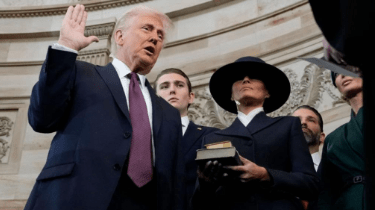
    thank you very much everybody well thank you very very much vice president Vance speaker Johnson Senator th chief justice Roberts justices of the United States Supreme Court President Clinton President Bush president President Obama President Biden vice president Harris and my fellow citizens the Golden Age of America begins right now from this day forward our country will flourish and be respected again all over the world we will be the Envy of every nation and we will not allow ourselves to be taken advantage of any longer during every single day of the Trump Administration I will very simply put America First our sovereignty will be reclaimed our safety will be restored the the scales of Justice will be rebalanced the vicious violent and unfair weaponization of the justice department and our government will end and our top priority will be to create a nation that is proud prosperous and free America will soon be greater stronger and far more exceptional than ever before I return to the presidency confident and optimistic that we are at the start of a thrilling New Era of national success a tide of change is sweeping the country sunlight is pouring over the entire world and America has the chance to seize this opportunity like never before but first we must be honest about the challenges we face while they are plentiful they will be annihilated by this great momentum that the world is now witnessing in the United States of America As We Gather today our government confronts a crisis of trust for many years a radical and corrupt establishment has extracted power and wealth from our citizens while the pillars of our societ Society lay broken and seemingly in complete disrepair we now have a government that cannot manage even a simple crisis at home while at the same time stumbling into a continuing catalog of catastrophic events abroad it fails to protect our magnificent law-abiding American citizens but provide sanctuary and protection for Dangerous criminals many from prisons and mental institutions that have illegally entered our country from all over the world we have a government that has given unlimited funding to the defense of foreign borders but refuses to defend American borders or more importantly its own people our country can no longer deliver basic services in times of emergency as recently shown by the wonderful people of North Carolina been treated so badly and other states who are still suffering from a hurricane that took place many months ago or more recently Los Angeles where we are watching fires still tragically burn from weeks ago without even a token of defense they’re raging through the houses and communities even affecting some of the wealthiest and most powerful individuals in our country some of whom are sitting here right now they don’t have a home in any longer that’s interesting but we can’t let this happen everyone is unable to do anything about it that’s going to change we have a public health system that does not deliver in times of disaster yet more money is spent on it than any country anywhere in the world and we have an education system that teaches our children to be ashamed of themselves in many cases to hate our country despite the love that we try so desper L to provide to them all of this will change starting today and it will change very quickly my recent election is a mandate to completely and totally reverse a horrible betrayal and all of these many betrayals that have taken place and to give the people back their faith their wealth their democracy and indeed their freedom from this moment on America’s decline is over our liberties and our nation’s glorious Destiny will no longer be denied and we will immediately restore the Integrity competency and loyalty of America’s government over the past eight years I have been tested and challenged more than any president in our 250e history and I’ve learned a lot along the way the journey to reclaim our Republic has not been an easy one that I can tell you those who wish to stop our cause have tried to take my freedom and indeed to take my life just a few months ago in a beautiful Pennsylvania field in Assassin’s bullet ripped through my ear but I felt then and believe even more so now that my life was saved for a reason I was saved by God to make America great again thank you very much that is why each day under our administration of American Patriots we will be working to meet every crisis with dignity and power and strength we will move with purpose and speed to bring back hope Prosperity safety and peace for citizens of every race religion color and Creed for American citizens January 20th 2025 is Liberation day it is my hope that our recent presidential election will be remembered as the greatest and most consequential election in the history of our country as our Victory showed the entire nation is rapidly unifying behind our agenda with dramatic increases in support from virtually every element of our society young and old men and women African-Americans Hispanic Americans Asian Americans Urban Suburban Rural and very importantly we had a powerful win in all seven swing States and the popular vote we won by millions of people to the Black and Hispanic communities I want to thank you for the tremendous outpouring of love and trust that you have shown me with your vote we set records and I will not forget it I’ve heard your voices in the campaign and I look forward to working with you in the years to come today is Martin Luther King day and his honor this will be a great honor but in his honor we will strive together to make his dream a reality we will make his dream come true thank thank you National Unity is now returning to America and confidence and pride is soaring like never before in everything we do my Administration will be inspired by a strong pursuit of excellence and unrelenting success we will not forget our country we will not forget our Constitution and we will not forget our God can’t do that today I will sign a series of historic executive orders with these actions we will begin the complete restoration ation of America and the revolution of common sense it’s all about common sense first I will declare a national emergency at our Southern border all illegal entry will immediately be halted and we will begin the process of returning millions and millions of criminal aliens back to the places from which they came we will reinstate my remain in Mexico policy I will end the practice of Catch and Release and I will send troops to the southern border to repel the disastrous invasion of our country under the orders I signed today we will also be designating the cartels as foreign terrorist organizations and by invoking the alien enemies Act of 1798 I will direct our government to use the full and immense power of federal and state law enforcement to eliminate the presence of all foreign gangs and criminal networks bringing devastating crime to us soil including our cities and inner cities as commander-in-chief I have no higher responsibility than to defend our country from threats and invasions and that is exactly what I am going to do we will do it at a level that nobody’s ever seen before next I will direct all members of my cabinet to Marshall the vast Powers at their disposal to defeat what was record inflation and rapidly bring down costs and prices the inflation crisis was caused by Massive overspending and escalating Energy prices and that is why today I will also declare a national Energy emergency we will drill baby drill America will be a manufacturing Nation once again and we have something that no other manufacturing Nation will ever have the largest amount of oil and gas of any country on Earth and we are going to use it let me use it we will bring prices down fill our strategic reserves up again right to the top and Export American Energy all over the world we will be a rich Nation again and it is that Liquid Gold under our feet that will help to do it with my actions today we will end the green New Deal and we will revoke the electric vehicle mandate saving our Auto industry and keeping my sacred pledge to our Great American Auto Workers in other words you’ll be able to buy the car of your choice we will build automobiles in America again at a rate that nobody could have dreamt possible just a few years ago and thank you to the UT workers of our nation for your inspiring vote of confidence we did tremendously with their vote I will immediately begin the overhaul of our trade system to protect American workers and families instead of taxing our citizens to enrich other countries we will tariff and tax foreign countries to enrich our citizens for this purpose we are establishing the external Revenue Service to collect all tariffs duties and revenues it will be massive amounts of money pouring into our treasury coming from foreign sources the American dream will soon be back and thriving like never before to restore competence and Effectiveness to our federal government my Administration will establish the brand new Department of government efficiency after years and years of illegal and unconstitutional Federal efforts to restrict free expression I will also sign an executive order to immediately stop all government censorship and bring back Free Speech To America never again will the immense power of the state be weaponized to persecute political opponents something I know something about we will not allow that to happen it will not happen again under my leadership we will restore Fair equal and impartial justice under the Constitutional rule of law and we are going to bring Law and Order back to our cities this week I will also end the government policy of trying to socially engineer race and gender into every aspect of public and private life we will Forge a society that is colorblind and Merit based as of today it will henceforth be the official policy of the United States government that there are only two genders male and female this week I will reinstate any service members who were unjustly expelled from our military for objecting to the covid vaccine mandate with full back pay and I will sign an order to stop our Warriors from being subjected to radical political theories and social experiments while on duty it’s going to end immediately our Armed Forces will be free to focus on their soul whole mission defeating America’s enemies like in 2017 we will again build the strongest military of the world has ever seen we will measure our success not only by the battles we win but also by the wars that we end and perhaps most importantly the wars we never get into my proudest Legacy will be that of a peacemaker and unifier that’s what I want to be a peacemaker and a unifier I’m pleased to say that as of yesterday one day before I assumed office the hostages in the Middle East are coming back home to their families thank you America will reclaim its rightful place as the greatest most powerful most respected Nation on Earth inspiring the awe and admiration of the entire world a short time from now we are going to be changing the name of the Gulf of Mexico to the Gulf of America and we will restore the name of a great President William McKinley to Mount McKinley where it should be and where it belongs President McKinley May our country very rich through tariffs and through Talent he was a natural businessman and gave Teddy Rosevelt the money for many of the great things he did including the Panama Canal which has foolishly been given to the country of Panama after the United States the United States I mean think of this spent more money than ever spent on a project before and lost 38,000 lives in the building of the Panama Canal we have been treated very badly from this foolish gift that should have never been made and Panama’s promise to us has been broken the purpose of our deal and the spirit of our treaty has been totally violated American ships are being severely overcharged and not treated fairly in any way shape or form and that includes the United States Navy and above all China is operating the Panama Canal and we didn’t give it to China we gave it to Panama and we’re taking it back above all my message to Americans today is that it is time for for us to once again act with courage Vigor and the Vitality of History’s Greatest civilization so as we liberate our nation we will lead it to new heights of Victory and success we will not be deterred together we will end the chronic disease epidemic and keep our children safe healthy and disease free the United States will once again consider itself a growing Nation one that increases our wealth expands our territory builds our cities raises our expectations and Carries our flag into new and beautiful Horizons and we will pursue our Manifest Destiny into the Stars launching American astronauts to plant the stars and stripes on the planet Mars ambition is the lifeblood of a great nation and right now our nation is more ambitious than any other there’s no Nation like our nation Americans are explorers Builders innovators entrepreneurs and Pioneers the spirit of the Frontier is written into our hearts the call of the next great adventure resounds from within our souls our American ancestors turned a small group of colonies on the edge of a vast continent into a mighty Republic of the most extraordinary citizens on Earth no one comes close Americans push thousands of miles through a rugged land of Untamed wilderness they crossed deserts scaled mountains braved Untold dangers won the wild west ended slavery rescued Millions from tyranny lifted billions from poverty harnessed electricity split the atom launched mankind into the heavens and put the universe of human knowledge into the palm of the human hand if we work together there is nothing we cannot do and no dream we cannot achieve many people thought it was impossible for me to Stage such a historic political comeback but as you see today here I am the American people have spoken I stand before you now as proof that you should never believe that something is impossible to do in America The Impossible is what we do best from New York to Los Angeles from Philadelphia to Phoenix from Chicago to Miami from Houston to right here in Washington DC our country was forged and built by the generations of patriots who gave everything they had for our rights and for our freedom they were farmers and soldiers Cowboys and Factory workers steel workers and coal miners police officers and Pioneers who pushed onward marched forward and let no obstacle defeat their Spirit or their pride together they laid down the railroads raised up the skyscraping built great highways won two world wars defeated fascism and communism and Triumph over every single challenge that they faced after all we have been through together we stand on the verge of the four greatest years in American history with your help we will restore America promise and we will rebuild the nation that we love and we love it so much we are one people one family and one glorious nation under God so to every parent who dreams for their child and every child who dreams for their future I am with you I will fight for you and I will win for you we’re going to win like never before thank you thank you in recent years our nation has suffered greatly but we are going to bring it back and make it great again greater than ever before we will be a nation like no other full of compassion courage and exceptionalism our power will stop all wars and bring a new spirit of unity to a world that has been angry violent and totally unpredictable America will be respected again and admired again including by people of religion faith and good will we will be prosperous we will be proud We will be strong and we will win like never before we will not be conquered we will not be intimidated we will not be broken and we will not fail from this day on the United States of America will be a free Sovereign and independent nation we will stand bravely we will live proudly we will dream boldly and nothing will stand in our way because we are Americans the future is ours and our golden age has just begun thank you God Bless America thank you all thank you thank you very much thank you very much thank you thank you ladies and gentlemen performing America the Beautiful please welcome the Armed Forces

    By Amjad Izhar
    Contact: amjad.izhar@gmail.com
    https://amjadizhar.blog

  • Presidential Briefing on Domestic and Foreign Policy

    Presidential Briefing on Domestic and Foreign Policy

    This transcript details a press briefing where a president announces several key decisions. These include numerous cabinet appointments, the reversal of policies concerning the Foreign Corrupt Practices Act and paper straws, a pardon for a former governor, and the reimposition of tariffs on steel and aluminum imports. Additionally, the president discusses his stance on the ongoing hostage situation in Gaza and other foreign policy matters, including his interactions with foreign leaders. Finally, he addresses domestic issues such as the Consumer Financial Protection Bureau and federal worker buyouts.

    Review and Study Guide: Presidential Actions and Policy Shifts

    Quiz

    Instructions: Answer each question in 2-3 sentences.

    1. What actions are being taken regarding the Foreign Corrupt Practices Act, and what reasoning is given for these changes?
    2. What changes are being made regarding the use of paper straws and why?
    3. What is the justification given for pardoning former Governor Rob Blagojevich?
    4. What are the changes being made to tariffs on imported steel and what is the rationale behind these changes?
    5. How are the new tariffs on imported steel expected to impact American steelworkers and businesses?
    6. How are the tariffs on aluminum being modified and why?
    7. What does the president mean by “reciprocal tariffs,” and what other industries will be affected?
    8. What actions are being taken at the border and what is their stated impact on border crossings?
    9. What is the president’s stance on the hostage situation in Gaza and what ultimatum has been delivered?
    10. What actions are being taken regarding the Consumer Financial Protection Bureau and why?

    Quiz Answer Key

    1. The Department of Justice is being ordered to use prosecutorial discretion to lessen the negative effects of the Foreign Corrupt Practices Act. The reasoning is that it has hindered American business opportunities abroad, as it has led to investigations for Americans doing legitimate business in foreign countries and created an environment where foreign partners are hesitant to engage with Americans due to fear of being investigated.
    2. The government is reversing the push for paper straws and returning to plastic straws. This is because paper straws are unpopular, ineffective, and have not been proven to be environmentally superior, causing dissatisfaction among consumers.
    3. The former governor was allegedly “set up by bad people,” he is described as a “very nice person” with a “fantastic wife,” and he received what the president considers a terrible injustice with an 18-year sentence.
    4. The order reinstates a 25% ad valorem tariff rate on all steel imports. This aims to protect the U.S. steel industry and bring back jobs, countering the negative effects of previous exclusions and exemptions that have hurt the domestic steel industry.
    5. The tariffs are expected to lead to the return of 120,000 American steelworker jobs that have been lost due to exemptions and exclusions. It is believed that companies will be more likely to produce steel domestically without the tariff, leading to more American jobs.
    6. The ad valorem tariff on aluminum is being increased from 10% to 25% with all exceptions and exemptions eliminated. This is to revitalize the American aluminum industry by encouraging domestic production.
    7. “Reciprocal tariffs” means that the U.S. will match the tariffs other countries impose on American goods. This policy is not just for steel and aluminum but will be implemented in other sectors like cars, drugs, pharmaceuticals, and chips.
    8. The military has been mobilized, physical barriers are being erected, agents are focused on law enforcement, weapons, drugs, and criminals are being interdicted, and illegal immigrants are being repatriated. Border crossings are reportedly down by approximately 95% as a result.
    9. The president believes the hostages are being mistreated and in poor condition. An ultimatum has been delivered that if all hostages are not returned by Saturday at 12:00, all bets are off, suggesting further retaliation and that a previously considered ceasefire would be canceled.
    10. The Consumer Financial Protection Bureau is being frozen and possibly eliminated as the president believes it is wasteful, corrupt, and was set up to destroy people. He aims to get rid of what he perceives as waste, fraud, and abuse.

    Essay Questions

    Instructions: Write an essay in response to each prompt.

    1. Analyze the core economic philosophies and principles underlying the various trade and tariff policy changes outlined in the provided text. In what ways are these ideas consistent, and what underlying logic or assumption connects the different aspects of policy?
    2. Compare and contrast the reasons provided for the reversal of policies relating to paper straws and the changes made to the Foreign Corrupt Practices Act. To what extent do these reasons show consistency or a similar underlying framework?
    3. Evaluate the role of political rhetoric and framing in the president’s communications. How do the president’s characterizations of specific individuals, groups, or ideas contribute to shaping perceptions of the policies discussed?
    4. Discuss the president’s approach to foreign policy issues, considering his statements regarding the hostage situation, the G20 Summit, and relations with other nations. How do his actions and statements reflect his views on international relations and the role of the United States in the world?
    5. Examine the common themes and justifications used to implement various policies, focusing on aspects of patriotism, economic recovery, and efficiency in government. To what extent are these justifications effective and how does the rhetoric work together to form a coherent narrative?

    Glossary of Key Terms

    • Sub Cabinet Level Appointments: Government appointments below the level of a Cabinet Secretary but still holding significant administrative roles within executive agencies.
    • Acting Designations: The appointment of an individual to temporarily lead a government office or agency, often while a permanent replacement is sought.
    • Office of Special Counsel: An office that handles allegations of wrongdoing by federal employees and other government ethics issues.
    • Office of Government Ethics: A United States federal agency whose mission is to foster high ethical standards for employees of the executive branch of the federal government.
    • Foreign Corrupt Practices Act: A U.S. law that prohibits American companies and individuals from bribing foreign officials to win or maintain business.
    • Prosecutorial Discretion: The authority of a government agency (such as the Department of Justice) to decide whether or not to prosecute a specific case.
    • Ad Valorem Tariff: A tariff based on a percentage of the value of the imported goods rather than a fixed amount per unit.
    • Tariff: A tax or duty imposed on imports or exports.
    • Exemptions and Exclusions (Tariffs): Specific exceptions to general tariff rules, allowing certain goods to be imported without duty or at a reduced rate.
    • Reciprocal Tariffs: Tariffs that a country imposes on another country, that match in rate the tariffs that the second country imposes on them.
    • Consumer Financial Protection Bureau (CFPB): A U.S. government agency responsible for consumer protection in the financial sector.
    • Woke: A term used to describe being alert to racial prejudice and injustice. Often used in political rhetoric as a pejorative term for liberal or progressive viewpoints.
    • Ad valorem: A Latin phrase meaning “according to value,” used to describe a tariff or tax based on the assessed value of goods.
    • Holocaust: The systematic, state-sponsored persecution and murder of six million Jews by the Nazi regime and its collaborators.
    • G20 Summit: An international forum for the governments and central bank governors from 19 of the world’s largest economies and the European Union.
    • Repatriating: The return of a person to their place of origin or citizenship.
    • Human Trafficking: The action or practice of illegally transporting people, especially for the purpose of forced labor or sexual exploitation.
    • Child Trafficking: The exploitation of children for labor or sexual purposes, often involving force or deception.

    Presidential Policy Briefing: February 10, 2025

    Okay, here is a detailed briefing document summarizing the key themes, ideas, and facts from the provided text:

    Briefing Document: Summary of Key Policy Changes and Statements

    Subject: Review of Policy Actions and Statements

    Introduction: This briefing document summarizes the key policy changes, appointments, and statements made by the President during a recent press conference or announcement. The actions range across various sectors, including foreign policy, trade, domestic affairs, and national security.

    1. Personnel and Appointments:

    • Sub-Cabinet Appointments: 56 sub-cabinet level appointments were made, including seven ambassadorial nominations that are the first ones sent to the Senate.
    • Quote: “first for your review we have uh 56 sub cabinet level appointments this includes probably most notably seven uh Ambassador appointments those will be the first ambassadors I believe that you’ve transmitted to the Senate”
    • Acting Designations: Doug Collins has been designated as the acting leader of both the Office of Special Counsel and the Office of Government Ethics.
    • Quote: “we’re actually designating Doug Collins to be the acting leader of both the office of special counsel and the office of government ethics”
    • Commentary: The president describes Collins as someone who “was in charge of the fake impeachment hearings” and repeats that he “won very conclusively fake charges by the radical left Democrats” suggesting a partisan leaning for the selection.

    2. Government Spending and Bureaucracy:

    • Elimination of Training Program: The administration is eliminating a training program for senior-level government bureaucrats, citing it as wasteful and ineffective in ensuring stewardship of taxpayer dollars.
    • Quote: “Ser Johnson Administration to train senior level government bureaucrats… the senior levels of our federal government are not uh adequately serving as stewards of taxpayer dollars so we’re recommending uh zeroing out that program effectively”

    3. Foreign Corrupt Practices Act (FCPA):

    • Executive Order: An executive order directs the Department of Justice to use its prosecutorial discretion to “ameliorate the negative effects” of the FCPA, arguing that it has hindered American business competitiveness abroad. The rationale provided is that the FCPA makes it too risky for American businesses to operate internationally, with the fear of investigation and indictment.
    • Quote: “we are essentially ordering the Department of Justice to use its prosecutorial discretion in a way to ameliorate the negative effects of the Foreign Corrupt Practices Act to allow Americans to do business abroad”
    • Commentary: The President criticizes the FCPA as a “disaster” that “hurts the country” because “nobody wants to do business with the Americans because of it”. He states “it turned out to be it sounds good on paper but in practicality it’s a disaster”

    4. Environmental Policy & Paper Straws

    • Paper Straw Directive: The administration is directing federal departments and agencies to review their procurement processes related to paper straws, and they’ll be going back to plastic straws. It is implied the domestic policy council will look at this “holistically”. The President expresses frustration over the environmental impact of plastic versus paper straws, stating “The environmental impact of plastic straws versus paper straws is entirely unclear” and notes that paper straws “don’t work,” “break,” “explode,” and don’t last.
    • Quote: “we’re asking uh aspects of of the Federal Government Federal departments and agencies to look at their existing procurement processes and we’re asking your domestic policy Council to look holistically at this issue to address it” and “we’re going back to plastic straws”

    5. Pardons:

    • Pardon of Rob Blagojevich: A full and unconditional pardon is granted to former Governor Rob Blagojevich of Illinois, whom the President believes was “set up by a lot of bad people.” He notes Blagojevich “was given a sentence of like 18 years and uh it was a sort of a terrible Injustice.”
    • Quote: “I’m signing this is a full part rodic… it’s my honor to do it I’ve watched him he was set up by a lot of bad people some of the same people that I had to deal with”
    • Commentary: The President mentions a past connection to Blagojevich from when he was on The Apprentice, and suggests “he’s now cleaner than anybody in this room” after the pardon.

    6. Tariffs on Steel and Aluminum:

    • Reimposition of Tariffs: The administration is reinstating a 25% ad valorem tariff on steel imports and eliminating exemptions that had been previously implemented. This is framed as a move to support the American steel industry. Similarly, a 25% tariff has been reimposed on aluminum.
    • Quote: “this order would reimpose that 25% odorum tariff rate on Imports of Steel… essentially we’re this is another way of saying we’re doing a 25% tariff on steel and aluminum”
    • Quote: “this eliminates all of those and also increases the odorum Tariff rate uh from 10 to 25%”
    • Rationale: The President asserts this measure will lead to “making America rich again,” and create new jobs. The Commerce Secretary stated the previous imposition of tariffs led to 120,000 jobs, but exclusions led to 107,000 jobs lost, and this measure seeks to restore those jobs.
    • Quote: “This is the beginning of making America Rich again…so when you imposed uh the tariffs the first time you added 120,000 jobs and since that time it’s been picked away and nicked away and excluded away and we’ve lost 107,000 jobs”
    • Reciprocity: The policy will be “reciprocal,” implying that if other countries impose tariffs on the U.S., the U.S. will impose similar tariffs. If products are made in the US, they will not be subject to tariffs.
    • Quote: “If they charge us we charge them if they’re at 25 we’re at 25 if they’re at 10 we’re a 10 and if they’re much higher than 25 that’s what we are too.”
    • Future Tariffs: The President indicated that tariffs on other sectors such as cars, drugs, and pharmaceuticals are being considered.
    • Quote: “we’re going to be doing others on other subjects topics… we’ll be talking about other subjects like cars we’ll be talking about uh drugs and pharmaceuticals we’ll be discussing chips”

    7. Hostage Situation in Gaza:

    • Saturday Deadline: The President has set a deadline of Saturday at 12:00 for Hamas to release all hostages. He suggests that if they are not all released by then, “all bets are off” and “hell will break loose.” The president believes “a lot of them are dead” and that the hostages released so far are in very poor condition, citing that they appear like Holocaust victims.
    • Quote: “as far as I’m concerned if all of the hostages aren’t returned by Saturday at 12:00 I think it’s an appropriate time I would say cancel it and all bets are off and uh let hell break out… Saturday at 12:00 and after that I would say uh all hell is going to break out”
    • Palestinian Relocation: The President stated that Palestinians would have a “nice place to live safely” and that they would want to leave Gaza, which is a “hell hole.” He is working with “various leaders of various countries” on finding land for them, and that they would not be guaranteed a return to Gaza.
    • Quote: “we’ve spoken to a lot of Palestinians they would love to leave Gaza if they could find a place to be…they would love to get out of Gaza but until now they never had an alternative now they have an alternative”
    • Potential Withholding of Aid: The President states that he would potentially withhold aid from Jordan and Egypt if they don’t agree to take in Palestinians.
    • Quote: “yeah maybe sure why not you mean if they don’t agree mention if they don’t agree I would I would conceivably withhold a”

    8. Consumer Financial Protection Bureau (CFPB):

    • Criticism: The President heavily criticizes the CFPB and refers to it as “Pocahontas” (Elizabeth Warren)’s “personal agency to go around and Destroy people” He accuses Warren of being a “fake” and “nasty woman” and describes the CFPB as having “a vicious group of people” who “destroyed a lot of people”.
    • Quote: “Pocahontas Pocahontas the fake the faker… that was set up to destroy people she used that as her little uh personal agency to go around and Destroy people and she’s a fake”
    • Goals: The President suggests they are “trying to get rid of waste Fraud and Abuse” and his goal is to have it eliminated.
    • Quote: “I say yeah because we’re trying to get rid of waste Fraud and Abuse”

    9. Approval Ratings, Immigration, and Common Sense:

    • High Approval: Despite actions deemed “controversial,” the president notes his “high approval ratings” are due to “common sense” policies.
    • Quote: “I have high approval ratings because I’m you know I’m using Common Sense”
    • Border Policy: The administration claims border crossings are down 95% due to the mobilization of the military, building of physical barriers, and enforcement. It is also claimed that people coming over are being prosecuted for “human trafficking and child trafficking.” The President asserts “they have to go through a process” legally to come into the country.
    • Quote: “since you issued your day one executive orders border crossings are down approximately 95%… there’s never been a lockdown like what you have implemented through your orders and vision since you took the O of office” and “we want people to come into our country but we want them to come illegally they have to go through a process”
    • “Woke” Culture: The President says that “woke” is costing the country “a fortune and cost us our reputation,” and the reputation is coming back “rapidly.”
    • Quote: “we’re going to make sure that it’s good and it’s it’s not going to be woke there’s no more woke in this country this woke has cost us a fortune and cost us our reputation but the reputation’s coming back very very rapidly”
    • Men in Women’s Sports: The President criticizes allowing men to compete in women’s sports as “ridiculous” and a 90% issue.
    • Quote: “whether it’s uh getting men out of women’s sports I mean have you seen what goes on with the boxers and with the weightlifters and with the swimmers and everything that’s so ridiculous”

    10. Federal Employee Buyouts

    • Buyout program: The President believes that the buyout program was “very generous” and that the court case that has temporarily paused it cannot be won.
    • Quote: “I don’t know how you can lose a case like that we’re talking about people you know everybody I got elected on making government better more efficient and smaller and that’s what we’re doing and uh I think it was a very generous buyout actually”
    • Work from home: The President claims that working from home is ineffective because people will be doing other things, and he believes that workers have an obligation to go to the office and an obligation not to have a second job while getting paid by the federal government.
    • Quote: “I happen to be a believer that you have to go to work I don’t think you can work from a home… they have an obligation to work and they have an obligation not to have a second job when they’re supposed to be working for the federal government”

    11. Other Notable Points:

    • South Africa: The President asserts the South African situation is “very, very dangerous” with “tremendously bad things going on” related to property confiscation, and suggests payments will be withheld until a determination can be made.
    • Quote: “the South African situation is very very dangerous and very bad for a lot of people uh there’s tremendously bad things going on and so including the confiscation of property and worse much worse than that you know what I’m talking about and we’re not making any payment until we find out what’s going on in South Africa”
    • Ukraine: The President claims that people are “making a deal” with Ukraine that allows the US to get minerals and oil. The President criticized previous aid to Ukraine that did not include such stipulations, and blames the start of the war on the current administration.
    • Quote: “we have people over there today who are making a deal that as we give money we get minerals and we get oil and we get all sorts of things because why are we doing this and uh all this money we’re in for maybe 350 billion and Europe’s in for 100 billion”
    • Kennedy Center: The President has taken over the Kennedy Center, citing that he did not like “what they were showing and various other things,” and states that it will “not be woke” under his direction. He has appointed Rick Grenell to handle it temporarily.
    • Quote: “we took over the Kennedy Center we didn’t like what they were showing and various other things and and uh I had a lot of the board members already as you know and we have uh some that will be replaced”

    Conclusion: This document provides a comprehensive overview of the various actions and statements made by the President, highlighting a clear shift in several policy areas. The actions demonstrate a commitment to increased tariffs, a more restrictive immigration policy, a push to reduce the size and spending of government, and a combative stance against his critics. The President also appears to be setting a more aggressive tone in foreign policy, particularly related to the hostage situation in Gaza and aid to countries in the Middle East.

    American Administration Policy Updates

    Frequently Asked Questions

    1. What are the key changes being made to the federal government’s personnel and structure?
    2. The administration is making several significant changes. Firstly, 56 sub-cabinet level appointments have been made, including seven ambassador appointments. Secondly, Doug Collins has been designated as acting leader of both the Office of Special Counsel and the Office of Government Ethics. Additionally, a program designed to train senior-level government bureaucrats is being eliminated due to concerns about stewardship of taxpayer dollars. Finally, the administration is implementing a “buyout” program for federal employees, although this is facing legal challenges. There is a strong emphasis on reducing waste, fraud, and abuse within government agencies, with an expressed desire to shrink the size of government and make it more efficient. There is a concern that some federal employees have been working second jobs while collecting government paychecks.
    3. How is the Foreign Corrupt Practices Act being modified, and why?
    4. The administration is directing the Department of Justice to use its prosecutorial discretion to ameliorate the negative effects of the Foreign Corrupt Practices Act. The administration believes the act has been enforced in a way that is detrimental to American businesses, creating a disincentive to operate abroad. The concern is that the broad application of the act leads to investigations and indictments that discourage Americans and their partners from doing business, making it too risky to conduct deals internationally. The aim is to allow American businesses to compete more effectively in the global market.
    5. What’s the rationale behind returning to plastic straws, and what’s the government’s broader approach to consumer goods?
    6. The decision to return to plastic straws is based on the claim that the environmental impact of paper straws versus plastic straws is unclear. It’s also been deemed that the switch to paper straws has been costly and has led to consumer dissatisfaction. The broader approach appears to be one of prioritizing practicality and consumer satisfaction over environmental concerns in this particular issue. A holistic review of the issue is being initiated by the Domestic Policy Council. The administration views the whole paper straw debate as “ridiculous”.
    7. What actions are being taken regarding tariffs on steel and aluminum?
    8. The administration is reimposing a 25% ad valorem tariff on imports of steel and aluminum, eliminating all prior exclusions and exemptions. The goal is to revitalize the U.S. steel and aluminum industries, with a focus on bringing manufacturing jobs back to America. There is a strong emphasis on a “Buy American” policy, where American made materials will not be subject to tariffs. The administration is also focused on “reciprocity”, meaning that if other countries impose tariffs, the US will respond in kind. This policy is seen as the beginning of making America rich again.
    9. What is the administration’s approach to the ongoing Israel-Hamas conflict and the hostage situation?
    10. The administration views the hostage situation as a “great human tragedy” and condemns Hamas for the condition of the hostages released so far, citing severe mental and physical harm. A deadline has been issued, indicating that if all hostages are not returned by Saturday at 12:00 PM, “all bets are off,” suggesting potential retaliation. The administration expresses strong support for Israel and suggests that Hamas is trying to send the best-looking hostages in a calculated attempt to hide the severity of the harm done to them. There is also a call to cease releasing hostages in “drips and drabs” and demands that all be released simultaneously by the deadline.
    11. What is the administration’s position on the future of Palestinians in Gaza?
    12. The administration believes that many Palestinians in Gaza would prefer to leave and seek a better alternative. It plans to collaborate with other countries to find land to build a nice, safe place where Palestinians in Gaza would want to relocate. The goal is to offer them an option to leave what is described as a “hell hole.” However, there was no indication of forcibly relocating Palestinians from Gaza and also no mention of the status of Palestinian refugees being able to return to Gaza.
    13. How is the administration addressing border security and immigration?
    14. Border crossings are reportedly down by approximately 95% following the implementation of new policies, with the mobilization of military personnel and border agents. The focus is on law enforcement, national security, and the interdiction of weapons, drugs, and violent criminals. There is a zero tolerance approach towards people attempting to enter the country illegally. The administration is also rapidly deporting illegal immigrants and prosecuting those involved in human and child trafficking. The administration states it wants people to come into the country but through a process and legally, not illegally.
    15. What are some of the other key areas of focus for the administration?
    16. Beyond the issues mentioned above, the administration is focused on several other areas. These include getting men out of women’s sports, which is viewed as “ridiculous”. There is concern about “woke” policies and their negative impacts and this is part of the motivation for a change in the leadership at the Kennedy Center. Medicare fraud is also being addressed with a subcommittee hearing on that issue. The administration is also engaging in conversations with foreign leaders, such as Vladimir Putin, and attempting to negotiate deals, potentially involving minerals and oil. There is concern that US is paying disproportionately for supporting Ukraine and is seeking more equitable contributions from Europe. There is no intention to attend G20 in South Africa given bad conditions there including property confiscation.

    Johnson Administration Appointments and Actions

    The sources discuss a number of cabinet-level appointments and related actions:

    • 56 sub-cabinet level appointments have been made, including seven ambassador appointments. These are described as “very good”. These are the first ambassador appointments transmitted to the Senate.
    • Doug Collins is being designated as the acting leader of both the Office of Special Counsel and the Office of Government Ethics. He is described as having been in charge of the “fake impeachment hearings”.
    • The Senior Johnson Administration program to train senior-level government bureaucrats is being eliminated. The rationale is that the senior levels of the federal government are not adequately serving as stewards of taxpayer dollars and that the program is a waste.
    • An executive order is being signed relating to the Foreign Corrupt Practices Act, directing the Department of Justice to use prosecutorial discretion to ameliorate the negative effects of the act, which has been described as devastating to American business opportunities and competitiveness abroad. The act is described as a “disaster” that has made it difficult for Americans to do business overseas.
    • A full and unconditional pardon was issued for former Governor Rob Bovich of Illinois. Although he was not appointed to a cabinet position, the person issuing the pardon stated he was “now cleaner than anybody in this room,” and was asked if he would be considered for ambassador to Serbia.
    • Rick Grenell is going to be handling the Kennedy Center on a temporary basis. It is also mentioned that the person issuing the statement will be the chairman of the Kennedy Center.

    In addition to these specific appointments and actions, a number of statements were made that reflect on general government policies and personnel:

    • There is a belief that the federal government is filled with “bad people” and “stupid people,” and that many have been “destroyed” by a “vicious group of people”
    • There is an emphasis on removing waste, fraud, and abuse from the government and a desire to make the government “better, more efficient, and smaller”.
    • A desire to eliminate “woke” ideology from the country.

    Government Ethics Reform

    The sources discuss government ethics in a few specific contexts:

    • Doug Collins is being designated as the acting leader of both the Office of Special Counsel and the Office of Government Ethics. This is noteworthy given the claim that he was “in charge of the fake impeachment hearings”. This appointment could be seen as undermining the impartiality of these offices, given the prior association with a political process described as “fake”.
    • The Senior Johnson Administration program to train senior-level government bureaucrats is being eliminated due to the claim that these senior levels of government are not adequately serving as stewards of taxpayer dollars. This suggests a concern about ethical behavior and proper use of funds within the bureaucracy. The program is also described as a “waste”.
    • There is a concern that the Consumer Financial Protection Bureau was set up to “destroy people,” and that it was run by a “vicious group of people”. It is mentioned that someone made $38 million running the agency. There is a stated goal to have it totally eliminated because it is viewed as waste, fraud, and abuse. This speaks to concerns about government overreach and the ethical conduct of those running the agency.
    • The Foreign Corrupt Practices Act is being addressed through an executive order that directs the Department of Justice to use its prosecutorial discretion to ameliorate the negative effects of the act. The concern is that the act has been enforced in a way that is “devastating to American Business Opportunities and business competitiveness abroad”. This suggests a view that the ethical standards imposed by the act are too strict and are hindering economic activity. It also seems to imply that the prosecution of US businesses for foreign actions is itself unethical.
    • A full and unconditional pardon was issued for former Governor Rob Bovich of Illinois, who was described as being set up by “bad people”. This decision also touches on the theme of ethics, as it implies a belief that the justice system itself can be unethical. It also implies that a pardon can make someone “cleaner than anybody in this room”.
    • There are concerns about people working second jobs while also collecting a federal government check. This speaks to a view of ethical obligations of federal employees. It also relates to a general idea of the government being wasteful and inefficient. There is also the idea that it is important to show up to work and that working from home is not as effective as working in the office.

    Overall, the discussion of government ethics in the sources reveals a perspective that is skeptical of the current state of affairs and seeks to drastically reform existing processes, personnel, and laws by eliminating or limiting their power. There is a belief that the government is riddled with waste, fraud, and abuse, and that ethical standards have been misapplied or used for political purposes.

    American Steel Tariffs and Trade Policy

    The sources discuss steel tariffs and related trade policies extensively:

    • In 2018, a 25% tariff on steel imports was imposed, which led to the creation of 120,000 jobs. However, subsequent exclusions and exceptions to this tariff rule have damaged the United States steel industry, resulting in the loss of 107,000 jobs.
    • An order is being implemented to reimpose the 25% tariff on all steel imports without any exclusions or exemptions, regardless of the country of origin.
    • If steel is made in the United States, there is no tariff. This is intended to encourage domestic production and create jobs.
    • The policy is described as “the beginning of making America rich again” and is presented as a way to protect the American steel worker.
    • The policy is intended to simplify tariffs on steel and aluminum so that everyone can understand them.
    • The move is described as a way to bring back American industries and jobs, with a focus on the “Resurgence of us manufacturing and production”.
    • The policy is described as “reciprocal” meaning that if other countries charge tariffs on US goods, the US will charge the same rate. This is not limited to steel and aluminum.
    • There is a prediction that prices will ultimately be reduced for consumers because foreign companies will move to the United States to make their steel and aluminum, thus avoiding the tariffs.
    • The tariffs are part of a broader policy to stop other countries from “dumping everything into our country”.
    • There is a suggestion that a possible exemption could be considered for Australia due to the fact that the US has a trade surplus with them.
    • It is argued that the US has been taken advantage of for years, and that it is time to be reciprocal.
    • The tariffs are supported by US steel workers.

    Additionally, the sources mention some related actions:

    • The order also increases the odorum Tariff rate on aluminum from 10 to 25% with no exceptions.
    • There are plans to discuss tariffs on cars, drugs, and pharmaceuticals in the coming weeks.
    • The idea that Canada should become the 51st state is proposed.

    Overall, the discussion of steel tariffs in the sources reflects a protectionist stance aimed at revitalizing American manufacturing and industry through the use of tariffs and reciprocal trade policies. The goal is to create jobs, protect American workers, and reduce dependence on foreign imports.

    The Paper Straw Fiasco

    The sources discuss the issue of paper straws as follows:

    • An executive order is being signed relating to the use of paper straws.
    • It is stated that “nobody really likes paper straws”.
    • It is claimed that the environmental impact of plastic straws versus paper straws is “entirely unclear”.
    • The switch to paper straws is described as having cost both the government and private industry “an absolute ton of money” and has left consumers “wildly dissatisfied”.
    • The government is asking aspects of federal departments and agencies to look at their existing procurement processes, and asking the domestic policy council to look holistically at the issue to address it.
    • The move to paper straws is described as something that affects ordinary Americans in their everyday lives.
    • The government is going back to plastic straws because paper straws “don’t work,” “break,” and “explode if something’s hot” and “don’t last very long”.
    • There is a statement that “plastic is not going to affect a shark very much”.
    • The paper straw issue was “number one trending for three days”.

    The discussion of paper straws indicates a belief that the move to paper straws was a misguided policy that has negatively affected both businesses and consumers. The decision to return to plastic straws appears to be based on a combination of practical considerations and a skepticism of environmental claims.

    Israel-Hamas Hostage Crisis

    The sources discuss a hostage situation, likely in the context of the Israeli-Hamas conflict, in considerable detail:

    • There is a concern that Hamas was going to stop releasing Israeli hostages. This was in reaction to seeing the condition of the released hostages.
    • The released hostages are described as emaciated and looking like they came out of a concentration camp, “something out of the 1930s” or “out of the Holocaust”. It is suggested that the hostages that have been released are “the best” and that other hostages are in worse condition.
    • The released hostages are described as having been badly hurt, both mentally and physically. One woman had her hand blown off while trying to stop a bullet from being fired at her.
    • There is a deadline of Saturday at 12:00 for the return of all hostages. If all hostages are not returned by that time, “all bets are off” and “hell is going to break out”. This is described as a personal deadline, and it is acknowledged that Israel could override it.
    • It is stated that if the hostages are not returned by the deadline, the response will be something that Hamas will “find out what I mean”.
    • There is a concern that many of the hostages are dead.
    • There is a criticism that hostages are being released in “drips and drabs” and not all at once.
    • There is a description of a captor laughing when a hostage who thought his family was alive found out they were dead. This event is used as evidence that the captors are “sick people”.
    • It is suggested that the hostage situation would have never happened if the speaker had been president.
    • The hostage situation is described as a “great human tragedy”.

    The sources also discuss related topics:

    • There is a discussion of a plan to build a “nice place” for Palestinians to live safely, indicating the desire for an alternative for Palestinians, some of whom would “love to leave Gaza”.
    • There is a mention of the possibility of withholding aid to Jordan and Egypt if they don’t agree to take in Palestinians.
    • There is also a statement that Palestinians in the West Bank are in a different situation from those in Gaza, with no plans to relocate them.
    • There is a reference to American hostages still being held and that it’s unknown whether they are alive.
    • It is noted that there is US involvement with saving the hostages and that an individual named “Steve Witkoff” has done an “amazing job”.
    • It is also mentioned that the Middle East is being changed and that there is support for Israel.

    The overall tone of the discussion is one of urgency and anger. The speaker is clearly deeply concerned about the plight of the hostages, and there is a strong desire to see them released. There is also a sense that the speaker believes that strong action is needed to resolve the situation.

    BREAKING NEWS: Trump Signs Raft Of New Executive Orders While Taking Questions From Reporters

    By Amjad Izhar
    Contact: amjad.izhar@gmail.com
    https://amjadizhar.blog

  • President Trump Signs Executive Order To Ban Transgender Athletes From Women’s Sports Banning Men From Women’s Sports

    President Trump Signs Executive Order To Ban Transgender Athletes From Women’s Sports Banning Men From Women’s Sports

    This transcript captures a speech announcing an executive order banning transgender women from competing in women’s sports. The speaker cites numerous examples of transgender women winning competitions against cisgender women, framing this as unfair and detrimental to women’s sports. He also boasts about improved military recruitment numbers and connects this to a perceived rejection of “woke” ideology. The speech concludes with the signing of the executive order and thanks to various supporters, showcasing a celebratory atmosphere. Throughout, the speaker uses strong rhetoric against transgender athletes and those perceived as opposing his views.

    Executive Order on Women’s Sports: A Study Guide

    Quiz

    Instructions: Answer the following questions in 2-3 complete sentences each.

    1. What is the main purpose of the executive order discussed in the speech?
    2. According to the speaker, what was the state of US Army recruitment prior to December?
    3. What specific claim does the speaker make regarding the number of victories and competitions “stolen” from women athletes by male athletes?
    4. Describe the speaker’s view on the “woke lunacy” in the military and women’s sports.
    5. How does the speaker describe the situation at the 2023 Paris Olympics concerning male athletes in women’s sports?
    6. What actions are schools threatened with if they violate the terms of the executive order?
    7. How does the speaker describe the current state of US education in the world?
    8. What does the speaker say he did to end “the extremism of the last four years”?
    9. What does the speaker say he offered the Biden Administration?
    10. What specific actions are being taken regarding visa applications of male athletes attempting to enter the US as female athletes?

    Answer Key

    1. The executive order aims to ban men from competing in women’s sports at all schools that receive taxpayer dollars and to end what the speaker refers to as the war on women’s sports. The order also targets schools that let men invade women’s locker rooms, and puts them at risk of losing federal funding.
    2. Prior to December, the US Army was experiencing shrinking force numbers and consistently missing recruiting targets every single month for four years. The speaker attributes the current success in recruitment to a new positive spirit in the country.
    3. The speaker claims that men claiming to be girls have stolen more than 3,500 victories and invaded more than 11,000 competitions designed for women. He cites examples like a male cyclist and a male weightlifter surpassing women’s records by large margins and winning events.
    4. The speaker believes that “woke lunacy” has negatively impacted both the military and women’s sports, implying that the military has suffered and women athletes have been treated unfairly. The speaker believes he is removing this “woke lunacy” from both sectors.
    5. The speaker describes the 2023 Paris Olympics as an example where a male boxer stole a woman’s gold medal after brutalizing his female opponent, noting that she had to forfeit and that two transitioned athletes won gold medals very convincingly, both instances viewed negatively.
    6. Schools that violate the executive order by allowing men to compete on women’s sports teams or invade their locker rooms will be investigated for violations of Title 9 and risk losing their federal funding. The speaker says there will be no federal funding if there is noncompliance.
    7. The speaker claims the US is ranked very poorly in education, stating the nation is 38th, 39th, or 40th out of 40 countries and that he will move it back to the states so the individual states can improve.
    8. According to the speaker, he has made it official policy that there are two genders (male and female), rescinded federal funds for programs promoting transgender ideology, and banned the chemical castration and surgical mutilation of minor children.
    9. The speaker says he offered to build a ballroom for the White House, at his own expense, but that the Biden Administration did not respond to his offer and did not seem to know what to do with it. He says that he plans to make the offer to himself.
    10. The Secretary of Homeland Security is being directed to deny any visa applications from men attempting to fraudulently enter the US while identifying themselves as women athletes. This is being done to prevent men from participating in the games or other events that they are otherwise unable to get into.

    Essay Questions

    Instructions: Develop a well-organized essay for each of the following prompts. Provide examples and draw evidence from the provided source material.

    1. Analyze the rhetorical strategies used by the speaker to persuade the audience about the need for the executive order. Consider the speaker’s use of appeals to emotion, logic, and authority.
    2. Evaluate the speaker’s arguments regarding the fairness and safety of women’s sports in light of transgender athletes’ inclusion. How valid are the presented examples and claims?
    3. Discuss the speaker’s broader political and cultural arguments presented in this speech beyond the issue of transgender athletes. How do these other issues tie into the speaker’s argument?
    4. Explore the significance of the numerous individuals mentioned by name in the speech. What does the speaker seem to be trying to accomplish by naming all of these individuals?
    5. Examine the speaker’s claims about US education and the need for changes, assessing the evidence provided and the speaker’s proposed plan for change.

    Glossary of Key Terms

    • Executive Order: A directive issued by the President of the United States that manages the operations of the federal government and has the force of law.
    • Title 9: A comprehensive federal law that prohibits sex discrimination in any educational program or activity receiving federal financial assistance.
    • Transgender Ideology: A set of beliefs or perspectives regarding gender identity that rejects the concept of binary sexes and embraces the idea that gender identity is separate from biological sex.
    • Woke Lunacy: A derogatory term used by the speaker to describe what he sees as excessive progressivism or activism on social issues.
    • Biological Sex: The classification of humans based on their reproductive organs, chromosomes, and hormones as either male or female.
    • Radical Left: A political label used by the speaker to refer to progressive or liberal ideologies that he perceives as extreme.
    • Chemical Castration: The use of medications to reduce sex drive, often used in the context of discussion around transitioning and gender identity.
    • Surgical Mutilation: A loaded and controversial term used in the speech to describe gender-affirming surgeries.
    • Common Sense: A term used by the speaker to represent his view that issues should be dealt with by a standard or logic that is supposedly obvious.
    • Visa Application: A request to enter a foreign country, subject to the specific rules and restrictions of that nation.
    • International Olympic Committee: The governing body responsible for organizing the Olympic Games.

    Okay, here is a briefing document summarizing the key themes and ideas from the provided text:

    Briefing Document: Executive Order on Women’s Sports

    Date: February 6, 2025

    Subject: Review of Speech Announcing Executive Order Banning Men from Women’s Sports

    Introduction:

    This document analyzes a speech given to announce an executive order banning men from competing in women’s sports. The speaker, presumably a former President, frames the issue as a matter of “common sense” and the restoration of “sanity” to government policy, contrasting it with the “radical left” and “woke lunacy.” The speech is highly political, with a strong emphasis on praising supporters and criticizing opponents. It also serves as a platform for the speaker’s broader political agenda.

    Key Themes & Ideas:

    Protection of Female Athletes:

    1. Core Argument: The central justification for the executive order is the protection of female athletes from being “beaten up, injured, and cheated” by men competing in women’s sports. The speaker asserts, “We will not allow men to beat up, injure, and cheat our women and our girls. From now on women sports will be only for women.”
    2. Examples of Alleged Injustice:The speaker cites examples like a male cyclist “obliterating” a female record, a male powerlifter breaking records by a significant margin, and a male boxer winning a gold medal after “brutalizing” a female opponent.
    3. He mentions that men “claiming to be girls have stolen more than 3,500 victories” and invaded “more than 11,000 competitions designed for women.”
    4. These examples are used to paint a picture of widespread unfairness and physical danger to female athletes.

    “Woke Lunacy” and the Radical Left:

    1. Framing: The speaker frames the issue as a battle against a “radical left” campaign to “erase the very concept of biological sex and replace it with a militant transgender ideology.”
    2. Opposition to Transgender Inclusion: The speaker is openly critical of transgender individuals participating in women’s sports and asserts, “America categorically rejects transgender lunacy.”
    3. Use of Rhetoric: The term “woke lunacy” is used to dismiss arguments for inclusivity and label opponents as irrational.

    The Executive Order and Its Scope:

    1. Banning Men from Women’s Sports: The executive order explicitly prohibits men from competing in women’s sports.
    2. Title IX Enforcement: Schools receiving taxpayer funding will be investigated for Title IX violations and risk losing federal funding if they allow men to compete on women’s teams or “invade” their locker rooms.
    3. National Impact: This order aims to affect virtually all public K-12 schools and U.S. colleges and universities.

    Restoring “Sanity” and Common Sense:

    1. Central Claim: The speaker argues his actions are about restoring “sanity” and “common sense” to government, suggesting the previous administration lacked both. “We are restoring sanity and Common Sense very simply to our government.”
    2. Biological Reality: The speaker asserts that there are only two genders (male and female), using this assertion as the basis for his policies. He declares that “on day one I made it official policy of the United States government that there is you know two genders we have two genders what might they be man and woman right male and female male and female.”

    Political Rally Tone & Self-Praise:

    1. Rally Atmosphere: The speech has a clear political rally feel. The speaker acknowledges and praises numerous politicians and supporters present.
    2. Emphasis on Accomplishments: The speech also highlights other claimed accomplishments, such as a recent increase in military recruitment and actions against the “chemical castration and surgical mutilation of minor children.”
    3. Contrast with Opponents: The speaker paints a picture of his supporters as being reasonable and patriotic while opponents are viewed as “fools” promoting “crazy things.”

    International Implications & Olympic Games:

    1. Rejection of Transgender Inclusion: The speaker directs the Secretary of State to inform the International Olympic Committee that the US categorically rejects transgender inclusion and demands they change all regulations pertaining to this issue.
    2. Los Angeles 2028 Olympics: The speaker vows that during the 2028 Los Angeles Olympics, his administration will not tolerate men “beating and battering” female athletes, suggesting the executive order will have implications for international sports.

    Visa Restrictions:

    • Homeland Security Directive: The speaker instructs the Secretary of Homeland Security to deny visa applications from men attempting to fraudulently enter the United States claiming to be women athletes.

    Specific Individuals Praised and Highlighted

    1. Riley Gaines: Praised as being at “the forefront of this battle” because she had to “share a spot on the podium with a male swimmer.”
    2. Payton McNab: Praised for being a “rockstar athlete” who was “partially paralyzed” after being struck by a ball by a taller, stronger male athlete.

    Notable Quotes:

    1. “We will defend the proud tradition of female athletes and we will not allow men to beat up injure and cheat our women and our girls.”
    2. “We’ve gotten the woke lunacy out of our military and now we’re very importantly getting it out of women’s sports.”
    3. “The war on women’s sports is over.”
    4. “America categorically rejects transgender lunacy.”
    5. “On day one I made it official policy of the United States government that there is you know two genders we have two genders what might they be man and woman right male and female male and female.”
    6. “We are restoring sanity and Common Sense very simply to our government.”

    Conclusion:

    This speech and executive order represent a significant move to exclude transgender individuals from women’s sports. The speaker frames this issue as a battle against a “radical left” agenda and as a defense of female athletes. The rhetoric is strong, divisive, and politically charged. The order carries major implications for schools, colleges, and international sports. The speech was delivered in a very political environment, praising many supporters and taking shots at opponents.

    Protecting Women’s Sports: An Executive Order

    Frequently Asked Questions

    1. What is the main purpose of the executive order being signed?
    2. The primary purpose of the executive order is to ban men from competing in women’s sports. This action is presented as a defense of female athletes, aiming to prevent them from being unfairly outmatched, injured, or cheated by men competing in women’s categories. The order aims to restore fairness and protect the integrity of women’s sports, according to the speech.
    3. What is the justification given for this executive order?
    4. The justification for the order is rooted in the belief that the radical left has waged an “all-out campaign to erase the very concept of biological sex.” It claims a militant transgender ideology has led to men falsely identifying as women in order to win competitions, citing instances of male athletes breaking women’s records and even causing injuries to female opponents. The order is presented as necessary to combat what is described as “woke lunacy” in sports.
    5. How does this executive order impact schools and universities?
    6. The executive order puts every school that receives taxpayer dollars on notice that if they allow men to participate in women’s sports or use their locker rooms, they will be investigated for violations of Title IX and could risk losing federal funding. This effectively aims to end male participation in female athletics at public K-12 schools and virtually all US colleges and universities.
    7. What other actions have been taken to combat the “radical left”?
    8. Beyond the executive order on sports, it’s mentioned that federal funds have been rescinded from programs that promote transgender ideology using taxpayer dollars. Additionally, chemical castration and surgical mutilation of minor children have been banned, and efforts are being made to control the southern border and stop those who are characterized as “criminals” from entering the country.
    9. What does this source say about the military and recruitment?
    10. The source claims that the US Army has experienced its single best recruitment in more than 15 years, attributing this to a renewed spirit in the country after the removal of “woke lunacy” from the military. This improved recruitment is portrayed as a sign of the country’s resurgence and indicates that the country is now recognizing what “heroism” is about and the positive changes within the military.
    11. How are the supporters of the executive order portrayed in the speech?
    12. The supporters of the executive order are presented as patriots who care about fairness and the protection of female athletes. The speech emphasizes the common sense nature of their views and suggests that the public overwhelmingly agrees with them. These individuals, including senators, governors, and attorneys general, are portrayed as courageous people pushing back against radical ideology.
    13. What concerns are expressed regarding the upcoming Olympic Games and other international events?
    14. There’s a strong concern that men may try to compete in women’s events at the upcoming Olympic Games in Los Angeles, and that international committees need to address the issue of transgender athletes competing against women. The speech claims that the U.S. will not allow this and that Marco Rubio will be clarifying this position with the International Olympic Committee. There is also a stated goal of denying visa applications from men fraudulently attempting to enter the U.S. as women athletes.
    15. What is the role of common sense in all of this?
    16. The speech strongly emphasizes that the issue of men competing in women’s sports is a matter of common sense and is something that is so obvious that it shouldn’t require much discussion. The arguments and actions taken are portrayed as obvious conclusions that have been arrived at through simple reasoning and that it’s being unnecessarily complicated by “radical” leftist forces.

    Protecting Women’s Sports

    The sources discuss several aspects of women’s sports, primarily focusing on the issue of men competing in women’s sports and the actions taken to address it. The main points include:

    1. Executive Order: An executive order was signed to ban men from competing in women’s sports. This order aims to defend female athletes and prevent men from “beating up, injuring, and cheating” women and girls.
    2. Biological Sex: The order is based on the idea that there are two genders, male and female, and that this biological reality should be the basis for sports. The sources state that the “radical left” has attempted to erase the concept of biological sex with a “militant transgender ideology”.
    3. Title IX: Schools that allow men to participate in women’s sports or invade their locker rooms will be investigated for violations of Title IX and risk losing federal funding. This applies to public K-12 schools and virtually all US colleges and universities.
    4. Examples of Male Participation: The sources cite several examples of men competing in women’s sports and breaking records, such as:
    • A male cyclist who “obliterated” the women’s course record in the Arizona Trail race by five and a half hours.
    • A man in women’s powerlifting who broke two world records and outlifted his closest female opponent by 440 pounds.
    • A male boxer who won a gold medal at the Paris Olympics after “brutalizing” his female opponent.
    1. Impact on Female Athletes: The sources highlight the negative impact on female athletes, claiming that men “stole more than 3,500 victories” and “invaded more than 11,000 competitions” designed for women. It also mentions that a female volleyball player was partially paralyzed after being hit in the face by a male athlete.
    2. The “War on Women’s Sports”: The executive order is portrayed as ending the “war on women’s sports”. The source states that it is ending the “extremism of the last four years”.
    3. International Olympics: The source indicates that the Secretary of State will make it clear to the International Olympic Committee that America “categorically rejects transgender lunacy” and wants them to change their policies.
    4. Visa Applications: The Secretary of Homeland Security is directed to deny visa applications made by men attempting to fraudulently enter the United States while identifying themselves as women athletes.
    5. Support for the Executive Order: Many political figures are mentioned who support the executive order such as senators, governors, State Attorneys General, and members of congress.
    6. Other related actions: The sources note that other related actions have been taken including the rescinding of federal funds to programs that promote transgender ideology and banning chemical castration and surgical mutilation of minor children.

    Common Sense: The speaker also mentions that this issue is one of “common sense”

    Banning Transgender Women in Sports

    The sources discuss a ban on transgender individuals participating in women’s sports, framed within a broader context of what is described as a rejection of “transgender lunacy”. Key aspects of this ban and its justifications are:

    1.      Executive Order: An executive order was signed to ban men from competing in women’s sports. This action is presented as a way to defend female athletes, preventing them from being “beaten up, injured, and cheated” by men. The order is said to be putting every school receiving taxpayer dollars on notice that they will be investigated for violations of Title 9 if they let men take over women’s sports teams.

    2.      Biological Sex: The ban is grounded in the concept of two biological sexes, male and female. The sources state that the “radical left” has waged an “all-out campaign to erase the very concept of biological sex and replace it with a militant transgender ideology”.

    3.      Impact on Female Athletes: The sources claim that female athletes have been negatively impacted by male participation, with men having “stolen more than 3,500 victories” and “invaded more than 11,000 competitions” designed for women. Specific examples are given, such as a male cyclist breaking a women’s record by a large margin, a male power lifter outlasting his female opponent by 440 lbs, and a male boxer who “brutalized” a female opponent in the Olympics.

    4.      Denial of Visa Applications: The Secretary of Homeland Security is directed to deny visa applications from men attempting to fraudulently enter the United States while identifying themselves as women athletes. This is intended to prevent such athletes from participating in sporting events within the US.

    5.      International Pressure: The Secretary of State is directed to make it clear to the International Olympic Committee that America “categorically rejects transgender lunacy” and wants them to change their policies. This indicates an attempt to influence international sports policies to align with the ban on transgender athletes.

    6.      “Transgender Lunacy”: The term “transgender lunacy” is used in the sources to describe the concept of transgender participation in sports, portraying it as a ridiculous and harmful concept. The speaker suggests that this is an idea that would have been considered impossible to imagine a few years ago. The speaker indicates that Democrats are in favor of transgender everything and “men playing in women’s sports,” which is a problem because they “can’t win the argument,” and they “look like fools”.

    7.      Related Actions: The sources note other related actions such as rescinding federal funds to any program that promotes transgender ideology using taxpayer dollars, and banning chemical castration and surgical mutilation of minor children.

    8.      Common Sense: The speaker also mentions that this issue is one of “common sense”.

    Overall, the sources present the ban as a necessary measure to protect women’s sports, grounded in a belief in binary biological sex and a rejection of transgender identities in sports. The sources portray this ban as a way of “restoring sanity” to the government.

    US Army Recruitment Surge

    The sources discuss military recruitment, noting a recent increase in the US Army. Here are the key points:

    • Recruitment Numbers: It was announced that in December, the US Army had its single best recruitment in more than 15 years.
    • New Enlistees: Nearly 350 new soldiers enlisted every day to defend the nation.
    • Reason for Increase: When asked why the increase was taking place now, the new recruits said that “there’s a spirit about our country that they haven’t seen in many many years”. The speaker agrees with this sentiment.
    • Previous Struggles: The source notes that the military has had years of shrinking force numbers and missed recruiting targets every single month prior to the recent increase.
    • “Woke Lunacy” Removed: The source also states that “woke lunacy” has been removed from the military.
    • Great Military Leaders: The source notes that there are “great leaders” in the military now and that people are “starting to understand what a hero is all about”.

    The sources connect the increase in recruitment to a renewed sense of patriotism and a shift away from what the speaker considers “woke lunacy” in the military. The speaker also notes that the new recruits are “very very happy to have done so”.

    Executive Order on Women’s Sports

    sources discuss an executive order that was signed to ban men from competing in women’s sports. Here are the key aspects of this order:

    1. Purpose: The executive order is intended to defend female athletes and prevent men from “beating up, injuring, and cheating” women and girls. It is presented as a way to end the “war on women’s sports” and to restore “sanity” and “common sense” to the government.
    2. Scope: The order puts every school receiving taxpayer dollars on notice that they will be investigated for violations of Title 9 if they allow men to participate on women’s sports teams or invade their locker rooms. This will effectively end the attack on female athletes at public K-12 schools and virtually all US colleges and universities.
    3. Biological Sex: The order is based on the concept of two biological sexes, male and female, and rejects what the source calls “militant transgender ideology”. The order is also described as a way to reclaim culture and laws from the “radical left crusade against biological reality”.
    4. Immediate Implementation: The executive order goes into effect immediately.
    5. International Impact: The order is part of a larger effort that includes directing the Secretary of State to make it clear to the International Olympic Committee that America “categorically rejects transgender lunacy”. The aim is to influence international sports policies to align with the ban on transgender athletes.
    6. Visa Restrictions: The Secretary of Homeland Security is directed to deny visa applications from men attempting to fraudulently enter the United States while identifying themselves as women athletes, further enforcing the ban.
    7. Support: The source mentions many political figures who support this executive order, including senators, governors, State Attorneys General, and members of congress.
    8. Related Actions: The executive order is described as part of a broader effort to counter what is described as “radical left” ideology, including rescinding federal funds to programs that promote transgender ideology, and banning chemical castration and surgical mutilation of minor children.

    Biological Sex and Women’s Sports

    The sources discuss biological sex as a foundational concept, particularly in the context of sports and gender identity. Here’s a breakdown of how biological sex is presented:

    1.      Two Genders: The sources explicitly state that there are two genders: male and female. This is presented as an official policy of the United States government and is described as a matter of “biological reality”. The source asserts that “male and female” are the only two genders and “can’t think of too many others”.

    2.      Rejection of Transgender Ideology: The sources suggest that the idea of more than two genders is a “militant transgender ideology” pushed by the “radical left” which is attempting to “erase the very concept of biological sex”. The executive order banning men from women’s sports is framed as a way to reclaim culture and laws from this “radical left crusade against biological reality”.

    3.      Basis for Sports Policy: The concept of biological sex is used as the basis for the executive order banning men from competing in women’s sports. The order is designed to defend female athletes by ensuring that they only compete against other females. The rationale is that men have an unfair physical advantage and that allowing them to compete in women’s sports leads to women being “beaten up, injured, and cheated”.

    4.      Title IX Enforcement: Schools that allow men to participate in women’s sports or invade their locker rooms will be investigated for violations of Title IX. This enforcement is based on the idea that sports should be divided along the lines of biological sex.

    5.      International Stance: The US government, according to the sources, also intends to make it clear to the International Olympic Committee that America “categorically rejects transgender lunacy” and wants them to change their policies. This reinforces the idea that sports should be based on the binary concept of biological sex on an international level.

    6.      Related Actions: Other actions, such as rescinding federal funds to programs that promote transgender ideology and banning chemical castration and surgical mutilation of minor children, further emphasize the focus on the binary concept of biological sex.

    In summary, the sources emphasize a binary view of biological sex (male and female), rejecting the concept of transgender identities. This binary understanding of sex is presented as a matter of common sense and is used to justify policies such as the executive order banning men from women’s sports, Title IX enforcement, and other related actions. The source indicates that this binary view is in opposition to a “militant transgender ideology”.

    BREAKING NEWS: President Trump Signs Executive Order To Ban Transgender Athletes From Women’s Sports

    By Amjad Izhar
    Contact: amjad.izhar@gmail.com
    https://amjadizhar.blog

  • Trump’s Second Term Begins Immigration Reform in Progress Faith Nation – January 21, 2025

    Trump’s Second Term Begins Immigration Reform in Progress Faith Nation – January 21, 2025

    President Trump’s second term began with a flurry of executive orders addressing immigration, border security, and pardoning January 6th defendants. He also rescinded Biden-era policies on diversity, inclusion, and transgender rights, sparking immediate legal challenges. Simultaneously, political discussions surrounded cabinet nominations, including Marco Rubio as Secretary of State, and the confirmation process faced potential roadblocks. Finally, the report also covers other news, such as Israeli firefighters aiding California wildfires and a heartwarming rescue of a dog from a frozen river.

    Review of President Trump’s Second Term: A Study Guide

    Quiz

    Instructions: Answer each question in 2-3 complete sentences.

    1. What were two of President Trump’s major executive orders issued on his first day back in office?
    2. How did President Trump justify ending birthright citizenship in the U.S.?
    3. How did President Trump characterize those who were arrested for their actions on January 6th, 2021?
    4. What was the justification given by President Trump for pardoning those involved in the January 6th, 2021 Capitol attack?
    5. What was President Trump’s rationale for his involvement in a potential deal regarding TikTok?
    6. What did Trump do that was unique during his public signing of executive orders at Capital One Arena?
    7. What is the significance of the executive order that defines gender based on reproductive function?
    8. How will the new executive order potentially affect healthcare providers offering gender-affirming care?
    9. What was the primary reason for the Israeli General’s resignation?
    10. What two events brought the US and Israeli firefighters closer?

    Answer Key

    1. President Trump issued executive orders increasing border security and declared an end to birthright citizenship, which states that a person born on US soil is automatically a citizen. He also pardoned many of those arrested for the January 6th Capitol attack.
    2. President Trump argued that the United States is one of the only countries in the world that grants birthright citizenship. He described it as ridiculous and as something that should be ended.
    3. President Trump referred to the January 6th prisoners not as criminals but as “hostages.” He expressed his belief that they were unjustly treated and imprisoned.
    4. President Trump emphasized that he had a mandate from 77 million voters, and that pardoning the January 6th individuals aligns with the will of the people. He also recognized that these individuals had suffered losses due to their involvement in January 6th.
    5. President Trump stated that TikTok, which has garnered a large following of young people, has “become a soft part of his heart.” He wants to make a deal with Tik Tok to salvage it because of his affinity for the social media platform.
    6. President Trump signed the executive orders in front of a large crowd at the Capital One Arena, and he then threw the commemorative pens used to sign them into the crowd. He did this as a demonstration of his connection to the people.
    7. The executive order defined gender strictly as male or female based on reproductive function. This executive order prohibits federal agencies from promoting “gender ideology” and limits official government documentation to only recognize male or female.
    8. Healthcare providers receiving federal funding cannot use it for gender affirming care under the new executive order. Although they may continue to provide these services, this is likely to limit access to care.
    9. The Israeli General resigned due to his admitted responsibility for the security failures that led to Hamas’ October 7th attack. He acknowledged the immense pain caused by the war.
    10. The relationship between US and Israeli firefighters was brought closer by the Southern California wildfires and Hamas’s attack on Israel. Israeli firefighters offered help in the California wildfires because the US offered help to Israel in the past.

    Essay Questions

    Instructions: Answer each question with a well-structured essay that provides supporting evidence from the provided text.

    1. Analyze the immediate impact of President Trump’s executive orders on his first day back in office. In your analysis, consider both the intended goals and the potential challenges or controversies surrounding these actions.
    2. Discuss how President Trump’s actions regarding the January 6th prisoners, the pardons and the commutations, reflect his broader political strategy and messaging.
    3. Examine the rationale behind President Trump’s decision to redefine gender at the federal level. How might this order impact the LGBTQ+ community and broader societal norms and values?
    4. Contrast the different narratives presented in the source regarding President Trump’s return to the White House. How do the interviewees view his actions, and what might those differing perspectives suggest about the current political climate?
    5. Evaluate the significance of the collaborative efforts between US and Israeli firefighters in the context of geopolitical relationships and humanitarian aid.

    Glossary of Key Terms

    • Executive Order: A directive issued by the President of the United States that manages operations of the federal government.
    • Birthright Citizenship: The principle that a person born within the territory of a country automatically becomes a citizen of that country.
    • January 6th: Refers to the events of January 6, 2021, when a mob of Trump supporters attacked the U.S. Capitol Building.
    • Pardon: An act of forgiveness for a crime by the President or a governor, relieving the offender of punishment.
    • Commutation: A reduction in the severity of a criminal sentence by the president or a governor.
    • Gender Affirming Care: Medical and therapeutic treatments to help transgender or non-binary individuals align their physical bodies with their gender identity.
    • Gender Ideology: A term often used by those opposed to LGBTQ+ rights to characterize perspectives that are not based on the biological concept of gender.
    • Maga: Acronym for “Make America Great Again,” a political slogan popularized by Donald Trump.
    • Title 9: An anti-discrimination law that prohibits discrimination based on sex in federally funded education.
    • Biological Sex: Refers to the classification of an individual based on their reproductive organs, typically as male or female.
    • Hamas: A Palestinian Sunni-Islamist fundamentalist organization, known for engaging in armed conflict with Israel.
    • Interfaith: Involving multiple religious faiths.

    Trump’s Second Term: First 24 Hours

    Okay, here’s a detailed briefing document summarizing the key themes and information from the provided news transcript:

    BRIEFING DOCUMENT: President Trump’s Second Term – First 24 Hours

    Date: [Assuming current date based on the news cycle] Source: CBN News Broadcast Transcript – “Faith Nation” Prepared For: [Intended Audience – e.g., Internal Analysis, Political Stakeholders]

    Executive Summary:

    This news transcript details the first 24 hours of Donald Trump’s second term as president, highlighting a flurry of executive actions aimed at rapidly reversing Biden-era policies and fulfilling campaign promises. Key themes include aggressive action on immigration, a redefinition of gender at the federal level, and controversial pardons for January 6th defendants. The report also touches upon cabinet appointments, international relations, and domestic issues. Trump’s actions are characterized as a “Maga Candy Factory,” with his supporters seeing it as a fulfillment of their agenda. The report also shows that these actions are very controversial and that many expect legal challenges.

    Key Themes and Policy Changes:

    • Aggressive Immigration Policy:State of Emergency: President Trump declared a national state of emergency at the southern border.
    • Quote: “declaring that the United States has a national state of emergency along the border…”
    • Remain in Mexico Policy: Sweeping changes were made to ensure asylum seekers remain in Mexico while waiting for hearings.
    • Quote: “he’s provided some sweeping changes to make sure that people remain in Mexico before coming to this country to even have an asylum hearing…”
    • End to Birthright Citizenship: Trump declared an end to birthright citizenship, likely facing legal challenges.
    • Quote: “the President also declaring an end to Birthright citizenship…the move already facing legal push back from more than a dozen states”
    • Drug Cartels as Terrorists: Drug cartels involved in human and drug trafficking are now designated as terrorist organizations.
    • Quote: “they are now designated as terrorist organizations… they’re killing our people they’re killing 250 300,000 American people a year…”
    • Pardons for January 6th Defendants:Trump issued full pardons and commutations for approximately 1,500 people involved in the January 6th Capitol riot.
    • Quote: “approximately 1,500 for a pardon yes full pardon full pardon or commutations full pardon we have about six commutations in there where we’re doing further research”
    • This move was widely criticized, including by members of both Republican and Democrat parties but applauded by his supporters.
    • Quote: “it comes as no surprise to his supporters… the president is receiving a lot of push back from various senators and members of Congress on the house side as well on Republican and Democrat sides”
    • Trump refers to those who participated in the January 6 riot as “hostages.”
    • Quote: “going so far as to do what he did along the campaign Trail calling those j6 prisoners not prisoners but hostages”
    • This is a move seen as popular with his base, but likely to be very unpopular in other sectors.
    • Quote: “Donald Trump has a mandate 77 million people voted for him so this idea that he’s pardoning the folks on January 6 look the American people have spoken”
    • Reversal of Biden-Era Policies:Withdrawal from Agreements: The U.S. was withdrawn from the Paris Climate Accord and the World Health Organization.
    • Diversity, Equity, and Inclusion (DEI): Dozens of Biden-era directives were rescinded, including DEI programs and federal recognition of transgender identity.
    • Quote: “additionally he re Ed dozens of Biden era directives including diversity equity and inclusion programs and federal recognition of transgender identity”
    • Redefining Gender:Executive Order on Gender: An executive order was issued defining gender strictly as male or female based on reproductive function.
    • Quote: “president Trump wasted no time signing an executive order that defines gender strictly as male and female based on reproductive function”
    • Federal Documents: Only male or female will be allowed on official government documents like passports and visas.
    • Single Sex Spaces: Federal departments that run prisons, migrant shelters and rape shelters are mandated to promote single-sex spaces.
    • Impact on Gender Affirming Care: Federal funding (Medicaid, Medicare, Obamacare) cannot be used for gender-affirming treatments.
    • Quote: “any of those dollars cannot now be used for gender affirming treatments that will make these procedures a lot less lucrative”
    • Challenges Expected: This order is expected to be challenged legally, possibly reaching the Supreme Court.
    • Quote: “it will certainly end up in court but wherever it’s brought to court I have every reason to believe Trump will be victorious”
    • TikTok and Business Dealings:Trump is taking a business approach to the future of the Tik Tok app. *Quote: “he’s actually trying to put himself in a position to do a deal with Tik Tock saying that Tik Tock has gathered or become a soft part of his heart because of the way that so many young people voted for him through Tik Tok he feels an affinity towards that he wants to salvage it”
    • Trump believes that if he does not approve a deal, the app is worthless, but that if he approves a deal it will be worth a trillion dollars. *Quote: “Tik Tock is worthless worthless if I don’t approve it it has to close I learned that from the people that own it if it if I don’t do the deal it’s worthless worth nothing if I do the deal it’s worth maybe a trillion dollars a trillion…”
    • Cabinet Appointments:Marco Rubio: Senator Marco Rubio was sworn in as Secretary of State.
    • Alice Stefanic: Republican Congresswoman Alice Stefanic was nominated for UN Ambassador. *Quote: “Republican congresswoman Alise stefanic is nominated for un embassador”
    • Cabinet Nominee Issues: A cabinet nomination (unspecified name in transcript) is facing new allegations that could potentially delay confirmation.
    • Quote: “that may be held up with some new allegations by his sister-in-law that has come to light”
    • Inaugural Interfaith Service:The inaugural interfaith service focused on unity, but there were some challenges to the President’s policies.
    • Quote: “the inaugural tradition typically focuses on a new Administration but this year service made Unity the central theme”
    • Reverend Mary and Buddy asked that the President show mercy to LGBTQ people and immigrants.
    • Quote: “she also challenged the president’s policies asking him to show Mercy to lgbtq people and immigrants”

    Analysis and Commentary:

    • “Maga Candy Factory”: Trump’s actions are described as a “Maga Candy Factory,” indicating a focus on fulfilling campaign promises and appealing to his base.
    • Quote: “this is like a Maga Candy Factory it’s like if you’re if you’re a Maga uh you know person in the Maga movement it’s like uh all these exe ERS were like Skittles or Starbursts or Twizzlers take your pick in the candy store…”
    • Public Signing of Executive Orders: Trump’s public signing of executive orders at a rally shows a direct connection to his base and a unique style of leadership.
    • Quote: “he would go to Capital One arena in front of 20,000 or so Maga faithful and sign executive orders in public on stage that has such a We the People ring to it”
    • Controversy: The pardons, gender identity policy, and other actions are expected to generate considerable controversy and legal challenges.
    • Legal Battles: The executive orders on birthright citizenship and gender identity are likely to be heavily contested, potentially reaching the Supreme Court.
    • Unconventional Approach: Trump’s business mind continues to be part of his political strategy as he attempts to make a deal with Tik Tok.

    Other Issues Covered:

    • Israel:Israeli General’s Resignation: The head of the Israeli military resigned due to security failures.
    • Counter Terror Campaign: Israel has launched a new counter-terror campaign in the West Bank.
    • Fire Fighters to the US: Israeli fire fighters assisted in fighting wildfires in the US, in return for the help given by the US in 2010 when there were fires in Israel.

    Conclusion:

    President Trump’s first 24 hours in office indicate a continuation of his “America First” policies and a willingness to implement significant changes through executive action. These rapid policy changes are likely to generate strong reactions both from supporters and opponents, resulting in a polarized political environment. Expect legal challenges and a series of domestic and international controversies in the coming days and weeks.

    This briefing document is based solely on the provided transcript and does not incorporate external data or analysis.

    Trump’s Second Term: Key Actions and Impacts

    Frequently Asked Questions about President Trump’s Second Term Actions

    1. What were some of President Trump’s first actions upon returning to office?
    2. President Trump initiated a series of executive orders immediately upon his return, focusing on several key areas. These included significant changes to immigration policy, such as declaring a state of emergency at the border, aiming to end birthright citizenship, and requiring asylum seekers to remain in Mexico while their cases are processed. He also moved to designate drug cartels as terrorist organizations, withdrew the US from the Paris Climate Accord and the World Health Organization, rescinded Biden-era diversity, equity, and inclusion programs and federal recognition of transgender identity, and issued pardons for January 6th defendants, among other things.
    3. How did President Trump address the January 6th Capitol riot and its participants?
    4. President Trump issued full pardons to approximately 1,500 people involved in the January 6th Capitol riot, referring to them not as prisoners, but as “hostages.” This action was met with mixed reactions, drawing criticism from some members of Congress but support from his base. Some of those pardoned had been accused of assaulting police officers during the riot. Trump’s stance underscores his view that these individuals have suffered considerably, including financial and relationship losses.
    5. What changes did President Trump make to immigration policy and border security?
    6. President Trump’s actions on immigration included declaring a national state of emergency at the border, implementing policies that would require asylum seekers to remain in Mexico, and taking steps to end birthright citizenship. He also designated certain drug cartels as terrorist organizations, claiming they are responsible for significant numbers of American deaths. These moves signal a focus on strengthening border security and reversing Biden-era policies.
    7. What significant steps did President Trump take regarding gender identity and LGBTQ+ issues?
    8. Trump signed an executive order defining gender strictly as male or female, based on reproductive function. This order prohibits federal agencies from promoting what it terms “gender ideology” and mandates that official documents, like passports, only offer “male” or “female” options. Federal agencies must also promote single-sex spaces for privacy, and federal funding cannot be used for gender-affirming treatments, with certain exceptions if people pay for them out of pocket or with private insurers. This signifies a reversal of the Biden administration’s inclusive policies and is expected to face legal challenges.
    9. What were the key changes regarding international agreements and organizations?
    10. President Trump took steps to withdraw the United States from the Paris Climate Accord and the World Health Organization. This indicates a move away from international cooperation on climate change and global health initiatives, reinforcing his “America First” approach to international relations.
    11. What is happening with the social media platform TikTok?
    12. President Trump is taking a business approach in dealing with TikTok. He stated that it would be “worthless” if he did not approve it. If he approves it, he said, it could be worth up to a trillion dollars. He is seeking a deal with TikTok for the United States, suggesting the U.S. should get half of the value of the company. In the meantime, he has extended the operation of the platform in the U.S. for 75 days, presumably to facilitate this deal.
    13. Who is Marco Rubio and what role did he assume in the new administration?
    14. Marco Rubio was quickly sworn in as President Trump’s Secretary of State after being confirmed by the Senate in a 99-0 vote. Despite past differences, Rubio is now expected to support and carry out Trump’s policies, transitioning from a more traditional conservative stance to a more populist approach, particularly on trade and other issues.
    15. What does this mean for the political and legal landscape?
    16. These actions have set the stage for significant legal battles and political conflicts. The executive orders on immigration, gender identity, and the pardons for January 6th participants are all expected to be challenged in court. The speed and scale of Trump’s policy changes indicate a sharp departure from the previous administration and a determination to quickly implement his agenda, which will likely dominate American political discussion for the foreseeable future. The article notes a game of “whack-a-mole” where the courts are struggling to keep up.

    Trump’s First 24 Hours: Executive Orders and Reactions

    President Trump has issued a number of executive orders within his first 24 hours back in office [1]. These actions include:

    • Immigration and border security: He declared a national state of emergency at the border, implemented policies to keep people in Mexico while they await asylum hearings, and declared drug cartels to be terrorist organizations [2]. He also declared an end to birthright citizenship [1].
    • Pardons: Trump issued pardons to approximately 1,500 individuals who were involved in the January 6th Capitol riot, including some who attacked police [1, 2]. He referred to these individuals as “hostages” [2].
    • TikTok: He signed an executive order to keep TikTok operating for 75 days, seemingly with the intent of making a deal with the company [3].
    • Gender Identity: He signed an executive order defining gender strictly as male or female based on reproductive function. This order prevents federal agencies from promoting “gender ideology” and restricts the use of non-binary markers on official documents. The order also promotes single sex spaces in federal facilities [4].
    • Reversal of Biden-era policies: He re-did dozens of Biden-era directives including those related to diversity, equity, and inclusion programs, and federal recognition of transgender identity [1]. He also withdrew the US from the Paris Climate Accord and the World Health Organization [1].

    These executive orders have been met with a variety of responses, including legal challenges, praise from his supporters, and criticism from various senators and members of Congress [1, 2, 4, 5]. Some of these orders are expected to face legal challenges and may ultimately be decided in the Supreme Court [5]. These actions were presented to the public at a rally [3], and are seen by some as fulfilling campaign promises [1, 2].

    Trump’s January 6th Pardons

    President Trump issued full pardons to approximately 1,500 individuals who were involved in the January 6th Capitol riot [1-3]. This action is controversial and has drawn both praise and criticism [2, 3].

    Here are some key details regarding these pardons:

    • Scope: The pardons included individuals who had assaulted police officers during the riot [1, 2].
    • Motivation: Trump has called the January 6th rioters “hostages” [2].
    • Public Reaction: The pardons were met with enthusiasm from Trump’s supporters [2]. One individual who was pardoned stated that he was “elated” [2]. However, the pardons also received pushback from both Republican and Democratic senators and members of Congress [2].
    • Justification: One source notes that Trump has a mandate, with 77 million people voting for him, suggesting that the pardons are in line with the will of a significant portion of the American people [3]. It is also noted that those who participated in the January 6th riot have suffered consequences, including financial hardship, damaged relationships, and bankruptcies [3].
    • Comparison: One source also mentions that President Biden had also issued pardons to family members on his way out of office [3]. This is used to frame the pardons of the January 6th rioters as potentially less controversial [3].
    • Controversy: There is discussion that these pardons, particularly those issued before anyone was convicted of a crime, may negatively impact Biden’s legacy [3].

    In summary, the pardons for the January 6th participants are a significant and contentious action taken by President Trump during his first 24 hours back in office [1, 2].

    Trump’s Border Security Actions

    President Trump has taken several actions related to border security during his first 24 hours back in office [1].

    Here are the key points:

    • National Emergency Declaration: Trump declared a national state of emergency along the US border [1, 2].
    • “Remain in Mexico” Policy: He implemented a policy to ensure that people remain in Mexico while they await their asylum hearings [2]. This is described as a dramatic change [2].
    • End to Birthright Citizenship: Trump declared an end to birthright citizenship [1]. This move is already facing legal challenges from more than a dozen states [1].
    • Terrorist Designation for Cartels: Trump designated drug cartels involved in human and drug trafficking as terrorist organizations [2]. He stated that these cartels are responsible for the deaths of hundreds of thousands of Americans each year [2].

    These actions are described as aggressive, fast-moving, and a fulfillment of campaign promises [1]. The president’s policies on immigration and border security are expected to face legal challenges [1, 2].

    Trump Executive Order on Gender Identity

    President Trump has taken a firm stance on gender identity by signing an executive order that defines gender strictly as male or female, based on reproductive function [1]. This order has several implications:

    • Federal Recognition: Federal agencies are now prohibited from promoting what the order refers to as “gender ideology” [1]. This means that the government will only recognize two biological sexes [1].
    • Official Documents: Americans will only be able to select male or female on official government documents such as passports and visas [1]. The ability to select “X” as a non-binary marker on official documents, which was permitted under the Biden Administration, is rescinded [1].
    • Single-Sex Spaces: Federal departments that operate prisons, migrant shelters, and rape shelters are now required to promote single-sex spaces to ensure privacy [1].
    • Reversal of Biden-Era Policies: This executive order is a direct reversal of the Biden administration’s efforts to be more inclusive of LGBTQ issues [1]. The previous administration had expanded the definition of sex in federal laws and regulations to include gender identity or expression [1].

    The executive order is not a nationwide mandate on which bathrooms transgender people can use, nor does it address sports competition participation [1].

    This policy shift is characterized by some as a “much needed miracle” [1]. Those who support this order believe that it protects the safety of women and girls, and the biological development of children [1].

    Impact on Healthcare: The order does not require hospitals or doctors to stop offering gender-affirming surgeries or treatments immediately [2]. However, any hospital, clinician, or provider that accepts federal funding (including Medicaid, Medicare, and the Affordable Care Act) will be unable to use those funds for gender-affirming treatments [2]. This may make such procedures less accessible or affordable for some, and it is expected to impact how healthcare providers view these services [2].

    Legal Challenges: This executive order is already facing legal challenges from groups like the ACLU and the Human Rights Campaign [2]. It is anticipated that this issue will likely be decided in the Supreme Court [2].

    Department of Education: The Department of Education is expected to be one of the first areas where challenges arise [2]. The expansion of Title IX to include gender identity, which had led to disputes about bathrooms, locker rooms, dorms, and sports, is now under review [2].

    Trump’s TikTok Deal: A Business Approach

    President Trump signed an executive order to keep TikTok operating for 75 days [1]. This action appears to be a strategic move to allow him time to negotiate a deal regarding the platform [1].

    Here are the key details about Trump’s approach to TikTok:

    • Business Mindset: Trump is approaching the situation with a business-oriented mindset, drawing from his book, “The Art of the Deal” [1].
    • Personal Connection: He stated that he feels an “affinity” towards TikTok because many young people voted for him through the platform [1]. He wants to “salvage” it [1].
    • Negotiation Strategy: Trump views TikTok as worthless if he doesn’t approve it, suggesting the platform’s value is contingent on his involvement [1]. He also stated that if he does make a deal for the United States, it could be worth a trillion dollars [1].
    • Financial Goal: If a deal is reached, he believes the United States should receive at least half of the value [1].

    In summary, Trump’s approach to TikTok is a unique blend of business strategy and personal sentiment, with a focus on a potential deal that would benefit the United States financially [1].

    By Amjad Izhar
    Contact: amjad.izhar@gmail.com
    https://amjadizhar.blog

  • Trump’s Evolving Stance on the Ukraine War – Washington Post

    Trump’s Evolving Stance on the Ukraine War – Washington Post

    These sources discuss Donald Trump’s shifting policy toward the Russia-Ukraine war, detailing his initial reluctance to support Ukraine and his later decision to provide weaponry and threaten sanctions against Moscow. They analyze the reasons behind his policy changes, including his frustration with Vladimir Putin’s actions and the influence of figures like Melania Trump and Ukrainian officials. Several authors highlight the “Lippmann gap” in U.S. foreign policy, where global commitments outstrip military resources, forcing difficult trade-offs. The articles also portray the devastating impact of the conflict on Ukrainian civilians, particularly the relentless aerial bombardments affecting their daily lives and sleep, and express concerns that Ukraine could still lose the war due to factors like dwindling aid and Russia’s quantitative advantages. Finally, the texts note Ukraine’s efforts to reorganize its government to better engage with the Trump administration.

    Podcast

    01
    Listen or Download Podcast : Trump’s Evolving Stance on the Ukraine War – Washington Post

    Trump’s Shifting Ukraine Policy: From Ambivalence to Action

    President Donald Trump’s Ukraine policy has been characterized by significant shifts, inconsistencies, and a reliance on improvisation and instinct, rather than a coherent strategic approach. Initially, his stance on Russia and Vladimir Putin was seen as vacillating, which was noted to hamper his chances of winning a Nobel Peace Prize.

    Here’s a breakdown of his policy:

    • Initial Stance and Peace Promises
    • At the start of his second term, Trump’s stated Ukraine policy was, “I just want to see people stop getting killed”.
    • He repeatedly pledged to end the war within 24 hours of returning to the White House, sometimes even before taking office, without providing specific details. He later claimed this “24-hour” comment was “a little bit sarcastic”.
    • Before Russia’s 2022 invasion, Trump had praised Putin’s moves as “genius” and “savvy”. He also appeared to blame Ukraine for the war during a meeting with President Volodymyr Zelensky, echoing Kremlin narratives.
    • His administration’s departure from U.S. strategic commitments and reliance on improvisation were deemed “antithetical to advancing peace initiatives” between Russia and Ukraine.
    • Weapons Freezes and Reversals
    • Trump’s administration has implemented multiple pauses or halts in weapon deliveries to Ukraine, which have then often been reversed.
    • For example, the U.S. announced halting deliveries of air defense munitions to Ukraine, which Ukraine desperately needed, only to resume sending some weapons six days later. Similar freezes occurred in February and May, with Trump reversing Defense Secretary Pete Hegseth’s decisions.
    • Reasons cited for these freezes included critical shortages in U.S. munitions stockpiles, with a need for them in the Middle East and the domestic arsenal, a concept known as the “Lippmann gap” where U.S. defense commitments exceed its military power. This suggests that Trump was making trade-offs between competing foreign policy priorities, prioritizing Israel over Ukraine at times.
    • These pauses in aid were seen as projecting “weakness to Russia” and could have “devastating and irreversible consequences” for Ukraine.
    • Recent Policy Shift and Tougher Stance
    • More recently, Trump has shown a major shift toward Ukraine, announcing a plan to help Ukraine obtain advanced U.S.-made weaponry, including essential Patriot air defense systems.
    • This shift came as his frustration mounted over Vladimir Putin’s continued bombardment of Ukraine and his unwillingness to seriously discuss an end to the war. Trump has stated, “talk doesn’t mean anything” after repeated fruitless conversations with Putin.
    • He has also threatened 100 percent tariffs against Russia and countries that buy Russian oil, gas, and other energy products if a peace deal is not reached within 50 days. This contrasts with past “empty threats” where he left Russia off tariff lists.
    • Trump has used uncharacteristically tough language toward Putin, accusing him of “a lot of bulls—” and saying he “has gone absolutely CRAZY!”. Senator Richard Blumenthal credited Trump with “taking off his rose-colored glasses when it comes to Vladimir Putin”.
    • An interesting detail is that Melania Trump’s observations about continued attacks on Ukrainian cities after Trump’s “wonderful conversation” with Putin reportedly influenced his thinking on foreign policy.
    • Under the new plan, the United States envisions European countries sending weaponry from their current stocks to Ukraine for immediate use, and then purchasing replacements from the U.S. defense industry. This system has drawn praise from European leaders.
    • Ukrainian President Volodymyr Zelensky has expressed gratitude for Trump’s willingness to support Ukraine and work to stop the killings.
    • Underlying Motivations and Political Considerations
    • Trump’s approach is often described as improvisation and instinct, rather than a coherent strategy.
    • He is seen as a populist politician, not necessarily a strategist focused on concepts like the Lippmann gap, but he makes “amoral political compromises” to allocate limited American military power.
    • His preference is for “brief and decisive conflicts” over “long and indeterminate ones” like the war in Ukraine.
    • His decisions have also been influenced by a desire to manage his Republican coalition, balancing the views of anti-interventionists and traditional foreign policy hawks. Taking a hard line on Iran while being softer on Russia had “obvious political advantages” from his perspective.
    • He also previously avoided putting his “fingerprint on a conflict that he often said was ‘Biden’s war’”.
    • Impact and Reactions
    • Kyiv has been “buffeted by the back-and-forth from Washington” regarding military aid.
    • The Ukrainian government has undergone a reshuffle, elevating Yulia Svyrydenko to prime minister, a move widely seen as a bid to improve communication with Trump and his administration due to her strong working relationship with U.S. Treasury Secretary Scott Bessent on a mineral resources deal.
    • European allies have significantly increased their contributions to Ukraine’s war effort, and Trump has been congratulated for achieving a new NATO defense spending target of 5% of GDP.
    • Despite Trump’s shifts, Russian officials have suggested that his policy changes are unlikely to alter their calculus.

    In essence, Trump’s Ukraine policy has evolved from an initial stance of skepticism towards Ukrainian aid and a belief in a quick, personally brokered peace with Putin, to a more recent, tougher posture that includes substantial military aid and threats of severe economic sanctions against Russia, influenced by perceived intransigence from Putin and internal and external pressures.

    Trump’s Shifting Ukraine Aid Policy

    President Donald Trump’s approach to U.S. military aid for Ukraine has been marked by inconsistencies, pauses, and a recent significant shift toward more direct support, influenced by a complex interplay of strategic considerations, domestic political dynamics, and personal frustrations.

    Here’s a detailed discussion of U.S. military aid under Trump:

    • Initial Stance and Early Promises:
    • At the beginning of his second term, Trump’s stated Ukraine policy was simply: “I just want to see people stop getting killed”.
    • He repeatedly pledged to end the war within 24 hours of returning to the White House, sometimes even before taking office, without providing specific details. He later claimed this “24-hour” comment was “a little bit sarcastic”.
    • Prior to Russia’s 2022 invasion, Trump had praised Vladimir Putin’s moves as “genius” and “savvy”. He also appeared to blame Ukraine for the war during a contentious meeting with President Volodymyr Zelensky in February, echoing Kremlin narratives.
    • Weapon Freezes and Their Rationale:
    • Trump’s administration has implemented multiple pauses or halts in weapon deliveries to Ukraine, which have then often been reversed.
    • For example, the U.S. announced halting deliveries of air defense munitions to Ukraine, which the country desperately needed. Similar freezes occurred in February and May.
    • A recent freeze in early June involved Patriot air defense missiles and precision-guided artillery shells, with some of these weapons already positioned in Poland. The freeze also included 155mm shells.
    • Reasons cited for these freezes included critical shortages in U.S. munitions stockpiles, with a need for them in the Middle East and the domestic arsenal.
    • This situation is linked to the “Lippmann gap,” a concept where U.S. defense commitments around the world exceed its military power, forcing presidents to make trade-offs between competing foreign policy priorities. Trump, as a populist politician, makes “amoral political compromises” to allocate limited American military power.
    • The Pentagon notably initiated some of these freezes, with Defense Secretary Pete Hegseth signing off on decisions to halt certain aid, sometimes without initial coordination with the White House or Trump’s prior awareness. This caused surprise among Trump allies and Congress.
    • The pauses were seen as projecting “weakness to Russia” and having “devastating and irreversible consequences” for Ukraine, particularly as Russia intensified its drone and missile attacks during these periods.
    • Recent Policy Shift and Tougher Stance:
    • More recently, Trump has demonstrated a major shift toward Ukraine, announcing a plan to help Ukraine obtain advanced U.S.-made weaponry, including essential Patriot air defense systems.
    • This shift occurred as his frustration mounted over Vladimir Putin’s continued bombardment of Ukraine and his perceived unwillingness to seriously discuss an end to the war. Trump expressed that “talk doesn’t mean anything” after repeated fruitless conversations with Putin, and publicly stated Putin “has gone absolutely CRAZY!”.
    • An interesting detail is that Melania Trump’s observations about continued attacks on Ukrainian cities, even after Trump’s “wonderful conversation” with Putin, reportedly influenced his thinking on foreign policy.
    • Under the new plan, the United States envisions European countries sending weaponry from their current stocks to Ukraine for immediate use, and then purchasing replacements from the U.S. defense industry. This differs from the Biden administration’s approach of mostly donating weaponry directly.
    • Trump has also threatened 100 percent tariffs against Russia and countries that buy Russian oil, gas, and other energy products if a peace deal is not reached within 50 days. This contrasts with past “empty threats” where he left Russia off tariff lists.
    • He has used uncharacteristically tough language toward Putin, accusing him of “a lot of bulls—“. Senator Richard Blumenthal credited Trump with “taking off his rose-colored glasses when it comes to Vladimir Putin”.
    • Ukrainian President Volodymyr Zelensky has expressed gratitude for Trump’s willingness to support Ukraine and work to stop the killings.
    • European allies have significantly increased their contributions to Ukraine’s war effort, and Trump has been congratulated for achieving a new NATO defense spending target of 5 percent of GDP. The new U.S. plan has drawn praise from European leaders like German Chancellor Friedrich Merz.
    • Underlying Motivations and Political Considerations:
    • Trump’s approach is often described as driven by improvisation and instinct, rather than a coherent strategy.
    • His decisions have been influenced by a desire to manage his Republican coalition, balancing the views of anti-interventionists and traditional foreign policy hawks. Taking a hard line on Iran while being softer on Russia had “obvious political advantages” from his perspective.
    • He also previously avoided putting his “fingerprint on a conflict that he often said was ‘Biden’s war’”.
    • Trump prefers “brief and decisive conflicts” over “long and indeterminate ones” like the war in Ukraine.
    • Congress has been working on legislation to enable Trump to impose steep sanctions against buyers of Russian energy, with strong bipartisan support.
    • Impact and Future Outlook:
    • Kyiv has been “buffeted by the back-and-forth from Washington” regarding military aid.
    • The Ukrainian government underwent a reshuffle, elevating Yulia Svyrydenko to prime minister, a move widely seen as a bid to improve communication with Trump and his administration due to her strong working relationship with U.S. Treasury Secretary Scott Bessent on a mineral resources deal.
    • Despite Trump’s shifts, Russian officials have suggested that his policy changes are unlikely to alter their calculus.
    • While Ukraine’s dependence on U.S. military aid has diminished in some areas as its battlefield needs evolved, it remains critical for others, and Europe can substitute or purchase new production from the U.S..
    • There is a recognized need to ramp up production of Patriot missiles and other armaments, with the U.S. military quadrupling its procurement targets.

    Trump’s Evolving Ukraine Strategy: Aid, Politics, and Putin

    The Russia-Ukraine conflict, initiated three years ago by Russian President Vladimir Putin, continues as a grinding war of attrition that has inflicted horrific casualties on both sides. Despite the conventional wisdom that neither side can win, the sources indicate that Ukraine can still lose, with defeat potentially taking various forms, including being forced to sue for an unjust peace.

    Russian Actions and Resilience: Russia’s war effort has intensified, marked by escalated drone and missile attacks on Ukrainian cities, including Kyiv. These attacks involve hundreds of drones and dozens of cruise and ballistic missiles fired in concert to overwhelm Ukraine’s air defenses. Putin has expressed maximalist territorial demands and rejected entreaties for a ceasefire. Despite colossal military and economic costs, Russia is capable of sustaining the conflict, partly due to its massive quantitative edge over Ukraine, including a nearly 4-1 population advantage. Russia has also been better able to replenish its ranks through various incentives and has largely shifted to a war economy.

    Ukrainian Situation and Challenges: Ukraine has demonstrated ferocious resilience in fighting a war of survival. However, it faces critical shortages of weapons and soldiers, a high military casualty rate (roughly 400,000 soldiers), desertions, and the flight of young men overseas to avoid conscription. The intensified aerial bombardments have also had a severe impact on Ukrainian civilians, leading to persistent lack of sleep, increased anxiety, stress, and general depression among residents, particularly in Kyiv. Experts note a threefold increase in patients with acute sleep problems since the air attacks began in June. Ukraine’s dwindling Patriot air defense missile stocks have left its cities increasingly defenseless.

    U.S. Military Aid and its Impact under President Donald Trump:

    • Initial Stance and Promises: At the beginning of his second term, Trump’s stated Ukraine policy was “I just want to see people stop getting killed”. He had previously praised Vladimir Putin’s moves as “genius” and “savvy” after Russia’s 2022 invasion and echoed Kremlin narratives on the war’s start. Trump also repeatedly pledged to end the war within 24 hours of returning to the White House, sometimes even before taking office, without providing specifics. He later claimed this “24-hour” comment was “a little bit sarcastic”. He also appeared to blame Ukraine for the war during a contentious meeting with President Volodymyr Zelensky in February.
    • Weapon Freezes and Their Rationale: Trump’s administration has implemented multiple pauses or halts in weapon deliveries to Ukraine, which have then often been reversed.
    • For instance, the U.S. announced halting deliveries of air defense munitions, including Patriot missiles, and precision-guided artillery shells, which Ukraine desperately needed. Similar freezes occurred in February, May, and early June.
    • Reasons cited for these freezes included critical shortages in U.S. munitions stockpiles, with a need for them in the Middle East and the domestic arsenal.
    • This situation is linked to the “Lippmann gap,” a concept where U.S. defense commitments around the world exceed its military power, forcing presidents to make trade-offs between competing foreign policy priorities. Trump, as a populist politician, makes “amoral political compromises” when allocating limited American military power. For example, backing Israel while leaving Ukraine more exposed has “clear — if brutal — political and strategic appeal”.
    • The Pentagon notably initiated some of these freezes, with Defense Secretary Pete Hegseth signing off on decisions to halt certain aid, sometimes without initial coordination with the White House or Trump’s prior awareness. This caused surprise among Trump allies and Congress.
    • These pauses were seen as projecting “weakness to Russia” and having “devastating and irreversible consequences” for Ukraine, particularly as Russia intensified its drone and missile attacks during these periods.
    • Recent Policy Shift and Tougher Stance: More recently, Trump has demonstrated a major shift toward Ukraine, announcing a plan to help Ukraine obtain advanced U.S.-made weaponry, including essential Patriot air defense systems.
    • This shift occurred as his frustration mounted over Vladimir Putin’s continued bombardment of Ukraine and his perceived unwillingness to seriously discuss an end to the war. Trump publicly stated Putin “has gone absolutely CRAZY!”.
    • An interesting detail is that Melania Trump’s observations about continued attacks on Ukrainian cities, even after Trump’s “wonderful conversation” with Putin, reportedly influenced his thinking on foreign policy.
    • Under the new plan, the United States envisions European countries sending weaponry from their current stocks to Ukraine for immediate use, and then purchasing replacements from the U.S. defense industry. This differs from the Biden administration’s approach of mostly donating weaponry directly.
    • Trump has also threatened 100 percent tariffs against Russia and countries that buy Russian oil, gas, and other energy products if a peace deal is not reached within 50 days. This contrasts with past “empty threats” where he left Russia off tariff lists.
    • He has used uncharacteristically tough language toward Putin, accusing him of “a lot of bulls—“. Senator Richard Blumenthal credited Trump with “taking off his rose-colored glasses when it comes to Vladimir Putin”.
    • Ukrainian President Volodymyr Zelensky has expressed gratitude for Trump’s willingness to support Ukraine and work to stop the killings.
    • European allies have significantly increased their contributions to Ukraine’s war effort, and Trump has been congratulated for achieving a new NATO defense spending target of 5 percent of GDP. The new U.S. plan has drawn praise from European leaders like German Chancellor Friedrich Merz.
    • Underlying Motivations and Political Considerations: Trump’s approach is often described as driven by improvisation and instinct, rather than a coherent strategy. His decisions have been influenced by a desire to manage his Republican coalition, balancing the views of anti-interventionists and traditional foreign policy hawks. He also previously avoided putting his “fingerprint on a conflict that he often said was ‘Biden’s war’”. Trump prefers “brief and decisive conflicts” over “long and indeterminate ones” like the war in Ukraine. Congress has been working on legislation to enable Trump to impose steep sanctions against buyers of Russian energy, with strong bipartisan support.
    • Impact and Future Outlook: Kyiv has been “buffeted by the back-and-forth from Washington” regarding military aid. The Ukrainian government underwent a reshuffle, elevating Yulia Svyrydenko to prime minister, a move widely seen as a bid to improve communication with Trump and his administration due to her strong working relationship with U.S. Treasury Secretary Scott Bessent on a mineral resources deal. Despite Trump’s shifts, Russian officials have suggested that his policy changes are unlikely to alter their calculus. While Ukraine’s dependence on U.S. military aid has diminished in some areas as its battlefield needs evolved, it remains critical for others, and Europe can substitute or purchase new production from the U.S.. There is a recognized need to ramp up production of Patriot missiles and other armaments, with the U.S. military quadrupling its procurement targets.

    Civilians Endure Relentless Russian Aerial Bombardments

    The Russia-Ukraine conflict has had a profound and devastating impact on civilians, particularly due to Russia’s intensified aerial bombardments and the grinding nature of the war of attrition.

    Key impacts on civilians include:

    • Horrific Casualties: The conflict has inflicted horrific casualty tolls on both sides. While Russia has suffered approximately 1 million military casualties, including 250,000 killed, Ukraine also faces a high military casualty rate of roughly 400,000 soldiers. The sources highlight that Ukrainian civilians, despite remaining in their home cities, are continuously at risk of missile attacks.
    • Intensified Aerial Bombardments: Russia has escalated its drone and missile attacks on Ukrainian cities, including Kyiv, in recent months. These attacks are described as “unprecedented waves of aerial attacks” and have “crescendoed in the past month, sowing terror”. These bombardments involve hundreds of drones and dozens of cruise and ballistic missiles fired in concert to overwhelm Ukraine’s air defenses. For example, in one week, Russia launched more than 1,800 drones, 1,200 glide bombs, and 83 missiles at Ukraine. Kyiv residents know that nearly every night is interrupted by air raid sirens or explosions, forcing them to scramble to bomb shelters or safer locations.
    • Psychological and Physical Health Deterioration: The persistent lack of sleep due to nighttime attacks has become a significant issue for Kyiv residents.
    • Civilians describe feeling drained, experiencing apathy, and a general sense of depression.
    • Experts note a threefold increase in patients with acute sleep problems since air attacks began in June.
    • Reasons for sleep deprivation include being woken by explosions, anxiety about needing to go to shelters, and general high levels of anxiety about potential attacks.
    • This chronic sleep deprivation leads to elevated levels of stress, anxiety, short-term memory loss, headaches, mood decline, loss of concentration, and appetite, as well as acute hypertension and endocrine system problems.
    • Children are particularly vulnerable, with interrupted sleep linked to increased anxiety, attention deficit syndrome, and hyperactivity, crucial for the development of their central nervous system. The emotional toll is evident in a common joke: “I’m not going to the bomb shelter, because I want to sleep more than I want to live,” reflecting the exhaustion and desire to not worry constantly.
    • Displacement and Flight: The severe conditions have led some families, especially those with young children, to temporarily move to safer regions. There is also mention of the flight of many young men overseas to avoid conscription, contributing to Ukraine’s troop shortages.

    The ability of Ukraine to defend its civilians from these attacks is heavily reliant on military aid, particularly Patriot air defense missiles, which have been in critical short supply. The vacillation in U.S. military aid, including pauses in weapon deliveries, has left Ukrainian cities increasingly defenseless against Russian ballistic missiles.

    Shifting Sands of Ukraine Diplomacy

    Diplomatic negotiations surrounding the Russia-Ukraine conflict have been characterized by shifting stances, unfulfilled promises, and deep-seated obstacles, particularly from the Russian side.

    Donald Trump’s Evolving Approach to Negotiations

    At the outset of his second term, President Donald Trump stated his Ukraine policy as: “I just want to see people stop getting killed”. He had previously praised Vladimir Putin’s moves as “genius” and “savvy” after Russia’s 2022 invasion and echoed Kremlin narratives on the war’s start. Trump also repeatedly pledged to end the war within 24 hours of returning to the White House, sometimes even before taking office, without providing specifics. He later claimed this “24-hour” comment was “a little bit sarcastic”. Trump’s approach has been described as lacking a “coherent strategy” and relying on “improvisation and instinct,” which is “antithetical to advancing peace initiatives”.

    However, Trump’s stance has notably shifted. His frustration mounted over Vladimir Putin’s continued bombardment of Ukraine and his perceived unwillingness to seriously discuss an end to the war. He publicly stated Putin “has gone absolutely CRAZY!” and accused him of “a lot of bulls—“. An interesting detail is that Melania Trump’s observations about continued attacks on Ukrainian cities, even after Trump’s “wonderful conversation” with Putin, reportedly influenced his thinking on foreign policy. This shift led him to a “major shift toward Ukraine,” announcing a plan to help Ukraine obtain advanced U.S.-made weaponry and threatening tariffs against Moscow. Trump acknowledged that while he initially believed talks with Putin would be productive, the continued missile launches into Ukrainian cities made him realize “the talk doesn’t mean anything” and “it’s got to be action. It’s got to be results”.

    Specific Diplomatic Initiatives and Proposals

    • “24-Hour” Peace Plan: Trump’s highly publicized promise to end the war quickly has been a cornerstone of his rhetoric, though consistently vague on details. The Biden administration’s view, in contrast, was that talks would only begin once Russia demonstrated it would engage in substantive negotiations.
    • Minerals Deal: A significant agreement was signed between the U.S. and Ukraine to permit U.S. companies to jointly develop Ukraine’s mineral resources, affirming a “long-term strategic alignment”. This deal was seen by Treasury Secretary Scott Bessent as signaling commitment to “a peace process centered on a free, sovereign, and prosperous Ukraine over the long term”. Ukraine’s recent government reshuffle, elevating Yulia Svyrydenko to prime minister, is widely seen as a bid to improve communication with Trump’s administration, particularly given her role in negotiating this mineral resources deal.
    • Ceasefire Proposals:Ukraine accepted a 30-day ceasefire proposed by the United States, but Putin rejected it, agreeing only to a 30-day halt to attacks on energy infrastructure.
    • In May, Russia and Ukraine held their first direct peace talks in Istanbul, but Putin sent only a low-level delegation, and talks ended quickly without a ceasefire agreement. The head of the Russian delegation stated, “Russia is ready to wage war forever”.
    • Special envoy Steve Witkoff, Trump’s Ukraine negotiator, floated a proposal to recognize Russia’s illegal annexation of Crimea and freeze the war’s front lines as part of a peace agreement, in exchange for an eventual lifting of sanctions.
    • Tariffs as Leverage: Trump has vowed to levy “secondary tariffs” of 100 percent against Russia and countries that buy Russian oil, gas, and other energy products if a peace deal is not reached within 50 days. Congress is actively working on legislation to enable such steep sanctions, with strong bipartisan support. This contrasts with past “empty threats” where he left Russia off tariff lists.

    Putin’s Stance and Obstacles to Peace

    Russian President Vladimir Putin has remained steadfast in his “maximalist territorial demands” and has rejected all entreaties for a ceasefire. His “mocking and stalling tactics” have been noted by U.S. senators. Putin’s core belief is that Moscow’s capacity for endurance will eventually wear down Kyiv and its Western allies. He has linked potential talks to the elimination of the “root causes” of the conflict, which is code for a replacement of the current Ukrainian government and a neutering of its military, aiming to effectively make Ukraine a client state. His conditions for a ceasefire include Ukraine’s complete withdrawal from the Donetsk, Luhansk, Kherson, and Zaporizhzhia regions, areas Russia only partially controls. Russian officials have suggested that Trump’s policy shifts are “unlikely to change their calculus”.

    Ukraine’s Position

    Ukraine has demonstrated “ferocious resilience” in fighting a “war of survival”. Ukrainian President Volodymyr Zelensky has expressed gratitude for Trump’s willingness to support Ukraine and work to “stop the killings and establish a lasting and just peace”. However, Ukraine, facing critical shortages of weapons and soldiers, has been unwilling to accept an “unjust peace” that would subjugate it to Putin’s will or force it to concede territory. Zelensky has sought to improve communication with the Trump administration through strategic government reshuffles, such as elevating Yulia Svyrydenko to prime minister.

    Impact of U.S. Aid Decisions on Negotiations

    The Trump administration’s decisions to pause or halt weapon deliveries to Ukraine have been seen as projecting “weakness to Russia” and having “devastating and irreversible consequences” for Ukraine. These freezes, sometimes initiated by the Pentagon without initial White House coordination, occurred as Russia intensified its drone and missile attacks. Such actions are believed to “vindicate the dictator’s core belief” that Moscow can outlast Western support, making Putin less inclined to negotiate.

    Overall Assessment of Negotiations

    The conflict continues as a “grinding war of attrition”. Despite claims of progress, the sources indicate that negotiations are largely “going nowhere”. Trump’s repeated optimism about a swift resolution has been unmet by Putin’s actions. Putin’s maximalist demands, which would effectively dismember Ukraine, make any productive talks difficult. If talks fail, Trump appears ready to “wash his hands of the conflict and let the war continue”. The current diplomatic landscape suggests a continued stalemate, with the immense human cost borne primarily by civilians.

    Trump’s Shifting Ukraine Policy and the War’s Toll

    The provided sources and our conversation history discuss a comprehensive range of topics related to the Russia-Ukraine conflict, focusing on Donald Trump’s evolving foreign policy, the provision of U.S. military aid, diplomatic negotiations, and the devastating impact on civilians.

    Here are the key topics discussed in detail:

    • Donald Trump’s Foreign Policy and Stance on Ukraine/Russia
    • Initial Rhetoric and Actions: At the beginning of his second term, Trump stated his Ukraine policy was simply: “I just want to see people stop getting killed”. He had previously praised Vladimir Putin’s moves as “genius” and “savvy” after the 2022 invasion and echoed Kremlin narratives on the war’s start. Trump also repeatedly pledged to end the war within 24 hours of returning to the White House, though he later claimed this comment was “a little bit sarcastic”. His early approach was characterized by a lack of “coherent strategy” and reliance on “improvisation and instinct,” deemed “antithetical to advancing peace initiatives”. He initially held back from opening the U.S. arsenal for Ukraine, often calling it “Biden’s war”. Trump was perceived as putting more pressure on Ukraine to make concessions.
    • Shift in Stance: Trump’s frustration mounted over Vladimir Putin’s continued bombardment of Ukraine and his perceived unwillingness to seriously discuss an end to the war. He publicly declared Putin “has gone absolutely CRAZY!” and accused him of “a lot of bulls—“. This shift was influenced by Melania Trump’s observations about continued attacks on Ukrainian cities, making him realize that “the talk doesn’t mean anything” and “it’s got to be action. It’s got to be results”. This led to a “major shift toward Ukraine,” where he announced plans to provide advanced U.S.-made weaponry and threatened tariffs against Moscow. Senator Richard Blumenthal credited Trump for “taking off his rose-colored glasses” and “seeing through Putin’s mocking and stalling tactics”.
    • Motivation for Policy Shifts: Some analysis suggests his shifts are part of “GOP coalition management,” balancing the demands of hawks (e.g., support for Israel) and doves (e.g., aversion to long conflicts) within his political base. He is described as a populist politician, not a strategist, who makes “amoral political compromise” when rationing U.S. power.
    • U.S. Military Aid to Ukraine
    • Pauses and Freezes: The Trump administration repeatedly halted or paused weapon shipments to Ukraine. These freezes occurred in February, May, and June. Some decisions to halt aid reportedly originated from the Pentagon, sometimes without initial White House coordination. The rationale given for these pauses included dangerously low U.S. munitions stockpiles and the need for weapons in other U.S. priorities, particularly the Middle East (e.g., Patriot missiles used during the Israel-Iran conflict).
    • Resumption and New Initiatives: Despite the pauses, the Trump administration eventually announced the resumption of some weapons deliveries. More recently, Trump unveiled a plan to send significant U.S.-made weaponry, including Patriot air defense systems, which Ukraine has long sought. This plan envisions European countries purchasing U.S. weaponry from their existing stocks and then buying replacements from the U.S. defense industry for immediate deployment to Ukraine. Germany and Norway are confirmed to send Patriot batteries, and other NATO countries like Finland, Denmark, Sweden, the Netherlands, and Canada intend to participate.
    • Impact of Aid Decisions: Pauses in aid are seen as projecting “weakness to Russia” and leaving Ukrainian cities “increasingly defenseless” against Russian missile attacks. These actions are believed to “vindicate the dictator’s core belief” that Moscow can outlast Western support, making Putin less inclined to negotiate.
    • Production and Capacity: Trump complained that defense contractors produce equipment “too slowly” and need to ramp up production. The U.S. military has quadrupled its procurement targets for Patriot interceptors, and manufacturers like Lockheed Martin plan to increase production.
    • Diplomatic Negotiations
    • Trump’s Peace Claims: Trump has consistently claimed he could end the war quickly, often within “24 hours,” and has expressed optimism that Putin would agree to a deal. He has also floated ideas such as freezing the front lines and recognizing Russia’s annexation of Crimea in exchange for sanctions relief.
    • Putin’s Obstinacy: Russian President Vladimir Putin has remained steadfast in his “maximalist territorial demands” and has rejected all entreaties for a ceasefire. His actions, such as increased bombardments after news of U.S. aid halts, demonstrate “mocking and stalling tactics”. Putin’s conditions for a ceasefire include Ukraine’s complete withdrawal from partially controlled regions like Donetsk, Luhansk, Kherson, and Zaporizhzhia. He has indicated that Russia is “ready to wage war forever”.
    • Ukrainian Stance: Ukraine has demonstrated “ferocious resilience” in fighting a “war of survival”. While Ukrainian President Volodymyr Zelensky has expressed gratitude for Trump’s willingness to support Ukraine and work to “stop the killings and establish a lasting and just peace”, Ukraine is unwilling to accept an “unjust peace” that would subjugate it or force territorial concessions.
    • Specific Initiatives: Ukraine accepted a U.S.-proposed 30-day ceasefire, but Putin rejected it, agreeing only to a 30-day halt to attacks on energy infrastructure. Direct peace talks in Istanbul in May were short-lived and did not result in a ceasefire.
    • Minerals Deal: A significant agreement was signed between the U.S. and Ukraine to allow U.S. companies to jointly develop Ukraine’s mineral resources, signaling a “long-term strategic alignment” and commitment to a “peace process centered on a free, sovereign, and prosperous Ukraine”. This deal is seen as a way to improve communication with the Trump administration.
    • Tariffs as Leverage: Trump has vowed to levy “secondary tariffs” of 100 percent against Russia and countries that buy Russian oil and gas if a peace deal is not reached within 50 days. Congress is actively working on legislation to enable such steep sanctions.
    • Overall Assessment: Despite various attempts and rhetoric, the sources indicate that diplomatic negotiations are largely “going nowhere“. If talks fail, Trump “appears ready to wash his hands of the conflict and let the war continue”.
    • Impact on Civilians in Ukraine
    • Casualties and Risk: The conflict has inflicted “horrific casualty tolls” on both sides, with Ukrainian civilians continuously at risk of missile attacks even in their home cities.
    • Intensified Aerial Bombardments: Russia has escalated its drone and missile attacks on Ukrainian cities, including Kyiv, in “unprecedented waves of aerial attacks”. These involve “hundreds of drones and dozens of cruise and ballistic missiles fired in concert to overwhelm Ukraine’s air defenses”. Residents of Kyiv experience nightly interruptions by air raid sirens or explosions, forcing them to seek safety in bomb shelters or safer parts of their homes.
    • Psychological and Physical Health Deterioration: The persistent lack of sleep due to nighttime attacks is a major issue. Civilians report feeling “drained, experiencing apathy, and a general sense of depression“. Sleep specialists in Kyiv have noted a threefold increase in patients with acute sleep problems since air attacks intensified in June. Reasons include being woken by explosions, anxiety about needing to go to shelters, and general high levels of anxiety about potential attacks. Chronic sleep deprivation leads to elevated levels of stress, anxiety, short-term memory loss, headaches, mood decline, loss of concentration, and appetite, as well as acute hypertension and endocrine system problems.
    • Impact on Children: Children are particularly vulnerable, with interrupted sleep linked to increased anxiety, attention deficit syndrome, and hyperactivity, which are crucial for their central nervous system development.
    • Coping Mechanisms and Displacement: The profound exhaustion is captured in a dark joke: “I’m not going to the bomb shelter, because I want to sleep more than I want to live”. Some families, especially those with young children, have temporarily moved to safer regions due to the severity of the attacks.
    • The “Lippmann Gap” and U.S. Defense Commitments
    • This concept refers to the challenge in American foreign policy where Washington’s defense commitments around the world exceed its military power. It forces presidents to make trade-offs between competing foreign policy priorities.
    • Conflicts in different regions, such as the Middle East, draw resources away from others. The most precious commodity is air defense, like Patriot missiles, which are in high demand globally.
    • The “biggest driver” of this gap is China’s military buildup in East Asia, as the Pentagon seeks to hoard weapons like Stinger missiles for deterrence in the Pacific. Trump’s approach, seen as an “amoral political compromise,” involves allocating limited military power, which may lead to allies like Israel winning at Ukraine’s expense.
    • Ukrainian Government Reshuffle
    • President Zelensky has reshuffled his government, a move widely interpreted as a bid to improve communication with President Donald Trump and his administration.
    • Yulia Svyrydenko, currently Deputy Prime Minister and Economy Minister, was proposed as the new Prime Minister. She is a known figure to the Trump administration, having played a key role in negotiating the mineral resources deal with the U.S.. Her appointment is intended to signal Ukraine’s commitment to cooperation with the U.S., particularly on economic issues.
    • The current Prime Minister, Denys Shmyhal, is expected to become defense minister.
    • Russia’s Military and Economic Situation
    • Russia has suffered “appalling losses,” with approximately 1 million military casualties, including 250,000 killed.
    • However, Russia has been better able to replenish its ranks by offering cash incentives, recruiting ethnic minorities and migrants, and pardoning prisoners.
    • Russia also benefits from a larger industrial base and has largely shifted to a war economy. It possesses a massive quantitative edge over Ukraine, including a nearly 4-1 advantage in population.
    • European Allies’ Role
    • European allies have greatly increased their contributions to Ukraine’s war effort. Europe surpassed the United States as Ukraine’s biggest donor of military aid in April.
    • However, European nations face challenges, including low weapons stocks from decades of underinvestment and reliance on the U.S. for military procurement.
    • Trump was congratulated for achieving a new NATO defense spending target of 5 percent of annual GDP, up from 2 percent.
    • Ukraine’s Military Situation
    • Ukraine continues to show “ferocious resilience” and has fought valiantly.
    • Despite this, Ukraine faces critical shortages of weapons and soldiers. It has a high military casualty rate (roughly 400,000 soldiers) and troop shortages due to desertions and young men leaving the country to avoid conscription.
    • Ukraine has engaged in innovative, low-cost, and low-tech asymmetric warfare, such as Operation Spiderweb, which used smuggled drones to target Russian airfields and strategic bombers. These operations, while boosting morale, have done little to change the dynamic on the front lines, where the conflict remains a “grinding war of attrition” with soldiers slogging over inches of territory in grueling, World War I-like conditions.

    Download PDF Article

    01
    Download PDF Trump’s Evolving Stance on the Ukraine War – Washington Post

    By Amjad Izhar
    Contact: amjad.izhar@gmail.com
    https://amjadizhar.blog

  • Capitol Hill Conversations: A Bipartisan Look Ahead

    Capitol Hill Conversations: A Bipartisan Look Ahead

    The provided sources offer an illuminating overview of the political landscape and a glimpse into the discussions surrounding President Trump’s first State of the Union address on January 30, 2018. Through interviews with key figures like Kellyanne Conway and Nancy Pelosi, the texts explore the White House’s policy agenda, including immigration and infrastructure, and the challenges of achieving bipartisan cooperation in a highly polarized political environment. The discussions also touch upon the impact of the Trump-Russia investigation and the emerging “Me Too” movement on the political climate, providing diverse perspectives on the administration’s first year and the outlook for the upcoming midterm elections.

    Podcast

    01
    Listen or Download Podcast : Transcript State of the Union Preview January 29, 2018

    State of the Union

    The State of the Union address, delivered by President Trump, was previewed at a live news event at The Washington Post on January 29, 2018, the eve of his historic first address. The event included discussions by influential lawmakers and political analysts who assessed his first year in office and looked ahead to the 2018 legislative agenda.

    Here’s a comprehensive overview of the State of the Union discussion from the sources:

    Expected Tone and Content of the Speech

    • Bipartisan and Forward-Looking Tone: White House Counselor Kellyanne Conway stated that the president was working on a “bipartisan, forward-looking speech that’s positive in tone and content”. This speech was intended to reflect on past accomplishments and provide a framework for working together in 2018. Conway emphasized that bipartisanship is the “only way to function in this town and as a democracy”.
    • Unifying Message: Speakers like Ari Fleischer hoped for a “normal” speech where the president “unifies us, talks about bigger things that unite a country”. David Urban anticipated an “aspirational Donald Trump” speech, similar to his well-received joint address to Congress the previous year. Senator Angus King hoped the president would “widen the aperture” in terms of his audience and resist the urge to “jab people”.
    • Key Priorities: Conway outlined the president’s top priorities as prosperity, security, transparency, and accountability, which he planned to discuss. He would also talk about a “safe, strong, proud America” and promoting dignity for all career types, including investment in skills training. Senator Shelley Moore Capito expected a strong, uniting speech focusing on economic accomplishments and the tax bill.

    Specific Policy Discussions

    The speech was expected to cover several major policy areas:

    • Immigration: Immigration was anticipated to be one of the “major five or six points covered” in the speech, with a focus on DACA recipients and Dreamers.
    • White House Framework: The White House proposed a framework that included a resolution for 1.8 million Dreamers (including those who never sought protection under the 2012 Obama administration action) and $25 billion for enhanced border security. Conway stated that border security, including “the wall and other security measures,” was the president’s “redline”.
    • Democrats’ Stance: House Democratic Leader Nancy Pelosi acknowledged the need for a deal on immigration and was open to resources for border security, including physical structures if appropriate. However, she called a 2,000-mile wall costing $25 billion “ineffective, too expensive, almost immoral,” particularly if Mexico wasn’t paying for it. She also emphasized that the focus should be on Dreamers and some security, rather than a broader comprehensive immigration reform that includes radical restrictions on legal immigration like ending chain migration or the visa lottery system. Senator King warned against Republicans becoming “greedy” and trying to push their entire immigration agenda in this bill, advocating for a narrow focus on DACA and border security.
    • Bipartisan Potential: The “Common Sense Caucus” of senators had shown bipartisan energy on the DACA issue, with many wanting to get something done. David Urban highlighted that the president’s offer of a path to citizenship for nearly two million people was “incredible” and something previous administrations couldn’t achieve.
    • Economy and Tax Cuts: The speech was expected to highlight the administration’s economic accomplishments, particularly the Tax Cut and Jobs Act.
    • Perceived Benefits: Conway cited that the tax cut was “helping upwards of 3 million people already” and leading to direct investments, raises, and bonuses from over 274 companies. Apple was repatriating billions of dollars and bringing 20,000 jobs to the U.S. due to the tax cut. Proponents argued that these metrics would resonate positively as economic growth picks up and wages rise.
    • Criticism and Concerns: Donna Brazile hoped the president would address the millions of Americans not yet feeling the economic thrust, despite stock market gains and low unemployment, as many are still going deeper into debt. Nancy Pelosi criticized the tax bill as a “dark cloud” that provided a “banquet” of benefits (83%) to the top 1%, while 86 million middle-class Americans would pay more. She accused Republicans of rushing it through with no hearings and using the resulting deficit as an excuse to cut domestic spending.
    • Infrastructure: Infrastructure was noted as another “big piece of the president’s State of the Union”.
    • President’s Vision: The president, described as a “builder,” aimed to rebuild the nation in a bipartisan fashion, committing to invest “at least $1 trillion” and reducing the permitting process from 8-10 years to about two.
    • Pelosi’s Critique: Pelosi criticized the president’s “mini plan” of $200 billion over 10 years ($20 billion/year) as insufficient compared to the “trillions of dollars of deficit” needed for infrastructure, according to civil engineers. She also argued it unfairly burdens states and cities and subsidizes the private sector, leading to taxpayers “paying twice”.
    • Bipartisan Promise: Senators Capito and King agreed that infrastructure held “great promise” for bipartisan cooperation, particularly rural broadband initiatives. However, Eric Swalwell pointed out that Republicans in Congress often don’t support such investments and the recent tax cuts have made it difficult to fund significant infrastructure spending.
    • Other Issues:
    • Opioids: Senator King identified the opioid crisis as a major, non-partisan public health crisis needing presidential leadership. Kellyanne Conway also referred to it as a “nonpartisan issue in search of bipartisan solutions”.
    • Russia Investigation: The “shadow” of the Trump-Russia investigation was acknowledged. While the president calls it a “hoax” and an “excuse for losing an election”, he believes in transparency regarding related information. It was generally agreed that he would likely not discuss the investigation in the speech, as it’s considered “nonsense” by David Urban. Eric Swalwell suggested that the president could unify the country by proposing an independent commission to secure future elections from foreign interference.

    Presidential Communication and Style

    • Sticking to Script: Panelists widely agreed that it would not benefit the president to go “rogue” or off-script during the State of the Union. They hoped he would stick to the teleprompter and maintain message discipline.
    • Critiques of Trump’s Approach: Ari Fleischer noted that Trump “too often creates his own problem” with spontaneous remarks and lacks the “discipline to stay on message,” which hinders his presidency. Donna Brazile felt the president struggles with “message discipline” and often reverts to campaigning, which she described as divisive. Senator Capito’s strongest disagreement with the president was his “tone,” especially on Twitter, which she found distracting from serious policy discussions.
    • Importance of “Normalcy”: Fleischer stressed that Trump needs “less disruption and more getting things done” to be successful, as people elected him to be a “disrupter to get things done sake,” not for disruption itself. He also suggested that the president should do a “road tour” to connect with constituents, a “normal” thing past presidents did, rather than relying solely on Twitter, which he felt only “goes skin deep”.

    Political Landscape and Midterms

    • Midterm Elections: The 2018 midterms were a significant backdrop. Kellyanne Conway acknowledged the historical trend of the party in power suffering losses in off-year and first midterm elections, citing Bill Clinton in 1994 and Barack Obama in 2010. However, she argued that the tax cut would be a major advantage for Republicans, allowing them to boast about direct investments and job creation in their states.
    • Democratic Strategy: Nancy Pelosi felt history was on the Democrats’ side if the president’s approval numbers were below 50%. She emphasized authenticity for candidates, focusing on local issues rather than running against Donald Trump. She also noted the “extraordinary numbers of women stepping up to run for office”.
    • “Check and Balance” Election: Eric Swalwell believed 2018 would be a “check and balance election,” where Americans would seek a Congress that could both collaborate with the president where beneficial and act as a check on policies like the border wall or the “Muslim ban”.
    • Partisan Division: The ongoing partisan atmosphere was evident in discussions about potential Democratic boycotts of the State of the Union. While some Democrats chose to attend as a “check on the president” and make statements through symbolic gestures (e.g., kente cloth, wearing black for #MeToo), others opted not to attend due to offense over the president’s remarks about certain countries.

    Significance of the State of the Union

    • Paramount Importance: Ari Fleischer asserted that the State of the Union remains “paramount” and an “essential feature of our democracy,” serving as a time for people to “tune in and see with their own eyes what a president does and says”. It is considered one of the few national rituals that can unite the country.
    • Opportunity for Connection: The event provides an opportunity for the president to make his case to the American people and honor American heroes, fostering a sense of shared national experience.
    • Challenges and Aftermath: Despite its importance, the “State of the Union bump” can be short-lived due to other breaking news or the president’s own actions, such as controversial tweets. After the speech, political analysts and opponents typically dissect the address and highlight any perceived shortcomings.

    Key Policy Issues

    The sources discuss several key policy issues that are central to the political landscape, particularly in the context of President Trump’s upcoming State of the Union address and the 2018 midterm elections. These issues reveal both deep partisan divisions and areas of potential bipartisan cooperation.

    Here are the key policy issues discussed:

    • Immigration:
    • This issue is a major focus and is expected to be one of five or six key points in the State of the Union address.
    • The White House framework includes a path to citizenship for 1.8 million “Dreamers” (DACA recipients, including those who never availed themselves of the 2012 program), which Kellyanne Conway presents as a sign of the President’s “openness and flexibility”.
    • The framework also proposes $25 billion for enhanced border security, including a wall and other measures, which Conway states is the President’s “redline”.
    • Democratic Leader Nancy Pelosi acknowledges the need for an agreement on immigration and is open to resources for border security, including some “physical structure” if appropriate. However, she strongly opposes a “2,000 mile wall that costs $25 billion,” calling it “ineffective, too expensive, almost immoral” and noting that Mexicans are not paying for it.
    • Pelosi also criticizes the President’s broader proposals for “radical restrictions on legal immigration,” such as ending chain migration and the visa lottery system, viewing them as undermining what immigration has meant to America.
    • Senator Angus King emphasizes the challenge of keeping the focus “narrow” on DACA and border security, warning that if Republicans “get greedy and try to do all of their agenda on immigration in this bill,” it will be very difficult to pass.
    • Despite the differences, there’s a recognized “bipartisan energy” towards “getting something done” on DACA, with a growing “Common Sense Caucus” of senators actively engaged in discussions.
    • Infrastructure:
    • This is another “big piece of the president’s State of the Union”. Kellyanne Conway notes the President’s commitment to investing “at least $1 trillion in infrastructure” and streamlining the permitting process.
    • Senators Shelley Moore Capito and Angus King both agree that infrastructure holds “great promise” for bipartisan cooperation, citing the need to modernize transportation systems, particularly rural broadband initiatives, which they call a “huge one”.
    • However, Nancy Pelosi criticizes the President’s actual proposal as a “mini plan” of only “$200 billion—that’s over 10 years–$20 billion a year,” which she deems insufficient compared to the “trillions of dollars” of deficit in infrastructure cited by civil engineers.
    • Pelosi argues that the President’s plan unfairly burdens states and cities (especially after recent tax changes affecting state and local tax deductions) and criticizes the idea of subsidizing the private sector to build infrastructure and then charging tolls, leading to taxpayers “paying twice”.
    • Eric Swalwell points out that Republican members of Congress often don’t support significant infrastructure investments, and recent tax cuts have made funding such projects even more challenging.
    • Tax Reform (Tax Cut and Jobs Act):
    • This is a major accomplishment touted by the administration. Kellyanne Conway claims the tax cut is already “helping upwards of 3 million people” and has led to direct investments, raises, and bonuses from over 274 companies, making it a key advantage for Republicans in the midterms.
    • Nancy Pelosi, however, labels the tax bill as the “dark cloud that hangs over the Capitol”. She criticizes it for being rushed through “with no hearings, no expert advice” and asserts that “83% of it goes to the top 1%” while “86 million middle class families, will be paying more”.
    • Pelosi also highlights that the bill adds nearly $2 trillion to the national debt, which she fears will be used as an “excuse” to cut domestic spending. She calls the benefits for the middle class “crumbs” or “goodies” compared to the “banquet” for the wealthy.
    • Opioid Crisis:
    • This is identified as a “nonpartisan issue in search of bipartisan solutions”.
    • Senator Angus King describes it as the “greatest public health crisis” in his state’s history, and Senator Shelley Moore Capito notes West Virginia is the “worst” affected. Both senators see it as an area where presidential leadership is critically needed and bipartisan cooperation is possible.
    • Intelligence and the Russia Investigation:
    • While not a legislative policy, the politicization of intelligence and the ongoing Russia investigation are significant political issues.
    • Kellyanne Conway reiterates President Trump’s stance that there’s “no collusion” and calls the investigation a “hoax” and “excuse for losing an election”. She advocates for transparency in the release of related documents.
    • Nancy Pelosi, drawing on her extensive intelligence background, strongly criticizes what she calls a “massive politicization of intelligence” by the House Intelligence Committee chairman. She claims a memo being prepared for release is “false, misleading, misrepresenting” and an attempt to “smear”.
    • Donna Brazile and Eric Swalwell emphasize the importance of addressing foreign interference in U.S. elections and the need for presidential leadership to secure the ballot box for future elections, with Swalwell suggesting an independent commission.
    • Healthcare (including Affordable Care Act and Abortion):
    • The Affordable Care Act (Obamacare) is referenced as a past divisive issue that impacted previous midterm elections, with Democrats having to defend their votes amidst public concerns about keeping doctors and plans.
    • On abortion, the Senate is holding a vote on a bill to outlaw abortions after 20 weeks. Nancy Pelosi opposes this bill, viewing it as government overreach into medical decisions and a “showboat” tactic for the Republican base, as 99% of abortions occur before 20 weeks and later ones often involve serious complications.
    • Senator Shelley Moore Capito intends to vote for the bill, acknowledging it’s a partisan vote used by leaders in an election year to “throw to their base,” and admits it is “unlikely to proceed to final passage” as it won’t get the necessary 60 votes. Senator Angus King also opposes the bill, aligning with Pelosi’s view on government not interfering between a doctor and a woman.
    • Government Functioning and Budget:
    • The recent government shutdown is cited as an example of partisan dysfunction, with a realization that it’s a “misery journey” that “doesn’t serve the public”.
    • Concerns are raised about ongoing legislative hurdles, including keeping the government open, raising the debt ceiling, and passing supplemental emergency spending bills.
    • Speakers lament the shift from “normal order” in Congress, where 13 spending bills used to be passed annually through a proper committee process, to a current state of going “from crisis to crisis”.
    • There’s a debate about potential rule changes in the Senate, such as reducing the procedural hurdle for legislation from 60 votes to 50, which Senator Capito suggests Leader McConnell is considering for appropriations and judicial appointments due to frustration, though not for general legislation. Senator King strongly warns against such changes, arguing they would be a “grave mistake” that would ultimately be used against the party in power and undermine bipartisanship.
    • Workplace Harassment (Me Too Movement):
    • This issue has prompted bipartisan efforts in the Senate to reform internal rules regarding sexual harassment and misconduct.
    • Senator Shelley Moore Capito is working with a bipartisan group to change an “antiquated” system from the 1970s that was “negative towards the person who feels like they’ve been violated”.
    • Mandatory training for senators and staff was implemented in December. Further discussions are ongoing about legal reforms related to transparency, reporting, and payment for settlements.
    • Kellyanne Conway supports individuals speaking up about mistreatment but cautions against conflating different situations or making support dependent on political beliefs.
    • Trade:
    • Senator Angus King explicitly states his strong agreement with President Trump on trade, believing the U.S. has not adequately advocated for itself and has faced “one-sided trade agreements”. He supports addressing situations where American companies struggle to compete with those in countries lacking similar labor, safety, or environmental protections.

    These policy issues collectively reflect a political landscape marked by ideological clashes, a desire for tangible achievements, and the challenges of governing in a deeply polarized environment.

    Bipartisanship Efforts

    Bipartisan efforts are a significant and recurring theme throughout the discussions, revealing both areas of potential cooperation and deep-seated obstacles on Capitol Hill.

    Areas of Potential Bipartisan Cooperation

    Several policy areas are identified where there’s a recognized need or desire for bipartisan solutions:

    • Immigration (DACA and Border Security):
    • There is a notable “openness and a flexibility” from President Trump on DACA recipients, or “Dreamers,” with the White House framework including a path to citizenship for 1.8 million individuals.
    • Democratic Leader Nancy Pelosi acknowledges the need for an agreement on immigration and is open to resources for border security, even some “physical structure” if appropriate, though she strongly opposes a 2,000-mile, $25 billion wall.
    • Senator Angus King highlights a “genuine energy toward getting something done” on DACA, noting the emergence of a “Common Sense Caucus” involving 35 senators, indicating a desire across the aisle for resolution.
    • David Urban, a former Trump campaign advisor, describes the current White House immigration offer as “incredible,” noting that previous presidents couldn’t achieve such a proposal due to internal caucus disagreements.
    • The challenge, according to Senator King, is to keep the focus “narrow” on DACA and border security, warning that expanding to “all of their agenda on immigration” (like chain migration) would make a deal “very difficult”.
    • Infrastructure:
    • This issue is consistently cited as having “great promise” for bipartisan cooperation.
    • Senators Shelley Moore Capito and Angus King agree on the shared interest across states in modernizing transportation systems and rural broadband initiatives, which they call a “huge one”.
    • Nancy Pelosi also states that infrastructure has “never been a source of partisan disagree[ment],” as its importance to the country is widely understood for job creation, commerce, and quality of life.
    • Despite bipartisan interest, Pelosi criticizes the President’s proposed “$200 billion—that’s over 10 years–$20 billion a year” plan as a “mini plan” insufficient for the “trillions of dollars of deficit” cited by civil engineers, and problematic for its potential to burden states and cities while subsidizing the private sector through tolls. Eric Swalwell adds that the recent tax cuts have made funding significant infrastructure spending even more challenging.
    • Opioid Crisis:
    • The opioid crisis is explicitly labeled a “nonpartisan issue in search of bipartisan solutions”.
    • Both Senator King and Senator Capito underscore its severity in their states (Maine and West Virginia, respectively) and view it as an area where “presidential leadership is critically needed” and cooperation is possible.
    • Workplace Harassment (Me Too Movement):
    • Bipartisan efforts are underway in the Senate to reform internal rules regarding sexual harassment and misconduct.
    • Senator Capito is working with Senators Klobuchar, Blunt, Fischer, and Feinstein to change an “antiquated” system from the 1970s that was “negative towards the person who feels like they’ve been violated”. Mandatory training for senators and staff was implemented in December.
    • Trade:
    • Senator Angus King expresses “strong agreement with President Trump on trade,” believing the U.S. has not adequately advocated for itself and has faced “one-sided trade agreements” that disadvantage American companies without similar labor or environmental protections.

    Obstacles and Challenges to Bipartisanship

    Despite the identified areas for cooperation, several factors significantly hinder bipartisan efforts:

    • Partisan Tone and Rhetoric:
    • Kellyanne Conway states that bipartisanship is “the only way to function in this town and as a democracy”. However, Ari Fleischer notes President Trump’s tendency to “get a penalty flag for unnecessary roughness” after accomplishments, and Donna Brazile questions if he will remain a “divider in chief” or become a “commander in chief”.
    • Senator Capito directly criticizes the President’s “tone” on Twitter, calling it a “distraction” from serious policymaking.
    • The political environment is described as “fraught” with “election-day surprises” related to behavior allegations.
    • Politicization of Key Issues:
    • Nancy Pelosi describes a “massive politicization of intelligence” by the House Intelligence Committee chairman, which she sees as undermining national security and the integrity of intelligence. The White House, conversely, views the Russia investigation as a “hoax” and “excuse for losing an election”.
    • The use of legislative votes, such as the abortion bill, is seen as a “showboat” tactic to “throw to their base” rather than a genuine attempt at legislation, contributing to partisan divide rather than solving problems.
    • Legislative Tactics and Funding Disputes:
    • Nancy Pelosi heavily criticizes the Tax Cut and Jobs Act for being rushed “with no hearings, no expert advice” and for disproportionately benefiting the wealthy, calling middle-class benefits “crumbs” or “goodies” compared to a “banquet” for the top 1%. She views this as a “dark cloud” impacting budget negotiations.
    • Pelosi also highlights a pattern where the administration offers “a little teaser and a big problem” on issues like immigration and infrastructure.
    • The recent government shutdown is viewed by both parties as a “misery journey” that “doesn’t serve the public”. David Urban and Eric Swalwell lament the shift from “normal order” in Congress, where spending bills were routinely passed, to going “from crisis to crisis”.
    • Senate Rule Changes:
    • There is ongoing discussion about whether Senate Majority Leader McConnell might reduce the procedural hurdle for legislation from 60 votes to 50 for appropriations and judicial appointments due to frustration.
    • Senator Angus King strongly warns against such changes, calling it a “grave mistake” that would undermine bipartisanship and eventually be used against the party in power, leading to a “downward spiral”.
    • Political Strategy and Election Focus:
    • Kellyanne Conway believes the Democratic “obstruct, resist” strategy failed in 2016 and is not the “best strategy” for future elections.
    • There’s a constant tension between unifying rhetoric and the desire for candidates to campaign to their base, with Donna Brazile expecting President Trump to revert to his “populist firebrand” style.
    • The looming midterm elections drive partisan behavior, with leaders often “throw[ing] to their base” through specific votes.

    In essence, while there are clear policy areas where a bipartisan consensus could be achieved due to shared national interests (like infrastructure and the opioid crisis), the entrenched political strategies, polarized rhetoric, and legislative tactics often create significant barriers that prevent meaningful cross-aisle cooperation. The sources indicate a desire for “normalcy” and “unifying” leadership, but also a deep skepticism about whether such a pivot can be sustained.

    Trump’s Presidency: Policies, Challenges, and Public Perception

    Donald Trump’s presidency, as discussed in the sources, is characterized by both significant policy initiatives and accomplishments, particularly in its first year, and persistent challenges stemming from its unique communication style and the highly polarized political environment.

    Key Areas and Initiatives:

    • Economic Accomplishments: The administration frequently touts the Tax Cut and Jobs Act as a major achievement, asserting that it has benefited “upwards of 3 million people already” and 274 companies, leading to direct investments, raises, and bonuses for employees. Republicans are expected to campaign on this tax cut, pointing to companies like Apple bringing jobs and repatriating wealth as a direct result. The economy is also described as having a strong stock market, near-full employment, and a GDP hovering around 3%. Manufacturing confidence is up, and there are reported 200,000 new manufacturing jobs. Kellyanne Conway states that the president’s economic policies are “going to carry the day” in terms of popularity. Ari Fleischer views tax reform as a substantial accomplishment that can broaden the president’s base.
    • Immigration: The White House proposed a framework that includes a path to citizenship for 1.8 million DACA recipients, or “Dreamers”. This offer is described by David Urban as “incredible,” something neither President Bush, Obama, nor Clinton could achieve due to caucus disagreements. However, the framework also includes a redline of $25 billion for enhanced border security, including a wall and other measures, and proposes ending chain migration and the visa lottery system. While Democrats are open to resources for border security, including some “physical structure,” Nancy Pelosi strongly opposes a 2,000-mile, $25 billion wall, calling it “ineffective, too expensive, almost immoral”. Senator Angus King emphasizes the challenge of keeping the focus “narrow” on DACA and border security, warning that expanding to “all of their agenda on immigration” would make a deal “very difficult”.
    • Infrastructure: This is consistently cited as an area with “great promise” for bipartisan cooperation. Nancy Pelosi acknowledges that infrastructure has “never been a source of partisan disagree[ment]” and is vital for job creation, commerce, and quality of life. Both Senator Shelley Moore Capito and Senator Angus King highlight shared interests in modernizing transportation systems and rural broadband initiatives, calling the latter a “huge one”. However, Pelosi criticizes the administration’s proposed “$200 billion—that’s over 10 years–$20 billion a year” plan as a “mini plan,” insufficient for the “trillions of dollars of deficit” cited by civil engineers. She also raises concerns that the plan burdens states and cities while subsidizing the private sector through tolls, making taxpayers pay twice. Eric Swalwell notes that the recent tax cuts have made funding significant infrastructure spending more challenging.
    • Opioid Crisis: The opioid crisis is explicitly labeled a “nonpartisan issue in search of bipartisan solutions”. Both Senator King and Senator Capito emphasize its severity in their respective states and see it as an area where “presidential leadership is critically needed” and cooperation is possible.
    • Workplace Harassment (Me Too Movement): Senator Capito is involved in bipartisan efforts in the Senate to reform internal rules regarding sexual harassment and misconduct, working to change an “antiquated” system from the 1970s that was “negative towards the person who feels like they’ve been violated”. Mandatory training for senators and staff was implemented in December.
    • Trade: Senator Angus King expresses “strong agreement with President Trump on trade,” believing the U.S. has not adequately advocated for itself and has faced “one-sided trade agreements” that disadvantage American companies without similar labor or environmental protections.
    • Afghanistan Policy: Kellyanne Conway points to President Trump’s Afghanistan policy speech in August as an example of his “openness and flexibility,” noting a diversion from his campaign stance after consulting with generals and his national security team.

    Communication Style and Public Perception:

    • “Disruptor” vs. “Uniter”: The president was elected to “break some china and shake things up” because many people were unhappy with the status quo in Washington. However, there’s a strong desire from some, like Ari Fleischer, for the president to be “normal” and “unify us, talk about bigger things that unite a country”. Donna Brazile questions whether he will remain a “divider in chief” or become a “commander in chief,” noting his tendency to revert to his “populist firebrand” style rather than a unifying one.
    • Tone and Rhetoric: Senator Capito criticizes the President’s “tone” on Twitter, calling it a “distraction” from serious policymaking. Ari Fleischer notes that after accomplishments, President Trump often “gets a penalty flag for unnecessary roughness” due to his spontaneous remarks. Kellyanne Conway, however, asserts that the president is the “president of all Americans,” not just his base.
    • Twitter Use: The president’s reliance on Twitter is noted, but it’s questioned whether it goes “skin deep and often hurt himself”. Donna Brazile suggests that while it makes for conversation, it can bring “anxiety for every day working people” and can be seen as lacking strategy, especially concerning sensitive international issues.
    • Popularity: While President Trump maintains high popularity in states like West Virginia and parts of Maine that voted overwhelmingly for him, his overall national popularity is cited as a factor influencing Democratic willingness to cooperate. His base is perceived as appreciating his direct communication and perceived fight for them, even if there are no accomplishments.

    Obstacles and Challenges:

    • Partisan Environment: The political environment is described as “fraught” with “election-day surprises” related to behavior allegations. There’s an ongoing challenge to bridge the divide on Capitol Hill. Ari Fleischer laments instances where Democrats refuse to attend the State of the Union, calling it part of the “destructive atmosphere of Washington”.
    • Government Shutdowns: The recent government shutdown is seen by both parties as a “misery journey” that “doesn’t serve the public” and a symptom of going “from crisis to crisis” in Congress rather than following “normal order”.
    • Russia Investigation: The Russia investigation is a persistent “shadow” over the presidency. The White House views it as a “hoax” and “excuse for losing an election”. Nancy Pelosi describes a “massive politicization of intelligence” by the House Intelligence Committee chairman, which she views as undermining national security and the integrity of intelligence. There’s a strong desire from the administration to “wash Russia-fever out of your system”.
    • Legislative Tactics: Pelosi criticizes the Tax Cut and Jobs Act for being rushed “with no hearings, no expert advice” and for disproportionately benefiting the wealthy, calling middle-class benefits “crumbs” or “goodies” compared to a “banquet” for the top 1%. She also highlights a pattern where the administration offers “a little teaser and a big problem” on issues like immigration and infrastructure. The use of votes on issues like the abortion bill is seen as a “showboat” tactic to “throw to their base” rather than genuine legislation.
    • Senate Rules: There’s discussion about whether Senate Majority Leader McConnell might reduce the procedural hurdle for legislation or judicial appointments from 60 votes to 50. Senator Angus King strongly warns against such changes, calling it a “grave mistake” that would undermine bipartisanship and eventually be used against the party in power, leading to a “downward spiral”.
    • Accountability and Follow-Through: While the president has had accomplishments like tax cuts, some promises, such as building a wall or repealing Obamacare, have not fully materialized. Eric Swalwell suggests that the upcoming election will be a “check and balance election,” where Americans assess whether Congress can collaborate with the president where it helps them and hold him accountable where needed.

    In summary, President Trump’s first year was marked by a bold, often unconventional approach to policy and communication, leading to legislative victories like tax reform and a strong economy. However, this has also been met with significant resistance and criticism regarding the tone of political discourse, concerns over the politicization of government institutions, and ongoing partisan gridlock, particularly on complex issues like immigration and infrastructure where bipartisan solutions are desired but hard to achieve. The sources suggest a constant tension between the desire for unifying leadership and the President’s tendency to appeal to his base.

    American Political Landscape: Challenges, Cooperation, and Midterms

    The political landscape, as described in the sources and our conversation, is characterized by a highly polarized and often contentious environment, yet it also presents opportunities for bipartisan cooperation on specific issues, alongside significant challenges related to presidential communication, ongoing investigations, and legislative processes. The upcoming 2018 midterm elections loom large, influencing political strategies and discussions.

    Here’s a breakdown of the political landscape:

    • Partisan Polarization and Disruption:
    • The political environment is described as “fraught” with “election-day surprises” and behavioral allegations impacting both parties.
    • President Trump was elected as a “disrupter” to “break some china and shake things up” due to widespread unhappiness with the status quo in Washington.
    • However, there’s a strong desire for the president to be “normal” and “unify us, talk about bigger things that unite a country”. Donna Brazile questions whether he will remain a “divider in chief” or become a “commander in chief,” noting his tendency to revert to his “populist firebrand” style.
    • The “destructive atmosphere of Washington” is highlighted by instances like Democrats refusing to attend the State of the Union.
    • The lack of bipartisan support for major legislation like the Affordable Care Act and the recent tax bill means “legislation is better if it’s formed that way” through negotiation.
    • Opportunities for Bipartisan Cooperation:
    • Immigration: The DACA issue has created “genuine energy toward getting something done”. The White House proposed a framework including a path to citizenship for 1.8 million “Dreamers,” which David Urban calls an “incredible offer”. Democrats are open to resources for border security, including some “physical structure,” but oppose a 2,000-mile, $25 billion wall as “ineffective, too expensive, almost immoral”. Senator Angus King stresses the challenge of keeping the focus “narrow” on DACA and border security to achieve a deal.
    • Infrastructure: This is consistently cited as having “great promise” for bipartisan agreement. Nancy Pelosi acknowledges that infrastructure has “never been a source of partisan disagree[ment]” and is vital for job creation and quality of life. Both Senator Shelley Moore Capito and Senator Angus King highlight shared interests in modernizing transportation and rural broadband initiatives, calling the latter a “huge one”. However, Pelosi criticizes the administration’s proposed $200 billion plan as insufficient and burdensome for states and cities, while potentially subsidizing the private sector through tolls. Eric Swalwell notes the recent tax cuts make significant infrastructure spending more challenging.
    • Opioid Crisis: This is explicitly labeled a “nonpartisan issue in search of bipartisan solutions”. Senator King emphasizes its severity in his state, noting “presidential leadership is critically needed” and cooperation is possible.
    • Workplace Harassment: Senator Capito is involved in bipartisan efforts in the Senate to reform “antiquated” internal rules regarding sexual harassment and misconduct, with mandatory training for senators and staff implemented in December.
    • Trade: Senator Angus King expresses “strong agreement with President Trump on trade,” believing the U.S. has not adequately advocated for itself in “one-sided trade agreements”.
    • Persistent Obstacles and Challenges:
    • Government Shutdowns: The recent shutdown is viewed as a “misery journey” that “doesn’t serve the public” and a symptom of going “from crisis to crisis” rather than following “normal order” in Congress.
    • Russia Investigation: The Russia investigation is a persistent “shadow” over the presidency. The White House views it as a “hoax” and an “excuse for losing an election”. Nancy Pelosi describes a “massive politicization of intelligence” by the House Intelligence Committee chairman, which she views as undermining national security. The administration expresses a strong desire to “wash Russia-fever out of your system”.
    • Legislative Tactics: Pelosi criticizes the Tax Cut and Jobs Act for being rushed “with no hearings, no expert advice” and for disproportionately benefiting the wealthy, calling middle-class benefits “crumbs” or “goodies” compared to a “banquet” for the top 1%. She also highlights a pattern of “a little teaser and a big problem” on issues like immigration and infrastructure. The use of votes on issues like the abortion bill is seen as a “showboat” tactic to “throw to their base” rather than genuine legislation.
    • Senate Rules: There’s ongoing discussion about whether Senate Majority Leader McConnell might reduce procedural hurdles (like the 60-vote threshold for legislation or the blue slip process for judicial appointments). Senator Angus King strongly warns against such changes, calling it a “grave mistake” that would undermine bipartisanship and eventually be used against the party in power, leading to a “downward spiral”.
    • Presidential Communication and Public Perception:
    • Tone and Rhetoric: Senator Capito criticizes the President’s “tone” on Twitter, calling it a “distraction” from serious policymaking. Ari Fleischer notes that after accomplishments, President Trump often “gets a penalty flag for unnecessary roughness” due to his spontaneous remarks.
    • Twitter Use: The president’s reliance on Twitter is noted, but it’s questioned whether it goes “skin deep and often hurt himself”. Donna Brazile suggests that while it makes for conversation, it can bring “anxiety for every day working people”.
    • Popularity: While President Trump maintains high popularity in states like West Virginia and parts of Maine that voted overwhelmingly for him, his national popularity influences Democratic willingness to cooperate. His base is perceived as appreciating his direct communication and perceived fight for them, even if there are no accomplishments.
    • Accountability: There is discussion about the importance of “follow through” on promises, with Eric Swalwell suggesting the upcoming election will be a “check and balance election,” where Americans assess whether Congress can collaborate with the president where it helps them and hold him accountable where needed.
    • 2018 Midterm Elections:
    • Democrats feel “quite bullish” about taking back the House, supported by historical trends where the party in power suffers losses in midterm elections and a “historically unpopular president”.
    • The tax cut is seen as the “centerpiece of the domestic agenda” for Republicans to campaign on, highlighting benefits like Apple bringing jobs and other companies making investments.
    • Factors like ongoing congressional retirements and potential “election-day surprises” related to behavior allegations (Me Too Movement) are considered “wild cards” in the election.
    • Democrats emphasize the importance of candidates having a strong connection to their districts and presenting their own “hopes, dreams, purpose” rather than just running against Donald Trump.
    • The “resistance is growing,” and millions of citizens who did not vote for the president have grown “increasingly frustrated”.

    In essence, the political landscape is a complex interplay of policy achievements (like tax reform and economic growth), aspirational goals (like infrastructure and immigration reform), fundamental disagreements, and a dynamic communication style, all set against the backdrop of an impending election cycle.

    State of the Union: Bipartisan Hopes and Hurdles

    Here are the titles of the discussions and two paragraphs of detail for each, as presented in the provided newspaper excerpt:

    White House Counselor Kellyanne Conway previews the State of the Union address Kellyanne Conway states that the president is crafting a bipartisan, forward-looking speech that aims to be positive in tone and content. This speech will reflect on the past year’s accomplishments, but more importantly, it seeks to establish a connection between these achievements and the everyday lives, businesses, and aspirations of Americans, serving as a framework for collaborative efforts in 2018. She highlights a recent 55-minute unscripted meeting in the Cabinet Room with a bipartisan and bicameral group of legislators on immigration as an example of the president’s openness and flexibility, which she believes promotes transparency, accountability, and democracy. She also cites the shift in the president’s Afghanistan policy from his campaign stance, after consulting with his generals and national security team, as another demonstration of this flexibility.

    Conway emphasizes that bipartisanship is crucial for the functioning of Washington and democracy itself, pointing to the recent government shutdown as proof that bipartisan cooperation, requiring 60 votes in the Senate, was necessary to reopen the government. She details the White House’s proposed immigration framework, which offers a resolution for 1.8 million DACA recipients and includes $25 billion for enhanced border security, stating that border security, including the wall, is the president’s “redline”. Conway clarifies that the president views his “base” as the entire country and asserts that the Tax Cut and Jobs Act is already directly benefiting millions of Americans and 274 companies, extending its positive impact beyond just his electoral supporters. She also mentions that she works on “nonpartisan issues in search of bipartisan solutions,” such as the opioid crisis.

    One-on-One with House Democratic Leader Nancy Pelosi House Democratic Leader Nancy Pelosi affirms that an agreement on immigration, specifically regarding Dreamers and border security, is necessary and achievable. She notes that a broader comprehensive immigration reform would require more time and is a bigger subject. Pelosi expresses disappointment with the president’s inconsistent stance on immigration, arguing that his current framework does not align with America’s historical identity as a nation continually revitalized by immigrants. She acknowledges that Democrats are open to allocating resources for border security, recognizing it as a fundamental responsibility for any country.

    However, Pelosi strongly distinguishes between various border protection measures and the concept of a “wall,” opposing a 2,000-mile, $25 billion physical wall as “ineffective, too expensive, almost immoral” due to its potential impact on cross-border communities. She criticizes the president’s proposed $200 billion infrastructure plan as insufficient given the trillions of dollars in deficit for American infrastructure, and argues that it unfairly burdens state and local governments while potentially subsidizing the private sector through tolls, effectively making taxpayers pay twice. Pelosi also expresses concerns about the “massive politicization of intelligence” by the House Intelligence Committee chairman, which she views as seriously undermining national security and the integrity of intelligence.

    State of the Union 2018 predictions from Donna Brazile, Ari Fleischer, Eric Swalwell and David Urban Congressman Eric Swalwell hopes the president’s State of the Union address will speak to the millions of Americans who are not yet experiencing the benefits of the current economy, despite positive indicators like the stock market and low unemployment, as many still struggle with financial emergencies and increasing debt. Ari Fleischer wishes for a “normal” president who unifies the country and addresses broader themes that unite Americans, observing that President Trump’s spontaneous remarks often result in “penalty flag[s] for unnecessary roughness” despite his accomplishments. Donna Brazile questions whether the president will use the speech to present himself as a “commander in chief” or if he will revert to his “divider in chief” persona, noting his past tendency to return to his “populist firebrand” style after attempting to reset his image.

    David Urban anticipates an “aspirational Donald Trump” in the speech, similar to his well-received joint address to Congress last year, recognizing the inherent difficulty of simultaneously being a disruptor and a uniter. Swalwell concurs that the president’s bipartisan meeting on immigration was a highlight of his presidency but lamented his inability to maintain that collaborative approach. The panel discusses the persistent “cloud” of the Russia investigation, with Urban dismissing it as “nonsense” and a “Democratic excuse,” while Brazile and Swalwell emphasize its importance as a matter of foreign interference in democracy that needs to be addressed for future election security. Fleischer suggests that if the president’s national popularity were to rise to about 50%, it would significantly pressure Democrats in Trump states to vote with him.

    Senators discuss the outlook for bipartisanship on Capitol Hill Senator Angus King notes that the DACA issue has generated “genuine energy toward getting something done” due to its importance for both sides, leading to increased bipartisan cooperation within the “Common Sense Caucus” in the Senate. Senator Shelley Moore Capito agrees, attributing the recent shift towards cooperation to a shared realization that government shutdowns are a “misery journey” that serve neither the public nor policymakers. Both senators identify infrastructure as an area with “great promise” for bipartisan agreement, citing universal interest in modernizing transportation systems and expanding rural broadband access.

    Senator King also points to the opioid crisis as a “nonpartisan issue in search of bipartisan solutions,” emphasizing the critical need for presidential leadership given its severe impact on states like his and West Virginia. Capito hopes for a strong, uniting speech from the president, focusing on economic accomplishments. Regarding Senate rules, King strongly warns against changes that would reduce procedural hurdles, like the 60-vote threshold or the “blue slip” process for judicial appointments, calling such moves a “grave mistake” that would ultimately be used against the party in power and undermine the necessary negotiation for better legislation. Capito expresses her primary disagreement with the president’s “tone” on Twitter, finding it a “distraction” from serious policymaking and counterproductive to achieving bipartisan goals.

    Download PDF Book

    01
    Download PDF Transcript State of the Union Preview January 29, 2018

    By Amjad Izhar
    Contact: amjad.izhar@gmail.com
    https://amjadizhar.blog

  • Trump’s Gaslighting: A Nation Made to Doubt

    Trump’s Gaslighting: A Nation Made to Doubt

    The provided text from “01.pdf” offers a critical perspective on the rise of Donald Trump and the political environment surrounding his 2016 campaign. The author recounts witnessing evangelical support for Trump despite his controversial personal history and past affiliations. Furthermore, the text examines the establishment’s reaction to outsider movements within the Republican party, using the examples of Senator DeMint’s clashes with McConnell. The author also analyzes Trump’s strategic use of “gaslighting” as a method of manipulation in politics and media. Finally, the text reflects on the dynamics of the 2016 election, including media complicity, Democratic miscalculations, and the effectiveness of negative campaigning, while also sharing the author’s personal experiences navigating this turbulent political landscape.

    Gaslighting

    psychological manipulation of a person usually over an extended period of time that causes the victim to question the validity of their own thoughts, perception of reality, or memories and typically leads to confusion, loss of confidence and self-esteem, uncertainty of one’s emotional or mental stability, and a dependency on the perpetrator

    Gaslighting can be a very effective tool for the abuser to control an individual. It’s done slowly so the victim writes off the event as a one off or oddity and doesn’t realize they are being controlled and manipulated.—Melissa Spino

    Gaslighting can happen in any relationship circumstance, including between friends and family members—not just in couple relationships.—Deena Bouknight

    This is a classic gaslighting technique—telling victims that others are crazy and lying, and that the gaslighter is the only source for “true” information. It makes victims question their reality …—Stephanie Sarkis

    the act or practice of grossly misleading someone especially for one’s own advantage

    Election season can create emotions spanning from immense anxiety all the way to extreme apathy. The public arguing, divisiveness, and competition for votes, including political gaslighting, can be overwhelming and exhausting.—Vernita Perkins and Leonard A. Jason

    As the midterm elections approach, Americans have gotten an earful both about crime itself and how the other side is distorting the news about it for political gain. “Cherry-picking!” “Fearmongering!” “Gaslighting!”—Chris Herrmann and Fritz Umbach

    Intense gaslighting techniques are making it difficult for Montana’s commoners to discern what’s truth and what’s propaganda.—Steve Kelly

    This corporate gaslighting effectively blames children for being addicted to social media and conveniently ignores how companies have intentionally designed their products to have addictive features …—Nancy Kim

    Trump’s 2016 Campaign: Gaslighting and the Rise of an Unconventional Candidate

    Donald Trump’s 2016 campaign was marked by his unconventional tactics and a focus on appealing to a specific segment of Republican voters who were disillusioned with the party establishment. The author of the source material observed devout evangelicals supporting Trump despite his controversial past. Many GOP candidates faced a choice: either endorse Trump’s “sleazy but effective precedent” or risk opposing him, a difficult decision given his grip on the party’s power.

    A central theme of Trump’s campaign, according to the author, was “gaslighting” America, a tactic of brazenly lying to make people question reality. This was evident in the “birtherism” controversy, where Trump repeatedly questioned Barack Obama’s birthplace, even into his presidential campaign. This tactic resonated with Republican voters who were predisposed to distrust Obama. Trump’s “major statement” on Obama’s birth circumstances in September 2016 was ultimately a self-congratulatory event, likened to a “political Rick Roll,” but it effectively kept the issue alive.

    The source highlights that Republican voters in 2016 were primarily driven by the desire to “beat liberalism,” even more so than simply “winning”. This created an environment where voters were willing to overlook Trump’s flaws if they believed he could achieve this goal. The rise of conservative media online provided an echo chamber for these sentiments, allowing Republican voters to bypass mainstream media. An essay describing a Hillary Clinton presidency as “Russian Roulette with a semi-auto” and Trump as a chance worth taking gained significant traction in conservative media, illustrating this mindset.

    Trump’s campaign employed a consistent five-step method of gaslighting. This was evident in his attacks on his Republican primary rivals, particularly Jeb Bush. Trump’s goal was to “destroy Jeb Bush” by linking him to his brother’s unpopular policies, especially the Iraq War. He used tactics like suggesting Bush’s immigration stance was due to his Mexican-born wife and blaming George W. Bush for the 9/11 attacks. While denying these claims, he simultaneously advanced the narratives, a key element of his gaslighting method. Other Republican candidates initially stood aside, believing Trump would damage himself, but ultimately, they were defeated and even blamed for not holding him accountable. Trump’s victory in the South Carolina primary led to Bush’s withdrawal, signifying a win against the “establishment” in the eyes of some.

    The author, a former conservative activist, personally experienced gaslighting from Trump supporters after publicly calling for a “blacklist” of Republicans who endorsed him. This illustrates how Trump’s influence extended to his base, creating a climate of unwavering support.

    The source also details various strategies used by Trump’s surrogates to defend him, including:

    • Whataboutism: Deflecting criticism by raising issues with Democrats, particularly Hillary Clinton.
    • Trumpsplaining: Asserting that only Trump supporters can correctly interpret his statements.
    • Play Pretend: Denying that Trump said controversial things.
    • The Snowflake Treatment: Dismissing critics as overly sensitive.
    • Sore Loserism: Attributing criticism to an inability to accept Trump’s success.
    • Not Hillary: Arguing that any alternative was better than Hillary Clinton.

    Trump also engaged in a “war” against the media, attempting to discredit any negative coverage and convince his base to trust him above all else. His attacks on Megyn Kelly after the first GOP debate and his boycott of a subsequent Fox News debate demonstrated his willingness to challenge even influential conservative media outlets. He promoted the narrative that the “system was rigged” against him, echoing his past claims about the Emmys and the 2012 election. This created suspense and kept the media focused on his claims.

    Trump’s campaign frequently attacked Hillary Clinton, focusing on her emails, the Benghazi attack, and Bill Clinton’s past infidelities. Despite feigning respect for Chelsea Clinton, his campaign actively pushed the narrative of Bill Clinton’s accusers. During a debate, Trump dismissed his own lewd comments as “words” compared to Bill Clinton’s “action”. This strategy aimed to make Clinton the central issue, even at the cost of focusing on Trump’s own controversies.

    Ultimately, Trump’s strategy of constantly attacking Clinton and the media, combined with his gaslighting tactics and appeal to anti-establishment sentiment, proved effective. His ability to “go big” with a simple slogan like “Make America Great Again” also contributed to his success. The author concludes that Trump’s 2016 victory was the “biggest gaslighting of his life,” as Clinton never fully understood the forces at play. The tactics used during the campaign laid the groundwork for his presidency and potential future campaigns.

    Jim DeMint: Challenging the Republican Establishment

    Jim DeMint’s political strategy, as portrayed in the sources, centered on challenging the Republican establishment and prioritizing conservative principles even at the risk of being an outcast within his own party. As a top staffer to both Jim DeMint and Ted Cruz, the author had firsthand experience with what it took to challenge the establishment and the resulting consequences.

    DeMint’s strategy can be broken down into the following key aspects:

    • Opposing Incumbents and Backing Outsiders: DeMint dared to oppose incumbent politicians and actively supported candidates willing to challenge the status quo in Washington. He famously backed Marco Rubio against the well-known and well-funded Charlie Crist in the Florida primary, and Pat Toomey against the incumbent Arlen Specter in the Pennsylvania GOP primary.
    • Prioritizing Principled Conservatism over Electability: DeMint’s famous quote to then–Senate minority leader Mitch McConnell in 2010, “I’d rather have 30 Marco Rubios than 60 Arlen Specters,” epitomizes this strategy. He believed that a smaller, more principled conservative minority would be more effective in the long run than a larger group of moderate Republicans who were considered more “electable” by the establishment.
    • Accepting the Consequences of Challenging the Establishment: DeMint was practically an outcast in Washington for his stance. His support for conservative challengers against establishment picks led to backlash and public relations efforts against him by McConnell’s allies. Despite this, DeMint stood firm in his beliefs.
    • Focusing on Long-Term Impact over Immediate Power: DeMint and his allies believed that their party would be more effective with a principled minority, even if it meant waiting for a more favorable political landscape where their conservative principles could gain broader acceptance. They were less concerned with simply holding power and more focused on advancing a conservative agenda.
    • Being Vindicated by the Actions of “Electable” Moderates: The author points out that the candidates McConnell preferred, Arlen Specter and Charlie Crist, eventually became Democrats when their chances for political success waned in the GOP. This, according to the author, proved DeMint right: these individuals were not truly Republican but opportunists who abandoned the party when it no longer served their ambitions. Despite this vindication, DeMint was still treated like a traitor by the establishment for challenging their choices.

    In essence, DeMint’s political strategy was about ideological purity and a willingness to fight the Republican establishment to promote a more consistently conservative direction for the party, even if it meant short-term setbacks or personal criticism. His actions laid the groundwork for the rise of other anti-establishment conservatives within the GOP.

    Trump’s Five-Step Gaslighting of America

    Donald Trump’s political strategy heavily relied on what the author describes as “gaslighting” America, a tactic of brazenly lying to make people question reality. The author argues that Trump is a “professional gaslighter” with a “rote and methodical” approach that has been hiding in plain sight. This method, honed from his time as a New York City business mogul using made-up sources and bluffs, proved to be a terribly effective way of controlling and manipulating the press and, later, the public.

    The source outlines a specific five-step method that Trump consistently employs in his political attacks, which was evident in his gaslighting about Barack Obama’s birth certificate and other instances:

    • Step One: Stake a Claim: Trump identifies a political issue or action that competitors are unwilling to adopt and that will ensure a media frenzy. An example is the claim, “President Obama is not a U.S. citizen”. Another example was Trump openly flirting with a third-party bid, which was uncharted political territory. He also used unfair labeling of opponents, which helped him stake a claim over them.
    • Step Two: Advance and Deny: Trump casts the issue into the public realm without taking direct responsibility. He does this by raising questions about or discussing what other people are saying, reporting, or thinking, often using tabloids, YouTube videos, tweets from unknown origins, and unverifiable Internet news stories as sources. For instance, he expressed sympathy toward “birthers” without explicitly stating he was one. Regarding the claim that George W. Bush was responsible for 9/11, Trump advanced the blame narrative while expressly denying it at the same time.
    • Step Three: Create Suspense: Trump suggests that evidence is forthcoming that will soon get to the truth of the matter. He can remain in this mode for weeks, months, or even years. This was seen in the birtherism issue and later when he hinted at having tapes of his conversations with James Comey. His favorite words to use here are often: “We’ll see,” with information promised “soon” or in “two weeks”.
    • Step Four: Discredit the Opponent: If critics gain traction, Trump attacks their motives and personal character, often using his Twitter account. Favorite adjectives include “loser,” “sad,” “weak,” “dumb,” “failing,” “overrated,” “phony,” and “crazy”. This was evident in his attacks on Megyn Kelly, branding her as “overrated,” “crazy,” “angry,” and “a bimbo” after she asked him questions he didn’t want to answer. He also labeled Ted Cruz as “Lyin’ Ted”.
    • Step Five: Win: Trump declares victory, no matter the circumstances. This step usually takes a long time to reveal itself, and Trump will often engage it when he is ready to drop the matter. His election win itself is described as the “biggest gaslighting of his life”.

    Trump’s motivations for using these tactics were multifaceted. It served to distract from negative press about his tax returns or business failings. It also allowed him to control the narrative and the emotional response of his supporters. The media, political parties, and voters were often incentivized to go along with the gaslighting for their own self-interested reasons, such as media outlets gaining viewership and rival candidates hoping Trump would damage their opponents. Trump also aimed to gain complete control over his environment and the people in it. By creating chaos and confusion, he forced his opponents into a defensive posture.

    Trump’s surrogates played a crucial role in amplifying his gaslighting. They employed various strategies to defend him:

    • Whataboutism: Deflecting criticism by raising issues with Democrats, particularly Hillary Clinton.
    • Trumpsplaining: Asserting that only Trump supporters can correctly interpret his statements .
    • Play Pretend: Denying that Trump said controversial things .
    • The Snowflake Treatment: Dismissing critics as overly sensitive.
    • Sore Loserism: Attributing criticism to an inability to accept Trump’s success .
    • Not Hillary: Arguing that any alternative was better than Hillary Clinton .

    The consequences of Trump’s gaslighting were significant. It helped him secure the Republican nomination by discrediting his rivals, as seen in his attacks on Jeb Bush, Marco Rubio, and Ted Cruz. His constant attacks on the media aimed to discredit negative coverage and build trust with his base. Ultimately, this strategy was effective in his 2016 presidential campaign, leading to his victory. The author suggests that these tactics continued during his presidency, such as in his claims of widespread voter fraud and his attacks on former FBI Director James Comey. The author emphasizes that understanding Trump’s gaslighting method is crucial for navigating the current political landscape.

    The Media’s Role in Elections: Coverage, Gaslighting, and Trust

    The media played a multifaceted and significant role in elections, as detailed in the sources, particularly in the context of the 2016 election.

    Extensive Coverage and Amplification of Candidates and Issues: The media provided a platform for candidates to reach a wide audience. In the 2016 election, the media gave extensive coverage to Donald Trump, with one firm estimating it to be worth $2 billion in free media coverage. This coverage persisted even as Trump insulted the media. The media’s focus on Trump brought “eyeballs” to their platforms, which was beneficial for them. Even Trump’s GOP primary rivals and the Democrats engaged with Trump’s narratives, inadvertently amplifying his reach. The media also covered specific issues, such as the debate over Obamacare, giving oxygen to different perspectives.

    The Spread of “Gaslighting” and its Consequences: The media became a crucial element in the dissemination of what the author terms Trump’s “gaslighting”. Trump’s five-step gaslighting method involved staking a claim, advancing and denying, creating suspense, discrediting opponents, and declaring victory. The media’s attempts to debunk Trump’s claims sometimes inadvertently extended their life, as seen with the birtherism controversy. Each step of Trump’s gaslighting process provided new material for the media to cover, ensuring a constant news cycle. This constant coverage, even negative, kept Trump in the spotlight and often benefited him.

    Financial Incentives and Ratings: The sources suggest that the media had financial incentives to cover controversial figures like Trump. Trump was considered “good for the news business, period”. The New York Times CEO even thanked Trump for a boost in paid subscriptions attributed to the intense news cycle surrounding him. The need for “balance” in news segments led media outlets to seek out Trump supporters willing to defend his narratives, increasing their marketability.

    The Rise of Conservative and Social Media: The media landscape evolved significantly with the growth of conservative media outlets online and the increasing reliance on social media for news. During the Obama years, right-wing websites flourished, catering to a right-of-center audience. By 2016, a majority of adults in the United States got their news via social media platforms like Facebook and Twitter. This shift presented both opportunities and challenges, as social media platforms often lacked the editorial accountability of traditional news sources, contributing to the spread of “fake news”.

    The Impact of “Fake News” and Declining Trust: The 2016 election saw a significant problem with hoax news stories circulating online, sometimes outperforming real news in terms of engagement on Facebook. Despite the existence of fact-checking organizations, a significant portion of the American public expressed distrust in fact-checking of candidates’ comments. Trump’s repeated labeling of critical media as “fake news” further contributed to a decline in public trust in mass media, particularly among Republicans. This distrust was evident at Trump’s rallies, where he encouraged his supporters to heckle the press.

    Media as a Target of Attacks: Candidates, particularly Trump, frequently attacked the media, aiming to discredit negative coverage and rally their base. Trump called the press “scum,” “horrible people,” “illegitimate,” and “terrible”. This strategy aimed to control the narrative and the emotional response of supporters. Some Trump allies also employed aggressive tactics against journalists.

    The Role of Debates and Forums: Media-hosted debates and forums played a crucial role in the election process, providing platforms for candidates to present their views and engage with each other. However, the format and focus of these events were sometimes criticized for prioritizing media outlets’ interests over those of candidates and voters.

    In summary, the media served as a critical, complex, and often controversial force in elections. It provided widespread coverage, amplified messages (both intentionally and unintentionally), faced financial incentives and declining trust, and became a frequent target of political attacks, all while navigating a rapidly evolving media landscape.

    Trump and the Birther Conspiracy

    The rise of birtherism, the conspiracy theory that President Barack Obama was not born in the United States, is detailed in the sources, particularly in the context of Donald Trump’s use of it as a political tactic.

    Initially, the birther fervor broke out during President Barack Obama’s first presidential election in 2008. However, by 2011, this fervor had mostly died down, although it was still joked about by Republicans. Most considered birtherism a nonproductive waste of time, if not totally racist. Even conservative figures like Senator Jim DeMint dismissed it as “nonsense”. There were efforts within conservative circles to distance the Tea Party movement from birtherism.

    Donald Trump played a crucial role in the revival and amplification of birtherism starting in 2011. The author describes Trump’s birtherism gambit as a “textbook example” of his political techniques. His method involved several steps:

    • Step One: Stake a Claim: Trump identified birtherism as a political issue that other candidates considered risky but held significant potential. He saw it as an “empty building that might look unsavory but can be developed into something valuable”.
    • Step Two: Advance and Deny: Trump raised questions about Obama’s birthplace without directly stating he was a birther himself. He expressed sympathy toward “birthers” and discussed what other people were saying and thinking. For example, he questioned why Obama didn’t show his birth certificate and claimed he was “starting to wonder myself whether or not he was born in this country”. This generated media attention and public speculation without Trump taking direct responsibility.
    • Step Three: Create Suspense: Trump promised that evidence would come out “soon” to support his inquiries. He mentioned a supposed tape of Obama’s grandmother in Kenya stating Obama was born there, though this tape never materialized. This kept the media and the issue alive for an extended period.
    • While Obama eventually released his birth certificate in April 2011, Trump continued to push the issue. He claimed an “extremely credible source” told his office Obama’s birth certificate was a fraud. In 2014, he was still calling on hackers to find Obama’s college records and place of birth.

    The media played a role by covering Trump’s birther claims extensively, even as they tried to debunk them. Democrats also initially thought the issue would hurt Republicans by drawing sympathy to Obama.

    Other GOP figures, like Texas Governor Rick Perry, later joined in, finding it a “good issue to keep alive”. Trump himself believed that pushing birtherism made him “very popular”.

    By May 2016, a significant portion (77 percent) of Trump’s supporters believed President Obama was “definitely” or “probably” hiding important information about his early life. The author argues that birtherism undeniably put Trump on the political map, as Republican voters liked how he “needled Obama”. Trump continued to build suspense around the issue leading up to the 2016 election.

    Finally, in September 2016, Trump held a press event where he stated, “President Obama was born in the United States period”. However, he also falsely claimed that Hillary Clinton’s campaign had started the birther controversy and that he had “finished it”. This marked Step Four (Discredit the Opponent) and Step Five (Declare Victory) of his gaslighting method.

    The source suggests that Trump’s motivation behind birtherism was not to find factual documentation but to tap into the idea that Obama was not a legitimate president. He embraced birtherism to signal to the Republican base that he was willing to use any means to challenge the Democrats. The author notes that by the time Trump embraced birtherism in 2011, Republicans were already “infuriated” with Obama and “willing to get rid of him at any cost,” even if it meant going along with a “smear”.

    Study Guide: Deconstructing Political Manipulation

    Quiz (Short Answer)

    1. Describe Mitch McConnell’s preference for Republican candidates before the rise of Donald Trump. What kind of candidates did he typically support, and how did this contrast with figures like Jim DeMint?
    2. Explain the concept of “nounism” as it relates to Donald Trump’s political tactics. According to the text, how did Trump utilize this strategy against his opponents?
    3. Summarize the public reaction and official response to the Jade Helm military training exercises in Texas. What did this event reveal about the prevailing sentiments of some Texans regarding the federal government?
    4. Detail the three initial steps Donald Trump took to “gaslight” the Republican Party concerning a potential third-party run. What was the purpose of each of these steps?
    5. Define the rhetorical tactic of “whataboutism” and provide an example of its use by Donald Trump or his surrogates, as described in the text. Where did this technique originate?
    6. Explain the argument made by Kellyanne Conway regarding the media’s approach to covering Donald Trump. What distinction did she draw between taking him “seriously” and taking him “literally”?
    7. Describe the incident involving Omarosa Manigault on Fox Business and its significance in the context of surrogate strategies. What tactic did she employ to deflect from the discussion?
    8. Summarize the conflicting statements made by Ivana Trump and Michael Cohen regarding the term “rape” in the context of her marriage with Donald Trump. What legal argument did Cohen attempt to make?
    9. According to Jonah Berger’s study, what types of online content are most likely to go viral? How did this relate to the emotional responses of readers?
    10. Explain the concept of “kayfabe” as it was used to describe Alex Jones’s defense of his controversial statements. What is the underlying dynamic of this concept?

    Quiz Answer Key

    1. Mitch McConnell preferred to run more “electable” Republican candidates, such as Arlen Specter and Charlie Crist, who were seen as having broader appeal. This contrasted with figures like Jim DeMint, who supported more ideologically conservative candidates willing to challenge the status quo and even oppose incumbents. McConnell often viewed DeMint’s choices as less likely to win general elections.
    2. “Nounism,” as described by Jeremy Sherman, is a tactic where someone uses “psychology as taxonomy,” labeling people as specific “sub-species” of winners or losers. Trump used this by assigning often unflattering and simplistic labels to his individual opponents, such as “Little Marco” or “Low Energy Jeb,” to define them in the eyes of the public and assert a form of dominance.
    3. The public reaction to Jade Helm in Texas involved widespread panic and conspiracy theories about the military preparing for war against the American people, leading to Governor Greg Abbott asking the Texas State Guard to monitor the exercises. This event revealed a deep suspicion and lack of trust in the federal government among a significant portion of Texans, across party lines.
    4. First, Trump openly flirted with a third-party bid, claiming uncharted political territory. Second, he advanced the idea that he might go third party but denied truly wanting to leave the GOP. Third, his confusing stance created suspense and uncertainty about his ultimate intentions, drawing the Republican National Committee into his game.
    5. “Whataboutism” is a rhetorical device, originating in the Soviet Union, that answers a criticism with a counter-accusation or question, deflecting from the original issue by pointing to perceived hypocrisy. An example is when Trump, questioned about Vladimir Putin being a “killer,” responded by saying, “There are a lot of killers. We’ve got a lot of killers. What do you think—our country’s so innocent?”
    6. Kellyanne Conway argued that the media consistently took Donald Trump “literally” but not “seriously.” She suggested that many Trump voters took his statements “seriously” in terms of understanding his broader intent (e.g., a more sensible immigration policy) but not “literally” as precise policy proposals.
    7. During a discussion about Black Lives Matter, Omarosa Manigault interrupted by mispronouncing a fellow panelist’s name and then making a derogatory comment about the size of her breasts. This tactic served to shut down the substantive discussion, distract from the topic, and allow Manigault’s talking points to go unchallenged in the ensuing awkwardness and laughter.
    8. Ivana Trump used the term “rape” to describe a marital encounter with Donald Trump, stating she felt violated due to the absence of love and tenderness, but later clarified she did not mean it in a literal or criminal sense. Michael Cohen initially claimed she was referring to emotional distress and then made the incorrect legal assertion that one cannot rape their spouse.
    9. Jonah Berger’s study found that online content that generates high physiological arousal, particularly awe and anger, is significantly more likely to be shared. This suggests that emotionally charged content, regardless of its intellectual depth, has a greater propensity to go viral due to the urge people feel to share strong emotional experiences.
    10. “Kayfabe” is a term from professional wrestling describing an unspoken agreement where something clearly fake is presented as real, allowing spectators to experience genuine emotion. Sociologist Nick Rogers used it to describe Alex Jones’s defense that his outrageous statements were satire, suggesting Jones was playing a character while his audience experienced real emotional responses.

    Essay Format Questions

    1. Analyze the role of “gaslighting” as a political strategy, as outlined in the text. Discuss the five steps identified and evaluate their effectiveness in the context of Donald Trump’s rise and presidency.
    2. Compare and contrast the approaches of traditional Republican politicians like Mitch McConnell and Jim DeMint with Donald Trump’s approach to challenging the political establishment. How did their relationships with the Republican Party base and the media differ?
    3. Discuss the various surrogate strategies employed by Donald Trump’s allies, such as “whataboutism” and attacking the media. Analyze the effectiveness and ethical implications of these tactics in shaping public perception.
    4. Examine the role of conspiracy theories and the “paranoid style” in American politics, as presented in the text. How did figures like Alex Jones contribute to this phenomenon, and how did Donald Trump interact with and utilize such narratives?
    5. Analyze the concept of “truthful hyperbole” in the context of political communication. How does the text portray Donald Trump’s use of exaggeration and superlative language, and what are its potential impacts on political discourse and public trust?

    Glossary of Key Terms

    • Establishment: The traditional, mainstream political elite or ruling class within a party or government, often seen as resistant to radical change.
    • Electability: The perceived likelihood of a candidate winning an election, often based on factors like moderate appeal, experience, and fundraising ability.
    • Purist: An individual who adheres strictly to a particular ideology or set of values, often seen as unwilling to compromise for pragmatic political gains.
    • Gaslighting: A form of manipulation that causes someone to doubt their sanity or perception of reality, often involving denial, misdirection, and false information. In a political context, it can be used to control the narrative and disorient the public.
    • Birtherism: The false conspiracy theory that Barack Obama was not born in the United States and therefore was not a legitimate president.
    • Nounism: A tactic of labeling individuals with simplistic and often negative terms to define them and undermine their credibility, as described in the context of Donald Trump’s rhetoric.
    • Jade Helm: A multistate military training exercise that became the subject of conspiracy theories alleging it was a prelude to martial law in the United States.
    • Whataboutism: A rhetorical technique of deflecting criticism by pointing out perceived similar faults in the accuser or a third party, often used to avoid addressing the original issue.
    • Tu Quoque: A logical fallacy, also known as “appeal to hypocrisy,” where an argument is dismissed because the person making it is seen as hypocritical. “Whataboutism” is a form of tu quoque.
    • Surrogate: A person who acts on behalf of another, often a political candidate, by speaking to the media and defending their views.
    • Kayfabe: A term from professional wrestling referring to the presentation of staged events and feuds as genuine; used in the text to describe Alex Jones’s defense of his outlandish statements as performance art.
    • Truthful Hyperbole: A term used by Donald Trump to describe exaggerated or embellished statements that he believes are essentially truthful in their underlying message or intent.
    • Never Trumper: Individuals, primarily within the Republican Party, who strongly opposed Donald Trump’s candidacy and presidency.
    • Deep State: A conspiracy theory referring to a shadowy, unelected group of individuals within government agencies who supposedly manipulate or control government policy behind the scenes.

    Briefing Document: Deconstructing Trump’s Rise and Methods

    This briefing document reviews the main themes and important ideas presented in the provided excerpts, focusing on the analysis of Donald Trump’s political strategies and the environment that enabled his rise. The author, a former top staffer to conservative Senators Jim DeMint and Ted Cruz, offers an insider’s perspective on the anti-establishment sentiment within the Republican party and how Trump capitalized on it, employing what the author terms “gaslighting” as a core tactic.

    Main Themes:

    • The Anti-Establishment Movement: The excerpts highlight a growing dissatisfaction with the Republican establishment, predating Trump’s arrival. Figures like Jim DeMint championed candidates willing to challenge the status quo, often clashing with more traditional leaders like Mitch McConnell who prioritized “electability” in a more conventional sense.
    • “Before Trump came along, DeMint was the rare senator who dared to oppose incumbents and backed candidates willing to challenge the status quo in Washington. This made then–Senate minority leader Mitch McConnell, who preferred to run more “electable” candidates such as Arlen Specter and Charlie Crist, fume.”
    • The examples of Arlen Specter and Charlie Crist switching to the Democratic party are presented as evidence that DeMint’s focus on ideological purity over perceived electability was correct. “Their actions proved that DeMint had been right all along. Those turncoats hadn’t been real Republicans; they had ditched the party the minute it no longer served their ambitions.”
    • The Definition and Application of “Gaslighting” in Trump’s Politics: The author lays out a five-step “gaslighting method” attributed to Trump, arguing it’s his primary tool for gaining control and manipulating the environment.
    • Step One: Stake a Claim: Introduce an extreme or unfounded narrative to grab attention.
    • Step Two: Advance and Deny: Simultaneously promote the claim while feigning uncertainty or attributing it to others.
    • Regarding birtherism: “‘Everybody that even gives a hint of being a birther . . . even a little bit of a hint, like, gee, you know, maybe just maybe this much of a chance, they label them as an idiot,’ he told ABC’s Good Morning America on March 17, 2011. Trump wasn’t exactly coming out and saying he was a birther, but he was using his platform to express sympathy toward the large number of birthers who could be watching.”
    • Step Three: Create Suspense: Keep the narrative alive through ambiguity, unanswered questions, and manufactured drama. This was seen in Trump’s initial refusal to pledge support to the Republican nominee.
    • “‘[I]f I do win, and I’m leading by quite a bit, that’s what I want to do. I can totally make that pledge. If I’m the nominee, I will pledge not to run as an independent. But—and I am discussing it with everybody, but I’m, you know, talking about a lot of leverage. We want to win, and we will win. But I want to win as the Republican. I want to be the Republican nominee.’”
    • Step Four: Discredit the Opponent: Attack the motives and personal character of critics.
    • Step Five: Declare Victory: Regardless of the outcome, Trump asserts he has won.
    • “There it is, Trump’s gaslighting method, which he has used time and again. This is how he achieves the true goal of every megamanipulator: attaining complete control over his environment and the people in it.”
    • Exploitation of Existing Grievances and Mistrust: Trump successfully tapped into pre-existing anxieties and distrust in institutions, including the government and the Republican party itself. The example of the Jade Helm military exercises highlights the widespread suspicion of the federal government, particularly among Republicans.
    • “Daron Shaw, the codirector of the poll and a professor of government at the University of Texas at Austin, said, “It cuts into everybody’s suspicion. Nobody trusts the federal government. About a third of Democrats are concerned about the government going nuts. Among Republicans, it’s between 55 percent and two-thirds.””
    • The author notes the low affinity for the Republican party among conservative voters in 2015, creating an opportunity for a rebel candidate: “Meaning, there were plenty of conservatives willing to vote for a GOP ticket, but a historically small number had any affinity for the party. These were the right conditions for a rebel candidate to thumb his nose at the GOP kingmakers and be rewarded for doing so. Which is exactly what Trump did.”
    • The Role of Surrogates and Media Manipulation: Trump’s allies and surrogates played a crucial role in amplifying his narratives and deflecting criticism through various techniques.
    • Whataboutism: Employing the Soviet-era tactic of responding to criticism with a counter-accusation.
    • “Known as a type of logical fallacy called tu quoque, or “appeal to hypocrisy,” it boils down to answering a tough question with another question: “What about [this]?””
    • Trump’s defense of Vladimir Putin against the “killer” accusation is cited as an example: “‘There are a lot of killers,’ Trump said. ‘We’ve got a lot of killers. What do you think—our country’s so innocent?’”
    • Taking Trump Seriously but Not Literally: A strategy used by surrogates to explain away Trump’s controversial statements.
    • “‘I think one thing that should be distinguished here is that the media is always taking Trump literally. It never takes him seriously, but it always takes him literally. . . . I think a lot of voters who vote for Trump take Trump seriously but not literally, so when they hear things like the Muslim comment or the wall comment, their question is not, “Are you going to build a wall like the Great Wall of China?” or, you know, “How exactly are you going to enforce these tests?” What they hear is we’re going to have a saner, more sensible immigration policy.’”
    • Personal Attacks and Diversions: Surrogates sometimes resorted to crude tactics to shut down discussions or distract from unfavorable topics. The example of Omarosa Manigault’s comments about a fellow panelist’s appearance illustrates this.
    • The Use of Conspiracy Theories and the Paranoid Style: The excerpts touch upon the prevalence of conspiracy theories in the American political landscape and how Trump and his allies sometimes embraced or amplified them.
    • The birtherism conspiracy is a prime example.
    • The author notes conversations with seemingly reasonable Republican voters who believe in Clinton-related murder conspiracies.
    • Alex Jones’s claims about Obama and Hillary smelling like sulfur are cited as an example of the extreme rhetoric that found an audience.
    • The concept of “kayfabe” from professional wrestling is used to describe the sometimes ambiguous line between genuine belief and performance in figures like Alex Jones. “‘We’ll present you with something clearly fake under the insistence that it’s real, and you will experience genuine emotion.’”
    • Weaponizing the Scandals of Opponents: Trump strategically used past scandals involving Bill and Hillary Clinton to deflect criticism of his own behavior and create a sense of moral equivalency or even superiority.
    • The focus on Bill Clinton’s accusers during the 2016 election is highlighted: “‘Mr. Trump has never treated women the way Hillary Clinton and her husband did when they actively worked to destroy Bill Clinton’s accusers. Hillary Clinton bullied and smeared women like Paula Jones, Gennifer Flowers, and Monica Lewinsky.’”
    • Trump’s non-apology regarding his own “Access Hollywood” tape is framed as a way to pivot to the Clintons’ past. “‘I’ve said some foolish things, but there is a big difference between words and actions. Bill Clinton has actually abused women and Hillary has bullied, attacked, shamed and intimidated his victims. We will discuss this more in the coming days.’”
    • Echoes of the Past: Nixon and Unwavering Loyalty: The excerpts draw parallels between Trump’s inner circle and the fiercely loyal aides of Richard Nixon, particularly figures like G. Gordon Liddy, highlighting the dangers of blind obedience to a leader.
    • The author quotes Nixon’s directive: “‘We’re up against an enemy, a conspiracy. They’re using any means. We are going to use any means. Is that clear?’”
    • Liddy’s extreme willingness to commit illegal acts, even murder, for Nixon demonstrates the potential consequences of such loyalty. “‘[T]he traditional backers of the Democratic Party among the media—The New York Times, The Washington Post, and networks—made it plain that we weren’t in for a campaign in ’72; it would be war. . . . I certainly had no reluctance to go to war. But it would be an undeclared war and what I would be doing was certainly illegal.’”
    • The Importance of Appearing “Normal” and Relatable: The author suggests that Trump’s appeal was partly due to his ability to connect with voters in a way that traditional politicians often failed to do.
    • The “beer-hall test” is used as a metaphor for relatability: “When people are polled about politicians they would like to have a beer with, what they are really being asked is who could they hang out with and talk about politics with in a way that is not painful, boring, or, worse, annoying. Trump, who doesn’t even drink, passes the beer-hall test. Hillary Clinton, no matter how many vodka shots she did with John McCain, could not walk into a watering hole without a $100,000 speaking fee, Huma, Secret Service protection, and a list of preapproved questions.”
    • Hillary Clinton’s attempts to appear relatable, like wearing blackout sunglasses at Chipotle, are portrayed as inauthentic.

    Key Ideas and Facts:

    • The anti-establishment sentiment within the GOP was a significant factor predating and contributing to Trump’s rise.
    • The author posits a five-step “gaslighting method” as central to Trump’s political strategy.
    • Trump skillfully exploited existing mistrust in government and the Republican establishment.
    • Surrogates employed “whataboutism” and the “taking Trump seriously but not literally” defense as key tactics.
    • Conspiracy theories and the “paranoid style” played a role in shaping the political landscape Trump navigated.
    • Trump strategically used past scandals of his opponents to deflect criticism.
    • Parallels can be drawn between the unwavering loyalty within Trump’s circle and that of Nixon’s aides, with potential dangers.
    • Appearing relatable and “normal” contributed to Trump’s connection with voters.
    • Trump understood the power of generating buzz and speculation.
    • Truthful hyperbole and exaggeration are part of Trump’s communication style.

    Quotes for Emphasis:

    • “I will not choose a politician over my values. For this, I’ve been accused of being a “purist” but it’s about something much bigger than that. I believe those kinds of choices make the difference between a life lived in freedom and a life lived in dictatorship.”
    • “You can’t say tonight that you can make that pledge?” – Bret Baier questioning Trump’s commitment to support the GOP nominee.
    • “Everybody has a way of interpreting the truth, or not truth. There’s no such thing, unfortunately, anymore of facts.” – Trump surrogate Scottie Nell Hughes.
    • “I could stand in the middle of Fifth Avenue and shoot somebody and I wouldn’t lose voters.” – Donald Trump.
    • “It is so farfetched. It’s so ridiculous. Honestly, I wish I had that power. I’d love to have that power, but Russia has no respect for our country.” – Donald Trump’s “nondenial denial” about Russian hacking.

    This briefing provides a framework for understanding the author’s analysis of Donald Trump’s political rise, emphasizing his strategic use of “gaslighting” within a pre-existing anti-establishment environment, amplified by loyal surrogates and the exploitation of societal mistrust and the weaponization of opponents’ vulnerabilities. The parallels drawn with the Nixon era serve as a cautionary tale about the potential dangers of unchecked loyalty and the erosion of ethical boundaries in pursuit of political goals.

    Frequently Asked Questions on the Dynamics of Political Power and Manipulation

    1. How did figures like Jim DeMint challenge the Republican establishment before Donald Trump’s rise, and what were the consequences they faced?

    Jim DeMint distinguished himself by actively opposing incumbent politicians and supporting candidates who aimed to disrupt the status quo in Washington. This put him at odds with establishment figures like then-Senate Minority Leader Mitch McConnell, who favored more conventional and “electable” candidates. DeMint’s approach was vindicated when some of McConnell’s preferred candidates, such as Arlen Specter and Charlie Crist, switched to the Democratic Party when their Republican prospects dimmed, proving their lack of core Republican values. Despite being correct in his assessments, DeMint was treated as a “traitor” by the establishment for challenging their authority, highlighting the intense resistance to those who defy the party line.

    2. What does the author mean by “not choosing a politician over my values,” and how does this relate to the idea of oaths and loyalty in American politics?

    The author emphasizes the importance of adhering to personal values and the Constitution over blind loyalty to any politician, candidate, or political party. They view the United States as founded on principles of liberty and justice, contrasting this with “cultish political regimes” where subservience to leaders is demanded. The author argues that public servants in America take an oath to support and defend the Constitution, which should be their primary allegiance, not a personal loyalty oath to any individual or group. This stance is presented as crucial for maintaining freedom and preventing a descent into authoritarianism.

    3. Can you explain Donald Trump’s “gaslighting method” as described in the text, particularly the first two steps?

    Trump’s gaslighting method is a strategy for gaining control over his environment and the people in it by manipulating their perception of reality. Step One involves staking a claim, often a controversial or even outrageous statement, usually made through a friendly outlet like Fox & Friends or via an early morning tweet to dominate the news cycle. Step Two is the “advance and deny” phase, where Trump addresses the incredulous reactions by both advancing the idea he initially floated (often by vaguely referencing unverified sources) and simultaneously denying he definitively believes it himself, creating confusion and keeping the issue in the public discourse without committing to a specific falsehood.

    4. How did the “birther” controversy exemplify Trump’s gaslighting techniques, and what was his goal in engaging with it?

    The “birther” controversy, where Trump questioned Barack Obama’s birthplace and thus his legitimacy as president, perfectly illustrates his gaslighting method. He began by raising doubts and insinuating that others were considering the possibility of Obama not being born in the U.S. (Step One). He then advanced this narrative by expressing sympathy for “birthers” while also denying that he was explicitly stating Obama wasn’t American, telling ABC News he wasn’t “exactly coming out and saying he was a birther” but was using his platform to express sympathy (Step Two). His goal was not necessarily to definitively prove Obama’s ineligibility but to fuel speculation, get people talking, and appeal to a segment of the population that harbored these doubts, thereby gaining political traction without having to fully own the claim.

    5. What is “whataboutism,” and how was it used by Trump’s allies during his campaign and presidency?

    “Whataboutism” is a rhetorical tactic originating from the Soviet Union, a logical fallacy also known as tu quoque or “appeal to hypocrisy.” It involves deflecting criticism by answering a tough question with another question that points to a perceived hypocrisy or wrongdoing by the critic or their side. Trump’s allies frequently used this technique to avoid directly addressing criticisms against him. For example, when questioned about Trump’s refusal to release his tax returns, a surrogate suggested Hillary Clinton was to blame for the complexity of the tax code because she had been in office for 30 years. Trump himself employed this, such as when he appeared to defend Vladimir Putin against the label of “killer” by saying, “There are a lot of killers. We’ve got a lot of killers. What do you think—our country’s so innocent?”

    6. How did Trump and his allies attempt to discredit opponents or deflect criticism regarding controversial statements, such as the “Second Amendment people” remark or the Access Hollywood tape?

    When faced with criticism of controversial statements, Trump and his allies employed several strategies to discredit opponents or deflect blame. One tactic was to attack the motives and personal character of critics (Step Four of his gaslighting method). In the case of the “Second Amendment people” remark, where some interpreted his words as a veiled threat against Hillary Clinton, his ally Kayleigh McEnany played pretend, suggesting he simply meant Second Amendment supporters could file amicus briefs. Regarding the Access Hollywood tape, the campaign attempted to downplay the significance of Trump’s words by contrasting them with Bill Clinton’s actions and Hillary Clinton’s alleged bullying of his accusers, thus shifting the focus and discrediting their opponents by highlighting past controversies.

    7. What does the text reveal about the nature of loyalty demanded by Trump and how it compares to historical examples like G. Gordon Liddy’s loyalty to Richard Nixon or the events surrounding Martha Mitchell?

    The text suggests that Trump cultivated a deep sense of personal loyalty among his supporters and staff, often testing the boundaries of this loyalty. His comment about being able to “shoot somebody on Fifth Avenue and not lose voters” illustrates this. This echoes the extreme loyalty exhibited by figures like G. Gordon Liddy to Richard Nixon, where Liddy was willing to commit illegal and even violent acts based on Nixon’s directives and his belief in a “war” against their political enemies. Similarly, the treatment of Martha Mitchell, who was discredited and forcibly silenced for revealing damaging information about the Nixon administration, shows the lengths to which some political operatives will go to protect their leader. These examples highlight a dangerous dynamic where loyalty to a leader can supersede ethical and legal boundaries, leading to the suppression of dissent and the normalization of extreme behaviors.

    8. What advice does the author offer for “fireproofing” oneself against political gaslighting, particularly in the context of Trump’s methods?

    The author advises several strategies for resisting political gaslighting. Firstly, it’s crucial to remain calm and analytical rather than succumbing to hysteria, as pushing people to hysterics is a goal of gaslighting. Secondly, when a new, outlandish claim is made, it’s important to question the objective behind it and what the real message might be. Thirdly, it’s essential to be aware of the tactics used, such as staking a claim, advancing and denying, creating suspense, and discrediting the opponent. Finally, the author implicitly suggests maintaining a connection to normalcy and common sense, as seen in the examples of the “beer-hall test” for relatability and the pitfalls of overly scripted or out-of-touch behavior by politicians. By understanding these methods and maintaining a critical perspective, individuals can better resist manipulation.

    By Amjad Izhar
    Contact: amjad.izhar@gmail.com
    https://amjadizhar.blog

  • Karoline Leavitt’s White House Briefing: Tariffs, Trade, and Economic Policy

    Karoline Leavitt’s White House Briefing: Tariffs, Trade, and Economic Policy

    Karoline Leavitt’s White House briefing outlines President Trump’s upcoming diplomatic engagements with El Salvador and Italy, his administration’s response to severe weather events, and a Supreme Court victory concerning the removal of foreign terrorists. A significant portion of the briefing focuses on President Trump’s new trade policies, characterized by reciprocal tariffs and a push for fairer trade deals with numerous countries seeking negotiations. Leavitt emphasizes the administration’s commitment to American workers and industries, highlighting recent job growth and investment figures as evidence of their economic agenda’s success. She addresses questions about the evolution of tariff negotiations, potential timelines, concerns about recession, and the specifics of trade talks with various nations, including China. The briefing concludes with discussions on topics like deportations to El Salvador, the administration’s stance on Iran, and upcoming energy and deregulation initiatives.

    Study Guide: White House Briefing on Tariffs and Economy

    Key Topics Covered:

    • Trade and Tariffs: President Trump’s new “America First” trade policy, reciprocal tariffs, negotiations with other countries, addressing trade deficits, impact on American workers and manufacturing.
    • Economic Growth: Job creation, private sector investment, deregulation efforts, energy policy, potential tax cuts, administration’s outlook on the economy and recession risks.
    • Foreign Relations: Meetings with leaders of El Salvador, Italy, and Israel; discussions on security and trade; stance on Venezuela and Iran.
    • National Security: Removal of foreign terrorist invaders under the Alien Enemies Act, border security, drug cartels, defense supply chain.
    • Domestic Policy: Emergency declarations for states affected by severe weather, Supreme Court rulings.

    Quiz:

    Answer the following questions in 2-3 sentences each.

    1. What is the central premise of President Trump’s “America First” trade policy as outlined in the briefing?
    2. According to Karoline Leavitt, why are so many countries reportedly eager to negotiate new trade deals with the United States?
    3. How does the White House characterize China’s reaction to the new US tariffs, and what action has President Trump taken in response?
    4. What are some key components of President Trump’s domestic economic agenda beyond tariffs, as mentioned in the briefing?
    5. What was the significance of the Supreme Court’s ruling under the Alien Enemies Act, according to the White House?
    6. What is the administration’s stance on the possibility of a recession in the near future, based on the briefing?
    7. Can you describe the White House’s stated approach to negotiating individual trade deals with different countries?
    8. What was the purpose of President Trump’s meetings with the leaders of El Salvador and Italy, as announced in the briefing?
    9. What is the administration’s message to foreign terrorist individuals residing illegally in the United States?
    10. According to the briefing, how does the Trump administration view the historical trade policies of previous US presidents?

    Answer Key:

    1. The central premise of President Trump’s “America First” trade policy is to end what he considers unfair trade practices by other countries that have disadvantaged American workers and businesses, leading to job losses and hollowed-out communities. He aims to prioritize the interests of the United States in all trade relationships.
    2. According to Karoline Leavitt, many countries are eager to negotiate new trade deals with the United States because they greatly respect President Trump and recognize the immense power and importance of the American market. These countries realize they have benefited from tariffs and barriers on American goods.
    3. The White House characterizes China’s reaction as one of retaliation and doubling down on mistreatment of American workers, which they believe is a mistake. In response, President Trump has threatened and implemented increased tariffs on Chinese goods, indicating a firm stance against their actions.
    4. Beyond tariffs, President Trump’s domestic economic agenda includes a significant deregulatory effort to reduce costs for businesses and boost small businesses, a “drill baby drill” energy agenda to lower energy prices and create jobs, and anticipated tax cuts aimed at further stimulating the economy.
    5. The Supreme Court’s ruling under the Alien Enemies Act was hailed by the White House as a massive legal victory, affirming the President’s core constitutional power as head of the executive branch and commander-in-chief to remove foreign terrorists who pose a grave threat to the country.
    6. Based on the briefing, the administration expresses optimism about the American economy, citing job growth, private sector investment, and deregulation. While acknowledging recession predictions, they highlight positive economic indicators and express confidence in their overall economic approach.
    7. The White House states that it will take a custom-tailored approach to negotiating individual trade deals with each country that expresses interest. These deals will not be “off the rack” but will be unique based on each country’s markets, exports, and imports, always prioritizing the benefit of American workers and industries.
    8. President Trump’s meeting with the President of El Salvador was to discuss El Salvador’s partnership on using their supermax prison for gang members and their cooperation as a model for working with the US administration. His meeting with the Prime Minister of Italy was also for an official working visit at the White House.
    9. The administration’s message to foreign terrorist individuals still hiding illegally in the United States is clear: they should deport themselves now, or they will be arrested, locked up, and sent back to their home countries.
    10. The Trump administration views the historical trade policies of previous US presidents as having been too lenient, allowing other countries to take advantage of the United States through unfair trade practices, leading to job losses and economic harm. President Trump positions himself as the first president to effectively address this issue.

    Essay Format Questions:

    1. Analyze the key arguments presented by the White House to justify President Trump’s new tariff policies. What evidence and reasoning are used to support these policies, and what potential counterarguments or criticisms might be raised?
    2. Evaluate the White House’s claims regarding the positive impact of President Trump’s economic agenda, including job creation, investment, and deregulation. To what extent are these claims supported by the information provided, and what other factors might influence these economic indicators?
    3. Discuss the relationship between trade policy and national security as presented in the White House briefing. How does the administration link these two areas, and what implications does this connection have for US foreign relations and domestic policy?
    4. Compare and contrast the White House’s rhetoric regarding negotiations with different countries (e.g., allies like Israel, adversaries like China, and developing nations). What underlying assumptions and strategic goals appear to be guiding these different approaches?
    5. Critically assess the White House’s response to concerns about potential negative economic consequences of the tariff policies, such as recession risks or harm to specific US industries or consumers. How effectively does the administration address these concerns, and what alternative perspectives might be considered?

    Glossary of Key Terms:

    • Tariffs: Taxes imposed by a government on goods imported from another country.
    • Trade Deficit: An economic condition in which a country’s imports exceed its exports during a specific period.
    • Reciprocal Tariffs: Tariffs imposed by one country on goods from another country at a rate comparable to the tariffs that the other country imposes on its goods.
    • America First: A political ideology and foreign policy approach emphasizing national interests and prioritizing domestic concerns over global involvement.
    • Onshoring: The practice of relocating manufacturing or other business operations back to the country where the company is headquartered.
    • Deregulation: The process of reducing or eliminating government rules and regulations that affect businesses and individuals.
    • Bilateral Meeting: A meeting or discussion held between two parties, typically representing two countries.
    • Emergency Declaration: A formal declaration by a government that a state of emergency exists, allowing for the mobilization of resources and implementation of special measures to address a crisis.
    • Alien Enemies Act: A US federal law that grants the president the power to apprehend, restrain, secure, and remove alien enemies in times of war or declared national emergency.
    • Due Process: Fair treatment through the normal judicial system, especially as a citizen’s entitlement. In the context of the briefing, the Supreme Court clarified the entitlement to a habeas petition, not necessarily full due process as typically understood in criminal proceedings for citizens.

    Briefing Document: White House Press Briefing on Tariffs, Economy, and Other Matters

    This briefing document summarizes the key themes, important ideas, and facts presented by White House spokesperson Karoline Leavitt during a press briefing. The primary focus was on President Trump’s new tariff policies and their anticipated economic impact, alongside updates on international visits, emergency declarations, and legal victories.

    1. Tariffs and Trade Policy: “America First” in Action

    • Shift in Approach (or lack thereof): The central theme is President Trump’s firm stance on what the administration considers unfair trade practices that have led to a “national security and economic crisis.” Leavitt refutes the idea of an “evolution” in the White House’s stance on tariffs, stating that while the President is open to dialogue, the underlying principle of addressing trade imbalances remains non-negotiable.
    • Quote: “as the president said yesterday Jasmine both things can be true at the same time and it is a non-negotiable position that the United States has faced a national security and economic crisis because of the unfair trade practices by countries around the world…President Trump is willing to pick up the phone and talk…”
    • Reciprocal Tariffs and Negotiations: The administration has implemented reciprocal tariffs and is actively seeking “tailor-made trade deals” with countries willing to reform their unfair trade practices and open their markets. Leavitt emphasizes that nearly 70 countries have already reached out to begin negotiations.
    • Quote: “since the Liberation Day announcement nearly 70 countries have already reached out to the president to begin a negotiation. Countries are falling over themselves to reform their unfair trade practices and free open their markets to our country.”
    • Economic Leverage: The administration believes the United States holds significant leverage due to the power of its market and the dependence of other countries on it. President Trump intends to use this leverage to the benefit of American workers and to address trade deficits.
    • Quote: “these countries greatly respect President Trump in the sheer power of the American market. These countries realize they’ve gotten filthy rich over the past few decades by imposing substantial tariffs on Americanmade products and ridiculous non-monetary barriers to block out American industry. The jig is up.”
    • China: China is portrayed as a country that has “chosen to retaliate” and is making a “mistake.” Leavitt announced that a 104% tariff would be going into effect on China. While stating President Trump believes China wants a deal, she emphasized that America will not break under pressure and that any deal must benefit American interests.
    • Quote: “on the other hand countries like China who have chosen to retaliate and try to double down on their mistreatment of American workers are making a mistake president Trump has a spine of steel and he will not break and America will not break under his leadership.”
    • Revenue Generation and Onshoring: The reciprocal tariffs are expected to generate “trillions of dollars in revenue” for the United States. A key goal of the policy is to “onshore jobs” and boost American manufacturing.
    • Quote: “the reciprocal tariffs which will continue to go in effect as these deals are negotiated and ongoing will generate trillions of dollars in revenue to the United States and this is twofold the president wants to onshore jobs here to the United States of America he wants to boost our manufacturing industry…”
    • Timeline and Exemptions: While the administration aims to move quickly (“Trump’s speed”), the focus is on ensuring good deals for American workers. Treasury Secretary Scott Bessett indicated negotiations could take months. Leavitt did not rule out potential exemptions in the future but stated the President does not currently intend on carving them out.
    • Historical Context: Leavitt repeatedly invoked past statements from prominent Democrats like Nancy Pelosi and Chuck Schumer regarding trade deficits with China, arguing that President Trump is finally taking the action they had previously called for.
    • Quote (Pelosi, 1996): “How far does China have to go how much more repression how big a trade deficit how many jobs have to be lost for the American workers how much dangerous proliferation has to exist before members of this House of Representatives will say “I will not endorse the status quo.””

    2. Economic Optimism and Achievements

    • Strong Economic Indicators: Leavitt highlighted positive economic news, including the recent jobs report which “smashed expectations,” and significant private sector investment secured under President Trump’s leadership.
    • Quote: “just look at Friday’s jobs report which smashed expectations for the second straight month. The American economy added 228,000 jobs nearly 100,000 more jobs than economists predicted…”
    • Quote: “in just 11 weeks President Trump has secured more than $1.5 trillion in private sector investment. This is a half trillion dollars more than Joe Biden secured in his entire term…”
    • Deregulation: The administration touts the “largest deregulatory effort in American history,” which is reportedly saving American families significant amounts of money.
    • Quote: “so far President Trump’s deregulation effort has already saved Americans more than 180 billion equivalent to 2100 per family of four.”
    • Energy Agenda: President Trump’s “drill baby drill” energy agenda aims to generate affordable energy, lower gas prices, and create jobs, positioning the US as a global energy leader.
    • Tax Cuts: The administration is counting on Congress to pass “one big beautiful bill” that will include the “largest tax cut in American history.”

    3. National Security and Immigration

    • Supreme Court Victory on Alien Enemies Act: The administration celebrated a Supreme Court ruling allowing the continued removal of “foreign terrorist invaders” under the Alien Enemies Act, calling it a “massive legal victory” and a “smackdown” to a lower court judge.
    • Quote: “last night the Supreme Court delivered a massive legal victory to the Trump administration and allowed us to continue removing foreign terrorist invaders under the Alien Enemies Act.”
    • Focus on Gangs: President Trump will welcome the President of El Salvador to discuss their partnership in combating the Tren de Aragua and MS-13 gangs, highlighting El Salvador’s cooperation as a model.
    • Quote: “they will discuss El Salvador’s partnership on using their supermax prison for trend Aaragua and MS-13 gang members and how El Salvador’s cooperation with the United States has become a model for others to work with this administration.”
    • Deportation of Criminal Citizens (Idea): President Trump has floated the idea of deporting heinous violent American criminals to El Salvador, acknowledging the legal complexities but emphasizing the desire to remove repeat violent offenders from US streets.
    • Quote: “you’re referring to the president’s idea for American citizens to potentially be deported these would be heinous violent criminals who have broken our nation’s laws repeatedly…the president has said if it’s legal right if there is a legal pathway to do that he’s not sure we are not sure if there is it’s an idea that he has simply floated…”

    4. International Relations

    • Upcoming Visits: President Trump will host the presidents of El Salvador and the Prime Minister of Italy for official working visits.
    • Meetings with Allies: President Trump held a bilateral meeting with Israeli Prime Minister Benjamin Netanyahu, who pledged to eliminate Israel’s trade deficit with the US. He also spoke with the leaders of Japan and South Korea, who are interested in negotiating trade deals. Allies and partners will be prioritized in trade negotiations.
    • Iran: Direct talks with Iran are scheduled, and the President has made it clear that Iran faces a choice between negotiation and “grave consequences.”
    • Venezuela: The administration has imposed secondary tariffs on Venezuela’s oil exports to cripple the Maduro regime.
    • Mexico: While there was a report of potential drone strikes on drug cartels in Mexico, Leavitt did not confirm it, deferring to the National Security Council. She maintained that the relationship between President Trump and President Shinbaum is “quite good” and that Mexico has taken steps to combat drug cartels and illegal immigration.

    5. Other Items

    • Supreme Court Justice Barrett: The administration expressed disappointment that Justice Amy Coney Barrett did not side with them in the Supreme Court ruling on the Alien Enemies Act, stating they wished for a 9-0 decision.
    • Doge Discovery: There has been an “incredible” and “horrible” discovery related to the “Doge team,” but details were not yet ready for release.
    • Meeting with House Republicans: President Trump is meeting with House Republicans to encourage them to pass the Senate-passed budget framework, emphasizing the mandate they received and the key promises to the American people within the bill.

    Overall Tone: The briefing conveyed a strong sense of confidence in President Trump’s economic and national security agenda. The rhetoric was assertive, emphasizing American strength and the President’s willingness to take decisive action to protect US interests. The administration presented a narrative of global recognition of President Trump’s power and a turning away from past trade policies deemed detrimental to American workers.

    Frequently Asked Questions on the Trump Administration’s Economic and Foreign Policy Initiatives

    1. What is the rationale behind President Trump’s new tariff policy, dubbed the “Liberation Day announcement,” and how does it differ from previous approaches?

    President Trump’s new tariff policy is based on the premise that the United States has suffered significant economic harm due to unfair trade practices by other nations over several decades, leading to job losses and hollowed-out communities. This policy marks a departure from past administrations that, according to the briefing, allowed these practices to continue. The core principle is “America First,” aiming to end what the administration terms “American economic surrender.” Instead of broad, multilateral agreements, the Trump administration is pursuing tailored, bilateral trade deals with individual countries. The administration believes this approach leverages the power of the American market to compel other countries to eliminate trade deficits with the U.S. and remove barriers to American exports, ensuring that deals directly benefit American workers and industries.

    2. How will the negotiation process for these new trade deals work, and what are the key objectives for the United States in these discussions?

    The negotiation process will involve direct engagement with countries that reach out to the United States, with nearly 70 countries reportedly doing so since the “Liberation Day” announcement. President Trump has directed his trade team, including the Treasury Secretary and the U.S. Trade Representative, to conduct tailor-made negotiations with each country. The key objectives for the United States include eliminating trade deficits, securing reciprocal trade terms (meaning other countries will face tariffs equivalent to those they impose on the U.S.), onshoring American jobs, and boosting the domestic manufacturing industry. While a 10% baseline tariff has been mentioned, the specific terms and tariff rates will be determined on a country-by-country basis, taking into account their markets, exports, and imports.

    3. What is the administration’s response to concerns about potential negative economic impacts, such as stock market volatility or a possible recession, stemming from these tariffs?

    The administration dismisses the idea that the new tariff policy is linked to stock market fluctuations and expresses strong optimism about the American economy. They point to recent positive jobs reports, significant private sector investment secured under President Trump, ongoing deregulation efforts, and a focus on lowering costs for American consumers (e.g., lower oil, gas, and egg prices). While acknowledging concerns like the Goldman Sachs recession prediction, the administration emphasizes a comprehensive economic approach that includes potential tax cuts aimed at further stimulating growth. They maintain that addressing long-standing unfair trade practices is crucial for long-term economic security and prosperity, even if it involves short-term adjustments.

    4. How does the administration justify imposing tariffs on countries with high levels of poverty, such as Madagascar and Bangladesh?

    The administration explains that the reciprocal tariff rates are not solely based on monetary tariffs imposed by these countries but also on non-monetary barriers and regulations that have historically made it difficult for the United States to export to them. The tariffs are intended to address these imbalances and create a fairer playing field for American businesses. The underlying belief is that all countries, regardless of their economic status, should engage in fair trade practices with the United States, and the leverage of the American market will encourage them to do so.

    5. What is President Trump’s vision for the future of American manufacturing, and does he believe technologies like iPhone production can return to the United States?

    President Trump aims to significantly increase manufacturing jobs in the United States across a diverse range of sectors, including traditional manufacturing and advanced technologies like AI. He believes that the U.S. has the labor force, resources, and capabilities to bring back industries that have moved overseas, including the production of sophisticated technologies like iPhones. The administration points to investments made by companies like Apple in the U.S. as evidence of this potential. The goal is to create a robust domestic manufacturing base that contributes to both economic prosperity and national security by reducing reliance on foreign countries for essential goods.

    6. What is the administration’s stance on foreign policy matters discussed during the briefing, such as relations with El Salvador, Italy, Venezuela, and Iran?

    The briefing highlights several foreign policy initiatives. With El Salvador, the focus is on security cooperation, particularly regarding gang members. Visits with the leaders of Italy and El Salvador are planned to strengthen partnerships. Regarding Venezuela, the administration has imposed secondary sanctions on the oil sector to exert pressure on the Maduro regime. On Iran, while downplaying specific details of upcoming direct talks, the administration emphasizes the reimposition of “crippling sanctions” and a firm stance that Iran must negotiate a deal or face “grave consequences.” The overall approach appears to prioritize direct diplomacy on U.S. terms, coupled with economic pressure to achieve foreign policy objectives.

    7. What is the administration’s reaction to the Supreme Court’s ruling on the Alien Enemies Act, and what message does it send regarding immigration and national security?

    The administration views the Supreme Court’s decision to allow the removal of “foreign terrorist invaders” under the Alien Enemies Act as a “massive legal victory.” They see it as a validation of the President’s constitutional authority to protect the homeland and remove individuals deemed a threat. While acknowledging the court’s affirmation of the need for habeas corpus petitions, the administration expresses confidence that all individuals deported under this act meet the criteria. The message is clear: the administration prioritizes national security and will use its executive powers to remove those it considers a threat, underscoring a firm stance on immigration enforcement.

    8. What are some other key elements of President Trump’s broader economic agenda beyond tariffs, as mentioned in the briefing?

    Beyond the new tariff policy, President Trump’s economic agenda includes a significant deregulatory effort across the federal government, aimed at reducing costs and boosting small businesses. The administration claims this has already saved American families a substantial amount of money. Another key component is the “drill baby drill” energy agenda, focused on leveraging domestic natural resources to generate affordable energy and jobs, with the aim of making the U.S. a global energy leader. Additionally, the administration is counting on Congress to pass a budget resolution that includes significant tax cuts, further aiming to stimulate economic growth and fulfill campaign promises.

    Trump Administration’s New Trade Negotiation Strategy

    The White House, under President Trump, has shifted its stance on trade, moving from an initial position of “this is not a negotiation on tariffs” to actively engaging in trade negotiations with numerous countries. While maintaining that the United States has faced a national security and economic crisis due to unfair trade practices, President Trump has directed his trade team to pursue “tailor-made trade deals with each and every country that calls up this administration”. These deals are intended to be unique, considering each country’s markets, exports, and imports, with the primary focus on benefiting American workers and industry.

    Key Aspects of the Trade Negotiations:

    • America First: President Trump’s overarching principle in these negotiations is “America first,” aiming to end the era of American economic surrender and ensure that deals benefit American workers and address the nation’s trade deficits.
    • Widespread Interest: Since the “Liberation Day announcement,” nearly 70 countries have reportedly reached out to begin negotiations, indicating a strong global response to President Trump’s approach. These countries are allegedly eager to reform their unfair trade practices and open their markets to the US due to their respect for President Trump and the power of the American market.
    • Targeted Negotiations: The administration is pursuing bilateral meetings and talks with individual countries. Examples include:
    • Israel: Prime Minister Benjamin Netanyahu pledged to immediately eliminate America’s trade deficit with Israel and remove trade barriers. Israel’s proactive approach is presented as a model for the rest of the world.
    • Japan and South Korea: Their respective prime ministers have also expressed a desire to negotiate. Secretary Bessant and US Trade Representative Jameson Greer are tasked with leading these talks.
    • China: Despite retaliating with tariffs, President Trump believes China wants and needs to make a deal. He has implemented a 104% tariff on China and states that he would be “incredibly gracious” if China reaches out to negotiate, but any deal must be in the best interest of the American people.
    • Role of Tariffs: Tariffs are a central tool in President Trump’s trade strategy.
    • Reciprocal Tariffs: These will continue to be implemented as deals are negotiated and are expected to generate trillions of dollars in revenue for the United States. The aim is to onshore jobs and boost American manufacturing.
    • Baseline Tariff: A 10% baseline tariff has been implemented across the board.
    • Leverage: President Trump sees the leverage of the American market as a key advantage in persuading countries to reform their trade practices.
    • Timeline and Urgency: While Treasury Secretary Scott Bessant suggests negotiations could take months, President Trump operates with a sense of urgency, wanting to secure good deals for American workers and manufacturing that address trade deficits. These will be “tailor-made” and “not off the rack”.
    • Comprehensive Approach: Trade negotiations may extend beyond tariffs to include discussions of foreign aid and military presence in other countries. The president’s economic team will be leading these tariff and trade negotiations.
    • Historical Context: The administration highlights past statements from prominent Democrats like Nancy Pelosi, Chuck Schumer, and Sherrod Brown, who previously criticized unfair trade practices and trade deficits, suggesting that President Trump is now taking the action they had called for.

    The White House rejects the idea that the shift towards active negotiation was influenced by stock market volatility. They maintain that President Trump has always been open to dialogue while firmly addressing the long-standing national security and economic crisis caused by unfair trade. The success of these negotiations and their specific outcomes, including potential tariff reductions or exemptions, remain to be seen.

    Trump Administration’s Import Tariff Policy

    Based on the information provided in the White House briefing, the Trump administration views tariffs on imports as a key tool to address what they consider unfair trade practices and a national security and economic crisis faced by the United States. The overarching principle guiding their use of tariffs is “America first,” aiming to ensure that trade deals benefit American workers and address the nation’s trade deficits.

    Here’s a breakdown of the key aspects of the administration’s approach to import tariffs:

    • Reciprocal Tariffs: As the administration negotiates trade deals with individual countries, reciprocal tariffs will continue to be implemented. These tariffs are expected to generate trillions of dollars in revenue for the United States. The aim is to onshore jobs and boost American manufacturing by making imported goods more expensive.
    • Baseline Tariff: A 10% baseline tariff has been implemented across the board. This serves as a minimum level of tariffs on imports.
    • Leverage in Negotiations: President Trump believes that the sheer power of the American market gives the United States significant leverage in persuading countries to reform their trade practices. Tariffs are used as a tool to encourage countries to come to the negotiating table with their “best offers”.
    • Targeted Tariffs on Specific Countries:China: Initially subject to the baseline tariff, China’s retaliatory measures led to a significant increase to 104% tariffs going into effect. President Trump views this as a consequence of China’s mistake in retaliating. He believes China wants and needs to make a deal and would be “incredibly gracious” if they reach out to negotiate, but any deal must benefit the American people.
    • Other Countries: The administration highlights that nearly 70 countries have reached out to begin negotiations since the “Liberation Day announcement”. The tariffs implemented on these countries were carefully crafted based on the monetary tariffs and non-monetary barriers they have historically imposed on the United States.
    • Tailor-Made Deals: The administration emphasizes that the trade deals being negotiated, involving tariffs, will be “tailor-made” and “not off the rack,” considering each country’s unique markets, exports, and imports.
    • No Exemptions (Initially): The President’s trade representative indicated that there were no intentions to carve out exemptions for products and companies regarding tariffs. However, this stance might be reconsidered if US companies dependent on trade face bankruptcy. Ultimately, the decision on exemptions rests with the President, considering the needs of the American people and workforce.
    • Potential for Lower Tariffs: While a 10% baseline is in place, it is possible for countries to negotiate tariffs lower than this as part of a trade deal, although this decision will be made by the President.
    • Beyond Tariffs: Trade negotiations might extend beyond just tariffs to include discussions on foreign aid and the cost of US military presence in other countries.

    The administration rejects the notion that the shift towards active negotiation on tariffs was influenced by stock market volatility. They maintain that President Trump has always been open to dialogue while firmly addressing the long-standing issues of unfair trade. They also draw attention to past statements from prominent Democrats criticizing trade deficits, arguing that President Trump is now taking the action they had previously called for. The revenue generated from these tariffs is intended to onshore jobs and strengthen American manufacturing.

    Trump Economic Agenda: Tariffs, Onshoring, and Growth

    President Trump’s economic agenda, as discussed in the White House briefing, centers on several key principles and initiatives aimed at benefiting American workers and industry. The core tenets of this agenda revolve around the idea of putting “America first” and reversing what the administration views as years of economic surrender due to unfair trade practices.

    Here are the main pillars of the economic agenda outlined:

    • Tariffs and Trade Negotiations: A central component of President Trump’s economic agenda is the use of tariffs and the pursuit of “tailor-made trade deals” with individual countries.
    • The administration believes that the United States has faced a national security and economic crisis due to unfair trade practices.
    • President Trump has directed his trade team to negotiate unique deals with each country, considering their specific markets, exports, and imports, with the primary goal of benefiting American workers and industry.
    • Reciprocal tariffs will continue to be implemented as these deals are negotiated and are expected to generate trillions of dollars in revenue for the United States. The aim is to onshore jobs and boost American manufacturing.
    • A 10% baseline tariff has been implemented across the board.
    • The administration sees the leverage of the American market as a key advantage in persuading countries to reform their trade practices and offer their “best offers”.
    • Nearly 70 countries have reportedly reached out to begin negotiations since the “Liberation Day announcement”.
    • Examples of targeted negotiations include Israel, whose Prime Minister pledged to eliminate the trade deficit and remove barriers, and expressions of interest from the leaders of Japan and South Korea. Secretary Bessant and US Trade Representative Jameson Greer are tasked with leading these talks.
    • Regarding China, despite their retaliation, President Trump believes they want and need to make a deal. A 104% tariff is going into effect on Chinese goods. While he would be “incredibly gracious” if China initiates negotiations, any deal must be in the best interest of the American people.
    • Trade negotiations may extend beyond tariffs to include discussions of foreign aid and US military presence in other countries.
    • The administration emphasizes that these will be “tailor-made” and “not off the rack” deals.
    • While some negotiations might take months, President Trump operates with a sense of urgency to secure beneficial deals.
    • The administration points to past criticisms of trade deficits by prominent Democrats like Nancy Pelosi, Chuck Schumer, and Sherrod Brown, suggesting President Trump is now taking the action they previously advocated for.
    • Onshoring of Manufacturing: A key objective is to supercharge the onshoring of American manufacturing. President Trump believes that America must be able to produce essential goods for its own people and export to the rest of the world, emphasizing the importance of a robust defense supply chain and reducing reliance on foreign countries for critical goods. He believes the US has the labor, workforce, and resources to bring manufacturing back home, even for products like iPhones.
    • Addressing Trade Deficits: The agenda aims to tackle the nation’s “crippling trade deficits” with almost every country around the world. The Prime Minister of Israel’s pledge to eliminate the trade deficit with the US is presented as a model.
    • Deregulation: The administration highlights the “largest deregulatory effort in American history” is underway, with the goal of eliminating unnecessary, burdensome, and costly red tape. This effort has reportedly saved Americans over $180 billion. The aim is to drive down costs and massively boost small businesses.
    • Energy Agenda (“Drill Baby Drill”): President Trump’s energy agenda focuses on capitalizing on the abundance of natural resources to generate more affordable electricity, cheap gas, and quality new jobs. The goal is for the American energy industry to lead the globe, delivering lower prices and strengthening the country’s economic position. This includes signing a bill to unleash the clean coal industry.
    • Tax Cuts: Republicans in Congress are working to pass a “big beautiful bill” that will include the largest tax cut in American history, as per President Trump’s direction.
    • Job Creation and Economic Growth: The administration points to positive economic indicators, such as recent jobs reports that have “smashed expectations” and significant private sector investment, as evidence that the President’s pro-growth economic agenda is working. Over $1.5 trillion in private sector investment has been secured in a short period, projected to create roughly 350,000 American jobs.
    • Investment: President Trump has reportedly secured an incredible $5 trillion in total investments, including pledges from foreign governments.

    The White House refutes the suggestion that the shift towards active trade negotiations was influenced by stock market volatility, maintaining that President Trump has always been open to dialogue while addressing long-standing trade issues. The administration emphasizes a “whole of government economic approach,” highlighting deregulation, lower energy prices, and tax cuts alongside the tariff strategy.

    Trump Administration Foreign Relations and Trade Policy

    Based on the White House briefing, President Trump’s approach to foreign relations, particularly in the economic sphere, is characterized by a strong emphasis on “America first” and the use of the United States’ economic leverage to secure favorable outcomes.

    Here are key aspects of the foreign relations discussed in the briefing:

    • Trade Negotiations and Tariffs: A central theme is the active renegotiation of trade relationships using tariffs as a primary tool.
    • President Trump believes that past trade practices have “ripped off” American workers and companies, leading to economic surrender. The goal is to end this era and ensure deals benefit the US.
    • The administration has announced a 10% baseline tariff across the board.
    • Reciprocal tariffs will continue to be implemented as new trade deals are negotiated, expected to generate trillions in revenue and incentivize the onshoring of jobs and boosting American manufacturing.
    • President Trump believes in the “sheer power of the American market” as leverage to persuade countries to reform unfair trade practices and open their markets.
    • Since the “Liberation Day announcement,” nearly 70 countries have reportedly reached out to begin negotiations. The administration prioritizes discussions with allies and partners.
    • Trade deals will be “tailor-made” and not generic, considering each country’s unique situation.
    • While a 10% baseline tariff is in place, the possibility of negotiating tariffs lower than 10% as part of a deal is not ruled out, with the final decision resting with the President.
    • Trade negotiations might extend beyond tariffs to include discussions on foreign aid and the cost of US military presence in other countries.
    • Specific Country Engagements:
    • Israel: Prime Minister Benjamin Netanyahu pledged to immediately eliminate America’s trade deficit with Israel and remove their trade barriers, serving as a model for other nations. Discussions on relaxing tariffs with Israel are ongoing.
    • Japan and South Korea: The leaders of both countries have expressed a desire to negotiate. Secretary Bessant and US Trade Representative Jameson Greer have been tasked with leading these talks.
    • China: Due to China’s retaliation, tariffs are increasing to 104%. President Trump believes China wants and needs a deal but made a mistake by retaliating. He stated he would be “incredibly gracious” if China initiates contact to negotiate, but any deal must benefit the American people. The 104% tariff on China will go into effect at 12:01 a.m. tonight (effectively tomorrow). Lowering tariffs on China would be contingent on conditions the administration is not currently disclosing.
    • Low-Income Countries (e.g., Madagascar, Bangladesh): Tariffs on these countries were carefully crafted based on the monetary tariffs and non-monetary barriers they have historically imposed on the United States. The 10% baseline tariff also applies.
    • El Salvador: President Blly will visit the White House to discuss their partnership on using a supermax prison for gang members and how their cooperation has become a model.
    • Italy: Prime Minister Giorgia Maloney will have an official working visit at the White House.
    • Relationship with Mexico: While the relationship between President Trump and President Shinbaum is described as “quite good,” there was a report about the US considering drone strikes on drug cartels in Mexico, which Mexico’s president rejects. The White House did not confirm or deny the report but noted President Shine Bomb has taken significant steps to clamp down on drug cartels and illegal immigration.
    • Stance on Iran: President Trump has re-imposed crippling sanctions on the Iranian regime. Direct talks with Iran are scheduled, although details are limited for security reasons. The President has presented Iran with a choice: negotiate a deal or face “hell to pay”.

    The briefing emphasizes that President Trump is actively engaging with foreign leaders and using the United States’ economic strength as leverage to reshape international trade relations in a way that he believes will prioritize American interests and address trade deficits. The administration refutes any suggestion that this approach is influenced by stock market volatility and presents it as a consistent stance to address long-standing issues.

    Revitalizing American Manufacturing: Trump Administration’s Onshoring Strategy

    The White House briefing outlines a significant focus on revitalizing the American manufacturing industry as a core component of President Trump’s economic agenda. The administration believes that past trade policies have negatively impacted American manufacturing by leading to job losses and the hollowing out of communities. Therefore, a central objective is to supercharge the onshoring of American manufacturing.

    The administration views a strong domestic manufacturing base as essential for both national and economic security, ensuring the United States can produce essential goods like food, medicines, critical minerals, and maintain a robust defense supply chain. President Trump believes that America possesses the necessary labor, workforce, and resources to bring manufacturing back home, even for complex products like iPhones.

    Several key strategies are being employed to achieve this goal:

    • Tariffs and Trade Negotiations: The imposition of tariffs and the pursuit of “tailor-made trade deals” are central to incentivizing the return of manufacturing to the US. The administration believes that reciprocal tariffs will generate revenue and, more importantly, encourage companies to onshore jobs. The leverage of the American market is seen as crucial in persuading other countries to adopt fairer trade practices that will benefit American manufacturing.
    • Addressing Trade Deficits: Tackling the nation’s trade deficits is directly linked to boosting domestic manufacturing, as the administration believes these deficits reflect unfair trade practices that have disadvantaged American producers.
    • Deregulation: The “largest deregulatory effort in American history” aims to reduce unnecessary costs and burdens on businesses, including manufacturers, thereby making the US a more attractive place to produce goods. This effort has reportedly saved Americans over $180 billion.
    • Energy Agenda: The “drill baby drill” energy policy seeks to lower energy costs, which can be a significant factor for manufacturing competitiveness.
    • Tax Cuts: The promise of a “big beautiful bill” including the “largest tax cut in American history” is intended to further incentivize domestic investment and manufacturing.

    The briefing highlights positive economic indicators, such as strong jobs reports with increases in transportation, construction, and warehousing employment, as early signs that the focus on American manufacturing is yielding results. The administration has also secured significant private sector investment, which is projected to create hundreds of thousands of American jobs.

    The White House refutes the idea that this aggressive trade approach, aimed at bolstering manufacturing, is a recent shift, stating that President Trump has consistently held the view that unfair trade practices have harmed American industry. They point to historical statements from prominent Democrats like Nancy Pelosi, Chuck Schumer, and Sherrod Brown criticizing trade deficits and urging action, suggesting that President Trump is now implementing the measures they previously advocated to restore American manufacturing.

    The administration envisions a future where a supercharged American manufacturing sector plays a leading role in the global economy, producing essential goods for domestic consumption and for export. This is seen as crucial for national prosperity and security.

    Karoline Leavitt on tariffs, economy | Full White House briefing

    By Amjad Izhar
    Contact: amjad.izhar@gmail.com
    https://amjadizhar.blog

  • Donald Trump Speech on 03-Apr-2025 Tarrifs

    Donald Trump Speech on 03-Apr-2025 Tarrifs

    YouTube Video

    Donald Trump Speech on 03 04 25 Tarrifs

    By Amjad Izhar
    Contact: amjad.izhar@gmail.com
    https://amjadizhar.blog

  • American Economic Revitalization and Foreign Policy Trump holds a press conference at Mar-a-Lago

    American Economic Revitalization and Foreign Policy Trump holds a press conference at Mar-a-Lago

    This transcript features a press conference given by a former U.S. president, focusing on his plans for the upcoming term. Key topics include significant foreign policy issues such as the war in Ukraine, the situation in the Middle East, and strained relationships with Canada and the Panama Canal. Domestically, the discussion centers on economic revitalization through tax cuts and deregulation, along with strong criticisms of his predecessor’s policies and actions. The president also addresses several legal challenges he is facing and his plans for pardons. Finally, he highlights projected economic growth and a return to American strength on the global stage.

    A Vision for America’s Future

    A Study Guide

    Short Answer Quiz

    1. What specific financial commitment did Damac Properties make to the United States, and what sectors will this investment primarily support?
    2. According to the speaker, what actions will be taken to expedite the environmental review process for major investments in the U.S., and what is the reasoning behind this?
    3. What are some of the criticisms that the speaker makes about the outgoing administration’s handling of energy policy, specifically mentioning offshore drilling?
    4. What is the speaker’s position regarding the current election system, and what is proposed to fix it?
    5. Describe the speaker’s view on the legal actions taken against them.
    6. What specific criticisms does the speaker level against President Biden’s energy policy regarding gas heaters and water usage?
    7. What economic figures does the speaker use to suggest the economy is already improving, citing both individual companies and broad market indicators?
    8. According to the speaker, what is the key issue with the Panama Canal, and what actions are proposed to address the situation?
    9. According to the speaker, what is the problem with the way the US handles its trade relations with Canada and what are some of the proposed solutions?
    10. What is the speaker’s position on windmills and what environmental issues are associated with them?

    Quiz Answer Key

    1. Damac Properties committed to investing at least $20 billion, possibly more, into the United States, primarily supporting massive new data centers across the Midwest and Sun Belt areas, focusing on technology and artificial intelligence.
    2. The speaker states that investments over a billion dollars will receive expedited environmental reviews to avoid the “quagmire” of regulations, which the speaker views as slowing down progress and delaying vital projects.
    3. The speaker criticizes the outgoing administration for banning offshore drilling, stating this action will cause energy costs to rise. The speaker also blames the administration’s “green new scam” for wasteful spending.
    4. The speaker believes the current election system is flawed and the counts are inaccurate. The speaker suggests that election counts need to be honest and completed by 10:00 PM on election night.
    5. The speaker claims that they have been targeted by a “weaponization of justice” and lawfare, and have done nothing wrong. They highlight the number of cases won against the Justice Department.
    6. The speaker claims that Biden wants all gas heaters replaced with electric ones, despite the greater expense of electric heat and the fact that 60% of homes have gas heaters. The speaker also states Biden is forcing Americans to conserve water, even in areas where it’s plentiful, resulting in inefficient water usage.
    7. The speaker cites a SoftBank $200 billion investment and Damac Properties $20 billion investment as well as the S&P 500 breaking 6,000 points and small business optimism soaring by 41 points to show the economy is improving.
    8. The speaker alleges that the Panama Canal is being operated unfairly by Panama, while China is essentially running it, charging more for American ships and not being in good repair while seeking US funding. The speaker wants the situation addressed.
    9. The speaker criticizes the US for subsidizing Canada’s economy, especially in terms of military protection, trade deficits, and imported goods. The speaker suggests implementing tariffs and considering Canada as a 51st state to change these conditions.
    10. The speaker opposes the building of windmills, calling them “garbage” and “disasters” while arguing that they are expensive, ineffective without subsidies, and dangerous to marine life, specifically referencing the whale deaths in Massachusetts.

    Essay Questions

    1. Analyze the speaker’s rhetoric and use of language throughout the address, identifying key themes and recurring motifs. How do these elements work to persuade the audience and reinforce the speaker’s message?
    2. Critically evaluate the speaker’s claims about the U.S. economy, specifically in terms of job creation, market performance, and trade relations. In what ways are the speaker’s claims supported by evidence or unsubstantiated?
    3. Discuss the speaker’s characterization of political opponents and the nature of their criticisms. In what ways does the speaker use terms like “weaponization of justice,” “lawfare,” or “green new scam” to delegitimize their opponents or their policies?
    4. Assess the feasibility and implications of the speaker’s proposed actions regarding U.S. foreign policy, particularly concerning the Panama Canal, Greenland, and the ongoing conflicts in Ukraine and the Middle East.
    5. Explore the speaker’s vision for America’s future, focusing on the concept of a “Golden Age.” What policies and actions does the speaker suggest to achieve this and what evidence supports these claims?

    Glossary of Key Terms

    • Data Centers: Facilities housing computer systems and associated components, such as telecommunications and storage systems, crucial for managing large volumes of digital data.
    • AI (Artificial Intelligence): The simulation of human intelligence processes by computer systems, involving learning, problem-solving, and decision-making.
    • Hyperscalers: Companies that provide large-scale computing resources, like cloud services, requiring significant data infrastructure.
    • Environmental Review: A process to assess the environmental consequences of a project or policy and determine compliance with regulations.
    • Offshore Drilling: The extraction of oil and natural gas from underwater reserves located beneath the seabed.
    • Green New Scam: A pejorative phrase used by the speaker to describe environmental policy initiatives of their political opponents.
    • Landslide Election: An election in which one candidate wins by a large margin.
    • Lawfare: The use of the legal system to achieve political or military goals.
    • Weaponization of Justice: The use of the justice system for political purposes, often to target opponents.
    • Gag Order: A legal order that prohibits an individual from discussing specific information or aspects of a case.
    • Reconciliation: A parliamentary procedure used in the United States Congress to expedite certain budget-related legislation.
    • Tariffs: Taxes imposed on imported goods, designed to protect domestic industries or generate revenue.
    • Subsidy: Financial aid or support granted by a government or organization, often to assist an industry or business.
    • Anwar (Arctic National Wildlife Refuge): A large area of protected land in Alaska with large potential oil reserves, which the speaker is in favor of developing.
    • National Security: The protection of a nation’s borders, resources, and citizens from threats.
    • Debt Ceiling: The legal limit on the amount of national debt that the U.S. Treasury can incur, controlled by Congress.
    • Insurrection: A violent uprising against a government or authority.
    • Heg: The International Criminal Court in The Hague.

    President-Elect’s Policy Proposals and Political Grievances

    Okay, here is a detailed briefing document summarizing the key themes, ideas, and facts from the provided text.

    Briefing Document: Analysis of “Pasted Text”

    Date: October 26, 2024 Subject: Analysis of Excerpted Speech Text

    Executive Summary:

    This document provides a detailed analysis of a speech excerpt, primarily focusing on themes related to economic development, foreign policy, domestic policy, and political grievances. The speech is delivered by an individual who refers to himself as the “President-elect,” who has had a recent electoral victory. The speaker promotes investment in the US and criticizes the current administration’s policies. He presents a vision for a revitalized America through energy independence, infrastructure development, and stricter trade practices, while also highlighting what he sees as the failings and incompetence of the current administration.

    Key Themes and Ideas:

    1. Economic Revival through Investment:
    • Damac Investment: A major focus is placed on securing a $20 billion (potentially more) investment from Damac Properties in the US for data centers, which the speaker attributes directly to the inspiration of his election.
    • Quote:…damac will be investing at least $20 billion over a very short period of time into the United States and they may go double or even somewhat more than double that amount of money is a great thing and I believe he will say that he’s doing it because of the fact that he was very inspired by the election…
    • Data Centers and AI: This investment is tied to supporting cutting-edge technology, particularly data centers for AI and cloud business.
    • Quote:The investment will support massive new data centers across the Midwest the Sun Belt area and also to keep America on The Cutting Edge of technology and artificial intelligence…
    • Expedited Environmental Reviews: The speaker promises to fast-track environmental reviews for large investments, cutting through “the Quagmire” of regulations.
    1. Critique of the Current Administration (Biden):
    • Inherited Problems: The speaker claims to be inheriting a “difficult situation” from the outgoing administration, citing high inflation, interest rates, and policies that he describes as harmful.
    • Quote:We are inheriting a difficult situation from the outgoing Administration and they’re trying everything they can to make it more difficult…
    • Policy Reversals: The speaker pledges to reverse the current administration’s policies, particularly regarding offshore drilling, which is seen as detrimental to the economy and energy independence.
    • Quote:President Biden’s actions yesterday on offshore drilling Banning offshore drilling uh will not stand I will reverse it immediately it’ll be done immediately and we will drill baby drill…
    • Green New Scam: The speaker is highly critical of “the green new scam” and excessive spending on projects related to it.
    • Quote:all this money trillions of dollars it’s like throwing it right out the window what they’re doing and they’re trying to spend so much now they’re just taking money and giving it to anybody that wants it for any project at all if it’s if it’s certified under the green news scam and they don’t work and it’s too expensive
    • Offshore drilling: The administration’s removal of 625 million acres of offshore drilling is presented as a disastrous decision costing the country up to $50 trillion.
    • Gas Heaters: The speaker criticizes the administration’s plan to ban gas heaters, pushing instead for electric heaters, which are argued to be less efficient and costly. He also claims that restrictions on water usage in homes (faucets, showers, dishwashers, washing machines) are unreasonable.
    1. Election Integrity and Political Grievances:
    • Disputed Election: The speaker continues to assert that he won a “landslide” election, claims that he won “every swing state” and “the popular vote by millions and millions of people”
    • “Lawfare” and Weaponization of Justice: The speaker accuses the current administration of using “lawfare” and weaponizing justice against political opponents.
    • Quote:…they’re even to this day they’re playing with the courts have their friendly judges that like to try and make everybody happy on the Democrat side it’s called lawfare it’s called weaponization of justice…
    • Jack Smith and Legal Battles: The speaker frames his legal battles as politically motivated attacks, emphasizing his victories in court.
    1. Foreign Policy and Global Relations:
    • Panama Canal: The speaker criticizes the US’s previous decision to give the Panama Canal to Panama (though not China, as he states later). He claims Panama is charging US ships and Navy more and that it is now effectively controlled by China, and is “a disgrace.”
    • Quote:The Panama Canal is a disgrace what took place at the Panama Canal Jimmy Carter gave it to them for $1 and they were supposed to treat us well I thought it was a terrible thing to do…
    • Greenland: He also states a need for Greenland for “national security purposes” saying, “We need Greenland for national security purposes…”, while also noting that Denmark’s ownership is questionable, suggesting potential action in acquiring it.
    • He does not rule out the use of “military or economic coercion.”
    • Ukraine War: The speaker blames the current administration for the war in Ukraine, claiming that the war would never have started if he were President. He says that a deal should have been made by an “average dealmaker.”
    • NATO: He claims to have saved NATO and states that European countries should contribute more to their defense.
    • Quote:I said they’re taking advantage I’m the one that got and the Secretary General was here as you know two weeks ago saying that if it weren’t for me Neto wouldn’t even exist right now because I I raised from countries that weren’t paying their bills at that time 28 countries uh 20 of them were not paying their bills 21 to be exact…
    • Mexico and Canada: The speaker proposes implementing tariffs against Mexico and Canada for what he sees as unfair trade practices and issues like drug trafficking and immigration. He suggests that Canada should become a state of the United States.
    • Gulf of America: There is also a proposal to change the name of the Gulf of Mexico to the “Gulf of America.”
    1. Energy Independence and Resource Strength:
    • Natural Resources: The speaker emphasizes the US’s abundance of natural resources, particularly oil and gas.
    • Quote:…we have oil and gas more than than anybody in the world we’re going to have more of it too…
    • Windmills: He criticizes windmills and calls them “garbage” and claims they are only successful due to subsidies.
    • Quote:they litter our country they’re littered all over our country like like dropping paper like dropping garbage in a field and that’s what happens to them because in a period of time they turn to garbage…
    1. Hostage Situation:
    • Middle East Hostages: A portion of the speech is dedicated to efforts to release hostages held in the Middle East, with the promise that “all hell will break out” if they are not released before the speaker takes office.

    Important Facts & Figures:

    • $20 Billion+ Investment: Damac Properties plans to invest at least $20 billion in US data centers, possibly more.
    • 625 Million Acres: The current administration has removed 625 million acres of offshore drilling land.
    • $50 Trillion: The speaker estimates the removal of the 625 million acres of offshore drilling land has cost the US $50 trillion dollars.
    • 571 Miles: The speaker claims to have built 571 miles of border wall during his previous administration.
    • 200 Billion Dollars The speaker states the US loses 200 billion dollars in trade with Canada, plus additional amounts in military spending.
    • $350 Billion: The speaker states the US has a $350 billion trade deficit with the European Union.
    • 100,000+ Jobs Softbank announced investment in the US creating 100,000+ jobs.
    • 200,000,000 The speaker claims Canada is subsidized 200 billion dollars per year.

    Potential Discussion Points:

    • The validity of the speaker’s claims regarding the election outcome.
    • The feasibility and implications of the proposed policy reversals, particularly regarding energy.
    • The potential impact of strained relations with key US allies and trade partners.
    • The legal and ethical considerations of the proposed “lawfare” and court-related claims.
    • The role of outside private capital in shaping the US economic landscape.

    Conclusion:

    The speech excerpt presents a narrative of a President-elect eager to implement sweeping policy changes and address what he perceives as the inadequacies of the outgoing administration. It highlights a strong focus on economic growth driven by private sector investments, coupled with a nationalistic approach to international relations. The text is riddled with controversial claims and attacks on political opponents, as well as an assertion that the US has suffered at the hands of other nations and the current administration’s policies.

    American Policy Proposals and Criticisms

    FAQ: Key Themes and Ideas

    Here’s an 8-question FAQ based on the provided source text, formatted using markdown:

    1. What is the significance of the $20 billion investment from Damac Properties, and why is it happening now?

    The $20 billion investment by Damac Properties is significant as it represents a major commitment to the United States, focused primarily on building massive new data centers across the Midwest and Sun Belt to support advancements in AI and cloud technology. According to the speaker, this investment is directly inspired by a recent election, implying that the company had been waiting for a change in leadership before committing such large sums. This suggests that the new political climate is perceived as being more business-friendly and conducive to investment. The investment is poised to keep the US on “The Cutting Edge of technology and artificial intelligence.”

    2. What are the key changes to environmental and regulatory policies that are being promised to encourage investment?

    The source outlines plans to expedite environmental reviews for projects that invest over a billion dollars in the U.S. It mentions that these reviews are often held up for many years (sometimes 12-15), essentially “stopping progress”. To counter this, a fast-track process will be implemented so investors are not “tied up for the rest of your life.” This expedited review process is presented as a key incentive to attract large-scale investment, with the speaker citing an example of approving a plant in Louisiana in “literally a week” after it had been stuck in the process for 14 years.

    3. What specific changes to energy policy are being proposed, and what is the justification for these changes?

    The source vehemently criticizes the existing administration’s energy policies, citing the ban on offshore drilling and the push for renewable energy (specifically “the green new scam”) as detrimental. The stated goal is to “drill baby drill” and reverse the current administration’s restrictions on offshore drilling. These moves are justified as a way to lower energy costs, which are seen as the root cause of inflation. The text asserts that the current green policies are wasteful, expensive, and ineffective, citing trillions of dollars being “thrown out the window.” The proposal is to favor fossil fuels, especially clean natural gas, over what the speaker considers “litter” like windmills. There is also a concern with the cost and practicality of transitioning to electric heaters and cars.

    4. What are some of the criticisms and claims about the previous administration and its practices?

    The previous administration is heavily criticized for various actions, including attempting to block reforms, “playing with the courts” (described as “lawfare” and “weaponization of justice”), “injustice” department, and allowing inflation and high interest rates. Claims of election fraud, including still “counting votes,” are presented as evidence of a broken system. There is also a criticism of the prior administration’s handling of the withdrawal from Afghanistan, and a ban on offshore drilling. The source indicates the prior administration is trying to make the transition as difficult as possible.

    5. What are the proposed changes in international relations and trade?

    The source describes a shift in approach to international relations and trade. The speaker suggests that the Panama Canal is not being used fairly and that the agreement with Panama is being violated, and it’s implied that “something” might need to be done. There’s a stated desire to renegotiate agreements and impose tariffs on countries such as Canada and Mexico for alleged trade imbalances, unfair practices and reliance on the US military and other subsidies. The text asserts that countries like Canada and Mexico are taking advantage of the US, with Canada using US support without a similar level of military spending. It’s asserted that the Panama Canal is being run by China and is therefore not treating the US fairly, even to the point that it is charging US ships more to use the canal.

    6. What is the proposed approach to NATO and how has it supposedly been strengthened in the past?

    The text outlines a history of the relationship with NATO, and claims that a prior administration has strengthened NATO by “getting them to pay their bills.” The speaker describes a situation in which they convinced NATO members, who were “not paying their bills,” to contribute their agreed-upon shares. It is also stated that Europe is not putting in a similar amount of money into Ukraine despite being “more affected than the United States.” The idea that the US has to provide a large proportion of resources is criticised, while simultaneously demanding that they do contribute more.

    7. What are the key points about the January 6th event and the proposed actions regarding the accused?

    The speaker has indicated that they will look at making “major pardons” for those involved in the events of January 6th. The speaker claims some individuals who did some “bad things” were not prosecuted, while some who didn’t even enter the building are in jail. It also includes the assertion that the FBI and DOJ’s actions were part of a political attack against the speaker, and suggests that the cases against those accused were not just. They also note, “there was never charges of insurrection or anything like that” and that those involved were not armed. There’s a focus on the death of Ashley Babbit, who they claim was “shot for no reason.” It also indicates the FBI “knows who the pipe bomber is”.

    8. What is the approach to the conflicts in Ukraine and the Middle East?

    The text expresses a desire to quickly address the conflict between Russia and Ukraine and states that the war would not have happened if they were in office. It outlines a belief that there were major errors in how the current administration dealt with Russia and Ukraine prior to the start of the war, and that negotiations failed. It also states that Europe is not contributing a reasonable share of money towards the effort in Ukraine. The text also says that all hell will break out in the Middle East if hostages from the October 7th attack are not released by the time the speaker takes office and asserts that the speaker’s reputation is driving the negotiations. There is a strong sense of urgency expressed when talking about the conflict, and a determination to take action.

    Trump’s Post-Election Vision: A Plan for America

    Okay, here’s the timeline and cast of characters based on the provided text:

    Timeline of Main Events:

    • Prior to November Election: The speaker (implied to be Donald Trump) asserts that his administration had the “greatest economy in the history of our country” with “sealed and beautiful” borders, defeated ISIS and no wars. He also claims to have “cut the most regulations in the history of our country.” He claims there was a plan to leave Afghanistan with dignity.
    • November Election: The speaker claims he had a “landslide election,” winning every swing state and the popular vote by millions.
    • Post-Election:The speaker states that “great things are happening” economically since the election. He mentions new investments being made due to his victory.
    • Damac Properties Announcement: Hussein Sani of Damac Properties announces a planned $20 billion (potentially more) investment in US data centers. He attributes this decision to being inspired by the election.
    • The speaker discusses expedited environmental reviews for large investors. He claims to have personally expedited approval for plants in Louisiana in a week after 14.5 years of delays.
    • The speaker claims that the outgoing Biden administration is trying to make things difficult, citing inflation, high interest rates and attempts to block the reforms the American people voted for.
    • The speaker states President Biden’s actions on offshore drilling “will not stand.”
    • The speaker asserts the need to “fix the election” to ensure honest counts are done promptly.
    • The speaker claims the Biden administration is spending “trillions of dollars” on the “green new scam”.
    • The speaker claims that they “won all of those” Jack Smith related cases in court.
    • The speaker makes numerous accusations of election and judicial lawfare being used against him, while also praising Judge Cannon.
    • The speaker discusses the withdrawal from Afghanistan, calling it “outrageous” and a “fiasco.”
    • The speaker states that the 625 million acres of offshore drilling are worth $40-50 trillion, and asserts that revoking this will be one of the first things he does on day 1.
    • The speaker mentions a SoftBank announcement of $100-$200 billion investment in the US and creating over 100,000 jobs.
    • The speaker mentions that since the election the stock market and S&P 500 have hit record highs and that business confidence is at the highest level in history.
    • The speaker mentions the Panama Canal, claiming it was given away for $1 and is being run by China, resulting in higher charges for US ships. He claims that he is in discussion about these issues.
    • The speaker claims that Canada is subsidized to the tune of about $200 Billion per year.
    • The speaker mentions potential tariffs on Mexico and Canada for trade deficits, drug issues, and immigration. He further suggests renaming the Gulf of Mexico to the Gulf of America.
    • The speaker criticizes the Biden administrations policies on windmills and renewable energy, calling them expensive and ineffective.
    • The speaker states that the US needs more electricity with the advent of AI.
    • The speaker states that he may utilize the concept of building a power plant for new manufacturing plants.
    • The speaker states the whole perception of the world is different since his election, mentioning countries thanking him.
    • The speaker states that he needs to “settle up” with Russia and Ukraine, claiming a “deal could have been made” by an “average dealmaker.”
    • Greenland and Panama Canal: The speaker states he needs Greenland and the Panama Canal for “national security purposes.” He does not rule out using military or economic coercion to secure them. He claims there is uncertainty about the legality of Denmark’s control over Greenland.
    • Ukraine Negotiations: The speaker states that the Russia/Ukraine situation is now “much more complicated” than it was before the war. He reiterates his stance that Ukraine should not have joined NATO, blaming the current conflict on Biden’s negotiations.
    • The speaker describes his past success in getting NATO members to pay their fair share. He further suggests NATO should increase their required contributions to 5%.
    • January 6th Pardons: The speaker confirms plans to pardon January 6th defendants, including those who were charged with violent offenses, and mentions potential FBI involvement. He claims that the “only one killed” was Ashley Babbitt, and that there were no weapons found in the January 6th riot.
    • Syria and Gaza: The speaker discusses the troop presence in Syria, and his relationship with President Erdogan of Turkey. The speaker also thanks Steve Witkoff for negotiating the release of hostages in Gaza, stating he wants them all released by the time he is inaugurated, or “all hell will break out.” He states the October 7th attack “should never have happened.”
    • The speaker calls the DOJ and the FBI “the department of injustice,” and claims the FBI raided his house “for other things” that the courts have ruled in his favor on. He further criticizes “very dishonest judges in New York”.
    • The speaker states he may apply tariffs to Denmark “at a very high level” if it does not give up Greenland.
    • The speaker states that he has spoken to Putin and that Putin wants to meet, however he doesn’t think its appropriate to meet until after the 20th. He hopes to address the situation in 3-6 months.
    • The speaker claims that the US “basically protects Canada.” He further states that Canada would not be able to function without the US, and that they should be a state.
    • The speaker criticizes the US trade deficit with Canada and the European Union.
    • The speaker claims that Judge Cannon “blocked the DOJ from releasing the Smith report”, and that the case against him was “fake”.
    • The speaker states that the US pays “billions of dollars” to the Taliban.
    • The speaker states “energy” will reduce inflation and that price reductions will occur on goods such as bacon, ham and apples.
    • The speaker states one of the biggest reasons he won the election was due to the number of prisoners being released into the country.
    • The speaker states that he believes Jimmy Carter giving away the Panama Canal “cost him the election.”
    • The speaker mentions that he built his wall using funds taken from the military, after being sued by the Democrats in Congress 9 times. He claims the wall was built with top of the line materials and that the Democrats in congress attempted to sell it back to the US for 200 cents on the dollar.
    • The speaker claims that Meta/Facebook are “coming a long way” and that their recent news conference was very good.
    • The speaker states that a military strike on Iran is a military strategy and that he doesn’t discuss it.
    • The speaker states that he may use the two bill approach to pass legislation, and states he supports big spending cuts.
    • The speaker claims that he had the safest border in history, and that the current situation is “10 times worse.”
    • The speaker states he is receiving great respect from other leaders, citing the Italian Prime Minister and the Prime Minister of France, and that the US is going to have a “Golden Age.” He reiterates the deal for the release of hostages must be done before his inauguration.
    • Conclusion: The speaker concludes by mentioning that the deal to free hostages must be complete prior to his inauguration.

    Cast of Characters:

    • Speaker (Implied to be Donald Trump): A former and presumed incoming President of the United States. He is the central figure, driving all the action and making the claims. He is focused on his election victory, economic gains, and reversing the policies of the Biden administration.
    • Hussein Sani: Founder and chairman of Damac Properties. He is described as a “respected businessman” investing a large sum into US data centers due to his inspiration from the election.
    • President Biden: The current President of the United States. He is the target of criticism throughout, blamed for the economy, policies on energy, NATO relations, Afghanistan withdrawal, and more.
    • Jack Smith: A prosecutor the speaker claims to have defeated in court.
    • Judge Cannon: Described as a “brilliant” and “courageous” judge in Florida who ruled favorably in a case involving the speaker.
    • Jimmy Carter: Former President of the United States. He is criticized for giving away the Panama Canal to Panama. The speaker also states, “he was a good man”.
    • President Putin: President of Russia. The speaker claims Putin is interested in meeting. He also believes Russia would never have attacked Ukraine had he been president.
    • President Erdogan: President of Turkey, described as “a friend” and someone the speaker respects.
    • Steve Witkoff: Described as a “great dealmaker” working to secure the release of hostages in the Middle East.
    • Ashley Babbitt: A woman killed during the January 6th Capitol riot. The speaker claims she was killed “for no reason.”
    • Pam Bondi: Noted as a staff member.
    • Kash Patel: Noted as a staff member.
    • Elon Musk: Mentioned as “very smart” and doing a good job.
    • John Thun: A Republican senator the speaker states has been doing a “fantastic job.”
    • Wayne Gretzky: A “great” friend of the speaker.
    • Governor Trudeau: The Prime Minister of Canada.
    • Mark Zuckerberg Mentioned as giving a very good news conference in regards to Meta/Facebook’s changes.
    • Secretary General (of NATO): The speaker claims that due to him, NATO “wouldn’t even exist right now.”
    • Brian: A reporter who asks many questions.
    • K: A reporter who asks a question.
    • Eric: The speaker’s son.

    Let me know if you have any other questions or requests!

    US Investment Surge Post-Election

    Multiple sources discuss US investments, including those by foreign entities and the US government.

    • Damac Properties is planning to invest at least $20 billion in the United States, with the possibility of increasing that investment to double or more, due to inspiration from the election [1]. This investment will support new data centers in the Midwest and Sun Belt regions, focusing on technology and artificial intelligence [1]. The first phase of this project is planned for Texas, Arizona, Oklahoma, Louisiana, Ohio, Illinois, Michigan, and Indiana [1]. Damac has delivered over 45,000 luxury units and has 45,000 more in the pipeline. They also operate data centers in 10 countries in Asia, Europe, and the Middle East [2].
    • The investment from Damac is intended for data centers catering to AI and cloud businesses for hyperscalers [2]. The company has been waiting for the election to increase its investments in the US [2].
    • The US government is offering expedited reviews for environmental processes for investments of $1 billion or more, which is meant to help investors avoid delays [2]. This offer is available for smaller investments as well [2].
    • SoftBank announced a $200 billion investment in the United States, which is projected to create over 100,000 jobs [3].
    • The sources also refer to the US government spending, including trillions of dollars on the “green new scam,” and money being given to anyone for any project certified under the “green new scam” [4].
    • The sources mention the US government purchasing ice breakers, and that Canada wants to join in this purchase. The US leader says he is not interested in having a partner, and the US has a right not to help Canada with financial difficulties [5].
    • There is also discussion of potential tariffs on Mexico and Canada [6]. Additionally, the US has a trade deficit with the European Union of $350 billion [7].

    The sources note that several business leaders are investing in the US because they see a bright economic future [2]. The sources also suggest that the stock market has set records, and small business optimism has increased since the election [3, 8].

    American Economic Boom

    The sources suggest a bright economic future for the United States, driven by a combination of factors, including significant investments and policy changes [1].

    Key points regarding the economic future include:

    • Large-Scale Investments: There are substantial investments being made in the US, indicating a positive outlook [1].
    • Damac Properties plans to invest at least $20 billion, possibly more, in data centers across the Midwest and Sun Belt, specifically for AI and cloud computing [2]. This investment is said to be a direct result of the election, with the company having waited four years to make this move [1, 2].
    • SoftBank has announced a $200 billion investment in the US, expected to generate over 100,000 jobs [1, 3].
    • Government Support: The US government is actively encouraging investments by streamlining environmental review processes [1].
    • Expedited reviews are offered for projects investing over $1 billion, to avoid regulatory delays [1].
    • Market Optimism:
    • The stock market has reached record highs [3]. The S&P 500 Index has broken above 6,000 points for the first time [3].
    • Small business optimism has increased by 41 points, the largest increase in the history of the group that tracks it [3, 4].
    • American people’s confidence in the economy is at the highest level in history [4].
    • Policy Changes: The sources describe policy changes aimed at boosting the economy [1].
    • There are plans to reverse bans on offshore drilling and promote domestic energy production [5, 6].
    • The sources mention plans to cut taxes and regulations [7].
    • There is a focus on bringing manufacturing back to the US [7].
    • Energy Sector: The sources portray the energy sector as a key driver of economic growth [6, 8].
    • There is a push to increase domestic oil and gas production [6].
    • The sources suggest that affordable energy will bring down prices across the board [5, 8].
    • Trade and Tariffs: The sources discuss the use of tariffs and trade policies to benefit the US economy [7].
    • New tariffs are planned to encourage products to be “made in the USA” [7].
    • There is discussion of trade deficits with Canada and the European Union [7, 9].
    • Focus on Common Sense: The sources portray the economic plan as one based on common sense, contrasting it with current policies [3, 10].
    • Challenges: The sources also highlight some challenges that the US economy is currently facing [3, 5].
    • The sources claim the current administration is making it difficult for the new administration to take over by implementing policies that are not beneficial [1].
    • Inflation and interest rates are described as being too high [5].

    In summary, the sources portray a positive outlook for the US economy, emphasizing the importance of large-scale investments, supportive government policies, and a focus on domestic energy and manufacturing. The sources suggest that these factors will lead to economic growth, job creation, and increased prosperity [1, 3, 7].

    American Political Landscape and Proposed Policy Changes

    The sources discuss several political issues, including election integrity, legal challenges, foreign relations, and domestic policy.

    Elections and Voting

    • The sources state that the election was a landslide victory, with the popular vote won by millions and all swing states won [1]. However, there are claims that votes were still being counted in some areas [1].
    • There is a concern that elections need to be fixed so that honest counts are done quickly, by 10:00 in the evening [1].
    • The sources mention that there was a fight against a political opponent by the justice system to influence the election [2].
    • There is a claim that the current administration is playing with the courts and using “lawfare” and the “weaponization of justice” against political opponents [1, 3].
    • The sources suggest that there are “friendly judges” who try to please the Democrat side [3].
    • There is also a claim that people who did bad things were not prosecuted, while people who didn’t even enter the Capitol building are in jail [4].

    Legal and Justice System

    • The sources describe a series of legal challenges and cases that have been won against the Justice Department [2, 3].
    • There are claims of a “crooked judge” in New York and a “vile” judge [3, 5].
    • A judge in Florida is described as “brilliant” and having “great courage” for seeing through a case [2].
    • The sources mention a gag order that prevents discussion of vital aspects of a case [3].
    • There are plans to pardon January 6th defendants, including those charged with violent offenses, and an investigation into the involvement of the FBI and other groups [4, 6].

    Foreign Relations

    • The sources discuss a number of foreign policy issues, including the Panama Canal, Greenland, Russia, Ukraine, Iran, Syria, and Canada.
    • The Panama Canal is a point of contention, with claims that it is being operated by China, and that the US is being overcharged and not treated fairly [7, 8]. There are questions about whether to use military or economic coercion, but no guarantees are given [5, 8].
    • Greenland is also mentioned as being needed for national security purposes, and there are questions about Denmark’s legal right to it [5]. The US might impose tariffs on Denmark if they don’t cooperate [5].
    • The sources claim the Russia-Ukraine war should have never happened and that the current administration is responsible for the war [9, 10]. There is a belief that a deal could have been made and that the war could escalate [10].
    • There is a plan to meet with Putin after the 20th to discuss the war [11].
    • NATO is discussed with claims of saving NATO by getting countries to pay their bills [10, 12]. There are concerns that Europe is not paying its fair share and that the US is paying a disproportionate amount [12].
    • There are plans to impose tariffs on Mexico and Canada due to trade deficits and issues with immigration and drugs [13].
    • The sources state that the Gulf of Mexico will be renamed to the Gulf of America [13].
    • Syria is discussed, mentioning US troops and Turkey’s interests [4]. There is an envoy working on getting hostages back from the Middle East [14].
    • There is a discussion of a potential preemptive strike on Iran’s nuclear facilities, although no comment is made [15].

    Domestic Policy

    • The sources discuss domestic policy issues such as energy, regulations, and the economy [1, 13].
    • There are plans to reverse the ban on offshore drilling and promote domestic energy production [1, 16, 17].
    • The current administration’s policies on energy and offshore drilling are described as “ridiculous,” “a scam” and “crazy” [1, 17].
    • There is a plan to end the electric car mandate and to address the issue of gas heaters being removed from homes [17].
    • There is a concern that current policies are impacting the amount of water coming out of faucets, showers, dishwashers, and washing machines [17, 18].
    • The current administration’s spending is described as out of control, with money being given to anyone for any project under the “green new scam” [1].
    • There are plans to cut taxes and regulations and to bring manufacturing back to the US [19, 20].
    • The sources mention the need to fix the border [1].
    • The leader plans to address the crisis at the border with executive action [21].
    • There are plans for reconciliation, with some Republicans wanting big spending cuts [22].
    • The leader claims that he is okay with spending cuts and he does not want to see a default on the debt [22].

    These political issues reflect a variety of domestic and foreign challenges with proposed policy changes. The sources express strong opinions and use strong language to describe these issues and the current political climate.

    Border Security Crisis: Policy and Politics

    The sources discuss border security as a significant political and economic issue, with multiple proposed policy changes.

    Key points regarding border security include:

    • Current Situation: The sources portray the current border situation as a “mess,” claiming it is “10 times worse” than it was previously [1, 2]. The sources also claim the country is currently “under siege” and “invaded” [2].
    • Immigration Concerns: There is concern over the number of people entering the country, with the sources claiming that “millions of people” are pouring in [3]. The sources also claim that prisoners, including murderers, and people from mental institutions are being released into the country [2, 4]. It is claimed that 32% of these released prisoners have killed more than one person [4].
    • Border Wall: The sources reference a border wall that had been previously constructed.
    • Over 500 miles of wall were built, with plans to add another 200 miles. The wall was designed by the border patrol with steel, concrete, and rebar. The wall was built using money from the military because the government wouldn’t provide funds for it [2].
    • After an election, the wall was going to be sold for “five cents on the dollar” to people who were planning to resell it for “200 cents on the dollar” [5].
    • Past Successes: The sources claim that there was a safe border previously, and that the previous administration had “the safest border in the history of our country” [6, 7]. It is stated that the border was secure before the current administration took over [6].
    • Executive Action: The sources indicate that the border crisis will be addressed with executive action [2]. The sources also note that, in the past, executive action was used to take money from the military to build the wall [2].
    • Legal Challenges: The previous administration was sued nine times by Democrats in Congress for building the wall, and won all the suits [2].
    • Tariffs: Tariffs on Mexico and Canada are mentioned as a way to address immigration and drug issues, as well as to make up for trade deficits [3].
    • Political Motivation: It is claimed that the border issue was a key factor in previous election wins [2].
    • Impact on the Country: There is concern about the impact of the border crisis on the country, with claims that the country is “Under Siege” and that the current administration is releasing prisoners into the US [2].

    In summary, the sources portray border security as a major problem, attributing it to the current administration. The sources propose a range of solutions, including executive action, building more wall, and using tariffs to put pressure on Mexico and Canada. The sources claim that a secure border is essential for national safety and economic prosperity.

    American Energy Independence Policy

    The sources outline a distinct energy policy, with a focus on domestic production, deregulation, and a rejection of green initiatives [1, 2].

    Key aspects of the proposed energy policy include:

    • Increased Domestic Production:
    • The sources emphasize drilling for oil and gas [1]. The slogan “drill baby drill” is used to emphasize this policy [1].
    • There are plans to reverse the ban on offshore drilling and open up areas for drilling that were previously restricted [1, 3]. It is claimed that 625 million acres of offshore drilling were taken away, which is said to be worth $40 to $50 trillion [3, 4].
    • The sources state that the US has more oil and gas than any other country in the world [3].
    • Rejection of Green Initiatives:
    • The sources express strong disapproval of the “green new scam,” describing it as a waste of money [1].
    • Windmills are criticized as being expensive, unreliable, and harmful to the environment, stating they “litter our country” and “turn to garbage” [2]. It’s claimed that windmills only work with government subsidies and that they are more expensive than clean natural gas [2, 5].
    • There are concerns that windmills are driving whales crazy, citing increased whale deaths near windmill locations [5].
    • There are plans to end the electric car mandate [4].
    • Focus on Traditional Energy:
    • The sources advocate for the use of gas heaters over electric heaters, stating that gas heaters are less expensive, provide better heat, and are more reliable [4]. It is claimed that the current administration wants to remove all gas heaters and replace them with electric heaters, which is described as “crazy” [4].
    • Deregulation:
    • The sources suggest that the current administration is implementing ridiculous regulations [1].
    • There are plans to cut regulations and streamline the environmental review process for large investments [6].
    • Energy Independence:
    • The sources state that the US has enough energy to be independent, and that the country is currently “throwing away” its most valuable asset with the current energy policies [3, 4].
    • It is said that these policies will bring down energy costs and reduce inflation [1].
    • Relationship with AI:
    • The sources mention that AI will need double the electricity that is currently being produced [7].
    • There is a suggestion to build electric facilities alongside plants, to be used for the plant and to sell the extra output to the public [7].

    In summary, the sources advocate for a policy that prioritizes traditional energy sources like oil and gas, rejects green initiatives, and promotes deregulation to achieve energy independence and economic growth. The sources indicate that this will lower energy costs and reduce inflation [1].

    By Amjad Izhar
    Contact: amjad.izhar@gmail.com
    https://amjadizhar.blog