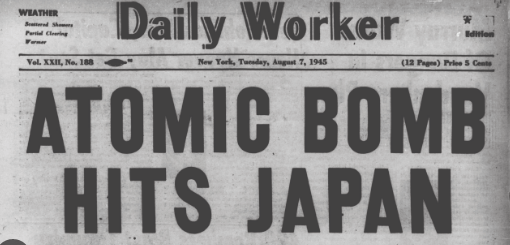
With a single blinding flash, Hiroshima was reduced to ashes — not just a city, but the very fabric of humanity was torn apart. The dawn of atomic weaponry marked a horrifying transformation in modern warfare, turning scientific progress into an existential threat. These weapons, capable of annihilating millions within seconds, remain the most terrifying innovation of the modern world.
Despite diplomatic efforts and non-proliferation treaties, the looming specter of nuclear war still hovers over our global society. The atomic bomb is not merely a military tool but a symbol of mankind’s potential for self-destruction. Nations amass arsenals not for defense, but for deterrence, locked in a paradox where peace is maintained by the threat of annihilation. As scholar Jonathan Schell argued in The Fate of the Earth, humanity now lives with the knowledge that “its fate can be sealed in a moment of political misjudgment.”
This blog delves into the moral, environmental, political, and social implications of atomic weapons, analyzing why they are not just tools of war but enduring curses on human civilization. By unpacking the wide-ranging consequences of nuclear armament, we can better understand why disarmament isn’t just a political ideal but a moral imperative.
1- Historical Genesis of Atomic Weapons
The atomic bomb was born out of the crucible of World War II, a product of the Manhattan Project — a secret initiative that brought together the brightest scientific minds, including Robert Oppenheimer and Enrico Fermi. While the project was spurred by fears of Nazi Germany developing such weapons first, its end result inaugurated a perilous new age. The bombings of Hiroshima and Nagasaki were not just military actions, but moral ruptures that changed the ethics of warfare forever.
The aftermath was staggering: over 200,000 people perished, many instantly, others through prolonged suffering due to radiation. Historian Richard Rhodes, in The Making of the Atomic Bomb, described this as “the ultimate technological crime.” This historical moment underscored the vulnerability of civilization when science is divorced from ethical responsibility.
2- Threat to Global Peace
Atomic weapons undermine global stability by creating a false sense of security among nuclear-armed states. The doctrine of Mutually Assured Destruction (MAD) may deter direct conflict but it amplifies the stakes of every geopolitical tension. Each confrontation becomes a game of brinkmanship with potentially apocalyptic outcomes.
Moreover, rogue states or non-state actors gaining access to nuclear weapons further destabilizes international peace. As former UN Secretary-General Kofi Annan once warned, “The world is over-armed and peace is under-funded.” The risk that nuclear weapons could fall into irresponsible hands cannot be overstated, and underscores the urgent need for global disarmament mechanisms.
3- Humanitarian Consequences
The immediate effects of a nuclear blast—heat, shockwave, and radiation—are catastrophic. But the long-term humanitarian consequences are even more harrowing. Survivors, known as hibakusha in Japan, suffer from chronic illnesses, genetic damage, and psychological trauma that span generations.
Organizations like the International Committee of the Red Cross (ICRC) have stated that no adequate humanitarian response is possible in the event of a nuclear detonation. The destruction of infrastructure, hospitals, and emergency systems means that survivors are left without care or support, illustrating that nuclear warfare is inherently inhumane and indiscriminate.
4- Environmental Devastation
The detonation of atomic weapons causes irreversible environmental damage. The heat and radiation incinerate ecosystems, poison water supplies, and render fertile land barren. Fallout particles can travel thousands of miles, contaminating areas far from the detonation site.
Additionally, scientists warn about the possibility of “nuclear winter”—a scenario in which multiple detonations could send soot into the atmosphere, blocking sunlight and drastically cooling the planet. As environmental scholar Alan Robock notes, “Even a limited nuclear war could disrupt global agriculture and threaten billions with famine.”
5- Psychological Impact on Populations
The mere existence of nuclear weapons casts a psychological shadow over humanity. Living under the constant threat of annihilation causes widespread anxiety, especially during geopolitical crises. Civil defense drills and the normalization of doomsday scenarios have deeply affected public consciousness.
This collective anxiety can lead to apathy or fatalism, undermining civic engagement and trust in governance. Philosopher Günther Anders described this as the “inability to feel,” arguing that our psychological defenses numb us to the true horror of nuclear reality — a dangerous detachment from existential risk.
6- Economic Burden of Nuclear Programs
The costs of developing, maintaining, and modernizing nuclear arsenals run into billions annually. These are resources that could otherwise be directed toward education, healthcare, and sustainable development. The Stockholm International Peace Research Institute (SIPRI) estimates that global military spending exceeded $2 trillion in recent years, with nuclear programs consuming a significant share.
Economists argue that nuclear investment is a poor allocation of national resources. Nobel laureate Joseph Stiglitz has pointed out that military spending, especially on nuclear arms, offers negligible returns in terms of social welfare or economic growth.
7- Risk of Accidental Launch
The complexity and speed of modern command-and-control systems raise the terrifying possibility of accidental nuclear launch. Historical incidents, like the 1983 Soviet false alarm where a satellite mistook sunlight reflecting off clouds as incoming missiles, nearly led to global catastrophe.
Reliance on fallible technology and human judgment in high-stakes scenarios is a recipe for disaster. As Daniel Ellsberg revealed in The Doomsday Machine, even top military officials have questioned the reliability of these systems, making disarmament not only ideal but necessary.
8- Proliferation Concerns
Despite international treaties like the Non-Proliferation Treaty (NPT), the spread of nuclear weapons remains a persistent threat. States often pursue nuclear capabilities under the guise of civilian programs, blurring the line between peaceful and military use.
This dual-use dilemma is exploited by nations seeking strategic leverage. The more actors that possess nuclear technology, the higher the risk of conflict escalation. As former US President John F. Kennedy feared, “Today, every inhabitant of this planet must contemplate the day when this planet may no longer be habitable.”
9- Diplomatic Challenges
Nuclear weapons complicate diplomatic relations. While they may prevent direct wars between superpowers, they also foster mistrust, secrecy, and hostility. Arms control negotiations are often stalled by accusations, geopolitical rivalries, and a lack of verification mechanisms.
Moreover, the possession of nuclear weapons often emboldens aggressive behavior, knowing adversaries must tread lightly. This undermines the very idea of sovereign equality and creates a global order skewed in favor of nuclear powers.
10- Violation of International Law
The use of atomic weapons violates principles of international humanitarian law, particularly the rules of distinction and proportionality. In 1996, the International Court of Justice concluded that the use of nuclear weapons would generally be contrary to international law.
Legal scholars like Richard Falk argue that nuclear arms “defy the moral and legal norms of civilization.” Their continued existence represents not just a military concern but a profound legal and ethical failing on the part of the international community.
11- Technological Arms Race
The possession of nuclear weapons has fueled a broader technological arms race, pushing nations to develop more advanced and lethal systems. Hypersonic missiles, space-based weapons, and AI-driven command systems are part of this dangerous spiral.
This arms race undermines global stability and channels scientific talent into destructive ventures. As Albert Einstein famously warned, “The splitting of the atom has changed everything save our modes of thinking, and thus we drift toward unparalleled catastrophe.”
12- Undermining Democratic Accountability
The decision to launch nuclear weapons often rests in the hands of a few individuals, bypassing democratic institutions. This centralization of power creates an undemocratic and opaque framework where life-and-death decisions are shielded from public scrutiny.
In countries like the United States and Russia, the president holds unilateral authority to launch nuclear weapons. This concentration of power erodes public trust and contradicts democratic principles of checks and balances.
13- Cultural Impact and Normalization of Violence
Nuclear weapons have seeped into popular culture through films, books, and games, sometimes glamorizing or trivializing their use. This desensitizes the public to their catastrophic consequences and normalizes violence on an unimaginable scale.
The portrayal of nuclear war as a backdrop for entertainment dulls the seriousness of the issue. As Susan Sontag noted, modern culture often uses “apocalyptic imagery” as spectacle, reducing real dangers to cinematic tropes and eroding public concern.
14- Hindrance to Global Disarmament Movements
The continued modernization of nuclear arsenals undermines disarmament efforts. When major powers refuse to disarm, they send a message that nuclear weapons are essential for security, encouraging others to follow suit.
This hypocrisy stymies global disarmament movements and alienates non-nuclear states. Efforts like the Treaty on the Prohibition of Nuclear Weapons face resistance not because of practicality, but due to entrenched power politics.
15- Ethical and Moral Objections
Many religious and philosophical traditions condemn the use of weapons capable of indiscriminate slaughter. The Vatican has declared nuclear weapons immoral, as they contradict the principles of human dignity and the sanctity of life.
Moral philosophers like Michael Walzer argue that just war theory cannot justify nuclear warfare, which inevitably targets civilians. The ethical cost of possessing such weapons outweighs any strategic benefit.
16- Generational Trauma
The impact of nuclear weapons spans generations. Genetic mutations, psychological scars, and social stigmatization affect not just direct survivors, but their descendants. The hibakusha community continues to report health issues and societal exclusion.
This intergenerational suffering highlights the enduring legacy of atomic warfare. No other weapon continues to harm long after the war is over, making nuclear arms uniquely malevolent.
17- Political Manipulation and Power Projection
Nuclear weapons are often used as tools of political theater. Leaders invoke their arsenals to boost national pride or intimidate adversaries, manipulating public sentiment for political gain.
This turns weapons of mass destruction into instruments of propaganda. As historian Eric Hobsbawm noted, “Power exercised through fear is not just unjust—it is unstable.” Such manipulation increases global insecurity.
18- Suppression of Scientific Dissent
Many scientists who contributed to the development of nuclear weapons later opposed their use, only to be marginalized. Figures like Leo Szilard and Joseph Rotblat were sidelined for their ethical objections.
This suppression of dissent discourages scientific conscience and critical thinking. When science serves politics without question, it risks becoming complicit in crimes against humanity.
19- Incompatibility with Sustainable Development Goals
The existence and funding of nuclear weapons contradict the United Nations’ Sustainable Development Goals (SDGs). Peace, environmental sustainability, and poverty alleviation are all compromised by nuclear programs.
Redirecting nuclear budgets toward SDG initiatives could dramatically improve global welfare. As the UN Development Programme emphasizes, “There can be no sustainable development without peace, and no peace without sustainable development.”
20- Call for Global Nuclear Disarmament
The only path to true security is complete and verifiable disarmament. International cooperation, transparency, and public advocacy are essential in this endeavor. Civil society movements and NGOs like ICAN (International Campaign to Abolish Nuclear Weapons) play a critical role in maintaining momentum.
Disarmament is not a utopian dream—it is a necessity for human survival. As former U.S. President Dwight D. Eisenhower said, “The world must devote its energies to peace, or face utter destruction.”
Conclusion
Atomic weapons, far from being deterrents or symbols of power, are ticking time bombs threatening all life on Earth. Their humanitarian, environmental, ethical, and psychological toll makes their existence an ongoing crisis. Despite efforts at arms control, the danger remains entrenched in global politics.
The choice before humanity is stark: disarm or perish. It is our collective moral responsibility to advocate for a world free from the shadow of nuclear annihilation. Let history be our witness and the future our motivation. As Oppenheimer reflected after the first atomic test, quoting the Bhagavad Gita, “Now I am become Death, the destroyer of worlds.” Let us not fulfill that prophecy.

By Amjad Izhar
Contact: amjad.izhar@gmail.com
https://amjadizhar.blog
Affiliate Disclosure: This blog may contain affiliate links, which means I may earn a small commission if you click on the link and make a purchase. This comes at no additional cost to you. I only recommend products or services that I believe will add value to my readers. Your support helps keep this blog running and allows me to continue providing you with quality content. Thank you for your support!

Leave a comment