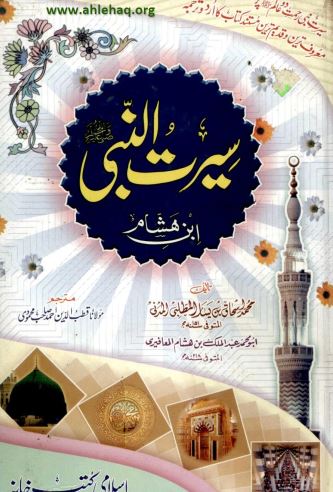
This text provides excerpts from the first volume of “Seerat Ibn Hisham”, a prominent classical biography of the Prophet Muhammad, with Arabic text and an Urdu translation. The content begins with the title page, which lists the work’s title, author (Ibn Hisham), and translator (Maulvi Qalb al-Din Ahmed Sahab Mahmoodi), along with the publisher and place of publication. The subsequent pages contain the table of contents, offering a detailed list of topics covered in this volume, including the lineage of the Prophet, stories from the pre-Islamic era such as the story of the elephant and the rebuilding of the Kaaba, and events leading up to the start of Islam. The remaining pages contain the narrative and textual content in both languages, illustrating the biographical and historical accounts mentioned in the index.

Sīrat Ibn Hishām: Biography of the Prophet Muhammad
This extensive document contains excerpts from the first volume of Sīrat Ibn Hishām, a foundational work on the biography of the Prophet Muhammad, authored by Muhammad Abd al-Malik Ibn Hishām and translated by Mawlawī Qutbuddin Ahmad Sahib Mahmūdi. The content is organized as a detailed table of contents and select text pages, revealing a chronological structure that begins with the Prophet’s lineage and early life. Key thematic sections include narratives about the early history of the Arabs, significant figures like Abd al-Muttalib, and crucial pre-Prophetic events such as the Year of the Elephant and the digging of the Zamzam well. The document’s purpose is to preserve and present detailed accounts of the Prophet’s life and the socio-historical context of early Islam, making it a critical resource for Islamic historical study.
Sīrat Ibn Hishām: Prophetic Biography and Arabian History
The text titled سیرت ابن ہشام (Sīrat Ibn Hishām) is also known by the broader designation سیرت النبی (Sīrat al-Nabī), meaning The Prophetic Biography. The provided sources are excerpts from Volume 1 of this work.
The author of the book is identified as Abu Muhammad Abd al-Malik bin Hishām al-Ma’āfirī (ابومحمد عبدالملک بن هشام المعافری), who passed away in 215 AH (المتوفی ۲۱۵ھ). The printed Urdu version provided specifies the author as Muhammad Abd al-Malik Ibn Hishām.
The work is considered a “treasure trove of Prophetic biography” (Sīrat Nabawī ﷺ ka pesh khazanah) and documents the life of the Prophet Muhammad (peace and blessings be upon him).
Content and Structure (Volume 1, Part 1)
The first part of Sīrat Ibn Hishām covers a period stretching from primordial ancestry up to the very early stages of prophethood in Mecca (Makkah).
Key Topics Covered:
The work begins by discussing the lineage (nasab) of the Holy Prophet Muhammad (ﷺ) traced back to Adam (علیہ السلام). The lineage and descendants of Isma’il (علیہ السلام) are also detailed.
The book extensively documents the history of the Arabian Peninsula leading up to the advent of Islam, including many pre-Islamic events and figures (the era of Jahiliyyah):
- Ancient Kingdoms and Tribes: Discussions include the rule of Rabī’ah bin Nasr bin Ḥakam in Yemen and the account of Shashq and Saṭīḥ. The state of the Himyarite kingdom is covered, along with the subsequent rule and downfall of Dhū Nuwās.
- The Story of the Ma’rib Dam: The tale of ‘Amr bin ‘Amir and the destruction of the Ma’rib Dam is recounted.
- The People of the Trench (Asḥāb al-Ukhdūd): The narrative of those mentioned in the Qur’an as the People of the Trench is discussed, involving the reign of Dhū Nuwās. This section also discusses the origin of Christianity in Najrān.
- Early History of Mecca and the Ka’bah:The account covers the management of the Ka’bah and the well of Zamzam. The digging of Zamzam by ‘Abd al-Muṭṭalib is narrated.
- The management and authority of the Ka’bah are linked to figures like Qusayy bin Kilāb and subsequent conflicts, such as the Ḥilf al-Fuḍūl (Pact of Fudhul).
- The Event of the Elephant (Aṣḥāb al-Fīl) is detailed, including the expedition by Abraha and God’s protection of the Ka’bah.
The Life of the Prophet (ﷺ):
The first part of the Sīrat transitions into the Prophet’s (ﷺ) early life:
- Birth and Early Guardianship: The death of the Prophet’s father, ‘Abdullah, and the events surrounding his birth, nursing, and guardianship under ‘Abd al-Muṭṭalib and Abū Ṭālib are covered.
- Early Life Events: The text narrates events like the trading journey to Syria and the encounter with Baḥīra the Monk, and the Battle of Fijār (Jang-e Fijār).
- Marriage and Prophethood: The marriage of the Prophet (ﷺ) to Khadījah (رضی اللہ عنہا) is mentioned. The book also describes the start of divine revelation (ibtida-e Nubuwwat) and the beginning of the obligatory prayers.
Ibn Hishām’s Methodological Approach
Ibn Hishām’s text largely presents narratives and traditions, particularly drawing heavily upon the earlier work of Ibn Isḥāq
Prophet Muhammad’s Ancestry and Early Meccan History
The discussion of Early Islamic History (Sīrat al-Nabī) in the provided source material, Volume 1 of Sīrat Ibn Hishām, focuses heavily on the historical, ancestral, and environmental context surrounding the Prophet Muhammad (ﷺ) before and during the early years of his prophethood in Mecca (Makkah).
The scope of this volume extends from the primordial ancestry of the Prophet (ﷺ) back to Adam (علیہ السلام) and covers the foundational period of Islam up to the beginning of obligatory prayers.
Pre-Islamic Context of Arabia (Jahiliyyah)
The sources provide significant detail regarding the state of Arabia, particularly Yemen and the Hijaz region (where Mecca is located), emphasizing events that shaped the cultural and religious environment before Islam:
1. Ancestry and Lineage
The history begins with the lineage (nasab) of the Holy Prophet Muhammad (ﷺ) traced back through his father, ‘Abdullah, and grandfather, ‘Abd al-Muṭṭalib, up to Adam (علیہ السلام). The descendants of Isma’il (علیہ السلام) are also detailed. The history of the Quraysh, the ruling tribe of Mecca, is intrinsically linked to the history of the Ka’bah.
2. Historical Shifts and Political Upheaval
The sources extensively narrate the history of kingdoms in the region, focusing particularly on Yemen and the transfer of power:
- Rule in Yemen: The history includes the reign of Rabī’ah bin Nasr bin Ḥakam in Yemen and the accounts of Shashq and Saṭīḥ.
- The Himyarite Kingdom and Dhū Nuwās: The book discusses the state, subsequent decline, and fall of the Himyarite kingdom, detailing the rule of Dhū Nuwās.
- Destruction of the Ma’rib Dam: The story of ‘Amr bin ‘Amir and the destruction of the Ma’rib Dam is recounted. This event led to the dispersal of certain tribes.
3. Religious and Social Precursors
Crucial events highlighting the religious landscape and moral environment include:
- The People of the Trench (Asḥāb al-Ukhdūd): This episode describes the atrocities committed by Dhū Nuwās against the people of Najrān, who had adopted Christianity, involving burning them in trenches. The account details the origin of Christianity in Najrān.
- Pagan Practices: The text describes the polytheistic practices prevalent in Mecca, mentioning idols and the way people dedicated animals (like the Sā’ibah and Waṣīlah) to deities other than God.
- The Ḥilf al-Fuḍūl (Pact of Fudhūl): This pact established among the Quraysh tribes in Mecca was aimed at upholding justice and standing against oppression. The Prophet Muhammad (ﷺ) attested to having been present at this covenant and approving of it.
- The Battle of Fijār (Jang-e Fijār): This conflict occurred during the life of the Prophet (ﷺ) before prophethood.
4. The Custodianship of the Ka’bah and the Event of the Elephant
Control and honor associated with the Ka’bah and the Zamzam well were central to Meccan history.
- Qusayy bin Kilāb held authority over the Ka’bah. After him, managing the Ka’bah and related rites led to conflicts between various groups.
- Digging of Zamzam: The sources detail ‘Abd al-Muṭṭalib’s rediscovery and excavation of the Zamzam well.
- The Event of the Elephant (Aṣḥāb al-Fīl): This miraculous event involved Abraha’s expedition from Yemen to destroy the Ka’bah in Mecca. The sources present this as a clear demonstration of divine protection for the Ka’bah and Mecca.
The Dawn of Islam
The text moves into the life of the Prophet Muhammad (ﷺ) and the foundation of the Islamic era:
1. Birth and Early Life
- The death of ‘Abdullah, the Prophet’s father, and the circumstances surrounding his birth are mentioned.
- The Prophet’s (ﷺ) nurturing and guardianship, first under his grandfather ‘Abd al-Muṭṭalib and then under his uncle Abū Ṭālib, are detailed.
- A significant early event is the encounter with Baḥīra the Monk during a trading journey to Syria, who recognized signs of prophethood in the young Muhammad (ﷺ).
2. Prophethood and Early Adherents
The historical narrative describes the pivotal transition into the prophetic mission in Mecca:
- Beginning of Revelation (ibtida-e Nubuwwat): The initiation of divine revelation is recorded.
- Early Islam: The volume documents the conversion of the earliest believers:
- Khadījah (رضی اللہ عنہا) embraced Islam and used her wealth to support God’s cause.
- Ali bin Abi Talib (رضی اللہ عنہ) was among the first men to accept Islam.
- Abu Bakr al-Ṣiddīq (رضی اللہ عنہ) was the first among the freedmen to embrace Islam and was praised for his status and dignity.
- The Prophet (ﷺ) also began performing obligatory prayers.
3. Opposition and Persecution
The final sections of the relevant excerpt detail the growing resistance from the Quraysh, marking the start of tribulations for the early Muslim community:
- Quraysh Opposition: The Quraysh began to speak negatively about the Prophet’s (ﷺ) teachings and attempted to find ways to oppose the spread of Islam.
- Persecution and Migration: The sources mention the rising intensity of oppression and tyranny (zulm aur sitam) against the Muslims by the Quraysh. This ultimately led to the first migration of Muslims to Abyssinia (Ethiopia). The account includes details about figures involved in persecuting Muslims, such as Walīd bin Mughīra.
- Conversion of Hamza and Umar: The conversion of Ḥamza bin ‘Abd al-Muṭṭalib (رضی اللہ عنہ) and Umar bin al-Khaṭṭāb (رضی اللہ عنہ) to Islam is a notable event mentioned in the struggle for early converts.
Pre-Islamic Arabia: History and Context from Sīrat Ibn Hishām
The provided sources, drawn from Volume 1 of Sīrat Ibn Hishām, detail the history and environment of Pre-Islamic Arabia (often referred to as the era of Jahiliyyah or ignorance) leading up to the advent of Islam. This historical account establishes the political, social, and religious context in which the Prophet Muhammad (ﷺ) was born and began his mission.
I. Political and Geographical Context
The narrative focuses on the history of important regions, particularly Yemen in the south and Mecca in the Hijaz.
A. Kingdoms and Tribal Shifts in Yemen
The text discusses several ancient ruling houses and significant shifts in power across Southern Arabia:
- The Himyarite Kingdom: The sources trace the history of the Himyarites, including the reign of Rabī’ah bin Nasr bin Ḥakam in Yemen. The accounts of Shashq and Saṭīḥ are documented in relation to this period.
- Dhū Nuwās and the Decline of Himyar: The rule and eventual downfall of Dhū Nuwās are detailed.
- The Ma’rib Dam Disaster: A pivotal event was the story of ‘Amr bin ‘Amir and the subsequent destruction of the Ma’rib Dam. This disaster led to tribes dispersing from the region.
- Foreign Influence: Later history mentions the rule of Saif bin Dhī Yazan over Yemen. The sources also cover the end of the rule of the Persians and their descendants in Yemen.
B. The Lineage and Authority in Mecca
The work begins by establishing the ancestry and status of the central tribe, the Quraysh:
- Lineage of the Prophet (ﷺ): The lineage (nasab) of the Holy Prophet Muhammad (ﷺ) is traced back through his ancestors. The lineage and descendants of Ismā’īl (علیہ السلام) are specifically outlined.
- Custodianship of the Ka’bah: The governance and authority over the Ka’bah and associated rites began with figures like Qusayy bin Kilāb. The text details the conflicts that arose over the control of the sacred sites and rituals.
- Zamzam Well: The history of the well of Zamzam, including its excavation by ‘Abd al-Muṭṭalib, is recorded, emphasizing its importance to Mecca.
II. Major Events Defining the Era
Several pre-Islamic events are highlighted for their political and religious significance:
A. The People of the Trench (Aṣḥāb al-Ukhdūd)
This narrative concerns the Christian community in Najrān during the reign of Dhū Nuwās.
- The sources describe how Dhū Nuwās became a tyrant and persecuted the people of Najrān who had adopted Christianity.
- The atrocities involved burning the believers in trenches (ukhudūd).
- The accounts detail the origin and introduction of Christianity in Najrān.
B. The Event of the Elephant (Aṣḥāb al-Fīl)
This famous event took place in the year of the Prophet’s (ﷺ) birth.
- The story recounts the expedition of Abraha (from Yemen/Abyssinian authority) who intended to demolish the Ka’bah in Mecca.
- God protected the Ka’bah, destroying Abraha’s army with birds (Abābīl) dropping stones. The Qur’anic reference to this event is included in the sources.
C. Social and Moral Agreements
Despite the prevailing disorder, attempts were made to enforce justice:
- The Battle of Fijār (Jang-e Fijār): A significant conflict that occurred before the Prophet (ﷺ) received revelation, in which he participated in carrying arrows.
- The Pact of Fudhūl (Ḥilf al-Fuḍūl): This agreement established among the Quraysh tribes was designed to oppose oppression and injustice and to return rights to the wronged. The Prophet (ﷺ) attested to having witnessed this pact and approved of it in Islam.
III. Religious Practices (Idolatry and Rituals)
The sources describe the pervasive idolatry and associated rites that characterized the religious environment of pre-Islamic Arabia:
- Idolatry and Its Origins: The Meccans worshipped idols alongside performing rites like the circumambulation (Tawāf) of the Ka’bah. The origins of some famous idols like Wadd, Suwā’, Yaghūth, Ya’ūq, and Nasr are traced back to the time of Nūḥ (علیہ السلام).
- Rituals and Sacrifices: The Meccans would dedicate animals to their idols:
- Sā’ibah (a she-camel set free due to a vow).
- Waṣīlah (a she-camel that gives birth to specific twins, dedicated to idols).
- The practice of dedicating animals, such as the Sā’ibah and Waṣīlah, meant making them unlawful (haram) for use or consumption, a practice criticized later in the Qur’an.
- Haram Months: The Arabs followed the practice of observing four forbidden (or sacred) months during which fighting was prohibited. The text notes that sometimes they would postpone or change the sequence of these sacred months (Nasī’), a practice mentioned in the sources.
Sīrat Ibn Hishām: Ancestry and Early Life of Muhammad
The first volume of Sīrat Ibn Hishām covers the period from the primordial ancestry of the Prophet Muhammad (ﷺ) up to the early years of his prophetic mission in Mecca, detailing crucial events that established the foundation of early Islamic history.
I. Ancestry and Early Life
The text begins by detailing the esteemed lineage (nasab) of the Holy Prophet Muhammad (ﷺ), tracing his descent back through his father, ‘Abdullah, and grandfather, ‘Abd al-Muṭṭalib, all the way to Adam (علیہ السلام). The lineage and descendants of Ismā’īl (علیہ السلام) are also specifically detailed.
The Role of ‘Abd al-Muṭṭalib
The Prophet’s (ﷺ) grandfather, ‘Abd al-Muṭṭalib, features prominently in the history immediately preceding his birth and early childhood:
- Digging of Zamzam: ‘Abd al-Muṭṭalib was responsible for the excavation of the Zamzam well. The account includes a dream he had regarding the well.
- The Vow and ‘Abdullah’s Sacrifice: The sources detail the story of the vow made by ‘Abd al-Muṭṭalib that, if he were granted ten sons, he would sacrifice one of them. The lot fell upon ‘Abdullah, the Prophet’s father, and the story concludes with ‘Abdullah being ransomed by camels.
- The Event of the Elephant (Aṣḥāb al-Fīl): This momentous event occurred in the year of the Prophet’s (ﷺ) birth and is narrated as a divine act of protecting the Ka’bah from Abraha’s expedition. ‘Abd al-Muṭṭalib is noted for his brave stance during this crisis.
Birth, Nursing, and Guardianship
- Father’s Death and Birth: The Prophet’s (ﷺ) father, ‘Abdullah, died before his birth. The text describes the circumstances surrounding the Prophet’s (ﷺ) birth.
- Nursing: The Prophet (ﷺ) was nursed by Ḥalīmah bin Abi Dhu’ayb al-Sa’diyyah (رضی اللہ عنہا), whose family subsequently experienced great blessing and prosperity.
- Guardianship: Upon the death of the Prophet’s mother, Āminah, his grandfather ‘Abd al-Muṭṭalib took charge of his upbringing. After ‘Abd al-Muṭṭalib’s death, the Prophet (ﷺ) came under the protection of his uncle, Abū Ṭālib, who provided support despite his own hardship.
II. Events Before Prophethood
As Muhammad (ﷺ) grew into maturity, he participated in events central to Meccan society and exhibited signs of his future mission:
- Trading Journey to Syria: The Prophet (ﷺ) embarked on a trading journey to Syria.
- Encounter with Baḥīra the Monk: During the journey, the Prophet
Sīrat Ibn Hishām: Genealogy and Arabian Tribes
The source material, Volume 1 of Sīrat Ibn Hishām, places immense importance on genealogy (nasab) and tribal history, using them as the framework for detailing the life of the Prophet Muhammad (ﷺ) and the pre-Islamic context of Arabia.
I. The Prophet Muhammad’s (ﷺ) Genealogy
The primary focus of the genealogical discussion is tracing the lineage of the Holy Prophet Muhammad (ﷺ):
- Ultimate Ancestry: The lineage (nasab) of the Prophet Muhammad (ﷺ) is documented back to Adam (علیہ السلام).
- The Line of Isma’il (علیہ السلام): The work details the lineage and descendants of Ismā’īl (علیہ السلام). The ancestry is traced through Ibrāhīm (علیہ السلام) and Ismā’īl (علیہ السلام).
- Emphasis on High Status: Ibn Hishām indicates that the lineage of the Prophet (ﷺ), specifically through his mother and father, is considered the “best and highest” in relation to all of Adam’s descendants.
- Ibn Hishām’s Editorial Note: The author, Ibn Hishām, states that he has abbreviated certain references to individuals from the progeny of Ismā’īl (علیہ السلام) and omitted mention of some details related to the time of Ibrāhīm (علیہ السلام) that are not substantiated by the Qur’an, traditions (sunnah), or sound reports.
II. Major Tribal Divisions and Relationships
The sources delve into the major tribal divisions that populated Arabia, highlighting their origins and power dynamics.
A. Adnān and Qaḥṭān
The primary tribal divisions mentioned are based on the descendants of Ismā’īl (علیہ السلام) and his progeny, leading to the distinction between the Adnān and Qaḥṭān groups:
- Adnān: Descendants of ‘Adnān are mentioned, and the lineage of the Prophet (ﷺ) is traced through him. These tribes were often involved in controlling Mecca and the Ka’bah.
- Qaḥṭān: The sources mention that Qaḥṭān is considered by some to be from the descendants of Ismā’īl (علیہ السلام), or otherwise, they are traced back to Yaqṭān bin ‘Ābir bin Shālih bin Arfakhshad bin Sām bin Nūḥ (علیہ السلام).
- Arab Tribes (Al-‘Arab): The sources mention that people sometimes refer to the descendants of Ismā’īl (علیہ السلام) as the Arab of the Hijaz and the descendants of Qaḥṭān as the Arab of Yemen.
B. The Quraysh and Control of Mecca
The Quraysh tribe, the immediate clan of the Prophet (ﷺ), held central authority in Mecca:
- Qusayy bin Kilāb: He is a critical ancestral figure, having gained control and authority over the Ka’bah. After his time, the management of the Ka’bah was inherited by his descendants.
- Quraysh Clans: The text details the internal structure and leadership dynamics of the Quraysh, including the disputes over authority after Qusayy.
- The Prophet’s lineage is traced through ‘Abd al-Muttalib, Hāshim, and ‘Abd Manāf, who were key figures in Quraysh nobility.
- The disputes over management tasks after Qusayy’s descendants caused disagreement and the division of authority into four parts (which suggests a complex power-sharing arrangement).
- The Ḥilf al-Fuḍūl (Pact of Fudhūl): This pact was a significant tribal agreement among the Quraysh aimed at maintaining justice and opposing tyranny. The Prophet Muhammad (ﷺ) affirmed participation in it before prophethood.
C. Other Major Tribes
The sources frequently mention other influential tribes in the Arabian Peninsula that interacted with Mecca or held regional power:
- Khuzā’ah: This tribe was initially responsible for the management of the Ka’bah and the well of Zamzam before Quraysh asserted control. They were later expelled.
- Banū Bakr and Banū Khuzaymah: These tribes are mentioned in connection with conflicts over the Ka’bah’s custodianship.
- The ‘Adwān Tribe: The text mentions ‘Amr bin al-Ḥārith bin Ya’mar bin ‘Adwān in the context of postponing the sacred months (Nasī’).
- Yemeni Tribes (Himyar and Others): The early history of Yemen focuses on the Himyarite kingdom and the rule of figures like Dhū Nuwās. Tribal movements, such as the dispersal resulting from the destruction of the Ma’rib Dam, are detailed, involving figures like ‘Amr bin ‘Āmir.
- The Anṣār (in Medina): While primarily referring to the Meccan period, the text mentions tribal conflicts (like the battle between Rabī’ah bin Nasr bin Ḥakam’s forces and the people of Yathrib/Medina). The history of the Anṣār (who would later support the Prophet) is briefly referenced in relation to those who settled in Medina.
III. Genealogical Methodology and Function
In Sīrat Ibn Hishām, genealogy serves several functions beyond mere identification:
- Validating Status: Genealogy is used to emphasize the lofty status and dignity of the Prophet (ﷺ).
- Establishing Historical Context: Detailed ancestry links the Prophet (ﷺ) and the origins of the Ka’bah to earlier prophets like Ibrāhīm and Ismā’īl (علیہم السلام), providing a religious and historical foundation for Islam.
- Clarification: Ibn Hishām and Ibn Isḥāq frequently use genealogical detail to explain alliances, conflicts, and the meaning of ancient poetry (ash’ār). For example, a discussion arises about whether the tribe of Khuza’ah were part of the descendants of Ismā’īl or not.
- Omission of Disputed Lineage: Ibn Hishām notes that he omits certain genealogies and historical details if they are not confirmed by the Qur’an or reliable tradition, focusing only on what is essential to the Prophet’s history.

Leave a comment