This tutorial provides a comprehensive guide to regression analysis, covering simple linear regression, multiple linear regression, and logistic regression. It explains how to model relationships between variables to make predictions, focusing on interpreting results and assessing model assumptions. The tutorial uses examples to illustrate the application of each regression type, including how to handle categorical variables using dummy variables. It also demonstrates calculations both manually and using statistical software, like Data.tab. Finally, it explains how to interpret key metrics in each type of regression, such as p-values and odds ratios.
Regression Analysis Study Guide
Quiz
Instructions: Answer the following questions in 2-3 sentences each.
- What is the primary purpose of regression analysis?
- Explain the difference between a dependent and an independent variable in regression.
- When is simple linear regression the appropriate method to use?
- How does multiple linear regression differ from simple linear regression?
- What type of dependent variable is used in logistic regression?
- What is the purpose of the regression line in simple linear regression?
- Explain the concept of multicollinearity in the context of regression analysis.
- What is the purpose of “dummy variables” when working with regression analysis?
- What does the P-value tell you in a regression analysis output?
- What is the odds ratio and how is it interpreted in logistic regression?
Answer Key
- Regression analysis is primarily used to model relationships between variables, allowing researchers to infer or predict the value of one variable based on one or more other variables. It can be used to measure the influence of one variable or several variables on another variable or you can predict a variable based on other variables.
- The dependent variable is the one being predicted or inferred, while the independent variables are those used to make the prediction. In other words, the dependent variable responds to changes in the independent variables.
- Simple linear regression is appropriate when you want to model the relationship between two variables, a single dependent variable and a single independent variable, and when this relationship can be represented by a straight line.
- Multiple linear regression extends simple linear regression by incorporating two or more independent variables to predict the dependent variable, allowing for a more complex and potentially accurate model. The goal is to understand how multiple factors influence a single outcome.
- Logistic regression is used when the dependent variable is categorical, typically binary, meaning it has two possible values, such as yes/no, success/failure, or diseased/not diseased.
- The regression line in simple linear regression is the straight line that best fits the data points on a scatter plot, minimizing the error or the distance between the actual data points and the line itself. This line represents the average relationship between the independent and dependent variables.
- Multicollinearity occurs when two or more independent variables in a regression model are highly correlated with each other. It can make it difficult to isolate the independent effect of each variable on the dependent variable. It can lead to unstable or unreliable results and may confuse the impact of individual variables.
- “Dummy variables” are used to include categorical variables with more than two categories in a regression model. They are artificial variables created to represent each category, typically coded with 0 or 1 to represent the absence or presence of the category.
- The p-value in a regression analysis is used to test the null hypothesis and to determine whether the relationship between the independent and the dependent variable is statistically significant, meaning that the relationship we observe is Meaningful or just due to random chance. If the p-value is smaller than a chosen significance level (e.g., 0.05), we reject the null hypothesis.
- The odds ratio in logistic regression is a measure of how much more likely an outcome is to occur given a specific condition or change in an independent variable. It represents the ratio of the odds of an event happening in one group compared to the odds in another group and can be used to understand how a variable influences the likelihood of the outcome.
Essay Questions
Instructions: Answer the following essay questions in a thorough, well-organized essay format.
- Compare and contrast the application of simple linear regression, multiple linear regression, and logistic regression. In what scenarios would each technique be appropriate? Provide specific examples.
- Describe the key assumptions of linear regression, explaining why each assumption is important for the validity of the results. Detail how to check for and address any violations of these assumptions.
- Explain the purpose of the multiple correlation coefficient (R) and the coefficient of determination (R²) in a multiple linear regression model. What do these values tell you about the model’s goodness of fit?
- Discuss the issue of multicollinearity in multiple linear regression. How does it impact a regression model, and what strategies can be employed to mitigate its effects?
- Explain the use and interpretation of odds ratios in logistic regression. How do they differ from coefficients in linear regression, and what information do they provide about the relationships between the variables?
Glossary of Key Terms
Categorical Variable: A variable that can take on one of a limited, and usually fixed, number of possible values, assigning each individual or other unit of observation to a particular group or nominal category. Can be binary (two categories) or nominal (more than two categories).
Coefficient of Determination (R²): A statistical measure that represents the proportion of the variance in a dependent variable that can be explained by the independent variables in a regression model. Ranges from 0 to 1, where a higher value indicates a better model fit.
Dependent Variable: The variable that is being predicted or inferred in a regression analysis; also called the response, output, or target variable. Its value is thought to depend on one or more other variables.
Dummy Variable: An artificial variable created to include categorical variables with more than two categories in a regression model. It uses a binary code (0 or 1) to represent the absence or presence of each category.
Homoscedasticity: The assumption in linear regression that the errors (the differences between actual and predicted values) have equal variance across all values of the independent variable(s).
Independent Variable: The variable that is used to make predictions about or infer relationships to the dependent variable; also called the predictor or input variable.
Intercept (a): The point where the regression line crosses the y-axis, representing the predicted value of the dependent variable when all independent variables are zero.
Linear Regression: A method for modeling the relationship between a dependent variable and one or more independent variables, assuming the relationship is linear.
Logistic Regression: A statistical method for modeling the relationship between a categorical dependent variable (usually binary) and one or more independent variables, using a logistic function to estimate the probability of an event occurring.
Multicollinearity: A condition in regression analysis where two or more independent variables are highly correlated with each other, making it difficult to isolate the effect of each variable and causing unstable or unreliable results.
Multiple Linear Regression: A form of regression analysis that uses two or more independent variables to predict a single, continuous dependent variable.
Odds Ratio: A measure of the relative odds of an outcome occurring in one group compared to another in logistic regression. It indicates how much more likely the event is to occur in one group compared to another.
P-value: A statistical measure that indicates the probability of obtaining results as extreme as, or more extreme than, the observed results if the null hypothesis is true. In regression, it is used to assess the statistical significance of relationships between variables.
Regression Analysis: A statistical method for modeling relationships between variables, often used to infer the influence of independent variables on a dependent variable or to predict one variable based on others.
Regression Line: In simple linear regression, the straight line that best fits the data points on a scatter plot, representing the average relationship between the variables.
Simple Linear Regression: A form of regression analysis that uses one independent variable to predict a single, continuous dependent variable.
Slope (b): The coefficient in a linear regression equation that shows how much the dependent variable changes with a one-unit increase in the independent variable.
Standardized Coefficients: Coefficients that result from standardizing the variables to the same scale. They can be compared to each other, and this can be used to assess the relative importance of the different independent variables.
Regression Analysis Tutorial
Okay, here’s a detailed briefing document summarizing the provided text on regression analysis:
Briefing Document: Regression Analysis Tutorial
Introduction
This document summarizes a comprehensive tutorial on regression analysis, covering its fundamentals, different types, and practical applications. The tutorial aims to provide a solid understanding of regression analysis for both research and prediction purposes, encompassing simple linear, multiple linear, and logistic regression techniques. The core idea is that regression analysis is a powerful method for modeling the relationship between variables, allowing for both understanding influence and making predictions.
Key Themes and Concepts
- What is Regression Analysis?
- Definition: Regression analysis is a statistical method for modeling relationships between variables, allowing one variable to be predicted or inferred based on others.
- Dependent and Independent Variables:The variable being predicted or inferred is called the dependent variable (also known as the response, output, or target variable).
- Variables used to make predictions are called independent variables (also known as predictor or input variables).
- Two Primary Goals:Measuring the influence of one or more variables on another.
- Predicting a variable based on other variables.
- Types of Regression Analysis
- Simple Linear Regression: Uses one independent variable to predict a metric dependent variable.
- Example: Predicting a person’s salary based on years of work experience.
- Multiple Linear Regression: Uses two or more independent variables to predict a metric dependent variable.
- Example: Predicting a person’s salary based on education level, weekly working hours, and age.
- Logistic Regression: Used when the dependent variable is categorical (binary in the case of binary logistic regression).
- Example: Predicting whether a person is at risk of burnout (yes/no) based on weekly working hours and age.
- Simple Linear Regression in Detail
- Purpose: To understand the relationship between two variables and predict one from the other.
- Equation: Y = a + bX, where:
- Y is the dependent variable.
- X is the independent variable.
- ‘a’ is the Y-intercept.
- ‘b’ is the slope of the line.
- Quoted: “…b is the slope of the line. The slope shows how much the house price changes if the house size increases by one square foot. a is the Y-intercept telling us where the line crosses the Y AIS.”
- Method: Finding the best-fit line through data points on a scatter plot, minimizing the error between predicted and actual values.
- Calculation:Slope (b) is calculated using correlation coefficients and standard deviations.
- Y-intercept (a) is calculated using the means of both variables and the slope.
- Quoted: “…R is the correlation coefficient between X and Y so in our case the correlation between house size and house price… s y is the standard deviation of the dependent variable house price and SX is the standard deviation of the independent variable so house size so so in this case our B is 10 18.35%…”
- Key output interpretation:P Value is used to determine statistical significance.
- If the P value is small (typically < 0.05), reject the null hypothesis, suggesting a significant relationship between the variables
- If the P value is large (typically > 0.05), fail to reject the null hypothesis.
- Assumptions of Simple Linear Regression
- Linear Relationship: The relationship between variables should be linear (i.e. able to be summarized by a straight line).
- Independence of Errors: Errors (differences between predicted and actual values) should be independent of each other.
- Homoscedasticity: The variance of errors should remain constant across all values of X.
- Quoted: “…If we plot the errors on the y axis and the dependent variable on the xais their spread should be roughly the same same across all values of X…”
- Normally Distributed Errors: Errors should be normally distributed.
- Multiple Linear Regression in Detail
- Purpose: To understand the relationship between multiple independent variables and a single metric dependent variable.
- Quoted: “… multiple linear regression uses several independent variables to predict or inere the dependent variable…”
- Equation: Y = a + b1X1 + b2X2 + … + bnXn, where:
- Y is the dependent variable.
- X1, X2, …, Xn are independent variables.
- ‘a’ is the intercept.
- b1, b2, …, bn are coefficients.
- Interpretation: Coefficients indicate the change in Y for each one-unit increase in the respective independent variable, holding other variables constant.
- Quoted: “… if an independent variable increases by one unit the associated coefficient B indicates the corresponding change in the dependent variable…”
- Standardized coefficients: Help compare the relative importance of independent variables measured in different units.
- Key output interpretation:Multiple Correlation Coefficient (R): Measures correlation between predicted and actual values (with higher values indicating a better fit).
- R-squared: Indicates the proportion of variance in the dependent variable explained by the independent variables.
- Adjusted R-squared: Accounts for the number of independent variables in the model (used to avoid overestimation).
- Standard Error of the Estimate: Measures the average distance between observed data points and the regression line.
- Assumptions: Similar to simple linear regression, with an added assumption of no multicollinearity
- Assumptions of Multiple Linear Regression
- Linearity, Independence of Errors, Homoscedasticity, Normally distributed errors. (same as with Simple Linear Regression).
- No Multicollinearity: Independent variables should not be highly correlated with each other; this is because it can make it difficult to separate the influence of independent variables.
- Detection:Using R-squared values (for each independent variable as the dependent in a regression with all the other independent variables) to calculate tolerance and variance inflation factor (VIF).
- Tolerance less than 0.1 or VIF greater than 10 indicates multicollinearity.
- Quoted: “…if the tolerance is less than 0.1 it indicates potential multicolinearity and caution is required…a VI value greater than 10 is a warning sign of multicolinearity…”
- Solutions: Remove one of the correlated variables or combine correlated variables.
- Handling Categorical Variables
- Dummy Variables:Used to incorporate categorical variables into regression models.
- Each category except one (the reference category) becomes a dummy variable (0 or 1).
- Quoted: “Dummy variables are artificial variables that make it possible to handle variables with more than two categories.”
- The number of dummy variables created is equal to the number of categories minus one.
- Interpretation: Coefficients for dummy variables represent the difference between each category and the reference category.
- Logistic Regression in Detail
- Purpose: Predict the probability of a binary outcome (e.g. yes/no, success/failure) based on independent variables.
- Quoted: “…binary logistic regression is now a type of regression analysis used when the outcome variable is binary meaning it has two possible values…”
- Logistic Function: Used to ensure predicted probabilities are between 0 and 1.
- Equation: Uses the logistic function to transform the linear regression output and calculate probabilities.
- Quoted: “…the equation for the logistic function looks like this…”
- Method: Estimates coefficients using the maximum likelihood method.
- Quoted: “…this is done using the maximum likelihood method…”
- Classification Threshold: Typically set at 50% for determining the predicted class (but different thresholds can be used).
- Quoted: “… if a value exceeds 50% the person is classified as diseased otherwise they are classified as not diseased…”
- Key output interpretation:Classification Table: Shows actual versus predicted classes and the overall accuracy.
- Chi-Square test: Evaluates the significance of the model.
- Model summary: Shows how well the regression model explains the dependent variable, including R squared values.
- Model Coefficients: Coefficients that can be entered in the logistic regression formula.
- Odds Ratio:Indicates how much more likely an event is to occur in one group compared to another
- Calculated by exponentiating each coefficient
- For continuous variables, represents the change in odds for a one-unit increase.
Summary
The tutorial provides a comprehensive introduction to regression analysis, explaining fundamental concepts and practical applications of simple linear, multiple linear, and logistic regression. The content emphasizes not only calculation but also the interpretation of results, assumptions underlying the models, and how to handle categorical data. By using both formulas and examples, the tutorial builds a strong foundation for applying regression techniques to real-world scenarios. The use of software like data tab is also shown to simplify analysis, making regression more accessible.
Regression Analysis FAQ
FAQ on Regression Analysis
- What is regression analysis and what are its main uses? Regression analysis is a statistical method used to model relationships between variables. It allows you to predict or infer the value of one variable (the dependent variable) based on one or more other variables (the independent variables). There are two main uses: first, to measure the influence of one or more independent variables on a dependent variable, and second, to predict a dependent variable based on the values of other independent variables. For example, you might investigate how education, working hours, and age affect salary, or predict hospital stay duration based on a patient’s characteristics.
- What are the different types of regression analysis and how do they differ? There are three main types: simple linear regression, multiple linear regression, and logistic regression. Simple linear regression uses one independent variable to predict a metric dependent variable (like salary or house price). Multiple linear regression uses two or more independent variables to predict a metric dependent variable. Logistic regression is used when the dependent variable is categorical (like ‘yes’ or ‘no’, ‘diseased’ or ‘not diseased’). The key difference lies in the nature of the dependent variable and the number of predictors used.
- How does simple linear regression work and what are its key components? Simple linear regression models the relationship between a single independent variable and a single metric dependent variable. It uses a straight line to represent this relationship, aiming to minimize the error between the line and the data points. The core equation is Y = a + bX, where Y is the dependent variable, X is the independent variable, ‘a’ is the y-intercept (the value of Y when X is zero), and ‘b’ is the slope (the change in Y for each one-unit increase in X). The goal is to calculate ‘a’ and ‘b’ to best fit the data.
- What are the key assumptions of linear regression (both simple and multiple)? Linear regression relies on several key assumptions. These include (1) a linear relationship between the independent and dependent variables, (2) independence of errors, meaning errors of one data point don’t influence others, (3) homoscedasticity, which assumes that the variance of errors is constant across all values of independent variables, and (4) normally distributed errors. Multiple linear regression adds one more: (5) no multicollinearity, meaning independent variables are not highly correlated with each other, as this could make it difficult to reliably determine the individual effects of the predictors on the outcome.
- What is multicollinearity, and how can it be detected and addressed? Multicollinearity occurs in multiple regression when two or more independent variables are highly correlated with each other. This makes it difficult to separate out their individual effects on the dependent variable. Multicollinearity can be detected by calculating the tolerance (ideally >0.1) and the Variance Inflation Factor (VIF) (ideally <10) for each independent variable. If multicollinearity is present, it can be addressed by either removing one of the correlated variables or by combining the correlated variables into a new composite variable.
- How do you handle categorical variables in regression analysis, especially when there are more than two categories? Categorical variables with two categories can be directly included by coding one category as ‘0’ and the other as ‘1’. For variables with more than two categories, dummy variables are created. For each category except one (the reference category), a new variable is made that is ‘1’ when the corresponding category is present and ‘0’ otherwise. For example, a variable like vehicle type with three categories (sedan, sports car, family van) would need two dummy variables, with one of the categories being the reference and setting the dummy variables to 0.
- What is logistic regression and when is it used? Logistic regression is used when the dependent variable is binary (categorical with two possible outcomes, like ‘yes/no’ or ‘success/failure’). It models the probability of the dependent variable being one of these categories based on the values of independent variables. It differs from linear regression by using a logistic function to ensure predictions stay within the 0-1 probability range. It does this using a modified equation that makes use of the original linear regression equation in its formula.
- How are the results of a logistic regression interpreted, particularly the odds ratios? In logistic regression, the results include coefficients, p-values, and odds ratios. Coefficients indicate the change in the log-odds for a one-unit change in the independent variable. P-values help determine whether the variable has a significant impact on the outcome or if the observed results are due to chance. An odds ratio compares the odds of an outcome in two different groups; an odds ratio greater than one indicates an increased likelihood of the outcome occurring in one group versus another. For instance, an odds ratio of 1.5 indicates an event is 1.5 times as likely to occur in the group compared to the reference group. Odds ratios are calculated by exponentiating each of the coefficients.
Regression Analysis Fundamentals
Regression analysis is a method used to model relationships between variables, allowing for the inference or prediction of a variable based on one or more other variables [1]. The variable to be inferred or predicted is the dependent variable, while the variables used for prediction are the independent variables [1]. Independent variables can also be called predictor or input variables, while dependent variables might be called response, output, or target variables [1].
Regression analysis can be used for two main purposes:
- To measure the influence of one or more variables on another [2]. This is common in research to understand the factors that impact a certain outcome [2].
- To predict a variable based on other variables [2]. This is often used to optimize processes, such as predicting hospital stay duration to improve planning or to suggest products to online store visitors [2].
There are different types of regression analysis:
- Simple linear regression: Uses one independent variable to predict a dependent variable [2]. For instance, predicting a person’s salary based on years of work experience [3]. The relationship between the variables is modeled by a straight line, and the goal is to find the line that minimizes the error or the distance between the actual data points and the line itself [3, 4].
- Multiple linear regression: Uses several independent variables to predict or infer a dependent variable [2]. An example of this would be predicting salary based on education level, working hours, and age [5].
- Multiple linear regression has assumptions that need to be met. These include:
- A linear relationship between independent and dependent variables [6].
- Independence of errors [6].
- Homoscedasticity, or equal variance of errors [6].
- Normally distributed errors [6].
- No multicollinearity, meaning that independent variables are not highly correlated with each other [6, 7]. Multicollinearity can be detected using the variance inflation factor (VIF) [8]. If the tolerance is less than 0.1 or VIF is greater than 10, there could be multicollinearity [8]. Multicollinearity can be addressed by removing one of the correlated variables or by combining them [8].
- Logistic regression: Used when the dependent variable is categorical [2]. The most common form is binary logistic regression, where the outcome has two possible values (e.g., yes/no, success/failure) [9]. Logistic regression is used to estimate the probability of an event occurring [10].
- In logistic regression, the predicted values range between 0 and 1, using the logistic function [10].
- The coefficients are determined using the maximum likelihood method [10].
- The odds ratio is used in logistic regression to compare the odds of an event occurring in two different groups [11].
In both linear and multiple regression, the dependent variable is a metric variable, whereas in logistic regression, it is a categorical or nominal variable [9]. Independent variables can be nominal, ordinal, or metric [9]. If a variable has more than two categories, dummy variables are created to use it in regression models [9, 12].
When conducting a regression analysis, it is important to check the assumptions of the model to ensure the results are reliable and meaningful [5].
Linear Regression: Simple and Multiple
Linear regression is a method used to model the relationship between variables, with the goal of predicting or inferring a dependent variable based on one or more independent variables [1, 2]. There are two main types of linear regression, simple and multiple [3, 4].
Simple Linear Regression
- Simple linear regression uses just one independent variable to predict a dependent variable [3, 4]. For example, a simple linear regression could be used to predict a person’s annual salary based on their years of work experience or to predict a house price based on its size [2].
- The relationship between the two variables is modeled using a straight line [5].
- The goal is to find the line that minimizes the error, or the distance, between the actual data points and the regression line [2, 6].
- The equation of a simple linear regression is defined by a slope (B) and a Y intercept (a) [6].
- The slope (B) shows how much the dependent variable changes if the independent variable increases by one unit [6].
- The Y intercept (a) tells where the line crosses the Y axis. If the independent variable is zero, the model will predict a dependent variable value of a [6].
- The slope and intercept can be calculated by hand using formulas or using statistical software [6].
- To calculate the slope (B), you need the correlation coefficient between the independent and dependent variables, as well as the standard deviation of each [6].
- Once the slope has been calculated, the intercept (a) can be found using the means of the independent and dependent variables [6, 7].
Multiple Linear Regression
- Multiple linear regression uses several independent variables to predict or infer the dependent variable [3, 4]. For instance, multiple linear regression could be used to predict a person’s salary based on their education level, weekly working hours, and age [8].
- The coefficients in multiple linear regression are interpreted similarly to simple linear regression [9]. If all independent variables are zero, the value a is obtained for the dependent variable [9]. If an independent variable increases by one unit, the associated coefficient B indicates the corresponding change in the dependent variable [9].
- Multiple linear regression has five key assumptions that need to be met to ensure the results are reliable and meaningful [10]:
- Linear relationship: A straight line should represent the data points as accurately as possible. While it is straightforward to plot the data and regression line in simple linear regression, multiple linear regression involves multiple independent variables, which makes visualization more complex. However, you can plot each independent variable against the dependent variable separately to check for a linear relationship [5, 10].
- Independence of Errors: The errors, or the differences between actual and predicted values, should be independent of each other. This can be tested with the Durbin Watson test [5, 10].
- Homoscedasticity: The variance of errors should remain constant. If you plot the errors on the Y axis and the predicted values on the X axis, the spread should be roughly the same across all values of X [5, 10].
- Normally Distributed Errors: The errors should be normally distributed. This can be tested using a QQ plot or analytical tests [5, 10].
- No Multicollinearity: There should not be a high correlation between two or more independent variables. Multicollinearity can make it difficult to separate the effects of individual variables [10, 11].
- To detect multicollinearity, a new regression model can be set up with one independent variable as the new dependent variable, and the others as independent variables [11].
- The variance inflation factor (VIF) can be used to test for multicollinearity. If the tolerance is less than 0.1 or VIF is greater than 10, there could be multicollinearity [12].
- Multicollinearity can be addressed by removing one of the correlated variables or combining them [12].
In both simple and multiple linear regression, the dependent variable is a metric variable [4, 9].
Multiple Linear Regression: A Comprehensive Guide
Multiple linear regression is a method for modeling relationships between variables, where the goal is to predict or infer a dependent variable using two or more independent variables [1, 2]. It extends simple linear regression, which uses only one independent variable [1, 2].
Key Concepts
- Dependent Variable: The variable being predicted or inferred. It is a metric variable [3, 4].
- Independent Variables: The variables used to predict the dependent variable. These can be nominal, ordinal, or metric [3].
- Coefficients: Similar to simple linear regression, each independent variable has a corresponding coefficient (B) that indicates the change in the dependent variable for a one-unit increase in the independent variable, assuming all other variables are constant [4]. There is also an intercept (a), which is the value of the dependent variable when all independent variables are zero [4].
Equation
- The multiple linear regression equation is an extension of the simple linear regression equation, but with multiple independent variables, each with its own coefficient [4].
- The equation can be expressed as: Ŷ = a + B1X1 + B2X2 + … + BkXk, where Ŷ is the predicted value of the dependent variable, a is the intercept, B1, B2,… Bk are the coefficients for the independent variables X1, X2,… Xk, respectively [4].
Assumptions
Multiple linear regression has five key assumptions that must be met to ensure the results are reliable and meaningful [5]:
- Linear Relationship: A linear relationship should exist between the independent variables and the dependent variable. While simple linear regression allows for a straightforward visualization of this relationship, it is more complex with multiple independent variables. However, you can plot each independent variable against the dependent variable separately to assess linearity [5].
- Independence of Errors: The errors (the difference between the actual and predicted values) should be independent of each other. This can be tested using the Durbin Watson test [5].
- Homoscedasticity: The variance of the errors should be constant across all levels of the independent variables. If the errors are plotted against the predicted values, the spread should be roughly consistent [5].
- Normally Distributed Errors: The errors should be normally distributed, which can be checked using a QQ plot or other analytical tests [5].
- No Multicollinearity: There should not be high correlations between two or more independent variables. Multicollinearity can make it difficult to determine the effect of individual variables [5, 6].
- Multicollinearity can be detected using the variance inflation factor (VIF) [7]. A tolerance of less than 0.1 or a VIF greater than 10 indicates potential multicollinearity [7].
- Multicollinearity can be addressed by removing one of the correlated variables or combining them [7].
Interpretation of Results
- Regression Coefficients: Indicate the change in the dependent variable for a one-unit increase in the independent variable, holding all other variables constant [8]. Standardized coefficients can be used to compare the relative importance of different variables, especially when they are measured in different units [8].
- P-value: Indicates whether the corresponding coefficient is significantly different from zero and whether a variable has a real influence, or if the result is due to chance. If the p-value is less than 0.05, the result is significant [9].
- Multiple Correlation Coefficient (R): Measures the correlation between the dependent variable and the combination of independent variables [9].
- Coefficient of Determination (R-squared): Indicates the proportion of variance in the dependent variable that is explained by the independent variables [9]. The adjusted R-squared accounts for the number of independent variables in the model [10].
- Standard Error of the Estimate: Measures the average distance between the observed data points and the regression line [10].
Use of Categorical Variables
- Multiple linear regression can include categorical independent variables.
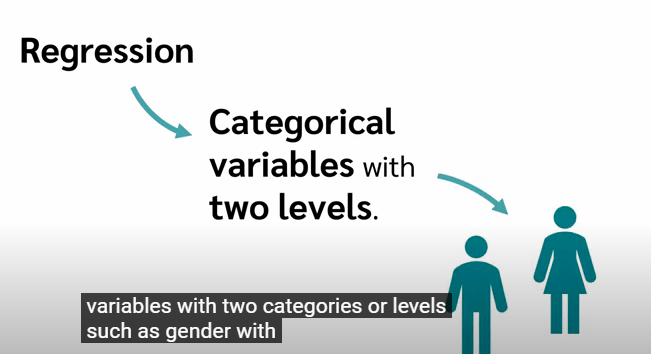
- Categorical variables with two levels (e.g., gender) can be coded as 0 or 1 [10].
- Categorical variables with more than two levels can be incorporated by creating dummy variables [11]. The number of dummy variables created will be one less than the number of categories [11]. For example, if a variable has three categories, two dummy variables will be created [11].
In summary, multiple linear regression is a powerful tool for analyzing the relationship between multiple independent variables and a single dependent variable, but it is important to ensure that the model’s assumptions are met and that the results are interpreted correctly [2].
Logistic Regression Analysis
Logistic regression is a type of regression analysis used when the outcome variable is binary, meaning it has two possible values, such as yes or no, or success or failure [1]. It is used to predict the probability of an event occurring [2].
Key Concepts
- Binary Outcome: The dependent variable in logistic regression is binary, meaning it has two possible outcomes [1, 3].
- Independent Variables: Logistic regression uses one or more independent variables to predict the probability of the binary outcome [1].
- Logistic Function: Logistic regression uses the logistic function to ensure that the predicted probabilities fall between 0 and 1 [2].
- Maximum Likelihood Method: The coefficients in logistic regression are determined using the maximum likelihood method, which finds the coefficients that best fit the given data [2].
Comparison to Linear Regression
- Dependent Variable: In linear regression, the dependent variable is a metric variable (e.g., salary, electricity consumption), while in logistic regression, the dependent variable is binary [1, 3].
- Prediction: Linear regression can produce values between minus and plus infinity, whereas logistic regression produces values between zero and one, representing probability [2].
- Straight Line: Linear regression puts a straight line through the data, whereas logistic regression uses the logistic function [2].
Equation
- The equation for the logistic function is used in logistic regression to predict the probability of the dependent variable being equal to one, given specific values of the independent variables [2].
Interpretation of Results
- Classification Table: Shows how often the categories were observed and how frequently they were predicted. A threshold of 50% is typically used to classify the predicted probabilities into one of the two categories. If the probability exceeds 50%, the person is classified as having the outcome; otherwise, they are classified as not having the outcome [4].
- Ki Square Test: Evaluates whether the model as a whole is statistically significant by comparing a model with all independent variables to a model without any independent variables [4].
- Model Summary: The model summary table contains the minus 2 log-likelihood value and coefficients of determination (R-squared) [4]. In logistic regression, the R-squared indicates the proportion of variance explained by the model, but there is no consensus on the best way to calculate it [4].
- Model Coefficients Table: This table provides coefficients, p-values, and odds ratios.
- The coefficients from the model can be inserted into the regression equation [5].
- The p-value shows whether the corresponding coefficient is significantly different from zero. If the p-value is less than 0.05, the difference is considered significant [5].
- The odds ratio is a comparison of the odds of an event occurring in two different groups, and it indicates how much more likely the event is to occur in one group compared to another [6]. An odds ratio greater than one means the event is more likely in the first group, while an odds ratio less than one means the event is less likely in the first group [6].
- The odds ratio can be calculated by exponentiating each coefficient [7].
Example
- Suppose we are studying the influence of age, gender, and smoking status on whether a person develops a certain disease. The outcome variable is whether the person developed the disease or not, and the independent variables are age, gender, and smoking status [1].
- The logistic regression model would estimate the probability of a person being diseased based on their age, gender, and smoking status [2].
- The odds ratio for a variable such as medication would compare the odds of getting the disease for people who took the medication versus those who did not [8].
- For a continuous variable such as age, an odds ratio would represent the change in the odds of the outcome for a one-unit increase in age [8].
In summary, logistic regression is a method used to model the relationship between independent variables and a binary outcome. It provides probabilities and odds ratios to help understand the effect of the independent variables.
Regression Analysis Assumptions
Regression analysis, whether simple linear, multiple linear, or logistic, relies on certain assumptions to ensure the validity and reliability of the results [1-4]. These assumptions vary slightly depending on the type of regression but generally revolve around the nature of the data, the errors, and the relationships between variables. Here’s a breakdown of the key assumptions in regression analysis:
Assumptions for Linear Regression (Simple and Multiple)
- Linear Relationship: A fundamental assumption for linear regression is that a linear relationship exists between the independent variable(s) and the dependent variable [3, 5].
- In simple linear regression, this is easy to visualize with a scatter plot, where the data points should roughly form a straight line [5].
- In multiple linear regression, it is more complex to visualize because there are multiple independent variables, but you can plot each independent variable separately against the dependent variable to assess linearity [3].
- Independence of Errors: The errors (the differences between the actual and predicted values) should be independent of each other [3, 5].
- This means that the error of one data point should not influence the error of another data point.
- This can be tested using the Durbin-Watson test [3, 5, 6].
- Homoscedasticity (Equal Variance of Errors): The variance of the errors should be constant across all levels of the independent variable(s) [3, 5].
- If the errors are plotted against the predicted values, the spread should be roughly consistent. A funnel shape in the plot indicates heteroscedasticity, meaning the variance is not constant [3, 5, 6].
- Normally Distributed Errors: The errors should be normally distributed [3, 5].
- This can be assessed using a QQ plot or analytical tests [3, 5, 6].
- A QQ plot can be used where the residuals should fall roughly along a straight line if they are normally distributed [5].
- Analytical tests should show a P-value greater than 0.05 for the data to be considered normally distributed [5].
- Graphical methods are often preferred to assess normality [5].
Additional Assumption for Multiple Linear Regression
- No Multicollinearity: In multiple linear regression, there should be no high correlation between two or more independent variables [3].
- Multicollinearity can make it difficult to determine the effect of individual variables because they overlap in the information they provide [7].
- Multicollinearity can be detected using the variance inflation factor (VIF). A tolerance of less than 0.1 or a VIF greater than 10 indicates potential multicollinearity [8].
- To address multicollinearity, one of the correlated variables can be removed, or the correlated variables can be combined into one [8].
Consequences of Violating Assumptions
- If these assumptions are violated, the regression results may not be reliable or meaningful, and the predictions could be inaccurate [6].
- It’s crucial to check these assumptions before drawing conclusions from a regression model [6].
Assumptions in Logistic Regression
While logistic regression does not have the same assumptions about the distribution of errors as linear regression, there are other considerations:
- Linearity in the Logit: Logistic regression assumes a linear relationship between the independent variables and the logit (log-odds) of the outcome variable, not the outcome variable itself [9].
- Independence of Observations: Similar to linear regression, the observations should be independent of one another. This means that the outcome for one observation should not influence the outcome for another observation.
- Absence of Multicollinearity: Similar to multiple linear regression, multicollinearity can be an issue and should be checked and addressed accordingly.
In Summary
- Linear Regression (Simple and Multiple) assumes linearity, independence of errors, homoscedasticity, and normally distributed errors, with an additional assumption of no multicollinearity for multiple linear regression [3, 5].
- Logistic Regression assumes linearity in the logit, independence of observations, and lack of multicollinearity [9].
- It is important to always check the assumptions of your chosen regression model to ensure that your results are valid and meaningful [6].

By Amjad Izhar
Contact: amjad.izhar@gmail.com
https://amjadizhar.blog
Affiliate Disclosure: This blog may contain affiliate links, which means I may earn a small commission if you click on the link and make a purchase. This comes at no additional cost to you. I only recommend products or services that I believe will add value to my readers. Your support helps keep this blog running and allows me to continue providing you with quality content. Thank you for your support!

Leave a comment