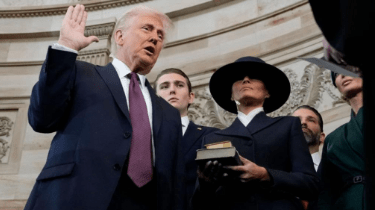
President Trump’s second term began with a flurry of executive orders addressing immigration, border security, and pardoning January 6th defendants. He also rescinded Biden-era policies on diversity, inclusion, and transgender rights, sparking immediate legal challenges. Simultaneously, political discussions surrounded cabinet nominations, including Marco Rubio as Secretary of State, and the confirmation process faced potential roadblocks. Finally, the report also covers other news, such as Israeli firefighters aiding California wildfires and a heartwarming rescue of a dog from a frozen river.
Review of President Trump’s Second Term: A Study Guide
Quiz
Instructions: Answer each question in 2-3 complete sentences.
- What were two of President Trump’s major executive orders issued on his first day back in office?
- How did President Trump justify ending birthright citizenship in the U.S.?
- How did President Trump characterize those who were arrested for their actions on January 6th, 2021?
- What was the justification given by President Trump for pardoning those involved in the January 6th, 2021 Capitol attack?
- What was President Trump’s rationale for his involvement in a potential deal regarding TikTok?
- What did Trump do that was unique during his public signing of executive orders at Capital One Arena?
- What is the significance of the executive order that defines gender based on reproductive function?
- How will the new executive order potentially affect healthcare providers offering gender-affirming care?
- What was the primary reason for the Israeli General’s resignation?
- What two events brought the US and Israeli firefighters closer?
Answer Key
- President Trump issued executive orders increasing border security and declared an end to birthright citizenship, which states that a person born on US soil is automatically a citizen. He also pardoned many of those arrested for the January 6th Capitol attack.
- President Trump argued that the United States is one of the only countries in the world that grants birthright citizenship. He described it as ridiculous and as something that should be ended.
- President Trump referred to the January 6th prisoners not as criminals but as “hostages.” He expressed his belief that they were unjustly treated and imprisoned.
- President Trump emphasized that he had a mandate from 77 million voters, and that pardoning the January 6th individuals aligns with the will of the people. He also recognized that these individuals had suffered losses due to their involvement in January 6th.
- President Trump stated that TikTok, which has garnered a large following of young people, has “become a soft part of his heart.” He wants to make a deal with Tik Tok to salvage it because of his affinity for the social media platform.
- President Trump signed the executive orders in front of a large crowd at the Capital One Arena, and he then threw the commemorative pens used to sign them into the crowd. He did this as a demonstration of his connection to the people.
- The executive order defined gender strictly as male or female based on reproductive function. This executive order prohibits federal agencies from promoting “gender ideology” and limits official government documentation to only recognize male or female.
- Healthcare providers receiving federal funding cannot use it for gender affirming care under the new executive order. Although they may continue to provide these services, this is likely to limit access to care.
- The Israeli General resigned due to his admitted responsibility for the security failures that led to Hamas’ October 7th attack. He acknowledged the immense pain caused by the war.
- The relationship between US and Israeli firefighters was brought closer by the Southern California wildfires and Hamas’s attack on Israel. Israeli firefighters offered help in the California wildfires because the US offered help to Israel in the past.
Essay Questions
Instructions: Answer each question with a well-structured essay that provides supporting evidence from the provided text.
- Analyze the immediate impact of President Trump’s executive orders on his first day back in office. In your analysis, consider both the intended goals and the potential challenges or controversies surrounding these actions.
- Discuss how President Trump’s actions regarding the January 6th prisoners, the pardons and the commutations, reflect his broader political strategy and messaging.
- Examine the rationale behind President Trump’s decision to redefine gender at the federal level. How might this order impact the LGBTQ+ community and broader societal norms and values?
- Contrast the different narratives presented in the source regarding President Trump’s return to the White House. How do the interviewees view his actions, and what might those differing perspectives suggest about the current political climate?
- Evaluate the significance of the collaborative efforts between US and Israeli firefighters in the context of geopolitical relationships and humanitarian aid.
Glossary of Key Terms
- Executive Order: A directive issued by the President of the United States that manages operations of the federal government.
- Birthright Citizenship: The principle that a person born within the territory of a country automatically becomes a citizen of that country.
- January 6th: Refers to the events of January 6, 2021, when a mob of Trump supporters attacked the U.S. Capitol Building.
- Pardon: An act of forgiveness for a crime by the President or a governor, relieving the offender of punishment.
- Commutation: A reduction in the severity of a criminal sentence by the president or a governor.
- Gender Affirming Care: Medical and therapeutic treatments to help transgender or non-binary individuals align their physical bodies with their gender identity.
- Gender Ideology: A term often used by those opposed to LGBTQ+ rights to characterize perspectives that are not based on the biological concept of gender.
- Maga: Acronym for “Make America Great Again,” a political slogan popularized by Donald Trump.
- Title 9: An anti-discrimination law that prohibits discrimination based on sex in federally funded education.
- Biological Sex: Refers to the classification of an individual based on their reproductive organs, typically as male or female.
- Hamas: A Palestinian Sunni-Islamist fundamentalist organization, known for engaging in armed conflict with Israel.
- Interfaith: Involving multiple religious faiths.
Trump’s Second Term: First 24 Hours
Okay, here’s a detailed briefing document summarizing the key themes and information from the provided news transcript:
BRIEFING DOCUMENT: President Trump’s Second Term – First 24 Hours
Date: [Assuming current date based on the news cycle] Source: CBN News Broadcast Transcript – “Faith Nation” Prepared For: [Intended Audience – e.g., Internal Analysis, Political Stakeholders]
Executive Summary:
This news transcript details the first 24 hours of Donald Trump’s second term as president, highlighting a flurry of executive actions aimed at rapidly reversing Biden-era policies and fulfilling campaign promises. Key themes include aggressive action on immigration, a redefinition of gender at the federal level, and controversial pardons for January 6th defendants. The report also touches upon cabinet appointments, international relations, and domestic issues. Trump’s actions are characterized as a “Maga Candy Factory,” with his supporters seeing it as a fulfillment of their agenda. The report also shows that these actions are very controversial and that many expect legal challenges.
Key Themes and Policy Changes:
- Aggressive Immigration Policy:State of Emergency: President Trump declared a national state of emergency at the southern border.
- Quote: “declaring that the United States has a national state of emergency along the border…”
- Remain in Mexico Policy: Sweeping changes were made to ensure asylum seekers remain in Mexico while waiting for hearings.
- Quote: “he’s provided some sweeping changes to make sure that people remain in Mexico before coming to this country to even have an asylum hearing…”
- End to Birthright Citizenship: Trump declared an end to birthright citizenship, likely facing legal challenges.
- Quote: “the President also declaring an end to Birthright citizenship…the move already facing legal push back from more than a dozen states”
- Drug Cartels as Terrorists: Drug cartels involved in human and drug trafficking are now designated as terrorist organizations.
- Quote: “they are now designated as terrorist organizations… they’re killing our people they’re killing 250 300,000 American people a year…”
- Pardons for January 6th Defendants:Trump issued full pardons and commutations for approximately 1,500 people involved in the January 6th Capitol riot.
- Quote: “approximately 1,500 for a pardon yes full pardon full pardon or commutations full pardon we have about six commutations in there where we’re doing further research”
- This move was widely criticized, including by members of both Republican and Democrat parties but applauded by his supporters.
- Quote: “it comes as no surprise to his supporters… the president is receiving a lot of push back from various senators and members of Congress on the house side as well on Republican and Democrat sides”
- Trump refers to those who participated in the January 6 riot as “hostages.”
- Quote: “going so far as to do what he did along the campaign Trail calling those j6 prisoners not prisoners but hostages”
- This is a move seen as popular with his base, but likely to be very unpopular in other sectors.
- Quote: “Donald Trump has a mandate 77 million people voted for him so this idea that he’s pardoning the folks on January 6 look the American people have spoken”
- Reversal of Biden-Era Policies:Withdrawal from Agreements: The U.S. was withdrawn from the Paris Climate Accord and the World Health Organization.
- Diversity, Equity, and Inclusion (DEI): Dozens of Biden-era directives were rescinded, including DEI programs and federal recognition of transgender identity.
- Quote: “additionally he re Ed dozens of Biden era directives including diversity equity and inclusion programs and federal recognition of transgender identity”
- Redefining Gender:Executive Order on Gender: An executive order was issued defining gender strictly as male or female based on reproductive function.
- Quote: “president Trump wasted no time signing an executive order that defines gender strictly as male and female based on reproductive function”
- Federal Documents: Only male or female will be allowed on official government documents like passports and visas.
- Single Sex Spaces: Federal departments that run prisons, migrant shelters and rape shelters are mandated to promote single-sex spaces.
- Impact on Gender Affirming Care: Federal funding (Medicaid, Medicare, Obamacare) cannot be used for gender-affirming treatments.
- Quote: “any of those dollars cannot now be used for gender affirming treatments that will make these procedures a lot less lucrative”
- Challenges Expected: This order is expected to be challenged legally, possibly reaching the Supreme Court.
- Quote: “it will certainly end up in court but wherever it’s brought to court I have every reason to believe Trump will be victorious”
- TikTok and Business Dealings:Trump is taking a business approach to the future of the Tik Tok app. *Quote: “he’s actually trying to put himself in a position to do a deal with Tik Tock saying that Tik Tock has gathered or become a soft part of his heart because of the way that so many young people voted for him through Tik Tok he feels an affinity towards that he wants to salvage it”
- Trump believes that if he does not approve a deal, the app is worthless, but that if he approves a deal it will be worth a trillion dollars. *Quote: “Tik Tock is worthless worthless if I don’t approve it it has to close I learned that from the people that own it if it if I don’t do the deal it’s worthless worth nothing if I do the deal it’s worth maybe a trillion dollars a trillion…”
- Cabinet Appointments:Marco Rubio: Senator Marco Rubio was sworn in as Secretary of State.
- Alice Stefanic: Republican Congresswoman Alice Stefanic was nominated for UN Ambassador. *Quote: “Republican congresswoman Alise stefanic is nominated for un embassador”
- Cabinet Nominee Issues: A cabinet nomination (unspecified name in transcript) is facing new allegations that could potentially delay confirmation.
- Quote: “that may be held up with some new allegations by his sister-in-law that has come to light”
- Inaugural Interfaith Service:The inaugural interfaith service focused on unity, but there were some challenges to the President’s policies.
- Quote: “the inaugural tradition typically focuses on a new Administration but this year service made Unity the central theme”
- Reverend Mary and Buddy asked that the President show mercy to LGBTQ people and immigrants.
- Quote: “she also challenged the president’s policies asking him to show Mercy to lgbtq people and immigrants”
Analysis and Commentary:
- “Maga Candy Factory”: Trump’s actions are described as a “Maga Candy Factory,” indicating a focus on fulfilling campaign promises and appealing to his base.
- Quote: “this is like a Maga Candy Factory it’s like if you’re if you’re a Maga uh you know person in the Maga movement it’s like uh all these exe ERS were like Skittles or Starbursts or Twizzlers take your pick in the candy store…”
- Public Signing of Executive Orders: Trump’s public signing of executive orders at a rally shows a direct connection to his base and a unique style of leadership.
- Quote: “he would go to Capital One arena in front of 20,000 or so Maga faithful and sign executive orders in public on stage that has such a We the People ring to it”
- Controversy: The pardons, gender identity policy, and other actions are expected to generate considerable controversy and legal challenges.
- Legal Battles: The executive orders on birthright citizenship and gender identity are likely to be heavily contested, potentially reaching the Supreme Court.
- Unconventional Approach: Trump’s business mind continues to be part of his political strategy as he attempts to make a deal with Tik Tok.
Other Issues Covered:
- Israel:Israeli General’s Resignation: The head of the Israeli military resigned due to security failures.
- Counter Terror Campaign: Israel has launched a new counter-terror campaign in the West Bank.
- Fire Fighters to the US: Israeli fire fighters assisted in fighting wildfires in the US, in return for the help given by the US in 2010 when there were fires in Israel.
Conclusion:
President Trump’s first 24 hours in office indicate a continuation of his “America First” policies and a willingness to implement significant changes through executive action. These rapid policy changes are likely to generate strong reactions both from supporters and opponents, resulting in a polarized political environment. Expect legal challenges and a series of domestic and international controversies in the coming days and weeks.
This briefing document is based solely on the provided transcript and does not incorporate external data or analysis.
Trump’s Second Term: Key Actions and Impacts
Frequently Asked Questions about President Trump’s Second Term Actions
- What were some of President Trump’s first actions upon returning to office?
- President Trump initiated a series of executive orders immediately upon his return, focusing on several key areas. These included significant changes to immigration policy, such as declaring a state of emergency at the border, aiming to end birthright citizenship, and requiring asylum seekers to remain in Mexico while their cases are processed. He also moved to designate drug cartels as terrorist organizations, withdrew the US from the Paris Climate Accord and the World Health Organization, rescinded Biden-era diversity, equity, and inclusion programs and federal recognition of transgender identity, and issued pardons for January 6th defendants, among other things.
- How did President Trump address the January 6th Capitol riot and its participants?
- President Trump issued full pardons to approximately 1,500 people involved in the January 6th Capitol riot, referring to them not as prisoners, but as “hostages.” This action was met with mixed reactions, drawing criticism from some members of Congress but support from his base. Some of those pardoned had been accused of assaulting police officers during the riot. Trump’s stance underscores his view that these individuals have suffered considerably, including financial and relationship losses.
- What changes did President Trump make to immigration policy and border security?
- President Trump’s actions on immigration included declaring a national state of emergency at the border, implementing policies that would require asylum seekers to remain in Mexico, and taking steps to end birthright citizenship. He also designated certain drug cartels as terrorist organizations, claiming they are responsible for significant numbers of American deaths. These moves signal a focus on strengthening border security and reversing Biden-era policies.
- What significant steps did President Trump take regarding gender identity and LGBTQ+ issues?
- Trump signed an executive order defining gender strictly as male or female, based on reproductive function. This order prohibits federal agencies from promoting what it terms “gender ideology” and mandates that official documents, like passports, only offer “male” or “female” options. Federal agencies must also promote single-sex spaces for privacy, and federal funding cannot be used for gender-affirming treatments, with certain exceptions if people pay for them out of pocket or with private insurers. This signifies a reversal of the Biden administration’s inclusive policies and is expected to face legal challenges.
- What were the key changes regarding international agreements and organizations?
- President Trump took steps to withdraw the United States from the Paris Climate Accord and the World Health Organization. This indicates a move away from international cooperation on climate change and global health initiatives, reinforcing his “America First” approach to international relations.
- What is happening with the social media platform TikTok?
- President Trump is taking a business approach in dealing with TikTok. He stated that it would be “worthless” if he did not approve it. If he approves it, he said, it could be worth up to a trillion dollars. He is seeking a deal with TikTok for the United States, suggesting the U.S. should get half of the value of the company. In the meantime, he has extended the operation of the platform in the U.S. for 75 days, presumably to facilitate this deal.
- Who is Marco Rubio and what role did he assume in the new administration?
- Marco Rubio was quickly sworn in as President Trump’s Secretary of State after being confirmed by the Senate in a 99-0 vote. Despite past differences, Rubio is now expected to support and carry out Trump’s policies, transitioning from a more traditional conservative stance to a more populist approach, particularly on trade and other issues.
- What does this mean for the political and legal landscape?
- These actions have set the stage for significant legal battles and political conflicts. The executive orders on immigration, gender identity, and the pardons for January 6th participants are all expected to be challenged in court. The speed and scale of Trump’s policy changes indicate a sharp departure from the previous administration and a determination to quickly implement his agenda, which will likely dominate American political discussion for the foreseeable future. The article notes a game of “whack-a-mole” where the courts are struggling to keep up.
Trump’s First 24 Hours: Executive Orders and Reactions
President Trump has issued a number of executive orders within his first 24 hours back in office [1]. These actions include:
- Immigration and border security: He declared a national state of emergency at the border, implemented policies to keep people in Mexico while they await asylum hearings, and declared drug cartels to be terrorist organizations [2]. He also declared an end to birthright citizenship [1].
- Pardons: Trump issued pardons to approximately 1,500 individuals who were involved in the January 6th Capitol riot, including some who attacked police [1, 2]. He referred to these individuals as “hostages” [2].
- TikTok: He signed an executive order to keep TikTok operating for 75 days, seemingly with the intent of making a deal with the company [3].
- Gender Identity: He signed an executive order defining gender strictly as male or female based on reproductive function. This order prevents federal agencies from promoting “gender ideology” and restricts the use of non-binary markers on official documents. The order also promotes single sex spaces in federal facilities [4].
- Reversal of Biden-era policies: He re-did dozens of Biden-era directives including those related to diversity, equity, and inclusion programs, and federal recognition of transgender identity [1]. He also withdrew the US from the Paris Climate Accord and the World Health Organization [1].
These executive orders have been met with a variety of responses, including legal challenges, praise from his supporters, and criticism from various senators and members of Congress [1, 2, 4, 5]. Some of these orders are expected to face legal challenges and may ultimately be decided in the Supreme Court [5]. These actions were presented to the public at a rally [3], and are seen by some as fulfilling campaign promises [1, 2].
Trump’s January 6th Pardons
President Trump issued full pardons to approximately 1,500 individuals who were involved in the January 6th Capitol riot [1-3]. This action is controversial and has drawn both praise and criticism [2, 3].
Here are some key details regarding these pardons:
- Scope: The pardons included individuals who had assaulted police officers during the riot [1, 2].
- Motivation: Trump has called the January 6th rioters “hostages” [2].
- Public Reaction: The pardons were met with enthusiasm from Trump’s supporters [2]. One individual who was pardoned stated that he was “elated” [2]. However, the pardons also received pushback from both Republican and Democratic senators and members of Congress [2].
- Justification: One source notes that Trump has a mandate, with 77 million people voting for him, suggesting that the pardons are in line with the will of a significant portion of the American people [3]. It is also noted that those who participated in the January 6th riot have suffered consequences, including financial hardship, damaged relationships, and bankruptcies [3].
- Comparison: One source also mentions that President Biden had also issued pardons to family members on his way out of office [3]. This is used to frame the pardons of the January 6th rioters as potentially less controversial [3].
- Controversy: There is discussion that these pardons, particularly those issued before anyone was convicted of a crime, may negatively impact Biden’s legacy [3].
In summary, the pardons for the January 6th participants are a significant and contentious action taken by President Trump during his first 24 hours back in office [1, 2].
Trump’s Border Security Actions
President Trump has taken several actions related to border security during his first 24 hours back in office [1].
Here are the key points:
- National Emergency Declaration: Trump declared a national state of emergency along the US border [1, 2].
- “Remain in Mexico” Policy: He implemented a policy to ensure that people remain in Mexico while they await their asylum hearings [2]. This is described as a dramatic change [2].
- End to Birthright Citizenship: Trump declared an end to birthright citizenship [1]. This move is already facing legal challenges from more than a dozen states [1].
- Terrorist Designation for Cartels: Trump designated drug cartels involved in human and drug trafficking as terrorist organizations [2]. He stated that these cartels are responsible for the deaths of hundreds of thousands of Americans each year [2].
These actions are described as aggressive, fast-moving, and a fulfillment of campaign promises [1]. The president’s policies on immigration and border security are expected to face legal challenges [1, 2].
Trump Executive Order on Gender Identity
President Trump has taken a firm stance on gender identity by signing an executive order that defines gender strictly as male or female, based on reproductive function [1]. This order has several implications:
- Federal Recognition: Federal agencies are now prohibited from promoting what the order refers to as “gender ideology” [1]. This means that the government will only recognize two biological sexes [1].
- Official Documents: Americans will only be able to select male or female on official government documents such as passports and visas [1]. The ability to select “X” as a non-binary marker on official documents, which was permitted under the Biden Administration, is rescinded [1].
- Single-Sex Spaces: Federal departments that operate prisons, migrant shelters, and rape shelters are now required to promote single-sex spaces to ensure privacy [1].
- Reversal of Biden-Era Policies: This executive order is a direct reversal of the Biden administration’s efforts to be more inclusive of LGBTQ issues [1]. The previous administration had expanded the definition of sex in federal laws and regulations to include gender identity or expression [1].
The executive order is not a nationwide mandate on which bathrooms transgender people can use, nor does it address sports competition participation [1].
This policy shift is characterized by some as a “much needed miracle” [1]. Those who support this order believe that it protects the safety of women and girls, and the biological development of children [1].
Impact on Healthcare: The order does not require hospitals or doctors to stop offering gender-affirming surgeries or treatments immediately [2]. However, any hospital, clinician, or provider that accepts federal funding (including Medicaid, Medicare, and the Affordable Care Act) will be unable to use those funds for gender-affirming treatments [2]. This may make such procedures less accessible or affordable for some, and it is expected to impact how healthcare providers view these services [2].
Legal Challenges: This executive order is already facing legal challenges from groups like the ACLU and the Human Rights Campaign [2]. It is anticipated that this issue will likely be decided in the Supreme Court [2].
Department of Education: The Department of Education is expected to be one of the first areas where challenges arise [2]. The expansion of Title IX to include gender identity, which had led to disputes about bathrooms, locker rooms, dorms, and sports, is now under review [2].
Trump’s TikTok Deal: A Business Approach
President Trump signed an executive order to keep TikTok operating for 75 days [1]. This action appears to be a strategic move to allow him time to negotiate a deal regarding the platform [1].
Here are the key details about Trump’s approach to TikTok:
- Business Mindset: Trump is approaching the situation with a business-oriented mindset, drawing from his book, “The Art of the Deal” [1].
- Personal Connection: He stated that he feels an “affinity” towards TikTok because many young people voted for him through the platform [1]. He wants to “salvage” it [1].
- Negotiation Strategy: Trump views TikTok as worthless if he doesn’t approve it, suggesting the platform’s value is contingent on his involvement [1]. He also stated that if he does make a deal for the United States, it could be worth a trillion dollars [1].
- Financial Goal: If a deal is reached, he believes the United States should receive at least half of the value [1].
In summary, Trump’s approach to TikTok is a unique blend of business strategy and personal sentiment, with a focus on a potential deal that would benefit the United States financially [1].

By Amjad Izhar
Contact: amjad.izhar@gmail.com
https://amjadizhar.blog
Affiliate Disclosure: This blog may contain affiliate links, which means I may earn a small commission if you click on the link and make a purchase. This comes at no additional cost to you. I only recommend products or services that I believe will add value to my readers. Your support helps keep this blog running and allows me to continue providing you with quality content. Thank you for your support!

Leave a comment