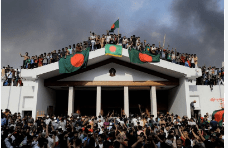
A post-coup political discussion in Bangladesh is analyzed, featuring interviews with a former Member of Parliament and a political analyst. The conversation centers on the nature of the recent events—whether a revolution or a coup—and the implications for the future, including constitutional reform and upcoming elections. Disagreements arise regarding the legitimacy of the actions and the potential for meaningful political change. The panelists debate the role of political culture and the necessity of consensus for successful reform, highlighting the challenges of achieving unity amidst deep divisions. Ultimately, the discussion underscores the uncertainty and fragility of the political landscape.
Political Turmoil and the Call for Change: A Study Guide
Quiz
Instructions: Answer the following questions in 2-3 complete sentences each.
- What are the main issues being discussed in this broadcast?
- What is the significance of the date December 31st, 2024 in the context of the discussion?
- Why does Dr. Zahidur Rahman question the use of the word “revolution” in the current context?
- What is the core argument made by Barrister Rumin Farhana regarding the current political situation?
- What are some examples of the changes in political culture being discussed, and why is this change seen as important?
- What is the speakers’ perspective on the possibility of political reform and consensus-building?
- What is the debate surrounding the existing constitution of 1972, and why are some calling for its replacement?
- What specific concerns are raised about the electoral process and potential manipulation?
- According to the speakers, what are the immediate priorities that need to be addressed before or alongside political reforms?
- How do the speakers characterize the current state of political discourse and the potential impact of the new movement?
Answer Key
- The discussion centers on the issues of dialogue, reform, and revolution declaration in Bangladesh, particularly following recent political upheaval. It addresses the validity of calling the recent events a revolution and how the current political system may or may not change.
- December 31st, 2024, is a date mentioned by revolutionaries as a day to gather at Shaheed Minar, suggesting a planned event or declaration that challenges the existing political order. The broadcast mentions it to highlight the planning by opposition forces.
- Dr. Rahman questions the use of the word “revolution” because it doesn’t fit the traditional definition of a revolution, and the movement has announced its proclamation five months after the events occurred. He also emphasizes that the changes are not addressing the state system and instead the system is still operating as before.
- Barrister Farhana believes that the current political situation is filled with confusion, chaos, and the potential for conflict among political parties. She sees the absence of a clear and transparent path forward and expresses doubts on the long term plan of the opposition movement.
- The speakers discuss the need to change the political culture, including moving away from corruption and manipulation. They also express the importance of engaging more talented people in politics to promote improvement in leadership and governance.
- The speakers express mixed opinions on political reform and consensus-building. They recognize the need for these changes but also acknowledge that extreme positions and lack of unity may hinder progress, especially if there is a conflict over political parties’ agendas.
- The existing 1972 constitution is being debated because it’s seen as insufficient for ensuring good governance. Some propose burying or canceling the constitution, asserting the need for a new political arrangement or a complete change in how the country operates.
- There is significant concern over the potential for election manipulation, with a history of vote rigging and unfair practices being brought up. Speakers express the need for transparency and accountability in the electoral process to ensure a fair and democratic election.
- Beyond major political reforms, the immediate priorities include ensuring law and order, controlling the prices of goods, and providing safety and security for citizens in their daily lives. These day to day issues are viewed as key to stabilizing the country.
- The speakers characterize the current political discourse as filled with division and hatred, stemming from years of political repression. They see the new movement as a catalyst for change, but also recognize the challenges of achieving lasting reform because the interests of all political groups don’t necessarily align.
Essay Questions
Instructions: Answer the following questions in well-structured essays.
- Analyze the different perspectives on the events described in the broadcast and evaluate their validity, and the impact of these perspectives on current political landscape.
- Discuss the role of political culture in Bangladesh, as presented in the broadcast, and explain how changing this culture is essential for long-term democratic success.
- Compare and contrast the views on the possibility of political reform and consensus-building between the various participants in the broadcast. What are the challenges to achieving reform?
- Explore the complexities of revolution, as presented in the context of the broadcast. Consider the relationship between political revolution and cultural change.
- Analyze the speakers’ concerns over the electoral process in Bangladesh and propose solutions for how to achieve fairer and more democratic elections in the future.
Glossary of Key Terms
Coup d’état: The sudden, illegal seizure of power from a government, often by a small group, and sometimes involving the military.
Revolution: A fundamental and often violent change in the political system, societal structure, and/or culture of a country. In the text, it’s discussed with the different implications the word can mean, i.e., industrial, political, or cultural revolution.
Political Culture: The set of shared beliefs, values, and practices that shape how people in a society engage with politics and government. In this context, it is used to indicate areas of needed reform for Bangladesh.
Interim Government: A temporary government set up to oversee the transition of power, especially during or after times of political upheaval. The interim government is discussed as not canceled even though the current system is considered to be canceled.
Shaheed Minar: A national monument in Bangladesh, often used for political gatherings, especially to pay respects to those who died in past uprisings and movements. The monument is an important location in this text.
Mujibism: A political ideology associated with Sheikh Mujibur Rahman, often seen as the founder of Bangladesh. This term is used in the text in the context of abolishing it as well as the current constitution.
Political Reform: Changes made to the political system aimed at improving governance, accountability, and democratic participation. Reforms in the context of this text include a review of the electoral process.
National Consensus: A broad agreement on critical issues among different political parties and groups, usually reached through dialogue and negotiation. The text emphasizes the difficulty of obtaining national consensus.
Anti-Discrimination Student Movement: A student movement mentioned in the broadcast that is at the forefront of the protests calling for change and are a driving force behind many of the changes being proposed.
Political Settlement: A negotiated agreement or framework designed to resolve a political conflict and establish a new order, which is being discussed in order to determine the future of the country.
Bangladesh’s Crossroads: Revolution, Reform, and the Future
Okay, here’s a detailed briefing document summarizing the key themes and ideas from the provided text:
Briefing Document: Analysis of Political Dialogue, Reform, and Revolution in Bangladesh
Date: October 27, 2024 (Based on the conversation which references a date in December 2024 and the 5 months following a July event)
Subject: Analysis of current political discourse in Bangladesh, focusing on calls for revolution, reform, and the implications for the nation’s future.
Sources: Excerpts from “Pasted Text” (Transcript of a news program featuring Babli Yasmin, Barrister Ruman Farhana, and Dr. Zahidur Rahman).
I. OVERARCHING THEMES
- The Nature of Revolution: The central question revolves around what constitutes a “revolution.” The program debates whether the recent events qualify as a revolution or if it is a coup d’état. Dr. Zahidur Rahman emphasizes that true revolutions involve systemic changes, not just regime change, referring to the Chinese and industrial revolutions as examples. He argues that the recent events in Bangladesh do not appear to be a revolution because the aim is to maintain the current political framework, rather than create something new.
- Political Reform vs. Revolution: A key tension exists between those advocating for radical change (“revolution”) and those favoring a more incremental approach via political reform, including electoral system reform and the rewriting of the constitution. The debate considers whether a full revolution is necessary or if targeted reforms could achieve desired results. Barrister Ruman Farhana expresses her concerns about chaos and conflict arising from a full revolution.
- The Role of Political Culture: The discussion highlights the importance of changing political culture, which is seen as deeply flawed by some participants. There is recognition that long term change can only occur through evolution, not revolution. Dr. Rahman points out how the political system has been corrupted over time, and that the country needs to nurture a better kind of political leadership.
- Consensus and Unity: The program emphasizes the need for national consensus on necessary reforms. However, there’s a growing concern that the potential for unity is fracturing due to extremist elements and disagreements within the involved parties.
- The Constitution and Systemic Issues: The current constitution is under scrutiny, with some groups aiming to bury it while others believe it can be adapted through amendments. There is a discussion about why a constitution, and even a country with no constitution, can still have good governance depending on how the nation is led. Participants emphasize systemic issues like corruption, electoral manipulation, and extrajudicial killings which exist despite the current constitution.
- The Issue of Time and Urgency: Some groups are pushing for immediate elections, while others prefer a period of transition to implement significant reforms. There’s a disagreement as to what would be most beneficial for Bangladesh, especially as the differing political parties seek to advance their own agendas.
II. KEY IDEAS & FACTS
A. The “Proclamation of July” and the December 31st Deadline: * A group associated with the Anti-Discrimination Student Movement and the Citizens’ Committee is pushing for a “Proclamation of July”, five months after the fact. * These groups are calling for a revolution on December 31, 2024, at Shaheed Minar, with the goal of creating a new political arrangement and possibly abolishing the constitution of 1972.
- There is debate as to whether this is a real call for revolution or simply a rhetorical tool used by political actors.
- Dr. Zahidur Rahman says this is “conflicting with our Chief Advisor in his last speech” and some tried to call the earlier events a “coup d’état” and others tried to call it a revolution.
B. Differing Views on the Nature of Change: * Dr. Rahman says, “We mean revolution very basically… basically you change the way a system works.” * Ruman Farhana states, “I see a lot of confusion ahead. I see chaos ahead. I see conflict between parties ahead.” * Dr. Rahman claims “if there was a revolution, you will come after five months and announce its proclamation and you will bury the constitution of 72 and write a new constitution, we don’t know what else to do”. * Dr Rahman claims, “… the word revolution must be added.”
- Ruman Farhana says, “… the system has been challenged… its practice is a change.”
- Ruman Farhana notes that “the political parties but they want a quick election… by reforming a thick spot to quickly move towards an election but those who were in the front line of this coup d’état They may be thinking because they want to see Bangladesh in a different way and want to see it in a different way.”
C. The Call for Reforms: * The program mentions six commissions that are supposed to give their reports, followed by a National Consensus Commission that will agree on reforms. This National Consensus Commission will be led by Dr. Yunus. * Specific reform areas mentioned include: * Electoral system reform * Voter list reform * Judiciary reform * Election commission formation * Administration reform
- Farhana points out the need for change in the existing political culture, noting the disconnect between political leadership and highly educated citizens. “We can’t think of geniuses among those who will decide the future of people.”
D. Critique of the Existing Political Order: * The program critiques the current system and the actions of the ruling party under Sheikh Hasina, including electoral manipulation and the creation of “an unprecedented system of voting” in the 14th, 18th, and 24th elections, with the 24th “a competition of one’s own party with one’s own party”. * Dr. Rahman asserts, “Hasina has been freed from her case… but she also went to the court, went to the court and came free from the high court. Some means there is room for improvement.” * Ruman points out that “the anger of the people… the politics of eradicating hatred and division, everything has become like a pressure cooker.”
- Dr Rahman questions, “… the election was an election…. Hasina has been freed from her case, what did she say, I am free from the case, no one will say anything else, but she also went to the court, went to the court and came free from the high court.”
E. Divisions and Challenges: * The discussion highlights the potential for divisions and conflict, with concerns that “extremist people” are working within both the BNP and the student movement to drive wedges between them.
- Dr. Rahman says, “The biggest challenge to reform will be consensus on the national dialogue we are having but when that unity is cracking when we are facing new challenges then consensus is if If not, then how will the reform actually be?”
- Ruman says that after the declaration by the government that they are “facilitators”, the student advisors of the government, seem to be disagreeing with this, “because they feel a little less powerful.”
- Ruman suggests that the student groups gave “an ultimatum to Mr. Mustafa Sarwar Faruqi from the position of adviser” and they failed.
F. BNP’s Position and Actions: * BNP’s stance is somewhat unclear. They are calling for early elections but also talking about abolishing the current constitution.
- BNP is taking steps within their own party to combat corruption and punish party members who commit crimes, with a request to a report to be made that is 168 pages.
- Mirza Abbas says of the constitution “when the Constitution written with the blood of martyrs is said to be buried but we feel pain.”
- Farhana states, “I don’t know how BNP sees it. I see a lot of confusion ahead.”
G. The Importance of an Ethical Leadership and Citizen Awareness: * Dr. Rahman argues, “Even the best constitution cannot guarantee you good governance unless you have the will and at the end of the day you have to go back to the people which Zaid repeatedly says that if the election process is not manipulated if the process continues then at the end of the day a nation stands in a state.”
- Farhana states “Some Patriotism Some Honesty Some Me We Me I’m not utopian that the absolute purest people will find we are here It is not necessary but it is also a little necessary.”
- Farhana states that it is up to the voters to be “more aware of the big responsibility here and look at the individual.”
- The discussion noted that “in our country there was a time in our country eat seven up coca cola and get vote but not so cheap vote will decide What kind of country will your next generation and your next generation actually live in?”
III. POTENTIAL IMPLICATIONS
- Political Instability: The conflicting goals and lack of consensus raise the specter of continued political instability and potential conflict.
- Electoral Uncertainty: The future of elections remains unclear as parties have different priorities and ideas about the ideal system.
- Risk of Violence: The program touches on the possibility of violent clashes.
- Potential for Reform or Stagnation: Whether Bangladesh will achieve significant reform or will be stuck in the current system is up in the air and depends on whether unity can be achieved.
IV. Conclusion The conversation highlights a country at a crossroads, grappling with fundamental questions about its political identity and future. There are a number of voices calling for radical change, but the lack of unity and conflicting goals of the various political actors are creating uncertainty, which could lead to the failure to reach the national consensus that they seek. It is also unclear if they will see any significant reform, in either the short or long term, given the numerous political roadblocks that they are facing. This discussion is a window into the complex realities of a nation seeking political change in an environment where the current system is under scrutiny.
Bangladesh’s July Revolution: Unrest and Reform
Frequently Asked Questions: Bangladesh Political Landscape
- What is the significance of the “July Revolution” mentioned, and why is it being proclaimed months after the initial events?
- The “July Revolution” refers to a period of political upheaval and protests, including a student movement and civic committee action, that is now being framed by some groups as a full-fledged revolution. This reclassification months after the fact seems to be driven by a need for a more impactful narrative and to assert authority within the post-uprising political space. It’s also used to legitimize calls for radical changes, such as replacing the existing constitution. There’s a sense that those who spearheaded the initial movement, feel a need to solidify their influence, perhaps because of perceived failures or being sidelined by the current interim leadership. The timing is likely influenced by upcoming deadlines for various commission reports and the end of the year, which they see as a point to re-launch efforts.
- What are the key debates and disagreements surrounding the nature of the recent political changes in Bangladesh: are they a revolution, a coup, or something else?
- There is a clear debate about whether the recent political changes should be characterized as a “revolution” or a “coup d’état”. Some, initially including public intellectuals, called it a revolution from the start while others view it as a coup, a forceful change of leadership. Those who label it a revolution argue that a fundamental shift in the political and social system is underway, necessitating radical change. However, critics argue that simply overthrowing a government does not constitute a revolution, as there hasn’t been a fundamental shift in the system itself. The lack of a clear post-overthrow plan and the focus on immediate power transfer over systemic reform further cloud the situation.
- What are the proposed reforms and constitutional changes being discussed, and why are they controversial?
- Discussions include replacing the 1972 constitution, forming a new political arrangement, electoral reforms, and judiciary reforms. These are controversial because they represent a radical departure from existing structures and reflect differing views on what changes are necessary and how quickly they should be implemented. Some advocate for complete systemic overhaul, while others prefer a more incremental approach. The proposed scrapping of the 1972 constitution is particularly sensitive due to its historical and symbolic value. There is disagreement regarding which reforms should take priority: institutional reforms versus addressing basic needs and maintaining law and order. These differences in views make it difficult to achieve political consensus.
- What is the current political climate like, and what are the major challenges facing Bangladesh in the aftermath of recent events?
- The political climate is characterized by confusion, chaos, and conflict among parties. There is a lack of clear direction and a sense of instability, coupled with distrust between various groups. Major challenges include building consensus on reform, establishing a stable and legitimate government, addressing systemic corruption, and ensuring a fair and free election process. The legacy of political manipulation, corruption, and authoritarian tendencies creates significant hurdles. There are conflicting interests among different political factions – some wanting a quick election, others prioritizing reforms first, and still others wanting to establish new political parties. This lack of unity undermines the potential for positive change.
- Why are the concepts of “political culture” and “cultural revolution” being discussed in this context, and what do they mean?
- The concept of “political culture” is being discussed because the current system is seen as corrupt, ineffective, and resistant to genuine change. There is recognition that simply replacing leaders will not fix the core issues. “Cultural revolution,” drawing a parallel to Mao’s cultural revolution, is invoked as a way to highlight the desire for profound societal changes. However, the speakers also note that culture changes through evolution not revolution and so reforms may be more appropriate. There is a desire to create a new political ethos, based on honesty and the inclusion of talented individuals in politics. This recognition stems from a deep-seated frustration with traditional political practices, with people disliking politics altogether. There is also acknowledgment that cultural change is slow and difficult to engineer through abrupt action.
- What role are the students and other activist groups playing in the current political landscape?
- Student groups, like the anti-discrimination student movement, played a significant role in the recent protests and are now pushing for radical change. They see themselves as the driving force behind a broader movement for change. However, they have faced criticism from others, who see their efforts as being disconnected from the broader population’s needs. There’s also a perception that they have an inflated sense of their influence and have been increasingly sidelined. They are now trying to regain authority through calls for revolution. Their insistence on a radical overhaul puts them at odds with other political groups, who may favor a more gradual process.
- How do differing opinions on the importance and timing of elections contribute to current political tensions?
- There are significant disagreements on the timing of elections. Some political parties, like the BNP, want a quick election, while others believe that critical reforms need to be implemented first. This conflict is driven by political expediency: those currently out of power see elections as the best way to regain influence quickly. In contrast, some feel that rushing into elections without systemic reforms would only perpetuate the existing problems and possibly return the country to a similar state of instability. The disagreement also highlights that the various actors aren’t united on their vision and that there are internal strategic divisions.
- What are the main obstacles to achieving a stable and democratic Bangladesh, and what solutions are being proposed?
- Major obstacles include a lack of political consensus, deeply ingrained corruption and manipulation of the political system, a weak or coopted judiciary, and a culture of distrust. The need for electoral and judicial reforms, and a new constitutional framework are widely acknowledged. Some also call for a political and cultural shift to make politics an honorable pursuit. The proposed solutions include a national dialogue to build consensus, a charter of reforms, and a “gentlemen’s agreement” that any government in power would need to adhere to them. There’s also a recognition that true change will ultimately be determined by the people at the end of the day.
Bangladesh’s July Uprising: A Political Reckoning
Okay, here is a detailed timeline and cast of characters based on the provided text:
Timeline of Events
- Pre-July People’s Uprising: The text alludes to an anti-discrimination student movement and a civic committee, suggesting these groups were active before the “July People’s Uprising.” There are references to people being involved in these movements, including some who would become the coordinators of the July Uprising.
- July People’s Uprising: A significant event, though its exact nature isn’t detailed, but is referred to as a “coup d’état” by some, and as a “revolution” by others. It involved diverse groups including BNP, Jamaat and “ordinary” and “deprived” people. It culminated in Sheikh Hasina being removed from power.
- Post-July Uprising (Months 1-5):The focus shifts to discussions about the nature of the uprising – was it a coup or a revolution?
- Talks of a revolutionary government emerge, raising questions about whether existing structures (constitution, laws) will be cancelled.
- The constitution of 1972 is mentioned as a possible target for replacement, with a new constitution being written.
- The anti-discrimination student movement and the civic committee announce plans to proclaim a new republic, separate from existing systems.
- The idea of a new political arrangement and potential reforms becomes prominent.
- The Anti-discrimination student movement begins to feel less powerful and less valued by the Chief Advisor.
- An ultimatum is given to Mr. Mustafa Sarwar Faruqi from the position of advisor.
- Five Months After the Uprising (End of December 2024):A proclamation of revolution is discussed and planned by those who led the July movement.
- A specific date of December 31st is mentioned for a gathering at Shaheed Minar, which is called for by Asif Mohammad Sajib Bhuiya, Sargis Alam, Asif Mahmud, and Abdul Hanan Masood.
- There are plans to form a revolutionary government and potentially cancel the existing constitution.
- There is talk of drafting a new constitution, possibly the one from 1972.
- Six commissions are expected to submit reports that are then supposed to go to the National Consensus Commission headed by Dr. Yunus.
- There is an underlying struggle over who will take credit for the revolution.
- Ongoing Issues and Debates:Discussions about electoral reforms, with the London period seen as important.
- Debate about the pace of reform vs. the urgency of elections.
- A possible lack of unity between different factions and parties involved in the changes.
- Concerns about a potential conflict between those who overthrew Sheikh Hasina and those seeking quick elections.
- Concerns about potential instability and conflict between political parties.
- Discussion about the need for the new regime to provide basic safety, law and order and price controls for ordinary citizens.
- There is talk of a new political arrangement, but its exact details and form remain unclear.
- Concerns are raised about extremists within the BNP and within the student groups in the frontline of the coup trying to create division and undermine unity.
- There is concern about whether the country will be able to maintain the stability achieved under the post-coup leadership.
- There is debate over whether a new constitution is actually needed.
- Discussion over the failure of the ruling powers to enact criminal charges against some members of BNP who were expelled for various crimes by the party itself.
- The government denies that a recent press release which spoke of the need for political reform had anything to do with the government.
- Future Concerns: There is general concern about the lack of a clear vision for the future and whether it will be possible to reform the political culture of Bangladesh.
- Mirza Abbas makes a statement: Mirza Abbas states that they feel pain when the constitution written in the blood of martyrs is mentioned as being buried.
Cast of Characters
- Babli Yasmin: The host of the program, moderating the discussion about the political events and proposed changes.
- Barrister Ruman Farhana: Former Member of Parliament of BNP. She provides insights into the BNP’s perspective on the recent political changes and the proposed new arrangements. She emphasizes the potential for confusion and chaos.
- Dr. Zahidur Rahman: Member of the Electoral System Reform Commission and a political analyst. He offers a critical analysis of the post-uprising political landscape, the nature of a revolution and the possible issues and problems with the proposed new arrangements.
- Asif Mohammad Sajib Bhuiya: A person calling people to Shaheed Minar on December 31.
- Sargis Alam: A person calling people to Shaheed Minar on December 31.
- Asif Mahmud: A person calling people to Shaheed Minar on December 31.
- Abdul Hanan Masood: A person calling people to Shaheed Minar on December 31.
- Nahid Islam: A government advisor, mentioned as having been questioned about the possibility of a revolutionary government.
- Sheikh Hasina: The former leader, whose removal from power was the result of the July People’s Uprising, and who is seen as representing a political system that needed to change.
- Mao Zedong: Mentioned in reference to the idea of cultural revolutions, and as a comparison with what some see as the needed changes in Bangladesh.
- Dr. Yunus: He is mentioned as being the head of the National Consensus Commission.
- Chief Advisor: The leader of the government that came to power after Sheikh Hasina’s fall. This person’s views and changing relationship with the student movement are discussed. They referred to the event as a coup in a speech on December 16.
- Mustafa Sarwar Faruqi: A government adviser who was given an ultimatum.
- Mirza Abbas: BNP Standing Committee member who made a statement about the current constitution.
Key Themes and Concepts
- Revolution vs. Coup d’état: The central question throughout the discussion, reflecting different interpretations of the July People’s Uprising.
- Constitutional Reform: A major point of discussion is the potential rejection of the current (and 1972) constitution and the development of a new one.
- Political Culture: A recurring theme, with concerns about the need to reform the existing political culture and move beyond traditional, potentially corrupt, practices.
- Electoral Reform: A crucial issue, with debates about the timing and nature of electoral reforms, and whether reforms can be agreed upon.
- Unity and Consensus: The discussion highlights the difficulty of achieving consensus and unity among the various groups involved in the post-uprising landscape.
- The Role of the People: The discussion emphasizes the need for reforms to benefit the people and to create a system that is responsive to their needs.
- Instability and Uncertainty: There is a great deal of uncertainty about the future and whether the country can avoid instability.
This breakdown should provide a comprehensive overview of the events and characters discussed in the provided text. Let me know if you have any other questions.
Political Reform in Bangladesh
Political reform is a key topic of discussion in the sources, with various perspectives on its necessity, scope, and potential impact. Here’s a breakdown of the key aspects:
1. The Need for Political Reform:
- There’s a general consensus that the current political culture in Bangladesh is not ideal [1, 2]. Some view it as a culture that has “gone backward” and is in need of change [2].
- The existing system is described as having been “challenged” [1]. Some believe that the political system has been damaged, and needs repair [2].
- There is a sense that a change in political culture is necessary [2]. There is also a desire for change from the “I hate politics generation” [3].
- Some believe that the country needs a political change [2].
2. What Political Reform Entails:
- Some propose a change to the entire political and social system [4]. This includes the possibility of replacing the existing constitution with a new one [4, 5].
- Reforms to the electoral system are frequently discussed [1]. This includes the Election Commission, voter lists, and the judiciary [1].
- There is talk of a new political arrangement to be created [4].
- The idea of a revolutionary government has also been mentioned, which would mean everything including the existing constitution and laws would no longer be in effect [6].
- Some call for a change in the way the system works, like the Cultural Revolution in China [2, 4].
3. Different Views on the Pace and Scope of Reform:
- Some advocate for quick elections after implementing essential reforms [1].
- Others think that focusing on basic reforms may result in more stable politics [2].
- Some propose a longer timeframe to allow for debates and new political parties to form [1].
- There are conflicting views about whether change should come through revolution or evolution [2, 7]. Some claim culture cannot be changed through revolution [2, 7]
- There is a concern that creating excessively high expectations will lead to conflict and mistrust [8].
4. Challenges to Achieving Reform:
- Lack of consensus among political parties is a major obstacle [3].
- There is a risk of conflicts between parties [4].
- The sources note that some “extremist” people within political parties are trying to prevent unity [3].
- Some view political parties as not genuinely democratic [9].
- The possibility of manipulation of elections is a concern [7, 8].
- There is a perception of a lack of accountability from the current government [7, 10].
- The source mentions that there are also disagreements about who should be given credit for the changes and who is the leader [11].
5. Specific Reform Proposals:
- The idea of a National Consensus Commission to oversee reforms [1].
- An agreement among parties to implement certain reforms, regardless of who comes into power [10].
- Reforms to address daily concerns of citizens such as law and order and the price of goods [10].
- The need for a more independent judiciary [7].
6. The Role of the People:
- The importance of voters being aware of their responsibility is mentioned [9].
- People should focus on ensuring that the election process is not manipulated [12].
- The people ultimately apply pressure, and leaders must listen to them or they will not be re-elected [7].
7. Warnings and Concerns:
- There is concern that focusing on elections without addressing underlying problems will not last [2].
- There is concern that the current stability could be destroyed [11].
- The sources acknowledge that even the best constitution does not guarantee good governance [12].
In summary, the sources highlight a strong desire for political reform in Bangladesh, but also significant challenges to achieving it. There is no single clear path forward and many competing ideas. The sources emphasize that true reform requires consensus, addressing core issues such as the electoral process, and the need for a more honest political culture.
Contesting the “July Revolution”
The sources discuss the “July revolution” as a complex and contested concept, with various interpretations and implications. Here’s a breakdown of the key aspects:
1. The “Proclamation of July” and its Context
- The sources refer to a “Proclamation of July” [1]. This proclamation is linked to a movement, possibly a people’s uprising, and is associated with the anti-discrimination student movement and the civic committee [1, 2].
- The movement is being framed as a “revolution” [1]. However, the term “revolution” is used in different ways in the sources, with some people disagreeing on whether the events constitute a revolution [1, 2].
- The proclamation of the revolution is happening five months after the events that are being called a revolution [1, 2].
- There were calls to meet at Shaheed Minar on December 31, associated with the revolutionary movement [1].
- Some people associated with the movement are now talking about drafting a new constitution, possibly the constitution of 1972, and forming a revolutionary government [1-3].
- The movement has given ultimatums and made demands, such as removing the president, that were not met [4, 5].
2. Differing Interpretations of “Revolution”
- Some people, including some public intellectuals, tried to call the events a revolution from the beginning [1]. Others, including some in the sources, see it as a coup d’état [1, 3].
- The sources note that the term “revolution” is used broadly to mean different things including political revolution, industrial revolution, and cultural revolution [2, 3].
- The sources suggest that a revolution involves a fundamental change in how a system works, citing the Chinese revolution and Mao’s cultural revolution as examples [3, 6].
- Some people question whether the events qualify as a revolution, saying that simply overthrowing a dictatorial government is not enough [2].
3. The Goals and Motivations
- The movement is associated with the desire to change the existing political system [2, 3]. Some say that the existing system has been challenged [7].
- The goals may include canceling the existing constitution and creating a new political arrangement [3].
- Some involved in the movement may want to see Bangladesh in a different way [7].
- The sources note that the movement leaders feel motivated and believe they were at the forefront of the change, despite not having the support of all the people [4].
4. The Role of Various Groups
- The anti-discrimination student movement and the civic committee are associated with the push for the revolution [1, 2].
- Various political parties including BNP and Jamaat, as well as ordinary people, were also part of the movement [4].
- Some people from the anti-discrimination student movement may feel less powerful now and want to re-assert their authority [4, 5].
- There are conflicting goals between the various parties and groups [5, 8].
5. Concerns and Criticisms
- There’s skepticism about the idea of announcing a revolution five months after the fact [2].
- Some question the feasibility of the revolutionary government [2].
- The sources mention a lack of unity among those who are calling for revolution [9].
- Some in the sources see a lot of confusion, chaos, and conflict ahead [3].
- There is a concern that the movement leaders have a misperception of their level of support [4].
- Some see the “July Revolution” as an attempt to claim credit for the changes [5].
6. The Constitution and the New Political Arrangement
- The discussion of the July revolution raises questions about the future of the constitution [1].
- Some want to bury the 1972 constitution and write a new one, while others argue that the existing constitution could be amended [2, 3, 10].
- The idea of a new political settlement is also being discussed [3].
In summary, the sources portray the “July Revolution” as a contested and complex event with a variety of perspectives and interpretations. Some view it as a genuine revolution with the potential for fundamental change, while others see it as a coup or a mismanaged attempt at political reform. The sources highlight the challenges of achieving consensus and implementing lasting change, noting the various groups and conflicting goals involved.
Bangladesh’s Constitutional Crossroads
The sources discuss the idea of a new constitution in the context of the proposed “July Revolution” and broader political reforms in Bangladesh. Here’s a breakdown of the key points:
1. The Push for a New Constitution:
- The idea of a new constitution is linked to the “Proclamation of July” [1, 2].
- Some involved in the movement are talking about burying the constitution of 1972 and drafting a new one [1, 3].
- This is part of a larger discussion about a new political arrangement [3].
- The anti-discrimination student movement and civic committee have stated they will proclaim the Republic and have also mentioned a new constitution [2].
- The call for a new constitution is tied to a desire to fundamentally change the way the system works [4].
- The idea is to make the current constitution irrelevant [5].
2. Arguments Against a New Constitution:
- Some argue that the existing constitution could be amended, making a completely new one unnecessary [5].
- It’s pointed out that some countries, like Britain and Israel, do not have written constitutions [5].
- The sources note that even the “best constitution” does not guarantee good governance [6].
- The most important factor is electing a good ruler and implementing a good system [6].
- Some think that focusing on a new constitution creates too high expectations [5].
3. The Constitution of 1972:
- There is a mention that the constitution of 1972 might be drafted [1].
- There is a sentiment that the “grave of Mujibism” will be written along with the constitution [3].
- It is mentioned that the current constitution does not mention vote stealing, extrajudicial killings, or corruption [6].
4. The Process of Creating a New Constitution:
- The sources indicate that there is a process of agreeing on reforms which will be part of a national dialogue and may result in changes to the constitution [7].
- The sources say that a new constitution could be drafted if it is felt necessary [5].
- The possibility of keeping parts of the current constitution in force until a new one is in place is also discussed [2].
5. Concerns and Challenges:
- There are concerns that the call for a new constitution is part of a larger power grab [1, 2, 8].
- Some believe that the push for a new constitution is unrealistic [5].
- There is a lack of unity and consensus among the different groups involved [7].
- There is concern about the possibility of conflict if there is not an agreement [3].
- Some argue that the focus on the constitution is a distraction from the real problems, such as the need for honest leadership [6].
6. The Context of Change
- The push for a new constitution is seen as part of a broader change in the political system [4, 9].
- The movement is being called a revolution, and involves changes to political culture, and creating a new political system [4].
- The sources suggest that there may be an interim government that would be in place while the new constitution is being written [2].
- The sources indicate the need for political reform and possibly an electoral system reform before an election [9].
In summary, the sources present a complex picture of the debate surrounding a new constitution in Bangladesh. While some see it as a necessary step towards a new political arrangement and a fundamental change in the system, others are skeptical about its necessity and feasibility, and believe that a new constitution will not solve the real issues unless other reforms happen as well. The discussion is closely linked to the idea of the “July Revolution” and the desire for broader political reform.
Bangladesh’s Political Culture: Crisis and Transformation
The sources discuss political culture in Bangladesh as a key factor influencing the current political climate and the potential for change. Here’s a breakdown of the main points:
1. Current Political Culture
- The sources suggest that the existing political culture in Bangladesh is not considered “very good” [1]. It is described as a culture that has developed over the last 50 years [1].
- There is a sense that politics has become a “dirty place” [2] and that the country has gone backward [2].
- There’s a concern that talented and educated people are not entering politics, and it is seen as unusual for someone from a decent, educated family to enter politics [2].
- The sources mention a culture of “hatred and division,” which has created a volatile political environment [3].
- The sources mention that there has been a culture of vote rigging, which is viewed as an innovation in the political culture [3, 4].
- The sources suggest that there is a culture of corruption, extortion, and land grabbing [3, 5]. There are some steps to address this, such as expelling members involved in such activities, but it is not always followed by legal action [3, 5].
- The sources note that democratic attitudes have not been properly developed within the political parties [6].
2. The Need for Change
- There is a call for a cultural change and a political change [2].
- The sources suggest that a change in political culture is necessary to prevent the country from going backward [2].
- Some believe that the current political culture is preventing the possibility of genuine reform [2].
- It is argued that the current system does not encourage good governance or honest leadership [6].
- There is a desire to see the contribution of talented people increase in politics [7].
- It is recognized that change will not happen quickly but will be a long-term process [7].
3. How Political Culture is Changed
- The sources argue that political culture changes through evolution, not revolution [8].
- It is argued that attempting to fix culture through revolution, such as in Mao’s Cultural Revolution, does not work [2].
- The sources indicate that political culture changes over time through the democratic process, with people holding their elected officials accountable [8].
- It is suggested that if people don’t want to be manipulated, they need to be more aware of the big responsibility they have as voters [6, 8].
4. Relationship to Current Events
- The discussion about the “July Revolution” is connected to the idea of changing the existing political culture [1, 9, 10].
- The sources indicate that the changes being discussed, such as a new constitution, are related to changes in political culture and creating a new political system [1, 10].
- The sources also suggest that some people involved in the movement may be trying to change the political culture [1].
- The current political culture is seen as a reason that there has been a lack of consensus between different parties [6, 7].
- There is a view that the political culture has led to a series of crises, including those that happen after an uprising or revolution [5].
5. Potential Obstacles to Change
- The sources indicate that there are extremist people within the political parties who are trying to create conflict, which is an obstacle to changing the political culture [7].
- The sources point out that conflicts and mistrust are created when there are too many expectations for change [4].
- The sources suggest that a lack of democratic attitudes within the political parties is a barrier to progress [6].
6. The Influence of Political Leaders
- The sources point out that some leaders have used their power to create new ways of influencing elections [3, 4].
- It is also noted that even leaders who are considered heroes may have engaged in corruption [7].
- The sources suggest that political leaders have not always been accountable for their actions [5].
In summary, the sources portray political culture in Bangladesh as deeply flawed and in need of significant change. The sources suggest that this change will be gradual, through an evolutionary process, and that the existing political culture is an obstacle to progress. The sources connect the discussion of political culture with the current political climate, including the “July Revolution,” the need for a new political settlement, and the potential for reform. The sources indicate that a change in political culture is needed for any real political change to take place.
Bangladesh Electoral Reform: Challenges and Prospects
The sources discuss electoral reform in Bangladesh as a crucial aspect of the current political discussions, particularly in the context of the proposed “July Revolution” and broader political changes. Here’s a breakdown of the key points:
1. The Need for Electoral Reform:
- The sources indicate a consensus that electoral reform is necessary.
- The current system is viewed as flawed and in need of change.
- There is a recognition that past elections have been manipulated and not free and fair [1, 2].
- Some feel that the current election system is part of a broader political culture that needs to be changed.
- The sources suggest that electoral reform is necessary to ensure that the next election is credible [3, 4].
2. Specific Areas of Reform:
- The sources mention the need to reform the Election Commission (EC) [3].
- There is also discussion of the need to reform the voter list [3].
- The sources point to the need for a more independent judiciary.
- The sources suggest there is a need to address the issue of vote manipulation.
- The sources indicate that there are six commissions that are supposed to give reports, which may be used to inform election reforms [3].
- The sources mention that the National Consensus Commission, headed by Dr. Yunus, will be used to reform things that are agreed upon.
- The sources suggest that a gentlemen’s agreement between political parties about how to conduct elections may be necessary for reform to happen [5].
3. The Connection to Other Reforms:
- Electoral reform is seen as part of a broader package of political reforms.
- The sources suggest that electoral reform cannot happen in isolation, and is part of the need for a new political arrangement.
- The sources suggest that reforms should be done to move towards an election, but that the reforms must be agreed upon [3, 5].
- The sources state that some involved in the “July Revolution” want to reform the election system.
- The sources suggest that there may be some disagreement regarding the extent of the reforms needed, and some may want to move quickly to elections, while others want to have more time.
4. Challenges to Electoral Reform:
- The sources indicate a lack of unity and consensus between political parties, which is a major challenge to reform.
- The sources point out that some political parties may be prioritizing their own interests rather than genuine reform [6].
- The sources suggest that some political actors are creating conflict and mistrust, which is an obstacle to reform [7].
- The sources mention the possibility that some people are trying to manipulate the process of reform to their advantage [8].
- The sources indicate that there is some conflict and disagreement between the different groups regarding the timing of elections and the extent of reforms needed [8].
- There is a concern that some parties may want to hold elections quickly to gain power and avoid the reforms [3].
- The sources point to a history of leaders manipulating the election system [1].
5. The Role of the People:
- The sources indicate that ultimately, the people will apply pressure to ensure the reforms happen.
- It is suggested that voters need to be more aware of their responsibility when voting.
- The sources indicate that if the election process is not manipulated, a nation will be in a stable place [6].
6. The Link to Political Culture:
- The sources indicate that the current political culture has led to a flawed election system.
- The sources suggest that a change in political culture is necessary for genuine electoral reform.
- The sources indicate that the electoral process can be a means of changing political culture over time.
7. The Urgency of Reform:
- The sources suggest that some reforms need to be implemented urgently, such as those related to law and order and the safety of daily life.
- The sources suggest that some parties want to have elections soon, and therefore the reforms must be made quickly.
In summary, the sources present electoral reform as a crucial issue in Bangladesh’s current political landscape. There is a recognition of the need for change, but also significant challenges to achieving it, including a lack of consensus, conflicting interests, and a problematic political culture. The sources also link electoral reform with broader political and cultural changes that some are hoping to achieve. The sources indicate that some want to reform the election system, but they may have different goals and timelines which makes the reform process more challenging.

By Amjad Izhar
Contact: amjad.izhar@gmail.com
https://amjadizhar.blog
Affiliate Disclosure: This blog may contain affiliate links, which means I may earn a small commission if you click on the link and make a purchase. This comes at no additional cost to you. I only recommend products or services that I believe will add value to my readers. Your support helps keep this blog running and allows me to continue providing you with quality content. Thank you for your support!

Leave a comment