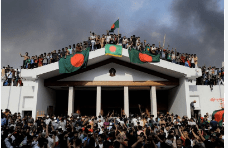
Multiple news reports from ATN Bangla News cover a range of significant events in Bangladesh. Key topics include: the submission of reform commission reports on the constitution, elections, the Anti-Corruption Commission (ACC), and the police; the acquittal of Khaleda Zia and Tarique Rahman in a corruption case; investigations launched by the ACC into various officials, including Sheikh Hasina’s family; upcoming national elections and the preparations underway; and updates on several criminal cases and political events. The reports also include information on international relations, specifically Bangladesh’s dealings with China, India, and the US, as well as economic news, such as the Dhaka International Trade Fair and a new Hisense TV launch. Finally, sports coverage of the Bangladesh Premier League (BPL) and an upcoming Asian Snooker Championship is included.

Bangladesh Politics & Society Study Guide
Quiz
- What were the four key areas targeted for reform by the interim government?
- What was the primary goal of the reform proposals, according to Chief Advisor Dr. Mohammad Yunus?
- What was the central argument in the Appellate Division’s decision to acquit Khaleda Zia and Tarique Rahman in the Zia Orphanage Trust corruption case?
- What allegations led to an investigation into Saima Wazed Putul’s appointment as the WHO Southeast Asia regional director?
- What specific recommendations were made to enhance the effectiveness of the Anti-Corruption Commission (ACC)?
- What incident prompted the filing of the first case against former President Abdul Hamid?
- What was the BNP’s stance on the timing of national elections?
- What were the key demands put forth by the Nationalist Chhatra Dal regarding DUCSU elections?
- What sentence was handed down in the Destiny Plantation embezzlement case?
- What was the central message conveyed by Foreign Affairs Advisor Md. Towhid Hossain regarding Bangladesh’s foreign policy?
Answer Key
- The four key areas targeted for reform were the Constitution, the Election Commission, the Anti-Corruption Commission (ACC), and the police force.
- Dr. Yunus emphasized that the reform proposals should reflect the aspirations and dreams of the people, particularly those who participated in the mass uprising.
- The Appellate Division asserted that the case was built on “revenge and hatred,” highlighting a flawed and vindictive trial process.
- Allegations centered on Sheikh Hasina using her influence to secure the position for her daughter despite concerns about her qualifications.
- Recommendations included increasing the number of commissioners, establishing an internal discipline department, and enacting legislation to address benami ownership and money laundering.
- The attack and violence that occurred during the anti-discrimination student movement in Kishoreganj led to the case against Abdul Hamid.
- The BNP demanded national elections be held within the year, emphasizing the people’s right to choose their government.
- The Chhatra Dal called for a revised DUCSU constitution to reflect current realities and demanded DUCSU elections be held after these reforms.
- The court imposed a 12-year prison sentence on the accused in the Destiny Plantation case and ordered them to pay double the embezzled amount as a fine.
- Md. Towhid Hossain stressed the importance of Bangladesh maintaining balanced relationships with China and India, prioritizing the country’s interests in its foreign policy decisions.
Essay Questions
- Analyze the significance of the reform movement initiated by the interim government, exploring its potential impact on Bangladesh’s political landscape.
- Evaluate the arguments presented in the Zia Orphanage Trust corruption case, considering the implications of the Appellate Division’s verdict for Bangladesh’s judicial system.
- Discuss the challenges and opportunities faced by the Anti-Corruption Commission in combating corruption in Bangladesh.
- Examine the role of student activism in shaping political discourse and advocating for change in Bangladesh.
- Analyze Bangladesh’s approach to balancing its relationships with major global powers like China, India, and the United States.
Glossary
- Interim Government: A temporary government formed to oversee a transition period, often after a political upheaval or crisis.
- Chief Advisor: The head of the interim government, responsible for leading the administration and implementing reforms.
- Appellate Division: The highest court of appeal in Bangladesh’s judicial system.
- BNP: Bangladesh Nationalist Party, a major political party in Bangladesh.
- ACC: Anti-Corruption Commission, the primary institution responsible for investigating and prosecuting corruption cases.
- DUCSU: Dhaka University Central Students’ Union, the representative body for students at Dhaka University.
- Chhatra Dal: The student wing of the Bangladesh Nationalist Party.
- Rohingya: A Muslim minority group in Myanmar facing persecution and displacement, with many seeking refuge in Bangladesh.
- BPL: Bangladesh Premier League, a professional Twenty20 cricket league in Bangladesh.
- VAT: Value-added tax, a consumption tax levied on goods and services.
Bangladesh: Reform, Corruption, and Political Tension
This briefing document analyzes recent events in Bangladesh based on provided news reports from ATN Bangla. The main themes that emerge are:
1. Reform Efforts and Political Dialogue:
- The interim government, led by Chief Advisor Dr. Mohammad Yunus, received reports from four reform commissions focused on the constitution, elections, the Anti-Corruption Commission (ACC), and the police.
- Dr. Yunus emphasized the importance of reflecting the people’s desires for change, stating that the reform proposals should “capture the people’s dreams and attitudes” and be implemented based on consensus.
- The goal is to create a “charter of a new Bangladesh” that all political parties will sign, forming a national commitment to reform.
- The government plans to hold discussions with political parties in mid-February to finalize a roadmap for reform.
- The tenure of all reform commissions has been extended by a month to facilitate further work.
Quote: “The reports that we took up today are definitely a big intellectual exercise for the country, but today’s importance is intellectual excellence. Because we are human. We have to discuss whether we have been able to capture the people’s dreams and attitudes and implement the reform proposal based on consensus.” – Dr. Mohammad Yunus
2. Corruption Investigations and Trials:
- The Appellate Division acquitted all accused, including former Prime Minister Khaleda Zia and acting BNP Chairman Tarique Rahman, in the Zia Orphanage Trust corruption case. The court observed that the trial was “vindictive” and based on “revenge and hatred.”
- The ACC is investigating allegations that former Prime Minister Sheikh Hasina used her influence to secure the position of WHO Regional Director for her daughter, Saima Wazed Putul.
- The ACC is also investigating corruption allegations against British MP Tulip Siddique and family members, along with former minister Jahangir Kovid Nanak and former MP Shamim Osman.
- The ACC Reform Commission submitted its report, recommending various measures to strengthen the institution and combat corruption, emphasizing the need for political will to implement the proposed reforms.
Quote: “The Appellate Division, observing the verdict, said that the verdict was given unanimously. All the accused, including Khaleda Zia and Tarique Rahman, were innocent. The law was misused in the case and the entire trial process was vindictive.”
3. Political Landscape and Upcoming Elections:
- The government aims to hold national elections between December 2025 and June 2026, with preparations already underway.
- The Election Commission stated it will analyze and incorporate recommendations from the Election Reform Commission in its preparations.
- There is public pressure for elections to be held sooner, with some questioning the need for extended reform processes.
- BNP Chairperson’s advisor Abdus Salam stressed that the people are the ultimate decision-makers, stating, “the people are the owners of the country and they will decide who will form the government in the future.”
Quote: “The Honorable Chief Advisor has said that there is a window starting from December 2025 to June 2026. We are making some kind of preparations based on the earliest date, but even then, if the political opinion stands, we will hold the election accordingly.” – Retired Brigadier General Abul Fazal Mohammad Sanaullah
4. Other Notable Events:
- The first case has been filed against former President Abdul Hamid and 123 others, including Sheikh Hasina and Sheikh Rehana, for alleged attacks and violence during student protests.
- Dhaka University’s Chhatra Dal demanded DUCSU elections and proposed amendments to the constitution to make the student union more effective.
- The Destiny Plantation embezzlement case saw several individuals sentenced, while others were acquitted and ordered released.
- Bangladesh aims to maintain balanced relationships with China and India, seeking to protect its own interests while fostering positive international relations.
Overall, Bangladesh is navigating a period of significant transition marked by calls for reform, ongoing corruption investigations, and political maneuvering ahead of upcoming elections. The success of reform efforts and the conduct of free and fair elections will be crucial for the country’s future stability and democratic development.
Bangladesh Interim Government: Reform, Trials, and Political Landscape
What are the key reform areas being addressed by the interim government?
The interim government has established four reform commissions: Constitutional, Election, Anti-Corruption Commission (ACC), and Police. These commissions aim to bring about major changes in the government’s power structure, the type of parliament, the electoral system, and the accountability of institutions like the police and ACC. The goal is to reflect the aspirations of the July Uprising and create a “charter of a new Bangladesh” based on consensus and national commitment.
How is the interim government approaching the trial of the July genocide?
Legal Advisor Dr. Asif Nazrul has stated that the July genocide trial will be completed before the next election. The government prioritizes this trial, and investigations are proceeding smoothly. Hearings are expected to begin in March, with the goal of achieving justice and preventing such atrocities in the future.
What is the significance of the acquittal of Khaleda Zia and Tarique Rahman in the Zia Orphanage Trust corruption case?
The Appellate Division’s acquittal of all accused, including Khaleda Zia and Tarique Rahman, in the Zia Orphanage Trust corruption case has significant political implications. The court declared the entire trial process vindictive, highlighting concerns about politically motivated cases. This verdict could impact the political landscape as it restores the innocence of key figures in the opposition BNP.
What are the allegations against former Prime Minister Sheikh Hasina and her family?
Sheikh Hasina faces allegations of using her influence to secure her daughter, Saima Wazed Putul, the position of regional director at the World Health Organization, despite concerns about her qualifications. The ACC is investigating this appointment. Additionally, investigations have been launched into the alleged corruption and illegal asset acquisition by Hasina’s nephew, Tulip Siddique, and other family members.
What steps are being taken to reform the Anti-Corruption Commission (ACC)?
The ACC Reform Commission has proposed 47 recommendations in five categories to enhance the effectiveness of the ACC. These include increasing the number of commissioners, establishing an internal discipline department, controlling corruption within the ACC, and ensuring that individuals cannot misuse their power for personal gain. The commission emphasizes the importance of political will and a change in political culture for successful reform.
What is the current status of election preparations?
The Election Commission is preparing to hold elections between December 2025 and June 2026, as per the Chief Advisor’s guidelines. However, they are awaiting the recommendations of the Election Reform Commission before finalizing the roadmap for the elections.
What is the interim government’s stance on foreign relations, particularly with China and India?
The interim government aims to maintain balanced and positive relations with all countries, including China and India, while prioritizing Bangladesh’s interests. The upcoming visit to China will focus on strengthening ties and potentially renegotiating the terms of ongoing projects. The government emphasizes a diplomatic approach and seeks to avoid any actions that could strain relations with major partners.
What is the latest update on BNP Chairperson Begum Khaleda Zia’s health?
Begum Khaleda Zia is currently undergoing treatment at a London hospital. Her personal physician, Dr. AZM Zahid Hossain, reported that her condition is stable and that reports from various medical examinations are being reviewed. The next phase of her treatment will be determined after a thorough assessment of her health.
Bangladesh’s Political Upheaval and Reform Efforts
Timeline of Events
This timeline is based on the provided text, which appears to be a news broadcast transcript. It’s important to note that the exact timeframe of these events is unclear as the text doesn’t specify the dates for most occurrences.
Before the Current Political Change:
- Sheikh Hasina’s Government: Sheikh Hasina served as Prime Minister, likely for an extended period.
- Alleged Corruption Cases: Cases were built against Khaleda Zia and others, possibly politically motivated.
- Saima Wazed’s Appointment: Saima Wazed, Hasina’s daughter, became the WHO Southeast Asia Regional Director, raising questions about her qualifications.
- Tulip Siddique’s Corruption Allegations: Tulip Siddique, Hasina’s nephew, faced corruption charges in the UK and Bangladesh.
- Anti-Discrimination Student Movement: Protests took place in Kishoreganj, leading to violence and injuries.
The July Uprising (Exact Date Unspecified):
- Mass Uprising: Students and likely other citizens participated in a large-scale uprising, demanding state reforms.
- Political Change (August 5th): The uprising led to a change in government. The date August 5th is mentioned but the year is not clear.
Interim Government and Reform Efforts:
- Formation of Reform Commissions: The interim government, led by Chief Advisor Dr. Mohammad Yunus, established commissions to address constitutional, electoral, ACC (Anti-Corruption Commission), and police reforms.
- Commission Reports Submitted: After months of gathering input, the four reform commissions presented their reports to Dr. Yunus.
- Focus on Consensus: The government stressed the need for reform proposals to be based on consensus among political parties and reflect the desires of the people.
- Genocide Trial: The government prioritized the trial of those responsible for the July genocide, aiming to complete it before the next election.
- Discussions with Political Parties: Advisor Syed Rezwana Hasan indicated that talks with political parties would take place in mid-February to finalize a reform roadmap.
- Extension of Commission Terms: The terms of all reform commissions were extended by one month.
Legal Cases and Investigations:
- Zia Orphanage Trust Case: The Appellate Division acquitted all accused, including Khaleda Zia and Tarique Rahman, overturning lower court verdicts. The court deemed the trial process vindictive.
- Investigation into Saima Wazed’s Appointment: The ACC launched an investigation into potential influence used by Sheikh Hasina to secure her daughter’s WHO position.
- Corruption Probe Against Tulip Siddique and Family: The ACC initiated an investigation into Tulip Siddique, his sister, and uncle on allegations of corruption and illegal asset acquisition.
- Case Against Former President Abdul Hamid: The first case against former President Abdul Hamid was filed, related to the violence during the anti-discrimination student movement. Sheikh Hasina and others were also named as accused.
Other Notable Events:
- Documentary Screening: A documentary about the July Movement was screened, with Advisor Asif Nazrul emphasizing the importance of justice for the victims.
- BNP’s Call for Elections: BNP advisor Abdus Salam demanded national elections within the year.
- DUCSU Election Demands: The Chhatra Dal called for DUCSU (Dhaka University Central Students’ Union) elections to be held after constitutional reforms.
- Destiny Plantation Embezzlement Case: Sentences were handed down in the Destiny Plantation embezzlement case.
- Diplomatic Relations: The government expressed its desire to maintain balanced relations with China, India, and the United States.
- President Shahabuddin’s Call for Japanese Investment: The President urged Japan to increase investments in Bangladesh.
- Khaleda Zia’s Health: BNP Chairperson Khaleda Zia was undergoing treatment in London, with her physician indicating that her next phase of treatment would begin after completing health check-ups.
- Dhaka International Trade Fair: The trade fair was gaining momentum, with vendors offering discounts to attract buyers.
Cast of Characters
Principal Figures:
- Dr. Mohammad Yunus: Chief Advisor of the interim government. A prominent figure, likely known for his work in microfinance.
- Asif Nazrul: Legal Advisor. He appears to be strongly committed to ensuring justice for the victims of the July genocide.
Political Figures:
- Sheikh Hasina: Former Prime Minister, now facing corruption allegations.
- Khaleda Zia: BNP Chairperson, recently acquitted in the Zia Orphanage Trust case. She is currently receiving medical treatment in London.
- Tarique Rahman: Acting Chairman of the BNP, also acquitted in the Zia Orphanage Trust case.
- Abdul Hamid: Former President, now facing his first legal case related to the anti-discrimination student movement.
- Abdus Salam: Advisor to the BNP Chairperson.
- Syed Rezwana Hasan: An advisor in the interim government involved in discussions with political parties about reforms.
Other Key Individuals:
- Saima Wazed Putul: Sheikh Hasina’s daughter, currently serving as the WHO Southeast Asia Regional Director. Her appointment has come under scrutiny.
- Tulip Siddique: Sheikh Hasina’s nephew, a British MP recently disqualified on corruption charges. He is now also facing investigations in Bangladesh.
- Mohammad Shahabuddin: President of Bangladesh.
- Saida Shinichi: Japan’s newly appointed ambassador to Bangladesh.
- AZM Zahid Hossain: Khaleda Zia’s personal physician.
Note: This is not an exhaustive list of all individuals mentioned in the text. Several other names, including those involved in specific cases, are mentioned but their roles are less prominent in the overall narrative.
Bangladesh’s Reform Agenda
The interim government of Bangladesh, led by Chief Advisor Dr. Mohammad Yunus, has received reports from four reform commissions focusing on the constitution, elections, the Anti-Corruption Commission (ACC), and the police. [1, 2] These reports, developed over three and a half months with input from various stakeholders, propose significant changes aimed at reshaping Bangladesh’s governance structure. [1, 2] The overarching goal of these reforms is to realize the aspirations of the people, particularly those expressed during the recent mass uprising. [2]
Key areas of reform include:
- Empowering the Election Commission: The reform proposals aim to grant the Election Commission greater independence and authority to ensure fair and credible elections. [2] This is seen as crucial to prevent a repeat of past failures in the electoral system. [2]
- Parliamentary Structure: The reports suggest changes to the structure of parliament, including the potential for a smaller upper house to ensure diverse representation. [2]
- Accountability of Political Leaders: The reforms seek to enhance the accountability of party leaders to members of parliament, who are seen as the true representatives of the people. [2]
- Combating Corruption: The ACC Reform Commission has submitted 47 recommendations to bolster the ACC’s effectiveness in tackling corruption. [3] These recommendations cover five categories and encompass short, medium, and long-term plans, including increasing the number of commissioners from three to five and establishing an internal discipline department. [3, 4] The commission also stresses the need for political will and a change in the political culture to effectively combat corruption. [3, 4]
The government’s commitment to these reforms is evident in their plans:
- Consensus-Based Approach: The government intends to engage in discussions with political parties in mid-February to finalize a roadmap for implementing the reforms. [5] Advisor Asif Nazrul emphasized that the reforms will be based on political consensus and subsequently enacted into law. [5]
- National Charter: Dr. Yunus envisions the creation of a “charter of a new Bangladesh” that encapsulates the spirit of the mass uprising and serves as a national commitment, transcending party lines. [2] The hope is that all political parties will endorse this charter, signifying a shared vision for the nation’s future. [2]
In addition to these institutional reforms, the government is prioritizing the trial of those responsible for the July genocide, aiming to complete the trial court proceedings before the next election. [5, 6] Legal Advisor Dr. Asif Nazrul assured that the trial is progressing well, with the expectation of hearings commencing in March. [5]
The government’s commitment to reforms and justice underscores their dedication to creating a new Bangladesh that reflects the aspirations of its people.
Bangladesh Corruption Investigations
The interim government in Bangladesh has initiated several corruption investigations targeting high-profile individuals, including former Prime Minister Sheikh Hasina and her family members. These investigations aim to address allegations of abuse of power, embezzlement, and illicit enrichment, signifying a commitment to accountability and transparency.
Here are some key investigations mentioned in the sources:
- Saima Wazed Putul’s appointment to the World Health Organization (WHO): The ACC is investigating allegations that Sheikh Hasina used her influence to secure the position of Regional Director for Southeast Asia for her daughter, Saima Wazed Putul, despite alleged lack of qualifications [1, 2]. The investigation stems from claims that Putul’s appointment was politically motivated and lacked merit [2].
- Tulip Siddique and family: The ACC is investigating Tulip Siddique, a British MP recently disqualified on charges of illegal assets, along with his sister, uncle, and their families [2, 3]. The investigation focuses on allegations of collusion, corruption, abuse of power, embezzlement of government land, money laundering, and acquisition of illegal assets both domestically and internationally [3].
- Other investigations: Cases have been filed against former MP Shamim Osman and Jahangir Kovid Nanak’s family on charges of money laundering [2, 3]. Additionally, an investigation has been launched against Tofazul Hossain Mia, the former Principal Secretary of the Prime Minister’s Office [3].
The ACC Reform Commission has proposed a range of measures to enhance the ACC’s effectiveness in tackling corruption, including increasing the number of commissioners, establishing an internal discipline department, and enacting legislation to address issues like beneficial ownership transparency [3]. However, the commission emphasizes that true reform requires political will and a shift in the political culture towards greater accountability [3].
Bangladesh’s 2025-2026 Election Preparations
The Election Commission of Bangladesh is actively preparing for the upcoming 13th National Parliament election, with a tentative timeframe of December 2025 to June 2026. While the specific date is yet to be finalized, the commission is working towards the earlier date, contingent upon political consensus [1].
Retired Brigadier General Abul Fazal Mohammad Sanaullah, a member of the Election Commission, highlighted that preparations are underway based on the Chief Advisor’s guidance. He mentioned ongoing efforts related to voter list updates, indicating a focus on ensuring an accurate and comprehensive electoral roll [1].
Importantly, the commission is awaiting the recommendations of the Election Reform Commission, which has recently submitted its report to the interim government. Sanaullah stated that it’s premature to act on those recommendations until the commission has reviewed and understood their contents [1]. This suggests that the final electoral procedures and framework will be shaped by the reform proposals.
The government’s commitment to holding elections within the stipulated timeframe signifies their intention to transition back to democratic rule. The emphasis on political consensus and adherence to the reform commission’s recommendations underscores a desire to conduct credible and fair elections that reflect the people’s will.
Bangladesh’s Shifting Political Landscape: Recent Court Verdicts
Several court verdicts mentioned in the sources highlight the evolving legal and political landscape in Bangladesh.
The most significant verdict is the Appellate Division’s acquittal of all accused, including former Prime Minister Khaleda Zia and her son Tarique Rahman, in the Zia Orphanage Trust corruption case. The court overturned the verdicts of the trial court and the High Court, observing that the entire trial process was vindictive and based on revenge [1]. This decision marks a significant development in the ongoing political saga surrounding Khaleda Zia and her family, who have faced numerous legal challenges over the years.
The Appellate Division’s strong criticism of the trial process raises questions about the use of legal proceedings for political purposes. The court’s assertion that the case was driven by malice and aimed at humiliating the accused underscores concerns about the politicization of the judiciary. The acquittal is likely to have significant political ramifications, potentially bolstering the BNP’s position as the Awami League faces scrutiny over its past actions [2].
In another case, a court in Kishoreganj recorded the first case against former President Abdul Hamid, along with former Prime Minister Sheikh Hasina, her sister Sheikh Rehana, and 123 others, on charges of attack and violence during a student movement. This case represents the first instance of legal action against a former President since the Awami League government’s fall [3]. The filing of this case, alongside other corruption investigations targeting high-profile figures associated with the previous government, suggests a shift in the balance of power and a concerted effort to hold individuals accountable for past wrongdoings.
Additionally, the sources mention a verdict in the Destiny Plantation embezzlement case, where MD Rafiqul Amin and Chairman Mohammad Hossain were sentenced to 12 years in prison. However, the court also ordered their immediate release as they had already served their sentences [4]. This case illustrates the complexities of legal proceedings and the potential for individuals to face consequences even while being acquitted due to time served.
Finally, a Natore court acquitted BNP central leader Ruhul Quddus Talukder Dulu in a case related to house vandalism and arson, removing any obstacles for him to participate in elections [4]. This acquittal, along with Khaleda Zia’s release from prison through an executive order in 2020, suggests a potential easing of legal pressure on the BNP and its leaders.
Bangladesh’s Pragmatic Foreign Policy
The interim government in Bangladesh is emphasizing the importance of balanced and pragmatic international relations, particularly with key regional powers like China and India. The government’s approach seeks to safeguard Bangladesh’s interests while navigating the complexities of geopolitical dynamics.
- China: The upcoming state visit of a high-level government delegation to China, led by Foreign Affairs Advisor Md. Towhid Hossain, signals a desire to strengthen ties with Beijing. The visit aims to discuss various issues, including reducing interest rates and extending repayment periods for ongoing Chinese-funded projects in Bangladesh [1]. This highlights the importance of Chinese investment and development assistance for Bangladesh’s economic growth. The government also seeks to leverage China’s influence to facilitate a conducive environment for the repatriation of Rohingya refugees from Myanmar [1].
- India: While acknowledging the importance of maintaining good relations with India, the government emphasizes the need for balanced engagement based on mutual understanding and respect for Bangladesh’s interests [1]. The Foreign Affairs Advisor acknowledged that concessions can be made to India in certain areas, but these should be based on reciprocity and should not compromise Bangladesh’s core interests [1]. This stance reflects a desire to manage a sometimes complicated relationship with its larger neighbor.
- United States: The sources do not provide specific details about the interim government’s approach to relations with the United States. However, the Foreign Affairs Advisor’s statement about maintaining balanced relations with global powers suggests a desire to engage constructively with Washington [1].
- Japan: President Mohammad Shahabuddin expressed his desire for increased Japanese investment in various sectors, including infrastructure, automobiles, and ICT, during a meeting with Japan’s newly appointed ambassador to Bangladesh [2]. The President also highlighted the need for Japan to accept more manpower from Bangladesh. This underscores the importance of economic cooperation and labor migration in Bangladesh’s relationship with Japan.
The interim government’s foreign policy approach reflects a pragmatic understanding of Bangladesh’s position in a complex geopolitical landscape. The emphasis on balanced relations, safeguarding national interests, and leveraging partnerships for development reflects a strategic approach to advancing Bangladesh’s goals on the international stage.

By Amjad Izhar
Contact: amjad.izhar@gmail.com
https://amjadizhar.blog
Affiliate Disclosure: This blog may contain affiliate links, which means I may earn a small commission if you click on the link and make a purchase. This comes at no additional cost to you. I only recommend products or services that I believe will add value to my readers. Your support helps keep this blog running and allows me to continue providing you with quality content. Thank you for your support!

Leave a comment