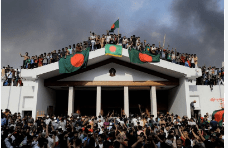
News reports from ATN Bangla cover diverse events in Bangladesh. These include an upcoming anti-discrimination student movement declaration, unrelated to the interim government; investigations into a secretariat fire and vandalism; political maneuvering and unity calls among opposition parties; road blockades causing public distress; economic analysis focusing on financial sector reforms and corruption; the burial of a political figure; and updates on sports and educational events. The reports also feature human interest stories on exotic bird farming and nursing students.

Revolution and Reform: A Study Guide
Short Answer Quiz
- What is the main goal of the anti-discrimination student movement’s declaration on December 31st?
- Why are the student leaders critical of the 1972 constitution?
- What is the interim government’s stance on the anti-discrimination student movement’s declaration?
- What caused the road blockades in Dhaka, and what groups were primarily involved?
- According to the report, what were the primary causes of economic hardship in Bangladesh leading up to 2024?
- What specific actions were taken to reform the banking sector after the July revolution?
- What were some of the key findings highlighted in the economic white paper about the previous Awami League government?
- What is the main focus of the Islami Chhatrashibir’s plans for the next generation?
- What are the major reforms being proposed for the country after Sheikh Hasina?
- Briefly describe the circumstances surrounding the death of college teacher Raju Ahmed?
Answer Key
- The main goal of the anti-discrimination student movement’s declaration is to present a new manifesto for Bangladesh, which prioritizes public expectations and will exclude the 1972 constitution and declare the Awami League irrelevant as a Nazi organization.
- The student leaders believe the 1972 constitution does not represent the masses and are calling for the grave of the Mujibwadi 72 constitution to be written from the place where the declaration is issued on December 31.
- The interim government claims that the anti-discrimination student movement’s declaration is a private initiative with no government affiliation or involvement. They stated that they neither support nor condemn this private endeavor.
- The road blockades in Dhaka were primarily caused by trainee doctors and retired members of the armed forces protesting for increased allowances, causing significant disruption to the city.
- The primary causes of economic hardship included high inflation, money laundering, and the looting of the financial sector over the past fifteen years. The economic white paper highlighted government corruption.
- After the July revolution, the banking sector was reformed by dissolving the board of directors of 11 banks and launching forensic tests into multiple banks. Ahsan S. Mansoor also took over the responsibility of the governor of Bangladesh Bank.
- The economic white paper revealed that during the 15-year Awami League regime, approximately 28 lakh crore rupees were smuggled out of the country through government purchases, 2.5 lakh crore rupees were given in bribes to politicians and bureaucrats, and 75,000 crore rupees were stolen from the stock market and development projects.
- The main focus of the Islami Chhatrashibir’s plans is to create a generation based on science and ethics, aiming to achieve what they perceive no previous government has been able to accomplish.
- Mission 2030, a set of reforms proposed by former leaders, includes reforms to state institutions and is meant to address questions about the future of Bangladesh. The elected government, when they come to power, is supposed to implement them.
- College teacher Raju Ahmed died when his motorcycle hit a tree in the Maheshpur Kalibari Bazar area. He was severely injured and died as a result of the accident.
Essay Questions
- Analyze the role and impact of student movements in Bangladesh, drawing on the specific case of the anti-discrimination student movement described in the text. How do these movements relate to national political developments and citizen aspirations?
- Assess the economic challenges facing Bangladesh as portrayed in the text. What are the main factors contributing to the economic crisis, and what steps are being taken to address them? What further steps do you think could help solve the problems that are described?
- Discuss the interplay between political parties and the interim government in the context of the July revolution and the subsequent declaration plans. To what extent does the interim government appear impartial, and what evidence suggests otherwise?
- Evaluate the concept of “reform” as it is discussed in the text. What are the major areas targeted for reform, and what are the different perspectives on the pace and direction of these changes?
- Examine the role of media and public opinion in shaping the narrative around the July revolution and its aftermath. How do different sources and actors contribute to this narrative, and what does this suggest about the nature of political discourse in Bangladesh?
Glossary of Key Terms
Anti-discrimination student movement: A student-led movement in Bangladesh that opposes the current regime and aims to create a new manifesto for the country, prioritizing public expectations and excluding the 1972 constitution.
Awami League: A major political party in Bangladesh, described in the text as a “Nazi organization” by the anti-discrimination student movement and accused of corruption and oppression during its time in power.
BNP (Bangladesh Nationalist Party): A significant political party in Bangladesh, positioning itself as part of the “anti-fascist unity” and urging for elections.
Constitution of 1972: The original constitution of Bangladesh, which the anti-discrimination movement seeks to replace, calling it a “grave” and irrelevant.
Interim government: A temporary government in power following the fall of the previous regime (Awami League), in this case tasked with leading the transition to elections.
July revolution: A period of mass protests and upheaval leading to the ousting of the Awami League government, with calls for a new political direction and reforms.
Mujibwadi: A term used to refer to the political ideologies associated with Sheikh Mujibur Rahman, the first president of Bangladesh, and sometimes used pejoratively by those who oppose his legacy.
Mission 2030: A set of proposed reforms for Bangladesh, supposedly already developed by previous leaders, that are supposed to be implemented by the newly elected government.
Shaheed Minar: A national monument in Dhaka symbolizing the martyrs of the Bengali Language Movement. Often a central gathering point for protests and rallies.
Economic white paper: A document published by the government outlining the details of the economic looting and corruption that occurred under the previous regime.convert_to_textConvert to source
Bangladesh in Crisis: Politics, Society, and Economy in Late 2024
Okay, here’s a detailed briefing document summarizing the key themes and information from the provided text:
Briefing Document: Bangladesh Political and Social Landscape – Late 2024
Date: October 26, 2024 (Based on the internal logic of the events described)
Subject: Analysis of political, social, and economic developments in Bangladesh as reported by ATN Bangla News.
Executive Summary:
This briefing document outlines the key events and themes emerging from ATN Bangla news reports. The period is marked by significant political upheaval following the ousting of the Awami League government, a burgeoning student-led anti-discrimination movement, economic instability, and widespread public discontent. Key developments include a planned student declaration challenging the existing constitution, accusations of corruption and mismanagement against the previous government, and ongoing public protests. The interim government is struggling to maintain stability and control information flow.
1. Political Landscape:
- Post-Awami League Government: The news reports a recent “mass coup” that led to the fall of the Awami League government. This has created a power vacuum with an “interim government” now in place. The details of the coup itself are not clear, but the new government is described as “so-called” by some, suggesting a lack of legitimacy or widespread support.
- Anti-Discrimination Student Movement: A significant development is the rise of a powerful student movement that is explicitly anti-discrimination. This movement, led by figures like Hasnat Abdullah, plans to issue a manifesto on December 31st, which is being touted as a potential “second constitution” for the country, superseding the 1972 constitution. They view the Awami League as a “Nazi organization” and see the 1972 constitution as fundamentally flawed.
- Quote: “The anti-discrimination student movement will issue a declaration where priority will be given to fulfilling public expectations by excluding the 72 constitution,”
- Quote: “The grave of Mujibwadi 72 constitution will be written from that very place.”
- Quote: “Awami League is an irrelevant political party in the context of Bangladesh which does not recognize the masses as human beings and tortures and oppresses them.”
- Interim Government’s Stance: The interim government claims to have no involvement in the student movement’s activities, branding the declaration a “private initiative.” This suggests a desire to distance themselves from the radical views of the student movement and potentially avoid any blame if the declaration backfires.
- Quote: “The manifesto of the anti-discrimination student movement is a private initiative. Our government has no involvement in this.”
- Calls for Unity & Concerns of Division:
- The reports indicate concerns from the BNP leadership that some parties are trying to brand the youth movement of the 24, and they urge against actions that create divisions, emphasizing the need for anti-fascist unity.
- Quote: “I am not a supporter of the 72 constitution. I am a supporter of the blood of the 71 liberation war. No one should try to brand the movement of 24 towards you. It is better not to say things that the people of the country will not like.”
- BNP’s Position: The BNP appears to be positioning itself as a moderate opposition force, calling for elections, while simultaneously criticizing the interim government for its alleged lack of transparency and potentially paving the way for the return of the Awami League. There is an accusation that a Pakshali secretary was appointed despite opposition.
- Quote: “Are you going to reform by taking the ghosts under your armpits, the question arises for the nation, are we paving the way to bring back the Awami League.”
- Accusations of Political Maneuvering: There are accusations that unnamed parties are trying to exploit the current unrest for political gain and spreading false propaganda.
- Information Control: The interim government is clamping down on media access, with accusations of fake press passes at the secretariat. This suggests a fear of criticism and a need to control the narrative of events.
2. Social Unrest:
- Public Protests: The reports describe significant public unrest, including road blockades led by trainee doctors and retired soldiers demanding increased allowances. This highlights the general discontent among certain groups within the population.
- Quote: “Road blockades in Bangladesh after August have added a different dimension to the demands that are being raised, so the general public is saying that the government should be more strict in alleviating this suffering”
- Suffering and Disruption: These protests lead to severe traffic disruptions and public suffering. The reports paint a picture of widespread chaos and inconvenience for the city’s residents.
- University Tensions: Incidents like the removal of Sheikh Hasina’s graffiti from university grounds, followed by promises of restoration, shows political undercurrents in educational institutions. The removal of memorials of the July Revolution by university authorities also indicates some tension and disagreement around the recent upheaval.
3. Economic Issues:
- Economic Crisis: Bangladesh is facing a severe economic crisis, marked by high inflation, money laundering, and financial sector looting. The report states that the country’s financial sector has been damaged due to irregularities and corruption.
- Quote: “2024 high inflation money laundering and a decade and a half of looting of the financial sector is leaving the eventful exit.”
- Quote: “Food inflation has been in the double digits since the beginning of the winter season.”
- Corruption and Embezzlement: The report cites a shocking amount of funds being embezzled and smuggled out of the country during the Awami League regime. This includes massive amounts from government purchases, bribery, and stock market manipulation. There are mentions of the SLM Group stealing large sums.
- Quote: “About 28 lakh crore rupees have been smuggled out of the country in government purchases, politicians and bureaucrats have taken bribes of two and a half lakh crore rupees and three quarter lakh crore rupees have been stolen from the stock market from development projects.”
- Quote: “Salam Group alone has stolen about 73 thousand crores of Islami Bank’s total debt, 90 percent of the money of 18 thousand Global Islami Banks from Union Bank”
- Reforms Underway: There are efforts underway to reform the financial sector. The new governor of Bangladesh Bank, Ahsan S. Mansoor, is working to reorganize the sector, including dissolving boards of directors of several banks. International task forces have been set up to investigate corruption.
- Quote: “International organizations [MUSIC] have formed a task force on financial sector reform to report corruption and looting.”
- Defaulted Loans: The amount of defaulted loans has exceeded three lakh crore rupees.
- Income Disparity: The income gap between the richest and poorest segments of society has increased drastically.
4. Other Key Points:
- BPL (Bangladesh Premier League): The news also covers the start of the 11th season of the BPL, mentioning ticket prices and team preparations, which shows the social impact of sports in the country.
- Education: There are reports on educational events, like a nursing graduation ceremony and a seminar on machine learning, and commentary on the education system’s shortcomings. There is a concern that the education system has failed to produce the expected generation. There is also a mention of the efforts by Islami Chhatra Shibir to address this issue.
- Quote: “Even though we are not getting the generation that we wanted due to mistakes, we believe that Islami Chhatra Shibir wants to give this nation a generation that no government has ever been able to achieve.”
- Art and Culture: There are mentions of celebrations for the birth anniversary of artist Zainul Abedin, an art exhibition, and a memorial event for a poet, which shows the vibrant cultural scene in the country.
- Personal Tragedies: The report includes news of a road accident that resulted in the death of a college teacher, which brings a sense of human tragedy to the report.
- Emerging Industries: The development of exotic bird farms indicates the entrepreneurial spirit of some individuals.
Conclusion:
The news reports from ATN Bangla paint a picture of a country in turmoil. There is significant political instability, social unrest, and a deep economic crisis. The student-led anti-discrimination movement is a force to watch, and its upcoming declaration could potentially reshape the political landscape. The interim government’s efforts to control information and maintain order, alongside the allegations of wide-spread corruption, further complicate the situation. The path forward for Bangladesh appears uncertain, with significant challenges ahead. This briefing provides the key points from the provided reports for further analysis.
Bangladesh: Politics, Economy, and Society in Transition
FAQ
- What is the primary focus of the anti-discrimination student movement in Bangladesh?
- The anti-discrimination student movement is primarily focused on challenging the existing political and constitutional framework of Bangladesh. They are specifically aiming to move away from the 1972 constitution, which they view as flawed and not representative of the current needs and aspirations of the people. Their stated goal is to create a new document, potentially called the “second constitution,” that better addresses the public’s expectations. They are also highly critical of the Awami League, labeling it a “Nazi organization” and accusing it of oppression and violence. The movement aims to represent the voices of marginalized groups, including tea and garment workers.
- What are the key demands and actions of the anti-discrimination student movement and associated groups?
- The movement is planning to issue a manifesto on December 31st, which will outline its vision for Bangladesh and serve as a “documentary proof of hope” for the students. This manifesto will prioritize public expectations and aims to exclude the 1972 constitution. They plan to gather at the Central Shaheed Minar on December 31, bringing together workers, the injured, and families to express their aspirations for the country. Furthermore, they intend to work alongside the National Citizen Committee to channel the new generation’s leadership into new political avenues. They emphasize that they will not operate as political parties but rather as platforms to fulfill people’s aspirations.
- What is the interim government’s stance on the anti-discrimination student movement and their proposed manifesto?
- The interim government has stated that the anti-discrimination student movement’s manifesto is a private initiative and has no official affiliation with the government. While individual members may support it, the government insists it has no involvement. They also declared that the proposed “second constitution” is being drafted as a private initiative and not as a government project.
- How does the BNP (Bangladesh Nationalist Party) view the current political situation and the actions of other groups?
- The BNP is urging for anti-fascist unity and cautioning against divisions that could weaken the opposition. They are concerned that certain actions, including those by the 24’s movement, might inadvertently create openings for the Awami League to regain power. The BNP supports elections to restore the people’s rights and are critical of the interim government’s alleged appointments of figures from the previous administration, expressing concerns about the legitimacy of the reform process. The BNP is also wary of individuals and groups who they believe are trying to exploit the political situation for their gain, even potentially “tarnishing” the BNP’s image.
- What are the main economic issues facing Bangladesh, and how is the government attempting to address them?
- Bangladesh is facing significant economic challenges, including high inflation, widespread money laundering, and a history of financial looting, particularly during the Awami League regime. There has been about 28 lakh crore rupees smuggled out of the country. The interim government has implemented contractionary monetary and fiscal policies and is trying to control inflation through market surveillance. They are also focusing on reforms in the financial sector by reorganizing banks and taking action against those responsible for corruption. Additionally, there’s a focus on improving the banking sector by enforcing discipline and ethics, addressing a massive amount of defaulted loans.
- What steps are being taken to address corruption and improve the banking sector?
To combat the financial sector corruption and looting, the government is reorganizing the financial sector with economist Ahsan S. Mansoor appointed as governor of the central bank. This includes dissolving the board of directors of many banks, initiating forensic tests to investigate financial irregularities. Task forces have been created involving international organizations to report corruption and looting. There is also a stated goal of taking control of management of mobile financial services and initiating probes against industrial groups suspected of irregularities. This is done with the hope of restoring depositors’ confidence in the sector.
- What is the situation regarding journalism and media access, and are there any restrictions?
There are significant restrictions on journalists’ access to government facilities. The Information and Broadcasting Adviser has declared that most accreditation cards issued at the Secretariat were fake, leading to their cancellation. Journalists have been temporarily barred from entering the Secretariat, and access is now limited and being issued with temporary passes. These actions have caused disruptions to news gathering, further highlighting the tension between media and authorities. The road blockades at Shahbagh and Jahangir gates are connected to the journalists being blocked as well.
- What are some other notable events or developments mentioned in the sources besides politics and the economy?
- Besides political and economic issues, the sources mention several other developments, including student-led protests and road blockades due to various demands including those of trainee doctors. There’s also coverage of cultural events like the celebration of the birth anniversary of artist Zainul Abedin, and sports events including the beginning of the Bangladesh Premier League (BPL) season. There is also the mention of a growing interest in exotic bird breeding in Tangail among local youths as an entrepreneurial venture. Lastly, a farewell reception for nursing students was held, highlighting the development of healthcare education in the country.
convert_to_textConvert to source
FAQ
- What is the primary focus of the anti-discrimination student movement in Bangladesh?
- The anti-discrimination student movement is primarily focused on challenging the existing political and constitutional framework of Bangladesh. They are specifically aiming to move away from the 1972 constitution, which they view as flawed and not representative of the current needs and aspirations of the people. Their stated goal is to create a new document, potentially called the “second constitution,” that better addresses the public’s expectations. They are also highly critical of the Awami League, labeling it a “Nazi organization” and accusing it of oppression and violence. The movement aims to represent the voices of marginalized groups, including tea and garment workers.
- What are the key demands and actions of the anti-discrimination student movement and associated groups?
- The movement is planning to issue a manifesto on December 31st, which will outline its vision for Bangladesh and serve as a “documentary proof of hope” for the students. This manifesto will prioritize public expectations and aims to exclude the 1972 constitution. They plan to gather at the Central Shaheed Minar on December 31, bringing together workers, the injured, and families to express their aspirations for the country. Furthermore, they intend to work alongside the National Citizen Committee to channel the new generation’s leadership into new political avenues. They emphasize that they will not operate as political parties but rather as platforms to fulfill people’s aspirations.
- What is the interim government’s stance on the anti-discrimination student movement and their proposed manifesto?
- The interim government has stated that the anti-discrimination student movement’s manifesto is a private initiative and has no official affiliation with the government. While individual members may support it, the government insists it has no involvement. They also declared that the proposed “second constitution” is being drafted as a private initiative and not as a government project.
- How does the BNP (Bangladesh Nationalist Party) view the current political situation and the actions of other groups?
- The BNP is urging for anti-fascist unity and cautioning against divisions that could weaken the opposition. They are concerned that certain actions, including those by the 24’s movement, might inadvertently create openings for the Awami League to regain power. The BNP supports elections to restore the people’s rights and are critical of the interim government’s alleged appointments of figures from the previous administration, expressing concerns about the legitimacy of the reform process. The BNP is also wary of individuals and groups who they believe are trying to exploit the political situation for their gain, even potentially “tarnishing” the BNP’s image.
- What are the main economic issues facing Bangladesh, and how is the government attempting to address them?
- Bangladesh is facing significant economic challenges, including high inflation, widespread money laundering, and a history of financial looting, particularly during the Awami League regime. There has been about 28 lakh crore rupees smuggled out of the country. The interim government has implemented contractionary monetary and fiscal policies and is trying to control inflation through market surveillance. They are also focusing on reforms in the financial sector by reorganizing banks and taking action against those responsible for corruption. Additionally, there’s a focus on improving the banking sector by enforcing discipline and ethics, addressing a massive amount of defaulted loans.
- What steps are being taken to address corruption and improve the banking sector?
To combat the financial sector corruption and looting, the government is reorganizing the financial sector with economist Ahsan S. Mansoor appointed as governor of the central bank. This includes dissolving the board of directors of many banks, initiating forensic tests to investigate financial irregularities. Task forces have been created involving international organizations to report corruption and looting. There is also a stated goal of taking control of management of mobile financial services and initiating probes against industrial groups suspected of irregularities. This is done with the hope of restoring depositors’ confidence in the sector.
- What is the situation regarding journalism and media access, and are there any restrictions?
There are significant restrictions on journalists’ access to government facilities. The Information and Broadcasting Adviser has declared that most accreditation cards issued at the Secretariat were fake, leading to their cancellation. Journalists have been temporarily barred from entering the Secretariat, and access is now limited and being issued with temporary passes. These actions have caused disruptions to news gathering, further highlighting the tension between media and authorities. The road blockades at Shahbagh and Jahangir gates are connected to the journalists being blocked as well.
- What are some other notable events or developments mentioned in the sources besides politics and the economy?
- Besides political and economic issues, the sources mention several other developments, including student-led protests and road blockades due to various demands including those of trainee doctors. There’s also coverage of cultural events like the celebration of the birth anniversary of artist Zainul Abedin, and sports events including the beginning of the Bangladesh Premier League (BPL) season. There is also the mention of a growing interest in exotic bird breeding in Tangail among local youths as an entrepreneurial venture. Lastly, a farewell reception for nursing students was held, highlighting the development of healthcare education in the country.
convert_to_textConvert to source
FAQ
- What is the primary focus of the anti-discrimination student movement in Bangladesh?
- The anti-discrimination student movement is primarily focused on challenging the existing political and constitutional framework of Bangladesh. They are specifically aiming to move away from the 1972 constitution, which they view as flawed and not representative of the current needs and aspirations of the people. Their stated goal is to create a new document, potentially called the “second constitution,” that better addresses the public’s expectations. They are also highly critical of the Awami League, labeling it a “Nazi organization” and accusing it of oppression and violence. The movement aims to represent the voices of marginalized groups, including tea and garment workers.
- What are the key demands and actions of the anti-discrimination student movement and associated groups?
- The movement is planning to issue a manifesto on December 31st, which will outline its vision for Bangladesh and serve as a “documentary proof of hope” for the students. This manifesto will prioritize public expectations and aims to exclude the 1972 constitution. They plan to gather at the Central Shaheed Minar on December 31, bringing together workers, the injured, and families to express their aspirations for the country. Furthermore, they intend to work alongside the National Citizen Committee to channel the new generation’s leadership into new political avenues. They emphasize that they will not operate as political parties but rather as platforms to fulfill people’s aspirations.
- What is the interim government’s stance on the anti-discrimination student movement and their proposed manifesto?
- The interim government has stated that the anti-discrimination student movement’s manifesto is a private initiative and has no official affiliation with the government. While individual members may support it, the government insists it has no involvement. They also declared that the proposed “second constitution” is being drafted as a private initiative and not as a government project.
- How does the BNP (Bangladesh Nationalist Party) view the current political situation and the actions of other groups?
- The BNP is urging for anti-fascist unity and cautioning against divisions that could weaken the opposition. They are concerned that certain actions, including those by the 24’s movement, might inadvertently create openings for the Awami League to regain power. The BNP supports elections to restore the people’s rights and are critical of the interim government’s alleged appointments of figures from the previous administration, expressing concerns about the legitimacy of the reform process. The BNP is also wary of individuals and groups who they believe are trying to exploit the political situation for their gain, even potentially “tarnishing” the BNP’s image.
- What are the main economic issues facing Bangladesh, and how is the government attempting to address them?
- Bangladesh is facing significant economic challenges, including high inflation, widespread money laundering, and a history of financial looting, particularly during the Awami League regime. There has been about 28 lakh crore rupees smuggled out of the country. The interim government has implemented contractionary monetary and fiscal policies and is trying to control inflation through market surveillance. They are also focusing on reforms in the financial sector by reorganizing banks and taking action against those responsible for corruption. Additionally, there’s a focus on improving the banking sector by enforcing discipline and ethics, addressing a massive amount of defaulted loans.
- What steps are being taken to address corruption and improve the banking sector?
To combat the financial sector corruption and looting, the government is reorganizing the financial sector with economist Ahsan S. Mansoor appointed as governor of the central bank. This includes dissolving the board of directors of many banks, initiating forensic tests to investigate financial irregularities. Task forces have been created involving international organizations to report corruption and looting. There is also a stated goal of taking control of management of mobile financial services and initiating probes against industrial groups suspected of irregularities. This is done with the hope of restoring depositors’ confidence in the sector.
- What is the situation regarding journalism and media access, and are there any restrictions?
There are significant restrictions on journalists’ access to government facilities. The Information and Broadcasting Adviser has declared that most accreditation cards issued at the Secretariat were fake, leading to their cancellation. Journalists have been temporarily barred from entering the Secretariat, and access is now limited and being issued with temporary passes. These actions have caused disruptions to news gathering, further highlighting the tension between media and authorities. The road blockades at Shahbagh and Jahangir gates are connected to the journalists being blocked as well.
- What are some other notable events or developments mentioned in the sources besides politics and the economy?
- Besides political and economic issues, the sources mention several other developments, including student-led protests and road blockades due to various demands including those of trainee doctors. There’s also coverage of cultural events like the celebration of the birth anniversary of artist Zainul Abedin, and sports events including the beginning of the Bangladesh Premier League (BPL) season. There is also the mention of a growing interest in exotic bird breeding in Tangail among local youths as an entrepreneurial venture. Lastly, a farewell reception for nursing students was held, highlighting the development of healthcare education in the country.
Bangladesh: Politics, Economy, and Society in Transition
FAQ
- What is the primary focus of the anti-discrimination student movement in Bangladesh?
- The anti-discrimination student movement is primarily focused on challenging the existing political and constitutional framework of Bangladesh. They are specifically aiming to move away from the 1972 constitution, which they view as flawed and not representative of the current needs and aspirations of the people. Their stated goal is to create a new document, potentially called the “second constitution,” that better addresses the public’s expectations. They are also highly critical of the Awami League, labeling it a “Nazi organization” and accusing it of oppression and violence. The movement aims to represent the voices of marginalized groups, including tea and garment workers.
- What are the key demands and actions of the anti-discrimination student movement and associated groups?
- The movement is planning to issue a manifesto on December 31st, which will outline its vision for Bangladesh and serve as a “documentary proof of hope” for the students. This manifesto will prioritize public expectations and aims to exclude the 1972 constitution. They plan to gather at the Central Shaheed Minar on December 31, bringing together workers, the injured, and families to express their aspirations for the country. Furthermore, they intend to work alongside the National Citizen Committee to channel the new generation’s leadership into new political avenues. They emphasize that they will not operate as political parties but rather as platforms to fulfill people’s aspirations.
- What is the interim government’s stance on the anti-discrimination student movement and their proposed manifesto?
- The interim government has stated that the anti-discrimination student movement’s manifesto is a private initiative and has no official affiliation with the government. While individual members may support it, the government insists it has no involvement. They also declared that the proposed “second constitution” is being drafted as a private initiative and not as a government project.
- How does the BNP (Bangladesh Nationalist Party) view the current political situation and the actions of other groups?
- The BNP is urging for anti-fascist unity and cautioning against divisions that could weaken the opposition. They are concerned that certain actions, including those by the 24’s movement, might inadvertently create openings for the Awami League to regain power. The BNP supports elections to restore the people’s rights and are critical of the interim government’s alleged appointments of figures from the previous administration, expressing concerns about the legitimacy of the reform process. The BNP is also wary of individuals and groups who they believe are trying to exploit the political situation for their gain, even potentially “tarnishing” the BNP’s image.
- What are the main economic issues facing Bangladesh, and how is the government attempting to address them?
- Bangladesh is facing significant economic challenges, including high inflation, widespread money laundering, and a history of financial looting, particularly during the Awami League regime. There has been about 28 lakh crore rupees smuggled out of the country. The interim government has implemented contractionary monetary and fiscal policies and is trying to control inflation through market surveillance. They are also focusing on reforms in the financial sector by reorganizing banks and taking action against those responsible for corruption. Additionally, there’s a focus on improving the banking sector by enforcing discipline and ethics, addressing a massive amount of defaulted loans.
- What steps are being taken to address corruption and improve the banking sector?
To combat the financial sector corruption and looting, the government is reorganizing the financial sector with economist Ahsan S. Mansoor appointed as governor of the central bank. This includes dissolving the board of directors of many banks, initiating forensic tests to investigate financial irregularities. Task forces have been created involving international organizations to report corruption and looting. There is also a stated goal of taking control of management of mobile financial services and initiating probes against industrial groups suspected of irregularities. This is done with the hope of restoring depositors’ confidence in the sector.
- What is the situation regarding journalism and media access, and are there any restrictions?
There are significant restrictions on journalists’ access to government facilities. The Information and Broadcasting Adviser has declared that most accreditation cards issued at the Secretariat were fake, leading to their cancellation. Journalists have been temporarily barred from entering the Secretariat, and access is now limited and being issued with temporary passes. These actions have caused disruptions to news gathering, further highlighting the tension between media and authorities. The road blockades at Shahbagh and Jahangir gates are connected to the journalists being blocked as well.
- What are some other notable events or developments mentioned in the sources besides politics and the economy?
- Besides political and economic issues, the sources mention several other developments, including student-led protests and road blockades due to various demands including those of trainee doctors. There’s also coverage of cultural events like the celebration of the birth anniversary of artist Zainul Abedin, and sports events including the beginning of the Bangladesh Premier League (BPL) season. There is also the mention of a growing interest in exotic bird breeding in Tangail among local youths as an entrepreneurial venture. Lastly, a farewell reception for nursing students was held, highlighting the development of healthcare education in the country.
Bangladesh’s July Revolution: A Political and Economic Crisis
Okay, here is a detailed timeline and cast of characters based on the provided text:
Timeline of Events
- Prior to July/August (Unspecified Date):The Awami League government, described as autocratic, is in power.
- A period of “15 years” under Awami League rule has seen significant financial corruption including 28 lakh crore rupees smuggled out of the country, politicians and bureaucrats taking 2.5 lakh crore in bribes, and 0.75 lakh crore stolen from the stock market and development projects
- The nation experiences high inflation, money laundering and a decade and a half of financial sector looting.
- The 5% of highest earners income is 31 times the lowest earners’ in 2010 and 81 times in 2022.
- The banking sector has weakened due to corruption, irregularities and manipulations.
- Defaulted loans exceed three lakh crore rupees.
- An Anti-Discrimination Student Movement is formed.
- July/August (Specific dates unmentioned):Mass coup ousts the Awami League government. An interim government is formed.
- August 3: Thousands gather at the Central Shaheed Minar to declare the downfall of the Hasina government. The Anti-Discrimination Student Movement leads a rally at the Central Shaheed Minar and issues a “one-sided declaration” against the “fascist” Hasina government.
- A “July Revolution” is referred to.
- The Anti-Discrimination Student Movement and the National Citizen Committee become active.
- The Anti-Discrimination Student Movement sits abroad in protest of “non-delivery of their demand for the Declaration of Revolution on August 5.”
- Mass protests occur in July and August.
- Road blockades become a common form of protest.
- Graffiti of Sheikh Hasina is removed from the university area.
- The memorials to the July Revolution are removed from Dhaka University, in accord with what the university calls “university law”
- Department of Films and Publications organizes an exhibition of news from July 1st to August 14th.
- Post-Coup (Unspecified Date):Interim government takes power with a chief advisor and various secretaries and advisors.
- Financial sector reorganization begins. Ahsan S. Mansoor becomes governor of Bangladesh Bank.
- A task force on financial sector reform is formed.
- The board of directors of 11 banks are dissolved.
- Probes on financial irregularities are launched and the dollar exceeds Rs 123.
- Ongoing (through December 2024):Trainee doctors and retired members of the armed forces stage protests.
- Road blockades and traffic jams become common in Dhaka.
- The government is trying to control inflation through monetary and fiscal policies and market surveillance but the economy has not changed.
- Food inflation remains in the double digits.
- Foreign reserves have increased to over $24 billion.
- The financial sector continues to be plagued by corruption and irregularities.
- A debate emerges over the 1972 constitution.
- A fire occurs in the Secretariat. An investigation is underway but the report is not being made public.
- BNP leaders criticize the interim government’s actions and the appointment of “Pakshali” secretaries.
- Fake media accreditation cards are discovered, temporarily limiting journalists’ access to the secretariat.
- BPL (Bangladesh Premier League) begins its 11th season.
- December 31st:The Anti-Discrimination Student Movement plans to issue a manifesto.
- This manifesto will exclude the 1972 constitution.
- The manifesto is intended to be a documentary proof of the hopes of the students and “the second constitution of the country.”
- The group hopes that tea and garment workers and others will gather at the Central Shaheed Minar.
- Family members and wounded persons are encouraged to attend to speak about their aspirations for a new Bangladesh.
- The declaration, planned to be released by Yasin Rana, will mark the burial of the “Mujibwadi 72 constitution”
- The exhibition of news published in 64 districts since July 1st will continue until December 31st.
Cast of Characters
- Hasnat Abdullah: Convener of the Anti-Discrimination Student Movement. Key figure in organizing the December 31st manifesto declaration.
- Sargis Alam: Main organizer of the National Citizens Committee.
- Shafiqul Alam: Press Secretary of the Interim Government’s Chief Advisor. States that the Anti-Discrimination Student Movement manifesto is a private initiative.
- Yasin Rana: To publish the declaration of the “July revolution” on December 31, which the young revolutionaries will call the second constitution of the country
- Azad Majumder: Secretary who announces that the fire investigation report will be submitted but not published immediately.
- Mirza Abbas: A committee member who urges against creating division within anti-fascist unity and not to disrespect the blood of the 71′ liberation war.
- Kamruzzaman Rajib: Reported on and organized a meeting with media journalists
- Ruhul Kovid Rizvi: Alleged that opponents of 71 are trying to tarnish the name of BNP.
- Nahid Islam: Information and Broadcasting Adviser, reports on the fake media accreditation cards.
- Fazle Rabbi: Local Government and Postal and Telecommunication Adviser.
- Masarul Haque Muhajir: Reporter who covers the road blockades and protests.
- Sharful Alam: Reported on the economy, food inflation, and the financial sector.
- Ahsan S. Mansoor: Distinguished economist who takes over as governor of Bangladesh Bank.
- Amir Khosru Mahmud Chowdhury: BNP Standing Committee member who said the elected government will fully implement reforms.
- Professor Rashidul: University Student Welfare Director
- Prof. Jahangir Alam Chowdhury: Dhaka University Registrar
- Mostafizur Rahman: CPD Honorary Fellow, commented on the financial sector at the golden jubilee of the Bangladesh Institute of Bangladesh Management BIBM
- Abul Haris Chowdhury: (Deceased) Political secretary and freedom fighter, his burial is mentioned in the text.
- Manjurul Islam: President of Islami Chhatrashibir.
- Dr. Mirza Gali: Assistant professor of Howard University.
- Raju Ahmed: College teacher killed in a road accident.
- Sohan Khan: Third-year honors student who breeds exotic birds.
- Nazmunnahar: Associate director of the Adin Nursing Institute.
- Dr. Ashfaqur: Keynote speaker at BUBT seminar.
- ABM A Shaukat Ali: BUBT Vice-Chancellor.
- Shantinarayan Ghosh: IQSC and BRI director, special guest at BUBT seminar
- Niaz Ahmed Khan: Dhaka University Vice-Chancellor
- Rafiquddaula Rabbi: (Deceased) Recitalist and organizer, memorialized in Naogaon.
- Tamim Iqbal: Captain of Fortune Barisal (BPL).
- Ejaz Ahmed: Coach of Durbar Rajshahi (BPL).
- Nazmul Abedin Fahim: BCB Director, who announced a new drinking partner for the BPL.
This timeline and character list aim to provide a comprehensive overview of the events and people involved in the situation described in the provided text. Let me know if you have any other questions.convert_to_textConvert to source
Bangladesh Student Movement: Anti-Discrimination and Constitutional Reform
The sources discuss an anti-discrimination student movement in Bangladesh, detailing their activities and goals [1, 2].
Key aspects of the student movement include:
- Declaration of a manifesto: The movement plans to issue a manifesto on December 31st, which will be a “documentary proof of the hope of the students” and will prioritize fulfilling public expectations by excluding the 1972 constitution [1]. This declaration is intended to be a “second constitution of the country” [2].
- Rejection of the 1972 Constitution: The movement aims to move away from the 1972 constitution, terming it the “grave of Mujibwadi 72 constitution,” [1]. The movement is also against the Awami League, describing it as a Nazi organization that does not recognize the masses as human beings and has engaged in oppression and violence [1].
- Gathering at Central Shaheed Minar: The movement is organizing a gathering at the Central Shaheed Minar on December 31st, where tea and garment workers, families, and the wounded will come to speak about their aspirations for Bangladesh [2]. They want to see Bangladesh as a symbol of unity [2].
- Non-Political Platform: The anti-discrimination student movement and the National Citizen Committee will not operate as political parties but rather as platforms to fulfill people’s aspirations [2]. These groups will encourage young leaders to join new political parties [2].
- July Revolution: The student movement is connected to a July revolution, with plans to publish a declaration of the revolution on December 31st [2].
- Government’s Stance: The interim government has stated that the student movement’s manifesto is a private initiative and that the government is not involved [2].
Other relevant points from the sources include:
- Accusations of Fascism: The movement views the Awami League government as fascist [1, 2].
- Call for Unity: There is a call for anti-fascist unity, with some leaders urging the student movement not to create divisions [3, 4].
- Reforms: The movement and other actors are calling for reforms in various sectors including finance, banking and others [5, 6]. The energy of the July-August student movement is called on to regain momentum in the new year [7].
The sources highlight the anti-discrimination student movement as a significant force seeking to bring about change by challenging the current political and constitutional framework in Bangladesh.convert_to_textConvert to source
Bangladesh Premier League Season 11
The sources provide details about the upcoming 11th season of the Bangladesh Premier League (BPL) cricket tournament. Here’s a breakdown of the key information:
- Upcoming Season: The 11th season of the BPL is set to begin, with the first match scheduled between Fortune Barisal and Durbar Rajshahi [1].
- Teams:The teams mentioned in the sources include: Fortune Barisal, Durbar Rajshahi, Dhaka Capitals, and Rangpur Riders [1].
- Rajshahi’s squad is dominated by youngsters, and the coach has faith in them [2].
- The defending champions will try to defend their title [2].
- Player Perspectives:
- Barisal captain Tamim Iqbal emphasizes the importance of playing well on the given day [1].
- Durbar Rajshahi coach Ejaz Ahmed notes that any team can win in this format [1].
- Tournament Schedule:The teams will play in Mirpur until January 3rd, then in Sylhet on January 6th and Chittagong on January 25th [2].
- Ticket Information:Tickets are available at various locations including Madhumati Bank branches and the Gobi Cricket BD website [2].
- Ticket prices range from a minimum of Tk 200 to a maximum of Tk 2000 [2].
- The Grand Ground Stand tickets are priced at a maximum of Rs 2000, while Pope Gallery tickets are available for Tk 200 [2].
- Venue and Arrangements:The academy ground has been covered at the request of the cricketers for privacy [2].
- BCB Director Nazmul Abedin Fahim stated that they may open the academy ground to the media if they think it is appropriate [2].
- General Expectations:The BPL franchises are having a star-studded party with local and foreign cricketers [2].
- A challenging test for any team, the current champions are expected to try to defend their title [2].
In summary, the BPL is presented as a major sporting event in Bangladesh, with high anticipation for the upcoming 11th season. The tournament features a mix of experienced and young players and will be played in multiple cities. The sources suggest that the tournament is being organized with the needs and expectations of the players and fans in mind.convert_to_textConvert to source
Government Neutrality Towards Student Movement Declaration
The interim government’s role in the student movement’s declaration is characterized by non-involvement and neutrality [1, 2]. Here’s a breakdown of their position:
- Private Initiative: The interim government has explicitly stated that the manifesto of the anti-discrimination student movement is a private initiative [2]. This means they are not officially endorsing or participating in the creation of the declaration.
- No Affiliation: The government emphasizes that it has no affiliation with the student movement’s activities, including their plans to issue a new declaration on December 31st [2].
- Distancing from the Constitution Debate: By characterizing the declaration as a private initiative, the government appears to be distancing itself from the constitutional debate initiated by the student movement [2]. This could be a strategy to avoid taking sides on a contentious issue.
- No Government Involvement: The government’s stance is that it has no involvement in the student movement’s declaration [1, 2]. The government’s press wing has also stated that the declaration of the July revolution will be published on December 31st, which young revolutionaries will call the second constitution of the country, but this is also a private initiative that the government is not involved in [2].
- Support is Private: The interim government acknowledges that some individuals within the government may support the student movement’s declaration, but emphasizes that this support is private and does not reflect the government’s official stance [2].
- Focus on Other Issues: The government’s actions and statements indicate that it is more focused on addressing other pressing issues, such as the economic crisis and maintaining law and order [3-6]. This suggests that the interim government wants to maintain a neutral position on the student movement’s declaration so they can focus on other issues.
In summary, the interim government is maintaining a hands-off approach to the student movement’s declaration. They are publicly stating that it’s a private initiative and that they have no official role or affiliation with the movement’s activities [1, 2]. This stance suggests that the government is trying to avoid being drawn into the constitutional debate and to concentrate on its immediate priorities.convert_to_textConvert to source
Student Declaration for Bangladesh
The anti-discrimination student movement plans to issue their declaration on December 31st [1, 2]. This declaration is intended to be a “documentary proof of the hope of the students” [1] and a “second constitution of the country” [2]. The declaration will prioritize fulfilling public expectations by excluding the 1972 constitution [1]. The anti-discrimination student movement plans to gather at the Central Shaheed Minar on December 31st, with family members and the wounded expected to be present to share their aspirations for Bangladesh [2].
Government Neutrality Towards Student Movement Declaration
The interim government’s role in the student movement’s declaration is characterized by non-involvement and neutrality [1]. Here’s a breakdown of their position:
- Private Initiative: The interim government has stated that the manifesto of the anti-discrimination student movement is a private initiative [1]. This signifies that they are not officially endorsing or participating in the creation or the release of the declaration [1].
- No Affiliation: The government emphasizes that it has no affiliation with the student movement’s activities, including their plans to issue a new declaration on December 31st [1]. This means that the government is not connected to or officially supporting the student movement’s goals or actions.
- Distancing from the Constitution Debate: By characterizing the declaration as a private initiative, the government appears to be distancing itself from the constitutional debate initiated by the student movement [1]. The government may be doing this to avoid appearing biased on a contentious issue.
- No Government Involvement: The government’s stance is that it has no involvement in the student movement’s declaration [1]. The government’s press wing also stated that the declaration of the July revolution will be published on December 31st, which young revolutionaries will call the second constitution of the country, but this is also a private initiative that the government is not involved in [1].
- Support is Private: The interim government acknowledges that some individuals within the government may support the student movement’s declaration, but emphasizes that this support is private and does not reflect the government’s official stance [1]. This indicates that any support from individuals within the government is not an official endorsement of the movement.
- Focus on Other Issues: The government’s actions and statements indicate that it is more focused on addressing other pressing issues, such as the economic crisis and maintaining law and order [2-4]. This suggests that the interim government wants to maintain a neutral position on the student movement’s declaration to focus on other priorities [1].
In summary, the interim government is maintaining a hands-off approach to the student movement’s declaration [1]. They are publicly stating that it’s a private initiative and that they have no official role or affiliation with the movement’s activities [1]. This stance suggests that the government is trying to avoid being drawn into the constitutional debate and to concentrate on its immediate priorities.
Government Neutrality Towards Student Movement Declaration
The interim government’s role in the student movement’s declaration is characterized by non-involvement and neutrality [1]. Here’s a breakdown of their position:
- Private Initiative: The interim government has stated that the manifesto of the anti-discrimination student movement is a private initiative [1]. This signifies that they are not officially endorsing or participating in the creation or the release of the declaration [1].
- No Affiliation: The government emphasizes that it has no affiliation with the student movement’s activities, including their plans to issue a new declaration on December 31st [1]. This means that the government is not connected to or officially supporting the student movement’s goals or actions.
- Distancing from the Constitution Debate: By characterizing the declaration as a private initiative, the government appears to be distancing itself from the constitutional debate initiated by the student movement [1]. The government may be doing this to avoid appearing biased on a contentious issue.
- No Government Involvement: The government’s stance is that it has no involvement in the student movement’s declaration [1]. The government’s press wing also stated that the declaration of the July revolution will be published on December 31st, which young revolutionaries will call the second constitution of the country, but this is also a private initiative that the government is not involved in [1].
- Support is Private: The interim government acknowledges that some individuals within the government may support the student movement’s declaration, but emphasizes that this support is private and does not reflect the government’s official stance [1]. This indicates that any support from individuals within the government is not an official endorsement of the movement.
- Focus on Other Issues: The government’s actions and statements indicate that it is more focused on addressing other pressing issues, such as the economic crisis and maintaining law and order [2-4]. This suggests that the interim government wants to maintain a neutral position on the student movement’s declaration to focus on other priorities [1].
In summary, the interim government is maintaining a hands-off approach to the student movement’s declaration [1]. They are publicly stating that it’s a private initiative and that they have no official role or affiliation with the movement’s activities [1]. This stance suggests that the government is trying to avoid being drawn into the constitutional debate and to concentrate on its immediate priorities.
Bangladesh Student Movement: A New Vision
The anti-discrimination student movement has several stated goals, primarily focused on creating a new vision for Bangladesh and addressing perceived injustices [1, 2]. Here’s a breakdown of their key objectives:
- Issuing a Declaration: The movement plans to issue a declaration on December 31st, which they see as a “documentary proof of the hope of the students” and a “second constitution of the country” [1, 2]. This suggests a desire to create a foundational document that reflects their vision for Bangladesh.
- Excluding the 1972 Constitution: A central goal of the movement is to exclude the 1972 constitution from their vision of the country [1]. They view the 1972 constitution as a symbol of oppression, referring to it as the “grave of Mujibwadi 72 constitution” [1].
- Prioritizing Public Expectations: The movement aims to fulfill public expectations [1]. This suggests that the movement seeks to represent the needs and desires of the general population in their vision of Bangladesh.
- Rejecting the Awami League: The student movement views the Awami League as an irrelevant political party and a “Nazi organization” [1]. They accuse the Awami League of not recognizing the masses as human beings, and torturing and oppressing them [1]. This indicates a deep-seated opposition to the current political establishment.
- Gathering at the Central Shaheed Minar: The movement plans to gather at the Central Shaheed Minar on December 31st, with family members and the wounded expected to be present to share their aspirations for Bangladesh [2]. This emphasizes the importance of involving the broader population in their movement and seeking a national consensus for their aims.
- Working as a Platform, not a Political Party: The movement has stated that it will never work as a political party, instead aiming to operate as a platform to fulfill people’s aspirations [2]. This distinction indicates that the movement is not primarily seeking political power, but rather societal change and reform.
- Addressing the Aspirations of the Wounded: They seek to give a voice to those who have been wounded, with the wounded expected to speak their longings at the December 31st gathering [2]. This shows a focus on addressing the needs and desires of those who have suffered.
- Promoting Unity: The movement aims to see Bangladesh as a symbol of unity, and will seek to create a vision of the country that reflects this ideal [2].
- Offering a Platform for New Leadership: The movement seeks to provide a platform for the young generation to take on leadership roles [2]. They believe those who want to lead should go and join a new political party. [2]
In summary, the anti-discrimination student movement aims to fundamentally change the direction of Bangladesh by rejecting the existing political framework and the 1972 constitution, creating a new vision based on public expectations, and emphasizing unity and the needs of those who have suffered.convert_to_textConvert to source
Dhaka University Graffiti Incident
The authorities responded to the removal of Sheikh Hasina’s graffiti by characterizing it as an unintentional mistake [1]. Here’s a more detailed breakdown:
- Unintentional Mistake: The authorities at Dhaka University stated that the removal of Sheikh Hasina’s graffiti in the university area was an unintentional mistake. This suggests that they did not intend to remove the graffiti as part of a deliberate effort to erase her image or political significance [1].
- Plan to Redo Graffiti: The Dhaka University authorities also said that they would redo the graffiti [1]. This indicates an effort to rectify their mistake, and they intend to restore the artwork.
- Removal of July Revolution Memorials: In addition to the graffiti, the university authorities also decided to remove memorials of the July Revolution, stating that this action was in accordance with university law [1].
- Preservation of Graffiti: The university authorities have made a decision to preserve graffiti on campus, which includes the graffiti that will be redone and other graffiti as well [1]. They will preserve them in the future under their own responsibility [1].
In summary, the removal of Sheikh Hasina’s graffiti was officially described as an unintentional error, and the authorities plan to reinstate the artwork and preserve it in the future, while also removing other memorials related to the July Revolution [1].
Bangladesh’s 2024 Economic Crisis
In 2024, Bangladesh faced significant economic challenges, including high inflation, money laundering, and a history of financial sector looting [1]. Here’s a detailed breakdown of the economic issues:
- High Inflation: Food inflation reached double digits at the beginning of the winter season [1]. Despite an increase in supply, market prices remained high and did not offer relief to the public [1].
- Money Laundering: A substantial amount of money, approximately 28 lakh crore rupees, was smuggled out of the country through government purchases during the Awami League regime [1]. This indicates a systemic problem of illicit financial flows.
- Financial Sector Looting: The financial sector experienced extensive looting, including approximately two and a half lakh crore rupees taken as bribes by politicians and bureaucrats, and three quarter lakh crore rupees stolen from the stock market from development projects [1]. Additionally, the owner of SLM Group and his associates stole at least 1000 crores from banks, and approximately 2 lakh crores from banks they occupied [2].
- Banking Sector Issues: The banking sector was weakened by irregularities, corruption, and various manipulations over the past decade and a half [3]. The amount of defaulted loans exceeded three lakh crore rupees [3].
- Income Disparity: The income disparity between the top 5% and the bottom 5% of the population widened significantly, increasing from 31 times in 2010 to 81 times in 2022 [3]. This demonstrates a growing gap between the rich and poor.
- Lack of Confidence in the Financial Sector: Due to the financial crisis, policy makers face the challenge of regaining the confidence of depositors [3]. This lack of trust has further destabilized the financial system.
- Failed Reforms: Despite attempts by the interim government to control inflation through monetary and fiscal policies, market surveillance and financial sector reforms, the economy did not improve [1]. A task force was formed to report on corruption and looting [2].
Additionally, the central bank was seen as an extension of the Ministry of Finance and political will, which contributed to a loss of $17 billion [3]. The financial sector has become more weak in recent years [3]. Despite some relief from expatriate and export earnings, analysts stated that the economy is in crisis [1, 2]. The value of the dollar also rose past Rs 123 due to probes on financial irregularities [2].
These issues indicate a severe economic crisis in Bangladesh in 2024, marked by high levels of corruption, mismanagement, and a lack of confidence in financial institutions.
Secretariat Fire Investigation
The sources indicate that an investigation was conducted into the fire at the secretariat, but they do not specify the outcome of that investigation. Here’s what the sources do reveal about the investigation:
- Investigation Report: An investigation report was prepared regarding the fire at the secretariat [1].
- Preliminary Report: A preliminary investigation report was to be submitted on Monday [2]. The head of the investigation committee said that they would hand over the initial report to the chief advisor on Monday [1].
- Report Submission: Secretary Azad Majumder stated that the investigation report would be submitted on Monday, but it should not be published [1].
- Ongoing Investigation: The investigation was described as ongoing and “very successful at the moment” [1].
- Evidence Collection and Testing: The investigation team collected necessary signs, some of which were being tested in the country. Some signs might be sent outside the country for testing if necessary [1].
While the sources confirm that an investigation took place and a preliminary report was prepared, they do not disclose the findings or conclusions of the investigation [1, 2]. The sources also indicate that the report was not intended for public release [1]. Therefore, based solely on the provided sources, the outcome of the secretariat fire investigation remains unknown.
Bangladesh’s Post-Revolution Financial Reforms
Following the July revolution, several economic reforms were implemented in Bangladesh, primarily focused on addressing corruption and stabilizing the financial sector [1]. Here’s a breakdown of the key reforms:
- Reorganization of the Financial Sector: The country’s financial sector was reorganized after the July revolution [1].
- Appointment of Economist: A distinguished economist, Ahsan S. Mansoor, took over as the governor of the central bank and began reforming the banking sector [1].
- Dissolution of Bank Boards: The boards of directors of 11 banks were dissolved [1]. Ten of these banks were owned by individuals who had engaged in corruption [1].
- Investigations and Forensic Audits: Probes were launched into financial irregularities, and forensic tests were to be conducted in certain banks [1].
- Task Force on Financial Reform: International organizations formed a task force on financial sector reform to report corruption and looting [1].
- Focus on Good Financial Governance: The Governor of Bangladesh Bank emphasized that there is no alternative to establishing good financial governance [2]. The need to punish directors and bankers who cooperated in the irregularities was also highlighted [2].
- Control of Financial Institutions: There were efforts to take control of the board of directors and management activities of banks, as well as mobile financial service providers. The central bank also started probes against 10 industrial groups [1].
- Contractionary Monetary and Fiscal Policy: The interim government attempted to control inflation through contractionary monetary and fiscal policy as well as market surveillance [3].
These reforms aimed to address the systemic issues that had led to widespread corruption and instability in the financial sector. While analysts noted that the situation was not fully under control, they suggested that if the pace of reform activities increased and the political situation normalized, the business and economy would return to speed [1]. However, there is also an understanding that these reforms will not happen suddenly and progress may be gradual [1].
Bangladesh Student Movement’s Demands for Change
The sources highlight the demands and actions of student movements in Bangladesh, particularly the anti-discrimination student movement. Here’s a breakdown of their key demands and activities:
- Rejection of the 1972 Constitution: The anti-discrimination student movement seeks to exclude the 1972 constitution [1]. They plan to issue a declaration on December 31, where they will prioritize fulfilling public expectations by setting aside the 1972 constitution [1]. This indicates a fundamental disagreement with the existing constitutional framework and a desire for a new one. The movement leaders are terming this declaration as the “second constitution of the country” [2].
- Manifesto for Bangladesh: On December 31, the anti-apartheid student movement will issue a manifesto for Bangladesh [1]. This manifesto is intended as a documentary proof of the students’ hopes [1]. This suggests that the movement is aiming to articulate a vision for the country’s future that addresses the needs and aspirations of the students and the broader population.
- Declaration of Revolution: The anti-discrimination students have been demanding the Declaration of Revolution since August 5 [1]. Their declaration is intended as a documentary evidence of the desire created in the people around the revolution [1]. This indicates their intention to bring about a significant change through a revolutionary movement.
- Public Participation: The movement aims to involve a wide range of people, including tea and garment workers, and family members of the wounded to gather at the Central Shaheed Minar on December 31 [2]. The wounded will share their longings and aspirations for Bangladesh [2]. This shows an attempt to create a broad-based movement that includes people from different backgrounds.
- Focus on People’s Aspirations: The anti-discrimination student movement and the National Citizen Committee will work to fulfill people’s aspirations [2]. These platforms will not work as political parties but will aim to bring about the changes that people desire [2]. This signals a commitment to representing the interests of the people, and an alternative to the existing political parties.
- Anti-Fascist Unity: The student movement also seeks to maintain anti-fascist unity [3]. They are calling on other groups, such as the movement of 24, not to create divisions in this unity by claiming their own achievements [3]. This indicates a recognition of the importance of collaboration and a unified front in order to achieve their goals.
- Critique of the Awami League: The student movement views the Awami League as an irrelevant political party, calling it a Nazi organization that does not recognize the masses as human beings and tortures and oppresses them [1]. This shows a strong opposition to the ruling party and a desire for a political alternative.
- Demands for Change: The movement has been demanding a change in government since August [2]. They aim to bring down the current government [2]. The student movement sees the need to replace the current government in order to fulfill its goals.
In summary, the key demands of the student movements revolve around rejecting the existing political and constitutional framework, articulating a vision for a new Bangladesh, mobilizing broad public participation, and maintaining unity against what they view as fascist forces. The movements are also calling for substantial reforms in the financial sector, and economic equality.

By Amjad Izhar
Contact: amjad.izhar@gmail.com
https://amjadizhar.blog
Affiliate Disclosure: This blog may contain affiliate links, which means I may earn a small commission if you click on the link and make a purchase. This comes at no additional cost to you. I only recommend products or services that I believe will add value to my readers. Your support helps keep this blog running and allows me to continue providing you with quality content. Thank you for your support!

Leave a comment