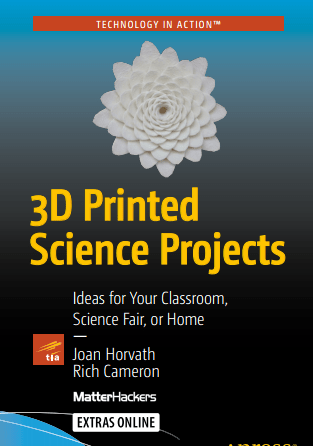
This document is an excerpt from “3D Printed Science Projects: Ideas for Your Classroom, Science Fair, or Home” by Joan Horvath and Rich Cameron. It focuses on practical applications of 3D printing for educational science projects. The text covers various scientific principles, including 3D math functions, wave phenomena, gravity, airfoils, simple machines, plant ecosystems, molecules, and trusses, offering OpenSCAD models and printing considerations for each. It serves as a resource for teachers and students, providing ideas for classroom demonstrations and science fair projects, emphasizing hands-on learning and building intuition through physical models.
The World of 3D Printing
3D printing is a process that creates three-dimensional objects by melting plastic filament and laying it down layer by layer. This technology is rapidly evolving, but its basic principles are expected to remain consistent for some time.
The 3D Printing Process
The overall workflow for creating something with a 3D printer typically involves three steps: making a 3D model, slicing that model into layers, and loading the sliced model onto a printer.
- 3D Model Development: You first develop a 3D model, often using programs like OpenSCAD. Models in the source material are based on OpenSCAD, a free and open-source 3D solid modeling program. Models are stored in files ending in .scad.
- Slicing: After the 3D model is developed, other software slices it into layers, which the printer then creates one at a time, usually from the bottom up. MatterControl, an open-source host program, is used for this slicing step in the sources. The .stl format is a common standard for 3D-printable models, and MatterControl takes an .stl file to output a .gcode file, which runs on the printer.
- Printing: 3D prints are made by melting plastic filament and depositing it layer by layer. These layers are typically very thin, around 0.2 mm. While some printers use powder or liquid resins, the models discussed are designed for filament-based 3D printers.
Materials for 3D Printing
The prints in the sources were primarily created using PLA (polylactic acid) filament. PLA is a corn-based, biodegradable plastic and is one of the most common materials for 3D printing filament. Other common filament plastics, such as ABS, are generally expected to work as well, though specific testing in the sources was limited to PLA. Filament is typically sold on spools of 1 kg or 1 lb of material.
Software for 3D Printing
The sources highlight two main software tools for 3D printing:
- OpenSCAD:
- This program allows you to develop models using a syntax similar to C, Java, or Python programming languages.
- It is free and open-source and is developed and maintained by Marius Kintel and other contributors.
- You can download it from http://www.openscad.org.
- When working with models, you can preview changes quickly using Design ➤ Preview (which doesn’t allow export) before performing a full render (Design ➤ Render) for export.
- The final model is exported as an .stl file (File ➤ Export ➤ Export as STL).
- OpenSCAD has some unique characteristics; for instance, its “variables” are more akin to constants in other programming languages, and its “functions” are mathematical functions returning a value, rather than performing other tasks.
- MatterControl:
- MatterControl is a free and open-source program from MatterHackers that converts .stl models into commands for 3D printers.
- It supports many 3D printer models, with a list available at http://www.mattercontrol.com/#jumpSupportedModels.
- After loading an .stl file (File ➤ Add File to Queue or the “+Add” button), you can view the model in 3D View to see its placement on the print bed.
- The Layer View screen is where the program breaks the model into printable layers, generates commands, and provides estimates for print time and filament usage. Support material generation is also handled here.
- Settings like Support Material and Skirt and Raft can be adjusted in MatterControl.
- It’s crucial to save any setting changes in the Settings window before generating a new printable file.
General 3D Printing Considerations and Tips
- Support Material: If parts of a print overhang significantly (beyond about 45 degrees), support material may be necessary to prevent the plastic from falling. The less support generated, the better, as it needs to be removed post-printing. MatterControl can generate support automatically.
- Raft and Skirt/Brim:
- A raft is a thin base layer printed first, with the model printed on top, useful for printers with uneven beds or for delicate parts. It must be removed cleanly after printing.
- A skirt is a line drawn around the model’s first layer to prime the nozzle. If printed attached (0 mm away), it’s often called a brim, which helps adhesion to the print bed.
- Scaling: For some models, particularly those with specific tolerances like the airfoil or simple machine models, it is recommended to adjust scaling parameters within OpenSCAD rather than using the 3D printer software’s scaling functions. Drastically scaling down can lead to reliability issues, with parts becoming too thin to print.
- Print Time: Some complex models can take a long time to render in OpenSCAD and MatterControl, and similarly long to print (several hours on small printers). Planning ahead is advisable for classroom use.
- Layer Height and Infill: Prints are typically done with a layer height of around 0.2 mm and often with 15% infill, though printer defaults may vary.
- Cooling Towers: For prints with tall, pointy features that need more cooling time per layer, a “cooling tower” (a separate tall, skinny object printed alongside the model) can be added to increase overall print time and allow layers to cool.
3D Printing for Science Projects
The sources emphasize that 3D printing offers a way to add another dimension to textbook understanding of science. It allows students, parents, and teachers to create physical, customizable models that aid in learning math, physics, botany, chemistry, engineering, and more. These models serve as starting points for explorations, enabling users to vary features and gain new scientific insights. The models are designed to be useful for science fairs, extra credit, or classroom demonstrations.
3D Printing Science: Models for Exploration and Discovery
3D printing offers a unique way to enhance understanding of science concepts by allowing students, parents, and teachers to create physical, customizable models. These models serve as starting points for explorations, enabling users to vary features and gain new scientific insights. The overarching goal of the science projects discussed in the sources is to add another dimension to textbook understanding of science, going beyond mere 2D projections.
The models are designed to be useful for science fairs, extra credit, or classroom demonstrations, providing open-ended, substantial explorations that can be pursued at various levels. The underlying science is built into the models, allowing for deeper insights into fundamental concepts.
Here are specific science fair project ideas suggested across different scientific disciplines:
- 3D Math Functions: Projects could involve printing out a model of a function relevant to a product and taking measurements with calipers to compare with theoretical predictions. Students can also explore how the creation of a physical model and any printing issues provide insight into the problem. Thinking about how to display a math function in 3D versus using a 2D illustration can also foster different perspectives.
- Light and Other Waves: Students can design and print a variety of different types of waves to compare, contrast, and measure. Interesting exercises could be built around one function being the envelope or negative space of another, and creating a “negative space” model so two models can fit together can be very insightful. More advanced students might consider whether a simplified model of magnetic fields, applied thoughtfully, could be explored for a narrow hypothesis, despite the complexities of full field equations.
- Gravity: Simple projects could involve applying the provided equations to more detailed models of planetary and comet orbits to determine orbital velocity at a given point. More sophisticated projects might include developing a model of the gravity well of a star with an eclipsing companion (like Algol) and using orbit equations to determine its period. Students could also model escape velocity or hyperbolic orbits, or explore what life might be like on a planet with a very elliptical orbit. It’s noted that the orbital velocity equation in the source applies only to two-body systems.
- Airfoils: A project could involve testing a series of airfoil models in a wind tunnel to measure lift and drag. Another idea is to approximate a bird’s wing and model how well a bird “should” fly. Alternatively, simpler qualitative tests in front of a box fan could be done, focusing on devising simple ways to measure lift and drag using weights.
- Simple Machines: Projects can focus on the real-world effects of friction on simple machines and finding systematic ways to minimize inefficiency. Students could analyze existing products for efficiency and suggest improvements based on varying human hand sizes or different environments (e.g., wearing gloves). Investigating factors that cause simple machines to break or malfunction, and designing enhancements to prevent this, is also a relevant project area.
- Plants and their Ecosystems: Projects could involve changing variables in the plant models and comparing the resulting plants to real ones to see how well the mathematics describes them. Students can also design a garden for a specific climate (e.g., sunny, hot, dry) and create a plant community, then analyze how it compares to real desert plant communities or how it might fare under sudden climate change. Introducing an “invasive species” into a balanced plant grouping and tracking its potential displacement of other organisms is another idea. Creating a game to track plant resources like water, sun, or nutrients could also be an engaging project.
- Molecules: A primary experiment is simply to print the provided models and see how they fit together. Further explorations might include building more complex molecules with basic close-to-tetrahedral structures. The sources advise caution when extrapolating too far from the given shapes, as they are simplified representations of quantum-mechanics-driven phenomena.
- Trusses: Students can play with the parameters for 2D and 3D truss models to see how changes in design affect their behavior, aiming to mimic ideal pin joints. More complex tensegrity projects could involve determining how much load these structures can hold, what types of forces they withstand, and what forces cause collapse. Exploring a biological tensegrity structure and mimicking it with a physical model is also suggested.
The models for these projects are written using OpenSCAD, a free and open-source 3D solid modeling program, which allows users to alter the models easily. MatterControl (or equivalent software) is then used for slicing the models into printable layers and controlling the 3D printer. While the projects can be just printed, they are particularly designed to be altered by the user to learn science or math principles through changing their features. The authors experienced the challenges of developing these models, often having to delve deep into the physics and historical context, which itself became a “Learning Like a Maker” experience.
3D Printing: Hands-On Science Exploration
3D printing offers a unique and powerful way to enhance the understanding of physical science concepts by enabling the creation of physical, customizable models that go beyond traditional 2D textbook illustrations. These models serve as starting points for hands-on explorations, allowing users to vary features and gain new scientific insights. The projects are suitable for various educational settings, including science fairs, extra credit, or classroom demonstrations, providing “open-ended, meaty explorations” that can be pursued at different levels. The underlying science is built directly into these models to foster deeper comprehension of fundamental principles.
The sources describe how 3D printed models can be used to explore several key areas within the physical sciences:
- 3D Math Functions: This serves as a foundational tool for visualizing underlying mathematics in scientific concepts. By printing out 3D models of functions, users can gain a different perspective compared to 2D illustrations. Projects could involve printing models of functions relevant to a product and taking measurements to compare with theoretical predictions, or exploring how physical creation and printing issues provide insight into mathematical problems. The process often involves defining surfaces z = f(x,y) in OpenSCAD, which can then be printed with a flat bottom or as a thin two-sided sheet.
- Light and Other Waves: This topic explores the properties and interactions of waves, particularly electromagnetic waves like light. Models visualize wave interactions, such as the principle of superposition where waves add (constructive interference) or cancel out (destructive interference). Key experiments like diffraction and Young’s double-slit experiment can be modeled to show how light behaves after passing through slits, demonstrating interference patterns. The models can also explore point sources, plane waves, and the concept of an “envelope” or “negative space” model to fit wave patterns together for deeper insight. While the full physics involves complex partial differential equations, the simplified 3D models still offer valuable conceptual understanding.
- Gravity: This section delves into concepts of universal gravitation, gravitational potential wells, and orbital mechanics. Models can visualize the gravity wells of celestial bodies, like the Earth-Moon system, illustrating the energy required to “climb out” of a gravitational pull. The Algol star system provides a more complex example of interacting gravity potentials. For orbits, models demonstrate Kepler’s laws and Newton’s vis viva equation, showing how bodies (like Halley’s Comet or inner solar system planets) speed up or slow down in their elliptical paths. These models help build intuition for concepts usually requiring calculus.
- Airfoils: This area focuses on the aerodynamics of wings. It covers the four forces of flight (lift, drag, gravity, thrust) and key airfoil characteristics like chord, camber, and thickness. The models are based on historic NACA airfoil profiles, which were empirically developed standards. Projects can involve testing a series of airfoil models in a wind tunnel to measure lift and drag, or approximating bird wings to understand flight principles. The models are designed for experimentation and analysis, rather than being flyable.
- Simple Machines: This topic explores devices that change the amount or direction of force, exploiting mechanical advantage. The six standard simple machines—inclined plane, wedge, lever, screw, wheel and axle, and pulley—are modeled. Projects can focus on analyzing the real-world effects of friction, finding ways to minimize inefficiency, or investigating factors that cause simple machines to break or malfunction. The models are physical representations of objects that are normally 3-dimensional, allowing for tactile learning.
- Molecules: This delves into chemistry, allowing visualization of abstract atomic and molecular structures. It covers concepts like valence electrons, basic orbital shapes (s and p orbitals), and how atoms form covalent bonds to create molecules. Models include a carbon atom with its orbitals and water molecules. The topic also extends to crystal structures, such as different forms of water ice (ice 1h and ice 1c) and their similarities to diamond, explaining how molecules form repeating patterns. The models, while simplified, help in developing intuition about these interactions.
- Trusses: This introduces structural engineering concepts, focusing on trusses as structural elements that use the strength of triangular arrangements to carry loads. Models include both 2D planar trusses and tensegrity structures, a special type of 3D truss composed of stiff and flexible elements. Projects can involve playing with parameters to see how design changes affect behavior under load, or exploring the load-bearing capabilities and failure points of complex tensegrity structures. These models help build engineering intuition about how structural design handles different forces.
These applications demonstrate how 3D printing provides a hands-on, interactive approach to learning physical sciences, moving beyond mere 2D representations and enabling deeper engagement with complex concepts. The authors themselves experienced a “Learning Like a Maker” journey, delving deeply into physics and historical contexts to develop these models.
3D Printed Models for Engineering Design and Science Education
Engineering design, as discussed in the sources, is significantly enhanced through the use of 3D printing by providing a hands-on, interactive approach to learning fundamental principles and developing intuition. Rather than merely viewing 2D projections, students, parents, and teachers can create and manipulate physical, customizable models that embody scientific and engineering concepts, allowing for deeper exploration and insight.
The goal of these 3D printed science projects is to provide “open-ended, meaty explorations” suitable for various educational contexts like science fairs, extra credit, or classroom demonstrations. The design process itself, often referred to as “Learning Like a Maker,” involves delving deep into the physics and historical context, leading to unexpected insights.
Here’s how 3D printing is applied to various aspects of engineering design within the physical sciences:
- Trusses
- Concept: Trusses are structural elements that leverage the inherent strength of triangular arrangements to efficiently carry loads with minimal material. This principle is vital in bridges, roof supports, and other infrastructure.
- Types: The sources discuss planar (2D) trusses (ignoring component thickness) and space (3D) trusses, which handle loads in three dimensions. A unique subset is tensegrity structures, composed of stiff members held in compression and flexible elements (like cables or rubber bands) held in tension.
- Modeling & Learning: A 3D printed 2D truss model incorporates “spring” members to functionally mimic ideal pin joints, allowing users to observe how members compress and expand under load and how the triangular structure prevents collapse. Tensegrity models (like a 3-rod prism or icosahedron) allow for hands-on assembly, demonstrating how these mixed-material structures achieve stability. The assembly process itself teaches about the inherent instability when members are removed.
- Projects: Students can vary parameters to see how design changes affect behavior and mimic ideal pin joints more closely. More complex projects involve determining load-bearing capacity, types of forces withstood, and causes of collapse in tensegrity structures. Biological tensegrity structures (like bones and tendons) can also be mimicked and explored physically.
- Challenges: Accurately modeling pin joints with 3D printing is difficult. The “spring” placement in the 2D truss required significant iteration. Tensegrity assembly can be tricky, highlighting the structural interdependence.
- NGSS Alignment: This material aligns with middle school and high school “Engineering Design” standards (MS-Engineering Design and HS-Engineering Design).
- Airfoils
- Concept: An airfoil is the cross-section of a wing, designed to generate lift and minimize drag during flight. Key design parameters include chord, camber, and thickness.
- NACA Airfoils: These historically significant profiles, developed empirically in the 1930s, provide a standardized system for airfoil design. The NACA four-digit series defines an airfoil based on maximum camber, its location, and maximum thickness.
- Modeling & Learning: 3D printing allows for the creation of physical models of NACA airfoils, enabling visual and tactile understanding of their geometry. Models can be designed with features like sweep and taper. A test stand with an adjustable angle of attack can be printed to experimentally measure lift (e.g., using a fan and a postal scale).
- Projects: Projects include testing series of airfoil models in a wind tunnel to measure lift and drag, approximating bird wings to understand flight principles, or performing qualitative tests with simple tools like a box fan. Students can explore how design changes affect performance.
- Challenges: The historical NACA airfoil equations presented challenges due to inconsistent naming conventions and transcription errors in various sources, requiring deep historical research. Ensuring models are both easy to print and aerodynamically relevant for experimentation is a design challenge.
- NGSS Alignment: Concepts align with “Forces and Interactions” (MS-PS-2) and “Energy” (MS-PS-3) standards.
- Simple Machines
- Concept: Simple machines are basic devices (inclined plane, wedge, lever, screw, wheel and axle, pulley) that alter the magnitude or direction of force, creating mechanical advantage. Most complex machines are combinations of these.
- Modeling & Learning: 3D printing enables the creation of physical versions of each simple machine. The OpenSCAD models allow users to vary critical dimensions, providing intuition about how changes in geometry affect mechanical advantage and efficiency. Examples include a functional vise model where the screw knob is printed in place, and a versatile wheel/pulley model.
- Projects: Projects can focus on analyzing the real-world effects of friction on simple machines and finding systematic ways to minimize inefficiency. Students can analyze existing products, suggest improvements based on user factors (e.g., hand size), or investigate causes of malfunction and design enhancements. Recreating historical machines is also a suggested project.
- Challenges: Unlike abstract concepts, simple machines are already 3D objects, so the design challenge lies in making models that are useful for demonstrating principles and can be integrated into more complex systems. Achieving precision in printed parts (like the screw for the vise) or complex assemblies (like the gear bearing) requires careful consideration of print settings and tolerances.
- NGSS Alignment: These topics generally align with “Forces and Interactions” (MS-PS-2) and “Energy” (MS-PS-3) standards.
The authors emphasize that while sophisticated computer programs can simulate and calculate engineering problems, developing intuition through hands-on model creation is crucial for understanding design, knowing the limitations of simulations, and innovating new solutions. The ability to physically build and interact with these models helps users ask “how could you make them better?” and understand why models might differ from reality.
3D Printing for Life Sciences: Plants and Molecules
The sources indicate that 3D printing significantly enhances the discussion of Life Sciences by providing tactile, customizable models that foster intuition and deeper understanding of complex biological and chemical concepts. The book offers “open-ended, meaty explorations” suitable for various educational settings, encouraging users to “Learn Like a Maker” by delving into the underlying science and history.
The main topics covered in the Life Sciences domain are Plants and their Ecosystems and Molecules.
Plants and Their Ecosystems (Chapter 6)
This section focuses on how plants grow and adapt to their environments, leveraging mathematical principles.
- Botany Background:
- Plants are stationary life forms that adapt to their environment by evolving various forms to fit their ecological niche.
- Their survival depends on six key elements: light, water, gases, temperature, mineral nutrients, and mechanical support.
- Water Management: Plants in wet environments, like jungles, develop strategies to shed water (e.g., waxy leaves with “drip tips”), while desert plants focus on water retention and deterring consumption (e.g., milky sap, spines, tough outer surfaces).
- Sunlight Capture: Plants use photosynthesis to capture the sun’s energy, and their forms optimize light absorption, with some adapting to low-light conditions under forest canopies.
- Nutrient Cycling: Plants obtain nutrients like nitrogen, potassium, and phosphorus from the soil, which are crucial for growth and various functions. Some plants “fix” nitrogen, benefiting others.
- Plant Communities: Plants coexist in ecosystems through competition and cooperation, influencing each other’s growth, nutrient access, and even pollinator attraction.
- Mathematics of Plant Growth:
- Efficient distribution of leaves and flower petals is evolutionarily favored to maximize light exposure and pollinator attraction.
- This efficiency often results from the golden angle (~137.52 degrees), which ensures that subsequent leaves or petals never quite align, allowing for even spacing.
- The Fibonacci sequence (e.g., 0, 1, 1, 2, 3, 5, 8, 13…) is closely related to the golden ratio, and many plants exhibit a number of leaves or petals corresponding to these numbers.
- Phyllotaxis is the process where plants generate new leaves at the meristem (tip of stem/branch) in a spiral pattern, often linked to the golden angle, to prevent self-shading.
- 3D Printed Models:
- The book provides stylized OpenSCAD models for plants and flowers that incorporate these mathematical principles.
- Desert Plant Models (e.g., aloe): designed with structures that direct water to roots, generally easier to print as they tend to grow upwards or gradually inwards.
- Tropical Jungle Plant Models: often spindly with large, curved leaves to maximize light, and “drip tips” to shed water. These are more challenging to print and require leaves to be printed separately and then assembled onto a base.
- Flower Models: like camellias and daisies, illustrate how petals are splayed for maximum display to attract pollinators. These may require support material during printing if petals are nearly horizontal.
- Learning Insights and Projects:
- Creating these models can provide unusual insight into how plant form evolves based on its ecosystem.
- Users can vary parameters in the OpenSCAD models (e.g., length, width, curvature, petal count) to “evolve” different plant species and consider where they might flourish in the real world.
- This can lead to projects exploring the design of plant communities, the impact of invasive species, or the analysis of plant structures in different climates.
- NGSS Alignment: This content aligns with various Next Generation Science Standards, including MS-LS2-5 (Ecosystems: Interactions, Energy, and Dynamics) and HS-LS2-7 (Ecosystems: Interactions, Energy, and Dynamics), as well as K-2 standards on plant-animal-environment interrelationships. Citizen science projects are also encouraged.
Molecules (Chapter 7)
This chapter provides minimalist models to build intuition about abstract chemical concepts, particularly molecular interactions and crystal structures relevant to biological systems.
- Chemistry Background:
- Atoms form molecules through chemical bonds, primarily involving their valence electrons.
- The octet rule states that atoms of representative elements tend to bond to achieve eight valence electrons.
- Orbital shapes (e.g., spherical s orbitals and dumbbell-shaped p orbitals) describe regions where electrons are likely to be found.
- Carbon Atom Model:
- The model consists of a nucleus, two s orbital halves, and three p orbital pieces, designed to snap together and visually represent the arrangement of orbitals.
- It is a stylized representation meant to “look right” rather than being derived from fundamental wave equations.
- The concept of hybridization (sp, sp2, sp3) is introduced, explaining how s and p orbitals combine to form new orbital structures that determine molecular geometry (e.g., sp3 creates tetrahedral structures).
- Water Molecules:
- A water molecule (H2O) consists of two hydrogen atoms covalently bonded to one oxygen atom.
- Water exhibits unique properties (e.g., high boiling point, liquid denser than solid) due to hydrogen bonds, which are dynamic interactions between hydrogen and oxygen atoms.
- The 3D-printed water molecule model is printed in halves with a flat side and features two plugs (hydrogens) and two holes (oxygen electron pairs) to allow connection to other molecules, particularly in crystal structures.
- Crystals:
- Many substances form crystals, which are regular, repeating patterns of molecules.
- Ice 1h (hexagonal ice): The common form of ice on Earth, characterized by layers of hexagons. Its sparsely packed structure explains why ice is less dense than liquid water. Assembly can be tricky, requiring consistent orientation of “spikes” and “holes”.
- Ice 1c (body-centered cubic ice): Another form of water ice with a different tetrahedral arrangement, found in high clouds. Its hexagons are offset from layer to layer.
- Diamond: This crystalline form of carbon has a structure very similar to Ice 1c, with each carbon atom bonded to four others in a tetrahedron, contributing to its strength. Graphite, in contrast, consists of flat sheets with loosely bonded electrons.
- Learning Insights and Projects:
- Developing these models required significant research and re-learning of chemistry concepts, validating the “Learning Like a Maker” approach.
- Physical model design necessitates compromises to ensure printability and assembly, highlighting the difference between idealized mathematical models and physical representations.
- Projects include building more complex molecules with tetrahedral structures, gaining insights by observing how models might differ from ideal representations, and understanding the challenges of accurately modeling quantum phenomena physically.
- NGSS Alignment: This content is applicable to HS-PS1 (Chemical Reactions) and MS-PS1 (Matter and its Interactions) standards.
Across both Life Sciences discussions, the authors emphasize that while sophisticated computer simulations exist, hands-on model creation is crucial for developing intuition about design, understanding the limitations of simulations, and innovating new solutions. The physical interaction with these models prompts questions about improvement and the differences between models and reality.

By Amjad Izhar
Contact: amjad.izhar@gmail.com
https://amjadizhar.blog
Affiliate Disclosure: This blog may contain affiliate links, which means I may earn a small commission if you click on the link and make a purchase. This comes at no additional cost to you. I only recommend products or services that I believe will add value to my readers. Your support helps keep this blog running and allows me to continue providing you with quality content. Thank you for your support!

Leave a comment