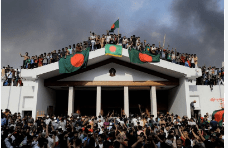
Political news from Bangladesh dominates this report, focusing on the government’s efforts to extradite former Prime Minister Sheikh Hasina from India to face corruption and other charges. The report also covers the release of a BNP vice chairman from prison, internal BNP party matters, and ongoing investigations into corruption allegations. Additionally, the news includes discussions on public administration reform, infrastructure projects like the Padma Bridge rail link, airport security exercises, and various social and political events. Finally, there are brief mentions of international events like the Israeli-Palestinian conflict.
Bangladesh Politics: July-August 2024
I. Short Answer Questions
Instructions: Answer the following questions in 2-3 sentences each.
- What specific demands did the Tablighi Jamaat make during their press conference at Kakrail Mosque?
- What were the key points raised by Dr. Hossain Zilur Rahman and Dr. Badiul Alam Majumdar during the Center for Government Studies dialogue?
- Explain the reasons behind the ACC’s decision to re-investigate the Novo Theater corruption case.
- Describe the circumstances surrounding the issuance of arrest warrants for Saiful Islam and four police officers by the International Criminal Tribunal.
- What were Mirza Fakhrul Islam Alamgir’s key statements regarding BNP’s stance on individuals involved in the July massacre and the party’s future direction?
- What were the main outcomes and significance of the joint security exercise conducted at Hazrat Shahjalal International Airport?
- Summarize the dispute surrounding the land in Jessore intended for the Tafseerul Qur’an Mahfil.
- Outline the key messages conveyed to distributors during the Walton and Safe Electrical Appliances annual conference.
- What significant developments occurred in relation to the ICC World Cup schedule?
- What were the primary concerns raised by the National Garment Workers Federation regarding labor rights and working conditions?
II. Answer Key
- The Tablighi Jamaat demanded a state ban on all Sad Panthi activities within 24 hours, swift justice for those involved in the December 1 and 17 terrorist attacks, and state assurance that all Tablighi activities would be conducted under Surai Nizam.
- They highlighted the failures of the interim government despite goodwill, the ongoing social anarchy and insecurity, and the persistent influence of brokers in the public administration system. They emphasized the need for reforms based on human rights and service assurance.
- The ACC decided to re-investigate due to allegations of widespread corruption and the previous dismissal of the case in 2015 based on claims of no corruption, prompting a review of the court’s decision and the case’s merits.
- The arrest warrants were issued due to allegations of Saiful Islam’s involvement in the shootings of six students and the deliberate burning of their bodies on August 5th, with the chief prosecutor arguing that the incident was a most brutal act requiring separate investigation.
- Mirza Fakhrul stated that BNP would not tolerate terrorists or corrupt individuals involved in the July massacre, emphasizing the party’s commitment to holding those responsible accountable. He also stressed the need for speedy national elections and the transfer of power to elected representatives.
- The exercise successfully demonstrated the coordinated efforts of various forces in responding to potential threats, enhancing airport security protocols, and reinforcing collective responsibility through training and regular risk assessments.
- Khadija Khatun, who purchased the land in 2012, accused the organizers of the Tafseerul Qur’an Mahfil of encroaching on her property, while the organizers and authorities denied her claims, stating that the land was rightfully acquired and her accusations were baseless.
- Distributors were urged to conduct timely market research, utilize effective marketing strategies, and embrace innovative business techniques to boost sales, highlighting the importance of adaptability and market awareness for continued success.
- The ICC announced a hybrid model for the World Cup, scheduling the opening match for February 19 in Karachi, followed by India vs. New Zealand in Dubai on February 20. The final was set for Lahore, with Dubai as an alternative venue if India qualified.
- The federation called for coordinated efforts to address challenges, emphasizing the importance of timely salary and allowance payments, efficient management practices, and a robust labor law framework that protects workers’ rights and promotes fair treatment.
III. Essay Questions
- Analyze the political climate in Bangladesh during the period covered by the source material. How did the events of July-August 2007 shape the country’s political landscape?
- Evaluate the role of the interim government in addressing the various challenges facing Bangladesh, including corruption, security concerns, and public administration issues. To what extent were they successful in fulfilling their mandate?
- Discuss the significance of the Novo Theater corruption case and the ACC’s decision to re-investigate. How does this case reflect broader issues of accountability and transparency in Bangladeshi politics?
- Critically examine the demands and actions of the Tablighi Jamaat. What were their motivations, and how did their approach contribute to the overall political discourse in Bangladesh?
- Assess the state of labor rights and working conditions in the garment industry during this period. What role did organizations like the National Garment Workers Federation play in advocating for improved conditions, and what challenges did they face?
IV. Glossary of Key Terms
- Awami League: A major political party in Bangladesh, often associated with secular nationalism and social democracy.
- BNP (Bangladesh Nationalist Party): A prominent political party in Bangladesh, known for its center-right ideology and emphasis on Bangladeshi nationalism.
- Caretaker Government: A neutral, interim government appointed to oversee elections and ensure a smooth transition of power in Bangladesh.
- Cyber Security Ordinance: A law aimed at addressing cybercrime and regulating online activity, often subject to debate regarding potential implications for freedom of expression.
- International Criminal Tribunal: A court established to prosecute individuals responsible for serious crimes such as genocide, war crimes, and crimes against humanity.
- Jamaat-e-Islami: A Bangladeshi Islamist political party, known for its conservative religious stance and historical involvement in the Bangladesh Liberation War.
- Sad Panthi: A term used to refer to followers of a particular Islamic sect, sometimes associated with controversy and differing interpretations of Islamic teachings.
- Surai Nizam: An Islamic concept referring to a system of governance based on Islamic principles and values.
- Tablighi Jamaat: A transnational Islamic missionary movement focused on propagating Islamic teachings and encouraging a revival of Islamic practices.
- Tafseerul Qur’an: The interpretation and explanation of the Quran, often delivered through lectures and gatherings.
Bangladesh: Politics, Justice, and Socioeconomic Issues
Bangladesh Politics and Justice in Focus: A Briefing
This document summarizes key themes and information from the provided ATN Bangla news segment. The news covers a range of topics, focusing on political developments, legal proceedings, and societal issues in Bangladesh.
Key Themes:
- Calls for accountability and justice: The news highlights the interim government’s efforts to bring former Prime Minister Sheikh Hasina back to Bangladesh to face charges related to corruption, extrajudicial killings, and the suppression of dissent during her tenure.
- Focus on corruption allegations: The segment details the Anti-Corruption Commission’s (ACC) decision to re-investigate several corruption cases against Sheikh Hasina, including the Novo Theater case and allegations of money laundering. The ACC is seeking documents from the central bank related to financial transactions of Hasina and her family.
- Political maneuvering and upcoming elections: The news features statements from various political figures, including Mirza Fakhrul Islam Alamgir, Secretary General of the Bangladesh Nationalist Party (BNP), who warns that individuals involved in violence and corruption will not be accepted in the party. The BNP calls for quick national elections and emphasizes the importance of a democratically elected government.
- Socioeconomic concerns and infrastructure development: The segment also touches upon issues such as the severe winter affecting the northern region, the launch of a new train route via the Padma Bridge, and the need to address public suffering and ensure the safety of citizens.
Important Ideas and Facts:
- Sheikh Hasina’s return: The Bangladesh government is seeking the extradition of Sheikh Hasina from India. Diplomatic efforts are underway, but India has yet to respond to the request. The government intends to prosecute Hasina for alleged crimes committed during her time in office.
- “Bangladesh will take the next step after receiving the reply sent to the government of India for the return of former Prime Minister Sheikh Hasina.”
- Corruption investigations: The ACC is re-opening investigations into several cases against Hasina, including the controversial Novo Theater project. They are also investigating allegations of money laundering and have requested financial transaction records from the central bank.
- “ACC reports letter to Bangladesh Bank seeking documents on Mahbub Kovid Chapal’s 1996 initiative to build Novo Theater at Vijay Sarani in the capital.”
- BNP’s stance: Mirza Fakhrul Islam Alamgir, Secretary General of the BNP, emphasizes the party’s commitment to holding free and fair elections and asserts that individuals involved in violence and corruption will not find a place within the BNP.
- “He went and said that while demanding the speedy national elections, Mirza Fakhrul said that the people’s elected representatives will run the country.”
- “Terrorists and people involved in genocide will not have place in BNP Mirza Fakhrul’s warning”
- Societal concerns: The news highlights the plight of people suffering due to the harsh winter conditions in the northern region and emphasizes the need for the interim government to address rising costs of living and ensure public safety.
Other Notable Events:
- The release of former Deputy Minister Abdus Salam Pintu after 17 years in prison.
- The issuance of arrest warrants for Saiful Islam, a former Member of Parliament, and four police officers in connection with the burning of six student bodies during the July-August agitation.
- The inauguration of a new train route from Dhaka to Khulna and Benapole via the Padma Bridge, reducing travel time significantly.
- A security exercise conducted at Hazrat Shahjalal International Airport to ensure preparedness in handling potential threats.
Overall, this news segment paints a picture of a nation grappling with political transitions, demands for accountability, and socio-economic challenges. The focus on legal proceedings against Sheikh Hasina and the upcoming elections signifies a critical juncture in Bangladesh’s political landscape.
FAQ about Political Developments in Bangladesh
1. What is the Bangladesh government’s stance on the return of former Prime Minister Sheikh Hasina?
The interim government of Bangladesh has sought the return of former Prime Minister Sheikh Hasina from India. They have sent a letter to the Indian government requesting her extradition to face legal proceedings in Bangladesh. The government will determine its next steps based on India’s response. They have also expressed concerns to India regarding Sheikh Hasina’s participation in Awami League events while residing in India.
2. What are the accusations against Sheikh Hasina?
Sheikh Hasina is accused of various crimes including establishing a dictatorship, involvement in extrajudicial killings, and corruption. Specifically, she faces accusations related to the Novo Theater corruption case and the burning of six student bodies during the July-August agitation. The government intends to re-investigate these cases.
3. What is the BNP’s position on the upcoming elections and the involvement of individuals implicated in past crimes?
The Bangladesh Nationalist Party (BNP) is demanding swift national elections and advocating for the country to be governed by elected representatives. BNP Secretary General Mirza Fakhrul Islam Alamgir has stated that individuals involved in terrorism, corruption, or the July massacre will not be allowed within the party.
4. What is the status of the investigation into the Novo Theater corruption case?
The Anti-Corruption Commission (ACC) has decided to reopen the investigation into the Novo Theater corruption case, which involves allegations of corruption during Sheikh Hasina’s tenure as Prime Minister. The ACC is seeking documents from Bangladesh Bank related to financial transactions associated with the project.
5. What are the demands of the Tablighi Jamaat?
The Tablighi Jamaat is demanding a state-imposed ban on all Sad Panthi activities within 24 hours. They also seek the swift prosecution of individuals involved in the December 17 terrorist attack and the December 1, 2018, incident at the Tongi Iztema ground. They insist that the state ensure all Tablighi activities are conducted under the Surai Nizam.
6. What is the significance of the joint security exercise at Hazrat Shahjalal International Airport?
The joint security exercise at Hazrat Shahjalal International Airport involves various security forces collaborating to ensure preparedness against potential threats and accidents. This exercise is conducted every two years in accordance with International Civil Aviation Authority (ICAO) regulations and aims to enhance security measures and passenger safety at the airport.
7. What is the latest development in the case of land encroachment in Jessore?
Allegations of land encroachment related to the Tafseerul Qur’an Mahfil event in Jessore have been refuted by the organizers and the land’s current owner. Following an investigation, the police found no evidence to support the claims of land grabbing.
8. What were the key highlights of the Walton and Safe Electrical Appliances distributor conference?
The annual distributor conference for Walton and Safe Electrical Appliances focused on strategies to enhance product sales. The event emphasized market research, effective marketing techniques, and business strategies. The conference also featured a cultural program led by director Amin Khan.
Hasina’s Return to Bangladesh: Corruption and Killings
Bangladesh is seeking the return of former Prime Minister Sheikh Hasina to face charges related to corruption and extrajudicial killings [1-3]. Bangladesh has sent a letter to India requesting her return, as she fled there on August 5th [1, 2]. India has issued a warrant for her return to Delhi but has yet to respond to Bangladesh’s request for her return [1].
Bangladesh will determine its next steps based on India’s response [2]. Meanwhile, Bangladesh has objected to India about Hasina’s speeches at Awami League meetings in various countries in India [1].
The government of Bangladesh has stated that Hasina will be prosecuted for alleged crimes committed during her time as Prime Minister. These include the extrajudicial killings of hundreds of people and the suppression of dissent through fear and violence [2, 3]. The government maintains that it is following existing legal processes [2]. The former Prime Minister is also accused of corruption, specifically in connection with the construction of the Novo Theater and the Padma Bridge project [2, 4]. The Anti-Corruption Commission (ACC) plans to re-investigate these cases and has requested documents related to Hasina’s family transactions from the central bank [2, 4].
BNP’s Rejection of Extremists
The Bangladesh Nationalist Party (BNP) has stated that terrorists and those involved in genocide will not be allowed in the party [1]. BNP Secretary General Mirza Fakhrul Islam Alamgir issued this warning while demanding the acceleration of national elections [1]. He emphasized that the country should be governed by elected representatives [1]. Mirza Fakhrul stated that the BNP would not accept any individuals associated with the massacres and killings [1].
Novo Theater Corruption Case Reopened
The Anti-Corruption Commission (ACC) in Bangladesh is reopening an investigation into a corruption case concerning the construction of the Novo Theater in Dhaka. The project, initiated by the Awami League government in 1996 and overseen by then-Prime Minister Sheikh Hasina, was accused of widespread corruption. [1] The initial cost estimate was Tk 120 crore, and the foundation stone was laid in 2000. [1]
Here’s a timeline of the Novo Theater corruption case:
- 2005: Three cases were filed by the Anti-Corruption Bureau against individuals involved in the project. [1]
- Later in 2005: The order to file charges was challenged by Justice Sultan Hussain Khan’s commission. [1]
- 2010: A High Court bench, led by Justice Shamsuddin Chowdhury Manik, deemed the chargesheet order illegal and accused the case of having ulterior motives. [1]
- 2015: All those accused in the Novo Theater case, including Sheikh Hasina, were acquitted. [2]
The ACC has now decided to reinvestigate this case. [2] The ACC is also looking into a separate case filed in 2012, which was dismissed in 2014 by the commission chairman on the grounds of no corruption. [2] The ACC aims to determine the reasoning behind the court’s decision to close the case and review the findings before making further decisions. [2] As part of the investigation, an inquiry committee has been formed to collect documentary evidence. [2] The team is contacting various offices for documentation and plans to interview individuals related to the complaint within two months. [2]
Bangladesh’s Failing Public Administration
Former advisor to the caretaker government, Dr. Hossain Zillur Rahman, stated that in the 53 years of Bangladesh’s existence, public administration reforms have not served the people’s interests. [1] Dr. Badiul Alam Majumdar, head of the Electoral Reform Commission, agreed, adding that the Awami government’s politicization of public administration has further hindered the public interest. [1]
Several key points regarding public administration reform emerged during a dialogue on democratic reconstruction:
- The reforms enacted during the 2007-2008 caretaker government period were not fully realized. Had these reforms been implemented, experts believe the current political climate might be different. [1]
- Public administration should prioritize human rights and reliable service delivery. [1]
- Local government and political parties should be given more consideration when creating effective public administration. [1]
- The ultimate responsibility for public administration reform rests with the political parties. Experts believe that the success of reforms hinges on the will of political parties to carry out the wishes of the people. [1]
Therefore, while the current government may have shown goodwill and sincerity, they have ultimately failed to implement effective public administration reforms that prioritize the needs of the Bangladeshi people. [1]
Bangladesh Railway’s Padma Bridge Express Services
The launch of a new passenger train service across the Padma Bridge marks a significant development for transportation in Bangladesh. The Jahanabad Express, running between Dhaka and Khulna, and the Rubsi Bangla Express, connecting Dhaka to Benapole, were inaugurated at Dhaka’s Kamalapur Railway Station. [1]
This new route reduces travel time significantly. Passengers can now travel between Dhaka and Khulna or Benapole in just four and a half hours, compared to the previous nine and a half hours. [1] The distance has been shortened by 212 km thanks to the Padma Bridge. [1]
While celebrating this achievement, Railway Advisor Fauzul Kovid Khan acknowledged the challenges facing the railway sector. He cited excessive spending as a major contributor to the current difficulties. To improve the railways’ financial sustainability, Khan emphasized the need for cost reduction. [1] He pointed out that project costs in Bangladesh tend to be higher than in neighboring countries like India. By reducing costs, Khan believes the railway sector can become self-sufficient and better serve the needs of passengers. [1]

By Amjad Izhar
Contact: amjad.izhar@gmail.com
https://amjadizhar.blog
Affiliate Disclosure: This blog may contain affiliate links, which means I may earn a small commission if you click on the link and make a purchase. This comes at no additional cost to you. I only recommend products or services that I believe will add value to my readers. Your support helps keep this blog running and allows me to continue providing you with quality content. Thank you for your support!

Leave a comment