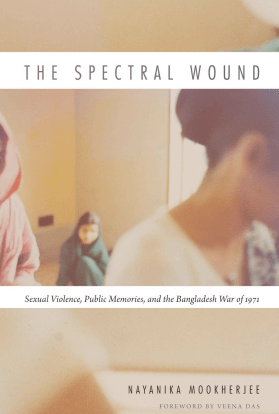
This academic text, “The Spectral Wound,” explores the complex history and public memory of sexual violence during the 1971 Bangladesh War, focusing particularly on the experiences of women known as birangonas (war heroines). It analyzes how the state and civil society have documented and represented these experiences, highlighting the tension between public recognition and the private struggles and social stigmatization faced by the women. The author, Nayanika Mookherjee, uses ethnographic research, including interviews with birangonas, their families, activists, and officials, to understand the varied ways sexual violence is remembered and articulated. The text also examines the gendered, racialized, and political dynamics that shape these memories and representations, including the controversial term birangona itself. Ultimately, the book reveals how the spectral wound of wartime sexual violence continues to resonate in contemporary Bangladesh, influencing social relationships, national identity, and political discourse.
Spectral Wound: War Rape and Public Memory
Based on the provided excerpts from “The Spectral Wound: Sexual Violence, Public Memories, and the Bangladesh War of 1971” by Nayanika Mookherjee, the topic of sexual violence is explored primarily within the context of the Bangladesh War of 1971. The book documents and analyzes the public memory of war time rape perpetrated by the West Pakistani army and local Bengali men during this conflict. It specifically examines the relationship between this public memory and the actual experiences of women who were raped.
The author challenges the common, often orientalized, understanding that views the raped woman solely as an “abnormal,” horrific, dehumanized victim abandoned by her kin. Instead, the book ethnographically analyzes the social life of testimonies and visual representations to show the varied experiences of war time rape during 1971 through a political and historical lens.
Key aspects of sexual violence discussed in the sources include:
- The Figure of the Birangona (War Heroine): Raped women were declared “war heroines” by the Bangladesh government. However, this term carries contradictory meanings, from being honored to being shunned as “soiled women”. The figure is central to public memory and representations. The public memory often focuses on her as a horrific “wound,” using a psychoanalytically loaded term. Identifying women only through suffering creates a homogeneous understanding of victimhood and implies that all victims experience war time rape the same way.
- Silence vs. Speaking Out: While the dominant understanding is that sexual violence in conflict is consigned to silence, feminists and activists have emphasized the imperative to testify and speak out, viewing it as empowering. The author, however, is wary of the idea of simply “breaking the silence,” seeing it as a complicated task that can potentially use the capacity to “unearth” facts as a weapon. Instead, the book focuses on “testimonial cultures” to examine the dominant narrative, exploring how the birangona is “searched for and then hidden” within public memory. This involves analyzing the circulation, dialectics, and social context of testimonies rather than providing a linear description.
- Everyday Life and Trauma: The book argues against the idea that wartime rape leads to a lifetime as a pariah. The experiences of 1971 have been folded into the everyday lives of those who were raped. Trauma is characterized not just by repetition or as a solely bodily experience, but as something encoded in social and everyday relations. Daily life and social interactions, particularly “khota” (scorn), keep the memory of rape alive and make the distant violence contiguous with everyday forms of violence.
- Public Secrecy and Khota: Sexual violence, particularly rape, is often veiled in public secrecy and referred to euphemistically. The term “man ijjot mara” (stealing/beating of honor/status/genitals) was commonly used instead of the direct word for rape, “dhorshon”. Talking about the rape is sometimes considered more shameful than the rape itself. “Khota” (scornful remarks and gossip) from villagers is a significant form of this public secrecy, inflicting judgments and constructing varied subjectivities of the women. Public secrecy based on rumor and judgment blurs public and private boundaries. The process of discussing “what one should not talk about” paradoxically keeps it a public secret.
- Gendered, Racialized, and Territorial Inscriptions: Sexual violence during the war brought together institutionalized forces like nationalism, religious identity, caste, ethnicity, and politics. It was a way of acting out historically established power relationships and identities grounded in specific frameworks of historical and racialized differences. Colonial discourses that considered Bengali Muslims “Hinduized,” “half Muslims,” and “impure” played a role. Pakistani soldiers checking Bengali men for circumcision (the “absent piece of skin”) to determine their Muslim identity involved humiliation and gendering, linking racial, religious, and masculine identity.
- Violation of Men: While the rape of women is heavily documented and part of public memory, sexual violence against men also occurred but remains largely silent in historical documents and the national narrative. Liberation fighters mentioned instances of male violation, but often with reluctance. The silence regarding male rapes suggests that this violation is excluded from the national narrative because it challenges dominant ideas of masculinity and heterosexuality.
- Masculinity: The book examines men’s relationships to sexual violence and the link between sexuality and the nation. Husbands of raped women were often demasculinized by the community’s scorn (“khota”). The violence against Bengali men, such as circumcision checks, was also an act of demasculinization, challenging their identity as men and Muslims.
- Representation and Eroticization: Literary and visual representations, including films, have depicted war time rape. Some films eroticized the birangona, portraying rape scenes in ways that could be seen as potentially erotic encounters. This highlights an inherent ambiguity towards the transgressed sexuality of the raped women.
- Language and Semantics: The language used to describe rape often emphasizes the loss of honor and status (e.g., lanchita, sombrhom hani, man ijjot hariyeche), focusing on the supposed metaphysical condition of the woman after the rape, tinged with disgust and repulsion. The women themselves often expressed their traumatic memories through fragmented imagery, bodily sensations, and everyday idioms, highlighting the inexpressibility of the violence.
Overall, the sources present sexual violence in the Bangladesh War as a deeply complex phenomenon intertwined with public memory, social relations, national identity, gender, race, and masculinity, moving beyond simplistic notions of silence, shame, or victimhood alone. The book argues that understanding these dynamics requires examining how violence is folded into the everyday lives and mediated through social and historical contexts.
Bangladesh 1971 War and Its Aftermath
Based on the provided sources, the Bangladesh War of 1971 is explored as a pivotal conflict leading to the creation of the People’s Republic of Bangladesh. It is also known as the Bangladesh Liberation War (Muktijuddho) or the War of Independence (Shadhinotar Juddho), among other names such as the year of chaos (gondogoler bochor), civil war, or the third Indo-Pakistani war, each carrying different ideological and geopolitical connotations. The war, lasting for nine months, involved intense guerrilla activities by Bengali fighters (Muktis) led by General M.A.G. Osmani, later joined by Indian forces, against the West Pakistani army and their local collaborators.
The war’s origins are linked to the historical trajectory of identity construction, tracing back to the 1947 partition of Bengal. Tensions escalated due to West Pakistan’s attempts to impose Urdu as the sole state language and purge Bengali culture of perceived “Hindu” elements, leading to movements like the Language Movement in 1952. By 1971, contestations over Bengali and Islamic identity, rooted in historical, racial, religious, cultural, and ethnic differences, fueled the conflict.
The Bangladesh War of 1971 was marked by extreme violence and atrocities. The West Pakistani army and their collaborators, referred to pejoratively as razakars, Al Badr, Al Shams, and Shanti Bahini, are accused of mass killings and widespread sexual violence. Contested numbers estimate the dead between 300,000 and 3 million and women raped between 100,000 and 400,000, with estimates of forced pregnancies ranging from 25,000 to 195,000. Intellectuals, journalists, students, workers, and villagers from all social classes were among those killed. However, the sources also highlight that violence was not one-sided, mentioning that non-Bengali “Bihari” communities were killed, and Bihari women were raped by liberation fighters during and after the war.
Sexual violence during the war is a central focus in the sources, particularly the rape of women, which became part of public conversation immediately after the war in the 1970s and has remained a topic of discussion since the 1990s. The rapes are described as acts of “nari nirjaton” (torture of women). Reasons cited for the rapes include the military’s mentality of forceful seizure, a distorted version of the religious discourse of “mal-e-gonemat” (booty during the war), soldiers being away from their wives, greed for “beautiful Bengali women,” and rechanneling of sexual energy. Some activists also explained it as an aim by Pakistani soldiers to “improve the genes” of the Bengali Muslim people and populate Bangladesh with “pure” Muslims, thereby destroying Bengali nationalism. Colonial discourses that had racialized Bengali Muslims as “Hinduized,” “half Muslims,” and “impure” also played a role.
The Bangladeshi government, immediately after the war, declared the raped women as birangonas (war heroines), an almost unparalleled effort to publicly honor them. The state also set up rehabilitation programs and centers for these women, including organizing marriages and helping them enter the labor market to prevent social ostracism. However, the term “birangona” also carried contradictory meanings and led to public debate and ostracism for some women. The representation of the birangona in public memory often focused on her as a horrific “wound”.
While the rape of women is heavily documented and part of public memory, the sources point out a significant silence regarding sexual violence perpetrated against men by the West Pakistani army. Liberation fighters mentioned instances of male violations, but often with reluctance, stating, “I don’t know whether I should be saying this”. A specific instance of sexual violence against men involved Pakistani soldiers checking Bengali men for circumcision (the “absent piece of skin”) at checkpoints as a way to inscribe religious, territorial, racialized, and gendered boundaries on their bodies. This silence regarding male rapes suggests that this violation is excluded from the dominant national narrative, potentially challenging ideas of masculinity and heterosexuality.
The history of the war and its atrocities are deeply intertwined with Bangladeshi national identity and politics. Different political factions, particularly the Awami League and the Bangladesh Nationalist Party (BNP), have contested the narrative of the war, emphasizing different aspects and leaders. The legacy of collaborators remains a contentious issue, with some gaining political power after the war.
In the 2000s, the issue of wartime atrocities gained renewed urgency with the establishment of the War Crimes Tribunal in 2009. This tribunal aimed to try individuals accused of murder, torture, rape, and arson during 1971. The controversial trials and convictions, particularly the death penalty for some individuals linked to Jamaat-e-Islami (JMI) and BNP, sparked significant political tensions, including the Shahbagh movement demanding justice for 1971 atrocities and counter-movements by groups like Hefazat-e-Islam. The Shahbagh movement notably brought the history of rape during the war to public prominence, challenging the notion that it remains unspoken.
The Bangladesh War of 1971 and its aftermath continue to be a site of contested memories, political struggle, and efforts to grapple with the deep wounds of violence, particularly the varied experiences and public representations of sexual violence against both women and, though often silenced, men.
Remembering War Time Rape in Bangladesh
Based on the sources, public memory in the context of the Bangladesh War of 1971 is explored not as an objective record of the past, but as interpretive reconstructions shaped by various social, cultural, political, and historical factors. It is distinguished from the idea of a consensual “collective memory”. The sources emphasize that public memory is influenced by local narrative conventions, cultural assumptions, discursive formations, practices, and the social contexts in which remembering and commemoration take place. “Institutionalized memory”, such as that promoted by a specific government, also plays a significant role in what and how things are recalled and transmitted.
The primary focus of the discussion on public memory in the sources is the Bangladesh War of 1971, particularly concerning war time rape. The conflict is described as having a “festering, unreconciled” history, with the narrative being a site of contestation between different political parties, such as the Awami League and the BNP.
A central figure in the public memory of wartime rape is the birangona (war heroine). Public memory often invokes the raped woman, but frequently depicts her as an “abnormal,” horrific, dehumanized victim. This imagery, including the concept of the birangona as a “spectral wound,” stands for the continuous wounded history of Bangladesh. Such a focus on suffering can lead to a homogeneous understanding of gendered victimhood and suggest that war time rape is experienced uniformly by all victims. Visual representations, like the “famous hair photograph,” are central to this public memory, visually identifying the raped woman and contributing to a sedimented image of the birangona. Literary and visual media have depicted the history of rape and the birangona for over forty years, contributing to this public memory.
The book explores the relationship between this public memory and the actual experiences of the women who were raped in 1971. It suggests that the representation in public memory, which often portrays the women as lifelong pariahs marked by suffering, may not fully capture the varied experiences of war time rape or how the events of 1971 have been “folded into the everyday lives” of those who were raped. The sources analyze how stories and experiences became part of broader national discourses and debates, and how public culture and representations of the raped woman influence processes of testifying and human rights.
Crucially, the sources argue against the prevalent assumption that war time rape is simply consigned to silence. Instead, they highlight the co-existence of both public memory and public secrecy concerning sexual violence in 1971. Public memory is visible in state declarations designating women as birangonas, in extensive visual and literary archives, and in human rights testimonies since the 1990s. Juxtaposed with this is public secrecy, particularly in rural areas like Enayetpur, where the rapes are known but villagers prefer not to talk about them openly, instead relying on euphemisms or scornful remarks (khota) which paradoxically keep the memory alive as a “public secret”. This public secrecy, often based on rumor and judgment, blurs public and private boundaries and can lead to sanctions against women who speak publicly.
The state (especially the Awami League government) and civil society (left-liberal groups and activists) are active in shaping public memory. They use commemorations, political rhetoric emphasizing Bengali identity or Sheikh Mujib, visual archives, and oral history projects to construct and uphold a specific version of the war and the birangona’s place within it, often aiming to present an “authentic history” and correct “distortions”. However, public memory is also a contested terrain, with different political factions promoting competing narratives.
Public memory is linked to the concept of trauma, often invoked to represent past injustice. The “horrifying life history” of the birangonas is seen as metonymic of Bangladesh’s unresolved independence. Affective engagement with the “wound” of the birangona allows citizens to feel for the violent history of rape, potentially mobilizing younger generations against collaborators. However, the book argues against solely configuring the raped woman as a wound or focusing only on the “horrifying genre” of her story.
The dynamics of public memory regarding the birangona are described using the metaphor of “combing” (searching and hiding) and the concept of “absent presence”. The birangona is “searched for and then hidden” within public memory. The horrific wound is documented by activists, but the intricacies of her long-term life after the rape are often “combed over,” hidden from human rights narratives and prevalent discourse.
The history of public memory regarding wartime rape has evolved. It was part of public conversation immediately after the war. Literary and visual representations became sites of political contestation later. In the 1990s, driven by feminist and human rights activism seeking justice and war crimes trials, documentation and testimony efforts brought war time rape back into prominent public discourse. The Shahbagh movement in 2013 further highlighted the history of rape and its connection to the war crimes tribunal.
Notably, while the rape of women is a significant part of public memory, the sources point to a significant silence regarding sexual violence against men perpetrated by the West Pakistani army. This contrast highlights how public memory selectively acknowledges different forms of violence, potentially influenced by dominant ideas of masculinity and their relationship to the national narrative.
Birangonas: Heroines, Victims, and Memory in 1971 Bangladesh
Based on the provided sources, the term “War heroines” primarily refers to the women who were raped and subjected to sexual violence by the West Pakistani army and local collaborators during the Bangladesh War of 1971. In Bengali, these women are known as birangonas.
Here’s a discussion of War heroines based on the sources:
- Designation and State Recognition: Immediately after the war in 1971, the newly formed Bangladeshi government, possibly led by Sheikh Mujibur Rehman, declared the raped women as birangonas or “war heroines”. This was an effort to publicly honor them, which the sources describe as “almost unparalleled” compared to other conflicts. The designation, combining bir (brave) and ongona (woman), literally means “brave woman”. This naming was also an emotive and public attempt to absorb the large number of raped women into the new nation and facilitate their “mingling in society”. The state also used this designation to distinguish itself from the Pakistani government, presenting Bangladesh as a different kind of “Muslim” nation that valued its women, including those who were raped.
- Rehabilitation Efforts: The government set up various rehabilitation programs and centers for the birangonas in 1972. These programs aimed to address the logistical challenge of integrating the women back into society and prevent social ostracism. Efforts included organizing marriages and helping women enter the labor market. Rehabilitation centers recorded detailed case histories, including information about capture, torture, pregnancy, and family attitudes. The program followed a “reformist and modernist agenda,” rooted in assumptions of “reproductive heteronormativity”. The state’s documentation process, while intended to “comb, search, and document” the women, also paradoxically “hid” them through a “code of purification”.
- Public Memory and Representation: War heroines are a central figure in the public memory of the 1971 war, particularly regarding wartime rape. However, this public memory often portrays the raped woman as an “abnormal,” “horrific,” and “dehumanized victim,” functioning as a “spectral wound” that symbolizes Bangladesh’s violent history. Literary and visual media, including photographs, films, and poems, have depicted the birangona for decades, contributing to a “sedimented practice” of viewing her through certain lenses. Examples include depicting her with physical wounds, emotional pain, and lack of social belonging. Human rights narratives and oral history projects in the 1990s also contributed to this public memory, often focusing on the “horrific genre” of their experiences.
- Public Memory vs. Lived Experience: The public memory, often focused on the birangona solely as a suffering victim, may not reflect the varied and complex experiences of the women or how they integrated the violence into their everyday lives. The sources highlight that their actual life trajectories after the war were diverse, including getting married, having families, or finding jobs, which often get “combed over” or hidden from the dominant narrative.
- Contradictory Meanings and Stigma: The term birangona itself is described as being infused with “contradictory affects” – from being war heroines to be honored to being considered “soiled women to be shunned”. Despite state efforts, visibility and the public recognition of being raped often led to social ostracism. The term sometimes functioned as a euphemism that ironically underscored their socially unacceptable status. They were often referred to using derogatory terms or metaphors related to their perceived transgressed sexuality. The stigma is presented not as a “natural” state but as a “language of relationship” used to belittle and shame.
- Subjectivity and Agency: The subjectivity of war heroines is explored as complex, oscillating between being seen as victims, agents, or even traitors. The women themselves contested how they were defined; some believed one becomes a birangona only by speaking out publicly about their rape. Some claimed the identity of muktijoddha (liberation fighter), arguing they fought the war by enduring the violation. Class location significantly influenced how their claims and experiences were perceived; middle-class women’s silence was sometimes seen as authenticity, while poor women who spoke were suspected of seeking compensation.
- Appropriation and Contestation: The narratives and identities of war heroines have been subject to appropriation by various actors, including the state and left-liberal activists, often for political or nationalistic goals. Women who went public felt their stories were sometimes altered or used in ways they did not control. While activists used their experiences to demand justice for collaborators, they sometimes failed to address the women’s own needs for rehabilitation.
- Silence on Male Sexual Violence: The dominant public memory and focus on war heroines (raped women) exist alongside a notable silence or covering over regarding sexual violence perpetrated against men by the West Pakistani army, highlighting a gendered selectivity in remembrance.
- Evolving Recognition: While the term birangona has been seen as potentially shameful, in recent years, some newspapers have referred to all war heroines as valiant freedom fighters. Events like the Shahbagh movement in 2013 brought the history of rape back into public focus. In 2007, birangonas were given a pivotal, agentive role in memorializing the war by inaugurating a program at the Shoheed Minar in Dhaka.
In summary, the discussion of War heroines (birangonas) in the sources reveals their complex position in Bangladeshi society and public memory. They were officially honored and offered rehabilitation by the state, yet often faced social stigma and ostracism. Their image became a powerful symbol in public memory and political discourse, frequently focusing on their suffering, while their individual experiences and agencies were often overlooked or appropriated.
Remembering 1971: State, Society, and War Memory
Drawing on the provided sources and our conversation history, the relationship between the State and society concerning the public memory of the Bangladesh War of 1971, particularly wartime sexual violence, is depicted as complex, dynamic, and often contested. Public memory itself is understood not as a collective consensus, but as interpretive reconstructions shaped by various social, cultural, political, and historical factors. The State and civil society emerge as key actors actively involved in shaping these memories.
The State’s Role in Shaping Memory and Influencing Society:
The sources highlight that the State, particularly the ruling political party like the Awami League, actively engages in constructing and promoting a specific national narrative of the 1971 war. This is done through various means:
- Commemorations and Rhetoric: State-sponsored ceremonies, political speeches, and television programs are used to emphasize Bengali identity, celebrate figures like Sheikh Mujibur Rehman as the “father of the nation,” and solidify a particular version of history.
- Designation and Rehabilitation: The government’s immediate post-war declaration of raped women as birangonas or “war heroines” was an unprecedented state attempt to honor these women and facilitate their social integration. Rehabilitation programs were established, reflecting a “reformist and modernist agenda” aimed at absorbing the women into the new nation and addressing social ostracism. The state’s documentation process for the birangonas, while seeking to make them “legible” as war heroines, also paradoxically “hid” them through a “code of purification”.
- Institutional Practices: State-linked institutions and processes, such as rehabilitation centers and the associated social workers and documents, exercised a form of “sovereign power” over the women, shaping their interactions and instilling ideas of “subject and citizen”.
- Political Contestation: The rivalry between major political parties like the Awami League and the BNP means that the history of the war is a “festering, unreconciled one,” with each party promoting competing narratives and interpretations. This political division at the state level directly impacts how the past is remembered and debated within society.
Civil Society’s Role and Interaction with the State:
Civil society, encompassing left-liberal groups, activists, NGOs, and intellectuals, also plays a significant role in memory-making and interacts with the State in complex ways.
- History Making and Documentation: Civil society actors are involved in documenting the war, including through oral history projects and museums, sometimes with transnational funding. These efforts contribute to the public memory, often focusing on seeking justice and recounting the experiences of war victims, including the birangonas.
- Alignment and Critique: While civil society sometimes positions itself as separate from and opposed to the state, its activities and projects can also inadvertently strengthen state ideology. Activists utilize the history of wartime rape to demand accountability for collaborators, a goal sometimes aligned with state priorities.
- Shaping Narratives: Civil society, particularly through human rights frameworks and activism, contributes to the public discourse around wartime rape. However, their focus on suffering and the “horrific genre” of the birangonas’ stories can inadvertently simplify or “mute” the complexities of the women’s lived experiences.
Tensions, Disjunctions, and Societal Reception:
Despite the State’s and civil society’s efforts to shape public memory, the sources reveal significant tensions and disjunctions in how these narratives are received and integrated into society, particularly at the local level:
- Stigma vs. Recognition: The State’s official recognition of women as birangonas, intended to bestow honor, often coexists with social stigma and ostracism in their communities. Visibility, partly a result of documentation efforts by state-linked or civil society actors, could lead to social sanctions. This highlights the gap between state declarations and societal norms and judgments.
- “Expectation Economy”: The State’s rhetoric of respect and promises of rehabilitation create an “expectation economy” among villagers and the birangonas’ families, leading them to demand that the State fulfill these assurances. When these promises are not fully met, it creates confusion and dissatisfaction.
- Disjunctions in Narratives: The women themselves sometimes experienced a disconnect between the national narratives promoted by the State and civil society and their own priorities and experiences. They might prioritize material aid or recognition of their long-term struggles over the narrow focus on their rape as a “horrific wound” in 1971.
- Local Resistance and Power Dynamics: Local communities and leaders may resist or be ambivalent towards national, state-driven narratives, particularly when they conflict with local politics, patronage networks, or concerns about the village’s reputation. The use of “khota” (scornful remarks) in villages is an example of local societal practices that keep the memory of rape alive as a “public secret” while simultaneously shaming the women, demonstrating a form of agency within local social relations that can defy or reinterpret national discourse.
In conclusion, the relationship between the State and society in the context of the 1971 war memory is not one of simple top-down control or bottom-up resistance. Instead, it is a dynamic interplay where the State and various civil society actors actively construct and circulate narratives, while local social relations, political divisions, and individual experiences filter, interpret, and sometimes contest these dominant accounts. Both state and civil society, in their efforts to remember and address the past, can inadvertently contribute to a “pathological public sphere” that confines the narratives of war heroines within limited tropes of suffering, often overlooking the complexities of their lives and the varied ways they have “folded” their experiences into the everyday.
Spectral Wound: A Study Guide
Quiz
- What is the “ghotona” (event, incident) referred to in the foreword?
- The “ghotona” refers to the rapes that occurred during the 1971 Bangladesh Liberation War. Women struggled to understand why they were vulnerable, linking the violence to their husbands’ political allegiances and everyday village conflicts.
- How did Mookherjee’s prior knowledge of other instances of wartime rape influence her research in Bangladesh?
- News of Japanese comfort women, rapes in Bosnia and Rwanda, and the UN declaration of rape as a war crime informed and triggered Mookherjee’s research, prompting her to assume silence surrounding the issue in Bangladesh.
- According to the text, how do left-liberal activists typically represent the “razakar”?
- Left-liberal activists stereotypically represent the “razakar” (collaborator) with a beard and a cap, associating these signifiers with an “Islamic” identity.
- What specific linguistic practice did Mookherjee adopt that drew criticism from minority Hindus in Enayetpur?
- Mookherjee adopted the use of the word “pani” for water, a word commonly used by her Muslim interlocutors. Minority Hindus preferred the word “jol” and saw her adoption of “pani” as a threat to their identity.
- How does Mookherjee use Jacques Derrida’s Specters of Marx to analyze the visual and state narratives of the birangona?
- Mookherjee uses Derrida’s concept of “absent presence” or the “effaced but legible trace” to deconstruct how the birangona is evoked in historical documents and narratives, making her a spectral figure that is called into presence only to be effaced.
- What does the defacing of Sheikh Mujib’s image on the ten-taka currency notes signify?
- The defacing of Sheikh Mujib’s image, turning him into a “goonda” or calling him “Father of Slippers,” signifies popular discontent and mockery of his title “Father of the Nation,” reflecting political dissent.
- According to the text, what is the most important thing for a woman, and how does it relate to the idea of “man ijjot”?
- For a woman, “man ijjot” (status and honor, sometimes linked to sexual relationships) is the most important thing. This concept is linked to the idea of covering and protecting female genitalia as the source of this honor.
- How did villagers and others explain the reasons for the soldiers’ rapes during the war?
- Reasons cited included avenging muktijoddhas’ families, Islamic discourses (a distorted version of “mal-e-gonemat”), greed for “beautiful Bengali women,” and rechanneling of sexual energy due to soldiers being away from their wives.
- What does the phrase “man shomman mara” or “man ijjot mara” (literally the stealing/beating of honor and status/genitals) signify in the context of rape narratives?
- This phrase signifies that the women viewed rape as a violation in terms of a man assaulting, beating, robbing, or stealing their sexuality and their position in the community, linked to the loss of their “jaat” (common characteristics of a group).
- How does the character Morjina Khatoon (the “military’s whore”) explain the derogatory names she is called?
- Morjina explains that she is called derogatory names like “military’s khanki, military’s beshsha” because she lacks male kin (a son or a husband) who could protect her and deter such insults.
Essay Format Questions (No Answers Supplied)
- Discuss the ways in which the everyday politics of the village and the phenomenon of khota make the violence of rape “contiguous to everyday forms of violence.” How does this challenge or complicate a view of war-related sexual violence as solely a dramatic, external event?
- Analyze the contrasting perspectives on the term birangona as presented in the text. How does the state’s use of the term, feminist activist interpretations, and local village perceptions differ, and what do these differences reveal about the complex aftermath of wartime sexual violence?
- Explore the concept of “public secrecy” as discussed in the text, particularly in relation to sexual violence. How is this secrecy maintained, and what are its effects on both the raped women and the wider community? Consider the role of khota and social knowing in this process.
- Examine the ways in which masculinity is articulated and contested in the aftermath of wartime sexual violence, as described in the text. How do the husbands of the raped women negotiate their gendered and moral identities, and how do the women’s actions and narratives influence these negotiations?
- Discuss the intersection of gender, ethnicity, and religious identity in the context of wartime sexual violence as explored in the text. How are colonial discourses and historical narratives re-employed in the violence against both men and women, and what does this reveal about the racialized and gendered logics at play?
Glossary of Key Terms
- Birangona: (Bengali) War heroine. A term coined by the Bangladeshi government after the 1971 Liberation War to refer to women who were raped during the conflict. The term carries complex and contested meanings.
- Bnp: Bangladesh National Party. A major political party in Bangladesh.
- Chakhash: Meeting (with the prime minister).
- Chinta: (Bengali) Worries or anxieties. Used in the text to describe the lingering emotional effects of rape.
- Dojok: (Bengali) Hell. Referred to in the context of religious judgments made about the raped women.
- Dhorshon: (Bengali) Rape. The text notes that this word was rarely used by villagers and the women themselves, who preferred other phrases.
- Duniyar nishsho: (Bengali) Loser of the world. A term used by the raped women to describe how they felt after the violation.
- Ghotona: (Bengali) Event, incident. Used in the text to specifically refer to the rapes during the war.
- Goonda: (Bengali) Gangster or hooligan. Used pejoratively in the text to describe a defaced image of Sheikh Mujib.
- Hadith: Sayings or traditions of the Prophet Muhammad, often used as a source of Islamic law.
- Hujoor: (Bengali) Head of the mosque or a religious leader.
- Iman: (Arabic/Bengali) Principle or faith. Used in contrast to man (honor) by a husband of a raped woman.
- Ijjot: (Bengali) Chastity or honor. Often used in conjunction with man.
- Jaat: (Bengali) Drawn from jati, meaning the common characteristics of a group, like caste, nationality, culture, or political affiliation. Used by women to describe the violation of their group identity through rape.
- Jatir Jonok: (Bengali) Father of the Nation. A title given to Sheikh Mujib.
- Jena: (Arabic/Bengali) Adultery or fornication. In some interpretations of Sharia law, rape is considered akin to jena.
- Jmi: Jamaat-e-Islami. A right-wing Islamic political party in Bangladesh, associated with the razakars.
- Jol: (Bengali) Water. Used by Hindu Bengalis, in contrast to pani used by Muslim Bengalis.
- Jutar Pita: (Bengali) Father of Slippers. A sarcastic term used to deface Sheikh Mujib’s image, implying humiliation.
- Khanki: (Bengali) Whore. A derogatory term used against a birangona.
- Khota: (Bengali) A term encompassing everyday squabbles, bitterness, revenge, or insult. Used in the text to describe the social violence and scorn directed at the birangonas and their families.
- Kizb: (Arabic) Lying. Discussed by Gilsenan and related to the performance of social selves and the maintenance of secrecy.
- Kolonkini: (Bengali) Stained person. A term used by a raped woman to describe her feeling of impurity.
- Kutumb: (Bengali) In-laws.
- Lojja: (Bengali) Shame.
- Lungi: (Bengali) A sarong-like garment worn by men.
- Mal-e-gonemat: (Arabic/Bengali) Booty during the war. A distorted version of this religious discourse was used to explain the rapes.
- Man: (Bengali) Honor. Often used in conjunction with ijjot or shomman.
- Man ijjot: (Bengali) Status and honor, sometimes linked to sexual relationships, and potentially referring to the genitals themselves as the source of honor.
- Man shomman: (Bengali) Honor and status. Often used interchangeably with man ijjot.
- Mara: (Bengali) To steal or beat. Used in phrases like man shomman mara to describe the act of rape.
- Mohila muktijoddha: (Bengali) Female liberation fighter.
- Molla: (Bengali) A derogatory term for someone considered a strict adherent to Islam and prescriptive of it.
- Muktijoddhas: (Bengali) Liberation fighters. Refers to those who fought in the Bangladesh Liberation War.
- Muktijuddho: (Bengali) Liberation War. Refers to the 1971 Bangladesh Liberation War.
- Nari nirjaton: (Bengali) Literally torture of women, commonly used to refer to rape.
- Pani: (Hindi/Bengali) Water. Used by Muslim Bengalis, in contrast to jol used by Hindu Bengalis.
- Pathological public sphere: A public sphere mesmerized by stories of suffering and spectacle, as defined by Mark Seltzer and applied to the context of the birangonas.
- Purush poricharika: (Bengali) Male servants providing sexual services. Refers to male rape.
- Punorbashon: (Bengali) Rehabilitation. Refers to the government’s program for the birangonas.
- Razakars: (Urdu/Bengali) Collaborators who supported the Pakistani army during the 1971 war.
- Ruchi: (Bengali) Taste or discrimination. Used in reference to the preferences of the Pakistani army.
- Salwar kameez: (Hindi/Urdu/Bengali) A traditional South Asian outfit consisting of loose trousers (salwar) and a long tunic (kameez).
- Sesh shimana: (Bengali) The last boundary. Used to describe the perceived boundary between birangonas and sex workers.
- Shanti: (Bengali) Peace.
- Sharia: Islamic law.
- Shoheeds: (Arabic/Bengali) Martyrs.
- Shomman: (Bengali) Honor or respect.
- Shorom: (Bengali) Shame.
- Shotitto: (Bengali) Chastity.
- Spectral: In the context of the birangona, refers to a presence that is evoked but simultaneously effaced, existing as an “absent presence.”
- Taka: The currency of Bangladesh.
- Testimonial culture: The societal tendency to produce and circulate testimonies, particularly about experiences of violence and conflict.
- Uddhar: (Bengali) Recovery or rescue.
- Virangana: (Sanskrit/Hindi) A female warrior or heroic woman. Used in the text for comparative purposes.
- West Pakistanis/Westerners: Refers to the Pakistani army and people from West Pakistan.
Briefing Document: Sexual Violence and the Politics of Memory in Bangladesh
This briefing document summarizes the main themes, key ideas, and important facts from the provided excerpts, which appear to be from the foreword, acknowledgements, introduction, and various chapters of a book titled “Spectral Wound.” The core focus is on the intersection of sexual violence during the 1971 Bangladesh Liberation War, its impact on the women who experienced it (termed birangonas or war heroines), and the complex social, political, and historical forces that shape the memory and representation of these events in independent Bangladesh.
Main Themes:
- The Multi-layered Impact of Sexual Violence: The sources emphasize that the impact of sexual violence during the war extended far beyond the physical act itself. It was deeply intertwined with village politics, family dynamics, and the construction of national identity. The authors highlight the concept of khota (scornful remarks or gossip) as a powerful form of everyday violence that made the distant trauma of rape contiguous with daily life.
- The Contested Memory of Sexual Violence and the Birangona: The figure of the birangona is central but also highly contested. While initially declared as war heroines by the state and national figures like Sheikh Mujib, their experiences were often met with shame, ostracization, and public secrecy within their communities. The sources demonstrate how the representation and memory of the birangona are shaped by political agendas, social norms, and historical narratives.
- Public Secrecy and Social Knowing: A significant theme is the concept of “public secrecy” – everyone knows about the rapes, but there is a collective effort to conceal or avoid talking about it directly. This secrecy is maintained through various social mechanisms, including khota and the fear of shame (lojja) and loss of honor (man ijjot).
- Gendered and Racialized Dimensions of Violence: The excerpts reveal how sexual violence in 1971 was not random but deeply rooted in existing gendered and racialized discourses. The dehumanization and feminization of Bengali Muslim men by the Pakistani army, intertwined with colonial narratives, played a crucial role in shaping the nature of the violence against both men and women.
- The Politics of Representation and the Archive: The sources critically examine how the war, and specifically sexual violence, are represented in various archives – literary, visual, and testimonial. They caution against simplistic or sentimental readings and highlight how representations can simultaneously invoke and efface the experiences of the birangonas.
Most Important Ideas or Facts:
- The term ghotona (the event, incident) is frequently used by women to refer to the rape. This highlights their struggle to understand the factors that made them vulnerable, including their husbands’ political allegiances.
- Everyday village politics, including khota, made the violence of rape “contiguous to everyday forms of violence.” This challenges the idea that war-time atrocities are isolated incidents, suggesting they can emerge from or be connected to ordinary forms of social conflict and animosity.
- The birangona is analyzed through the lens of “absent presence” and “spectral logic” (drawing on Derrida). This signifies how the war heroine is evoked in national narratives but often effaced or made safely available through representations that emphasize her “wound” and trauma, making her a horrific alterity.
- The public sphere in Bangladesh is described as “pathological” due to its “mesmerized by stories of suffering and the spectacle of [wound].” This suggests that while there is an affective engagement with the birangona‘s suffering, it often prevents a deeper understanding or redress for their experiences.
- The defacement of currency notes featuring Sheikh Mujib in 1998 reveals a public discontent and sarcasm towards the “Father of the Nation” narrative. This demonstrates a disconnect between state-sanctioned memory and popular sentiment.
- Village references to the exposure of birangonas as “loss of man ijjot” (status and honor, sometimes linked to sexual relationships) and a “shameful thing” are central to the concept of public secrecy. This highlights the deep-seated social stigma attached to sexual violation.
- The use of khota involving references to the rapes was a common form of everyday squabble and insult, even affecting economic negotiations within the village. This underscores the pervasive nature of the public secret and its material consequences.
- The notion of man ijjot can refer not only to honor and social status but also literally to the genitals as the source of that honor. This explains why exposing the birangonas‘ faces in testimonies and portraits is seen as bringing a “covered public secret” to light.
- Villagers cited various reasons for the rapes, including avenging muktijoddhas’ families, Islamic discourses (distorted), greed for “beautiful Bengali women,” and the rechanneling of soldiers’ sexual energy. These explanations often point to a “natural” phenomenon of rape during conflicts, potentially absolving the perpetrators.
- The public secrecy is maintained through “social knowing what not to know,” where people state that one “should not talk about it as it was a secret” while simultaneously elaborating on khota. This illustrates the complex performance of memory and the fetishization of concealment.
- Local leaders, particularly supporters of the BNP, expressed concern that the national emphasis on rape in 1971 would defame their communities and make them appear vulnerable. This highlights how national historical narratives are contested at the local level and influenced by political rivalries.
- War heroines themselves referred to rape with expressions like “those words,” “those stories,” “tales,” and “that work,” and as “secret words,” “the event,” and “loss.” They rarely used the Bengali word for rape, dhorshon.
- The verb mara (to steal/beat up) was frequently used with jaat and man shomman, indicating that women saw rape as a violation of their sexuality and position within their community (jaat meaning the common characteristics of a group like caste or culture).
- The birangonas often blamed themselves for being raped, calling themselves “sinners,” “bad,” and “spoiled,” and feeling they had lost their shotitto (chastity). This reflects the internalized social stigma and the devastating impact on their sense of self-worth.
- Husbands of birangonas were often “demasculinized through the khota of substitution of their sexual act by the violent activities of the rapist.” This illustrates how the trauma of rape also affected the male relatives and challenged their perceived roles as protectors.
- The state’s declaration of raped women as birangonas aimed to establish its sovereignty and highlight the atrocities of the Pakistani army. This demonstrates the political utility of the term and the state’s attempt to control the narrative.
- Sheikh Mujib is described as establishing himself as the “paternal, sovereign, foundational authority who needed to protect and recover his mothers and sisters.” This paternalistic framework is further illustrated by a father’s letter to Mujib seeking redress for his birangona daughter.
- Sexual violence against East Pakistani men by the West Pakistani army is largely “combed/covered” in the history of the war, unlike the public discourse surrounding the rape of women. This points to a gendered silence in the historical narrative.
- The Pakistani army’s search for “the absent piece of skin” (circumcision) among Bengali Muslims reveals how violence was translated into either a sense of community or an abrogation of what makes them human. This highlights the racialized and ethnic dimensions of the violence, where Bengali Muslims were often seen as effeminate, Hinduized, and less than human.
- The interpretation of the famous image of a soldier peering into a lungi is shown to be fluid and contested, reflecting different political and territorial readings. This illustrates how visual archives are not neutral but are inscribed with multiple meanings.
- The figure of the birangona is contrasted with that of the sex worker (barbonita). This highlights how the nation’s “purity” is often defined in opposition to transgressed female sexuality.
- The stories of women like Morjina Khatoon, who lacked male kin, demonstrate how the absence of a son or husband left them vulnerable to being called the “military’s whore.” This underscores the importance of patriarchal protection within the social structure.
Key Quotes:
- “As much as the sexual violence wounded them, the everyday politics of the village and the khota that burst out in everyday squabbles, in petty forms of revenge or insult, made the distant violence of the rape contiguous to everyday forms of violence.” (foreword xiii)
- “In the nation’s positive conceptual formulation of the raped woman, she can only be exemplified in the absence of her presence, through horrific enactment and repre sen ta tion as a wound, which ensures a greater invocation of her “trauma.”” (introduction 25)
- “They say we should not put our words in newspapers as we have grown-up children, married daughters, and kutumb [in- laws] who would come to know these things.” (chapter 3, quoting Kajoli)
- “Do the covered genitalia then stand in for a public secret? Lila Abu- Lughod (1988, 107) shows how in Egypt various Koranic references to modesty and chastity imply that it is necessary to literally protect female genitalia.” (chapter 3, linking man ijjot to genitals)
- “It is this social knowing what not to know that lies at the heart of perform-ing memory and of fetishizing public secrecy.” (chapter 3, discussing public secrecy)
- “The Bengali word for rape— dhorshon— was rarely used. The frequent use of the verb mara with jaat and man shomman indicated that the women thought of rape as a violation in terms of a man as-saulting / beating, robbing / stealing their sexuality and their position in their community in terms of their loss of jaat…” (chapter 5, discussing the language used for rape)
- “When I was being raped I felt my life was over, I would not be able to see my husband and anybody. I thought that I had been married for just a year, so my husband may not keep me at home, may not give me rice and clothes.” (chapter 5, quoting Rashida)
- “The husbands of raped women were demasculinized through the khota of substitution of their sexual act by the violent activities of the rapist.” (chapter 5, discussing demasculinization)
- “Here Sheikh Mujib established himself early on as the paternal, sovereign, foundational authority who needed to protect and recover his mothers and sisters— the female citizens—in in de pen dent Bangladesh.” (chapter 6, discussing Sheikh Mujib’s paternal role)
- “The Pakistani army’s search for the absent piece of skin among Bengali Muslims shows how people can translate experiences of violence into either a sense of community or an abrogation of what makes them human.” (chapter 7, discussing the racialized nature of violence against men)
- ““The raped woman might be mobilizing the nation only now,” Naibuddin Ahmed mused in the interview. “Earlier they were only referred to as the 200,000 mothers and sisters who have lost their ijjot [chastity]. But they are not barbonita [sex workers] that their ijjot will be gone, lost, sold? They are the illustration of our nation’s purity,” he reflected angrily.” (chapter 8, discussing the contrasting views of birangonas and sex workers)
- ““They call me the ‘military’s khanki, military’s beshsha’ [the military’s whore, mistress]. If I had a man in my life— a son or a husband—no one would have dared to tell me anything,” said Morjina Khatoon…” (chapter 9, quoting Morjina Khatoon)
This briefing document provides a concise overview of the central arguments and evidence presented in the provided excerpts, emphasizing the complex interplay of violence, memory, gender, and politics in post-conflict Bangladesh.
Sexual Violence and Memory in Bangladesh
What role did village social dynamics play in the vulnerability of women to wartime sexual violence?
The vulnerability of women to wartime sexual violence was intertwined with the everyday politics of the village. Beyond the direct violence of rape, local conflicts, petty forms of revenge, and insults (referred to as khota) made the distant violence of rape feel continuous with everyday forms of violence. The existing slights, bitterness, betrayal, and perverseness within intimate and enemy relationships in the village provided a context for how dramatic acts of violence could emerge from the ordinary. Examples include men using the opportunity of conflict to rape a neighbor’s daughter or collaborators (razakars) supplying women to soldiers, suggesting that pre-existing social tensions and animosities contributed to creating opportunities for such atrocities.
How was the term “birangona” for raped women used by the Bangladeshi state and how did this affect perceptions?
The Bangladeshi state used the term “birangona” (war heroine) to refer to women who were subjected to sexual violence during the war. This was a deliberate effort by the government to rehabilitate these women and establish the sovereignty and language of stateness of the new nation. By calling them birangonas, the state highlighted itself as a victim of the West Pakistani state’s abuses and emphasized the rapes perpetrated by the Pakistani army. This contrasted with a perceived “Pakistani” sharia-driven approach that might view rape as adultery. While the term aimed to disrupt middle-class values about chastity and purity and locate these women within heroic iconographies, it also created a pathological public sphere where the raped woman could only be perceived as a horrific alterity, primarily through the lens of her “wound,” ensuring she could be affectively felt for mobilization against collaborators but also seen as a threatening figure due to her transgressed sexuality.
What is “khota” and how did it impact the lives of the war heroines and their families?
Khota refers to scornful remarks, gossip, and everyday squabbles that are used to publicly shame or insult someone, often by bringing up past transgressions or sensitive issues. For the birangonas and their families, khota predominantly took the form of neighbors, extended family, and acquaintances raising the issue of the rapes during arguments or disagreements. This public shaming affected the women’s families economically, as illustrated by examples of husbands losing business or payment due to neighbors’ sarcastic comments referencing their wives’ experiences of sexual violence during the war. Khota also served as a constant reminder and trigger of traumatic memories for the women, preventing them from moving past the event.
How does the concept of “public secrecy” relate to the experiences of wartime sexual violence in Bangladesh?
Public secrecy in the context of wartime sexual violence refers to the collective knowledge of an event that is simultaneously acknowledged and actively concealed or avoided in public discourse. Everyone in villages like Enayetpur knew about the “gondogoler bochor” (year of chaos) and included generic accounts of “nari nirjaton” (torture of women, i.e., rape) in their narratives. However, there was also a pervasive sense that “those words” (referring to the rapes) should not be talked about, despite the widespread knowledge of the events. This “social knowing what not to know” lies at the heart of performing memory and fetishizing public secrecy. The act of speaking about the rapes, especially for the birangonas themselves, was often met with scorn and disapproval, reinforcing the public secret and the idea that the subject should remain covered.
How did gender and racialized identities intersect with sexual violence during the Bangladesh War?
The sources suggest that sexual violence during the Bangladesh War was intrinsically intertwined with existing historical and colonial discourses that racialized and gendered Bengali Muslims. The Pakistani army’s actions were influenced by stereotypes and derogatory views of Bengali Muslims, who were sometimes seen as effeminate, lazy, Hinduized, and less of a Muslim or man. The search for the “absent piece of skin” (circumcision) among Bengali men by the Pakistani army exemplifies how ethnic and religious differences were used to justify violence and construct the “other.” While rape of women was an explicit political act used to defile the enemy community, the violence against men, including sexual assault, was also a means of humiliation and demasculinization, deeply connected to these racialized and gendered constructions of identity.
What does the concept of “man ijjot” encompass and how did it influence the understanding of wartime rape?
Man ijjot translates to status and honor, and it is deeply linked to sexual relationships, particularly for women. In the context of the war, the exposure of birangonas was referred to as “loss of man ijjot” and considered a “shameful thing.” Man ijjot is not just about social standing but can also refer to the genitals themselves as the source of that honor. Therefore, exposing one’s face in testimonies or photographs, like the genitals, was seen as bringing to light a covered “public secret.” The notion of man ijjot being “stolen” or “beaten” (man shomman mara or man ijjot mara) emphasizes the violation as a robbery of one’s sexuality and community standing, rather than simply physical torture. This cultural framework heavily influenced how the raped women and their communities understood and reacted to the violence.
How did the experiences of the birangonas challenge or reinforce traditional notions of masculinity for their husbands and male relatives?
The experiences of the birangonas, and the subsequent khota and social interactions, often led to the demasculinization of their husbands and male relatives in the eyes of the community. This was based on the idea that the husbands failed to protect their wives and were unable to prevent the violation of their “man ijjot.” The women themselves sometimes perceived their husbands as “less of a man” due to their inability to provide protection, comfort, and support after the event. However, the husbands also attempted to retrieve and reassert their masculinity in various ways, such as acting as gatekeepers to the women’s narratives or articulating their sense of loss of honor alongside the retention of principle (iman). These negotiations highlight the complex and sometimes contradictory nature of masculinity in the face of wartime sexual violence and its aftermath.
How has the representation of wartime sexual violence and the “birangonas” evolved in Bangladeshi public discourse and archives?
The representation of wartime sexual violence and the birangonas has been complex and contested over time. Immediately after the war, the state used the term “birangona” as a symbol of the nation’s suffering and heroism. Visual and literary archives from the early post-war period often aestheticized the rape or used it to mobilize nationalistic sentiment. Over time, there have been shifts in how the birangona is portrayed, from iconic figures in national history to subjects of human rights discourse and feminist activism. However, the birangona remains a spectral figure, often evoked but also effaced or made safely available for national narratives through the emphasis on her wound. The silence surrounding male rapes in the official history of the war, in contrast to the public discourse on female sexual violence, highlights the selective nature of how these experiences are remembered and represented. Recent movements and tribunals have brought some testimonies to the forefront, but the struggle for complete acknowledgment and justice continues.

By Amjad Izhar
Contact: amjad.izhar@gmail.com
https://amjadizhar.blog
Affiliate Disclosure: This blog may contain affiliate links, which means I may earn a small commission if you click on the link and make a purchase. This comes at no additional cost to you. I only recommend products or services that I believe will add value to my readers. Your support helps keep this blog running and allows me to continue providing you with quality content. Thank you for your support!

Leave a comment