Cinema is more than just a means of entertainment—it’s a mirror held up to society, a lens through which we examine the human condition, and at its best, a symphony of story, image, and sound that transcends borders. For every true movie lover, some films don’t just entertain—they leave an imprint. These are the kinds of stories that challenge our perspectives, stir our emotions, and stay with us long after the credits roll.
This curated list of 30 must-see films spans decades, genres, and continents. From groundbreaking social commentaries to poignant love stories, each film has earned its place in cinematic history not just for its artistic merit, but for its ability to spark dialogue, shift paradigms, and reflect truths that are often hard to confront. Whether you’re new to film study or a seasoned cinephile, these selections provide a cinematic education in their own right.
As film scholar David Bordwell once noted, “Films are not just reflections of reality—they are part of the reality they depict.” With this ethos in mind, this list isn’t just about the ‘best’ films—it’s about those that matter. Each title below is a gateway to deeper cultural understanding and emotional resonance, perfect for the discerning viewer eager to experience the full breadth of cinematic expression.
1 – ‘Her’ (2013)
Spike Jonze’s Her isn’t just a tale of futuristic romance—it’s a philosophical inquiry into what it means to be human in an age of artificial intimacy. The film follows Theodore, a lonely man who falls in love with an intelligent operating system named Samantha. Through stunning visuals and an emotionally nuanced performance by Joaquin Phoenix, Jonze crafts a haunting portrait of isolation in the digital age.
As artificial intelligence becomes a more prominent part of our daily lives, Her serves as a prescient reminder of both the promises and perils of technology. The film raises critical ethical and emotional questions echoed in Sherry Turkle’s Alone Together, where she argues that technology may be changing not just how we communicate, but who we are. With its subtle yet searing critique of modern relationships, Her is a must-watch for anyone curious about the intersection of love and tech.
2 – ‘Get Out’ (2017)
Jordan Peele’s Get Out is a masterclass in using genre as subversion. What appears at first to be a classic psychological thriller quickly evolves into a harrowing exploration of systemic racism, microaggressions, and cultural appropriation. It’s a rare film that manages to be socially incisive and pulse-poundingly suspenseful all at once.
Peele’s directorial debut invites the audience to confront uncomfortable truths about race relations in America. The film draws from W.E.B. Du Bois’ concept of “double consciousness,” wherein marginalized individuals navigate life through the lens of both their own identity and that of a dominant culture. This duality is explored with biting wit and unnerving symbolism, making Get Out essential viewing for those who believe horror can—and should—speak truth to power.
3 – ‘Brokeback Mountain’ (2005)
Ang Lee’s Brokeback Mountain is more than a love story—it’s a quiet revolution. Set against the majestic backdrop of rural Wyoming, the film chronicles the complex and often heartbreaking relationship between two men who fall in love in a time and place where such affection was taboo.
This film shattered stereotypes and paved the way for broader LGBTQ+ representation in mainstream cinema. Drawing thematic inspiration from James Baldwin’s Giovanni’s Room, Brokeback Mountain underscores the tragic consequences of a society that denies people the freedom to live authentically. The emotional restraint of its characters echoes the social repression they face, making the film a poignant commentary on the cost of conformity.
4 – ‘Schindler’s List’ (1994)
Steven Spielberg’s Schindler’s List is a harrowing reminder of humanity’s darkest hour. Shot predominantly in black and white, the film tells the real-life story of Oskar Schindler, a German industrialist who saved more than a thousand Jews during the Holocaust. The stark cinematography adds to the haunting realism, while the use of a single red coat amid monochrome offers a powerful metaphor for lost innocence.
As historian Deborah Lipstadt points out in Denying the Holocaust, remembering is a moral act. Spielberg’s masterpiece does just that—confronts the horrors of history so they are neither ignored nor repeated. It is not merely a film to be watched, but a testimony to be witnessed. Its emotional gravity and historical importance make it indispensable viewing.
5 – ‘The Godfather’ (1972)
Francis Ford Coppola’s The Godfather is often hailed as the pinnacle of American cinema, and for good reason. This epic tale of crime, family, and power isn’t just a gangster saga—it’s Shakespearean in its exploration of loyalty, corruption, and the American Dream. Every scene, from the iconic opening monologue to the final baptism sequence, is etched into the collective consciousness of film lovers.
Drawing from the pages of Mario Puzo’s novel, the film elevates pulp fiction into high art. As philosopher Stanley Cavell once noted, “the power of film lies in its ability to externalize the internal.” The Godfather does exactly that, transforming familial tension and moral compromise into cinematic poetry. It’s not just a movie—it’s a cultural touchstone.
6 – ‘Call Me by Your Name’ (2017)
Luca Guadagnino’s Call Me by Your Name is a lyrical ode to first love, sensuality, and the fleeting beauty of summer. Set in 1980s northern Italy, the story unfolds through the eyes of Elio, a precocious teenager who experiences a transformative romance with an older graduate student, Oliver. The film’s strength lies in its intimacy—every glance, gesture, and silence speaks volumes.
Guadagnino’s direction, coupled with André Aciman’s source material, captures the bittersweet nature of memory and desire. The film’s final scene, a long close-up of Elio’s face, is a masterclass in emotional storytelling. As Roland Barthes wrote in A Lover’s Discourse, “the heart has its own memory.” Call Me by Your Name invites viewers to bask in that memory, however painful, because it is what makes us truly human.
7 – ‘Mean Girls’ (2004)
On the surface, Mean Girls is a high school comedy. But dig deeper, and you’ll find a razor-sharp social satire on adolescent identity, conformity, and the subtle tyranny of peer dynamics. Written by Tina Fey and inspired by Rosalind Wiseman’s book Queen Bees and Wannabes, the film brilliantly dissects the politics of popularity.
Its iconic one-liners aside, Mean Girls serves as an astute commentary on how social hierarchies form and fracture. Academic insights from Erving Goffman’s The Presentation of Self in Everyday Life can be seen in the performative behaviors of the characters. Through laughter and exaggeration, the film reflects truths about insecurity, social masks, and the very real consequences of exclusion.
8 – ‘City of God’ (2002)
Fernando Meirelles’ City of God offers a brutal, unflinching look into the cycle of poverty and violence in Rio de Janeiro’s favelas. Shot with gritty realism and kinetic energy, the film follows two boys whose lives diverge—one becomes a photographer, the other a drug lord. Through their eyes, we see a world governed by chaos, survival, and lost innocence.
Adapted from Paulo Lins’ semi-autobiographical novel, the film reveals how systemic inequality fuels generational violence. It echoes themes explored in Pedagogy of the Oppressed by Paulo Freire, suggesting that education and storytelling may be the only means of liberation. City of God is not just a film—it’s a necessary confrontation with the structures that shape real lives.
9 – ‘The Notebook’ (2004)
Nicholas Sparks’ The Notebook has become a quintessential modern romance, resonating with audiences through its sweeping portrayal of love that defies time, class, and memory loss. While some dismiss it as sentimental, the film’s enduring popularity speaks to its emotional authenticity and the universal longing for a love that lasts.
It explores the philosophy of enduring affection, echoing themes from Alain de Botton’s The Course of Love, where he argues that true romance lies in reconciliation, compromise, and devotion over time. The film reminds us that love, in its truest form, is not grand gestures, but quiet constancy—especially when memory begins to fade.
10 – ‘Parasite’ (2019)
Bong Joon-ho’s Parasite is a genre-defying marvel that oscillates between dark comedy, thriller, and social allegory. It offers a scathing critique of class inequality, telling the story of two families at opposite ends of the socioeconomic spectrum and how their lives become entangled in a devastating dance of deception.
The film builds upon Karl Marx’s theory of class conflict, illustrating how capitalism creates invisible yet unbreachable boundaries. As philosopher Slavoj Žižek notes, “Parasite captures the structure of today’s global capitalism.” Every frame, from the vertical architecture to the subtle motifs of smell and sight, reinforces the chasm between privilege and poverty. It’s cinema as intellectual provocation.
11 – ‘Back to the Future’ (1985)
Robert Zemeckis’ Back to the Future remains a cultural landmark—a time-traveling adventure packed with wit, heart, and nostalgia. Its clever screenplay and charismatic performances make it a timeless film that balances humor with deeper questions about destiny, choice, and the ripple effects of our actions.
The film’s exploration of alternate timelines and paradoxes has even been discussed in academic circles focused on temporal philosophy and theoretical physics. As David Lewis explores in On the Plurality of Worlds, the idea that multiple realities can coexist is more than just science fiction—it’s a fascinating philosophical proposition. Back to the Future makes these concepts digestible and delightful.
12 – ‘Casablanca’ (1942)
Michael Curtiz’s Casablanca is often cited as the epitome of classic Hollywood romance. Set against the backdrop of World War II, the film combines political intrigue with doomed love, all framed by unforgettable performances and one of the most quotable scripts in cinematic history.
But beyond the romance lies a profound meditation on sacrifice, loyalty, and resistance. As critic Roger Ebert once noted, the film succeeds not just because of its love story, but because it explores the moral choices one must make in times of crisis. Casablanca isn’t just a film you watch—it’s a film you feel in your bones.
13 – ‘Before Sunrise’ (1995)
Richard Linklater’s Before Sunrise is an ode to conversation, connection, and the magic of chance encounters. The film follows Jesse and Céline, two strangers who meet on a train and spend one unforgettable night wandering Vienna. The dialogue-driven narrative makes the mundane transcendent.
Drawing inspiration from existentialist texts like The Ethics of Ambiguity by Simone de Beauvoir, the film ponders the meaning we assign to moments, people, and time. It’s a cinematic haiku—simple in structure but profound in effect. Before Sunrise speaks to the romantic in all of us and the philosopher within.
14 – ‘Coming to America’ (1988)
John Landis’ Coming to America is a brilliant blend of satire and charm, with Eddie Murphy at the peak of his comedic prowess. The story follows an African prince who ventures to Queens, New York, in search of true love, free from the trappings of wealth and royalty. The film’s humor is matched by its subtle critique of American materialism and class divisions.
At its core, the film questions the idea of identity and what it means to define oneself outside of societal expectations. Echoing Frantz Fanon’s explorations in Black Skin, White Masks, it presents a playful yet pointed reflection on race, assimilation, and self-perception. Coming to America is as thought-provoking as it is hilarious, a rare feat in the world of comedy.
15 – ‘Edward Scissorhands’ (1990)
Tim Burton’s Edward Scissorhands is a gothic fairy tale that explores the themes of alienation, beauty, and societal rejection. With Johnny Depp’s haunting portrayal of Edward—a gentle soul with blades for hands—the film paints a picture of how difference is often met with fear.
The suburban setting, pastel and perfect on the outside, becomes a metaphor for superficiality. The film touches on the concept of the “Other,” as explored in Edward Said’s Orientalism, highlighting how societies project their anxieties onto those who do not conform. It’s a poignant reminder that the most human among us might not look the part at all.
16 – ‘Titanic’ (1997)
James Cameron’s Titanic remains one of cinema’s most epic romances and technical triumphs. Based on the real-life 1912 maritime disaster, the film weaves a love story into a historical tragedy with sweeping grandeur. Leonardo DiCaprio and Kate Winslet’s chemistry elevated the film into an emotional touchstone for an entire generation.
Beyond the romance and spectacle, Titanic critiques class inequality—first-class passengers escape first, while steerage passengers are trapped. This mirrors the real-world analysis in books like A People’s History of the United States by Howard Zinn, which reminds us that tragedy often strikes along socioeconomic lines. The film’s emotional core lies not in its scale, but in its intimacy.
17 – ‘The Truman Show’ (1998)
Peter Weir’s The Truman Show is an eerily prescient film about surveillance, reality television, and existential freedom. Jim Carrey’s Truman gradually discovers that his entire life has been a staged lie, broadcast to the world without his consent. The film challenges viewers to consider how much of their reality is authentic.
In an age dominated by curated digital lives and constant observation, The Truman Show feels more relevant than ever. The film parallels themes from Michel Foucault’s Discipline and Punish, particularly the concept of the panopticon—a metaphor for modern surveillance societies. Truman’s final act of defiance is both cathartic and deeply philosophical.
18 – ‘Do the Right Thing’ (1989)
Spike Lee’s Do the Right Thing is a cinematic powder keg—a film that simmers with racial tension until it explodes in raw, visceral conflict. Set in Brooklyn on the hottest day of the year, the film explores police brutality, gentrification, and racial animosity with unflinching honesty.
As Cornel West discusses in Race Matters, art must reflect social truths. Lee’s film does just that, challenging the audience with moral ambiguity rather than clean resolutions. It’s not about telling you what’s right, but forcing you to confront what’s wrong. It remains one of the most important American films ever made.
19 – ‘Life is Beautiful’ (1997)
Roberto Benigni’s Life is Beautiful is a heartbreaking and heartwarming story of a father who uses humor to shield his son from the horrors of a Nazi concentration camp. The film juxtaposes whimsy with unspeakable horror, demonstrating the resilience of the human spirit.
Inspired by Viktor Frankl’s Man’s Search for Meaning, the film underscores how love and hope can persist even in the darkest places. Guido’s choice to frame their suffering as a game is both absurd and heroic. It’s a testament to the power of storytelling to protect innocence and preserve dignity.
20 – ‘You’ve Got Mail’ (1998)
Nora Ephron’s You’ve Got Mail captures the transition from analog to digital romance, set in the early days of the internet. The film is more than a romantic comedy—it’s an exploration of connection in the digital age, long before dating apps became the norm.
With nods to Jane Austen’s Pride and Prejudice, the film explores how misunderstanding and pride can be overcome through authentic communication. It also critiques corporate homogenization, as represented by the bookstore rivalry, a theme still relevant in today’s monopolized market. It’s both a time capsule and a timeless love story.
21 – ‘Pulp Fiction’ (1994)
Quentin Tarantino’s Pulp Fiction reshaped the narrative structure of modern cinema. With its non-linear storyline, razor-sharp dialogue, and unforgettable characters, the film blends dark humor with gritty violence, creating a cinematic mosaic that is as chaotic as it is deliberate. Each vignette reveals how chance and choice intertwine to form a gripping narrative tapestry.
More than its stylized surface, Pulp Fiction delves into themes of redemption, fate, and morality. As explored in Slavoj Žižek’s film theory essays, especially in The Pervert’s Guide to Cinema, Tarantino’s film invites viewers to explore the subconscious forces at play in pulp narratives. This film isn’t just cool—it’s philosophical in its own blood-soaked way.
22 – ‘Forrest Gump’ (1994)
Robert Zemeckis’ Forrest Gump is a panoramic sweep of American history through the eyes of a man with a simple mind and a golden heart. As Forrest stumbles through key historical events, his innocence highlights the absurdities and tragedies of modern society. Tom Hanks’ portrayal adds a layer of sincerity that anchors the film’s emotional depth.
Beyond sentiment, the film subtly critiques the pursuit of success and the randomness of destiny. Forrest’s journey mirrors existential reflections from Albert Camus’ The Myth of Sisyphus, where meaning arises not from intellect but from action and integrity. “Life is like a box of chocolates” isn’t just a quote—it’s a worldview.
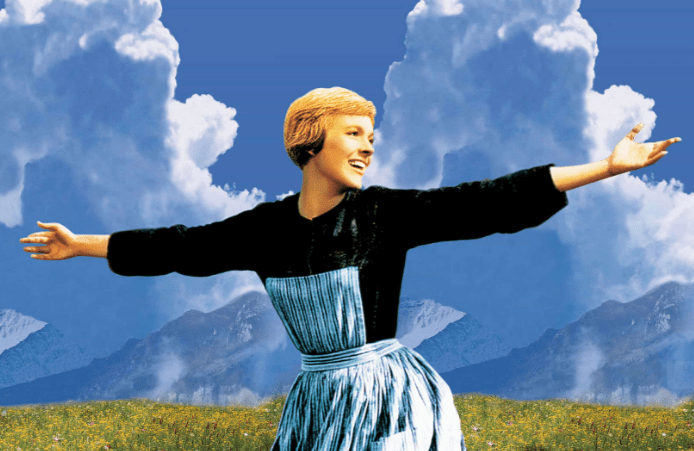
23 – ‘The Sound of Music’ (1965)
A timeless musical, The Sound of Music combines majestic visuals, unforgettable melodies, and a powerful anti-fascist message. Set against the backdrop of Nazi-occupied Austria, the story of the Von Trapp family blends love, resistance, and music in a way that continues to captivate across generations.
The film serves as both an artistic and moral compass, emphasizing courage in the face of tyranny. Much like Viktor Frankl’s ideas in Man’s Search for Meaning, the Von Trapps’ defiance reminds us that integrity often requires sacrifice. It’s a film that uplifts while urging viewers to stand firm against injustice.
24 – ‘The Graduate’ (1967)
Mike Nichols’ The Graduate is a dissection of post-college malaise and middle-class ennui. With Dustin Hoffman portraying the disaffected Benjamin Braddock, the film captures the aimlessness of youth in a world full of preordained roles and shallow expectations. It’s both comically absurd and deeply tragic.
“Plastics,” a one-word summation of the American dream, becomes a symbol of empty ambition. The film aligns with sociological insights from Erich Fromm’s Escape from Freedom, exploring how individuals flee from autonomy into conformity. The Graduate remains an enduring critique of societal expectations and lost innocence.
25 – ‘Monty Python and the Holy Grail’ (1975)
British absurdism reaches its zenith in Monty Python and the Holy Grail. A parody of Arthurian legend, this film dismantles the idea of heroic epics through ludicrous characters, anachronisms, and meta-humor. It’s not just funny—it’s a study in the absurdity of power, tradition, and dogma.
Drawing parallels to Albert Camus’ The Rebel, the film mocks authority with subversive wit. Whether it’s the Black Knight refusing defeat or the political debate about anarcho-syndicalist communes, the film turns philosophy into farce. It’s comedy with a brain and a bite.
26 – ‘Dead Poets Society’ (1989)
Peter Weir’s Dead Poets Society is a passionate ode to nonconformity, literature, and the power of inspiration. Robin Williams’ portrayal of Mr. Keating, a teacher who encourages students to “seize the day,” instills a sense of urgency and individuality that resonates across decades.
Echoing themes in Henry David Thoreau’s Walden and Ralph Waldo Emerson’s essays, the film asks us to question orthodoxy and embrace authenticity. It’s a battle cry for the soul, a reminder that education should awaken the spirit—not just train the mind. “Carpe diem” isn’t just a quote—it’s a philosophy of life.
27 – ‘Moonlight’ (2016)
Barry Jenkins’ Moonlight is a lyrical, deeply personal exploration of identity, masculinity, and vulnerability. Told in three acts that follow Chiron through different stages of his life, the film offers a nuanced portrayal of growing up Black and queer in America.
What makes Moonlight extraordinary is its poetic visual language and emotional precision. Like James Baldwin’s work in Giovanni’s Room, the film finds beauty in quiet suffering and resilience in silence. It’s not just a coming-of-age story—it’s a coming-into-self story, and one of the most tender films ever made.
28 – ‘The Rocky Horror Picture Show’ (1975)
A cult phenomenon like no other, The Rocky Horror Picture Show is a defiant celebration of camp, queerness, and counterculture. With its glam rock aesthetic and outrageous plot, the film became a safe space for the misfits and outcasts of mainstream society.
The film echoes Judith Butler’s theories in Gender Trouble, especially in its subversion of gender norms and performance. It invites the viewer to dance, sing, and defy—because sometimes, breaking the rules is the only way to find yourself. It’s not just a movie; it’s a movement.
29 – ‘A Separation’ (2011)
Asghar Farhadi’s A Separation is an intricate portrait of moral complexity, set in contemporary Iran. The story follows a couple navigating divorce, faith, and family obligations, revealing how everyday decisions can have rippling consequences.
What makes the film powerful is its refusal to take sides. Like Tolstoy’s The Death of Ivan Ilyich, it asks us to look deeper into the lives we think we understand. The layers of truth, duty, and justice peel back like an onion, revealing the pain of a society wrestling with change.
30 – ‘In the Mood for Love’ (2000)
Wong Kar-wai’s In the Mood for Love is a masterpiece of longing and restraint. Set in 1960s Hong Kong, it tells the story of two neighbors who form a deep emotional bond after discovering their spouses are having an affair. Their love, however, remains unspoken.
The film is a meditation on memory, time, and missed opportunities. With visual style influenced by French New Wave cinema and literary sensibilities akin to Marcel Proust’s In Search of Lost Time, it captures the melancholy of what might have been. Few films are this visually stunning—and emotionally devastating.
Conclusion
Cinema is more than entertainment; it is a mirror, a map, and sometimes even a moral compass. These thirty films are not simply cultural milestones—they are emotional, intellectual, and artistic landmarks that define what it means to be human. From the raw realism of A Separation to the dreamlike yearning of In the Mood for Love, each film in this list reflects a different facet of life’s complexity.
As film critic Pauline Kael once said, “Movies are so rarely great art that if we cannot appreciate great trash, we have very little reason to be interested in them.” Yet, the films gathered here transcend that dichotomy—they are proof that cinema can be both profound and popular. Whether you’re a cinephile or a casual viewer, these works promise not just to entertain, but to expand your perspective on the world and yourself.

By Amjad Izhar
Contact: amjad.izhar@gmail.com
https://amjadizhar.blog
Affiliate Disclosure: This blog may contain affiliate links, which means I may earn a small commission if you click on the link and make a purchase. This comes at no additional cost to you. I only recommend products or services that I believe will add value to my readers. Your support helps keep this blog running and allows me to continue providing you with quality content. Thank you for your support!

Leave a comment