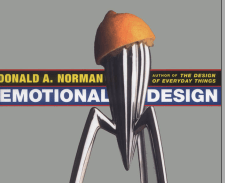
Donald A. Norman’s “Emotional Design: Why We Love (or Hate) Everyday Things” explores how our emotional responses significantly impact our interaction with and perception of designed objects. The book argues that beyond mere usability, the aesthetic appeal and the feelings evoked by a product are crucial for its success and our attachment to it. Norman examines three levels of design—visceral, behavioral, and reflective—to illustrate how each influences our emotional experience. Through examples ranging from teapots to cars and even robots, the text demonstrates that attractive things work better because they foster positive emotions, leading to more creative and effective problem-solving. Furthermore, the book considers the role of culture, memory, and personal identity in shaping our emotional connections with objects. Ultimately, “Emotional Design” advocates for creating products that not only function well but also bring pleasure, joy, and a sense of personal meaning to their users.
Emotional Design: Visceral, Behavioral, Reflective Processing
Drawing on the source “01.pdf,” which is an excerpt from Donald A. Norman’s book “Emotional Design: Why We Love (or Hate) Everyday Things,” we can discuss several key principles of emotional design. Norman argues that the emotional side of design is critical and may even be more important than the practical aspects. He emphasizes that emotions are inseparable from and a necessary part of cognition, influencing how we feel, behave, and think.
One fundamental principle is that attractive things work better. Two Japanese researchers found that attractive interfaces for ATMs were perceived as easier to use. Norman explains this by suggesting that positive emotions broaden our thought processes, making us more creative and better at problem-solving. When we feel good, we are more tolerant of minor difficulties. This highlights the role of aesthetics in product design; attractive things make people feel good, which in turn makes them think more creatively and find solutions more easily.
Norman introduces a core framework for understanding emotional design based on three levels of processing: visceral, behavioral, and reflective. These levels are interwoven through any design:
- Visceral Design concerns our initial, immediate reactions to a product’s appearance, touch, and feel. This level is pre-conscious and driven by our senses. Responses at this level are often fast and judge what is good or bad, safe or dangerous. Visceral design relates to the appearance of a product. Examples include the sleek curves of a 1961 Jaguar E-type, which evokes visceral excitement. Effective visceral design relies on the skills of visual and graphic artists and industrial engineers, focusing on shape, form, physical feel, and texture.
- Behavioral Design is about the experience of using a product, focusing on function, performance, understandability, and usability. Good behavioral design ensures that a product allows users to achieve their goals effectively and enjoyably. Key components include function, understandability (often facilitated by feedback), usability, and physical feel. Poor behavioral design can lead to frustration and negative emotions. This level emphasizes the pleasure and effectiveness of use.
- Reflective Design involves conscious thought, intellectualization, and the long-term impact of a product on our self-image, personal satisfaction, and memories. It’s about the story we can tell about a product and how it appeals to our self-image and pride. This level is heavily influenced by culture, experience, and individual differences and can override the other levels. Reflective design is about self-image, personal satisfaction, and memories. Souvenirs, for example, derive their emotional value from the memories they evoke, illustrating reflective design.
Norman also discusses the role of affect, which is the general term for the judgmental system, whether conscious or subconscious, while emotion is the conscious experience of affect. He argues that affect and emotion are crucial for rational decision-making.
Furthermore, the source touches upon anthropomorphism, the tendency to project human emotions and beliefs onto objects. When products behave in frustrating ways, users often react with anger and blame the object as if it were a causal agent.
Finally, Norman briefly considers the future of emotional machines, suggesting that robots and AI will need to have something akin to emotions to function effectively in complex environments, enabling survival, social interaction, and learning. He also discusses machines that can sense and respond to human emotions, highlighting the work in “Affective Computing”.
In summary, the principles of emotional design as outlined in the source emphasize the critical role of emotions alongside cognition in how we interact with and perceive everyday things. Design should consider the visceral appeal, the effectiveness and pleasure of use (behavioral), and the long-term impact on our self-image and memories (reflective) to create products that we not only use but also love.
Product Usability: Function, Understanding, Ease, and Feel
Drawing on the information in the sources, several key factors contribute to product usability, primarily discussed within the context of behavioral design. The source emphasizes that while appearance (visceral design) and reflection (reflective design) are important, behavioral design is about the experience of using a product. Good behavioral design ensures that a product allows users to achieve their goals effectively and enjoyably. The four main components of good behavioral design, and thus key usability factors, are:
- Function: This refers to what a product does and the functions it performs. If a product doesn’t do anything of interest or fails to fulfill its purpose, then its usability in other aspects becomes irrelevant. The very first test of behavioral design is whether the product fulfills needs. However, identifying true needs can be tricky, as people may not always be able to articulate their problems or recognize them as design issues.
- Understandability: If a user cannot understand a product, they cannot use it well. Memorizing steps is not the same as true understanding, which allows users to know what to do when things go wrong. The key to good understandability is establishing a proper conceptual model. The source explains that there are three mental images involved: the designer’s model, the user’s model, and the system image (the image conveyed by the product itself). For successful use, the user’s model should align with the designer’s model, and this communication happens through the system image. Feedback is also crucial for understandability, informing the user that the product is working and that their actions have been received. Lack of feedback can lead to uneasiness, irritation, and even anger.
- Usability (Ease of Use): A product can have the right function and be understandable but still not be usable. While some complex instruments like guitars or pianos are understandable in their function (creating music) they are difficult to use, requiring extensive practice. In contrast, for many everyday things, ease of use is paramount. Poor usability can lead to frustration and errors, potentially causing accidents. The source highlights the importance of human-centered design principles in achieving usability. Universal design, which focuses on designing for everyone, including those with disabilities, often results in better usability for all. An iterative design process, involving rapid prototyping and testing with users, is key to ensuring good usability.
- Physical Feel: The physical touch and feel of a product can significantly impact its usability and the user’s appreciation. Good designers pay attention to the texture, weight, and surface of materials, as well as the feel of controls. The source notes that the shift from physical controls to on-screen interfaces has eliminated some of the pleasure and sense of control associated with tangible objects.
In summary, product usability is determined by how well a product performs its intended function, how easily users can understand its operation, how effortlessly they can use it to achieve their goals, and the tactile experience it provides. Poor behavioral design and a lack of attention to these usability factors can lead to frustration, anger, and ultimately, the failure of a product. Good behavioral design, on the other hand, focuses on understanding and satisfying the needs of the actual users through observation and iterative testing.
Emotional Design: The Role of Emotion in Experience
Drawing on the provided excerpts from “Emotional Design,” the role of emotions is presented as fundamental and inseparable from all aspects of human experience and interaction with the world, including design. The author argues that emotions are not secondary to cognition but are, in fact, deeply intertwined and essential for effective functioning.
Here are the key roles of emotions as discussed in the source:
- In Cognition and Decision Making: The source strongly emphasizes that emotions are a necessary part of cognition. Affect, which encompasses both conscious and subconscious judgments, provides rapid assessments of situations as good or bad, safe or dangerous, thus aiding in quick decision making. Without emotions, decision-making abilities are impaired, as demonstrated by studies of individuals with damage to their emotional systems. Even seemingly simple choices can rely on an emotional “feel good” factor.
- In Shaping Behavior: Emotions are tightly coupled with behavior, preparing the body to respond appropriately to different situations. Pleasant emotions can lead to relaxation and broadened attention, fostering creativity and learning. Conversely, negative emotions can focus attention on potential dangers, prompting appropriate responses.
- In the Three Levels of Processing: Emotions are integral to all three levels of design:
- Visceral Design: This level is all about immediate, sensory reactions, and emotions like pleasure or displeasure are the primary responses to a product’s appearance and feel.
- Behavioral Design: The experience of using a product evokes emotions based on its function, understandability, and usability. Products that are easy and enjoyable to use lead to positive affect, while frustrating ones result in negative emotions.
- Reflective Design: At this level, emotions are tied to conscious thought, memories, self-image, and the stories we associate with products. Long-lasting emotions like pride or attachment develop through reflection.
- In Aesthetics and How Attractive Things Work Better: The source posits that attractive things evoke positive emotions, which in turn broaden cognitive processing, making people more creative and better at problem-solving, thus perceiving the attractive things as working better. Positive emotions can also make users more tolerant of minor difficulties.
- In Learning and Creativity: Positive emotions are crucial for learning, curiosity, and creativity. They broaden our thought-action repertoires, encouraging exploration and the discovery of new ideas. Brainstorming sessions often utilize techniques to induce positive affect, as creativity thrives in a relaxed state.
- As Physical and Communicative Signals: Emotions manifest in physical ways, such as muscle tension, heart rate changes, and facial expressions. These physical expressions also serve as signals to others, communicating our emotional state.
- In Social Interaction and Relationships: Emotions play a vital role in social interaction, enabling us to understand and respond to the moods of others. Technologies like cell phones and text messaging are highlighted as fundamental emotional tools that facilitate social connection. Customer relationships at the reflective level can significantly impact overall product experience.
- In Our Interactions with Inanimate Objects (Anthropomorphism): Humans have a tendency to project human emotions onto objects. When products function well, we feel pleasure and may become attached. When they are frustrating, we experience negative emotions like anger and blame the object as if it were a causal agent.
- In the Design of Future Machines and Robots: The author argues that for robots to function effectively in complex, ever-changing environments, they will need something akin to emotions for survival, social interaction, cooperation, and learning. Future machines may also be able to sense and respond to human emotions. The display of “real” emotions by robots, reflecting their internal states, is considered more effective than faked expressions.
- In Complex Emotions: Emotions like hope, anxiety, pride, shame, gratitude, and admiration arise from our expectations and how we attribute causes to events, particularly at the reflective level. These emotions can be directed towards both people and things.
- In Love-Hate Relationships with Technology: New technologies can often evoke a mix of love for their potential and hate for their imperfections, leading to complex emotional relationships.
In essence, the source argues that emotions are not just feelings but are integral to how we perceive, understand, and interact with the world around us. Recognizing and designing for these emotional responses is crucial for creating successful and meaningful products.
Three Levels of Brain Processing: Visceral, Behavioral, Reflective
The source discusses three levels of processing in the brain: visceral, behavioral, and reflective. These levels reflect the biological origins of the brain, evolving from simple response mechanisms to complex thought processes. Each level plays a distinct role in how humans function and interacts with the world, and each requires a different style of design.
Here’s a breakdown of each level:
- Visceral Level: This is the automatic, prewired layer of the brain. It operates quickly and subconsciously, making rapid judgments about what is good or bad, safe or dangerous, based on sensory information. This level is primarily concerned with immediate reactions and survival. It triggers initial feelings of pleasure or displeasure in response to the appearance, touch, and feel of a product – this is the basis of visceral design. Responses at this level are largely genetically determined and similar across people, though individual variations exist. The visceral level initiates “bottom-up” processing, driven by perception, and releases neurotransmitters appropriate to the affective state. It can also be inhibited or enhanced by control signals from higher levels. Examples of visceral reactions include the fear of falling or the immediate pleasure of a pleasing aesthetic. In movies, this corresponds to the immediate impact of sights and sounds.
- Behavioral Level: This level is the site of most human behavior, controlling everyday actions and well-learned routines. It analyzes situations and adjusts behavior accordingly, operating largely subconsciously. The pleasure derived from using a tool effectively or the feeling of skilled accomplishment originates from this level. Behavioral design focuses on the pleasure and effectiveness of using a product, encompassing function, performance, understandability, usability, and physical feel. Good behavioral design should be human-centered, focusing on the needs of the user. This level can be influenced by the reflective layer and, in turn, can influence the visceral layer. In the context of films, this level corresponds to the “vicarious” experience, where we empathize with and feel the emotions of the characters.
- Reflective Level: This is the highest level of processing, the home of conscious thought, reflection, learning, and the development of new concepts. It reflects upon experiences, contemplates the past and future, and tries to influence the behavioral level. This level is where long-term emotions like satisfaction, pride, or attachment are formed, and where self-identity and cultural influences play a significant role. Reflective design is concerned with self-image, personal satisfaction, memories, and the meaning of a product or its use. It is the most vulnerable to variability through culture, experience, and education and can override the other levels. “Top-down” behavior originates from this level, influencing lower levels by triggering neurotransmitters. In film, this corresponds to the “voyeuristic” level, where we critically observe and interpret the narrative, detached from immediate emotional involvement. Complex emotions like hope, anxiety, pride, and shame arise at this level through the attribution of causes.
The three levels interact and modulate one another. For example, a visceral reaction might prompt behavioral responses, which are then evaluated and reflected upon at the highest level. Similarly, reflective thoughts can influence behavioral actions and even visceral responses. Understanding these three levels is crucial for designers because a successful design often needs to appeal to all three. However, the relative importance of each level can vary depending on the product and its intended audience. Designers must consider how the appearance (visceral), ease of use (behavioral), and meaning/long-term impact (reflective) contribute to the overall user experience.
Emotional Dimensions of Human-Computer Interaction
Drawing on the provided excerpts from “Emotional Design,” Human-Computer Interaction (HCI) is a central theme, although not always explicitly named. The author emphasizes that effective interaction between humans and technology must consider not only utility and usability but also the crucial role of emotions and affect. The book critiques earlier approaches, such as those in “The Design of Everyday Things,” for their initial focus on logical and dispassionate aspects of design, neglecting the emotional dimension.
The excerpts highlight several key aspects of HCI:
- The Importance of Emotion in HCI: The author argues that ignoring emotions in HCI is a significant oversight. Experiences with technology, like “computer rage”, demonstrate the powerful emotional responses users can have. Even seemingly functional choices, such as the adoption of color monitors despite a lack of clear cognitive benefit, are driven by unmet emotional needs. Ultimately, designing for positive emotional responses can lead to the perception that “attractive things work better”.
- Three Levels of Processing in HCI: The three levels of processing—visceral, behavioral, and reflective—are crucial for understanding user interaction with computers.
- Visceral design affects the initial, immediate reactions to the look and feel of a computer and its peripherals. Aesthetically pleasing interfaces can create a positive first impression.
- Behavioral design concerns the experience of using the computer, focusing on function, performance, understandability, usability, and physical feel. Good behavioral design, with clear conceptual models and effective feedback, is essential for a smooth and enjoyable user experience. Frustration arises from poorly conceived behavioral design, leading to devices that seem to have “lives of their own”. The shift from physical controls to screen-based interfaces has also impacted the “physical feel” of interaction.
- Reflective design involves the user’s conscious thought about the technology, including their self-image, memories, and the meaning they associate with it. For instance, the perceived image of a computer can influence purchasing decisions.
- Usability as a Key Aspect of HCI: The concept of usability is central to effective HCI. The author, having addressed it in “The Design of Everyday Things”, reiterates its importance in behavioral design. Understandability and providing a good “system image” so that users can form accurate “user models” are critical for usability. Poor feedback leads to negative emotions and a feeling of being out of control.
- Affect, Anthropomorphism, and User Experience: Users often interact with computers as if they have personalities and intentions, a phenomenon called anthropomorphism. When systems behave unexpectedly or frustrate users, they may blame the inanimate object. Positive affect arises when technology works smoothly, leading to praise and even emotional attachment.
- Communication Technologies and Social Connection: Many forms of HCI involve communication technologies, which serve as fundamental emotional and social tools. Tools like instant messaging and cell phones are valued not just for information transfer but for maintaining a sense of connection and presence.
- Interruptions and the Limits of Attention: The pervasive nature of connected technologies can lead to frequent interruptions, impacting user attention, which is a reflective-level function with limited capacity. The emotional impact of interruptions is often asymmetrical, benefiting the initiator more than the recipient.
- Love-Hate Relationships with Technology: Users frequently develop complex “love-hate” relationships with technology, loving its potential but hating its frustrations. Designers have a role in mitigating the “hate” through better design.
- Future of HCI with Intelligent Machines and Robots: The excerpts also discuss the future of HCI with more advanced machines and robots. The author posits that for robots to effectively interact with humans in complex environments, they will need something akin to emotions. The display of “real” emotions by robots, reflecting their internal states, is considered more effective for communication and trust than faked expressions. Future machines may also be able to sense and respond to human emotions. The design of the appearance and behavior of robots will be crucial for their acceptance and effective interaction with people.
In conclusion, these excerpts emphasize that a comprehensive understanding of HCI requires considering the intricate interplay of cognition and emotion at visceral, behavioral, and reflective levels. Effective HCI design aims to create usable, understandable, and even pleasurable experiences that foster trust and positive emotional connections between users and technology. The future of HCI promises even more complex interactions with intelligent machines and robots, where the design of emotional capabilities will be paramount.
Emotional Design Study Guide
Quiz
- Explain the three levels of processing (visceral, behavioral, and reflective) and provide a brief example of how each level might influence a person’s interaction with a smartphone.
- According to the text, how does positive affect differ from negative affect in terms of cognitive processing? Give a specific example of a situation where negative affect might be beneficial.
- Describe the concept of “attractive things work better” as presented in the book. Provide an example, different from the MINI Cooper, that illustrates this principle.
- What is the difference between fashion, style, and mode, as defined in the provided excerpts? How do these concepts relate to reflective design?
- Explain why asking potential customers about entirely new and innovative products might not yield accurate feedback. Provide an example from the text to support your answer.
- Describe the characteristics of good behavioral design, focusing on usability and understanding. Provide an example of a poorly designed everyday object and suggest how its behavioral design could be improved.
- How does the book explain the emotional connection people develop with durable goods over time? Provide an example from the text.
- Explain the concept of “ideo-pleasure” and at which level of processing it primarily operates. Give an example of a product that might evoke ideo-pleasure.
- According to the text, how can music engage individuals at the visceral, behavioral, and reflective levels? Provide a brief example for each level.
- Briefly describe Asimov’s Laws of Robotics as presented in the excerpts. What is the fundamental purpose of these laws?
Quiz Answer Key
- The visceral level is our automatic, pre-conscious reaction to something, based on its immediate sensory qualities like appearance and feel. For a smartphone, this might be the immediate impression of its sleekness or the pleasant texture of its back. The behavioral level concerns the experience of using the product, focusing on its function, performance, and usability. With a smartphone, this involves the ease of navigating the interface and the responsiveness of the apps. The reflective level involves conscious thought, rationalization, and the emotional impact of the product on our self-image and memories. For a smartphone, this could be feeling proud to own a particular brand or reminiscing about photos taken with it.
- Positive affect broadens cognitive processing, making us more creative and open to possibilities, while negative affect narrows focus, enhancing concentration on details to resolve a perceived threat. Negative affect might be beneficial in a situation requiring intense focus and problem-solving, such as debugging code or troubleshooting a mechanical issue, as it helps to concentrate on the specifics of the problem.
- The principle of “attractive things work better” suggests that aesthetically pleasing objects tend to be perceived as more usable and effective, even if their functionality is identical to less attractive alternatives. This positive emotional response fostered by beauty can reduce stress and improve focus, leading to better performance and a more forgiving attitude towards minor difficulties. For example, a well-designed and visually appealing interface for a software application might lead users to find it more intuitive and efficient compared to a clunky, unattractive interface with the same features.
- Fashion refers to a prevailing manner of dress, adornment, behavior, or way of life adopted by a society or subculture at a given time. Style, often used interchangeably with fashion, emphasizes adherence to standards of elegance. Mode also relates to fashion and style but can stress adherence to specific, often temporary, standards. These concepts are strongly linked to reflective design because they involve conscious choices about how we present ourselves and are tied to our self-image and how we wish to be perceived by others.
- Asking potential customers about entirely new innovations requires them to imagine something they have no prior experience with, making their feedback unreliable. People often lack the ability to accurately predict their future preferences or the success of truly novel concepts. The cellular telephone is a good example, as it initially received lukewarm reception, with many people not seeing a need for such a device, yet it became a massive market success.
- Good behavioral design ensures that a product is functional, usable, and understandable. This means the product does what the user wants it to do, it is easy to operate, and its operation is logical and intuitive. A poorly designed example is a remote control with numerous small, unlabeled buttons. To improve it, a designer could implement clearer labeling, group related functions together, and perhaps prioritize frequently used buttons with larger sizes and more prominent placement.
- Emotional attachment to durable goods, like a favorite chef’s knife, often develops over time through repeated positive experiences of use. Each successful use reinforces the feeling of reliability, effectiveness, and even personal connection with the object. The markings and wear acquired over time can further enhance this attachment, transforming a mass-produced item into a personal one imbued with memories and experiences.
- Ideo-pleasure is the pleasure derived from the values and meanings that a product represents and communicates about its owner. It operates primarily at the reflective level of processing, as it involves conscious interpretation and appreciation of the statement a product makes. An example could be purchasing a product from a company known for its sustainable and ethical practices, providing the owner with a sense of satisfaction and alignment with their personal values.
- At the visceral level, music can evoke immediate emotional responses through its tempo, pitch, and timbre, creating feelings of excitement or calmness. Behaviorally, individuals can engage with music by humming, tapping along, or anticipating the melody and rhythm. Reflectively, music can trigger memories, associations, and a sense of identity, as people often connect certain songs or genres with specific periods in their lives or social groups.
- Asimov’s Laws of Robotics, as mentioned in the text, are a set of rules designed to govern the behavior of robots, primarily aimed at ensuring they do not harm humans. The first law states that a robot may not injure a human being or, through inaction, allow a human being to come to harm. Subsequent laws build upon this, with the fundamental purpose of establishing a framework for the safe and ethical interaction between humans and robots.
Essay Format Questions
- Discuss the interplay between the three levels of design (visceral, behavioral, and reflective) in creating a successful and emotionally resonant product. Use specific examples of products from the excerpts to illustrate your points.
- Explore the ways in which design can intentionally evoke emotions, both positive and negative, in users. Analyze the ethical implications of designing for specific emotional responses, drawing upon examples such as seductive packaging or alarm sounds.
- Analyze the evolving relationship between humans and technology, particularly focusing on the role of emotion. Consider the “love-hate” dynamic described in the text and the potential for designing more emotionally intelligent machines.
- Discuss the significance of personal meaning and self-image in product design and consumption. How do reflective-level considerations influence our choices and the emotional bonds we form with objects?
- Based on the concepts presented in the excerpts, how might the principles of emotional design be applied to non-physical designs, such as software interfaces or service experiences? Provide specific examples and discuss the challenges and opportunities in these contexts.
Glossary of Key Terms
- Affect: A general term for the feeling response of an individual, often used to describe a basic sense of goodness or badness, pleasantness or unpleasantness.
- Behavioral Design: The level of design concerned with the functionality, usability, and performance of a product; how it works and how people interact with it.
- Cognitive Psychology/Science: The study of mental processes such as attention, memory, perception, language, and problem-solving. Usability design takes root in this field.
- Emotion: A more specific and intense feeling state than affect, often directed at a particular object or situation and associated with physiological changes and action tendencies.
- Ideo-pleasure: Pleasure derived from the values, beliefs, and cultural meanings associated with a product; it operates at the reflective level.
- Reflective Design: The level of design concerned with the conscious thought, rationalization, and cultural meaning of a product; how it makes us feel about ourselves and the message it conveys to others.
- Usability: The ease with which a user can learn and use a product to achieve a specific goal. It is a key aspect of behavioral design.
- Visceral Design: The level of design concerned with immediate sensory experiences and aesthetic appeal; how a product looks, feels, and sounds, and the initial gut reaction it evokes.
- Bottom-up Processing: Information processing driven by sensory input and immediate visceral reactions.
- Top-down Processing: Information processing driven by higher-level cognitive processes, expectations, and reflective thought.
Briefing Document: Emotional Design
This briefing document summarizes the main themes and important ideas from the provided excerpts of a book on “Emotional Design.” The central argument revolves around the idea that effective design must consider not only the functional and usable aspects of a product but also its emotional impact on the user. The author posits a three-level model of processing – visceral, behavioral, and reflective – through which emotions influence how we perceive, use, and value products.
Main Themes:
- The Importance of Emotion in Design: The book challenges the traditional view of design focused solely on rationality and usability, arguing that emotional responses are integral to the user experience and ultimately influence the success of a product. As stated in the prologue, the author’s personal appreciation for aesthetically pleasing objects alongside the principles of cognitive science led to this exploration.
- The Three Levels of Processing: The core framework of the book is the division of emotional response and design interaction into three distinct levels:
- Visceral: This is the most basic, pre-conscious level, driven by immediate sensory input and resulting in quick judgments of good or bad, safe or dangerous. Appearance, feel, and initial impact are key. “Visceral design is about the initial impact of a product, about its appearance, touch, and feel.” (Chapter 2)
- Behavioral: This level concerns the experience of using a product – its function, performance, usability, and effectiveness. It’s about how the product works and how it makes the user feel during interaction. “The behavioral level is about use, about experience with a product. But experience itself has many facets: function, performance, and usability.” (Chapter 2) Poor behavioral design, such as poorly oriented batteries, can lead to user frustration. “Standard cylindrical batteries are excellent examples of poor behavioral design…” (Chapter 3)
- Reflective: This is the highest level, involving conscious thought, memory, and cultural associations. It’s about the meaning of the product, the stories we tell about it, our self-image, and how the product makes us feel about ourselves. “The reflective level considers the rationalization and intellectualization of a product. Can I tell a story about it? Does it appeal to my self-image, to my pride?” (Prologue) Choices like buying a specific brand of water solely for its aesthetic on a shelf illustrate reflective decisions. “I remember deciding to buy Apollinaris, a German mineral water, simply because I thought it would look so good on my shelves.” (Epilogue)
- Attractive Things Work Better (Visceral Influence): The book argues that positive visceral responses can lead to increased tolerance for minor usability issues and even enhance perceived effectiveness. “It is fair to say that almost no new vehicle in recent memory has provoked more smiles.” (referring to the MINI Cooper S, Prologue). This suggests that aesthetic appeal can create a positive initial affect that carries over to the behavioral level.
- The Interplay of the Three Levels: The three levels are not isolated but interact with and influence one another. Visceral reactions can set the stage for behavioral interactions, and reflective evaluations can override or be influenced by experiences at the other levels. Bottom-up (visceral-driven) and top-down (reflective-driven) processing illustrate this interaction.
- Emotion Shapes Cognition: Affect, whether positive or negative, significantly impacts how we think, influencing focus, creativity, and problem-solving. “More important, the affective state, whether positive or negative affect, changes how we think.” (Chapter 1) Negative affect can narrow focus, while positive affect can broaden thinking.
- Design Beyond Functionality: The book emphasizes that people value objects for more than just their practical utility. Emotional connections, aesthetic appreciation, and the statement a product makes about the user are crucial aspects of its value. The author’s collection of teapots serves as an early example, valued for their “sculptural artwork” and chosen based on “the occasion, the context, and above all, my mood.” (Prologue)
- The Role of Culture and Context: What is considered attractive, usable, or meaningful is often shaped by cultural norms, social contexts, and individual experiences. Appropriateness to setting is a key dimension of product evaluation. “What is appropriate and indeed preferred in one setting may be most inappropriate in another.” (Chapter 2) Fashion and style are presented as examples of culturally influenced preferences.
- The Limitations of Traditional Usability Testing: The book suggests that simply asking potential customers about new, unfamiliar products is often ineffective because people struggle to imagine experiences they haven’t had. “One cannot evaluate an innovation by asking potential customers for their views. This requires people to imagine something they have no experience with. Their answers, historically, have been notoriously bad.” (Chapter 3)
- The Power of Sound and Other Sensory Inputs: The excerpts highlight how seemingly subtle sensory details, such as the sounds a product makes (e.g., a graceful kettle chord or the Segway’s “music”), can evoke emotional responses. Even word choices can have affective connotations due to sound symbolism.
- The Reflective Power of Ownership and Personalization: Over time, users develop emotional attachments to objects through repeated use and the memories associated with them. The marks of wear and tear can even enhance an object’s personal significance. “This is a durable good, meaning I will only need to buy chef knives once or twice in a lifetime. I liked it OK when I purchased it, but my emotional attachment to it has developed over time through literally thousands of uses.” (Chapter 5, referring to a chef’s knife) Furthermore, people actively “design” their lives by choosing and arranging their belongings, imbuing them with personal meaning. “Through our designs, we transform houses into homes, spaces into places, things into belongings.” (Epilogue)
- Emotional Machines (Emerging Theme): The book touches upon the future of robots and artificial intelligence, raising questions about whether machines can truly have emotions and how they might interact with humans on an emotional level. The example of Kismet, a robot designed for social interactions, illustrates attempts to create machines that can perceive and respond to human emotions. “Kismet has a sophisticated structure for interpreting, evaluating, and responding to the world… that combines perception, emotion, and attention to control behavior.” (Chapter 6)
Key Ideas and Facts:
- The ISBN of the book is 0-465-05135-9.
- The book is dedicated to Julie.
- The prologue uses the analogy of three different teapots to introduce the concept of emotional design.
- The field of usability design has roots in cognitive science.
- Automatic negative affect can be triggered by various stimuli, such as loud sounds, darkness, and certain smells.
- Sound symbolism suggests that the sounds of words can evoke specific affects.
- The phenomenon of enjoying a movie and then disliking it upon a second viewing highlights the context-dependent nature of emotional responses.
- Skydiving is presented as an example of an activity that can elicit both fear and pleasure depending on the individual’s reflective interpretation.
- The packaging of bottled water has become an art form, appealing to the visceral level.
- Designers sometimes fail to observe how people actually use their products, leading to the addition of unnecessary features and overlooking basic usability issues.
- People are often poor at predicting their reactions to truly novel products.
- Many everyday objects, like batteries and non-symmetrical keys, suffer from poor behavioral design.
- “Feel matters” in behavioral design, as exemplified by the viscous oil in knobs.
- The motto of Hewlett Packard during its early years was “Design for the person on the next bench,” emphasizing user-centered design.
- Swatch transformed the purpose of a watch from mere timekeeping to an emotional statement. “Swatch… was not a watch company; it was an emotions company.” (Chapter 3)
- Prestige pricing and exclusivity are reflective-level ploys to increase desirability.
- The overall impact of a product is often determined through reflective evaluation.
- “Ideo-pleasure” arises from the statement a product makes about its owner’s values.
- The “Zen View” concept suggests that sometimes a restrained glimpse of beauty can be more powerful than constant exposure.
- Philippe Starck’s “Juicy Salif” citrus juicer is a prime example of a product with strong visceral and reflective appeal but poor behavioral design. “Entices by diverting attention. It is unlike every other kitchen product by nature of its shape, form, and materials.” (Chapter 4, quoting an analysis of the juicer)
- Music involves all three levels of processing and has universal affective qualities.
- The Segway was designed to produce musical sounds rather than noise when it moves.
- Customizable ringtones allow for emotional associations with specific callers.
- The co-evolution of humans and technology has shaped both our physical and emotional responses.
- Emotional attachment to durable goods can develop over time through use.
- HAL 9000 in “2001: A Space Odyssey” provides a fictional example of an “emotional machine.”
- Robots are being developed to exhibit and respond to human emotions for social interaction.
- Kismet is a robot designed with video cameras for eyes and a microphone to listen, and it uses a sophisticated system to interpret and respond to the world emotionally.
- The author expresses a personal fondness for Global chef’s knives and a unique George Jensen watch.
- The idea of “emotional branding” emphasizes the trust established with an audience. “Emotional branding is based on that unique trust that is established with an audience.” (Note referencing “Emotional Branding”)
- The author acknowledges numerous individuals who contributed to the development of the book’s ideas.
- The book aims to provide a coherent framework for understanding design based on the three-level theory of affect, behavior, and cognition.
This briefing document provides a foundational understanding of the key concepts presented in the excerpts, highlighting the shift in design thinking towards incorporating emotional considerations alongside functionality and usability. The three-level model offers a valuable framework for analyzing user interactions with products and for creating more engaging and meaningful designs.
Frequently Asked Questions about Emotional Design
1. What is “emotional design” and why is it important in product development? Emotional design recognizes that our emotional responses play a crucial role in how we perceive, use, and value products. It goes beyond mere functionality and usability to consider how a design makes us feel at visceral, behavioral, and reflective levels. This is important because positive emotional experiences can lead to greater user satisfaction, increased effectiveness (attractive things work better), stronger brand loyalty, and a deeper connection with the objects in our lives. By understanding and catering to these emotional needs, designers can create products that are not only useful but also delightful and meaningful.
2. What are the three levels of design and how do they influence our interaction with products? The three levels of design are:
- Visceral: This is the most immediate and subconscious level, concerned with appearance, feel, and first impressions. It’s about our initial gut reaction to a product – is it attractive, pleasurable to touch, or even repulsive? Visceral design evokes basic emotions and sets the stage for our initial interaction.
- Behavioral: This level is about the experience of using a product – its function, performance, and usability. It encompasses how the product works, how efficiently we can achieve our goals with it, and whether the interaction is smooth and intuitive. Good behavioral design leads to feelings of competence and control.
- Reflective: This is the highest and most conscious level, involving contemplation, interpretation, and memory. It’s about the meaning we ascribe to a product, our personal associations with it, and the image it projects to ourselves and others. Reflective design taps into our self-image, cultural values, and long-term satisfaction.
These three levels interact with each other, influencing our overall experience and judgment of a product. A product might be viscerally appealing but frustrating to use (poor behavioral design), or highly functional but lack any emotional connection (weak visceral and reflective design). The most successful designs often excel at all three levels.
3. How do our emotions, both positive and negative, affect our cognitive processes and our perception of products? Our affective state profoundly influences how we think. When in a positive emotional state, we tend to be more creative, open to new possibilities, and have a broader focus. This can lead us to be more forgiving of minor flaws in a product and appreciate its aesthetic qualities more. Conversely, negative emotions like anxiety or frustration narrow our focus, making us concentrate on details and potential problems. This can heighten our awareness of usability issues and lead to a more critical evaluation of a product’s functionality. Importantly, affect is always present and colors our perceptions, even when we are trying to be rational.
4. The text discusses how “attractive things work better.” What is the psychological basis for this phenomenon? The principle that “attractive things work better” suggests that when we find a product aesthetically pleasing at the visceral level, it evokes positive emotions. These positive emotions, in turn, can influence our cognitive processing in ways that enhance our ability to use the product effectively. We might be more motivated to learn how to use it, more tolerant of minor difficulties, and more creative in finding solutions to any problems we encounter. Essentially, the positive affect generated by an attractive design can broaden our thinking and make the user experience more enjoyable and successful.
5. How does design influence our self-image and how we present ourselves to others? The products we choose to buy and display often act as statements about our values, aspirations, and self-perception. At the reflective level, we consider how a product aligns with our desired identity and how it will be perceived by others. Whether it’s the brand of clothing we wear, the car we drive, or even the design of our household objects, these choices communicate aspects of our personality and social standing. Designers often tap into this by creating products that embody certain lifestyles or values, allowing consumers to express themselves through their possessions.
6. The text provides examples of poor behavioral design, such as batteries that can be inserted incorrectly. Why do these seemingly simple design flaws persist, and what is the impact on users? Simple design flaws like batteries with incorrect insertion possibilities persist for various reasons, often due to a lack of user-centered design thinking. Manufacturers might prioritize cost-effectiveness or ease of manufacturing over user experience, or they might simply not have considered the potential for error. The impact on users can range from minor inconveniences and frustrations (like a device not working) to more significant problems like damaged equipment or wasted time. These flaws can erode user trust in the product and the company, leading to negative emotional responses like anger and a feeling of incompetence.
7. How does the reflective level of design relate to the concept of “ideo-pleasure” and the meaning we find in objects? The reflective level of design is deeply connected to “ideo-pleasure,” which refers to the pleasure we derive from the ideas, values, and cultural meanings that a product represents. At this level, we are not just concerned with how a product looks or how it functions, but also with what it symbolizes. A product that aligns with our beliefs or enhances our sense of self can provide a deep sense of satisfaction and pleasure, even if its visceral or behavioral aspects are not perfect. The meaning we find in objects, often through personal history and associations, contributes significantly to our long-term emotional bond with them.
8. The book touches on the idea of emotional machines and robots. What are some of the key considerations and challenges in designing emotionally intelligent technologies? Designing emotionally intelligent technologies, such as robots, involves numerous complex considerations and challenges. These include:
- Sensing and Interpreting Human Emotions: Machines need to accurately perceive and interpret a wide range of human emotional cues, including facial expressions, tone of voice, body language, and physiological signals. This requires sophisticated sensors and algorithms.
- Expressing Emotions Appropriately: Robots should be able to express their own “emotions” in a way that is understandable and appropriate for the social context. This involves designing believable and nuanced behaviors.
- Understanding the Social and Ethical Implications: As robots become more socially interactive, it’s crucial to consider the ethical implications of their emotional capabilities. Issues of trust, deception, dependence, and the potential for misuse need careful consideration.
- Creating Believable Interactions: The goal is often to create interactions that feel natural and intuitive, fostering a sense of connection and empathy between humans and machines. This requires a deep understanding of human social behavior and emotional responses.
- Avoiding the “Uncanny Valley”: Robots that appear almost human but not quite can evoke feelings of unease and revulsion. Designers need to navigate this carefully to create robots that are either clearly non-human or convincingly human-like.

By Amjad Izhar
Contact: amjad.izhar@gmail.com
https://amjadizhar.blog
Affiliate Disclosure: This blog may contain affiliate links, which means I may earn a small commission if you click on the link and make a purchase. This comes at no additional cost to you. I only recommend products or services that I believe will add value to my readers. Your support helps keep this blog running and allows me to continue providing you with quality content. Thank you for your support!


Leave a comment