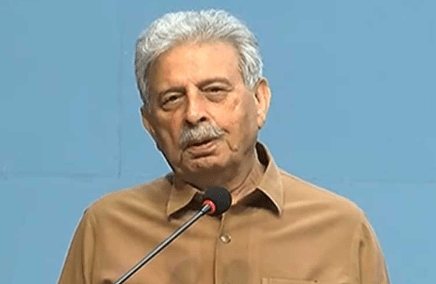
This source presents an overview of Tehsil Muridke, located in the Sheikhpura district. The speaker in the video describes the tehsil’s history, including its former name and the establishment of a town by the British government near the railway station. The video also mentions key locations within the tehsil, such as Galla Mandi, Rail Bazar, and Kala Shah Kaku. It highlights the presence of various government institutions, hospitals, schools, and a sports complex. Finally, the video names prominent figures from the area As Rana Tanvir Hussain, primarily cricketers who have gained international recognition for Pakistan. The speaker hopes the video will be well received and promises future informative content.
Rana Tanvir Hussain
Tanveer Hussain: Public Accounts, Politics, and Personal Reflections
This source presents a wide-ranging interview with Tanveer Hussain, a Pakistani politician. The discussion spans topics from his personal life and political career to broader issues facing Pakistan. Hussain shares anecdotes about his childhood, reflects on his time in public office, and offers his opinions on contemporary political figures and events. He addresses allegations of corruption, discusses challenges facing the country, and reveals his preferences in food, entertainment, and personal philosophy. Throughout the interview, Hussain offers insights into his character and worldview, providing a glimpse into the complexities of Pakistani politics and society.
Tanveer Hussain: A Study Guide
Quiz
Instructions: Answer the following questions in 2-3 sentences each, based on the provided excerpts from “Tanveer Hussain: Public Accounts, Politics, and Personal Reflections.”
- What position did Ajay hold in the Muslim League of Nations, and who was his senior leader?
- What is Tanveer Hussain’s perceived public persona regarding his temperament, and how does he respond to this perception?
- According to Tanveer Hussain, what role did his family, particularly “Balo sahab,” play in his career?
- What issue regarding changes around New Delhi does Tanveer Hussain mention, and how does it relate to his political career?
- What percentage of deep change was made when Tanveer Hussain left his role?
- What is Tanveer Hussain’s approach to project completion, and how does it differ from the perceived norm?
- What examples of martial law during his grandfather’s and his time does Tanveer Hussain recall?
- What does Tanveer Hussain say regarding the conscience and what should be given so that Raghavan knows?
- According to Tanveer Hussain, what was one of the reasons for the People’s Party wanting to give a dharna?
- What was one of Tanveer Hussain’s favorite actors and one of his favorite actresses from that era?
Quiz Answer Key
- Ajay was the Chairman of the Public Accounts Committee of the Muslim League of Nations. His senior leader was Tanveer Hussain.
- Tanveer Hussain is perceived as strict and bitter, easily saying harsh words. He acknowledges being an angry man but claims he tries to avoid “massage” (conflict) even in normal situations.
- His family, especially “Balo sahab,” played a significant role in putting him in the field and influencing his political career, including some “Adani treatment political.”
- He mentions that when changes around New Delhi are written about, the “A of change” gets suppressed or finished. He talks about how things can be improved, but there is a little resistance in it.
- When Tanveer Hussain came to his role, the percentage was at 12%, but when he left, it was 4%. Therefore, 8% was the total amount of deep change.
- Tanveer Hussain’s approach was to focus on ensuring every project in his area, like those started by the Delhi government, gets completed according to the rules. He did not want one project to be completed and others to be left undone.
- He recalls martial law being imposed during his grandfather’s time and again during his time, mentioning the imposition of 200 “Vimaanchaan” (restrictions) in March.
- Tanveer Hussain says that whatever you know about the conscience, you should give so that Raghavan till today knows.
- Tanveer Hussain states that he cannot say if the People’s Party and the establishment are on the same page, but the way the People’s Party wanted to give a dharna might explain that they are not.
- One of Tanveer Hussain’s favorite actors was Ibrani the great, and his favorite actress was Meena.
Essay Questions
Instructions: Choose one of the following essay questions and write a well-structured essay based on the provided source material.
- Analyze Tanveer Hussain’s leadership style and political philosophy as revealed in the interview. Support your analysis with specific examples from the text.
- Discuss the challenges and obstacles Tanveer Hussain faced during his political career, drawing on evidence from the excerpts.
- Explore the role of family and personal background in shaping Tanveer Hussain’s political identity and trajectory.
- Examine Tanveer Hussain’s views on governance, corruption, and social change, providing textual evidence to support your claims.
- Evaluate Tanveer Hussain’s self-perception and public image, comparing and contrasting his own assessment with the interviewer’s perspective.
Glossary of Key Terms
- Public Accounts Committee: A legislative committee responsible for examining the government’s expenditures and financial accounts.
- Muslim League of Nations: A political party (as identified in the text).
- Adani Treatment Political: An apparent reference to specific political treatments or situations involving or like Adani (needs more context to be specific).
- Dhanush Yagya: A specific administrative plan or project (as identified in the text).
- Vimaanchaan: Restrictions or limitations (as identified in the text).
- Ehsaas Program: A specific social welfare or poverty alleviation program (as identified in the text).
- Langar Khana: A community kitchen or free food distribution center, often associated with religious institutions.
- Vote Bank: A group of voters who consistently support a particular political party or candidate.
- Dharna: A form of protest or sit-in demonstration.
- PTI Cats: Reference to political party debt.
Tanveer Hussain: Politics, Governance, and Personal Reflections
Okay, here’s a briefing document summarizing the main themes and important ideas from the provided excerpt of “Tanveer Hussain: Public Accounts, Politics, and Personal Reflections.”
Briefing Document: Tanveer Hussain Interview Analysis
Source: Excerpts from “Tanveer Hussain: Public Accounts, Politics, and Personal Reflections” (translated)
Main Themes:
- Political Life and Career: The interview provides insights into Tanveer Hussain’s political career, focusing on his role as Chairman of the Public Accounts Committee of the Muslim League of Nations, and various political events that shaped his trajectory.
- Personal Philosophy and Character: The interview explores Tanveer Hussain’s personality, his approach to leadership, his values, and his reflections on life experiences.
- Governance and Development: The conversation touches upon topics related to governance, development, and specific projects undertaken during his time in power, including discussions about infrastructure, education, and social welfare.
- Party Politics and Alliances: The interview delves into the dynamics of party politics, including pressures faced within the party, defections, alliances, and the ever shifting political landscape.
- Elections and Electoral Processes: There is considerable discussion of elections, including concerns about electronic voting machines, rigging allegations, and the integrity of the electoral process.
- Social and Cultural Reflections: The interview also touches upon social and cultural aspects, including reflections on women, entertainment, and personal preferences.
Key Ideas and Facts:
- Personal Traits: Tanveer Hussain acknowledges being perceived as “strict and bitter” and “an angry man,” but claims he tries to avoid unnecessary conflict.
- “You are a very strict and bitter man. How can you say harsh words very easily? I think people should understand that I am a very angry man, but this promise is also correct. I try to avoid massage even in normal ways…”
- Early Life and Influences: He mentions being born in Shahpura and credits his family for his involvement in politics and public service.
- “Born in Shahpura and reached the wire fences what kind of environment was around you in your childhood which helped you in deciding the self of life we will increase things, we will make arrangements now we did it in between 10-12 I did it but later I came to know that there are changes around New Delhi…”
- Development Efforts: He highlights efforts made during his tenure to improve infrastructure, electricity access, and education enrollment, claiming significant progress in these areas.
- “…with Bhargava’s vision we tried to work in the social sector relief to the people these facilities so basic they should also be given a lot of lettuce and in that the account was less successful the second infrastructure is the matter of electricity fixed enrollment or people got inflation the whole thing will be that when we came the total percentage was made 12 per cent so when we left 4 percent we made deep change…”
- Project Management: He emphasizes his focus on ensuring projects are completed on time and according to regulations, preventing selective focus on certain projects over others.
- “Subhash, the project on which you used to focus, it used to get completed before time, my point was that till Rajanpur Chilli, every project or every place is getting delivered as per the rules, evening, if any 20 projects have started in my area by the Delhi government, if I focus on one then it should get completed, but the other one should not be completed, this should not happen in front, that is called Bigg Boss, who is delivering a behavior to every gram individual…”
- Martial Law memories: Hussain recalls the era of martial law and the imposition of restrictions during his grandfather’s and his own time.
- “…I will tell you one interesting thing that all the March holidays that were imposed when martial law was imposed, you take that in my grandfather’s time and while filling 98100 in my time, 200 Vimaanchaan was imposed that in nine March, the statue was run, if our family saw, then we in order Ghagra because we made it too and it is said that you have very good people with you so different sir both are hot fruits of recovery correction market second was theirs general they had hair of love type so Ghagra accident happened, birth story is being written second is doing it from top and from top to bottom and according to their own so these people are and channel and according to their work we should move forward…”
- Party Defections: He addresses the issue of people leaving the party, mentioning potential offers and the importance of conscience.
- “…till today someone knows that I am myself now how much symptoms maybe in the party itself If we finish then because of two statements that how difficult it is for the leadership and on which side do you feel yourself to stand, Mohammad is a word of love, it was a protected statement due to the media asking questions…”
- Allegations of Corruption: The interview references allegations against political figures, including accusations of corruption and money laundering.
- “…the way People’s Party wanted to give a dharna, when we wanted to talk, the way they have retreated a little from there, if the arrest is made, then today you would not have got any opinion, they would have done it, they must have some thinking, but the way this thing is going on, this prayer you help matter, give honey and People’s Party in any of their shops, first in Punjab and then in the next phase, Markaz also had an India, then why did you people like me, Ramesh, it could be an explanation of the role Punjab played during that period…”
- Views on Imran Khan: He critiques Imran Khan’s governance and his actions, specifically regarding electricity pricing.
- “you used to say that if there were Chinese banks, then the Prime Minister is a thief, you wanted electricity to be expensive, cars, chillies and all these things, will we do it? No, now we will do it, right? People are calling it thief, you tell us the formula, because if the rate of electricity is increased, then the Prime Minister is a thief, if petrol is expensive, then the Prime Minister is a thief, and if the dollar is expensive, then the Prime Minister is a thief, let’s talk about it…”
- Electronic Voting Machines: Concerns are raised about the reliability and vulnerability of electronic voting machines.
- “… talks of this hand have been going on in your race also but now what do you people have to do with the electronic voting machines, the British Raw Race which we brought, we had a lot of management but we did some 40 crores on which the total position was right in the intoxication, rich parliament I took refuge in their consensus, why is CTI fighting with us, so a committee was formed, Jasmine skin was expensive, it was such a Dungar, the CSP was clear, they said yes to it, we did 401 cream, the rest we did not do and we had also tried the voting machine once, but we saw that it is not that strong and its rejection is what we want to do, the answer is that a correct election poll cannot be done under election alarms and many other things can be done under it, under this the election commission can do the post only on the voting machine because it is stuck…”
- Personal Preferences: He shares his enjoyment of music and movies, mentioning old Indian films and favorite actresses. He also expresses a fondness for certain foods and places.
- “Let me tell you what can be shown on camera, it is painful but the thing is that I am very fond of some things, that is to say ginger, when this path is full, to the launch network, many songs should be sung, it is good and there are songs of a cycle and many more songs are also there in me today and I listen, I used to keep a record player in college also and then came the tape recorder, I used to keep that too, so long play, that they used to consider India Se Swagat, clock play in which there are more songs of singer, so that Mumtaz was not made near our college and it was available nearby, so we used to take from there, Akshay, Bomb, Prateek, Rafi’s all these are false and good games…”
Overall Assessment:
The interview provides a multifaceted glimpse into the life and career of Tanveer Hussain, offering valuable insights into Pakistani politics, governance challenges, and personal reflections. However, due to the fragmented nature of the transcript and potential translation issues, some aspects may require further clarification. The interview reveals a politician who is both reflective and opinionated, willing to engage in discussions about controversial topics and share personal anecdotes.
Tanveer Hussain: Public Accounts, Politics, and Personal Reflections
Tanveer Hussain FAQ: Public Accounts, Politics, and Personal Reflections
1. Can you describe your personal approach to your role as Chairman of the Public Accounts Committee, particularly when dealing with sensitive issues?
My style is direct and complete. I am known for being strict and perhaps even bitter, but I believe in avoiding superficialities. While I strive to be fair, I also don’t shy away from harsh words when necessary. I try to work as part of a team, focusing on achieving results, and making sure that projects are delivered on time.
2. What are some of the key changes or reforms you attempted to implement during your time in power?
We tried to work on the social sector providing relief to the people with basic facilities. Some of the key areas we focused on included infrastructure, electricity, and fixed enrollments. We managed to significantly reduce the percentage of inflated costs in projects from 12% to 4%.
3. You mentioned focusing on project completion. How did you ensure projects were completed on time and according to regulations?
My priority was ensuring every project, from Rajanpur to Chilli, adhered to regulations and timelines. If the government of Delhi initiated twenty projects in my area, my focus was on ensuring every project was completed on time and according to regulations.
4. What is your opinion on the current state of Pakistan’s political leadership and governance, particularly concerning corruption and debt?
The current state of political leadership and governance leaves something to be desired. I question the transparency of financial arrangements with entities like Chinese banks, and believe that the current method of how the Prime Minister is deemed a “thief” is not being properly addressed.
5. What is your stance on electronic voting machines and the fairness of elections in Pakistan?
I have concerns about the reliability of electronic voting machines. I believe a correct and fair election process cannot be guaranteed if the election commission only relies on voting machines.
6. The interview touches on pressure from within the party and offers you may have received. Can you elaborate on these experiences and why you remained committed to your path?
Yes, I have faced pressure from within the party and received offers that would compromise my ideals. However, my loyalty lies with my conscience and standing up for justice, this has caused me to remain committed to my principles even amidst difficulties.
7. What are your thoughts on the role of family legacy and inherited privilege in politics?
I acknowledge that family legacy can be a tool, but it does not guarantee capability. The son of a doctor may not necessarily become a doctor, and the sons of landowners might pursue different paths. Ultimately, individual merit and competence are essential.
8. What are some of your personal interests and leisure activities that provide you with a break from the pressures of politics?
Away from politics, I appreciate solitude and enjoy listening to music. I am fond of old Indian films and music, and I also enjoy spending time with friends.
Tanveer Hussain: Politics, Governance, and Personal Reflections
Tanveer Hussain is a senior leader associated with Ajay, who is the Chairman of the Public Accounts Committee of the Muslim League of Nations. The source text provides insights into his background, personality, political views, and personal preferences:
- Personality and Approach: Tanveer Hussain acknowledges being perceived as strict and bitter, admitting he can use harsh words easily. He describes himself as an angry person but also someone who avoids flattery.
- Political Involvement and Reflections:He was born in Shahpura and discusses his journey to higher political positions.
- He reflects on changes that occurred during his rule, particularly in the social sector and infrastructure, such as improvements in electricity and enrollment rates. He notes that while they achieved a decrease in a certain percentage from 12 to 4 percent, he felt they could have done more.
- Hussain mentions his focus on ensuring projects were completed on time and delivered to every individual, highlighting his attention to detail and execution.
- Views on Governance and Leadership:He expresses concern over corruption and the need for accountability.
- Hussain talks about the qualities and labels of delivery being attached to the claimant government of Delhi.
- He reflects on the challenges of working with elected officials and the importance of leaders completing their terms.
- Personal Preferences and Interests:He enjoys being alone and away from people.
- He has an interest in music, particularly old songs, and used to keep a record player and tape recorder.
- He enjoys watching movies and reminisces about going to see Indian films with friends.
- Encounters and Views on Prominent Figures:He shares anecdotes about his interactions with various political figures and his perspectives on their actions.
- He mentions figures like Imran Khan, Nawaz Sharif, and Bilawal Bhutto Zardari, offering brief assessments of their political standing and actions.
- Views on Elections and Political Processes:He expresses skepticism about electronic voting machines and discusses the importance of fair elections.
- Hussain touches on the role of the Election Commission and the potential for manipulation in the electoral process.
- Social and Cultural Observations: He reflects on societal changes, cultural preferences, and the importance of community support.
Tanveer Hussain’s Political Reflections
Tanveer Hussain’s political reflections, as presented in the source text, cover a range of topics, including his personal experiences, observations on governance, and views on prominent political figures and processes.
Key aspects of his political reflections include:
- Governance and Leadership Hussain reflects on his efforts to bring about change during his time in power, specifically in the social sector and infrastructure. He emphasizes the importance of project completion and delivering results to individuals. He also touches on the difficulties of working with elected officials and the need for leaders to fulfill their terms.
- Corruption and Accountability He voices his concerns about corruption and the necessity for accountability in governance.
- Electoral Processes Hussain expresses skepticism regarding electronic voting machines and emphasizes the need for fair elections. He also comments on the role of the Election Commission and the potential for manipulation.
- Political Figures Hussain shares his views on various political figures, such as Imran Khan, Nawaz Sharif and Bilawal Bhutto Zardari, providing insights into their political positions and actions.
- Party Politics Hussain reflects on his experiences within his own party, including instances of people leaving and offers being made. He also touches on the challenges of leadership and the importance of standing by one’s principles.
- Social Impact and Personal Involvement He mentions his work in the social sector, aiming to provide basic facilities and relief to the people. Hussain also reflects on his interactions with the public, noting his regular meetings with constituents to address their problems.
- Statements and Media Hussain also touches on how statements can be misinterpreted by the media.
- Views on Elections and Political Processes: He expresses skepticism about electronic voting machines and discusses the importance of fair elections. Hussain touches on the role of the Election Commission and the potential for manipulation in the electoral process.
In essence, Tanveer Hussain’s reflections offer a multifaceted view of Pakistani politics, shaped by his personal experiences, observations, and perspectives on key issues and figures.

Leave a comment