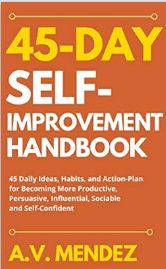
The “45 Day Self-Improvement Handbook” is a guide offering daily ideas, habits, and action plans to enhance productivity, persuasion, self-confidence, and social skills. It is structured into four sections, each focusing on a specific challenge: productivity, persuasion, self-confidence, and social skills. Each of these challenges is broken down into daily tasks or suggestions to improve the specified area. The handbook suggests practical action for getting things done, and reflection to better yourself. It ends with a bonus section on the importance of physical health and energy.
45-Day Self-Improvement Handbook: Study Guide & Glossary
45-Day Self-Improvement Handbook: Study Guide
Quiz
Answer the following questions in 2-3 sentences each:
- What is the main goal of the “Challenge for Productivity” section (Days 1-10)?
- According to the handbook, what is one of the biggest distractions we have today?
- Explain the concept of “Time-Chunking.”
- Why is it important to prepare the tools needed for a task the day before?
- What does the handbook suggest you do to confront your fears?
- What does the author say about showing energy when trying to persuade someone?
- What does “WIFFM” stand for, and why is it important?
- What does the author suggest is the best way to become more confident?
- What is the “Law of Reciprocity,” and how can it be used for persuasion?
- Why is it important to acknowledge someone when they do a good job?
Quiz Answer Key
- The main goal of the “Challenge for Productivity” section is to maximize your effectiveness and productivity while helping you avoid procrastination. It emphasizes identifying and minimizing time-wasting activities such as excessive social media use.
- According to the handbook, one of the biggest distractions we have today is being constantly online, with e-mail, Facebook, YouTube, and other desktop applications constantly displaying notifications. This constant stimulation fragments attention and hinders productivity.
- Time-Chunking is a method of working in chunks of time, typically involving 25-minute intervals of focused work followed by 5 minutes of rest, or alternatively, 40 minutes of work followed by 10 minutes of rest. It is used to help you stay focused and avoid exhaustion.
- Preparing the tools needed for a task the day before makes it easier to get started and less likely to wander off to do something else. Having everything ready eliminates potential distractions and reinforces your commitment to the task at hand.
- The handbook suggests that you start by facing your smallest fears first, and then tackle fears that don’t have a big impact on your life. The point is to make it a process and to make the smallest commitment that you can do easily.
- When trying to persuade or influence someone, it is important to show the right energy for the setting. Being aware of the situation and acting accordingly by matching energy levels are the key.
- “WIFFM” stands for “What’s In It For Me?” It is important because when trying to persuade someone, you need to think about what the other person wants and what the emotional benefits are for the other person.
- The author suggests that the best way to become more confident is by knowing what you’re good at and doing what you do well. Being great at what you do becomes the foundation for your confidence.
- The “Law of Reciprocity” states that when someone does something for us, we have a strong urge or motivation to do something back in return. It can be used for persuasion by offering something valuable to someone else, making them more likely to fulfill your request in the future.
- Acknowledging someone when they do a good job is important because it makes them feel noticed and uplifts them. It is an easy way to build trust, strengthen relationships, and encourage positive behavior.
Essay Questions
- Discuss the relative importance of the four sections of the book, arguing which section is the most important or impactful, and why.
- Analyze the connection between productivity and self-confidence as presented in the handbook. How does improving one affect the other?
- Compare and contrast the ideas of “perfectionism” and “momentum” as presented in the handbook. How can these two concepts either help or hinder self-improvement efforts?
- Evaluate the effectiveness of the “Action Guide” prompts at the end of each section. How helpful are these prompts in applying the concepts discussed?
- To what degree does the author acknowledge the differences between introverted and extroverted personalities and tendencies? Are the recommendations within the text applicable for introverts and extroverts alike?
Glossary of Key Terms
- Productivity: The effectiveness of productive effort, especially in industry, as measured in terms of the rate of output per unit of input.
- Procrastination: The action of delaying or postponing something.
- Time-Chunking: A method of breaking down work into small, manageable intervals to improve focus and productivity.
- Perfectionism: The refusal to accept any standard short of perfection.
- Influence: The capacity to have an effect on the character, development, or behavior of someone or something.
- Persuasion: The action or process of persuading someone or of being persuaded to do or believe something.
- Law of Reciprocity: A social norm where people tend to reciprocate actions made toward them.
- Self-Confidence: A feeling of trust in one’s abilities, qualities, and judgment.
- Body Language: The process of communicating nonverbally through conscious or unconscious gestures and movements.
- WIFFM (What’s In It For Me?): The underlying question of a consumer that must be answered before they consider your product or service.
45 Day Self-Improvement Handbook: A Practical Guide
Okay, here is a briefing document summarizing the main themes and important ideas from the provided excerpts of “45 Day Self-Improvement Handbook: 45 Daily Ideas, Habits, and Action-Plan for Becoming More Productive, Persuasive, Influential, Sociable and Self-Confident” by A.V. Mendez:
Briefing Document: 45 Day Self-Improvement Handbook
Document Title: 45 Day Self-Improvement Handbook: 45 Daily Ideas, Habits, and Action-Plan for Becoming More Productive, Persuasive, Influential, Sociable and Self-Confident Author: A.V. Mendez Date: Provided excerpts dated 20/02/2023
Overview:
This handbook outlines a 45-day program focused on self-improvement, broken down into four sections: productivity, persuasion and influence, self-confidence, and social skills. The core approach emphasizes small, consistent actions, habit building, and practical application of ideas. The document is action-oriented, providing specific steps and guidance to help the reader implement changes.
Key Themes and Ideas:
- Incremental Improvement & Action-Orientation: The handbook emphasizes the importance of taking action, even if it’s imperfect. “Getting things done is better than not doing stuff in the first place.” The document encourages immediate implementation of small, easy-to-do actions. It discourages overthinking and excessive planning before starting. For example, “Do not get bogged down by the details. Just apply your idea fast.”
- Productivity Focus (Days 1-10): This section focuses on maximizing effectiveness and productivity and avoiding procrastination. Key ideas include:
- Combating distractions, particularly those online.
- Learning to say “no” to requests that take up time.
- “Time Chunking” to focus on specific tasks with breaks.
- Eliminating perfectionism: “Aim for progress instead. Aim for getting better every single day.”
- Streamlining To-Do Lists: Prioritize tasks and schedule repetitive tasks.
- Optimizing the Environment: Factors like light, noise, and temperature.
- Process maps: Outsource certain tasks or take steps to streamline a process.
- Preparing the tools you will need for tomorrow’s task.
- “Taking Out The Trash”: Tackling nagging personal issues promptly.
- Persuasion and Influence (Days 11-20): This section emphasizes the importance of influence, teaching and adding value to others. Key ideas include:
- Influence is not about manipulation. It’s about pointing someone on the right direction.
- Ask rather than not ask.
- Reciprocity is important in persuasion.
- Become an authority on your subject.
- Cultivating a reputation or legend.
- Identifying “WIIFM” (What’s In It For Me) for the person you are trying to persuade.
- Self-Confidence (Days 21-33): This section addresses self-confidence as a skill that can be developed. Key ideas include:
- Acknowledge the truth and be honest about where you are.
- Owning your skills and working to improve on them.
- Look at past accomplishments to build confidence.
- Eliminate ego.
- Ask good questions and help others improve their self-esteem.
- Manage highs and lows and celebrate wins.
- Personal hygiene and dressing appropriately.
- Build momentum.
- Surround yourself with good people.
- Face fears in small steps.
- Set small targets.
- Set a big target and go small.
- Social Skills (Days 34-45): This section addresses the ability to work with other people. Key ideas include:
- The right people will help you meet your goals.
- Use the right insider words or terminology to speak to the right audience.
- The right body language.
- Acknowledge peers.
- Downplay mistakes.
- Listen.
- Take notes during conversation.
- Encourage other people.
- Say their name.
- No bragging.
- Introverts can speak too.
- The magic of saying thank you.
- Physical Fitness & Energy: Improving yourself includes making sure you are physically fit and energetic.
- The “Stonecutter’s Credo”: The handbook concludes with the idea of persistence, comparing self-improvement to a stonecutter patiently hammering away at a rock until it splits. “When nothing seems to help, I go and look at a stonecutter hammering away at his rock perhaps a hundred times without as much as a crack showing in it. Yet at the hundred and first blow, it will split in two, and I know it was not that blow that did it, but all that had gone before.”
Target Audience:
Individuals seeking practical, actionable advice on self-improvement in areas such as productivity, influence, self-confidence, and social skills.
Actionable Takeaways:
- Focus on taking small, consistent actions to achieve larger goals.
- Prioritize productivity by minimizing distractions and maximizing focus.
- Build influence by adding value to others.
- Develop self-confidence by acknowledging your strengths and accomplishments and working to improve your weaknesses.
- Improve social skills by working with the right people and using the right language and body language.
This briefing document provides a concise overview of the “45 Day Self-Improvement Handbook” excerpts and highlights its core principles and actionable advice.
45-Day Self-Improvement Handbook: A Practical Guide
FAQ: 45 Day Self-Improvement Handbook
- What is the core idea behind the 45-Day Self-Improvement Handbook?
- The handbook revolves around the idea of gradual and consistent self-improvement. It’s based on the concept that significant personal growth can be achieved by incorporating daily ideas, habits, and action plans into one’s life, focusing on areas such as productivity, persuasion, self-confidence, and social skills. It suggests breaking down larger goals into smaller, manageable steps, and building habits through consistent action. The process emphasizes learning, adapting, and building momentum over perfection.
- How does the handbook approach productivity?
- The handbook suggests a practical and action-oriented approach to productivity. It focuses on optimizing effectiveness by taking small steps, avoiding procrastination and minimizing distractions from things like social media. It advocates for identifying and prioritizing the most impactful tasks, breaking down work into manageable “time chunks” with scheduled rest, and simply getting started by doing instead of overthinking.
- What techniques does the handbook propose for improving persuasion and influence?
- The handbook views influence as guiding people in the right direction with good intentions, not manipulating them. Key techniques include asking for what you desire, acknowledging the other party’s point of view, and teaching others what you know. It also emphasizes the “Law of Reciprocity,” suggesting you provide something of value to others to increase the likelihood of them accepting your requests. Creating content and building authority are also strategies suggested for influence.
- How does the handbook define and address self-confidence?
- The handbook defines self-confidence as the ability to recognize what you’re capable of based on evidence. It is about having a belief in yourself based on reality. It discourages ego, which is based on thinking you are better than everyone else. It suggests several ways to build it, including acknowledging the truth about yourself, “owning your stuff” (improving what you are good at), looking at your track record of achievements, and setting small targets to build momentum. Eliminating ego is crucial.
- What strategies does the handbook offer for improving social skills?
- The handbook approaches social skills by addressing body language, active listening, using the right terms within your industry, and acknowledging your peers. It emphasizes understanding your audience’s needs, making a good first impression through appropriate dress, and being genuine in your interactions.
- What does the handbook advise regarding dealing with perfectionism?
- The handbook strongly advises against perfectionism. It emphasizes the importance of action over striving for unattainable flawlessness. The “F*ck Perfectionism” principle suggests aiming for progress and getting better every day, rather than waiting for the perfect moment or outcome. It encourages taking action, even if imperfect, as this leads to more progress than inaction.
- How does the handbook suggest managing distractions, particularly online distractions?
- The handbook recognizes that online distractions such as social media can significantly hinder productivity. It suggests scheduling dedicated “distraction time” to browse social media and other non-productive sites, rather than fighting the urge constantly and losing focus on current tasks. Disconnecting from the internet while working and using tools to block out noise and distractions are also encouraged.
- What role does personal environment play in self-improvement according to the handbook?
- The handbook emphasizes the importance of a conducive personal environment for enhancing productivity and motivation. It suggests optimizing things like lighting, noise level (using noise-cancelling headphones), and temperature to create a comfortable and focused workspace. Preparing tasks and tools the night before is also suggested to minimize distractions and facilitate getting started in the morning.
45 Day Self-Improvement Handbook: Productivity, Persuasion, and More
The “45 Day Self-Improvement Handbook” contains daily ideas, habits, and action plans for becoming more productive, persuasive, influential, sociable, and self-confident. The handbook is divided into sections that include:
- Productivity (Day 1-10)
- Persuasion and Influence (Day 11-20)
- Self-Confidence (Day 21-33)
- Social Skills (Day 34-45)
The handbook suggests different ways to improve including:
- Getting things done by not thinking too much about them.
- Saying no to requests.
- Using time chunking.
- Aiming for progress instead of perfection.
- Creating to-do lists.
- Optimizing your environment.
- Scheduling time for distractions.
- Creating process maps.
- Preparing the tasks that you need to finish on the next day.
- Taking care of nagging personal issues.
- Being aware of your own feelings.
- Using the power of body language.
- Acknowledging the truth about yourself.
- Improving your skills.
- Looking at your track record.
- Eliminating your ego.
- Asking good questions.
- Managing your highs and lows.
- Practicing personal hygiene.
- Dressing to impress.
- Building momentum.
- Surrounding yourself with good people.
- Facing your fears.
- Setting a small target.
- Hitting a big target by starting small.
- Finding the right people to talk to and knowing your goal.
- Using the right words.
- Acknowledging peers.
- Downplaying mistakes.
- Listening.
- Taking notes.
- Encouraging other people.
- Saying people’s names.
- Avoiding bragging.
- Saying thank you.
45 Day Self-Improvement Handbook: Productivity, Persuasion, and Social Skills
The “45 Day Self-Improvement Handbook” focuses on daily ideas and habits to foster self-improvement in productivity, persuasion, self-confidence and social skills. Here are some of the ideas:
- Productivity: The handbook advises to not overthink tasks, say no to requests, use time chunking, aim for progress over perfection, create to-do lists, optimize your environment by adjusting noise, lighting, and temperature, schedule time for online distractions, create process maps, prepare tasks the day before, and address nagging personal issues.
- Persuasion and Influence: To be more persuasive and influential, the handbook suggests to ask for what you want, give to others, become a “celebrity” in your market by creating content, teach others by sharing your knowledge, and cultivate a legend by controlling your narrative. When trying to persuade or influence someone, focus on what you can offer and what the other person wants. Also, show energy by reacting appropriately to a situation.
- Self-Confidence: To improve self-confidence, the handbook recommends acknowledging your feelings and the truth about yourself, improving your skills, looking at your track record, eliminating your ego, asking good questions, managing highs and lows, practicing personal hygiene, and dressing to impress. Build momentum and surround yourself with supportive people.
- Social Skills: To improve social skills, the handbook suggests to face your fears, set small targets, hit big targets by starting small, find the right people to talk to and know your goal, use the right words, use body language, acknowledge peers, downplay mistakes, listen, take notes, encourage others, say people’s names, avoid bragging, say thank you, and understand that even introverts can improve their social skills.
45 Day Handbook: Productivity Guide
The “45 Day Self-Improvement Handbook” includes a section that is dedicated to productivity, called “The Challenge for Productivity (Day 1-10)”. The goal of this section is to help maximize effectiveness and productivity, and help avoid procrastination.
To improve productivity, the handbook advises the following:
- Do not overthink tasks. Getting things done is about the speed of implementation.
- Say no to requests. You can politely decline by responding in a way that does not make them feel bad.
- Use time chunking. Time chunking is working in chunks of time, for example, 25 minutes, then resting for 5 minutes.
- Aim for progress instead of perfection. Aim for getting better every day.
- Create to-do lists. Personally making to-do lists can make you feel like you’re accomplishing the tasks you’re supposed to be doing.
- Optimize your environment. Adjust things like noise, lighting, and temperature.
- Schedule time for distractions. Schedule time for mindless tasks like browsing social media.
- Create process maps. Process maps are written steps on how to achieve a specific task that you normally do every day.
- Prepare tasks the day before. Prepare the tasks that you need to finish on the next day, which makes getting started easier.
- Address nagging personal issues. Take care of nagging personal issues you haven’t taken care of.
45 Day Self-Improvement Handbook: Personal Hygiene
The “45 Day Self-Improvement Handbook” includes personal hygiene as a means to improve self-confidence. Having a clean physical appearance can make one more confident.
The basics of personal hygiene include:
- Hair
- Face
- Body
- Nails
- Teeth
The handbook advises the following for taking care of yourself:
- Cut your hair every 3-4 weeks and find the best haircut for your head shape.
- Wash your face twice a day, preferably once in the morning and once before you sleep.
- Use soap that smells good and use a light perfume on your body, and always use deodorant no matter where you are going.
- Cut your nails at least once a week.
- Brush your teeth for 2-3 minutes, 2-3 times a day and use an electric toothbrush if you can.
45 Day Self-Improvement Handbook: Facing Your Fears
The “45 Day Self-Improvement Handbook” suggests facing your fears as a way to improve your social skills. Facing your fears can be nerve-racking, but it has many benefits that will change your life. Many people never face their fears because they are afraid of failure.
Here is how you can face your fears, according to the handbook:
- Start with your smallest fears.
- Start with fears that don’t have a big impact on your life.
- Make a list and start facing the smallest one you can beat.
The point is to make it a process and make the commitment small enough that you can do it easily. Remember that “Rome wasn’t built in a day”.

By Amjad Izhar
Contact: amjad.izhar@gmail.com
https://amjadizhar.blog
Affiliate Disclosure: This blog may contain affiliate links, which means I may earn a small commission if you click on the link and make a purchase. This comes at no additional cost to you. I only recommend products or services that I believe will add value to my readers. Your support helps keep this blog running and allows me to continue providing you with quality content. Thank you for your support!

Leave a comment