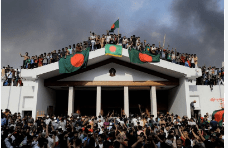
This interview features Abdul Quader Siddiqui, a Bangladeshi freedom fighter, reflecting on the country’s history since its liberation war. He critiques the dominant narrative surrounding the war, particularly the portrayal of Sheikh Mujibur Rahman, and challenges the current political climate, expressing concerns about corruption and a lack of genuine democracy. Siddiqui also discusses the roles of India and Pakistan in the war and advocates for a more inclusive and accurate historical understanding of Bangladesh’s independence. Finally, he offers his perspective on the political activism of young people and the future of the country.
Bangladesh Liberation War: A Study Guide
Short Answer Quiz
- According to the speaker, what was the primary goal of the Liberation War, and has it been achieved?
- What is the speaker’s view on the claim that only the Awami League represents the pro-liberation forces?
- What is the speaker’s opinion of Sheikh Mujibur Rahman and his role in the independence movement?
- According to the speaker, what is the significance of the destruction of Bangabandhu’s portrait and house?
- How does the speaker view the actions of Jamaat-e-Islami during the Liberation War, and how does he see their role in current Bangladeshi society?
- What is the speaker’s perspective on India’s role in the Liberation War?
- What does the speaker think about the declaration of independence and the role of Sheikh Mujibur Rahman and Ziaur Rahman?
- What is the speaker’s critique of Sheikh Hasina’s leadership of the Awami League?
- How does the speaker view the idea of family-based political leadership in Bangladesh?
- What does the speaker think of the young generation’s role as a pressure group in politics and their call for reforms?
Answer Key
- The speaker states the primary goal was freedom from the deprivation imposed by Pakistan, but he believes the dreams of a free country have not been fully realized even after more than 50 years.
- The speaker disagrees, arguing that it is a false narrative and that the claim that all who are not Awami League are Razakars is incorrect.
- The speaker acknowledges Mujibur Rahman’s significant contributions, but also suggests he is not the sole hero and that he was not without faults.
- The speaker condemns it as a heinous crime and says that it is a sign of the current political problems, noting it should not have happened if the country was true to the values of the liberation war.
- The speaker condemns Jamaat-e-Islami for their direct involvement in atrocities during the war. However, he also says that current members who weren’t involved in the war deserve the same rights as everyone else while he says that the organization will never be able to atone for the past actions of their predecessors.
- The speaker acknowledges India’s help but states it was primarily for India’s own strategic reasons. He also points out the important role played by Bangladeshi freedom fighters in the victory.
- The speaker values the declaration of independence and acknowledges that both Sheikh Mujibur Rahman and Ziaur Rahman played important roles, noting that even if Ziaur Rahman declared on behalf of Sheikh Mujibur Rahman it was still a valid declaration.
- The speaker criticizes Sheikh Hasina for straying from the original ideals of the Awami League, for holding two positions of power, and for her corrupt practices.
- The speaker is against family-based political leadership, expressing that it has no place in Bangladesh and should not continue to be the norm.
- The speaker is positive about the young generation’s activism and believes that they need to win people’s hearts to run the state successfully instead of using pressure tactics.
Essay Questions
- Analyze the speaker’s critique of the current political landscape in Bangladesh, focusing on how it relates to the legacy of the Liberation War.
- Compare and contrast the speaker’s views on Sheikh Mujibur Rahman and Sheikh Hasina, discussing how their leadership has shaped the post-independence trajectory of Bangladesh.
- Evaluate the speaker’s stance on the role of India in the Liberation War. Is he appreciative, critical, or both? Provide evidence from the text.
- Explore the complex relationship between historical memory and political narratives in the context of the Bangladesh Liberation War. How does the speaker challenge the official narrative?
- Discuss the speaker’s vision for the future of Bangladesh, based on his comments regarding democracy, leadership, and the role of the younger generation.
Glossary of Key Terms
Assalamu Alaikum: A common greeting in Islam, meaning “peace be upon you.” Bangabandhu: An honorific title, meaning “Friend of Bengal,” referring to Sheikh Mujibur Rahman. Bangbir: A term meaning “Hero of Bengal,” used to address Abdul Quader Siddiqui in the provided text. Bakshal: The Bangladesh Krishak Sramik Awami League, a political party formed by Sheikh Mujibur Rahman in 1975, which restructured the nation into a one-party system. Freedom Fighter: An individual who participated in the Bangladesh Liberation War of 1971. Jamaat-e-Islami: A religious political party in Bangladesh that opposed the Liberation War and is accused of collaboration with Pakistani forces. Liberation War: The war fought in 1971 for the independence of Bangladesh from Pakistan. Razakar: A derogatory term used to refer to collaborators of the Pakistani army during the 1971 Liberation War, particularly those who were against the independence of Bangladesh. Sheikh Hasina: The current Prime Minister of Bangladesh and daughter of Sheikh Mujibur Rahman. Sheikh Mujibur Rahman: The founding leader of Bangladesh, also known as Bangabandhu, who led the country during its Liberation War and early years of independence. Shramik Janata Party: The name of the political party founded by Abdul Quader Siddiqui, as mentioned in the text. Tikka Khan: A Pakistani Army General known for his brutal actions during the 1971 Liberation War in Bangladesh. Yahya Khan: The President of Pakistan during the 1971 Liberation War. Ziaur Rahman: A former President of Bangladesh and a military leader in the Liberation War who declared the independence of Bangladesh on behalf of Sheikh Mujibur Rahman.
Siddiqui on Bangladesh: A Critical Perspective
Okay, here’s a detailed briefing document based on the provided text, which appears to be an interview with Abdul Quader Siddiqui, a freedom fighter and political figure in Bangladesh:
Briefing Document: Analysis of Abdul Quader Siddiqui Interview
Date: October 26, 2023 (Assumed, as no date given in source)
Subject: Key themes and critical perspectives from an interview with Abdul Quader Siddiqui regarding Bangladesh’s history, politics, and current state.
Source: Excerpts from an Interview on RICL TMA Straight Cut, featuring Deepti Chowdhury and Abdul Quader Siddiqui.
Overview:
This interview provides a critical and often contentious view of Bangladesh’s history, particularly its liberation war and subsequent political landscape. Siddiqui, a prominent figure in the liberation war, expresses deep disappointment with the country’s trajectory, criticizing the current government, and highlighting what he sees as significant historical inaccuracies and ongoing injustices. He challenges the dominant narrative of the Awami League and its leader, Sheikh Hasina, while also giving nuanced perspectives on other key figures like Sheikh Mujibur Rahman and Ziaur Rahman.
Key Themes and Ideas:
- Disillusionment with Post-Liberation Bangladesh:
- Siddiqui expresses profound disappointment with the state of Bangladesh since its independence. He states bluntly, “Bangladesh is not good at all.” He suggests the sacrifices made during the liberation war have not yielded the desired outcomes of a truly free and prosperous nation. He criticizes the claim that the country was completely liberated, stating that “it will be a lie if we say that we freed Bangladesh from the hands of Pakistanis with our lives.” He implies that the ideals of the liberation war have not been met, and there’s a lack of the desired progress.
- Critique of the Awami League and Sheikh Hasina:
- Siddiqui is highly critical of the Awami League and its current leader, Sheikh Hasina. He accuses her of not upholding the ideals of the party’s founders and for engaging in corruption and vote-rigging. He argues that “Sheikh Hasina led Awami League I usually call it Hasina League no leadership developed here no personality developed here.” He believes that she has turned the party into an autocracy. He contrasts her actions with the party’s early ideals stating that “Sheikh Hasina was the president of Awami League for 16 years and 15 and a half years, she was the prime minister, then she acted against her father’s ideals.”
- Re-evaluation of Sheikh Mujibur Rahman’s Legacy:
- While acknowledging Sheikh Mujibur Rahman’s significant contributions to the nation’s liberation, Siddiqui contests the notion that he was the sole hero of the liberation war, “It is also not true that Mujib has been singled out as a hero and we have not been able to highlight Sheikh Mujib as much as it should have been.” He criticizes the portrayal of Mujibur Rahman by the Awami League, which he feels has been exaggerated, and believes that Mujib was unable to fulfill the promises of the country’s freedom. He also says that “the way the Awami League has tried to call Sheikh Mujib Bangabandhu is not Bangabandhu.” He also believes that the second revolution of Bangabandhu was tarnished and not fully understood.
- Siddiqui highlights that Mujib himself recognized some shortcomings in his leadership, “Sheikh Mujibur Rahman has to admit that he could not do it to some extent…“
- Recognition of Ziaur Rahman’s Role:
- Siddiqui acknowledges Ziaur Rahman’s importance, stating, “Ziaur Rahman is a great leader and it must be accepted.” He notes Ziaur Rahman’s declaration of independence as valuable and significant to the people during the war. He seems to argue that while Mujibur Rahman made the initial call, it was Ziaur Rahman who actively participated. He also contends that historical narratives have unfairly undermined Zia’s contribution.
- The Nature of the Liberation War:
- Siddiqui points out the complexity of the war and how it was not solely the Awami League that contributed. He suggests that the narrative promoted by the current government is one-sided, where, “only those who make Awami League are the pro-independence forces, the pro-liberation forces, and all the rest are the forces of Razaka, the rest are the opposition forces.“
- He emphasizes that many individuals and groups participated in the liberation, and their contributions should not be ignored.
- He emphasizes the role of the freedom fighters in the victory, arguing that Indian Army’s victory is not the only contributing factor, noting that “lakhs of freedom fighters have stayed with the Indian forces like the shadow of the Indian forces, they have stayed ahead, they have stayed behind, that is why the Indian forces have won.“
- Critique of the Anti-Discrimination Movement & Violence:
- Siddiqui is critical of those who have vandalized Bangabandhu’s portraits and home, calling it a “heinous crime in the judgment of history“, emphasizing that disrespecting Bangabandhu means disrespecting freedom. He suggests that while he disagrees with many of his policies, respect is due to him and to any human being. He hopes those involved will express regret, while also stating that, “I believe in my heart that they did not do this.”
- He states that those who oppose the government should be thankful to the Jamaat-e-Islam, despite their negative actions during the war.
- Rejection of Family Politics:
- Siddiqui rejects the idea of family-based politics and leadership, noting that “there is no place for the family system in Bangladesh.” He highlights that a system where leadership is passed down through family ties is not sustainable or good for democracy. He also mentions how the present system has continued for years.
- The Role of the Young Generation:
- Siddiqui views the new generation as important to the future, emphasizing that they “will run the state and the country“. He suggests that the current generation should focus on people’s will and should strive to win people’s hearts instead of resorting to pressure.
- Relationship with India:
- Siddiqui stresses the importance of Bangladesh having an equal relationship with India and does not want to be treated as a younger brother. He highlights that the Indian Army did not win any wars except for the 71 liberation war because of the freedom fighters from Bangladesh and their support.
Key Quotes:
- “Bangladesh is not good at all.”
- “It will be a lie if we say that we freed Bangladesh from the hands of Pakistanis with our lives.”
- “only those who make Awami League are the pro-independence forces, the pro-liberation forces, and all the rest are the forces of Razaka, the rest are the opposition forces.”
- “Sheikh Hasina led Awami League I usually call it Hasina League no leadership developed here no personality developed here.”
- “Ziaur Rahman is a great leader and it must be accepted.”
- “It is also not true that Mujib has been singled out as a hero and we have not been able to highlight Sheikh Mujib as much as it should have been.”
- “the way the Awami League has tried to call Sheikh Mujib Bangabandhu is not Bangabandhu.”
- “There is no place for the family system in Bangladesh”
- “If you abuse Bangabandhu, you also abuse eat your parents will also be abused”
Analysis & Implications:
This interview reveals deep-seated dissatisfaction with the current political situation in Bangladesh and a strong desire for change. Siddiqui’s comments challenge the official narrative surrounding the liberation war and its heroes. He believes that the country has strayed from its founding principles and is currently plagued by corruption and authoritarianism. His critical perspectives have the potential to resonate with many in Bangladesh who are similarly disillusioned. His commentary also highlights the deep political divisions that persist in the country. The interview also raises the question of how the country should move forward after a contentious political history. Siddiqui seems to emphasize the need for a new generation of leadership and for a more equitable system of governance.
Conclusion:
This interview with Abdul Quader Siddiqui provides valuable insight into the complexities and challenges facing Bangladesh. His perspectives highlight the need for a more inclusive and accurate historical narrative, a reevaluation of leadership, and a commitment to upholding the democratic values for which the country fought. It is imperative to understand these viewpoints in order to properly assess the current state of the country and its future trajectory.
Bangladesh: Liberation, Legacy, and Future
Frequently Asked Questions: Bangladesh Liberation War and Politics
- What is the speaker’s overall assessment of Bangladesh’s current state since the Liberation War, and what is the basis of this assessment? The speaker expresses deep dissatisfaction with the current state of Bangladesh, stating that it is “not good at all” even 53-54 years after independence. He believes that while the country gained freedom from Pakistan, the initial goals and dreams of the Liberation War have not been realized. He criticizes the lack of progress in the country, stating it would be a “lie” to say that Bangladesh is in a good place since the war and that the war was not about a complete victory over all the opposing ideas and ideals. The speaker also points out that there was the aim for a country free from discrimination which has not been achieved.
- How does the speaker view the role of Sheikh Mujibur Rahman in Bangladesh’s history and his legacy? While acknowledging Sheikh Mujibur Rahman’s significant contribution to the liberation struggle, the speaker doesn’t portray him as the sole hero of the independence movement. He argues that while Mujib did a lot, he didn’t do it alone and the idea of a single hero is a distortion of history, and there are many who contributed to the freedom of Bangladesh. The speaker criticizes the attempts to focus only on him and to brand him “Bangabandhu” in the way that he has been. He also admits that there are ways in which Mujibur Rahman’s government failed and suggests that the attempt to tarnish the second revolution is detrimental to a full understanding of history. He also condemns the destruction of Bangabandhu’s portraits and house as heinous acts.
- What is the speaker’s opinion of the Awami League and Sheikh Hasina’s leadership? The speaker is critical of the Awami League under Sheikh Hasina’s leadership, stating that the party is not living up to its ideals and has become corrupt. He points out that under Sheikh Hasina’s leadership, no other leader within the party has developed and that her leadership is the final word. He notes that there is a focus on authority rather than ideals. He also accuses the government of stealing votes and not conducting fair elections. Furthermore, the speaker criticizes her for acting against her father’s ideals as she is both the head of the party and the government. The speaker says the party cannot use Sheikh Hasina as a means to facilitate the freedom war and will benefit without her involvement.
- What is the speaker’s perspective on the role of Ziaur Rahman and his declaration of independence? The speaker recognizes Ziaur Rahman as a great leader and acknowledges his declaration of independence as extremely valuable, particularly when broadcast on the radio during the war. He acknowledges that there was a lot of radio broadcasting of his message in the BBC. He seems to suggest that the declaration was valid at the time, given that he held the relevant authority, and that all actions taken during a movement are valid as long as people support them. He contrasts the legitimacy of Ziaur Rahman’s declaration to a hypothetical declaration from a professor who has been sacked, and he suggests that to leave Bangabandhu out of the declaration lessens it’s value.
- How does the speaker view the current youth movements and their demands for reforms? The speaker supports the youth movements, highlighting their efforts and the need for a complete overhaul of the system. He sees the youth as the future of the country and believes that winning the hearts of the people is the only way to govern effectively. He does not believe that reform should be achieved through a pressure system. He views the youth as having the energy and the ability to move the country forward.
- What is the speaker’s view on the role of India in Bangladesh’s liberation war? The speaker acknowledges India’s assistance during the Liberation War and believes that Bangladesh should be grateful. However, he insists that the victory was not solely India’s but a shared effort with the Bangladeshi freedom fighters. He points out that the Indian army did not win many wars and that the liberation of Bangladesh was exceptional because of the sacrifices of Bengalis alongside the Indian forces. The speaker does not believe Bangladesh should be subservient to India but be considered on equal status as a neighboring country.
- How does the speaker view the Jamaat-e-Islami and its members today? The speaker is critical of Jamaat-e-Islami’s actions during the Liberation War but believes that the current members who were born in an independent Bangladesh should be considered equal citizens with equal rights. He makes a distinction between the past crimes of the party and the current membership. However, he does say that until the crimes of the party are absolved, those in the party cannot be completely free from being associated with those crimes. He believes that if people are anti-independence, they should not be living in the country.
- What are the key issues that the speaker believes need to be addressed in Bangladesh’s political landscape? The speaker identifies several key issues: the distortion of history regarding the Liberation War, the lack of development within political leadership and the corruption of the Awami League, the need for fair elections and political reform, the necessity to address historical injustices committed by groups like Jamaat-e-Islami while acknowledging the rights of present members, and finally the need to move beyond hero-worship towards collective appreciation of all who contributed to independence, and most importantly to build a country that reflects the original aims of the war of liberation.
Bangladesh: Liberation, Legacy, and the Struggle for Democracy
Okay, here’s a detailed timeline and cast of characters based on the provided text:
Timeline of Main Events
- Pre-1970: The text refers to the discrimination faced by Bengalis in Pakistan, leading to the 1970 election.
- 1970: Pakistan does not accept the results of the 1970 election where Bengalis had a major victory.
- 1971 (March 7): Sheikh Mujibur Rahman’s speech where he urges people to resist with whatever they have.
- 1971 (March 25): The text suggests that if the movement hadn’t continued, they may not have heard of Ziaur Rahman. This is generally considered the start of the Liberation War.
- 1971: The Liberation War of Bangladesh takes place. The text refers to the Pakistani Army having 300,000 soldiers, and the Bengalis having 16-17,000, and the war as having been against the “deprivation of Pakistan”. The Liberation war is described as a time when “every hour on the hour, it was played Bangladesh was saved from the radio.”
- 1971 (December 16): Victory Day. The text mentions that the allied forces (Indian and Bangladeshi) enter Niazi Cave. It states that Abdul Quader Siddiqui was the only Bengali and the other three were Indian: two brigadiers and one major general (Major General Nagra.)
- Post-Liberation War: The text suggests that the country was not run properly after the war.
- Post-Liberation War: Refers to a period when Sheikh Mujibur Rahman had “vanquished” the Awami League, and it had reemerged from the Bakshal, and that this proved Bakshal’s decision was wrong.
- Unknown Date (Post-Liberation War): Sheikh Mujibur Rahman is killed by Bengalis. The text notes a “second revolution” was tarnished by this killing.
- Later: The text mentions that the house and museum of Bangabandhu Sheikh Mujibur Rahman were vandalized and set on fire. The text suggests this is a “heinous crime.”
- Unknown Date: There was a time when the declaration of independence in Ziaur Rahman’s voice was “broadcasted many times on BBC.”
- Current (as of the interview): There is an anti-discrimination movement, and students are agitating and calling for an overhaul of the state system followed by elections. There is criticism of the current government under Sheikh Hasina, with claims of corruption, and criticisms that the “Hasina League” lacks proper leadership development. There are questions about election integrity, with the statement that “the previous governments have ruined” it.
- Recent: There are criticisms of the ruling party, the Awami League for trying to make Sheikh Mujibur Rahman into a single hero of the independence, rather than an important figure in a broader struggle.
Cast of Characters
- Abdul Quader Siddiqui: The interviewee. Described as a “hero freedom fighter” and “Bangbir” (Hero of Bengal) who worked as an organizer during the Liberation War. He is also the Founder President of Shramik Janata Party. He seems to have been present at the surrender in “Niazi’s Cave.”
- Deepti Chowdhury: The interviewer. She is with RICL TMA Straight Cut organization.
- Sheikh Mujibur Rahman (Bangabandhu): A central figure in the text. Described as a key leader of the liberation movement, and “father” of the Awami League, the text indicates a debate whether he should be elevated as the hero of the war. There is criticism that the government has not “highlighted him as much as it should have been.” His house and museum were vandalized.
- Sheikh Hasina: Current leader of the Awami League and Prime Minister. Criticized for her leadership style, described as making the Awami League into “Hasina League.” Her leadership is described as “the last word,” with little room for others. She is also criticized for corruption. She is mentioned as having been “the president of Awami League for 16 years and 15 1/2 years the prime minister” which is said to be against her father’s ideals. The text implies she has taken power through vote stealing.
- Ziaur Rahman: Presented as a significant figure during the Liberation War, who was “in the barracks” on March 7th. His declaration of independence is described as “very valuable,” and was broadcast “many times on BBC.” The text notes that his existence might not have been known “if we could not hold the movement till March 25th.”
- Maulana Abdul Hamid Khan Bhashani: Described as the “father” who gave birth to the Awami League before Bangabandhu, he is mentioned as having argued against leaders holding two positions at the same time.
- Hossain Shaheed Sarwardi: Mentioned as having led the Awami League after Maulana Abdul Hamid Khan Bhashani.
- Obaidul Quader: Described as a “bridge minister.” He is mentioned as not having “carried the ideals of Bangabandhu politically” and as someone who wanted to take “leadership and authority” himself.
- Tajuddin Ahmed: Mentioned as someone whose daughter has written a book stating that Sheikh Mujibur Rahman did not agree to declare independence at the time.
- Tikka Khan and Yahya: Their rule was described as “not at all the contribution of Bangabandhu’s daughter incompetent leader Sheikh Hasina.”
- Murarji Desai, Atal Bihari Vajpayee, Narendra Modi: Leaders from India who are mentioned as examples of political transitions, in contrast with the veneration of Sheikh Mujibur Rahman, they are all meant to show that “no one could destroy anyone’s museum.”
- Pandit Jawaharlal Nehru: Indian leader mentioned in the context of the 1962 war with China and the war with Pakistan in 1965.
- Niazi: Pakistani army general who was in command during the surrender at the end of the war.
- Major General Nagra: Indian army officer who was with Abdul Quader Siddiqui in the surrender at Niazi Cave.
- Brigadier Sunsin Clear: Indian army officer who was with Abdul Quader Siddiqui in the surrender at Niazi Cave.
- Prof. Yunus: Mentioned as having been sacked.
- Students: Described as leading the current agitation and demanding reforms to the state system.
Key Themes and Conflicts
- The Legacy of the Liberation War: The text highlights the ongoing debate about who should be credited for the independence of Bangladesh. There is conflict over the role of Sheikh Mujibur Rahman versus others, including freedom fighters and Ziaur Rahman. There are statements that suggest an attempt to rewrite the history by “making Sheikh Mujibur Rahman a single hero.”
- Criticism of the Current Government: There is strong criticism of Sheikh Hasina’s leadership, with accusations of corruption, authoritarian tendencies, and election rigging. The text implies the current government is not adhering to the ideals of the liberation movement.
- Political Polarization: The text highlights the deep divisions within the country, with a clear distinction between those who are pro-Awami League and those who are opposed, and that those opposed are labeled as “forces of Razaka.”
- Ongoing Struggle for Democracy: The interviews makes clear the desire for democratic reform and fair elections, with student agitation being seen as an important movement for change.
Let me know if you have any other questions or sources you’d like me to analyze!
Bangladesh Liberation War: Politics and Legacy
The sources discuss the Liberation War of Bangladesh, its aftermath, and its continuing impact on the country’s politics and identity. Here’s a breakdown of key points:
- The War and its Goals: The war was fought against the deprivation imposed by Pakistan [1]. The aim was to achieve freedom and independence for Bangladesh [1]. It is stated that the war was not a complete victory for the freedom fighters as the dream of a free country is still not fully realized even 53-54 years later [1].
- The Role of Different Groups:Bengalis in the Pakistan Army: At the time of the war, there were around 300,000 members in the Pakistan Army, with 16-17,000 of them being Bengalis [1].
- Freedom Fighters: The freedom fighters played a crucial role in the war and fought alongside Indian forces [2]. They are described as being like “the shadow of the Indian forces” [2].
- Jamaat-e-Islami: The Jamaat-e-Islami is criticized for not only supporting Pakistan politically but also forming armed groups that committed atrocities [3]. However, it is also mentioned that the current members of Jamaat-e-Islami were mostly born in an independent Bangladesh and have the same rights as other citizens, as long as they atone for the crimes of their predecessors [3].
- Awami League: The Awami League is viewed as the pro-independence force [4]. The party’s history and the roles of its leaders, including Sheikh Mujibur Rahman and Sheikh Hasina, are discussed in detail [2, 4].
- Sheikh Mujibur Rahman’s Role: Sheikh Mujibur Rahman is considered a key figure in the liberation movement [4]. While some acknowledge his significant contributions, there is also a view that he was not the sole hero of the war [4, 5]. It is mentioned that he may have not agreed to declare independence at a certain time [6]. The sources note that the Awami League has, at times, presented him as the single hero of the war [4]. It is also stated that Bangabandhu’s house and portrait were vandalized which is considered a “heinous crime” [4, 5].
- Ziaur Rahman’s Role: Ziaur Rahman’s declaration of independence is deemed very valuable [6]. It is mentioned that while Bangabandhu called for resistance, Ziaur Rahman did not come out to face the enemy but remained in the barracks [5]. However, Ziaur Rahman is also acknowledged as a great leader [5].
- India’s Involvement: India’s role in the war is acknowledged, but it is clarified that it was not a victory solely for the Indian army [2, 7]. The victory was possible because of the sacrifices of the Bangladeshi people [2]. India’s strategic goals were to squeeze Dhaka and negotiate the Pakistani army’s return, rather than occupying Dhaka [7].
- Post-War Issues:The country’s inability to be run properly after the war is acknowledged, even by Sheikh Mujibur Rahman [4].
- The political landscape has been shaped by the war, with the Awami League often claiming to be the sole pro-liberation force, while other parties are considered to be the opposition [4].
- The need for reforms in the election process is highlighted [3].
- The current political climate is seen as problematic, with a focus on individuals rather than ideals [2].
- The Current Political Situation: There are concerns about the current state of democracy and the need for genuine representation of the people [8]. The youth is seen as a pressure group demanding reforms [8]. It is suggested that winning the hearts of the people is crucial for a better future for the country [8]. The interview concludes with hope for a “golden sun” and a beautiful Bangladesh [8].
The sources emphasize that the Liberation War was a complex event with multiple actors and various interpretations of its history and impact. It continues to influence the political landscape and the identity of Bangladesh [4].
Bangladesh’s Political Crossroads
The sources provide a detailed look at the political future of Bangladesh, particularly concerning the Awami League and the role of the younger generation. Here’s a breakdown of key points:
- Awami League’s Future: The Awami League is described as a party born through struggle, with its leadership evolving from Maulana Abdul Hamid Khan Bhashani and Hossain Shaheed Sarwardi to Bangabandhu Sheikh Mujibur Rahman [1]. However, it is argued that current leaders like Sheikh Hasina and Obaidul Quader have deviated from the ideals of Bangabandhu [1]. The party is seen as facing challenges, with some suggesting it is currently in a weakened state and on the streets [1, 2]. There’s a view that the party’s reliance on Sheikh Hasina’s leadership has stifled the development of new leaders and personalities within the party [3].
- Sheikh Hasina’s Role: Sheikh Hasina’s leadership is criticized for not adhering to her father’s ideals, particularly concerning holding multiple positions in the government and the party [1]. It’s argued that her leadership has become overly centralized and authoritarian [3]. The sources also mention that she came to power by stealing votes and that her government has failed to implement necessary reforms [3]. The sources suggest that the Awami League’s association with Sheikh Hasina may be a hindrance to its political future [2]. It is stated that Sheikh Hasina might need to struggle for 15 years to regain political strength [2].
- Need for Reforms: The sources emphasize the need for significant reforms, particularly in the electoral process [3]. The current system is seen as flawed, with allegations of vote-stealing and a lack of genuine voter participation [3]. There’s a call for creating an environment where people can vote freely and the right voter can go to the polling station [3]. It’s suggested that the previous governments have ruined the election process and that reforms are necessary to ensure fair elections [3].
- Role of the Younger Generation: The younger generation is portrayed as a pressure group that is actively involved in politics and demanding reforms [2]. They are seen as being present in the interim government and on the streets, advocating for change [2]. The sources suggest that they will play a crucial role in shaping the future of the country [2]. It’s emphasized that the future of the state and the country will be determined by the new generation, and not by pressure tactics [2]. The need to win the hearts of the people is highlighted as crucial for the success of any political movement [2].
- Political Instability and Change: The sources suggest that the political landscape is unstable and that change is inevitable. The idea that “the beggar on the street will be the king tomorrow” indicates a belief in the potential for significant shifts in power [2]. There’s a call for letting “people’s democracy continue” [2]. The sources express hope that the country will overcome its current challenges and move towards a better future [2]. The idea of a “golden sun” rising is used as a symbol of this hopeful future [2].
- Family System: It is stated that there is no place for the family system in Bangladesh [2].
- Importance of Ideals: There is a concern that current politics are focused on individuals rather than ideals [1, 3]. There’s a call for sincerity in making reforms and a focus on genuine representation of the people [3].
In conclusion, the sources suggest that the political future of Bangladesh is uncertain, with potential for significant changes. The Awami League faces challenges due to its leadership and lack of adherence to its founding ideals. The younger generation is expected to play a key role in demanding reforms and shaping a better future for the country.
The Awami League: History, Leadership, and Future Prospects
The sources discuss the Awami League extensively, covering its history, leadership, current state, and future prospects. Here’s a breakdown of key points:
- Historical Roots: The Awami League was not founded by Sheikh Hasina, but rather emerged through struggle, with early leadership from Maulana Abdul Hamid Khan Bhashani and Hossain Shaheed Sarwardi [1]. Later, Bangabandhu Sheikh Mujibur Rahman became a key leader [1]. There were disputes in the party as early as 1957 regarding leaders holding multiple positions in government and party, which led to Sheikh Mujibur Rahman resigning his ministerial position to be only the secretary general of the Awami League [1].
- Sheikh Mujibur Rahman’s Leadership: Bangabandhu Sheikh Mujibur Rahman is recognized as an important leader in the history of the Awami League [1]. However, it is noted that the Awami League has, at times, presented him as the single hero of the liberation war, which is not entirely accurate [2]. The sources also indicate that the Awami League has not highlighted Sheikh Mujib as much as it should have [2]. His ideals are referenced as a standard against which the current leaders of the Awami League are judged [1]. It is also noted that Bangabandhu’s house and portrait were vandalized, which is considered a “heinous crime” [2].
- Sheikh Hasina’s Leadership: Sheikh Hasina’s leadership is heavily critiqued in the sources. It is argued that she has deviated from her father’s ideals, particularly regarding holding multiple positions in the government and the party [1]. She has been the president of the Awami League for 16 years and the prime minister for 15 and a half years, which is seen as a violation of the principle that no leader should hold two positions at the same time [1]. It’s argued that her leadership has become overly centralized and authoritarian [1, 3]. The sources also mention that she came to power by stealing votes [3] and that her government has failed to implement necessary reforms [3]. The Awami League’s association with Sheikh Hasina may be a hindrance to its political future [4]. The sources suggest that Sheikh Hasina might need to struggle for 15 years to regain political strength [4]. There is a view that the party’s reliance on Sheikh Hasina’s leadership has stifled the development of new leaders and personalities within the party [3].
- Current State: The Awami League is described as a party that is currently facing challenges and is on the streets [4]. The sources indicate that the party is in a weakened state [4]. There is a concern that current politics are focused on individuals rather than ideals [1]. It is stated that the Awami League, along with Sheikh Hasina, is “not doing well” [1].
- Ideological Deviation: The sources argue that current leaders like Sheikh Hasina and Obaidul Quader have deviated from the ideals of Bangabandhu [1]. It’s stated that they are more focused on leadership and authority for themselves rather than the ideals of the party [1]. The party is seen as not having a clear set of ideals after Sheikh Hasina came to power [3].
- Political Future: The political future of the Awami League is uncertain [4]. There is a suggestion that the party’s reliance on Sheikh Hasina is not helping its future prospects [4]. It is also suggested that the party may be able to recover if it has stamina [4]. It is thought that the Awami League will not be able to facilitate the freedom war by involving Sheikh Hasina [4].
- Connection to Liberation War: The Awami League is viewed as the pro-independence force in Bangladesh [2, 5]. However, there is a view that the Awami League has tried to monopolize the narrative of the liberation war, and that it has not given due credit to all those who contributed to the independence of Bangladesh [2].
In conclusion, the sources present a complex and critical view of the Awami League. While acknowledging its historical significance and role in the liberation war, the sources raise significant concerns about its current leadership, ideological direction, and political future. The party’s reliance on Sheikh Hasina’s leadership is seen as a weakness, and there’s a call for a return to its founding ideals.
Sheikh Hasina’s Leadership: A Critical Analysis
The sources offer a critical perspective on Sheikh Hasina’s leadership and her role within the Awami League. Here’s a breakdown of key points regarding Sheikh Hasina, drawing from the sources:
- Deviation from Ideals: The sources argue that Sheikh Hasina has deviated from the ideals of her father, Bangabandhu Sheikh Mujibur Rahman [1]. A key example cited is that she has held multiple positions in the government and the party, whereas her father resigned from his ministerial position to avoid doing so [1]. It’s suggested that current leaders like Sheikh Hasina and Obaidul Quader are more focused on leadership and authority for themselves rather than the ideals of the party [1].
- Authoritarian Leadership: Sheikh Hasina’s leadership is described as overly centralized and authoritarian [1, 2]. The sources suggest that the party’s reliance on Sheikh Hasina’s leadership has stifled the development of new leaders and personalities within the party [3].
- Illegitimate Rise to Power: The sources mention that Sheikh Hasina came to power by “stealing votes” [3]. This suggests that her legitimacy as a leader is questioned. It’s stated that she did not have a clear set of ideals when she came to power [3].
- Failure to Implement Reforms: The sources criticize Sheikh Hasina’s government for failing to implement necessary reforms [3]. The sources indicate that her government has tried to deviate from the fact that no reform is possible [3].
- Negative Impact on Awami League: The Awami League’s association with Sheikh Hasina is seen as a potential hindrance to its political future [2]. It’s argued that involving Sheikh Hasina will not benefit the party in the context of the liberation war and that this is what they have done for the past 16 years [4].
- Weakened State of the Party: The sources indicate that the Awami League is currently in a weakened state and is “on the streets” [2, 4]. This is seen as a consequence of the current leadership and policies [4].
- Need for Struggle: It’s suggested that if Sheikh Hasina wants to regain political strength, she will have to struggle for 15 years [4]. This implies that her current position is precarious and she faces significant challenges.
- Not the Founder of Awami League: The sources emphasize that Sheikh Hasina did not found the Awami League, but that the party emerged through struggle [1]. The founders of the Awami League were Maulana Abdul Hamid Khan Bhashani, Hossain Shaheed Sarwardi and then Bangabandhu Sheikh Mujibur Rahman became the leader [1].
- Comparison to her Father: Sheikh Hasina’s actions are often compared to those of her father. It’s noted that she has acted against her father’s ideals [1]. It’s also stated that Sheikh Mujib has not been highlighted as much as he should have been [2].
- Criticism of Her Government: The sources say that Sheikh Hasina’s government has ruined the election process and failed to make necessary reforms [3].
- Public Disconnect: It is noted that when Sheikh Hasina called for people to go to the polling station, no one went, including members of the Awami League [3].
In conclusion, the sources portray Sheikh Hasina as a leader who has deviated from the ideals of her father and has become overly authoritarian. Her leadership is seen as detrimental to the Awami League, and her government is criticized for failing to implement reforms and stealing votes. The sources suggest that her political future is uncertain, and she faces significant challenges in regaining political strength.
Bangladesh’s Liberation War: Contested Narratives and Unfinished Dreams
The sources provide several perspectives on the history of Bangladesh’s independence, with a focus on the roles of key figures, the liberation war, and its aftermath. Here’s a detailed discussion:
- The Liberation War: The sources emphasize that the liberation war was a crucial event in the history of Bangladesh [1-3]. It’s noted that the war was fought against the deprivation imposed by Pakistan [1]. The war resulted in Bangladesh’s freedom, but it is argued that the dream of a free country has not been fully realized [1]. The war was not just a military conflict but also a struggle for the recognition of the Bengali people’s rights [1]. The war is seen as a defining moment in the country’s history, and it is asserted that it only happens once in a country [2].
- Role of Key Figures:Sheikh Mujibur Rahman: Bangabandhu Sheikh Mujibur Rahman is acknowledged as a key figure in the independence movement. However, it is argued that the Awami League has, at times, presented him as the single hero of the liberation war, which is not entirely accurate [2, 4]. It’s also stated that the Awami League has not highlighted Sheikh Mujib as much as it should have [2]. He gave a speech on March 7, calling people to face the enemy with whatever they have [4].
- Ziaur Rahman: Ziaur Rahman’s role in the declaration of independence is highlighted. It is mentioned that the declaration of independence in his voice was broadcasted on the radio [5]. It is also noted that while Bangabandhu called on people to face the enemy, Ziaur Rahman was in the barracks at the time [4]. It is further stated that it was valuable that the declaration of independence was made in his voice [5].
- Declaration of Independence: The declaration of independence is considered a precious moment and was broadcasted during the war [5]. It is mentioned that Tajuddin Ahmed’s daughter wrote that Bangabandhu Sheikh Mujibur Rahman did not agree to declare independence at that time [5]. The declaration of independence in Ziaur Rahman’s voice is also mentioned as being broadcasted multiple times on BBC [5]. The importance of this declaration is emphasized, stating that the country was saved from the radio and airwaves through it [5].
- The Pakistani Army: It is mentioned that there were about 3 lakh members in the Pakistan Army, and Bengalis were among them [1]. The source indicates that the Pakistanis did not accept the election results of the 70s, which led to Bengalis standing against them [1]. It’s noted that Bengalis got rid of Pakistan because they did not obey the vote verdict [1]. December 16th is referred to as the day of victory of the Pakistani army by some, where the word Bangladesh was not even uttered [6].
- India’s Role: India’s participation in the liberation war is acknowledged, but the sources also note that it was not in India’s plan to occupy Dhaka [6]. It is mentioned that India’s goal was to squeeze Dhaka from all sides and negotiate the exit of the Pakistani army [6]. It’s emphasized that the Indian army won because of the support of the freedom fighters [7]. One source indicates that there is no history of the Indian army winning any war other than the Liberation War of 71 [7].
- Post-Independence Challenges: The sources mention that the country could not be run properly after the war of independence [2]. It’s also noted that there has been a lack of progress in the 53-54 years since independence, and the country is not in good condition [1]. There’s a concern that the dreams of the liberation war have not been fully realized [1]. There is also concern that those who lost in the war were not totally defeated [1].
- Contested Narratives: The sources highlight that there are different narratives about the liberation war. The Awami League is seen as trying to monopolize the narrative, with some arguing that this is not accurate. There are disagreements about who played the most crucial roles and how the events unfolded [2]. For example, it’s questioned whether Sheikh Mujibur Rahman should be considered the single hero of the war and whether Ziaur Rahman’s contribution to the war is acknowledged enough [2, 4].
- Anti-Discrimination Movement: The sources discuss the anti-discrimination movement in the context of the independence war. It is mentioned that the anti-discrimination movement in 2024 is not a good sign for the country [1]. The anti-discrimination movement is seen as a continuation of the struggle for equal rights, which was also a key goal of the liberation war [1].
- The Legacy of the War: The sources emphasize that the war is still relevant and the freedom gained from the war needs to be studied, seen, and understood. It’s also said that many people contributed to freedom [2]. The burning of Bangabandhu’s house and museum is considered a “heinous crime in the judgment of history” [4].
In conclusion, the sources present a multi-faceted view of Bangladesh’s independence history, highlighting the significance of the liberation war, the roles of key figures, the challenges faced after independence, and the contested narratives surrounding these events. The sources suggest that while the country has achieved independence, it is still grappling with many issues and that the ideals of the liberation war have yet to be fully realized.

By Amjad Izhar
Contact: amjad.izhar@gmail.com
https://amjadizhar.blog
Affiliate Disclosure: This blog may contain affiliate links, which means I may earn a small commission if you click on the link and make a purchase. This comes at no additional cost to you. I only recommend products or services that I believe will add value to my readers. Your support helps keep this blog running and allows me to continue providing you with quality content. Thank you for your support!

Leave a comment