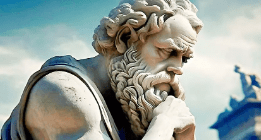
This text offers excerpts from The Daily Stoic, a book applying ancient Stoic philosophy to modern life. The excerpts present daily meditations based on the writings of Seneca, Epictetus, and Marcus Aurelius, focusing on practical applications of Stoicism. The book aims to make Stoicism accessible as a tool for self-improvement, not just an academic pursuit. Meditations cover topics like managing emotions, overcoming addiction, finding contentment, and developing resilience. The authors use anecdotes and contemporary examples to illustrate Stoic principles.
Stoic Study Guide
Quiz
- What are the three disciplines of Stoicism, and how are they related? The three disciplines are Perception, Action, and Will. They are overlapping but critical, representing how we understand things, how we act, and how we choose to approach life. They are intertwined, and training is required in each area for clarity and success.
- According to the Stoics, what causes most of our trouble? Stoicism asserts that our perceptions of things, rather than the things themselves, are the root of most of our trouble. Our reactions and judgments significantly impact our experience of the world.
- What is a Stoic mantra, and how does it help? A Stoic mantra is a phrase or thought intended to provide clarity or guidance when we feel overwhelmed by false impressions or distractions. It helps by focusing the mind and blocking out external disturbances, allowing one to see the truth.
- What does it mean to “cut the strings that pull your mind?” It means understanding that you have an inner power stronger than your bodily passions and that you can control the thoughts that occupy your mind. This process requires you to recognize fear, suspicion, desire, and other such impulses.
- Explain the concept of “Amor Fati”. “Amor Fati,” or “love of fate,” is the acceptance of everything that happens as necessary and good. It involves embracing all aspects of life, even the difficult ones, and recognizing that external circumstances are beyond our control.
- What is the importance of “reasoned choice” in Stoicism? Reasoned choice is the ability to use our reason to choose how we categorize, respond to, and reorient ourselves to external events. It’s where the Stoics believe true good and evil reside, as it reflects the choices we make.
- What does it mean to “do your job,” according to the Stoics? “Do your job” means fulfilling your purpose and doing your duty to be a good human being. It involves acting with virtue and fulfilling your role in the interconnected whole of the universe.
- What are some of the qualities a Stoic strives to develop? A Stoic seeks to cultivate qualities like self-control, courage, justice, and wisdom, as well as honesty, dignity, endurance, chastity, contentment, frugality, kindness, and freedom from gossip. These virtues are the essence of a “good person.”
- How does Stoicism view obstacles in life? Stoicism teaches that obstacles can be used as opportunities for growth and the practice of virtue. Instead of seeing them as hindrances, Stoics believe that they can be converted into a means of achieving a goal.
- What is the concept of sympatheia, and how does it relate to living a good life? Sympatheia is the notion of an interconnected cosmos, where everything is part of a larger whole. It encourages individuals to view themselves as a bee within the hive, emphasizing that what benefits the whole benefits the individual.
Answer Key
- The three disciplines are Perception, Action, and Will. They are overlapping but critical, representing how we understand things, how we act, and how we choose to approach life. They are intertwined, and training is required in each area for clarity and success.
- Stoicism asserts that our perceptions of things, rather than the things themselves, are the root of most of our trouble. Our reactions and judgments significantly impact our experience of the world.
- A Stoic mantra is a phrase or thought intended to provide clarity or guidance when we feel overwhelmed by false impressions or distractions. It helps by focusing the mind and blocking out external disturbances, allowing one to see the truth.
- It means understanding that you have an inner power stronger than your bodily passions and that you can control the thoughts that occupy your mind. This process requires you to recognize fear, suspicion, desire, and other such impulses.
- “Amor Fati,” or “love of fate,” is the acceptance of everything that happens as necessary and good. It involves embracing all aspects of life, even the difficult ones, and recognizing that external circumstances are beyond our control.
- Reasoned choice is the ability to use our reason to choose how we categorize, respond to, and reorient ourselves to external events. It’s where the Stoics believe true good and evil reside, as it reflects the choices we make.
- “Do your job” means fulfilling your purpose and doing your duty to be a good human being. It involves acting with virtue and fulfilling your role in the interconnected whole of the universe.
- A Stoic seeks to cultivate qualities like self-control, courage, justice, and wisdom, as well as honesty, dignity, endurance, chastity, contentment, frugality, kindness, and freedom from gossip. These virtues are the essence of a “good person.”
- Stoicism teaches that obstacles can be used as opportunities for growth and the practice of virtue. Instead of seeing them as hindrances, Stoics believe that they can be converted into a means of achieving a goal.
- Sympatheia is the notion of an interconnected cosmos, where everything is part of a larger whole. It encourages individuals to view themselves as a bee within the hive, emphasizing that what benefits the whole benefits the individual.
Essay Questions
- Discuss the role of perception in Stoic philosophy. How can Stoic practices, like using a mantra or practicing unbiased thought, help individuals manage their perceptions more effectively?
- Analyze the Stoic concept of “duty” and its significance in living a virtuous life. How does this concept influence Stoic actions, and what are the practical implications of adhering to it?
- Explain the relationship between “reasoned choice” and “virtue” in Stoicism. How do the Stoics believe that the development of reason leads to a more ethical and fulfilling existence?
- Examine the Stoic approach to emotions, including passions and desires. What specific techniques do Stoics use to manage strong emotions, and how do they distinguish between helpful and harmful desires?
- Explore the Stoic perspective on adversity and the concept of Amor Fati. In what ways do Stoics suggest that individuals accept and even benefit from negative circumstances, and how does this perspective differ from other philosophical approaches?
Glossary of Key Terms
Adiaphora (ἀδιάφορα): Indifferent things; neither good nor bad in an absolute moral sense. In Stoic thought, all things outside our sphere of reasoned choice are indifferent. Amor Fati: Love of fate; the acceptance of everything that happens as necessary and good. Aretê (ἀρετή): Virtue, goodness, and human excellence; the source of absolute value. The four cardinal virtues are self-control, justice, courage, and wisdom. Daimon: The divine spark within each individual; inner conscience or guiding spirit. Diairesis (διαίρεσις): Analysis, division into parts. Used when distinguishing what is subject to our power of choice from what is not. Dianoia (διανοία): Thought, intelligence, purpose, faculty of mind. Dikaiosunê (δικαιοσύνη): Justice, righteousness. Dogma (δόγμα): That which seems to one; opinion or belief. Philosophically, dogmata are principles or judgments established by reason and experience. Dokimazein (δοκιμάζω): To assay; to put to the test; to thoroughly examine. Eph’ hêmin (ἐφ’ ἡμῖν): What is up to us; what is in our control; our correct use of impressions, impulses, and judgments. Epistêmê (ἐπιστήμη): Certain and true knowledge, over and above that of katalêpsis. Ethos (ἔθος): Custom or habit. Hêgemonikon (ἡγεμονικόν): Ruling or guiding reason; ruling principle. Heimarmenê (εἱμαρμένη): Fate, destiny. Hexis (ἕξις): A state of mind or habit, disposition toward something. Hormê (ὁρμή): Positive impulse or appetite toward an object that leads to action. Logos: The guiding reason of the world, an all-powerful force that governs the universe. Oiêsis: False conceptions responsible for disturbances in the soul and chaotic lives. Prohairesis (προαίρεσις): Reasoned choice, the ability to use reason to choose how we respond to external events. Psychê (ψυχή): State of mind, soul, life, living principle. Sophos (σοφός): Wise person, virtuous sage, and the ethical ideal of a practicing Stoic. Sympatheia: The notion of an interconnected cosmos, where everything is part of a larger whole. Technê (τέχνη): Craft, art in the sense of profession or vocation. Telos (τέλος): The end goal or objective of life. Theôrêma (θεώρημα): General principle or perception, a truth of science. Theos (θεός): God; the divine, creative power that orders the universe and gives human beings their reason and freedom of choice. Tonos (τόνος): Tension, a principle in Stoic physics accounting for attraction and repulsion.
The Daily Stoic: A Guide to Living
Okay, here is a detailed briefing document summarizing the main themes and ideas from the provided excerpts of “The Daily Stoic”:
Briefing Document: The Daily Stoic
Introduction:
This document provides a review of key themes and concepts presented in the provided excerpts from “The Daily Stoic: 366 Meditations on Wisdom, Perseverance, and the Art of Living.” This book, rooted in the ancient philosophy of Stoicism, aims to offer daily guidance for navigating life’s challenges and cultivating a virtuous existence. The core tenets of Stoicism, derived from the writings of figures like Marcus Aurelius, Seneca, and Epictetus, are broken down into daily meditations, emphasizing the importance of perception, action, and will.
Core Themes and Disciplines:
The book is structured around three core, overlapping disciplines:
- The Discipline of Perception: This area focuses on how we interpret the world around us and the impressions we receive. Stoicism posits that our perceptions, rather than external events themselves, are the primary source of our distress.
- Clarity: The goal is to achieve clear and unbiased thinking, free from false assumptions (oiêsis) that lead to chaotic and dysfunctional lives. “When your efforts are not directed at a cause or a purpose, how will you know what to do day in and day out?” This involves using reason to understand situations and not being pulled by passions like a puppet.
- Passions and Emotions: Recognizing and managing the passions is a key theme. Stoics believe that strength comes from controlling emotions rather than being controlled by them. “A real man doesn’t give way to anger and discontent, and such a person has strength, courage, and endurance—unlike the angry and complaining.”
- Awareness: Being aware of our thoughts and identifying negative feelings such as fear, suspicion, or desire is crucial. Marcus Aurelius suggests asking, “What thoughts now occupy my mind? Is it not fear, suspicion, desire, or something like that?”
- Unbiased Thought: The practice involves seeing things as they are, without personal judgment or interpretation. “The cause of my irritation is not in this person but in me.” This requires actively managing our internal responses to external events.
- The Discipline of Action: This area focuses on our conduct and how we interact with the world.
- Right Action: Stoics emphasize acting for the common good, aligning our deeds with reason, and focusing on our own responsibilities. As Marcus Aurelius says, “Whatever anyone does or says, for my part I’m bound to the good.”
- Problem Solving: This involves using our reason to address problems, adapting to obstacles, and taking responsibility for our own actions. The concept of a ‘reverse clause’, having backup options, is presented as useful. “While it’s true that someone can impede our actions, they can’t impede our intentions and our attitudes, which have the power of being conditional and adaptable.” The idea that ‘the obstacle is the way’ highlights that challenges can be opportunities for growth.
- Duty: Stoics place importance on fulfilling our duties, without getting carried away by external factors. “Never shirk the proper dispatch of your duty, no matter if you are freezing or hot, groggy or well-rested, vilified or praised, not even if dying or pressed by other demands.” Doing the right thing because it is the right thing to do is emphasized over seeking external praise.
- Pragmatism: Focus is placed on what is in front of us, “Do your job,” not getting lost in distractions, while also thinking ahead. “Having an end in mind is no guarantee that you’ll reach it…but not having an end in mind is a guarantee you won’t.” Planning and purpose are important in guiding action.
- The Discipline of Will: This area focuses on what we choose to desire and how we react to circumstances.
- Fortitude and Resilience: Developing inner strength to withstand adversity and focusing on what is within our control is paramount. Stoics believe that “no one is crushed by Fortune, unless they are first deceived by her” and that “no one can thwart the purposes of your mind.”
- Virtue and Kindness: Stoics view virtue – particularly the cardinal virtues of wisdom, justice, courage, and self-control – as the source of true happiness. Kindness is also presented as a strength. “Most rudeness, meanness, and cruelty are a mask for deep-seated weakness. Kindness in these situations is only possible for people of great strength.”
- Acceptance/Amor Fati: This key principle is about accepting what we cannot control and embracing our fate. “Just as we commonly hear people say the doctor prescribed someone particular riding exercises, or ice baths, or walking without shoes, we should in the same way say that nature prescribed someone to be diseased, or disabled, or to suffer any kind of impairment. In the case of the doctor, prescribed means something ordered to help aid someone’s healing. But in the case of nature, it means that what happens to each of us is ordered to help aid our destiny.” It also involves being grateful for the present and finding joy even in unfavorable circumstances. This includes not judging the actions of others. “Leave the past behind, let the grand design take care of the future, and instead only rightly guide the present to reverence and justice.”
- Meditation on Mortality: Recognizing the impermanence of life and the inevitability of death is crucial for focusing on what truly matters and living each day with purpose. “This is the mark of perfection of character—to spend each day as if it were your last, without frenzy, laziness, or any pretending.” It encourages us not to cling to things, but live a purposeful life.
Key Ideas and Quotes:
- The Big Three: “All you need are these: certainty of judgment in the present moment; action for the common good in the present moment; and an attitude of gratitude in the present moment for anything that comes your way.” This encapsulates the core principles of Stoicism – perception, action, and will.
- Internal Power: “Understand at last that you have something in you more powerful and divine than what causes the bodily passions and pulls you like a mere puppet.” Emphasizing the power of reason and our internal strength, not external factors.
- The Three Areas of Training: “There are three areas in which the person who would be wise and good must be trained…desires and aversions…impulses to act…freedom from deception and composure and the whole area of judgment.”
- Simplicity: “At every moment keep a sturdy mind on the task at hand, as a Roman and human being, doing it with strict and simple dignity, affection, freedom, and justice…” Doing our job well and not getting lost in distractions.
- Control of Passions: “Keep this thought handy when you feel a fit of rage coming on—it isn’t manly to be enraged. Rather, gentleness and civility are more human, and therefore manlier.” This idea stresses that true strength lies in controlling one’s passions.
- Planning to the end: “By planning to the end you will not be overwhelmed by circumstances and you will know when to stop.”
- Don’t Seek Strife: “The wise person will endure that, but won’t choose it—choosing to be at peace, rather than at war.” Seeking peace is emphasized over engaging in conflicts.
- Pleasure as Punishment: “Whenever you get an impression of some pleasure…let it await your action, give yourself a pause.” The importance of resisting impulse and considering long-term consequences.
- The Grand Parade of Desire: “Robbers, perverts, killers, and tyrants—gather for your inspection their so-called pleasures!” Examining the results of unchecked desires.
- Wish Not, Want Not: “Remember that it’s not only the desire for wealth and position that debases and subjugates us, but also the desire for peace, leisure, travel, and learning.” Emphasizing that attachment to desires, even seemingly positive ones, can lead to suffering.
- Focus on what is yours alone: “if you deem as your own only what is yours, and what belongs to others as truly not yours, then no one will ever be able to coerce or to stop you, you will find no one to blame or accuse, you will do nothing against your will, you will have no enemy, no one will harm you, because no harm can affect you.” This focuses on what we control internally.
- Character over Display: “For philosophy doesn’t consist in outward display, but in taking heed to what is needed and being mindful of it.” Stoicism is reflected through actions and character.
- The Good and Evil: “Where is Good? In our reasoned choices. Where is Evil? In our reasoned choices.”
- Habit Building: “Every habit and capability is confirmed and grows in its corresponding actions, walking by walking, and running by running…” The importance of building positive habits.
- The Mind as the Asset: “According to the Stoics, your mind is the asset that must be worked on most—and understood best.”
- The Obstacle is the Way: “That which is an impediment to action is turned to advance action. The obstacle on the path becomes the way.” Seeing obstacles as opportunities for growth.
- Always have a mental reverse clause: “…in every course of action, it has retained “a reverse clause.” What’s that? It’s a backup option.”
- It’s not on them, it’s on you: “If someone is slipping up, kindly correct them and point out what they missed. But if you can’t, blame yourself—or no one.” Taking responsibility for interactions with others.
- Follow the Logos: “The person who follows reason in all things will have both leisure and a readiness to act—they are at once both cheerful and self-composed.” Aligning with the natural order of the universe.
- You were born good: “The human being is born with an inclination toward virtue.”
Conclusion:
The excerpts from “The Daily Stoic” provide a valuable framework for living a more deliberate and meaningful life. By emphasizing the control we have over our perceptions, actions, and will, Stoicism empowers us to navigate life’s inevitable challenges with greater resilience, wisdom, and compassion. The daily meditations encourage constant self-reflection and practical application of these principles, fostering personal growth and ethical conduct. The ideas presented are intended to be a starting point, encouraging deeper reflection and learning about Stoicism.
Stoicism: A Practical Guide
What is Stoicism and where did it originate?
Stoicism is an ancient philosophy founded in Athens by Zeno of Citium in the early third century BC. The name derives from the Greek word “stoa,” meaning porch, where Zeno first taught his students. It asserts that virtue, defined primarily by the four cardinal virtues of self-control, courage, justice, and wisdom, is happiness, and that our perceptions of things, rather than the things themselves, cause most of our trouble. It emphasizes what is within our “reasoned choice”—our ability to use our reason to choose how we categorize, respond, and reorient ourselves to external events.
What are the three disciplines of Stoicism?
The three core, overlapping disciplines of Stoicism are perception, action, and will. The discipline of perception focuses on clarity and unbiased thought, helping us interpret events objectively. The discipline of action pertains to right and pragmatic action, problem-solving, and duty. Finally, the discipline of will involves building fortitude, resilience, kindness, acceptance, and meditating on mortality. These areas are interconnected, with our judgment affecting what we desire, our desires affecting how we act, and our judgment influencing how we act.
How does Stoicism view emotions and desires?
Stoicism emphasizes the importance of controlling our passions and emotions rather than being controlled by them. It teaches that strong emotions arise when we fail in our desires and aversions. It encourages us to train ourselves to resist impulsive reactions and to instead think before we act. The philosophy cautions against seeking out strife and reminds us that pleasure can become punishment, urging self-control and moderation. It also encourages us to analyze our desires, recognizing that excessive attachment to anything external, even seemingly good things, can subjugate us. Stoicism sees desire for externals as a source of unhappiness, and advocates for contentment with what is within our control.
What is the role of “reasoned choice” in Stoic thought?
“Reasoned choice” (prohairesis) is central to Stoic philosophy. It refers to our ability to use reason and judgment to choose our responses to external events, thus influencing our emotions and actions. Stoicism emphasizes that we cannot control what happens to us, but we can control how we perceive and react to it. It teaches that our reasoned choices, or our “ruling reason” (hêgemonikon), are the only things that can hinder or harm us, and our choices, not external events, are the true source of our good and bad. This inner control provides freedom and resilience even in the face of adversity.
What is the Stoic view on external events and obstacles?
Stoicism teaches that external events are indifferent (adiaphora), meaning they are neither inherently good nor bad. Our judgments and interpretations of these events determine their impact on us. It proposes that we can view obstacles as opportunities for growth and practice. By using our reason, we can transform any impediment into a means of advancing action. Rather than fighting or complaining about what is out of our control, we should focus on our responses, using situations to practice patience, forgiveness, or other virtues.
How does Stoicism define virtue and what are the primary virtues to strive for?
Stoicism defines virtue (aretê) as human excellence and the source of absolute value, which is synonymous with happiness. The four cardinal virtues are self-control (sôphrosunê), justice (dikaiosunê), courage (andreia), and wisdom (phronêsis). These virtues are not theoretical; they are meant to be actively embodied in our daily lives. Stoicism argues that by consistently practicing these virtues, we can live a life of purpose, meaning, and true well-being, becoming more than just outwardly beautiful, and making ourselves into good and moral people.
What is the Stoic perspective on duty and contributing to society?
Stoicism emphasizes the importance of fulfilling our duty and acting for the common good. It teaches that every person has a purpose in nature, and our job as humans is to be good human beings, regardless of external circumstances. It highlights that the most important aspect of life is to strive to be good, even when it is hard. Further, Stoics believe in sympatheia, or interconnectedness of all things, and that what is good for the whole is also good for the individual, promoting empathy and social responsibility.
How does Stoicism approach death and mortality?
Stoicism advocates for meditating on mortality, reminding us that life is finite. This perspective helps us focus on what is truly important, and not be distracted by fleeting pleasures or fears. It encourages us to use each day wisely and live it as if it were our last, without frenzy or laziness. By accepting our mortality and the nature of impermanence, Stoicism seeks to reduce the fear of death, helping us to embrace life fully while we are here.
A Stoic Timeline and Character Guide
Okay, here is a detailed timeline and cast of characters based on the provided text from “The Daily Stoic”:
Timeline of Main Events and Concepts
This timeline focuses on the development of Stoic philosophy and its core ideas. It’s important to note that the provided text is structured as daily meditations, not a chronological history; thus the timeline is organized by concepts and the figures associated with them, not as a traditional historical account.
Ancient Greece
- Early 3rd Century BC: Zeno of Citium founds the Stoic school of philosophy in Athens. He teaches from the Stoa (porch), which gives the philosophy its name. Stoicism emphasizes virtue as happiness and that our perceptions cause our problems. The school focused on what we can control- our reason and choice.
- Zeno’s ship sinks, and while in a bookstore, he is introduced to the philosophy of Socrates, leading him to become a philosopher.
- Early Philosophical Development: Early Stoicism emphasizes that the four cardinal virtues: self-control, courage, justice, and wisdom, lead to happiness. These virtues become an area of training for the Stoics, also important is training the areas of desire, action and judgement.
- Development of the Stoic concept of sympatheia, the interconnectedness of the cosmos, and the concept of being a citizen of the world.
- Further development of the concept of logos as the divine guiding reason of the universe.
- Also introduced is the concept of adiaphora, or indifferent things- things that are neither good nor bad in an absolute moral sense.
- Zeno states that his mind remains with his teacher Stilpo, even though his body may be harmed, indicating the importance of reason and inner strength.
- The philosophy is later refined to include training of impressions, impulses and judgement.
Roman Stoicism (Key figures)
- Seneca: A Roman playwright, power broker, and Stoic philosopher. He believes philosophy is for all, not only the wise, but also the lazy and those “hindered by bad habits.”
- Seneca talks of virtus and how virtue is in ‘true and steadfast judgment’.
- Seneca states, ‘to bear trials with a calm mind robs misfortune of its strength and burden’.
- His writings focus on using philosophy to strip away the wrong ideas and return to our natural state. He emphasizes that it’s better to have someone whose example can make the inner sanctum inviolable, even when not present.
- Epictetus: A former slave turned influential teacher, whose lectures form the basis of Stoicism. He focuses on reasoned choice, what is ‘up to us’, and training the way we react to external impressions.
- Epictetus states that the right thing to do comes from reasoned choice and how most meanness and cruelty are a mask for weakness.
- His philosophy emphasizes controlling impulses and thinking before you act, asking ‘Who is in control here?’.
- He stresses the need to test impressions, comparing it to how merchants test coins.
- He uses the term dogmata to describe opinions or beliefs, which should be rooted out by reasoned choice.
- He encourages us to use a ‘contrary habit’ against a bad habit, making the habit weak and then eventually obliterated.
- His teachings use the term eph’ hemin to denote the things that are in our control, and that worrying over things that are not in our control leads to anxiety.
- He also uses horme to describe the positive impulses that lead to action and to remind us that we have the ability to choose those actions.
- Marcus Aurelius: A Roman emperor and Stoic philosopher, famous for his private diaries called Meditations. Marcus advocates training the hegemonikon, our ruling reason, for clarity and strength.
- Marcus highlights the importance of an attitude of gratitude for anything that comes your way, and emphasizes Perception, Action and Will as core to stoicism.
- His Meditations frequently uses the term psychê to denote ‘state of mind, soul, life’.
- He also uses dianoia to describe thought, purpose, or our minds faculties.
- He repeatedly reminds himself about stoicism and focuses on acting for the common good and embracing everything nature assigns.
- He emphasizes the need to do what is in front of us and to make character your loudest statement.
- He states that we should follow the Logos, or the guiding reason of the world, and that those who follow the logos have both leisure and a readiness to act.
- He encourages the concept of amor fati or acceptance of everything that occurs as if it were specifically willed for you.
- He states that the human mind should be treated as sacred because it is given from the gods.
- Cato the Younger: Roman politician known for his self-discipline, used as an example of strong and noble character.
Key Stoic Concepts and Themes
- The Three Disciplines: Perception, Action, and Will, which are areas of training in the path to virtue.
- Virtue as the Sole Good: Stoics believe that external factors (wealth, health, reputation) are indifferent and only virtue is truly good.
- Reasoned Choice (Prohairesis): The ability to use reason and make choices based on virtue.
- Control vs. Lack of Control: Stoicism is about focusing on what you can control (your thoughts and actions) and accepting what you cannot.
- The Power of Perception: The belief that our interpretations of events, not the events themselves, cause our emotions. We should try to see the truth.
- Negative Visualization: A technique that includes imagining setbacks, which serves to appreciate current blessings and prepare for challenges.
- Amor Fati: The love of fate; accepting and embracing everything that happens.
- Self-Control: The ability to manage one’s passions and desires.
- Present Moment Focus: Concentrating on the task at hand, and taking each action as if it were your last.
- Duty: Fulfilling one’s roles and responsibilities, and being a good person above all.
- Cosmopolitanism: The idea that we are all citizens of the world and interconnected.
- The Use of Mantras Using short phrases, words, or thoughts to help maintain clarity in the face of distractions and problems.
- Habit Formation: The understanding that habits grow from constant practice, and that to break bad habits, one must replace them with good ones.
- Turning Obstacles into Opportunities: The idea that even negative circumstances can be used to advance action.
- Impermanence: The awareness that all things are in a constant state of change.
- Preparation for the Inevitable: Preparing for tough times, even when times are good.
- Inner Strength: The development of the ability to find your own power and freedom in your reason and choice.
- The use of philosophical teaching: The need for those who understand philosophy to share it with others so they may be lifted up.
Cast of Characters and Brief Bios
- Zeno of Citium: (c. 334-c. 262 BC) – Founder of the Stoic school of philosophy in Athens. He was originally a merchant before becoming a philosopher and believed it is our perceptions that cause trouble, and virtue that is happiness.
- Stilpo– The teacher of Zeno who influenced his thinking.
- Seneca (Lucius Annaeus Seneca, c. 4 BC-65 AD): A Roman Stoic philosopher, statesman, dramatist, and in one period, an advisor to Emperor Nero. He is known for his writings on ethics and morality, he believed in working to return to our true nature.
- Epictetus (c. 55-c. 135 AD): A Greek Stoic philosopher, who was a former slave. His teachings, preserved in Discourses and Enchiridion, emphasize the importance of using reason to control emotions and focusing on what we can control, he heavily emphasizes the importance of prohairesis or reasoned choice.
- Marcus Aurelius (121-180 AD): Roman Emperor and Stoic philosopher, most famous for his private writings Meditations. His writings emphasize the idea of acceptance and the importance of training the mind, or hegemonikon, and a strong focus on action towards the common good.
- Cato the Younger (Marcus Porcius Cato Uticensis, 95-46 BC) A Roman politician noted for his self discipline and defense of the Republic against Julius Caesar. He is used as an example of a noble and strong character, an example that the other Stoics encouraged.
- Heraclitus: An ancient Greek philosopher known for his concept of constant change and flow, “No man steps in the same river twice,” a concept used by Marcus Aurelius.
- Socrates: Greek philosopher who influenced the early Stoics, especially in regards to his focus on ethics and virtue.
- Crates: Athenian philosopher who influenced Zeno.
- Diogenes Laertius: Ancient biographer who preserved many of the Stoic philosophical ideas by recording the lives and thoughts of the ancient philosophers.
- Musonius Rufus: A Roman Stoic philosopher who believed that we are all born with an inclination towards virtue.
- Publilius Syrus: A former slave, who believed that self control was more important than ruling over an empire.
- Plato: Ancient Greek philosopher, his idea of four cardinal virtues had a large impact on the teachings of the Stoics.
- John D. Rockefeller: Wealthy industrialist who believed that wealth was determined by the relation of desires and expenditures to ones income.
- Alexander the Great: Historical figure used as a contrast to how Stoics should live, known for his ambition and quest for legacy which the Stoics saw as meaningless.
- Rubin “Hurricane” Carter: Boxer wrongly convicted of homicide, who maintained the concept of an inner mind not contained by his physical incarceration.
This detailed timeline and cast of characters should provide a good overview of the Stoic philosophy as presented in your provided source. Let me know if you have any more questions!
Stoicism: A Practical Guide to Virtue and Happiness
Stoicism is an ancient philosophy that was once a popular civic discipline in the West, practiced by people of all social classes in the pursuit of a good life [1, 2]. The core texts of Stoicism are derived from the private diaries of Roman Emperor Marcus Aurelius, the personal letters of the playwright and political advisor Seneca, and the lectures of the former slave turned teacher Epictetus [1]. Although Stoicism was once essential to many, knowledge of it has faded over time, and the term “stoic” has become shorthand for “emotionlessness,” a mischaracterization of the vibrant, action-oriented philosophy [2].
The goal of Stoicism is to provide a practical tool for self-mastery, perseverance, and wisdom [3]. Many historical figures have studied and admired the Stoics including George Washington, Walt Whitman, and Theodore Roosevelt [3]. Those who have found value in Stoicism are often “doers of the world” who found that it provides strength and stamina for challenging lives [4]. Stoicism seems particularly well-suited for the field of battle, as leaders like Captain James Stockdale and General James Mattis have carried Stoic texts with them into combat [5].
Stoicism was founded in Athens in the early third century BC by Zeno of Citium [6]. The philosophy asserts that virtue is happiness and that our perceptions, rather than the things themselves, cause most of our trouble [6]. Stoicism teaches that we can’t control or rely on anything outside our “reasoned choice”—our ability to use reason to choose how we categorize, respond, and reorient ourselves to external events [6].
Early Stoicism was a comprehensive philosophy, but as it progressed from Greece to Rome, it became more practical [7]. The Stoics address questions such as, “What are my obligations to my fellow human beings?”, “How can I deal with difficult situations?”, and “How should I handle success or power?” [8] The Stoics framed their work around three critical disciplines [8]:
- The Discipline of Perception: How we see and perceive the world around us [8].
- The Discipline of Action: The decisions and actions we take, and to what end [8].
- The Discipline of Will: How we deal with the things we cannot change, attain clear judgment, and understand our place in the world [8].
By controlling our perceptions, we can find mental clarity [9]. Directing our actions properly and justly will lead to effectiveness. Utilizing and aligning our will allows us to find the wisdom and perspective to deal with anything the world presents [9]. The Stoics believed that by strengthening themselves in these disciplines, they could cultivate resilience, purpose, and even joy [9]. The Stoics also used morning and nightly rituals: preparation in the morning, and reflection in the evening [10].
The Stoics seek steadiness, stability, and tranquility by filtering the outside world through the lens of reasoned judgement [11]. They are not monks in quiet solitude, but are equally at peace in the marketplace or the battlefield [12]. Serenity is a result of your choices and judgment, not your environment [12].
Other important Stoic ideas include:
- The importance of differentiating between what we can change and what we cannot, focusing on what is within our control [13].
- The idea of the “inner citadel”: a fortress that protects our soul. While we may be physically vulnerable, our mind is protected by philosophy [14, 15].
- The concept of adiaphora, or “indifferent” things: things outside our sphere of reasoned choice that are neither good nor bad in an absolute moral sense [16]. Some of these things may be preferred (proêgmena) or dispreferred (aproêgmena) [16, 17].
- The understanding that impulses will come, and our job is to control them using justice, reason, and philosophy [18].
- The notion that there is no such thing as an objectively good or bad occurrence, but that situations require our participation, context, and categorization to be “bad” [19].
- The importance of finding a role model or mentor, who can provide a good example for our own development [20].
- The idea that we must focus on the effort, activity, and choices that lead to something, not just how it appears [21].
- The concept that our problems are not caused by external circumstances, but by our assumptions [21].
- The belief that the mind is the asset that must be worked on most and understood best [22].
- The idea that philosophy is something we apply, not just something to aspire to, and that it’s a process of making incremental progress [23].
- The necessity of turning words into works and using actions to illustrate knowledge [24].
- The concept that our human essence and purpose is found in the joy of our proper human work [25].
- The practice of accepting what happens and adapting and changing with circumstances [26].
- The understanding that we always have some opportunity to practice our philosophy and make a contribution [27].
- The idea that we each have a duty, a specific job; the most important of which is to be good and wise [28, 29].
- The concept of a deep, internal joy, as opposed to surface level cheerfulness [30].
- The understanding that virtue is the only good and is found in our rational part, which manifests as “true and steadfast judgment” [31, 32].
- The practice of eliminating the inessential from our lives [33].
- The idea that endless pleasure becomes its own form of punishment [34].
- The concept that what doesn’t harm the community can’t harm the individual, and that good for the individual is naturally carried by the good of the whole [35].
- The importance of focusing inward to make ourselves better rather than focusing on the faults of others [36].
- The notion that we have two essential tasks in life: to be a good person and to pursue the occupation that we love [37].
- The concept of amor fati – to not just accept, but to love everything that happens [38].
- The idea that change isn’t good or bad; these labels are our opinions. The goal is to make the most of everything [39].
The Stoics were not monks or ascetics, but people who lived and worked in the world [33]. The ultimate goal of Stoicism is to live a better life by practicing these principles daily [10].
Stoic Self-Mastery
Self-mastery is a key concept in Stoic philosophy, involving the control of one’s thoughts, actions, and reactions to external events [1-3]. The practice of self-mastery involves a focus on what is within one’s control, while accepting what is not [1, 4].
Key aspects of self-mastery according to the sources include:
- Distinguishing between what can and cannot be controlled [1, 4]. According to Stoics, only one’s mind is truly within one’s circle of control [3]. This includes one’s opinions, choices, desires, and aversions, or everything of one’s own doing [4]. Things not within one’s control include one’s body, property, reputation, position, and anything not of one’s own doing [4].
- Focusing on the mind as the primary area for self-mastery [3, 5]. The mind is the only thing a person truly possesses [6]. Managing one’s choices, will, and mind is the single responsibility of the Stoic [3].
- Controlling impulses and emotions [7-9]. Rather than being controlled by emotions, a person should be in control of them [9]. Strong emotions arise when desires and aversions are not properly managed [10]. By exercising one’s guiding reason, one can question emotions and beliefs [11].
- Training in three areas [10, 12]. These areas are desires and aversions, impulses to act or not act, and freedom from deception and composure [10]. The most urgent of these is the first, dealing with passions, because strong emotions arise when we fail in our desires and aversions [10, 12].
- Recognizing that external events are not inherently good or bad, but are only the raw material for our reasoned choices [5]. The essence of good and evil is found in our reasoned choices [5, 13].
- Understanding that the only path to happiness is giving up what is outside one’s sphere of choice [6].
- Avoiding self-deception and having an accurate self-assessment [14, 15]. One must cultivate the ability to judge oneself accurately and honestly [16]. Self-deception is the enemy of one’s ability to learn and grow [15].
- Cultivating inner strength and self-awareness [17, 18]. Without focusing on internal integration and self-awareness, a person risks external disintegration [18].
- Practicing self-reliance [13]. Self-reliance is the ultimate form of self-mastery [13].
- Developing character by accepting responsibility for one’s own life [19]. By developing character, one will gain self-respect [19].
- Using philosophy as a cure for the self, addressing negative characteristics [20]. Philosophy helps to remove our faults [21].
- Understanding that true freedom is achieved not by fulfilling desires, but by removing them [22].
- Controlling one’s desires, and shifting one’s aversions to what lies within one’s reasoned choice [23]. One must also avoid anger, resentment, envy, or regret [23].
- Taking responsibility for one’s own actions, rather than blaming others [24]. If someone slips up, blame yourself or no one [24].
- Focusing inward and not on the faults of others [21]. The proper direction of philosophy is inward [21].
- Understanding that you are always the one in control; the cause of irritation comes from within [25].
- Maintaining a hold of oneself [8]. Strength is the ability to maintain a hold of oneself, and to not be controlled by one’s passions [8].
- Using reason to navigate situations [26]. This gives us the ability to alter our circumstances [26].
- Persisting in what is virtuous and resisting what is not [27].
- Practicing self-control, justice, courage, and wisdom, the four cardinal virtues [28].
According to Stoics, self-mastery is not an easy task, but it can be achieved through consistent effort, practice, and training [29, 30]. The Stoics believed that by developing these practices, one can achieve a state of tranquility and freedom from the passions [6, 24, 31]. They also saw that it was important to apply these concepts to everyday life [22, 32].
Stoic Wisdom: A Practical Guide
Wisdom is a central theme in Stoic philosophy, representing the ultimate goal of a life well-lived [1]. It is considered one of the four cardinal virtues, along with self-control, courage, and justice [2, 3]. According to the sources, wisdom is not just theoretical knowledge, but a practical understanding that informs how we live and make decisions [4, 5].
Key aspects of wisdom in Stoicism include:
- The use of reason: Stoics believe that wisdom is derived from the proper use of reason [6]. This means using our rational faculty to make sound judgments and to understand our place in the world [2]. It involves being able to analyze one’s own mind, question emotions and beliefs, and not take things for granted [7].
- Clarity of judgment: Wisdom involves the ability to see things clearly and properly [6]. It means having certainty of judgment in the present moment [8]. It also involves the ability to discern what is truly good or bad, which is found only in our reasoned choice [5, 9]. True and steadfast judgment is the essence of virtue [3, 5].
- Understanding what is within our control: A wise person knows what is inside their circle of control and what is outside of it [10]. They focus their efforts on what they can influence, accepting what they cannot [2, 9].
- Deep understanding: Stoics value deep understanding over superficial knowledge [11]. They believe that one should not be satisfied with a rough understanding of the whole but should strive for clarity [11]. This involves reading carefully, not agreeing too quickly, and questioning assumptions [11, 12].
- Humility: To gain wisdom, one must be humble and willing to learn [13, 14]. A person cannot learn what they think they already know [13]. This means recognizing that we are not as smart or wise as we think we are [14].
- Self-awareness: Wisdom involves being aware of one’s own thoughts, beliefs, and emotions [15]. It means having the ability to analyze one’s own mind [7]. It also involves understanding that one’s own assumptions can be harmful [16].
- Learning from others: Wisdom is gained by observing the actions of wise people [17]. This can include philosophers, writers, thinkers, or anyone who provides a good example [17]. It also involves being willing to learn from anyone, regardless of their station in life [18].
- Application of knowledge: Stoic wisdom is not just about acquiring knowledge, but about applying it to one’s daily life [19]. It is about turning words into works and letting actions illustrate knowledge [19, 20]. It also involves training and practicing the principles of philosophy [20].
- Inner peace and tranquility: Wisdom leads to inner peace and tranquility [21, 22]. This is because the wise manage their expectations, consider both best- and worst-case scenarios, and act with a “reverse clause,” seeing challenges as opportunities for virtue [23]. They do not seek out strife, but rather choose to be at peace [21].
- Freedom from deception: Wisdom involves freedom from deception and the ability to make clear judgments [24, 25]. This includes avoiding self-deception, conceit, and arrogance [26].
- Ability to see the world clearly: A wise person can see the world with clarity and find harmony in places others overlook [27]. They do not see the world as a dark place, but find joy and grace in it [27].
- Using experience to make good judgments: Wisdom comes from using our experience and knowledge to make better judgments [12]. This also means avoiding acting on biases, stereotypes, and assumptions [12]. It involves questioning our impressions and putting them to the test [12].
- Understanding the value of things: Wisdom involves understanding the true value or worth of things [22]. It means not trading things of great value for things of little value [22].
Ultimately, Stoic wisdom is about living in accordance with nature and using reason to guide our thoughts, actions, and judgments [2, 6]. It is a practical approach to life that enables us to deal with whatever comes our way with clarity, strength, and tranquility [15]. A moment of wisdom can be just as valuable as an eternity of exercising virtue [3, 28].
Stoic Philosophy: Perception, Action, and Will
The concepts of perception, action, and will are central to Stoic philosophy, representing three critical disciplines for navigating life and achieving virtue [1, 2]. These disciplines are interconnected and form a framework for how Stoics approach the world, make decisions, and handle challenges [2, 3].
Perception
- Control of perceptions: The discipline of perception involves how we see and perceive the world around us [1]. It’s about how we interpret and make sense of our experiences [1, 2]. Stoics emphasize that our perceptions are not always accurate, and we must actively work to control them [2, 4].
- Not trusting the senses: The senses can be deceptive [5]. Stoics believe that our senses can lead us astray [5, 6]. It is important to question our instincts and assumptions [5]. We should not trust our initial impressions without testing them [7, 8].
- Testing impressions: Stoics advocate for examining and testing our impressions by applying rules and principles [8]. The first rule is to determine whether something is within or outside of our control [8]. If it’s outside our control, we must accept it [4, 8].
- Avoiding self-deception: Self-deception is considered an “awful disease” [5]. We must be able to objectively evaluate ourselves and not hold unchallenged opinions [5]. A true self-estimate is necessary to avoid over or underestimating our abilities [9, 10].
- Seeing things as they are: Stoics believe we should strive to see things as they really are, not how we wish them to be [11]. They emphasize separating facts from our judgments of them, and only accepting what is true [12, 13].
- Maintaining perspective: We should avoid adding to our initial impressions and stick to the facts [12]. This helps prevent negative emotions and allows us to respond more rationally.
- Understanding that it is not the things themselves that disturb us, but our judgments about them [14, 15]. We have the power to wipe out those judgments at a moment’s notice [14].
- Protecting peace of mind: Constant guard over perceptions is needed to protect one’s peace of mind, freedom from pain and fear, and freedom [16].
Action
- Right action: The discipline of action focuses on the decisions and actions we take [1]. Stoics believe that actions must be directed toward a specific end [4]. The goal of our actions should be the common good [2].
- Acting deliberately for good reasons: Stoics emphasize acting deliberately, and not carelessly [17, 18]. We should act with good intentions [4]. The focus is not on whether something is rewarded or successful, but whether it is the right thing to do [19].
- Understanding duty: The Stoics believed that everything has a purpose, and we should fulfill our duties [20]. We should not shirk our duty no matter the circumstance [21]. Our duty is usually the harder choice but is still important [22].
- Putting principles into practice: The goal is not just to know the principles of philosophy, but to practice them in daily life [23, 24]. It’s not enough to have knowledge, one must apply that knowledge [25]. Actions demonstrate what we know [25].
- Focusing on the present: Stoics emphasize living in the present moment and making the most of each day [19]. We must set out with a single purpose and not be distracted [19]. We should seize what flees [19].
- Showing, not telling: Rather than just talking about philosophical theories, one should show through action how the theories have been digested [25]. Actions should be aligned with principles [26].
- Thinking before acting: Stoics emphasize thinking before acting [27]. One should ask who is in control and what principles are guiding their actions [28].
- Being a leader: Leaders should do good deeds without expecting anything in return [23].
- Making a plan: Rather than making things up on the fly, Stoics emphasize having a plan [29].
- Using reason to make decisions: Stoics believe that we should use reason to make decisions [7]. We should not be guided by our emotions, but by our rational mind [6, 30].
- Always doing what is right: Right action is not about external rewards but about making the right choice, regardless of the outcome [19].
Will
- Acceptance of what is outside of our control: The discipline of will is about how we deal with things we cannot change [1]. This involves attaining clear judgment and understanding our place in the world [1]. Stoics believe we must willingly accept what is outside our control [4].
- Focusing on what we can control: Stoics emphasize that the only thing we can truly control is our own mind [31]. We must focus on what is in our power and not waste energy on what is not [32].
- Embracing fate: The Stoics believed in embracing fate and accepting what is meant to be [13]. They saw that challenges and difficulties can be opportunities for growth and virtue [33]. We should accept with good cheer that we have been chosen for our path [34].
- Inner strength: Self-awareness and inner strength are critical for the discipline of will [16]. We should value inner strength, self-awareness, and a sense of justice [16].
- Flexibility of the will: Stoics believe it is ok to change our minds when necessary [35]. It is important to be open to correction and to not be a prisoner of our determination [35].
- Overcoming obstacles: Stoics see obstacles as opportunities [20]. Obstacles can be converted into raw material for our own purpose [33].
The three disciplines of perception, action, and will are not separate areas, but are interconnected [3]. Our perceptions influence our actions, and our actions are guided by our will. By developing our skill in each of these areas, we can live a more fulfilling and virtuous life [3]. These disciplines provide a framework for self-mastery and for living in accordance with nature and reason.
Stoic Strength: Cultivating Inner Resilience
Internal strength, as described in the sources, is a crucial element of Stoic philosophy, essential for navigating life’s challenges and achieving a state of tranquility and virtue [1]. It is not about physical prowess but rather a deep-seated resilience and control over one’s thoughts, emotions, and actions [1].
Key components of internal strength include:
- Control over Passions: A core aspect of internal strength is the ability to control one’s passions rather than being controlled by them [1]. This involves not giving way to anger or discontent [2], and maintaining a calm mind even in difficult situations [1].
- Reasoned Choice: Internal strength stems from the power of reasoned choice, which is the ability to use reason to make decisions and guide actions [3, 4]. This means not being swayed by external events or the opinions of others, but by one’s own internal compass of reason and virtue [5, 6].
- Inner Citadel: The Stoics used the concept of an “Inner Citadel” as a metaphor for the mind as a fortress [7]. This fortress is protected not by physical barriers, but by the strength of one’s judgments and principles [7, 8]. Internal strength involves protecting this inner space from fear, greed, and other negative influences [8].
- Self-Awareness: Internal strength requires a deep understanding of oneself [9, 10]. This involves self-reflection and examining one’s own thoughts, beliefs, and emotions [10-12]. It also means understanding one’s capabilities and what it takes to unlock potential [13].
- Resilience: Internal strength equips a person to be resilient, able to endure hardship and persevere through life’s difficulties [14-16]. This resilience is developed through training and preparation [15]. Like a wrestler who trains for a match, one must train their mind to prevail in life [17].
- Independence: Internal strength is a form of self-reliance and does not depend on external factors [4, 18, 19]. It involves having one’s own resources, rather than relying on possessions, relationships, or other external assets [20]. It is about finding goodness within oneself [21].
- Virtue: The Stoics believe that true strength is found in virtue [22, 23]. Virtue, comprising traits such as justice, honesty, discipline, and courage, is considered its own reward and is the only thing worth striving for [22]. A person who possesses virtue is seen as beautiful [24].
- Acceptance: Internal strength also encompasses the ability to accept what is outside of one’s control, recognizing that the only thing we can truly control is our own mind [6, 25]. This involves understanding the nature of the universe and one’s place within it [26, 27]. It means not being miserable in advance of misery and focusing on the present rather than fearing the future [28].
- Overcoming Obstacles: Internal strength is what allows us to transform obstacles into opportunities for growth [6, 29]. We are able to turn any obstacle into raw material for our own purpose [30].
- Focus on inward change: True internal strength results from inward change [28]. Outward transformations may feel important but are superficial compared to the inward work, which is where our focus should be [28].
- Integrity: Internal strength is about being a unified human being and striving for self-coherence [10, 13, 31]. One should prioritize internal integration to prevent external disintegration [10]. It is about making a commitment to your principles and your values [26].
- The importance of habit: Internal strength is built through repeated actions and habits [32]. Good habits strengthen the mind, while bad habits weaken it [33]. One should make an effort to choose good habits over bad habits [33].
- Training: The Stoics compare the training needed for internal strength to that of an athlete or soldier [16, 17]. Such training prepares us for any circumstance and strengthens our resolve [15, 17]. This includes mental exercises like reviewing actions, thoughts, and areas for improvement [34].
- Inner power: Acquiring power inwardly is better than acquiring it externally [27]. Internal power is the kind that allows us to rule ourselves [27].
- Freedom: Internal strength is linked to freedom. A person who lives as they wish, unconstrained by external forces, is free [10].
- Objectivity: We must cultivate the ability to judge ourselves accurately and honestly [13]. We must not overestimate ourselves or other’s abilities, and strive to find a middle ground [13].
- The most valuable asset: Seneca believed that the wise person stores up everything for themselves by being virtuous and developing inner strength [19]. He said this asset cannot be diminished or increased, which is why it is the most valuable [19, 20].
In essence, internal strength is the cornerstone of the Stoic approach to life, enabling individuals to cultivate virtue, maintain their composure, and respond effectively to whatever life presents [1, 9]. It is not an innate quality but a developed capacity achieved through continuous self-examination, practice, and commitment to living a life guided by reason [1, 12, 13, 15, 32].

By Amjad Izhar
Contact: amjad.izhar@gmail.com
https://amjadizhar.blog
Affiliate Disclosure: This blog may contain affiliate links, which means I may earn a small commission if you click on the link and make a purchase. This comes at no additional cost to you. I only recommend products or services that I believe will add value to my readers. Your support helps keep this blog running and allows me to continue providing you with quality content. Thank you for your support!

Leave a comment