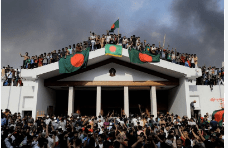
This transcript covers a New Year’s Day discussion on Bangladeshi politics in 2025. Three panelists, representing different political viewpoints, debated the upcoming elections, the ongoing reforms process following a recent popular uprising, and the challenges facing the government. Key concerns included election timing, the implementation of reforms, and the need for political consensus. The panelists expressed skepticism about the government’s commitment to reform and fair elections, predicting continued political instability unless significant changes occur. The discussion highlights deep divisions and anxieties about the country’s future.
Politics in Bangladesh: A 2025 Study Guide
Quiz
Instructions: Answer each question in 2-3 sentences.
- What are the three reform commissions mentioned in the text and what were their supposed reporting deadlines?
- According to the text, what major shift occurred within student organizations after the mass uprising, and what did this shift imply about the government?
- What claim is made about Bangladesh’s human rights situation after Hasina was forced to flee the country?
- According to the text, what are the reasons some people want to delay the election?
- What is Nurul Haque Noor’s opinion about Dr. Muhammad Yunus and the current interim government, and how does that influence his view on the present political situation?
- What is meant by the “July Declaration” and what is its stated significance in the text?
- What criticisms does Nurul Haque Noor make about the interim government’s actions related to the mass uprising?
- What does Rumin Farhana suggest is the primary need of the Bangladeshi people and what issues does she identify that currently stand in the way of that need being met?
- How does Ruhin Hussain Prince describe the current state of the electoral process, specifically regarding the timing of the election?
- What does the text say about the role of external forces and conspiracies in Bangladesh’s current political landscape?
Quiz Answer Key
- The three reform commissions mentioned are the Electoral Reform Commission (supposed to report by January 3), the Anti-Corruption Reform Commission (by January 7), and the Constitutional Reform Commission (by January 15). These commissions were expected to provide reports but apparently did not.
- After the mass uprising, student organizations shifted to align with political parties, indicating that the government may be more fractional and aligned with certain political factions rather than being a broad representation of the people.
- The text claims that Bangladesh’s human rights situation has improved considerably after Hasina was forced to flee, with people feeling safer at home and less fearful of police harassment, but this claim is disputed within the text.
- Some people want to delay the election to gain more time to strengthen their parties and their positions for votes, suggesting that the timing of the election is being seen through a strategic, rather than a purely reformist, lens.
- Nurul Haque Noor believes that the interim government should be trusted because it is led by Dr. Muhammad Yunus. However, he criticizes its lack of transparency and roadmap, and finds that the government is failing in its basic duties.
- The “July Declaration” refers to a set of demands for reform that arose from a popular uprising. The government initially stated it would respond to the declaration’s demands, especially concerning election dates, and those demands have been tied to the current political conflicts.
- Nurul Haque Noor criticizes the government for not fulfilling the promises made to the people after the mass uprising, specifically stating that those who participated in the massacres have not been brought to justice and are instead being “rehabilitated”.
- Rumin Farhana believes the primary need of the Bangladeshi people is good governance, including a safe society, rule of law, affordable goods, and job stability. She notes the current unstable business environment and government partisanship as obstacles to these needs.
- Ruhin Hussain Prince notes confusion surrounding the election timing, asserting that there has been a stated train of election reform set into motion, but that no one knows when the train will arrive. There is an ambiguity that is causing uncertainty and frustration.
- The text suggests that external forces and conspiracies, both domestic and international, are at play and that they will not allow the country to be at peace. There is an insinuation of external interference and potential conspiratorial elements impacting the country’s politics.
Essay Questions
Instructions: Answer each question in a well-structured essay with a clear thesis, supporting evidence from the text, and logical analysis.
- Analyze the different perspectives on the role of the interim government presented in the text. How do these viewpoints reflect the broader political divisions in Bangladesh?
- Discuss the significance of “reform” as it is used in the text. How do different political actors define reform, and what are the major areas of reform being debated?
- Explore the concept of mass uprisings in the context of the text. How are such uprisings perceived by different actors, and what are the long-term implications of these movements for Bangladesh’s political landscape?
- Evaluate the tensions between calls for electoral reforms and immediate elections. How do the different speakers in the text prioritize these issues, and what are their underlying motivations?
- Assess the impact of economic factors on the political climate as depicted in the text. How do concerns about the economy intersect with political debates and social unrest?
Glossary of Key Terms
Anti-Discrimination Student Movement: A student-led movement advocating for equality and an end to discriminatory practices. Awami League: A major political party in Bangladesh that is often referred to within the text as having engaged in past wrongdoings. BNP (Bangladesh Nationalist Party): A major political party in Bangladesh, often in opposition to the ruling party and other actors in the text. Constitutional Reform Commission: A commission that was tasked to provide recommendations to reform the constitution. CPB (Communist Party of Bangladesh): A communist political party in Bangladesh and a participant in political discourse within the text. Electoral Reform Commission: A commission established to look at and provide recommendations to reform the electoral process. Fascist: A term used to describe what is thought to be an oppressive form of government. Hegemonic power: A dominant power or influence, often used in the context of political or international relations. Interim Government: A temporary government put in place after the ousting of a previous administration in order to oversee the country until new elections. July Declaration: A declaration of demands arising from a popular uprising that happened in July, including calls for reform of the state. Mass Uprising: A large-scale popular revolt against the government. Misrule: Poor or corrupt governance. National Consensus: A general agreement or accord among political actors and the citizens of a nation. Rajkan Studio: The apparent broadcast studio where the discussion is taking place. Reforms: Changes intended to improve a system, institution, or policy. Rohingya Crisis: The situation involving the displacement and persecution of the Rohingya people. Sheikh Hasina: A political leader in Bangladesh who is the subject of some controversy in the source text.
Bangladesh’s Political Landscape: Early 2025
Okay, here’s a detailed briefing document summarizing the main themes and important ideas from the provided text, using quotes where appropriate:
Briefing Document: Analysis of Political Discourse in Bangladesh – Early 2025
Date: October 26, 2023
Subject: Analysis of political discussions regarding Bangladesh in early 2025, based on a televised debate.
Sources: Excerpts from “Pasted Text” – A transcript of a panel discussion on Rajkan Studio featuring Barrister Rumin Farhana (former BNP MP), Ruhin Hussain Prince (CPB General Secretary), and Nurul Haque Noor (President of People’s Rights Council)
Executive Summary:
This briefing analyzes a panel discussion that took place at the beginning of 2025, focusing on the political landscape of Bangladesh. The discussion highlights a complex situation marked by a recent “mass uprising” and a new government attempting to implement reforms. The panel grapples with questions about the government’s legitimacy, the speed and scope of reforms, the timing of elections, and the potential for further unrest. Key themes include the need for political consensus, concerns about the government’s actions, the role of the student movement, the ongoing struggle against corruption and the legacy of past misrule, and the influence of both domestic and international forces on Bangladesh’s political stability. There is significant distrust among political parties. The primary concern appears to be the potential for conflict and uncertainty surrounding the upcoming elections.
Key Themes & Ideas:
- The Aftermath of the Uprising:
- The discussion is framed by a recent “mass uprising” that resulted in a new government. This uprising is positioned as a rejection of past misrule and a movement towards democracy: “The main thing that had to be organized was the reception of the students, a mass reception and massive blood donation.”
- Participants note the fluidity of the situation since the uprising and the move from a unified front to more complex political maneuvering.
- There’s an expectation that the government should fulfill the aspirations of the uprising, including anti-discrimination reforms.
- There are concerns that the spirit of the uprising is being lost, and a feeling that its sacrifices are being politicized: “Even here, if there is an attempt to establish it as the contribution of a certain ideology or a certain group of people to the exclusion of others, then naturally others will not own it.”
- Reform and the Electoral System:
- Reforms are a central topic of debate. The panelists discuss various commissions formed to address electoral, anti-corruption, and constitutional reforms.
- There is a strong desire for electoral reforms to ensure free and fair elections. The focus is on direct people’s vote and that elections should ensure that “power in the hands of those who win”.
- A key point of contention is the timing of the elections. Some believe the government is delaying elections to solidify its position: “The more time you build, the more time you will get and the better the party is before the election, the better the party will be.”
- Some believe that the Election Commission must take control of the election process and ensure a fair process, including an updated voter list and seat adjustments.
- However, there is disagreement as to whether reforms should precede any election, with some advocating for a clean slate of reforms before any elections.
- Government Actions and Legitimacy:
- The new government is criticized for a lack of transparency and a failure to create a clear roadmap for its agenda: “We just wanted a clear roadmap from day one. What is your short-term, mid-term, and long-term plan?.”
- Concerns are raised about the government’s perceived bias and the possibility of it functioning as a political party itself: “This government is creating so much division between the political parties and the government is becoming a party which is very dangerous.”
- There is considerable distrust of the government’s commitment to neutrality, with one panelist stating that there is mistrust between the political parties.
- The government’s decision to move forward with things at a fast pace is causing confusion and skepticism, with some suggesting that “no one can see the train running”.
- Some believe the government’s response to the uprising is slow and that it has not arrested enough individuals involved in corruption.
- Political Divisions and the “Big War”:
- The phrase “a big war has to be fought” is mentioned in connection with the BNP’s position, referring to a struggle against forces they perceive as fascist: “Your Acting Chairman Tariq Rahman said that the country has entered a new phase of transformation but also said that another big war has to be fought…”
- There is a strong sense of political fragmentation, with different political actors taking different stances on the timing of elections, the scope of reform, and support for the government.
- The government is accused of failing to establish a national consensus and instead creating divisions amongst parties.
- The Role of the Student Movement:
- The anti-discrimination student movement played a key role in the uprising and is now a political factor, with the government itself seen as representing some of the movement’s ideals.
- However, there are concerns that the movement has been fragmented and taken over by political parties: “After this incident, now the organization has gone to the place of the political party.”
- There is concern that student leaders are part of a government that is not pursuing the goals of the movement: “During their government, those who were involved in this massacre are not being slowly rehabilitated from bureaucrats to businessmen.”
- Corruption and the Legacy of the Past:
- The discussion includes numerous references to the corruption and misrule of past governments.
- There is a sense that these issues still plague the current government, highlighting that people are experiencing challenges with the cost of living, law and order and other similar issues.
- A panelist states that while the government has been in power for five months, it is not enough time to undo 16 years of corruption and maladministration, but it needs a proper plan.
- International Influence
- There is a reference to the Rohingya crisis as a potential challenge in the new year.
- There is a mention of “hegemonic power” from both international and domestic forces who will not want peace.
- There is also mention that international states are pressing the government for an election and a political government.
Quotes highlighting key concerns:
- On government transparency: “We didn’t say that. We just wanted a clear roadmap from day one.”
- On the government’s perceived bias: “If this government constantly presents itself as a party then that’s why it said the big war yes if this government constantly presents itself as the voice of a party other political We are the party or Prince brothers or Noor brothers, but we will not feel safe. Elections under this government.”
- On lack of progress: “Now everyone is saying that Saira Dimak means Kaindaba, who left quickly after the reforms, but he is saying this because now he is saying that without a political government, there will be no new momentum in employment, no new investment will come in the economy, no stability will be created in the country from neighboring countries.”
- On need for consensus: “But in all cases what we say is that without political consensus without participation of citizens nothing will be successful.”
- On the uncertainty surrounding elections: “The train has started but the train has started but no one can see the train running. This is a confusion.”
Conclusion:
The political landscape of Bangladesh in early 2025 is highly volatile and uncertain. While there is optimism that the new government can address past issues, there’s a lack of trust and a growing sense of division. The tension surrounding the upcoming elections suggests the possibility of further unrest. The need for political consensus, transparency, and substantive reforms remains crucial for Bangladesh to move forward. This analysis suggests that the government needs to address the key concerns in the areas of reforms, election transparency and building trust.
Recommendations:
- Monitor the situation closely, paying attention to upcoming announcements from the government
- Track political maneuvering in the run up to potential election dates.
- Analyze how the government responds to the concerns that have been raised and whether they can bridge the gaps with political parties.
- Consider the international influence on the government and be prepared for reactions to different political announcements.
This briefing document provides an overview of the complex political situation in Bangladesh based on the provided text. Further information may be required for a deeper understanding.
Bangladesh’s 2025 Political Outlook
Frequently Asked Questions on the Political Situation in Bangladesh
1. What are the major political challenges facing Bangladesh in 2025, as highlighted in the discussions?
The discussions identify several key challenges: Firstly, navigating the complex political landscape after a period of significant upheaval. This includes establishing a stable government, addressing the deep distrust among political parties, and managing the expectations of various groups including students, workers, and the general public. Secondly, ensuring fair and transparent elections, with debates surrounding the timing and necessary electoral reforms. Thirdly, dealing with the deep rooted corruption and maladministration of the previous regime and delivering on the promise of a better future. Finally, addressing economic instability, unemployment, and the rising cost of goods, along with ensuring citizen safety and maintaining law and order.
2. What is the significance of the “July uprising” and how is it impacting the current political climate?
The July uprising refers to a period of significant public unrest and protest, driven largely by student movements, seeking to overthrow the previous government. It created a demand for significant reforms and a transition to a better political and social system. While the uprising successfully removed the previous government, the discussions suggest that the new government has failed to live up to expectations in the five months since. It is described as a period of fluid and complex situations where initial unity has fragmented. The spirit and goals of this uprising remain a benchmark against which current progress is measured, but are often seen as being unfulfilled. The anti-discrimination student movement is key.
3. What are the key demands of the student movement and how are they interacting with the government?
The student movement played a critical role in the July uprising and continues to advocate for reform and change. They demand significant reforms across various sectors such as the electoral system, the judicial system and anti-corruption measures. They also seek accountability for past wrongs, including human rights abuses and extrajudicial killings. The discussions suggest that the initial unity between student organizations has waned since the uprising, with some now aligning more closely with political parties. Furthermore there is a rising distrust in the new government’s commitment to their demands.
4. What are the main points of contention regarding the timing and conditions of the upcoming elections?
There is a significant disagreement over the timing of the elections, with some advocating for immediate elections while others, like the student movement, insist on comprehensive reforms before any election takes place. The discussion also includes concerns that those in power may use delays to consolidate their position. There is a fear that elections held under current conditions may not be truly fair or representative given the legacy of the previous government and that it could further entrench political instability. The government’s mixed messaging on the date, with several varying dates being floated, has not helped to settle the debate.
5. How does the concept of reform factor into the political dialogue, and what are some specific reforms being discussed?
The idea of reform is central to the political dialogue. Various reforms are demanded including: electoral system reform to ensure free and fair elections, legal and judicial system reform to ensure accountability, and administrative reforms to tackle corruption. Calls have also been made for specific commissions that were intended to carry out reform work to report on their findings, and there is a call to involve people in discussion of these reforms. The discussions highlight that these reforms are seen as necessary before elections can be held, but there is an ongoing debate as to what should be prioritised. Some believe that these reforms should be a priority and the current government should be working towards implementing these to ensure better governance.
6. What role do political parties play in the current political landscape, and what are some of their main concerns?
Political parties are both key players and major sources of conflict in Bangladesh’s political landscape. The discussions highlight a deep mistrust between parties, particularly between those who previously supported the old regime, and those in the new government. The BNP specifically have concerns about the leader of their party’s absence, raising a question about political freedom. There’s an apparent division among political parties regarding the need for consensus and reform as a pre-condition for elections, and there is skepticism about whether the new government can act neutrally due to its formation after the mass uprising. Some worry about the government’s potential bias, leading to potential calls for a caretaker government.
7. How is the new government being assessed after five months in power, and what are the main criticisms it faces?
After five months in power, the new government faces several criticisms. They are criticized for a lack of a clear roadmap for their short, mid, and long-term goals. There is a perceived failure to deliver on the promise of reforms and to address major issues like corruption. They are also criticised for not engaging with other political parties and citizens enough and for potentially becoming partisan. Furthermore, there is concern that members of the previous corrupt regime are not being held accountable and are in fact being rehabilitated. There is an overall sense that the new government’s performance has been undesirable, lacking coordination, transparency and effectiveness.
8. What are some of the international concerns and influences at play in Bangladesh’s political situation?
International factors play a significant role in the discussions. There are concerns about foreign powers and hegemonic influences that might interfere in the country’s affairs. There are also discussions about media from neighboring countries spreading misinformation, and concerns about international agreements being impacted by the current political instability. The Rohingya refugee crisis is highlighted as a potential challenge in the coming year. Overall, there is a call for stronger national sovereignty and more transparency with both domestic and international relations.
Bangladesh’s 2024 Uprising and its Aftermath
Okay, here is a detailed timeline and cast of characters based on the provided text:
Timeline of Main Events (as discussed in the text)
- Prior to July/August [2024]:
- Long period of “misrule” and “mafia rule” in Bangladesh.
- The political parties gathered in Vajra Atani (a specific place is inferred, but not described)
- People from extreme right to extreme left, united in a desire to be “freed from this hand,” assumed to mean the government.
- BNP leader Tariq Rahman states the country has entered a new phase of transformation and says another “big war” is needed after the “dispensation of fascists.”
- July/August [2024]:
- A significant “people’s uprising” occurs.
- Anti-discrimination student movement gains broad support.
- Many people are killed, and many more injured during the uprising.
- The government is described as a result of mass participation.
- This mass uprising is aimed at the downfall of “fascism”.
- A new government is formed, described as an interim government. Dr. Muhammad Yunus is installed as its head.
- A declaration is made, seemingly by or on behalf of the government, within a certain timeframe. (The exact nature of the declaration is not fully specified, but it’s related to student demands and potential reforms).
- There is a suggestion that the student movement is shifting to align with political parties.
- Post-Uprising (August – December [2024]):
- The situation is described as fluid and complex, with political parties and student groups possibly shifting allegiances.
- Reform commissions are established to address electoral, anti-corruption, and constitutional issues, with reporting deadlines.
- The government is under pressure to deliver on the promises of reform.
- Political parties become focused on elections, and how they will fare in them.
- There is a lack of clear direction or roadmap from the interim government on its short-term, mid-term, and long-term plans.
- Mistrust is said to be growing between political parties, especially regarding the government’s neutrality.
- A push to hold the election within the year is promoted.
- January 1st, 2025 (Date of the Discussion):
- Discussion about the challenges and opportunities of the new year, particularly in relation to politics and reform.
- The government’s perceived lack of action on promised reforms is highlighted.
- There is disagreement over whether an election date should be prioritized or focus should be given to reforms first.
- The issue of “conspiracy” arises as a potential challenge.
- Concerns are raised about the state of the economy, with garment factories closing, and investment stagnant.
- There are calls for national consensus and a need for the interim government to engage more effectively with political parties and civil society.
- January 15th, 2025 (Potential Declaration): *The government is expected to make a declaration, although its contents and timing are unknown. It seems that the date is a benchmark of when to expect something of significance.
- Mid to Late 2025, or Mid 2026:
- The potential time frame for when elections may occur. There is no consensus on if the election is a priority.
Cast of Characters
- Barrister Rumin Farhana: Former parliament member of the Bangladesh Nationalist Party (BNP) and co-editor of international affairs. She believes Bangladesh has been freed from misrule and corruption and human rights have improved, but the country still faces significant challenges. She focuses on political party’s positions and the need for reforms.
- Ruhin Hussain Prince: General Secretary of the Communist Party of Bangladesh (CPB). He is interested in seeing meaningful political reforms, is aware that the current situation is becoming increasingly complex, and is involved in pushing for reforms.
- Nurul Haque Noor: President of the People’s Rights Council. He emphasizes the sacrifices of the people involved in the uprising, criticizes the government for not fulfilling its mandate, and calls for national unity and the inclusion of citizens in political processes.
- Tariq Rahman: Acting Chairman of the BNP. He believes the country has entered a new phase of transformation, but that another “big war” has to be fought.
- Sheikh Hasina: While not participating in the discussion, she is mentioned as the leader of the prior regime that was removed after the people’s uprising. She is described as having presided over an era of misrule.
- Mirza Fakhrul Islam Alamgir: The Secretary General of the BNP, who says “the path of suffering must be followed”.
- Dr. Muhammad Yunus: Head of the interim government. He is internationally recognized and respected, but the government is perceived as failing to capitalize on his presence. His credibility is expected to bring stability.
- General M.S. Osmani: The commander in chief of the armed forces during the 1971 Liberation War, who the speakers use as an example of a historically significant person who is not remembered enough, and they see a parallel between his legacy and the people who died in the July/August 2024 uprising.
Key Themes and Issues
- Reform: The need for electoral, anti-corruption, and constitutional reforms is a central theme.
- Elections: The timing and nature of upcoming elections are a major point of contention.
- Government Legitimacy: Questions arise about the interim government’s neutrality and its ability to gain public trust.
- National Unity: The call for national consensus and inclusion is present throughout the discussions.
- Economic Stability: Concerns about the economy and the lack of investment are highlighted.
- Student Movement: The role of the anti-discrimination student movement and its evolving relationship with political parties is an important thread.
- Conspiracy: The fear of potential domestic and international actors working to undermine the new government is a concern.
Let me know if you would like any further clarification or have any more sources to analyze.
Bangladesh Political Reforms: Challenges and Perspectives
Political reforms are a central topic of discussion in the provided sources, with various perspectives on their necessity, scope, and implementation. Here’s a breakdown of the key aspects:
Need for Reforms:
- The sources indicate a widespread agreement on the need for political reforms in Bangladesh [1-3].
- There’s a call to move away from a broken electoral system and return to real democracy with direct votes ensuring power for the winners [1].
- Many feel that reforms are necessary due to past misrule and a desire to establish good governance, ensure safety, and improve the law and order situation [2, 4].
- Concerns are raised about the current administration’s inability to address corruption and administrative irregularities, which underscores the need for reforms [5].
Areas of Reform:
- Electoral System: A key focus is on reforming the electoral process to ensure fair elections [1, 3, 6, 7]. This includes addressing issues like correct voter lists and seat allocation [7].
- Constitutional Reform: There are discussions about constitutional reforms and the need to address major problems within the constitution [6].
- Anti-Corruption Measures: Reforms are sought to tackle corruption, which is seen as a major impediment to progress [5, 6].
- Administrative Reforms: The sources also mention the need for a clean-up campaign in the administration, law and order forces [7].
- Judicial System: There are calls for the existing laws of Bangladesh to be followed [8].
Perspectives on Reform:
- Political Parties: Political parties are seen as key stakeholders in the reform process [3].
- Some parties want to delay the election as long as possible for their own benefit [3].
- There are concerns that the government is not engaging with political parties to create a consensus [9-11].
- Student Movements: Student movements are also calling for reforms [5].
- They emphasize that reforms should come before elections [5].
- There’s a sense that the government has not lived up to the expectations of the student movements, particularly regarding the anti-discrimination movement [6, 12].
- Government: There are conflicting statements from the government regarding the timing of reforms and elections [3, 6].
- The government states that the process of talking to everyone has started to achieve consensus [6].
- There is an emphasis that the government will do according to the time limit [6].
- However, there are concerns that the government is acting like a party rather than a neutral entity [4].
- Public: The public’s desire is to ensure good governance, safety, and a better economy [4].
Challenges to Reform:
- Lack of Trust: A lack of trust between political parties and the government is a major obstacle [5].
- Disagreement on Timeline: There are disagreements over the timing of elections and reforms, with some wanting elections delayed and others demanding them quickly [3, 7].
- Complexity of the Situation: The sources indicate a complex and fluid situation, making it difficult to achieve consensus [1, 6].
- Potential for Division: There is a risk of the reforms causing further division, rather than uniting the nation [9].
- Government Inaction: A lack of progress from the government in implementing reforms and addressing the needs of the public is creating frustration [5, 10, 11].
- Conspiracy Theories: The rise of conspiracy theories is seen as a challenge [13].
Other Considerations:
- International Pressure: There is a mention of international states pressuring the government to say something and make new agreements [13].
- Economic Impact: Concerns are raised about economic instability, lack of investment, and the closing of garment factories [4].
In conclusion, the sources highlight a strong desire for comprehensive political reforms in Bangladesh, but the path forward is fraught with challenges. The need for consensus, clear timelines, and genuine commitment from all stakeholders is emphasized, as is a worry that the government may not be working towards real reforms.
Bangladesh Elections: Uncertainty and Reform
Upcoming elections are a significant point of discussion in the sources, with various perspectives on their timing and necessity [1-10]. Here’s a breakdown of the key points:
Timing and Uncertainty:
- There is considerable uncertainty surrounding the timing of the elections. The government has mentioned timelines, but these have been inconsistent. The sources note the government has said it could be by the end of this year or the middle of next year [10], while the Chief of the patriotic army said that elections cannot be held within 18 months, and the CA office has stated that it has the exclusive jurisdiction to declare the election date [6].
- Some political parties are seen to want to delay the election as long as possible, whereas others are demanding elections soon [4].
- A government advisor has stated that the election will be announced when the students want it, and there was a time limit set until January 15th [4]. This deadline is tied to a July manifesto [4].
- There is a sense of confusion around the election timeline, with a metaphor that “the train has started but no one can see the train running” [7].
Relationship between Elections and Reforms:
- There’s a debate over whether reforms should precede the elections [5]. The anti-discrimination student movement has stated that reforms and trials of the Awami League should happen before the elections [5].
- Some believe that the election date should be announced as soon as possible to resolve the problems [6, 10].
- Others emphasize that elections should be held only after necessary reforms are implemented [4].
- There are calls for a “clean-up campaign” in the administration and law enforcement before the elections to ensure a free and fair process [10].
Concerns and Challenges:
- There are concerns that the current government is acting like a political party rather than as a neutral entity, raising fears of unfair elections [3, 4, 11].
- The sources indicate a lack of trust between political parties and the government, which makes it difficult to have consensus on the election process [5].
- It is noted that there could be a fight for another caretaker government if the elections are held under the current government [11].
- The question of the acceptability of the election is raised, especially if the Awami League is involved [6]. The sources note that any candidate associated with a party that committed “genocide” is problematic [6].
- There is concern that the election might be delayed [4], and that the government will not address real problems, and that public anger will increase [12].
Perspectives of Various Groups:
- Political Parties: The BNP has said the country has entered a new phase of transformation but that another big war has to be fought [3]. The BNP also notes that the political parties had gathered before August, and now they see a change [4]. The BNP also questions why the Acting Chairman is unable to return to the country [5].
- Student Movements: The student movements emphasize that reforms should come before elections [5]. They are concerned that the government has not met their expectations [13].
- Government: The government’s statements on the election timing are inconsistent [6]. They also stated they would make the declaration within 15 days [2].
- Public: The public wants good governance, safety, and a better economy, and they expect that the election will solve these issues [11].
Potential Outcomes:
- It is suggested that the real debates will begin after the election date is announced and will revolve around whether the Awami League will participate and if the election will be acceptable [6].
- The sources suggest that there is a potential for the election to cause further division if it is not handled carefully [11].
- There is a view that without a political government, there will be no new momentum in employment and investment [7].
In summary, the upcoming elections in Bangladesh are a subject of much debate and uncertainty. There are significant concerns regarding the fairness of the process, the timing of the elections in relation to necessary reforms, and the potential for further political instability. The sources emphasize the need for consensus among political parties, student movements, and the government, to ensure that the elections are conducted in a way that will benefit the country.
Bangladesh’s Government Stability: Challenges and Uncertainties
Government stability is a significant concern in the sources, with multiple factors contributing to a sense of unease and uncertainty. Here’s an analysis of government stability based on the provided information:
Lack of Consensus and Trust:
- A major issue is the lack of consensus among political parties, the government, and student movements [1-5]. This lack of unity creates an unstable environment where different groups are not aligned in their goals or visions for the country [5].
- There’s a pervasive mistrust between political parties and the government [4]. This mistrust makes cooperation and agreement on key issues, like elections and reforms, very difficult [4]. The government is perceived by some as acting as a political party, rather than a neutral entity, further eroding trust [6].
- The government’s perceived failure to engage with political parties and the public in a meaningful way is contributing to instability [7]. The government does not seem to be holding regular dialogues with various political parties, which is seen as a missed opportunity to create consensus [5].
Internal Divisions and Inaction:
- There’s a lack of coordination within the administration [8]. The sources note a “gachara gachara feeling” at the root level of the administration [8]. This suggests a disorganized and unstable government that is not working together effectively [8].
- The government is criticized for not taking decisive action in the five months since taking power [4]. They have not fulfilled the expectations of the public regarding corruption, maladministration, and the implementation of reforms [4].
- The government’s inability to address the concerns of the public regarding the cost of goods, law and order, and the lack of job opportunities are all contributing to instability [6, 9].
- The sources point out that the government has not arrested 50 Awami League leaders in the five months since taking charge, raising questions about their commitment to change [5].
External Factors and Potential Threats:
- The sources suggest that there are internal and external forces that do not want the current government to succeed [7]. There are concerns about “hegemonic power” and “imperialist power” both at home and abroad creating further instability [7].
- There is a concern that the Rohingya crisis will be one of the challenges in the new year [7].
- The rise of conspiracy theories is also seen as a challenge to the stability of the government and country [10].
- The economic situation in the country, including garment factory closures, stagnant investment, and a lack of new employment opportunities are also undermining stability [6, 10].
Uncertainty about the Future:
- The government’s own statements regarding election dates and reform timelines are inconsistent and add to the instability [11, 12].
- There is a fear that the government’s actions might lead to another fight for a caretaker government [6].
Positive aspects
- Despite the many concerns about stability, there is recognition that some progress has been made. The sources state that Bangladesh has been freed from misrule, mafia rule, and the human rights situation has improved [3].
- There is also recognition that some individuals within the government are respected. For example, Dr. Muhammad Yunus’s position is considered a positive aspect by some [4].
In conclusion, the sources portray a government facing significant challenges to its stability. The lack of trust, internal divisions, inaction on key issues, and external threats all contribute to an unstable environment. The inconsistent messaging from the government and the uncertainty about the future of the elections, as well as the state of the economy, have contributed to this state of affairs. The government’s ability to address these issues and create a sense of unity and consensus will be critical to the country’s overall stability and progress.
Student Movements and Political Upheaval
Student movements are portrayed as a significant force in the sources, with a history of activism and a current role in shaping political discourse. Here’s an analysis of student movements based on the provided information:
Historical Significance and Recent Uprising:
- The sources reference a “mass uprising” in July and August, which involved students. The student movements played a key role in this uprising, indicating a capacity for mobilization and collective action [1].
- The sources mention that the anti-discrimination student movement was supported by all student organizations, except those associated with dictatorship, and political parties [2]. This implies a broad base of support and unity among student groups at that time [2].
- The sources suggest that this movement was critical in creating a shift in the political landscape.
Demands and Expectations:
- The student movements are primarily focused on reforms and trials of the Awami League [3]. They have emphasized that these actions should take place before elections [3]. This indicates a focus on systemic change and accountability.
- The students do not want the government to act as a political party [4].
- The student movement feels that the government has not met their expectations [3].
- There is a concern that the government is not listening to the student movement, and are not acting with confidence.
- The sources note that the students gave the government a “blank check” but no longer trust the government because of their performance over the last five months [5].
- The students are concerned about the lack of action regarding corruption, maladministration, and the implementation of reforms [3].
Current Role and Challenges:
- The sources indicate that the student movement’s role has evolved [2]. After the mass uprising, the movement has, in some ways, become aligned with political parties [2]. This may indicate a potential shift in focus or priorities.
- The student movements are seen as an important voice in the political landscape, and may be a key factor in determining the timing of the election [6].
- There is concern that the spirit of the mass uprising cannot be allowed to be damaged in any way [7].
- The student movement is critical of the government and their lack of action in the past five months [7].
- The students are concerned with a lack of coordination within the administration, and believe the government is not acting with any sense of responsibility [5].
- The student movement is ready to take their concerns to the street if necessary [7].
Relationship with the Government and Political Parties:
- The student movements are critical of the government, noting that it is acting like a political party instead of as a neutral entity [4].
- The student movements initially supported the government, but now feel betrayed [5].
- The sources suggest a tension between the student movements and the government, particularly over the pace of reform [7].
- The student movements, which were previously united, are now seen as having gone “to the place of the political party” [2].
Impact and Potential Future Influence:
- The student movements’ demands for reform and accountability have a strong influence on the political discourse.
- The student movements’ ability to mobilize people is a challenge to the government [7].
- The student movements’ current criticisms are contributing to the perception of an unstable government [7].
- The sources imply that the student movements will continue to play a significant role in the political landscape and in shaping the future of the country [5].
- The way the government responds to the student movement will likely have a big impact on its ability to implement its agenda [8].
In summary, student movements are a critical element in the political landscape, with a history of activism and a strong voice in the current political climate. They have shifted from a position of widespread unity to a more partisan position aligned with different political parties. The student movement’s demands for reform, accountability, and a fair election process, along with their concerns about government stability, highlight their important role in the country’s political future. Their level of influence, and their continued capacity for collective action, is one of the many challenges facing the current government.
Bangladesh’s July-August Uprising: A Nation’s Struggle
The sources describe a “mass uprising” that took place in July and August, which is a significant event in the recent political history of the country [1]. Here’s an analysis of the mass uprising based on the provided information:
Key Characteristics and Participants:
- The uprising involved a broad range of participants, including students [1, 2].
- The anti-discrimination student movement played a central role, uniting various student organizations except for those associated with dictatorship [2].
- Political parties also supported the movement and joined the uprising [2].
- The uprising included people from all walks of life, such as garment workers, laborers, fishmongers, vegetable sellers, bus helpers, and rickshaw pullers [3, 4].
- The sources emphasize that many people sacrificed their lives during the uprising [5].
Motivations and Goals:
- The uprising was driven by a desire to end “misrule” and “mafia rule” [2].
- It was aimed at removing the existing government, with a desire for a change in leadership [2].
- The uprising was also fueled by a desire for reform of the state and an end to the existing political system [5].
- The participants sought good governance, safety, a good law and order situation, and affordable prices for goods [3].
Impact and Consequences:
- The uprising led to a change in government, with a new interim government taking power [6].
- The sources suggest that the uprising created a new political landscape, where a broad range of people were united against the previous government [7].
- The uprising resulted in the ousting of Hasina, who was forced to flee the country, according to the sources [2].
- The uprising is credited with freeing Bangladesh from “misrule,” and improving the human rights situation [2].
- The uprising is credited with creating an environment where people are no longer afraid of being taken by the police and tortured [2].
- The uprising has brought about a focus on the need for systemic reform, including electoral reform, anti-corruption measures, and constitutional changes [8].
- The uprising is associated with the July manifesto, and the government is expected to act on this within a set time limit [7].
Current Perspectives and Challenges:
- There is concern that the spirit of the uprising may be damaged or forgotten [9, 10].
- There are differences of opinion about whether the current government is fulfilling the goals of the uprising. Some believe that the government is not taking the necessary steps for reform, and has not met the expectations of the people [4, 6, 11-13].
- The families of those who were killed during the uprising are not being properly cared for [4].
- There is concern that the government is taking credit for the uprising, instead of recognizing the contributions of all participants [4].
- There are also concerns that the government is not taking into account the demands for reform of the state [4, 5].
- There are worries that the government may be creating divisions and acting as a political party, which could lead to further instability [3].
- The government is accused of not acting with enough responsibility and not coordinating properly [11].
- The sources indicate the possibility that the government will be unable to meet the demands and expectations of the people due to a lack of action on key issues [14].
In summary, the mass uprising of July and August was a significant event that brought about a change in government and highlighted the need for systemic reform. The uprising was driven by a desire for better governance, justice, and an end to the previous regime’s misrule. However, there are ongoing concerns about whether the current government is fulfilling the goals of the uprising, leading to a complex and fluid political environment. The challenges the government is facing, including its perceived inaction, lack of consensus, and failure to address key issues, all suggest that this mass uprising was a crucial turning point, but also represents an ongoing challenge to the new government’s legitimacy and stability.

By Amjad Izhar
Contact: amjad.izhar@gmail.com
https://amjadizhar.blog
Affiliate Disclosure: This blog may contain affiliate links, which means I may earn a small commission if you click on the link and make a purchase. This comes at no additional cost to you. I only recommend products or services that I believe will add value to my readers. Your support helps keep this blog running and allows me to continue providing you with quality content. Thank you for your support!

Leave a comment