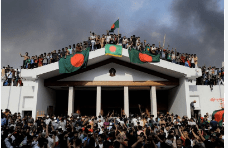
Multiple Bangladeshi news sources report on political events, including the interim government’s ban on Awami League activities until an apology for the July massacre, and BNP’s planned state reforms. Other news covers economic issues like inflation and the challenges faced by the private sector, social issues such as illegal vehicles in Rangamati and rooftop farming initiatives in Bogra. Finally, the sources also include reports on the Bishwa Ijtema religious gathering, international relations, and sports news.
Comprehensive Study Guide: News Analysis
Quiz
Answer each question in 2-3 sentences.
- What is the interim government’s stance regarding the Awami League’s activities, and what conditions must they meet to be allowed to operate?
- What are the main points of Tarique Rahman’s call for unity among political parties, and what historical context does he invoke?
- What are the key issues to be discussed in the upcoming BJP-BSF meeting between Bangladesh and India, according to the Home Affairs Advisor?
- According to the Center for Policy Dialogue (CPD), what is the current state of the economy and what factors are contributing to the challenges?
- What actions are being taken to address the issues of document verification for expatriates, as mentioned by Foreign Affairs Advisor Towhid Hossain?
- What are the main demands of the student protests at Dhaka University, and what specific organizations are they targeting?
- What are the two phases of the Bishwa Ijtema, and what is the rationale behind this two-phase organization?
- What is the new economic opportunity being developed by Janardhan Debnath in Pirojpur, and what are the benefits of this industry?
- What are the main reasons cited for the traffic problems in Rangamati, and what actions, if any, have been taken to address them?
- What is the current state of the BPL and which teams are leading?
Answer Key
- The interim government will not allow the Awami League to carry out any activities until they apologize for the July massacre and their leaders are brought to justice. They are seen as lacking remorse for past actions, and the government seeks accountability.
- Tarique Rahman calls for unity among parties oppressed by the Awami League, framing it as revenge against injustice. He references the Liberation War, stating that during that crisis, BNP stood by the people.
- The BJP-BSF meeting will discuss the Assam Accord, border killings, fair water distribution, and construction of border facilities. The Home Affairs Advisor stated that Bangladesh will not make any concessions.
- The CPD states that the interim government has not been able to curb inflation and control the price of goods. They blame this on previous autocratic policies, high levels of extortion, hoarding, and unreasonable pricing.
- Foreign Affairs Advisor Towhid Hossain has established an integrated online authentication system to streamline document verification, reducing the need for physical visits to various ministries and saving time and money.
- Students are demanding the immediate arrest of Chhatra League leaders and activists for attempting to destabilize the country. They are also demanding that the Awami League be banned for their role in the July massacre.
- The Bishwa Ijtema is organized into two phases to manage the large number of participants, dividing the time between supporters of Maulana Zubair and Shad. This approach is meant to reduce pressure and allow for more orderly worship.
- Janardhan Debnath has created an industry using banana trees to create yarn for carpets, mats, and sheets. This is creating income for local families and employment opportunities for housewives in the area.
- The traffic problems in Rangamati are caused by an excess of vehicles, including a high number of illegal CNG auto-rickshaws, on its narrow roads. The residents have been petitioning the administration to stop illegal vehicles without any visible response.
- The round robin league is underway with Fortune Barisal and Rangpur Riders as top teams. Fortune Barisal is in first place after beating the Dhaka Capitals.
Essay Questions
- Analyze the power dynamics and political tensions revealed in the news reports, focusing on the conflicts between the interim government, Awami League, and BNP.
- Discuss the interplay between economic policies, social concerns, and political stability, referencing the CPD’s criticisms and the impact of inflation.
- Evaluate the role of the media in reporting and shaping public opinion, considering the different news outlets and their coverage of political events.
- Assess the significance of international relations in the context of the news reports, paying specific attention to the Bangladesh-India border discussions and the Bangladesh-China relationship.
- Considering the reports on the Ijtema, the banana yarn industry, and rooftop gardening, discuss the diversity of activity that is going on in Bangladesh right now and whether this variety adds to the political tension.
Glossary of Key Terms
- Awami League: A major political party in Bangladesh that is currently facing criticism for its past actions by the current interim government and student groups.
- BNP (Bangladesh Nationalist Party): A major opposition political party in Bangladesh, led by acting chairman Tarique Rahman, calling for unity to counter the Awami League.
- Chhatra League: A student organization affiliated with the Awami League, currently banned by the interim government for alleged involvement in the July massacre.
- Interim Government: A temporary government in power following the departure of the previous administration, currently focused on bringing the perpetrators of the July massacre to justice and planning for national elections.
- Bishwa Ijtema: An annual Islamic gathering held in Tongi, Bangladesh, that attracts a large number of participants.
- July Massacre: Refers to a significant event of violence, which is currently under scrutiny by the interim government.
- 31-Point Plan: BNP’s comprehensive plan for state reform in Bangladesh, advocating for various changes and policies.
- CPD (Center for Policy Dialogue): A research organization that provides analyses and criticisms of the current economic policies in Bangladesh.
- BJP-BSF Meeting: A planned meeting between the Border Security Forces of Bangladesh and India to address issues relating to the border.
- Apostille Convention 1961: An international treaty that establishes a simplified system for authenticating documents for use in foreign countries.
- Umrah: A pilgrimage to Mecca, Saudi Arabia, which can be undertaken at any time of the year.
- Hajj: An annual Islamic pilgrimage to Mecca, Saudi Arabia, considered one of the five pillars of Islam, occurring during a specific time of year.
- BPL (Bangladesh Premier League): The professional Twenty20 cricket league in Bangladesh.
Bangladesh Political Transition and Socioeconomic Overview
Okay, here’s a detailed briefing document summarizing the main themes and important information from the provided news sources:
Briefing Document: Bangladesh News Analysis
Date: October 26, 2023 (Approximate, based on context)
Sources: Excerpts from ATN Bangla News and Channel I News Transcripts
Overall Themes:
The news sources highlight a period of significant political tension and transition in Bangladesh. Key themes include:
- Interim Government & Accountability: The country is under an interim government following what appears to be the fall of the Awami League government. A major focus is on holding the Awami League accountable for the “July massacre” (details unclear but seems to involve a violent event).
- Political Conflict: Deep divisions are evident, with the Awami League facing strong opposition from the interim government and student groups. The BNP is positioning itself as the main opposition and potential future leader.
- Electoral Reforms & Elections: The interim government is preparing for national elections, with a reform commission working to finalize electoral processes. The date of elections is dependent on the extent of reforms.
- Economic Situation: There are concerns about inflation, high commodity prices, and a struggling business environment. The interim government claims to be improving the economy, while the CPD criticizes its economic policies.
- Regional Relations: Discussions are ongoing with India regarding border issues and water sharing, while Bangladesh is also celebrating the 50th anniversary of diplomatic ties with China.
- Social Issues: Reports cover a major religious gathering (Bishwa Ijtema), a bus strike, the struggles of the film industry and a success story in a rural region regarding yarn creation from banana trees.
Key Ideas & Facts:
1. Interim Government & Awami League Accountability:
- No Programs Allowed: The interim government, through its Chief Advisor’s Press Secretary, Shafiqul Alam, has declared that the Awami League will not be allowed to hold any programs (protests, marches, etc.) until they apologize for the “July massacre” and their leaders are brought to justice.
- “Until the Awami League apologizes for the July massacre and its leaders are brought to justice for the July massacre, they will not be allowed to hold any programs in the country.”
- “Such a big massacre in the history of Bangladesh, and then there is no remorse among them… until they apologize, until their leadership is brought to trial, until they are held accountable, they will not be allowed to protest in the capital.”
- No Remorse: The government representatives are adamant that the Awami League has not shown any remorse or regret for the events, indicating a deep sense of grievance.
- “Children were killed in front of your eyes, and many children were blinded, many were crippled for life. It’s done, then there is no remorse, no remotes, no regrets among them.”
- Justice is Goal: The interim government’s press secretary stated that “bringing the murderers to justice is one of the goals of the current government.”
2. Political Opposition & BNP:
- Tarique Rahman’s Leadership: BNP Acting Chairman Tarique Rahman is actively engaging with party members and the public. He is calling for unity among political parties to “thwart all conspiracies of the anti-nationals.”
- “BNP Acting Chairman Tarique Rahman has called on anti-fascist political parties to remain united to thwart all conspiracies of the anti-nationals.”
- 31-Point Plan: The BNP is promoting a 31-point plan for state reform as a response to past oppression under the Awami League government.
- “The 31-point plan will be implemented as BNP’s revenge against undemocratic forces,”
- Trust in BNP: Rahman emphasizes that people are placing their trust in the BNP and sees the party as the leader in this time of national crisis.
- “A large part of the population believes that if anything good happens in the future, it will be possible to do something good under the leadership of BNP.”
- Accusations of Oppression: BNP claims to have endured significant torture and oppression during the past 15 years, highlighting this history to gain support.
- “BNP leaders and activists have endured indescribable torture and torture for the past 15 years to establish human rights.”
3. Elections and Electoral Reforms:
- Reform Commissions: Six reform commissions are working to submit reports by February 15th. The timing of national elections depends on the reports, with the possibility of elections in June (large-scale reforms) or December (minimal reforms).
- “The six reform commissions will submit their reports by February 15.”
- “if there are large-scale reforms, then by June 26 and if there are minimal reforms, then the national elections will be held in December this year”
- Student Protests: Students at Dhaka University have protested against the Awami League Chhatra League’s announcement of public programs, calling for the arrest and trial of their leaders, as well as a ban on the Awami League.
- “They held a short rally there and said that February Chhatra League wants to destabilize the country throughout February.”
4. Economic Concerns:
- Inflation and Prices: The CPD (Center for Policy Dialogue) has criticized the interim government for failing to control high prices of goods and inflation, blaming the policies of the previous government.
- “The Center for Policy Dialogue (CPD) has said that it has not been able to return the price of goods. The organization blames the wrong policies of the autocratic government led by Sheikh Hasina for this.”
- Business Environment: The government claims improvements in the business environment and economic achievements over the last six months, with promises of increased foreign direct investment.
- “During the current government, our business environment has expanded in business and commerce, and the achievements of this government in the last six months are unprecedented.”
- Tax Collection: The government needs to collect 451% of the revenue to meet its financial goals and that the CPD views this as impossible.
5. Regional Relations:
- India Border Meeting: An upcoming meeting between Bangladesh and India’s border security forces (BSF) will focus on border issues such as the Assam Accord, border killings and water distribution. Bangladesh is emphasizing a desire to resolve the issues peacefully.
- “The upcoming BJP-BSF meeting will discuss the Assam agreement with India, Home Affairs Advisor Jahangir Alam Chowdhury said… Bangladesh hopes to resolve all issues through talks.”
- China Relations: The country is celebrating 50 years of diplomatic relations with China, with expressions of commitment to continued cooperation and prosperity.
- “This year, the golden jubilee of the establishment of diplomatic relations between the two brotherly countries will be celebrated on a large scale,”
6. Social Issues:
- Bishwa Ijtema: The Muslim religious gathering at Tongi is being held in two phases due to the large number of participants, with significant security measures in place.
- “The first phase of the Bishwa Ijtema is starting on the banks of the Turak in Tongi… There is multiple layers of security across the ground.”
- Banana Yarn: A businessman from Pirojpur has successfully developed a process to make yarn from banana trees, creating employment opportunities and export markets.
- “A businessman from Pirojpur is successful in making yarn from banana trees… Exports are being made to various.”
- Film Industry Challenges: The cultural advisor is urging students to protest for film industry reforms, including addressing the issue of cut-piece movies in cinemas.
- “Advisor on Cultural Affairs Mustafa Sawar Farooqui has called on students to take to the streets to implement all the proposals related to film development.”
- Hajj Preparations: The Saudi government has instructed all preparations for Hajj by mid-February but private agencies in Bangladesh are not prepared.
7. Miscellaneous
- Journalist Accreditation: A new policy for journalist accreditation cards is being developed.
- CNG auto-rickshaws: Rangamati is experiencing a problem with illegal CNG auto-rickshaws.
Analysis:
The news sources paint a picture of a nation in flux. The interim government appears to be actively consolidating power and seeking to address past grievances. The BNP is mobilizing its support base, while the Awami League is facing significant challenges. The economic situation remains precarious, and regional relations are important for the country’s stability. The focus on accountability and political change is central to this period. The various social and cultural activities described in the sources also provide a broad scope into the day-to-day life in Bangladesh during this time.
Further Questions:
- What are the specific details of the “July massacre”?
- What exactly are the 31 points of the BNP reform plan?
- What are the details of the proposed electoral reforms?
- What are the different factors causing high commodity prices and inflation?
- What are the specific issues being discussed with India regarding the border and water sharing?
This briefing document should provide a solid overview of the situation depicted in the provided news sources.
Frequently Asked Questions
- What is the current interim government’s stance on the Awami League and their activities? The interim government has taken a firm stance against the Awami League, stating they will not be allowed to hold any programs or protests until they apologize for the July massacre and their leaders are brought to justice. The government views the lack of remorse from the Awami League as unacceptable and has made it clear that accountability for the July events is a primary goal. They will not allow any demonstrations until they have been tried and held responsible. This reflects a deep sense of injustice and a focus on legal and moral retribution.
- What are the key demands of the student protests at Dhaka University regarding the Awami League and Chhatra League? Student protesters at Dhaka University are demanding the immediate arrest and public trial of leaders and activists of the banned student organization, Chhatra League. They also seek a complete ban on the Awami League, citing their role in the July massacre. The students view the Chhatra League’s activities as attempts to destabilize the country, and they believe these organizations must be held accountable for their actions. They also called the Awami League “fascist” and said they took away the people’s democratic rights and freedom of speech.
- What is BNP Acting Chairman Tarique Rahman’s message to political parties and the people of Bangladesh? Tarique Rahman is calling for unity among all political parties that have been oppressed during the Awami League government. He urges them to stand together against any anti-national conspiracies. He also aims to implement a 31-point plan for state reform and views this as a way of avenging the injustices that have occurred. He emphasizes that the BNP stands by the people in times of crisis and that the people have placed their trust in them. His leadership is aimed towards repairing the damage done by previous administrations.
- What are the plans for the upcoming national elections, and what are the key factors influencing the timeline? The timeline for the national elections is contingent on the reports of six reform commissions. If extensive reforms are recommended, the elections will likely be held by June 26; if minimal reforms are deemed necessary, the elections will be scheduled for December. The Concession Commission’s findings are crucial to setting a firm date and will influence the extent of changes made before the elections are held. The government is working towards economic reform to facilitate foreign investment.
- What is the significance of the Bishwa Ijtema and how is it being organized? The Bishwa Ijtema is a significant gathering of the Muslim Ummah, taking place on the banks of Turak in Tongi. This year, it is being organized in two phases, led by the supporters of Maulana Zubair and Shad respectively. The dual-phase organization is intended to manage the large number of participants and ensure orderly worship and sermon attendance. High levels of security are being implemented due to previous disputes between the two groups. This highlights the need for careful management and safety at large religious events.
- What initiatives are being taken to support local industries, specifically in Pirojpur? A businessman in Pirojpur has successfully developed a method to create yarn from banana trees. This has led to the production of carpets, papas, and sheets, which are being exported. The initiative has provided income opportunities for local women and contributed to job creation in the region. The Department of Agriculture is advising farmers to use banana trees in this way after harvesting their fruit in order to promote financial self-sufficiency and reduce waste. This highlights a positive approach to rural development and income generation.
- What are some of the economic concerns raised by the Center for Policy Dialogue (CPD)? The CPD has expressed concerns that the interim government has not been able to reduce the high prices of goods and is failing to manage inflation. They attribute this to the previous government’s flawed policies, noting that the market is experiencing extortion, hoarding, and unreasonable pricing. They also criticize the IMF’s pressure to increase taxes without consideration for the financial struggles of ordinary people. The CPD suggests that the government focus on tax evasion and the direct tax system, rather than mandatory debt dependency.
- What issues are being addressed in the upcoming BJP-BSF meeting between Bangladesh and India? The upcoming meeting between the Border Security Forces of Bangladesh and India will focus on issues such as the Assam Accord, border killings, fair water distribution, and the construction of facilities. Bangladesh aims to address these issues through dialogue, emphasizing the need to build good relations and resolve border disputes. The government is determined not to make any concessions on these matters and is seeking to address various issues such as the border fence. The meeting is important for bilateral relations between the two countries.
Awami League Ban: Calls for Accountability and Justice
The sources discuss the possibility of a ban on the Awami League due to their actions and the current political climate. Here’s a breakdown of the key points:
- Calls for a Ban: Multiple sources indicate a strong push to ban the Awami League [1-4]. These calls are largely due to the party’s alleged involvement in a “July massacre” [1-3, 5, 6]. The sources suggest that until the Awami League leadership is tried and apologizes for this massacre, they should not be allowed to hold any programs [1, 3, 5].
- Interim Government’s Stance: The interim government, through its press secretary, has stated clearly that they will not allow the Awami League to carry out activities until the party apologizes for the July massacre and its leaders are held accountable [1, 3, 5]. The government views bringing the “murderers” to justice as one of its goals [1, 5].
- Student Protests: Students at Dhaka University protested against the Awami League Chhatra League’s announcement of programs [1, 2, 4, 7]. The students demanded the immediate arrest and trial of Chhatra League members and a ban on the Awami League for the July massacre, which they see as a destabilizing force [2, 4].
- Accusations Against Awami League: The Awami League is accused of taking away people’s voting rights, democratic rights, and freedom of speech [4, 8]. They are also labeled as a “genocidal party” [2, 4], and their leaders are accused of having no remorse for the July massacre [1, 3, 5].
- BNP’s Position: BNP Acting Chairman Tarique Rahman called for unity among anti-fascist political parties to thwart any conspiracies by “anti-nationals,” and has called for “revenge” for the “oppression” by the Awami League [3, 8, 9]. He stated that the BNP has stood by the people during times of crisis and that the people of the country have placed their trust in the BNP [8, 10, 11]. He also mentioned that those responsible for destroying state institutions will be held accountable [9, 11, 12].
In summary, the potential ban on the Awami League is a significant issue in the sources, stemming from accusations of past atrocities, current political tensions, and calls for accountability and justice from various groups.
Bishwa Ijtema: Organization, Security, and Attendance
The sources provide information on the Bishwa Ijtema, a large Muslim gathering, focusing on its organization, security, and the participation of devotees [1-5].
Here’s a breakdown of the key points:
- Two-Phase Event: The Bishwa Ijtema is being held in two phases [3, 4].
- The first phase is organized by supporters of Maulana Zubair and is further divided into two parts [3, 4].
- The first part of the first phase begins on Friday with the Aam Bayan after Fajr prayers and concludes with the final prayer on Sunday [3, 4].
- The second part of the first phase starts on Monday and ends on Wednesday [3, 4].
- The second phase of the Ijtema is scheduled from February 14 to 16 and will include the participation of Shad supporters [3].
- Location: The event is taking place on the banks of the Turak in Tongi [1, 2, 4, 5].
- Purpose of Two Phases: The division into two phases is primarily to manage the large number of participants and avoid congestion [3, 4]. The organizers have divided the time given to them into districts and Dhaka city [3, 4]. This is intended to make it easier for devotees to worship and listen to sermons in an orderly manner [3, 4].
- Security Measures:Multiple layers of security are in place across the grounds [1, 5, 6].
- A security zone has been created, taking into account the dispute between Zubair and Shad supporters [3, 4].
- The police chief mentioned that security arrangements are much stronger than in the past.
- Law enforcement agencies are working with the knowledge that many weapons are still outside due to looting from the police station on August 5 [3, 4].
- Attendance: Both local and foreign devotees are participating in the gathering [1-4]. Religious devotees from different parts of the country have started gathering at the Ijtema Maidan [3, 4]. Foreign guests have also taken their places in designated tents [3, 4].
- Significance: The Bishwa Ijtema is described as the second-largest gathering of the Muslim Ummah [2, 4].
In summary, the Bishwa Ijtema is a major religious event that has been organized into two phases to manage the large number of attendees, with significant security measures in place.
Tarique Rahman: BNP’s Opposition Platform
Tarique Rahman, the acting chairman of the BNP, is a prominent figure in the sources, and is presented as a key voice of opposition against the current government. Here’s a breakdown of his activities and statements, drawing from the sources:
- Call for Unity: Tarique Rahman has called on anti-fascist political parties to unite against the “anti-national” conspiracies, which is a frequent theme in the sources [1-4]. He emphasizes that all political parties that were “oppressed” during the Awami League government must remain united [5-7]. He believes that the people of Bangladesh trust the BNP and that “good things will happen in the coming days” under the party’s leadership [2, 3]. He also states that the BNP has stood by the people during times of crisis [5, 6].
- Condemnation of the Past Government: Tarique Rahman asserts that the previous government, which he calls a “dictatorship,” has left the country in ruins and destroyed every institution of the state [2, 5, 8]. He also states that “whoever is responsible” for this destruction “must be held accountable” [5, 8]. He also alleges that those in power have engaged in theft, corruption, and looting [5, 9].
- He accuses various groups of spreading propaganda against the BNP and states that the party has endured “indescribable torture” for the past 15 years to establish human rights [2]. He considers it the responsibility of BNP leaders and activists to maintain the trust and confidence of the people [2, 9].
- 31-Point Plan for State Reform: Tarique Rahman is promoting a 31-point plan for state reform and public engagement. He is conducting workshops at the district level to convey the plan to the common people [2, 3, 5]. He describes the 31-point plan as the BNP’s “revenge” against “undemocratic forces” and asserts that it will be an ongoing process [5, 8, 9].
- He stresses that all oppression must be responded to by working for the welfare of the state and implementing the 31 points for the people of Bangladesh [6].
- Response to Awami League: Tarique Rahman has called for revenge for the “oppression” by the Awami League and to remain united in the face of it [5, 7, 10]. He states that one group “crossed the border” during the Liberation War while another group directly opposed it [5].
- Virtual Participation: Tarique Rahman is participating in workshops and addressing party members virtually, including those in the Khulna division [2, 3, 5]. This suggests he may not be in Bangladesh, as some reports state he is in London [5].
In summary, the sources present Tarique Rahman as a key opposition figure who is actively campaigning against the current government, promoting the BNP’s agenda for state reform, calling for unity among opposition parties, and seeking to hold the previous government accountable for its actions [2, 3, 5].
Banana Fiber: A Bangladeshi Success Story
The sources discuss a new and successful venture involving the production of yarn from banana trees in Bangladesh. Here’s a breakdown of the key points:
- Innovative Use of Banana Trees: A businessman from Pirojpur, Janardhan Debnath, has found a way to make yarn from banana trees, which were previously discarded after the fruit harvest [1, 2]. This innovation is creating a new source of income and employment [2].
- Production Process:
- After harvesting the bananas, the banana trees are cut into pieces, peeled, washed, and dried in the sun [2].
- The dried material then acquires a golden color [2].
- The raw materials are sold to factories to be made into yarn [2].
- Products Made: The banana fiber is being used to make carpets, paps, and sheets [1, 2]. These products are being exported to various countries [1, 2].
- Economic Impact:This venture is creating additional income for housewives in the area and generating new employment opportunities [2].
- Women entrepreneurs in the village sell the raw materials, which is benefiting the local economy [2].
- Farmers are being advised by the Department of Agriculture to use the trees instead of discarding them to earn extra income [2].
- It is possible to extract two to three kilograms of raw material for making yarn from one banana tree [3].
- The work has created employment for nearly two hundred families in Nesarabad and Kalakhali [3].
- Demand: There is high demand for the products made from banana fiber both domestically and abroad, leading to increased production [2]. The demand for raw materials is also increasing [2].
- Government Support: The Department of Agriculture is encouraging farmers to participate in this practice for extra income and financial self-sufficiency. They are planning to inform other farmers about this on a larger scale through training [2].
In summary, the production of yarn from banana trees is a successful initiative in Pirojpur, Bangladesh, providing economic benefits and employment opportunities while utilizing a previously discarded resource. The process involves turning the banana tree into yarn, which is then used to produce various textile products for domestic and international markets. This innovative venture is also receiving support from the Department of Agriculture to expand its reach and impact [2].
Hajj 2025: Bangladesh Agency Preparedness
The sources discuss the preparations for the Hajj pilgrimage, highlighting the roles of both the Saudi government and private agencies in Bangladesh. Here’s a summary of the key aspects:
- Saudi Government Preparations: The Saudi government is actively preparing for the Hajj, with ongoing beautification work in Mecca, Medina, Mina, and Muzdalifah [1, 2]. They have set a deadline of February 14 for all Hajj preparations to be completed [1].
- House Rentals: The Saudi government has instructed that the rental of houses for Hajj pilgrims be completed by February 14 [1]. The government of Bangladesh has completed renting houses for government-managed pilgrims in Mecca and has selected six houses [2].
- Private Agency Concerns: Most of the private Hajj agencies in Bangladesh have not yet started renting houses in Mecca and Medina, despite the Saudi government’s deadline [1, 2]. Many private agencies have not yet signed the necessary service contracts [2]. There are concerns that these agencies are not adequately prepared [1, 3, 4].
- Urgency for Completion: The Religious Affairs Secretary has urged private agencies to complete Hajj activities quickly, emphasizing that all agreements should be finalized by February 14, 2025 [2]. There is also a call for all Hajj arrangements in Medina to be completed [2].
- Past Incidents: There is mention of incidents that occurred last year, especially in Mina, Muzdalifah, and Arafat, which are influencing the current preparations [2].
- Government Initiatives: The government has completed house rentals for government pilgrims in Mecca and is monitoring the progress of private agencies. A notice is expected from the government by February 14 regarding house rentals [2].
- Challenges: The sources note that most private agencies in Bangladesh have not yet made proper arrangements for the Hajj [3, 4]. This has led to doubts about the overall preparations for Hajj activities [1].
In summary, while the Saudi government is actively preparing for the Hajj, many private agencies in Bangladesh are lagging in their preparations, particularly regarding house rentals. The February 14 deadline is a key factor, and there are concerns that private agencies may not be able to meet it. The government is urging them to speed up the process and has completed its own preparations for government-sponsored pilgrims. There is a clear emphasis on the need for all preparations to be completed on time to ensure a smooth and well-managed Hajj experience.

By Amjad Izhar
Contact: amjad.izhar@gmail.com
https://amjadizhar.blog
Affiliate Disclosure: This blog may contain affiliate links, which means I may earn a small commission if you click on the link and make a purchase. This comes at no additional cost to you. I only recommend products or services that I believe will add value to my readers. Your support helps keep this blog running and allows me to continue providing you with quality content. Thank you for your support!

Leave a comment